Nov. 21, 2024 The Midwest Center For Investigative Reporting
How Trump’s mass deportations could impact ag workforce
President-elect Donald Trump plans to make deportation of undocumented immigrants a Day 1 priority when his second term begins in January. It could have a significant impact on the agriculture sector.
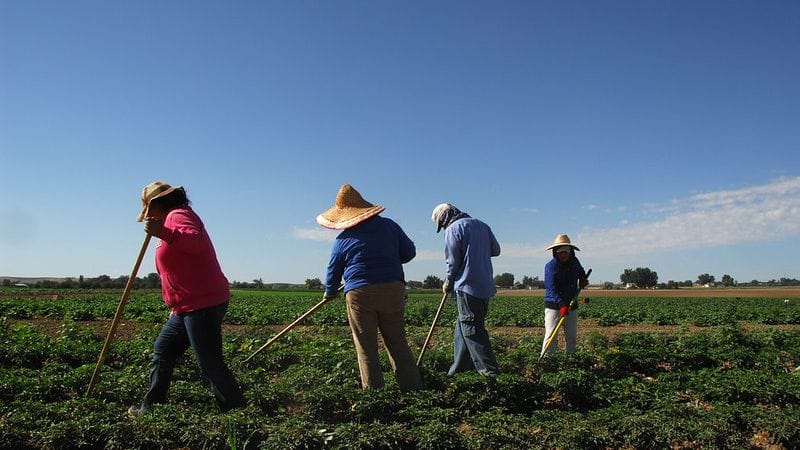
Undocumented immigrants make up 5% of the total labor force but around 16% of workers in the nation’s food supply chain, which includes meatpacking plants. However, among crop farmworkers, undocumented people make up roughly 45% of workers, according to the USDA.
In our latest Graphic of the Week, Jennifer Bamberg took a closer look at federal labor data to quantify the impact a loss of undocumented workers could have on the agriculture sector.
If a significant number of those workers were no longer in the country, many ag employers would likely turn to guest visa farmworkers, those allowed to work in the country under the H-2A program.
However, as Investigate Midwest’s Sky Chadde reports, the already high demand for H-2A visa employees is straining the federal government and its ability to investigate labor abuses.
Trump has previously praised the H-2A program, but some of his advisors have called for its elimination. Important to all this will be who Trump nominates as his labor secretary, the person ultimately responsible for the H-2A program.
— Ben Felder, editor in chief

US could rely more on foreign ag workers under Trump. High demand is already straining the government.
By Sky Chadde, Investigate Midwest
Here are key takeaways from this story:
- Shifted resources. To keep up with high demand, the U.S. Department of Labor moved staff from processing other visas to reviewing H-2A visas. That has created a backlog in other visas the agency oversees.
- Questioned integrity. Because of high demand, the Labor Department performed far fewer audits of H-2A applications in 2023 than it did just a few years ago. That’s because the staff that would perform the audits are busy processing applications. The agency itself has said high demand might affect “program integrity.”
- Continued growth? The first Trump administration promoted the use of the H-2A program while performing raids on workplaces suspected of having undocumented workers — a large component of the agriculture workforce.
Read the full story.
GRAPHIC: Here’s why mass deportation could affect the nation’s food supply
By Jennifer Bamberg, Investigate Midwest
President-elect Donald Trump has promised to begin his second term with the largest mass deportation in history, making the jobs held by undocumented workers available to U.S. citizens.
Undocumented immigrants make up only 5% of the total labor force, according to the most recent federal data from the U.S. Census Bureau and analysis from the Pew Research Center. However, the share of undocumented workers across the nation’s food supply chain is at least 16%.
A significant portion of food- and agriculture-related jobs are filled by immigrants, which include naturalized citizens, green-card holders, permanent residents, people on long-term temporary work visas, refugees, people who have received asylum and undocumented immigrants.
Search the graphic.
ICYMI: Mixed-status families weigh leaving Iowa
By Mónica Cordero, Investigate Midwest/Report for America
This investigation from early July spotlights how Iowa's new immigration law allows law enforcement to arrest and charge noncitizens with a crime if they are found in the state after previously being deported or blocked from entering the U.S.
WATERLOO, Iowa — Having spent more than half her life in Waterloo, Iowa, she has built a life here. It’s where she met her husband and where her only daughter, who wants to become a sonographer, was born.
That’s why, after a day’s work at an area meatpacking plant, the 55-year-old Mexican-born woman took to Waterloo’s streets Monday. Waving a banner reading in Spanish, “We are the strength of this country,” she protested a new state law that could severely impact her family, she said.
The law, which a federal judge temporarily blocked recently as it is contested in court, would allow Iowa law enforcement to arrest individuals even if they have legal permission to remain in the country. While the woman herself would not be directly affected by the law, her husband could be. He’s an undocumented immigrant who was previously deported and re-entered the country.
Read more.
OPINION: Will there be movement on overdue Farm Bill during the lame duck session?
By Dave Dickey, Columnist
USDA Secretary Tom Vilsack says talking about the stuck-in-the-mud farm bill negotiations “feels like ‘Groundhog Day.’ ”
Congress is required to approve a new federal farm bill every five years. The 2018 farm bill expired on Sept. 30, 2023. But the Republican led House couldn’t get its version of the bill across the finish line amid GOP in-fighting over a host of issues.
With no other options and time running out Congress was forced to extend the 2018 law to Sept. 30, 2024.
Senate Agriculture Chair Debbie Stabanow hasn’t been shy about voicing her displeasure, saying in June that “I’ve actually been involved in six farm bills and led on three of them, and this has been the most frustrating time. Because it’s so much more partisan than usual and particularly around food assistance.”
Bipartisanship is out the window. Everything is up for passionate debate driven by party ideology that leaves little room for common ground.
So it was inevitable that when Sept. 30 rolled around this year lawmakers still hadn’t come to agreement.
Read more.
News from our partners:
Amish farmers’ partnership with beef giant JBS produces manure mess By Keith Schneider, Circle of Blue
Investigate Midwest is an independent, nonprofit newsroom. Our mission is to serve the public as a watchdog over influential corporations and institutions through in-depth and data-driven investigative journalism.