Nov. 7, 2024 The Midwest Center For Investigative Reporting
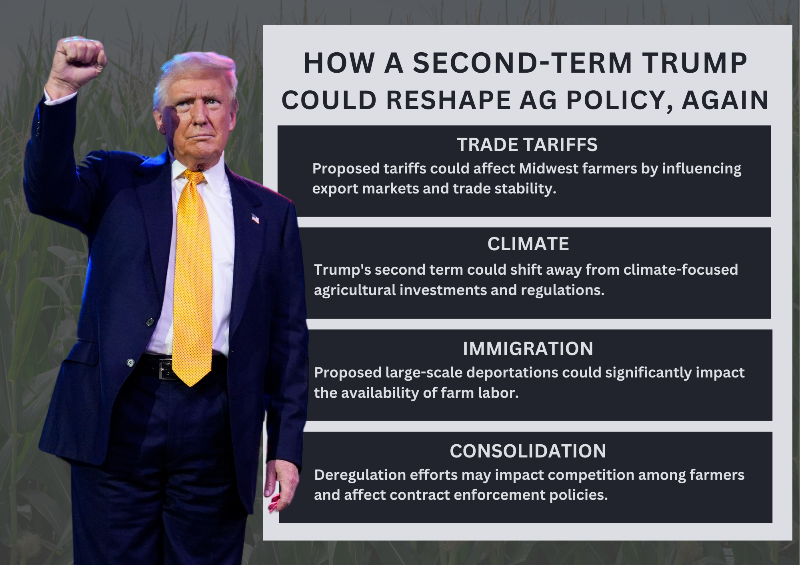
What a Trump return means for agriculture
Donald Trump will return to the White House and the impacts on agriculture could be significant.
During his first term, Trump reshaped U.S. agriculture with sweeping changes by imposing higher tariffs, rolling back environmental regulations and enacting tougher immigration policies.
In his bid for a second term, Trump vowed to increase tariffs even more, more aggressively roll back climate-related agriculture regulations and floated the idea of ending immigration programs designed to boost farm labor.
In the run-up to election day, Investigate Midwest covered the two main candidates and how each of their policies could impact farmers, ranchers, meatpacking and corporate agriculture. You can find those stories here.
This week’s story draws from our extensive reporting to offer readers specific insight into Trump and four ways he could shape the agriculture industry’s future.
— Ben Felder, editor in chief
Four ways Trump could impact the agriculture sector during second term
By Investigate Midwest staff
Donald Trump’s first term as president brought sweeping change to environmental regulations, trade policy and a host of issues that impact America’s agriculture sector. After winning his return bid on Tuesday, Trump’s second term is likely to once again have a sizable impact on the nation’s farms and ranches.
Read more.
GRAPHIC: US agricultural exports support 1.25 million jobs
By Mónica Cordero, Investigate Midwest/Report for America
In 2022, U.S. agricultural exports supported approximately 1.25 million full-time civilian jobs, totaling more than $197 billion.
These jobs are measured in full-time equivalents (FTEs), meaning the conversion of hours worked as if they were full-time positions. This translates to roughly 6,338 jobs for every $1 billion in agricultural exports.
These figures are based on the latest estimates from the Economic Research Service’s Agricultural Trade Multipliers (ATM), which provide annual assessments of the employment and economic output impacts of farm and food product trade on the U.S. economy.
Search the graphic.
Denver voters reject meatpacking plant ban, keeping open one of nation’s largest lamb slaughterhouses
By Ben Felder, Investigate Midwest
Denver voters rejected a proposed ban on meatpacking plants within city limits, keeping open the nation’s largest lamb processing facility.
Denver Initiated Ordinance 309 was rejected by 64% of voters on Tuesday. The ballot initiative, if approved, would have prohibited the construction or operation of slaughterhouses and meatpacking facilities beginning in 2026.
Superior Farms operates a lamb processing plant in Globeville, a north Denver neighborhood plagued by high rates of poverty and pollution.
“We have one message for those who tried to (come) to our city and our state to run their experiment to upend the lives of so many hardworking people: it was a baaaaaaaad idea,” wrote Ian Silver, spokesperson for “Stop the Ban, Protect Jobs,” a campaign organization that opposed the ban.
Superior Farms, which produces about 20% of the nation’s lamb meat and processes nearly 1,500 head a day, spent more than $171,000 to oppose the ballot question, according to the Office of the Denver Clerk and Recorder.
In total, more than $2.4 million was spent by organizations, businesses and individuals to oppose the ballot initiative.
Read more.
Series on Neb. governor earns SEJ, SABEW award recognition
By Investigate Midwest staff
Our collaborative series with the Flatwater Free Press on Nebraska Gov. Jim Pillen’s global hog enterprise, water quality issues surrounding his operations, and his political influence over agricultural policy won first place in Explanatory Reporting from the Society of Environmental Journalists (SEJ). Judges praised the series, co-written by senior reporter Sky Chadde and Flatwater Free Press reporter Yanqi Xu, for its “masterful investigative reporting” that uncovered the hidden environmental impacts of Pillen’s hog empire.
The series also received the top business reporting award in the government (small division) category from the Society for Advancing Business Editing and Writing (SABEW) in its 2024 Best of Business awards. This recognition underscores the critical importance of investigating the intersection of politics, business, and environmental health.
Ben Felder, Investigate Midwest’s editor-in-chief, received two honors from Oklahoma Society of Professional Journalists for his time as a reporter covering key issues affecting rural Oklahoma.
“Oklahoma’s permit system ushered in new wave of industrial poultry farm growth” won third place for its critical examination of Oklahoma’s permitting system for large-scale poultry farms.
The story reveals how the state’s less stringent Poultry Feeding Operation (PFO) permits allow industrial farms to bypass the more rigorous Concentrated Animal Feeding Operation (CAFO) regulations, enabling them to operate near homes and avoid notifying residents. Felder’s reporting captured the environmental and health challenges local communities face, from water pollution to degraded air quality, underscoring the regulatory complexities surrounding these farms in rural eastern Oklahoma.
Felder’s second-place, award-winning piece, “Oklahoma governor says China is buying up the state’s farmland. The data he cites points to other countries,” delves into foreign land ownership in Oklahoma, challenging state-level narratives about Chinese investment. Through meticulous data analysis, Felder reveals that farmland purchases involve entities from several countries, offering clarity on an often misinterpreted issue and prompting discussion about foreign agricultural investments and state policy responses.
ICYMI: Meatpacking plants mostly pollute low-income, communities of color, EPA data shows
By John McCracken, Investigate Midwest and Mónica Cordero, Investigate Midwest/Report for America
This investigation from a few weeks ago spotlights the impact large meatpacking plants have on the small coomunities around them.
POSTVILLE, Iowa — In March, officials in Postville shut down its water treatment facility for two days as city employees worked to prevent polluted water from a meatpacking plant from entering the water supply.
Agri Star Meat and Poultry had discharged more than 250,000 gallons of untreated food processing waste — blood, chemicals and other solid materials — into the city’s wastewater system. Chris Hackman, the city’s wastewater operator for the past 25 years, said it was one of the worst incidents he could remember.
“We’ve never seen anything like that,” he said.
In majority-white Iowa, most Postville residents are people of color, with more than 40% identifying as Hispanic. Many work at Agri Star Meat and Poultry, the town’s largest employer.
Read more.
LAST CHANCE! Get your tickets now
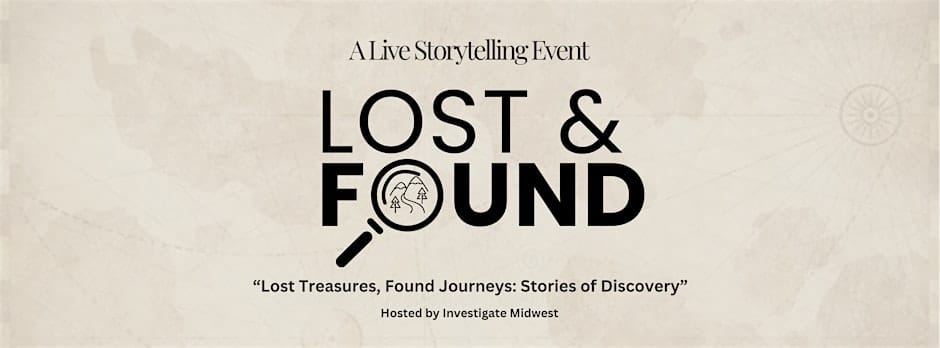
Out fall Storytelling event is tonight! Join us for "Lost & Found: Lost Treasures, Found Journeys" at Poindexter Coffee, located within the Graduate Hotel in Downtown Iowa City.
This fundraising event will feature a selection of Iowa speakers and their personal stories:
- Molly Harris (all pronouns) is a poet from West Des Moines, Iowa
- Jeff Huettman (he/him) is from Princeton, Iowa
- Jordan Sellergren (she/her) serves as chair of the Iowa City Historic Preservation Commission
- MK Shultz (they/them) is a junior at University of Iowa from Lawrence, Kansas.
- Leslea Haravon Collins (Lea) (she/her) is a writer, cantorial soloist, teacher and yoga instructor.
The central theme will expand upon the topics of loss, identity, and change. The event will also feature a silent auction and trivia. Trivia is cash only, $5 a person.
Event tickets are a $25 donation and include a drink ticket good for a glass of wine, beer, or soda. Additionally, food and additional beverages will be available to order. The hotel is at 210 S. Dubuque St., Iowa City 52240
Doors open at 5:30 p.m., and the event starts at 6:30 p.m. Our emcee for the evening will be Charity Nebbe, Host of Iowa Public Radio's "Talk of Iowa." All profits from this event will go towards supporting Investigate Midwest and it's independent journalistic efforts!
Investigate Midwest is an independent, nonprofit newsroom. Our mission is to serve the public as a watchdog over influential corporations and institutions through in-depth and data-driven investigative journalism.