Research. Data. Stories.
In a few short months, migrant farmworkers will be making their way through the Midwest to work in our fields and process our crops.
But the places they live while here are riddled with health and safety issues.
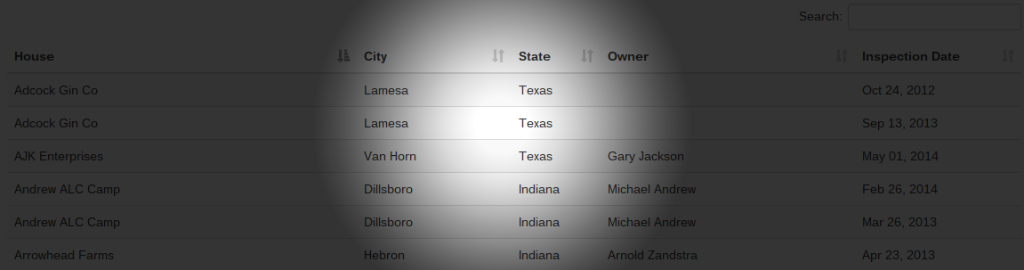
For the past several months, The Midwest Center for Investigative Reporting has analyzed hundreds of state inspection reports of migrant farmworker housing across the Midwest.
State agencies and federal laws — most notably the Migrant and Seasonal Agricultural Workers Protections Act — are supposed to protect hundreds of thousands of migrant farmworkers from deficient and unsafe housing.
But an ongoing investigation by The Midwest Center for Investigative Reporting has found the oversight of migrant housing is a fractured and ineffective system despite decades of reforms.
As a result of the splintered regulatory system, migrant workers end up living in a patchwork of converted motels, makeshift trailers, rundown apartments and other types of housing plagued with violations.
Our months-long review of inspection reports show that housing facilities often lack even basic safety measures, such as working smoke detectors or fire extinguishers.
In one, at a former lllinois Air Force Base hospital - inspectors noted filthy mattresses, plumbing issues and even a lack of a basic telephone for emergencies.
Standards for housing are minimal at best.
"No one is being promised anything like a private bath or a TV or anything like that,” said Miguel Keberlein Gutiérrez, director of the immigrants and workers’ rights practice group at the Chicago-based Legal Assistance Foundation. “I mean, [housing] standards are relatively the same as you would offer a prisoner in jail.”
As a result of the splintered regulatory system, migrant workers end up living in a patchwork of converted motels, makeshift trailers, rundown apartments and other types of housing plagued with violations.
Owners of migrant housing argue that it is difficult to keep housing in good shape because workers are constantly moving in and out, and inspection agencies say they can only do so much with the staffs and laws they have.
The Center’s initial examination has focused on Illinois, Indiana, Iowa, Michigan, Missouri, Texas and Wisconsin. The investigation included a review of hundreds of mostly handwritten inspection reports from five of the states obtained through Freedom of Information Act requests.
The Center is using those reports, which date from 2011 to 2014 so far, to create the first-ever nationwide database of migrant worker housing inspections.
Among our findings:
--- Inspection reports show black mold, raw sewage and pest infestations were among the most serious violations. Other common violations ranged from broken doors and windows to defective plumbing and electrical wiring.
--- States often have a low number of inspectors, who have additional duties beyond inspecting migrant housing. Inspectors also sometimes lack the authority to penalize owners for health and safety violations or do not issue fines even if they can.
--- Agencies responsible for inspecting housing vary from state to state, and federal agencies generally become involved only when there are complaints.
--- Overall, inspectors cited housing for health and safety deficiencies in at least half their reports.
--- Much of migrant worker housing goes unlicensed and uninspected. Licensed facilities make up only a small portion of the total housing because employers often avoid registering their housing. Workers sometimes arrange their own.
You can read all of our coverage from the links below. We'd love to hear your feedback. Please feel free to email pamelagdempsey@investigatemidwest.com with any thoughts or comments.
Best,
Pam Dempsey
Executive Director
Blighted Housing : Inspections fail to stem poor conditions for migrant farmworkers
Ricardo Arismendez left his home in Temple, Texas, in the autumn of 2014 to work 12-hour days for $9.50 an hour at a corn processing facility in central Illinois.
As part of the deal that included overtime pay, a job recruiter promised the then 21-year-old that the work in Farmer City would come with free temporary housing.
“I’m used to traveling a lot,” said Arismendez, who was starting his third season as a migrant agricultural worker. “I never settle in one spot, so for me it’s normal.”
But when Arismendez arrived at the housing, known as Nightingale Camp, he quickly learned the former hospital building in Rantoul had many problems — though it was inspected and licensed by the state of Illinois.
The housing conditions were so poor, Arismendez said, that some workers refused to stay there, including one of the five friends he traveled with.
In fact, inspectors noted over the years that the housing had deficient plumbing and lighting and inoperable smoke detectors.
Much of Missouri migrant farmworker housing left out of inspection program
In Missouri, inspections for migrant worker housing are required only for employers that own housing units that will be occupied by temporary foreign workers, according to the Missouri Department of Economic Development.
These workers, who labor under the H-2A visa program, are required to return to their home countries after their work is done. Employers who get approval to hire H-2A workers must provide quality housing free of charge.
Data on exactly how many migrant workers come to Missouri annually is hard to come by, but officials at some non-profit organizations in the Midwest estimated in recent years the number has probably ranged from 15,000 to 18,000.
In contrast, only about 300 to 600 of those workers are part of the migrant worker population on H-2A visas, according to U.S. Department of Labor data
A conversation with Monsanto on migrant farmworker housing
The St. Louis-based seed company Monsanto employs migrant farmworkers each year for work in fields and processing plants.
As part of that employment, Monsanto at times arranges housing for workers.
Here's what Monsanto says about housing seasonal workers.
A look inside eight migrant farmworker 'camps'
Here's a look at noteworthy problems inspectors observed at eight migrant farmworkers .
Opinion: Little protections exist for much needed farm laborers
This week, our investigative series is detailing the shocking conditions under which many U.S. migrant farmworkers work and live.
It might be possible to write this off as just another sad story of farmworker abuses, except this has been going on in the United States for decades.
The nation's farmworkers are for the most part invisible — but without their efforts, U.S. consumers would not enjoy the blemish-free fruits and vegetables they demand.
Keep up with big ag in our newest project. Sign up now for
Big Ag Watch Weekly
Follow us on Facebook @investigatemidwest or on Twitter @imidwest to keep up!
Check out our own peeps too - @RobertWadeHolly, @DavidADickey, @Tin_Gorton, Darrell Hoemann and @pamelagdempsey
About this newsletter
The Midwest Center for Investigative Reporting is a nonprofit 501(c)(3) online newsroom dedicated to providing you with the best investigative, enterprise and resources on agribusiness and related issues. Spy something we're missing? Drop a note to pamelagdempsey@investigatemidwest.org.