This article originally appeared in Grist at https://grist.org/business/simple-way-to-protect-workers-extreme-heat-osha/.
Grist is a nonprofit, independent media organization dedicated to telling stories of climate solutions and a just future. Learn more at Grist.org
) by Grist.* A new study confirms that commonsense workplace protections from extreme heat — water, shade, breaks — help save workers from being injured on the job. The finding — something labor and climate advocates have long known and pushed for in public policy — comes just as the federal government shutdown may have suspended the Occupational Safety and Health Administration’s lengthy rulemaking process to create the U.S.’s first-ever nationwide heat standard for workers. Some experts now fear that the agency, which ordinarily takes about seven years on average to establish new rules, will face further delays. In order to calculate the risk of injury on hot days, researchers from the public health schools at Harvard University and George Washington University utilized OSHA’s [database for workplace injuries](https://www.osha.gov/injuryreporting/?ref=investigatemidwest.org), pulling nearly 900,000 cases from 2023\. They found that 28,000 injuries were attributable to heat, and that workers in all industry sectors, including [those who mostly work indoors](https://grist.org/labor/heat-waves-are-making-restaurant-kitchens-unsafe-workers-are-fighting-back/?ref=investigatemidwest.org), were impacted. The [study](https://ehjournal.biomedcentral.com/articles/10.1186/s12940-025-01231-1?ref=investigatemidwest.org), published this week, also found that the risk for injury starts to increase when the heat index, a measure of how temperatures really feel to the human body, reaches 85 degrees Fahrenheit, and then becomes even more likely once the heat index passes 90. “This study elegantly confirms what all of us have experienced,” said Charlotte Brody, vice president of health initiatives at the BlueGreen Alliance, a coalition of labor and environmental groups. “When it gets really hot, it’s hard to do hard work safely. And the hotter it gets, the more clumsy and fuzzy thinking we get.” Much of the prior research on the impact of heat on workers has focused on [illnesses caused by exposure to high temperatures](https://grist.org/labor/fast-food-workers-dangerous-heat-inside-restaurants/?ref=investigatemidwest.org) — such at heat stroke, fatigue, nausea, dizziness, and vomiting. By examining the likelihood of workplace injuries on hot days, researchers are revealing other hidden costs of extreme heat — for both laborers and employers. “It’s very clear that heat causes more than simply heat illness and unfortunately heat fatalities,” said David Michaels, one of the authors of the study and a professor at the Milken Institute School of Public Health at George Washington University. “But it also causes thousands of injuries every year. When you’re working in heat, you can much more easily make mistakes.” Michaels also served as the head of OSHA from 2009 to 2017. “The numbers on this one are a little bit eye-opening,” said Juanita Constible, a senior advocate for environmental health at the Natural Resources Defense Council, who described this study as the first national look at the impact of heat on workplace injury. (Barrak Alahmad, lead author of the study and senior research scientist at the Harvard T.H. Chan School of Public Health, said his team was not aware of any other nationwide study that covered the contiguous United States.) Constible added that [worker injuries hurt employers’ pocketbooks](https://www.osha.gov/businesscase?ref=investigatemidwest.org) in the form of workers’ compensation claims. Recently, the insurance company Liberty Mutual found that worker injuries cost employers [more than $58 billion](https://p.allego.com/7IevHd-I-vMc-t7?ref=investigatemidwest.org) in 2021. Crucially, the study also found that states that have enacted their own heat standards to protect workers had a lower risk of injury on hot days compared to states that lack such rules. Constible considered this “the most critical piece of the paper.” She added, “It’s the first big picture look that we have at how well standards are working to reduce these kinds of traumatic health problems.” The idea that working on hot days may not just be uncomfortable, but also potentially dangerous, is likely not surprising to labor and climate advocates. It’s also probably unsurprising to anyone who has had to work on hot days. “People know it intuitively when they’re out mowing their lawn for a few hours and they get really hot and miserable, right?” said Constible. “It impairs our judgment, makes our hands slippy, affects our posture.” With time, the human body can [become acclimated](https://www.nytimes.com/2024/07/28/well/heat-stress-body-temperature.html?ref=investigatemidwest.org) to hotter temperatures. But employers often use this to justify not providing basic necessities like water, rest breaks, and shade to workers, said Brody. “This study shows that hot weather creates more workplace injuries and that a commonsense heat rule matters,” she said. OSHA is [currently in the process](https://grist.org/labor/federal-workplace-heat-protections-osha-temperature-regulation-trump-farmworkers/?ref=investigatemidwest.org) of receiving final comments from parties that testified on a Biden-era proposal for a national heat rule earlier this year. But the federal government shutdown could potentially drag on or complicate this phase. “I think we can expect that this will lead to delays in promulgating an OSHA rule,” said Brody. Constible, who testified at an OSHA hearing on the proposed heat rule in June, said that what the ultimate impact of the shutdown will be is unclear. For now, the online portal through which she and others can submit final comments to the agency remains active. Since the shutdown began last Wednesday, OSHA has not extended its deadline for comments, which is currently October 30. But could a prolonged federal funding shortage change that? The online portal is, after all, just a website, that “like all the others, requires maintenance,” said Constible. Without that, “the question is: Will it continue to work?” She noted that there is an option to email comments to the agency. “If the deadline does not get extended and the website’s not working, then we’ll just start emailing. Or I’ll walk down to OSHA’s office.” Grist’s emailed request to OSHA for comment returned an automatic message citing the government shutdown as a reason why the account is not being monitored. Even if the current heat standard proposal continues to move through OSHA without a shutdown-related delay, Constible and Brody expressed concern it may ultimately be watered down — due to industry groups who say following standards is expensive and burdensome and President Donald Trump’s deregulatory agenda. Michaels, however, argued that, “if the Trump administration recognizes the importance of protecting workers, they will issue a strong standard.” ### Pesticides used near farm communities tied to rare but deadly childhood cancer URL: https://www.investigatemidwest.org/pesticides-used-near-farm-communities-tied-to-rare-but-deadly-childhood-cancer/ Last updated: 2025-10-17T16:00:00.000Z *This story was [originally published](https://www.thenewlede.org/2025/10/pesticides-child-cancer-california/?ref=investigatemidwest.org) by The New Lede.* Children whose mothers lived near farms and fields treated with certain pesticides during pregnancy have a higher risk of a deadly cancer that is most commonly found in infants before their first birthday, according to a new study. The new study, published in the [*Environmental Research*](https://www.sciencedirect.com/science/article/abs/pii/S0013935125022807?ref=investigatemidwest.org) journal, found that pregnant women in California who lived near areas that were treated with insecticides — flonicamid, cypermethrin or permethrin — or a now-banned fungicide called benomyl were more likely to have babies that would suffer from neuroblastoma, a cancer of the nerve cells that is seldom diagnosed after the age of five. While considered rare — there are about 600 to 800 new cases each year in the U.S. — it is the most [common cancer in infants](https://www.cancer.org/cancer/types/neuroblastoma.html?ref=investigatemidwest.org) and accounts for about 15% of U.S. child cancer deaths each year. Previous studies have found an association between some pesticides and neuroblastoma, but this is the first to examine links between prenatal exposure from specific sprayed pesticides near the home and the disease. “Just knowing the pesticides broadly might be linked to cancer doesn’t provide an actionable strategy,” said Julia Heck, senior author of the study and a professor and epidemiologist at University of North Texas. “We wanted to know which are the bad actors.” Heck and colleagues looked at data of more than 200,000 children born in California from 1998 to 2016, including 199 children who had neuroblastoma. They used the state’s pesticide use reporting system to estimate the mothers’ exposure to dozens of different pesticides that have previously been linked to cancers. Prenatal exposure to flonicamid, cypermethrin, permethrin and benomyl was associated with a 33%, 53%, 24% and 20% increased risk, respectively, for neuroblastoma after birth compared to babies that had no estimated exposure to those pesticides. > “Just knowing the pesticides broadly might be linked to cancer doesn’t provide an actionable strategy. We wanted to know which are the bad actors.” – Julia Heck, University of North Texas Flonicamid and cypermethrin are largely used to kill insects on cotton and some crops. The most recent data on use shows that both are sprayed in California’s Central Valley. Cypermethrin [use declined sharply](https://water.usgs.gov/nawqa/pnsp/usage/maps/show%5Fmap.php?year=2018&map=CYPERMETHRIN&hilo=L&disp=Cypermethrin&ref=investigatemidwest.org) since peak use in the early 1990s. Permethrin, used to control insects on crops and at orchards, is heavily used in California’s [Central Valley region](https://water.usgs.gov/nawqa/pnsp/usage/maps/show%5Fmap.php?year=2018&map=PERMETHRIN&hilo=L&disp=Permethrin&ref=investigatemidwest.org), and is also commonly used to control mosquitoes via treated clothing or sprays. Amy MacPherson, deputy director of outreach and communications for the California Department of Pesticide Regulation (DPR), said the study’s use of proximity to pesticide applications as a proxy for exposure is “a useful starting point, \[but\] it does not account for important factors such as the chemical properties of individual pesticides, actual exposure levels, or other potential risk factors for neuroblastoma.” She said while cypermethrin and permethrin tend to bind to soil — making them less likely to become airborne — the state included them in its pesticide air monitoring effort [published in 2023](https://www.cdpr.ca.gov/2025/09/30/2023-final-air-monitoring-network-report/?ref=investigatemidwest.org). Both “were detected only a handful of times, and always at trace levels far below DPR’s health-based screening levels,” she said. Flonicamid was not included in the report. Benomyl was banned in the U.S. in 2001 due to concerns over how toxic it was. Heck said finding benomyl’s potential link to neuroblastoma decades after its ban shows how difficult it is to study pesticides’ health harms. “There are bans, pests become resistant, pesticide companies come out with new formulations,” Heck said. “It’s hard to stay on top of something that changes so fast.” ## Suspected carcinogens In its most recent human health assessments the U.S. Environmental Protection Agency (EPA) classified both [flonicamid](https://downloads.regulations.gov/EPA-HQ-OPP-2023-0280-0004/content.pdf?ref=investigatemidwest.org) and [permethrin](https://www.regulations.gov/document/EPA-HQ-OPP-2011-0039-0130?ref=investigatemidwest.org) as having “suggestive evidence of carcinogenic potential” and [cypermethrin](https://www.regulations.gov/document/EPA-HQ-OPP-2012-0167-0145?ref=investigatemidwest.org) as a “possible human carcinogen.” The agency, however, did not assess potential hazards from nearby spraying of permethrin or cypermethrin, saying there is no need because exposures from people using it around their home, which were assessed, would be greater. For both chemicals the agency concluded “there are no risks of concern” for residential uses or from spray drift from the chemicals. For flonicamid, however, the agency acknowledges “spray drift is a potential source of exposure to individuals who are located in close proximity to pesticide applications.” The EPA could not be reached for comment on the new study because of the federal government shutdown. Heck said she hopes the work catches the attention of the EPA or international bodies like the World Health Organization to better address pesticide harms. “We’re trying to add evidence that will ideally allow them to take action,” she said. MacPherson said DPR reviews new studies like this one as part of their ongoing oversight. ### The shutdown is poised to deepen hunger in America — just as the Trump administration stopped tracking it URL: https://www.investigatemidwest.org/the-shutdown-is-poised-to-deepen-hunger-in-america-just-as-the-trump-administration-stopped-tracking-it/ Last updated: 2025-10-16T15:14:39.000Z *This story was [originally published](https://grist.org/food-and-agriculture/shutdown-deepen-hunger-america-trump-administration-stopped-tracking-it/?ref=investigatemidwest.org) by Grist.* The federal government shutdown is stretching into a second week with no end in sight. As Democrats and Republicans in Congress face a politically charged funding impasse, nutrition experts warn that women and children reliant on federal food assistance funding are particularly vulnerable to imminently losing their grocery benefits. In the midst of it all, America’s ability to track the real-world impacts of the shutdown on hunger is disappearing. Shortly before the shutdown, the Department of Agriculture moved to scrap the Household Food Security Report, the nation’s primary tool for tracking food insecurity, and in doing so, stripped away the very infrastructure needed to remedy rising hunger in America. “If you want a functioning country where people are food-secure, this is the survey that gives you an indication of how food-secure people are. And that data shows us that food insecurity has gone up,” says Zia Mehrabi, a data scientist researching climate change and food insecurity at the University of Colorado Boulder. “So, actually, as a country, the government response to that should be, ‘How do we fix that?’ rather than say, ‘Oh … let’s cut the whole survey altogether.’” If the shutdown continues into next week, the lapse in government funding could directly affect the nearly 7 million American pregnant women, new mothers, infants, and young children that rely on WIC, or the [Special Supplemental Nutrition Program for Women, Infants, and Children](https://www.fns.usda.gov/wic?ref=investigatemidwest.org). The National WIC Association has warned that the program is days away from running out of money. The USDA told state agencies last week that they will not receive their quarterly allocation of money for WIC because of the lapse in federal funding, CNN [reported](https://www.cnn.com/2025/10/06/politics/millions-of-moms-and-young-kids-could-lose-wic-food-assistance-within-two-weeks-amid-shutdown?ref=investigatemidwest.org). > “People are struggling to put food on their tables, and farmers are losing support, and food banks are being pushed beyond capacity. Removing this data specifically — it silences the reality of hunger in America.” > > Jenique Jones, the executive director of the nonprofit WhyHunger On Tuesday, the [White House stated that it would use revenue](https://www.nytimes.com/live/2025/10/08/us/trump-news?ref=investigatemidwest.org) from some of President Donald Trump’s tariffs to pay for the WIC budget shortfall. Just how much funding would be provided, and how that would work, however, [went unspecified](https://www.nwica.org/press-releases/national-wic-association-responds-to-white-house-announcement-on-temporary-wic-funding-urges-full-congressional-action?ref=investigatemidwest.org). “While Democrats continue to vote to prolong the government shutdown, blocking funding for mothers and babies who rely on Special Supplemental Nutrition Program for Women, Infants, and Children (WIC), USDA will utilize tariff revenue to fund WIC for the foreseeable future,” a USDA spokesperson told Grist. The representative did not provide clarification on the impacts of the shutdown on nutrition funding, nor did they provide further details about Trump’s proposed tariff revenue strategy. The White House declined Grist’s request for comment. According to Mitch Jones, managing director of policy and litigation at Food & Water Watch, the president’s tariff move is “[likely impossible](https://www.foodandwaterwatch.org/2025/10/09/millions-of-u-s-children-could-go-hungry-next-week-if-trumps-shutdown-persists/?ref=investigatemidwest.org)” without an act of Congress to appropriate the funds. The nonprofit [mapped where the most young children at risk of losing benefits live](https://www.investigatemidwest.org/content/files/www-foodandwaterwatch-org/wp-content/uploads/2025/10/rb%5F2510%5Fwic3.pdf), finding that the shutdown will affect the highest proportion of kids in Puerto Rico, California, and New York. “It is poor women and children who will feel the impacts first and worst,” said Jones. In the U.S., food insecurity is not a problem of production. (America grows and imports more than enough food to feed its population.) Food insecurity is [an economic and social condition](https://www.ers.usda.gov/topics/food-nutrition-assistance/food-security-in-the-us/measurement?ref=investigatemidwest.org). When low-income households are forced to decide between rent, utilities, gas, or groceries, [research shows](https://grist.org/food-and-agriculture/farmworker-hunger-crisis-climate-inflation-grocery-costs/?ref=investigatemidwest.org) that food is almost always one of the first costs that people cut. The 2023 Household Food Security Report found that [13.5 percent of American households](https://www.ers.usda.gov/topics/food-nutrition-assistance/food-security-in-the-us/key-statistics-graphics?ref=investigatemidwest.org#foodsecure), or roughly 47.4 million people, were struggling to afford enough food to meet basic nutritional needs. Nearly [14 million](https://www.ers.usda.gov/publications/pub-details?pubid=109895&v=57.6&ref=investigatemidwest.org) of them were [children](https://frac.org/hunger-poverty-america?ref=investigatemidwest.org). The survey gathers data about economic status, food accessibility, and participation in federal and other food assistance from a nationally representative sample of roughly [30,000 U.S. households](https://www.investigatemidwest.org/content/files/ers-usda-gov/sites/default/files/%5Flaserfiche/publications/109896/err-337%5Fsummary-v-71014.pdf). That report, which contains the most recent data available, also revealed that not only had [food insecurity overall risen from the year before](https://www.cbpp.org/blog/food-insecurity-rises-for-the-second-year-in-a-row?ref=investigatemidwest.org#:~:text=Food%20insecurity%20increased%20in%202023,high%20food%20prices%20in%202023.), but that the number of food-insecure children had leapt by 3.2 percent [in that same time period](https://frac.org/hunger-poverty-america?ref=investigatemidwest.org). The idea for the survey came to a head during Ronald Reagan’s presidency, when anti-hunger activists and policymakers ramped up discussions about tracking the economic levers that contribute to food insecurity on a large scale. It became evident that [there was no relevant government data to enable their work](https://theconversation.com/trump-scraps-the-nations-most-comprehensive-food-insecurity-report-making-it-harder-to-know-how-many-americans-struggle-to-get-enough-food-266006?ref=investigatemidwest.org#:~:text=These%20statistics%20are%20based%20on,the%20Biden%20administration's%20last%20year.), which sought to counter the [Reagan administration’s move to shrink nutrition assistance funding](https://www.nytimes.com/1983/12/15/us/if-one-american-is-going-hungry-reagan-says-it-s-one-too-many.html?searchResultPosition=15&ref=investigatemidwest.org) based on a stagnating number of people using federal food benefits — a benchmark of national hunger. The government’s stance was in sharp contrast with soaring demand reported by food banks, and what activists and media coverage were capturing [at the time](https://www.investigatemidwest.org/content/files/rwkates-orgs/b1990-01%5Fch1.pdf). In 1990, Congress passed [legislation](https://www.congress.gov/bill/101st-congress/house-bill/1608/text?ref=investigatemidwest.org) that mandated nutritional monitoring and research, which would serve as the formal basis for the creation of the annual food security survey carried out by the Department of Agriculture’s Economic Research Service, or ERS. In the decades since, the data has been widely regarded as the federal government’s most accurate, reliable, and comprehensive way of measuring national food insecurity and Americans’ economic well-being. “I think that it is on the same level as the unemployment rate and the poverty rate. It’s one of those central measures,” said Colleen Heflin, a professor at Syracuse University who researches food insecurity, nutrition, and welfare policy. When the USDA announced its termination of the survey [on September 20](https://www.usda.gov/about-usda/news/press-releases/2025/09/20/usda-terminates-redundant-food-insecurity-survey?ref=investigatemidwest.org), the agency called it “redundant, costly, politicized, and extraneous,” and claimed that it does “nothing more than fear monger.” Shortly after, roughly a dozen [ERS staffers were placed on administrative leave](https://www.cnn.com/2025/09/23/politics/usda-hunger-researchers-on-leave?ref=investigatemidwest.org). Other federal datasets do capture some of the indicators recorded by the food security survey. But those reports are scarce and limited in their scope, according to Heflin. The Household Trends and Outlook Pulse Survey is one example — collected every other month, it asks fewer and much less detailed questions about food insecurity. Heflin says it’s a poor substitute for the annual report. She also strongly objects to the USDA’s claim about the purpose of the survey. “Clearly the person that wrote that announcement has never read the food security report,” said Heflin. “It is a very, very dry and clearly written report that just describes the statistics. There’s nothing about fear-mongering. \[That’s\] so far from the truth.” The USDA’s press release also noted that trends in the prevalence of food insecurity have remained “virtually unchanged” despite substantive increases in SNAP spending — and evidence of rising food insecurity captured by earlier surveys. “For 30 years, this study — initially created by the Clinton administration as a means to support the increase of SNAP eligibility and benefit allotments — failed to present anything more than subjective, liberal fodder,” a USDA representative told Grist. When asked how USDA plans to track food insecurity in America moving forward, the spokesperson noted the agency “will continue to prioritize statutory requirements and where necessary, use the bevy of more timely and accurate data sets available to it.” Heflin warns that the loss of the report will have wide-reaching consequences. “It really leaves a huge hole in our understanding of who is food insecure, where food insecurity is most prevalent, and how changing economic conditions and policy conditions are impacting the American population,” said Heflin. “I think of it as driving without your speedometer,” she said. “We’re not going to have accurate information to guide our reactions, both from a federal policy level and community level … We really are driving blind.” The timing could not be worse. Food prices are at the highest they’ve been in five years, [up 29 percent since 2020](https://www.npr.org/2025/09/19/nx-s1-5539547/grocery-prices-tariffs-food-inflation?ref=investigatemidwest.org), according to the Bureau of Labor Statistics. America’s public safety net is shrinking, too: Trump’s “[One Big Beautiful Bill Act](https://grist.org/food-and-agriculture/trump-tax-bill-win-for-big-ag-everyone-else-not-so-much/?ref=investigatemidwest.org)” cut [an estimated $186 billion from ](https://www.cbo.gov/publication/61533?utm%5F&ref=investigatemidwest.org)the Supplemental Nutrition Assistance Program, or SNAP, and tightened work requirements that reduce eligibility of who can qualify for the benefits. “People are struggling to put food on their tables, and farmers are losing support, and food banks are being pushed beyond capacity,” said Jenique Jones, the executive director of the nonprofit WhyHunger. “Removing this data specifically — it silences the reality of hunger in America.” All the while, [climate change](https://grist.org/economics/dont-blame-biden-for-inflation-blame-the-climate/?ref=investigatemidwest.org) is further inflating the cost of [food](https://grist.org/food-and-agriculture/how-forecasts-of-bad-weather-can-drive-up-your-grocery-bill/?ref=investigatemidwest.org). It’s another reality that University of Colorado Boulder’s Mehrabi sees worsening as Trump continues his misinformed [climate denial campaign](https://www.pbs.org/newshour/politics/trump-called-climate-change-a-con-job-at-the-united-nations-here-are-the-facts-and-context?ref=investigatemidwest.org) and [regulatory rollbacks](https://blog.ucs.org/laura-peterson/trump-administration-attempt-to-eliminate-carbon-emissions-reporting-could-backfire/?ref=investigatemidwest.org). The [growing destabilization](https://grist.org/food-and-agriculture/a-new-app-details-where-your-food-comes-from-and-just-how-fragile-the-global-food-system-really-is/?ref=investigatemidwest.org) of food supply chains — wrought by the compounding impacts of extreme weather events, global warming, the spread of diseases and pests, and migration and conflict — [makes climate change one of the biggest threats to global food security](https://grist.org/food-and-agriculture/one-in-11-people-went-hungry-last-year-climate-change-is-a-big-reason-why/?ref=investigatemidwest.org), according to the Food and Agriculture Organization of the United Nations. Rising carbon levels also [diminish the nutritional values](https://magazine.publichealth.jhu.edu/2024/less-nutritious-crops-another-result-rising-co2?ref=investigatemidwest.org) of the food we eat, making it even harder for people to get the base nutrition they need. “There’s really clear evidence that things like zinc, vitamin A, iron, these really important micronutrients that we are really dependent on, are going to go down with climate change,” said Mehrabi. “Climate change is putting up the price, and pushing down the nutritional content. So what do you think that’s going to do to low-income households that are trying to feed kids that need their micronutrients?” All the while, the government shutdown has left thousands of workers across the nation bereft of [income](https://www.cnn.com/politics/live-news/government-shutdown-news-10-07-25?ref=investigatemidwest.org), in danger of falling behind on bills and over the “[hunger cliff](https://frac.org/research/resource-library/snap-hunger-cliff-state-fact-sheets?ref=investigatemidwest.org).” And without the national hunger dataset, Mehrabi warns that our ability to track the longer-term effects of government policy on food insecurity — or of the shutdown’s possible lapse in food assistance benefits — will be very difficult to do. As will efforts to combat what’s driving more and more Americans to struggle to afford food. “The government wants to reduce accountability. This is the big picture of what’s happening right now. You’d be blind to think this is just the USDA, just one thing. This is a whole systematic attack,” he said. “There’s a story being told that this is going to make America great again. Actually, this is going to make America worse.” ### Walmart enters the beef business. Ranchers are worried. URL: https://www.investigatemidwest.org/walmart-enters-the-beef-business-ranchers-are-worried/ Last updated: 2026-09-11T03:57:33.000Z A closer look at the next front in America’s battle over food system consolidation. _This post is for subscribers only._ ### Walmart looks to tighten its grip on the beef supply chain URL: https://www.investigatemidwest.org/walmart-looks-to-tighten-its-grip-on-the-beef-supply-chain/ Last updated: 2026-09-23T18:12:21.000Z To Mike Schultz, Kansas ranchers are stuck in velvet handcuffs. Walmart, the nation’s largest grocery retailer and private employer, recently expanded into the U.S. beef industry with its own processing plant in Olathe, Kansas, a suburb of Kansas City. The opening of the Walmart-owned plant in July marked a turning point for the company and the nation’s cattle industry. Schultz, a cattle rancher in Brewster, Kansas, — a state that accounts for roughly 4% of the nation’s cattle supply — said for now, local ranchers are likely to have better prices with Walmart bidding against other beef giants. But Walmart is known for cheap prices and Schultz believes the Arkansas-based retailer will soon look to drive down the price it pays for cattle. “If you want a race to the bottom to produce cheaper than anybody else, Walmart’s your guy,” he said.  This year, the nation’s beef industry is at a crossroads. Ranchers and agricultural experts warn the nation’s already stunted beef industry could be falling under more corporate control. The domestic herd is at a record low as the U.S. imports more beef than ever before. Brazilian meat giant JBS, the world’s largest beef producer, recently became a publicly traded company with access to U.S. capital, and consumers are spending record prices on beef at the grocery store. Walmart is now poised to become a significant player in the beef industry, owning cattle from slaughter to sale. This comes at a time when ranchers have fewer buyers for their cattle and declining inventory. Nine out of 10 states that make up the majority of the nation’s beef supply have seen a decline in the past decade, according to a review of USDA data. Kansas has seen the largest loss, from 1.4 million in 2016 to 1.2 million in 2025, a 21% decline. Mike Callicrate, owner of Ranch Direct Foods in Colorado Springs and an advocate for family farms, believes Walmart’s entry into the beef industry at the same time JBS went public on the New York Stock Exchange is the “last domino” to fall for independent ranchers. Beef is a heavily consolidated industry, with four companies controlling nearly all of the nation’s supply. The federal government attempted to rein in the power of the consolidated meat industry in recent years, but under the Trump administration, guidelines for preventing and investigating antitrust violations in agriculture were scrapped. “I think our industry is in real trouble until we start enforcing antitrust laws and breaking up concentrated power,” Callicrate said. “You cannot let Walmart control the supply chain.” ## The power of Walmart Walmart’s Kansas beef plant is not the first time the company has dipped its toe into owning parts of the nation’s beef supply chain. It is, however, the first time they’ve had full control. In 2020, it opened a Thomasville, Georgia, beef processing facility. Owned by a separate food company, the facility's employees process beef to be case-ready — taking large cuts and slicing them into smaller portions before packaging them for the meat case at their grocery stores. An independent ranching company supplies the Georgia plant with meat from multiple herds across the region. Walmart fully owns and operates its new Kansas plant and also holds a minority stake in Sustainable Beef, the Nebraska-based cattle company that sources cattle within a 250-mile radius, including Kansas. The Kansas plant will provide beef for Walmart stores in Missouri, Arkansas, Iowa, Nebraska, Colorado, Montana, Wyoming, North Dakota, Oklahoma, Minnesota and Wisconsin, according to the company. Walmart’s foray into the beef industry is not adding new cattle to the market, but rather competing for cattle in an overwhelmingly consolidated market. JBS, Tyson Foods, Cargill and Marfrig control roughly 85% of the U.S. beef industry, according to industry estimates.  Tyson Foods, JBS, Cargill and National Beef own dozens of meat brands sold in U.S. grocery stores, as shown in this illustration from Farm Action. Note: National Beef is owned by the Brazilian company Marfrig. [Chart by Farm Action, April 2025.](https://farmaction.us/agriculture-consolidation-data-hub/?ref=investigatemidwest.org) Walmart's buying and processing of its own beef will initially compete directly with these companies. It could also reduce the amount of meat it buys from Tyson and Cargill, according to the company's statements. Walmart accounts for such a large portion of Tyson’s sales – almost 20% – that Tyson has said in SEC filings that if this were to be disrupted, it would “have a material impact” on their operations. Tyson did not respond to a request for comment on Walmart’s expansion into the beef industry. Walmart first announced its plan to enter the beef industry in 2019, stating it wanted to create an end-to-end supply chain for Angus beef, which led to its Georgia and Kansas plants.  Aerial photo of Walmart's facility in Olathe, Kansas, on Aug. 2, 2025\. photo by David Eulitt for Investigate Midwest “It’s important to build more resiliency and capacity in the industry,” a Walmart spokesperson said in an email statement to Investigate Midwest. “Opening a case-ready facility fully owned and operated by Walmart allows us greater control over the products entering our stores so we can continue to bring the highest quality offerings possible.” Walmart said it has no plans to open another beef processing plant in the future, according to the statement. The company did not answer specific questions about its role in the concentrated meat industry and who it sees as competitors in this space. Schultz, the Kansas rancher, said it's an appealing prospect for ranchers to sign on with Walmart, as it's likely offering better prices than competitors. “Ranchers are going to make some money for a little bit, but once they’ve got their hooks in you, you’re done,” he said. This isn’t the first time Walmart has captured a section of its food supply. Walmart opened a Fort Wayne, Indiana, milk-processing plant in 2018 to cut out major milk processors. Grocery stores Kroger and Albertsons also opened milk-bottling plants in 2017.  Greg Foran, former Walmart CEO of American stores, said the company decided to enter meat and dairy spaces because of the consolidated nature of those industries, speaking to CNN in 2019. “What drives a decision like that is if we start to see a consolidation in supply,” Foran said. Foran noted that Walmart’s prices for milk had risen and the company aimed for “leverage” with its distributors when finalizing contracts. Austin Frerick, an agricultural antitrust expert and author of the book “Barons: Money, Power, and the Corruption of America's Food Industry,” said Walmart is known for its power in the food supply chain because of the volume of products it purchases, often dictating the prices of many food items. “The most powerful person in the food system is Walmart and entering the beef industry only adds to their power,” Frerick said. ## ‘The writing is on the wall’ While Walmart expands into the U.S. beef industry, foreign companies are filling in gaps left by the nation’s declining cattle herd. The U.S. increased its beef and veal imports by 38% from 2015 to 2024. Spurred by rising costs and prolonged droughts in recent years, the U.S. cattle herd sits at just under 28 million, the lowest since 1962. Brazil’s impact on the nation’s agriculture sector has caught the attention of the United States Trade Representative, USTR, the nation’s negotiating office for global trade. The USTR held an investigative hearing on Sept. 3 into Brazil’s trade practices and any related harms to the U.S. economy. Representatives of the U.S. beef industry spoke at the hearing, saying Brazil has not been transparent in its sourcing and animal health practices in the beef industry. “The United States holds all trading partners to the highest science-based standards, and Brazil should not be the exception,” said Kent Bacus, executive director of government affairs for the nation’s beef industry trade group, National Cattlemen’s Beef Association, at the hearing. Since the beginning of this year, Brazil, a major cattle-producing country, has imported a record number of beef into the U.S., despite ongoing tariffs and trade disputes. JBS, the world’s largest meat company, headquartered in São Paulo, Brazil, benefits from these imports and a declining cattle herd in the U.S., and will now have access to the country’s domestic capital markets after becoming a publicly traded company on the U.S. Stock Exchange in July. According to documents filed with the U.S. Securities and Exchange Commission, JBS’s North American beef segment is the largest revenue producer for the company, coming in at over $13 billion at the end of June. The company’s SEC registration documents note the beef industry is volatile, and JBS avoids volatility by not owning cattle, unlike its poultry and pork segments.  The nation’s beef industry has skirted the problems its protein counterparts, chicken and pork, have faced in recent decades, leaving American ranchers one of the few remaining independent animal farmers. The majority of the nation’s chicken is produced under contract, meaning the farmers are essentially independent workers who raise animals for a corporation, while 74% of hogs raised in the country as of 2020 were raised under contract. Contract farming has been linked to a decline in competition and an increase in [economic exploitation](https://www.investigatemidwest.org/early-morning-calls-barren-chicken-barns-millions-in-debt/). Currently, the nation’s beef herd is not under contract, but beef industry experts worry Walmart’s expansion is a step in the wrong direction. “What Walmart is doing will lessen competition in the beef industry,” said Bill Bullard, CEO of R-CALF, a cattle producer-only trade association. “It'll mean less competition. It'll mean fewer producers and it'll mean a more concentrated and centralized food production system that is contrary to the national security of this country.” Bullard said continued concentration and capture of the beef industry will make ranchers exit the industry or go the way of poultry or pork. “The writing is on the wall,” he said. “We will continue to see more ranchers exit the industry and we will continue to see fewer cows in the U.S beef cow herd. Walmart is simply just another step in the road to fully integrated, industrialized food production.” --- ****Corrections** **An earlier version of this story misspelled the last name of Austin Frerick, an agricultural antitrust expert and author. Investigate Midwest regrets the error.* ****Citations & References** ****Interviews** Kent Bacus Sept. 3, 2025, [NCBA testimony](https://www.ncba.org/news-media/news/details/43980/ncba-testifies-at-trade-hearing-investigation-on-brazil?ref=investigatemidwest.org) Bill Bullard, July 12, 2025, phone call Mike Callicrate August 4, July 11, 2025, phone call Austin Frerick July 11, 2025,.phone call Mike Schutlz July 30, 2025, phone call Walmart spokesperson August 27, 2025, email statement ****Documents** [JBS N.V. F-4 filing SEC April 11, 2025](https://www.sec.gov/Archives/edgar/data/1791942/000119312525079335/d654052df4a.htm?ref=investigatemidwest.org) [Tyson 10-K SEC filing September 28, 2024 ](https://investigate-midwest.ghost.io/content/files/www-sec-gov/Archives/edgar/data/100493/000010049324000119/tsn-20240928.xml?ref=investigatemidwest.org) ### USDA’s new SNAP rules sound healthy. Until you read the fine print. URL: https://www.investigatemidwest.org/usdas-new-snap-rules-sound-healthy-until-you-read-the-fine-print/ Last updated: 2025-10-14T13:00:00.000Z In case you didn't know it, the Supplemental Nutrition Assistance Program is under siege by USDA, Congress, and the Trump administration. USDA [reports](https://www.ers.usda.gov/data-products/chart-gallery/chart-detail?chartId=55416&ref=investigatemidwest.org) 41.7 million people received SNAP food stamps in 2024. That’s 12.3% of the U.S. — so any announcement from the feds regarding SNAP changes is a big deal. Last month, USDA Secretary Brooke Rollins announced the Food and Nutrition Service is proposing[ new regulations](https://www.usda.gov/about-usda/news/press-releases/2025/09/24/secretary-rollins-strengthens-snap-retailer-stocking-requirements-make-america-healthy-again?ref=investigatemidwest.org) for participating SNAP food retailers. Specifically, the rules would increase stocking requirements for retailers. Currently, SNAP retailers are required to stock three varieties of food in each of four staple food categories — dairy, protein, grain, and fruits and vegetables — 12 foods total. The proposed rule: - Increases variety requirements from three to seven per staple food category, potentially increasing choices for SNAP participants. - Would terminate certain snack foods counting as staple foods. - Would simplify food classifications, making compliance and enforcement easier. On the face of it, this appears to be a win for SNAP participants — more choices with an emphasis on healthy food items. But the devil is in the details. For some current retailers the proposed new stocking rules are going to be difficult, if impossible, to meet. Smaller retailers may struggle to increase fruits and vegetables, dairy, grain, and protein offerings from 12 to 28 total. Retailers who can't cut the mustard will surely be dropped as SNAP providers. Other small retailers are likely to pass on additional SNAP stocking costs to their customers, increasing their grocery bills. Some SNAP families will perhaps be forced to shop at less convenient stores that are able to comply with USDA stocking regulations. For her part, Rollins thinks participating SNAP retailers haven't done enough: “Retailers participating in SNAP need to sell real food, plain and simple. Right now, the bar for stocking food as a SNAP retailer is far too low, allowing people to game the system and leaving vulnerable Americans without healthy food options.” Exact numbers are unavailable, but[ Congressional reports](https://www.congress.gov/crs-product/IF10860?ref=investigatemidwest.org) estimate retailer fraud amounted to $1.27 billion. Payment errors in fiscal year 2023 were slightly higher than $10 billion, a national payment error rate of 11.68%. So yes, there's room for improvement. But I suspect new restocking rules will force some SNAP beneficiaries out of the program, especially in areas of the country with significant populations of “[low income and low access](https://gisportal.ers.usda.gov/portal/apps/experiencebuilder/experience/?id=a53ebd7396cd4ac3a3ed09137676fd40&ref=investigatemidwest.org)” to healthy food. How many people will eventually suffer from the proposed change is anyone’s guess. That's because going forward SNAP statistics will be increasingly hard to come by after USDA's decision last month to cancel the[ annual Household Food Security report](https://www.npr.org/2025/09/22/nx-s1-5549115/usda-food-insecurity-survey-hunger?ref=investigatemidwest.org).[ USDA calls the report “redundant, costly, politicized, and extraneous](https://www.usda.gov/about-usda/news/press-releases/2025/09/20/usda-terminates-redundant-food-insecurity-survey?ref=investigatemidwest.org),” setting off a firestorm from[ alliances seeking to end hunger](https://eji.org/news/usda-report-on-hunger-in-the-u-s-is-terminated/?ref=investigatemidwest.org). Well, hunger alliances, ya shouldn't be surprised. The GOP White House and Congressional Republicans have long wanted to shrink SNAP benefits. This summer, the One Big Beautiful Bill Act made[ broad changes to nutrition programs, slashing](https://www.cbo.gov/system/files/2025-08/61367-SNAP.pdf?ref=investigatemidwest.org) almost [$186 billion](https://www.cnbc.com/2025/08/08/trumps-spending-bill-cuts-billions-in-snap-benefits.html?ref=investigatemidwest.org) through 2034\. The Congressional Budget Office [estimates](https://www.cbo.gov/system/files/2025-08/61367-SNAP.pdf?ref=investigatemidwest.org) new work requirements will kick roughly 2.4 million people in an average month off the program through 2034. By now it should be obvious: the GOP is fine with anything that derails SNAP payments. USDA is offering new SNAP shelf stocking requirements under the guise of more healthy choices. But if you can't shop at a grocery store offering the options, what does that matter? ### Where do your pumpkins come from? Illinois keeps the crown URL: https://www.investigatemidwest.org/where-do-your-pumpkins-come-from-illinois-keeps-the-crown/ Last updated: 2026-10-06T20:37:37.000Z It’s pumpkin season – from spiced lattes to Halloween decorations on the porch – and chances are it was grown in Illinois. Just over a third of all pumpkins in the United States – 485 million pounds – come from Illinois, according to annual USDA surveys. Much of that production centers on Morton, a village in Tazewell County that proudly calls itself the “[Pumpkin Capital of the World](https://www.morton-il.gov/citizen-support-center/tourism/?ref=investigatemidwest.org).” About 85% of the world’s canned pumpkin is packed at the Nestlé/Libby’s plant in the middle of town. Indiana ranks second in production, but Illinois grows roughly three times as many pumpkins, even after its production fell by 30% last year. That decline came even though the harvested acres remained steady; acreage had already dropped by nearly 18% in 2023 compared to the previous year. Despite their hard exterior, pumpkins are highly susceptible to adverse weather conditions. Depending on the location, farmers typically begin planting between late May and early July, allowing the pumpkins approximately [four months to mature](https://www.ncei.noaa.gov/news/pumpkin-patch-paradox?ref=investigatemidwest.org#:~:text=A%20warmer%20climate%20will%20affect,climate%20change%20during%20crop%20production.) for a fall harvest. A late spring frost can wipe out young plants before they have a chance to take root. At the same time, extreme summer heat can cause blossoms to fall before they are pollinated, according to a [2024 publication](https://www.ncei.noaa.gov/news/pumpkin-patch-paradox?ref=investigatemidwest.org#:~:text=A%20warmer%20climate%20will%20affect,climate%20change%20during%20crop%20production.) from the National Centers for Environmental Information (NCEI). Excessive rainfall can also delay planting in spring or harvesting in autumn, and leave crops more vulnerable to disease. According to [USDA](https://www.ers.usda.gov/newsroom/trending-topics/pumpkins-background-statistics?ref=investigatemidwest.org) Economic Research Service data, Illinois not only leads the nation in pumpkin production acreage but also devotes most of its fields to processing varieties, the kind used in pies and canned filling. Nearly 70% of Illinois' pumpkin acres are dedicated to pie filling and other processing uses, compared with just 3% in Pennsylvania and even less in Washington, Indiana, and California. This focus helps explain why Illinois outpaces other states in both yield and price. Other states are catching up, though. In 2024, New York, Wisconsin and Michigan reported the most significant gains, with production increasing by 49%, 43%, and 33%, respectively. ### ICE raids, seafood workers, bird flu fallout URL: https://www.investigatemidwest.org/ice-raids-seafood-workers-bird-flu-fallout/ Last updated: 2026-09-11T03:57:32.000Z Read our latest stories on how the threat of immigration raids shadow every food warehouse shift in Chicago. _This post is for subscribers only._ ### H-2B visa holders keep the nation’s seafood industry afloat URL: https://www.investigatemidwest.org/h-2b-visa-holders-keep-the-nations-seafood-industry-afloat/ Last updated: 2026-09-23T18:12:20.000Z What began in 1952 [as a stopgap for seasonal labor](https://www.americanimmigrationcouncil.org/report/h-2b-workers-united-states/?ref=investigatemidwest.org) has become a test case for U.S. immigration policy under President Trump. The H-2B visa program has become a backbone of seafood processing and meatpacking, particularly in coastal states. The number of H-2B visa holders working in meatpacking has increased 60% since 2016, according to an Investigate Midwest analysis of [U.S. Citizenship and Immigration Services data](https://www.uscis.gov/tools/reports-and-studies/h-2b-employer-data-hub?ref=investigatemidwest.org). The expansion has revealed a paradox: industries are increasingly reliant on foreign-born workers at the very moment federal officials are moving to scale back their access. In the 1980s, Congress split the program in two, a track for seasonal farmworkers and a track for workers in other seasonally based jobs, such as hospitality. The latter, H-2B, now supplies tens of thousands of foreign-born workers to seafood processors and meatpacking plants. Workers with H-2B visas have totaled more than 90,000 visas in the past decade. The states with the largest concentration of visa holders are Alaska, Louisiana, Texas, North Carolina and Virginia. Visa holders work mainly in salmon, scallop and shrimp processing facilities in these states. Seafood processors have benefited from the seasonally focused program since its inception, as the industry is seasonal, unlike other meat sectors. Visa holders can also be found in more inland states working at pork processing plants in [Minnesota](https://www.investigatemidwest.org/in-bankruptcys-wake-a-minnesota-meatpacking-plants-visa-workers-face-an-uncertain-future/) and [Oklahoma](https://www.investigatemidwest.org/meatpacking-plants-have-long-relied-on-immigrant-labor-now-some-are-turning-to-foreign-workers/). Trade groups have looked at increasing visa workers in industries that operate yearlong, like meat and dairy, in response to increased deportations carried out by the Trump administration. ### Ag department cuts 30-year survey of food insecurity URL: https://www.investigatemidwest.org/ag-department-cuts-30-year-survey-of-food-insecurity/ Last updated: 2025-10-08T15:38:29.000Z Download [1007Bill.wav](https://storage.ghost.io/c/cd/d3/cdd3c059-8898-40b1-bcf7-cb2d3aa89775/content/media/investigatemidwest-org/wp-content/uploads/2025/10/1007bill.wav?ref=investigatemidwest.org) The U.S. Department of Agriculture is canceling a survey that hunger groups use to understand — and respond to — food insecurity across the country. The USDA has collected data using the Food Security Supplement for about 30 years. Once a year, the questionnaire was included in the U.S. Census’ monthly Current Population Survey. [The survey asked questions such as how often people couldn’t afford food that year or if they lost weight due to a lack of food.](https://www.investigatemidwest.org/content/files/ers-usda-gov/sites/default/files/%5Flaserfiche/publications/109896/err-337-v-56777.pdf) It specifically measured food insecurity, which the USDA calls a “household-level … condition of limited or uncertain access to adequate food.” “With that data, we're able to know estimates for food insecurity rates across the country and then also at the state level,” said University of Missouri Senior Project Coordinator Bill McKelvey. The most recent report showed that in 2023, 13.5% of households were food insecure, the highest rate since 2014\. Between 2021 and 2023, the six states with the highest food insecurity — Arkansas, Texas, Louisiana, Mississippi, Oklahoma and Kentucky — were all in the Mississippi River Basin. The recently passed One Big Beautiful Bill Act codified new, more-stringent work restrictions for the Supplemental Nutrition Assistance Program, or SNAP – a move the Congressional Budget Office estimated would result in 2.4 million people losing access to nutritional benefits meant to alleviate food insecurity. McKelvey authors the Missouri Hunger Atlas, an annual, statewide report on hunger that pulls together data from multiple sources, including the USDA survey. “With that data, you can sort of understand how the issue affects different subpopulations,” he said. “For example, we know how food security status can differ based on race and ethnicity, based on household composition and other factors like that.” The Hunger Atlas uses about a dozen data sources in total, according to McKelvey. But much of that data is from sources that don’t have direct data about hunger, but instead use models to estimate food insecurity. For example, the non-profit network of foodbanks Feeding America maintains a county-level food insecurity map called [Map the Meal Gap](https://map.feedingamerica.org/?ref=investigatemidwest.org). The map models food insecurity by using factors including “unemployment, poverty, disability, homeownership, and median income.” The USDA’s survey is more direct — it asks a representative sample of the population about their access to food through 10-18 questions. It also has demographic data so researchers can see how factors such as race and ethnicity affect food insecurity. “We appreciate having both measures, because, to some degree, they help to kind of corroborate one another,” McKelvey said “And they both, in our opinion, have their place within this whole sphere of food insecurity research and policy and program development.” The 2024 report is still set to be released later this month, according to the Wall Street Journal. #### Not perfect, but valuable In its press release terminating the program, the USDA called the survey “redundant, costly, politicized, and extraneous” and said it does “nothing more than fear monger.” Angela Rachidi, a senior fellow at the American Enterprise Institute — a center-right think tank – said the administration was right to cancel the survey. Rachidi studies the effects of safety-net programs and said the survey’s measure of what the government calls “food security” does not necessarily translate to understanding hunger. “If we really want to measure hunger, or people going without food due to a lack of resources, this survey is not helping us,” she said. She points to survey questions that ask whether people were “worried” their food budgets would run out or if they couldn’t afford to eat “balanced meals.” While these may be indicators of hunger, Rachidi said, these sorts of statements are too subjective to be useful. “Your idea of nutritious and my idea of nutritious are completely different,” she said. “It's just subjective, and I don't think that we should be basing public policy and huge federal expenditures on things that are so subjective.” Rachidi also said the data is redundant, pointing to 11 federal data sources that also track food insecurity using the same model. But some of them survey the population less frequently than the USDA survey or focus on specific segments of the population, meaning they provide a less complete picture. Still, she said, “there will definitely be a break in the food insecurity measure produced by the USDA (Food and Nutrition Service). That is true, and we won't be collecting it through the same methodology.” In a statement following the USDA’s announcement, Feeding America said the data “has never been a perfect resource, but it has been a valuable one that helped us all to track trends over time, highlight the experiences of households and children, and understand how programs and support can influence families’ stability and self-sufficiency.” Feeding America partner food banks use the Map the Meal Gap study — which incorporates the USDA survey — to know how many food-insecure people live in each county to make sure they are distributing their resources where they’re needed. “Then we pair that with the information that we have from our partners on the ground, to say: ‘Is that reflecting the same reality, and are we being fair at the partner level and the county level?’” said Grace Kroll, director of programs at the Food Bank for Central & Northeast Missouri. That food bank is part of a coalition of Missouri food banks called Feeding Missouri, a partner of Feeding America. Executive director Leigh Anne Haun said the national organization has been in contact with partners about the path forward. “We're assured underlying data is going to continue to be collected, and they're already working to adapt their research … and incorporating additional and more timely data resources,” she said. “We're all adjusting to it in the same timeline as everyone else.” In its statement, the national organization said it is “exploring innovative ways to measure food access” and specifically working with Arkansas food banks on a “groundbreaking statewide study of food needs.” Arkansas currently ranks worst in the country for food insecurity. Between 2021 and 2023, an average of 18.9% of Arkansas households were food insecure, nearly 7 percentage points higher than the U.S. average during that period. Claire Tiffin works at the Arkansas Food Bank, another Feeding America Partner. “The most important thing about having a lot of data about food insecurity is so that we know: A, where are the most food insecure areas? And then B, as we target those areas with a response, how is that response working?” Tiffin said. Tiffin said Feeding America uses the data to set its targets for three-year periods, so there won’t be any immediate disruptions. “That being said, we are definitely going to work to develop alternative data sources so that we can continuously maintain accuracy,” she added. Haun, in Missouri, said that while data can be useful for research and decision-makers, a lot of the day-to-day decisions by foodbanks are handled at the grassroots level. "This household food security report — it has been a valuable tool, but even if that ends, our food banks are still going to see the real-time human impact every day,” she said. “We're going to see the parents, seniors and kids represented in those reports.” *This story is a product of the* [*Mississippi River Basin Ag & Water Desk*](http://www.agwaterdesk.org/?ref=investigatemidwest.org)*, an independent reporting network based at the* [*University of Missouri*](https://journalism.missouri.edu/2023/07/mississippi-river-basin-ag-water-desk-expands-coverage-of-local-environment-and-agriculture-news-with-new-grant/?ref=investigatemidwest.org) *in partnership with* [*Report for America*](http://www.reportforamerica.org/?ref=investigatemidwest.org)*, with major funding from the Walton Family Foundation.* ### Small farmers are more squeezed than ever. A California grant program offers a lifeline. URL: https://www.investigatemidwest.org/small-farmers-are-more-squeezed-than-ever-a-california-grant-program-offers-a-lifeline/ Last updated: 2025-10-08T14:21:19.000Z *This story was [originally published ](https://grist.org/food-and-agriculture/california-farm-to-school-grant-program-offers-a-lifeline/republish/?ref=investigatemidwest.org)by Grist.* When Javier Zamora started his organic berry farm more than a decade ago, he was working with just an acre and a half of land in Monterey County, near California’s central coast. Today, he and his crew grow strawberries, raspberries, and blackberries, as well as vegetables and flowers, on more than 100 acres. Recently, Zamora participated in a farmers market hosted by a San Jose school that serves a largely Hispanic community. At the event, Zamora found that he was not just bringing fresh produce to students, but introducing them to foods they’d never tried before. “They never get to see a brussels sprout or a purple potato and they definitely do not ever get to taste a French strawberry, like Mara des Bois, or a golden raspberry,” Zamora said. “So it makes me feel really, really nice to connect with those people.” Making inroads with other communities outside of his farm is important to Zamora, who comes from a farming family in Mexico. That got a lot easier after purchasing a refrigerated van, with the help of a $150,000 grant from the California Department of Food and Agriculture, or CDFA. Now, he can deliver to clients as far as Sacramento, bringing his berries to school districts some three hours away. “We’ve had it for two years now, and it’s incredible. It’s a beautiful thing, and drives nicely,” he said of the Mercedes-Benz Sprinter van. “And we can deliver up to 400 cases of strawberries, which is really good.” A recent report shows that the farm-to-school [grant program](https://calbudgetcenter.org/resources/a-guide-to-the-california-state-budget-process/?ref=investigatemidwest.org#h-key-facts-about-california-s-state-budget), which started in 2021, has been effective at supporting small, mid-sized, and socially or economically disadvantaged farmers. The program is open to applications from farmers, schools, child care centers, and other organizations focused on assisting schools with local food procurement or other food education initiatives. It’s designed to both support local producers and bring more fresh, sustainably grown produce to students across California. It’s also a sign of how some states are continuing efforts to support farmers in the face of mounting federal cuts. In 2022, an independent team of researchers from UC Berkeley, UC Agriculture and Natural Resources, the U.S. Department of Agriculture, and other groups, set out to evaluate how well the grant program was adhering to the state’s [roadmap](https://www.investigatemidwest.org/content/files/www-gov-ca-gov/wp-content/uploads/2022/02/farm%5Fto%5Fschool%5Freport%5F20220222-small.pdf) for building a more equitable and sustainable regional food system. The roadmap initially established a goal of allocating 25 percent of funds in 2022, followed by 40 percent of funds in 2024, to those small and mid-sized farmers historically left out of opportunities in the food system. According to the report, the program has far outdone that: Last year, 100 percent of grant funding went to these prioritized farmers, up from 84 percent in 2022. One of the other goals of the grant program is to support and incentivize farmers in adopting climate-smart practices like cover cropping, which stabilize and improve soil chemistry and improve soil’s ability to store carbon. On this note, the program has somewhat mixed results: The evaluation team found that most of the money awarded by CDFA has not gone to farmers experimenting with climate-smart ag for the first time. Instead, grants are going to growers who are already implementing these practices, said Beth Katz, one of the contributors to the report. Katz is curious about how the grant program could better assist farmers who are new to climate-smart ag, but believes supporting farmers already using these practices is still beneficial for the environment. In [California](https://www.kqed.org/news/12056927/as-federal-funds-end-for-small-farms-local-food-banks-will-take-a-big-hit?ref=investigatemidwest.org) and [nationwide](https://www.marketplace.org/story/2025/05/14/small-farms-bear-brunt-of-slashed-usda-grants?ref=investigatemidwest.org), small farms are struggling to make ends meet in an age of cuts to federal programs. If state dollars help these farmers stay in business, it means they can continue implementing greener practices, argued Katz, who also heads the Food Insight Group, a food systems research firm. For Zamora, buying his refrigerated van, which came out to around $100,000, wouldn’t have been possible without support from CDFA. “Many farmers, we just don’t have that kind of dough to buy something like that, so these grants are just an incredible tool for us,” he said. He hopes to apply for additional funding during the next grant cycle — maybe for more vans, a walk-in cooler, or other kinds of infrastructure. California’s progress demonstrates how states can aid farmers that depended on federal programs that promoted purchasing local food, which have been closed or underfunded by the Trump administration. With the federal government shutdown, which began on Wednesday, U.S. farmers are feeling [more squeezed than ever](https://www.reuters.com/world/us/more-pain-us-farmers-government-shutdown-halts-payments-2025-10-01/?ref=investigatemidwest.org). The Trump administration’s track record with farm country has been mixed this year, as the president’s trade war with China and most other parts of the world has meant farmers must find new markets for their crops. Losing access to vital public services due to congressional infighting is likely to make this financial pressure worse. For example, the Farm Service Agency, a subagency of the U.S. Department of Agriculture that provides farm loans and disaster aid and runs conservation programs, [closed offices around the country](https://www.politico.com/live-updates/2025/10/02/congress/farmers-impact-shutdown-republicans-thune-00591654?ref=investigatemidwest.org) as the ag department [furloughed half its workforce](https://www.farmweeknow.com/policy/national/half-of-usda-workforce-furloughed-following-federal-shutdown/article%5Fb2a8ae3a-d114-4e7f-b263-c775722864c7.html?ref=investigatemidwest.org). As Republicans and Democrats blame each other for the funding stalemate, which is expected to last [at least until next week](https://www.politico.com/live-updates/2025/10/02/congress/farmers-impact-shutdown-republicans-thune-00591654?ref=investigatemidwest.org), Trump and his allies are threatening resorting to [layoffs](https://www.nbcwashington.com/news/national-international/trump-administration-government-shutdown-gaza-israel-hamas-october-01-2025-live-updates/3995848/?ref=investigatemidwest.org) or [permanent cuts](https://www.nytimes.com/2025/10/02/us/politics/trump-vought-shutdown-cuts.html?ref=investigatemidwest.org) if a deal isn’t reached soon. State programs like California’s can help offset some of the economic uncertainty farmers face while the fight over funding plans drags on. “I think it’s just all the more important,” said Katz. “And I think that all the investments that California as a state is continuing to make in school meal programs and food systems infrastructure broadly are a bit of a buffer” for growers and consumers alike. The farm-to-school grant program has also been successful in helping schools in remote areas access local produce by working with organizations like food hubs. At Julian Union School District in San Diego County, building a program where students could engage with local farmers would have involved hour and a half drives, said Mati Moon, a garden education coordinator at Julian Pathways, a nonprofit that provides wraparound services for Julian Union. Many years ago, the district received a [farm-to-school grant from the USDA](https://www.farmtoschool.org/news-and-articles/transforming-lunch-building-community-with-a-usda-planning-grant?ref=investigatemidwest.org) — but the rural location of the schools made it difficult to connect with farmers, said Moon. Working with CDFA has been more fruitful. Moon applied for a farm-to-school grant on behalf of Julian Pathways, which does food procurement for the school district’s nutrition program. Upon receiving the funding, Moon’s contact at CDFA encouraged her to contact a local food hub that distributes fresh produce throughout San Diego County. Moon was able to convince the hub to deliver to her community by starting a community-supported agriculture, or CSA, program and signing on about 75 families to receive produce from the hub. Through that, “we were able to secure some regular deliveries up in the Julian area to support our nutrition program” using grant dollars, said Moon. Establishing a relationship with a food hub that might have previously considered Julian too far away to work with has been a boon for the community. “Tying into that network, which allows schools and businesses to access produce from all over the county in an easier, more cost-effective way, has been a game-changer,” said Moon. Zamora dreams of opening his own food hub one day and supporting more farmers hoping to sell their food locally. He notes that his farm has lost several clients, as USDA funding that they once relied on dries up. He remains hopeful, though, about his business — and also hopes more of his peers can take advantage of grant programs like the ones CDFA is offering as they devise new ways to stay afloat. “In at least my case, what I’ve applied for and what I got has been nothing but a blessing,” said Zamora. ### Behind our reporting: what we built together in 2025 URL: https://www.investigatemidwest.org/behind-our-reporting-what-we-built-together-in-2025/ Last updated: 2026-09-11T03:05:23.000Z You helped fuel 90+ stories, new audience growth, and stronger watchdog reporting across the Midwest. _This post is for subscribers only._ ### Midwest oat growers want a renaissance, but it will be hard without Big Ag URL: https://www.investigatemidwest.org/midwest-oat-growers-want-a-renaissance-but-it-will-be-hard-without-big-ag/ Last updated: 2026-09-10T17:09:55.000Z ### *Iowa and Minnesota farmers are investing in new oat mill and pushing Quaker and General Mills to check out their product.* ---  ## Midwest oat growers want a renaissance, but it will be hard without Big Ag **Iowa and Minnesota farmers are investing in new oat mill and pushing Quaker and General Mills to check out their product.* *Note: This story has been updated to reflect that Practical Farmers of Iowa is based in Ames, Iowa — not Des Moines. Investigate Midwest regrets the error.* CEDAR RAPIDS, Iowa – Few people outside Quaker Oats know exactly what the Cedar Rapids factory is making when a sweet, wholesome smell wafts from the plant north of downtown. Locals call it a Crunch Berry day because Quaker – the world’s largest cereal plant – [makes Cap’n Crunch’s Crunch Berries](https://www.tourismcedarrapids.com/blog/taste-the-crunch-berries/?ref=investigatemidwest.org), but the aroma could also be oats roasting for Oatmeal Squares or maple-flavored instant oatmeal. The oats fueling that sweet-smelling goodness come not from the rich Iowa soil near the plant, but from up to 1,000 miles away in Canada. For decades, the plumpest, most consistent oats came from the northern plains, but new field trials show food-grade oats can be grown in Iowa and Minnesota by farmers eager for an alternative to corn and soybeans. Buying domestic oats would help Quaker save freight costs and avoid [threatened tariffs](https://www.foodbusinessnews.net/articles/27915-oats-in-the-crosshairs-as-tariffs-supply-issues-loom?ref=investigatemidwest.org) on Canadian goods. It could also improve Midwest water quality and soil health ravaged by an endless corn/soy rotation. Expanding Midwest oat production offers economic and environmental benefits for farmers and local communities, advocates say.  Martin Larsen operates a combine harvester on August 3, 2025 in Byron, Minn. photo by Steven Garcia, Investigate Midwest But agricultural companies and commodity groups don’t have financial incentives tied to oats because oats don’t require hybrid seeds, crop insurance or as much fertilizer. These big players aren’t opposing oats, but they aren’t cheerleading either. The lack of support has left oat growers to be their own hype machines. “We can actually pick our varieties and our production practices to provide a better product than Canada, not only on a protein level, but on an environmental impact level,” said Landon Plagge, a Latimer, Iowa, farmer and oat advocate. In May, Plagge and other oat farmers in Iowa and Minnesota loaded 100,000 bushels of their oats into a rail car bound for Quaker’s factory in Cedar Rapids. Three months later, they’re still waiting to hear what the grain giant thought of the domestic product. ## **Iowa is a ‘donut hole’ for oat research** Baby boomers who grew up on Iowa farms remember growing oats to feed horses and other livestock. Iowans harvested more than 6 million acres of oats a year until the 1950s, according to Matt Liebman, an emeritus Iowa State University agronomy professor. But as Americans started eating more meat, demand increased for corn to feed the cattle, hogs and chickens. When ethanol was approved as a fuel additive in the 1970s, corn demand rose again. Now, [about 45% of corn](https://www.ers.usda.gov/topics/crops/corn-and-other-feed-grains/feed-grains-sector-at-a-glance?ref=investigatemidwest.org) nationwide becomes ethanol. [Ag department cuts 30-year survey of food insecurity - Investigate MidwestThe U.S. Department of Agriculture is canceling a survey that hunger groups use to understand — and respond to — food insecurity across the country. The USDA has collected data using the Food Security Supplement for about 30 years. Once a year, the questionnaire was included in the U.S. Census’ monthly Current Population Survey. The \[…\]Investigate MidwestLauren Cross, Investigate Midwest](https://investigatemidwest.org/2025/10/08/ag-department-cuts-30-year-survey-of-food-insecurity/?ref=investigatemidwest.org) [Data Harvest - Investigate MidwestWant us to explore other data trends? Let us know here. Submit a request. Have an idea or a trend you’d like to see covered? Let us know! While we can’t guarantee every submission will be published, we value your insights and always look for new ways to inform our readers. Thanks for being part \[…\]Investigate MidwestLauren Cross, Investigate Midwest](https://investigatemidwest.org/data-harvest/?ref=investigatemidwest.org) [Support Investigate Midwest - Investigate MidwestWe’re an independent, nonprofit newsroom committed to holding Big Ag and government accountable to the public. Because the air you breathe, the food you eat, and the water you drink deserve watchdog reporting.Investigate MidwestShannon Kelleher, The New Lede](https://www.investigatemidwest.org/donate-3) Like kernels around a cob, industries popped up to serve King Corn. Specialty seed breeders, co-ops that sell fertilizer and consultants who tell farmers how much corn to feed their hogs all benefit from expansion of corn acres. Still, Iowans harvested nearly 40,000 acres of oats for grain in 2022, putting it eighth in the nation behind North Dakota, Minnesota, South Dakota, Wisconsin, Texas, Pennsylvania and New York, according to the [Census of Agriculture.](https://www.nass.usda.gov/Publications/AgCensus/2022/Full%5FReport/Volume%5F1,%5FChapter%5F2%5FUS%5FState%5FLevel/st99%5F2%5F024%5F024.pdf?ref=investigatemidwest.org) Oats harvested to feed animals and humans increased 12.6% in Iowa between 2017 and 2022\. Iowa State University, a land-grant school with a powerhouse agriculture college, once had a distinguished oat breeding program. Kenneth Frey and J. Artie Browning developed a crown rust-resistant oat cultivar they shared with farmers as certified seed in 1968, according to the [Agronomy Department’s 125th Points of Pride.](https://www.cals.iastate.edu/content/department-agronomy-125th-points-pride?ref=investigatemidwest.org#:~:text=Kenneth%20Frey%20served%20on%20the,cultivar%20concept%20for%20disease%20resistance.) But Iowa State hasn’t had an oat breeder since 2007 and doesn’t do its own oat trials. The university did partner with Practical Farmers of Iowa, a sustainable agriculture nonprofit based in Ames\*, to [hold oat trials at four ISU research farms](https://practicalfarmers.org/research/oat-variety-trial-2024/?ref=investigatemidwest.org).  ## Sign up for Investigate Midwest Thoughts, stories and ideas. Subscribe Email sent! Check your inbox to complete your signup. No spam. Unsubscribe anytime. “Iowa is the donut hole,” Liebman said, referring to oat research in neighboring states of Minnesota, South Dakota, Wisconsin and Illinois. Liebman, who retired in 2021, understands university budgets are tight and there’s no corporate constituency clamoring for oat research. “There’s more money to be made in selling corn and soybeans,” he said, referring to ag companies. “With oats, you don’t have to keep buying seed every year because it’s not hybrid and it’s not transgenic. It’s much less lucrative.” He’d like to see ISU prioritize research of oats and other small grains because of the benefits to soil health and water quality. Glen Ritchie, who started as[ ISU’s Agronomy Department chair](https://www.cals.iastate.edu/news/2025/ritchie-selected-iowa-states-next-agronomy-department-chair?ref=investigatemidwest.org) in July, said he knows there is renewed interest in oats among Iowa farmers and that might affect research priorities. “We’re always looking for opportunities to provide the best value we can to the agricultural community in Iowa,” he said. “Oats are part of the discussions we’re having on that.”  Martin Larsen climbs aboard the combine harvester to continue harvesting grain from the field on August 3, 2025 in Byron, Minn. photo by Steven Garcia, Investigate Midwest ## **He’s seen it happen** Martin Larsen dipped his toe into small-grains farming in 2018, planting oats on a small swath of his farm near Byron, Minnesota. He was curious. Would his combine work for oat harvest? Could he get at least 38 pounds per bushel – the minimum threshold for food-grade oats? The answers were yes and yes. “I ramped up from there to the point I have a full three-crop rotation on 1,400 acres,” he said. Larsen has even invested in specialized equipment, including a header for his combine that strips the seeds from the top of the oat plant rather than running the whole stalk through the machine. This speeds harvest and keeps the stalk in place to reduce erosion. Other farmers want to know whether Larsen is making money from oats. “It’s always the thing we hear,” he said. “Soybeans, especially, can see an up to 10% yield bump because you’ve broken up the crop rotation.” Glyphosate-resistant water hemp vexes every Midwest corn farmer. When the weed wants to make its move in late spring, oats already have a lush green cover and the water hemp can’t compete. That means less weed pressure during the next corn round and less pesticide he has to apply, Larsen said. By planting red clover with the oats, the clover provides nitrogen to the soil, which feeds future corn crops with reduced fertilizer costs, he said. “So you really start to put all this together and it’s looking like the right thing for my farm,” he said. It’s also the right thing for protecting water quality, said Larsen, who is a conservation and feed lot technician for the [Olmsted County Soil and Water Conservation District.](https://www.olmstedcounty.gov/residents/soil-water-resources/soil-and-water-conservation-district?ref=investigatemidwest.org) The U.S. Environmental Protection Agency has [asked Minnesota to develop a plan](https://www.epa.gov/mn/southeast-minnesota-groundwater?ref=investigatemidwest.org) for reducing nitrate pollution to groundwater in southeastern Minnesota’s Driftless region. Nitrate in drinking water not only can cause blue baby syndrome, but [studies](https://pmc.ncbi.nlm.nih.gov/articles/PMC6068531/?ref=investigatemidwest.org) – including [some done in Iowa](https://pubmed.ncbi.nlm.nih.gov/11338313/?ref=investigatemidwest.org) – show a link between ingesting nitrate from drinking water and cancers including colorectal, thyroid, bladder and ovarian. “We have to raise something different than corn and soybeans or raise corn and soybeans differently if we’re going to affect nitrates,” Larsen said. “We have hundreds and hundreds of data points of groundwater samples below oats compared to corn and soybeans, and it's black and white that oats will reduce nitrates in groundwater.” Tests of groundwater under Larsen’s oat acres show up to 60% less nitrate than under corn acres.  Jess Offord cleans the combine harvester rotor which gets full of non-grain material from the field due to recent wet weather in the area on August 3, 2025 in Byron, Minn. photo by Steven Garcia, Investigate Midwest ## **Farmers band together** While running a grocery store in Latimer for eight years, Anne and Landon Plagge were always thinking about what customers wanted to buy. “We were on vacation in Europe and we saw the proliferation of oat products on the shelves there,” Landon Plagge said. “Our (U.S.) consumer patterns tend to mirror that.” The global market for oat milk was valued at more than $2 billion in 2020 and is [projected to climb through at least 2028](https://www.grandviewresearch.com/industry-analysis/oat-milk-market?ref=investigatemidwest.org), especially with new shelf-stable milk. Beyond oat milk, there is oat flour for people trying to avoid gluten, and oatmeal boosted with flax and chia for people trying to get more protein. Plagge decided he wanted to grow oats for the segment of the U.S. population that wants an allergen-free, pesticide-free product. [Grain Millers](https://www.grainmillers.com/?ref=investigatemidwest.org) processes oats in St. Ansgar, Iowa, near the Minnesota border, but they grind wheat and barley, too, so the oats can’t be completely free of allergens, Plagge said. He recruited about 70 farmers, mostly from Iowa and Minnesota, to invest in Green Acres Milling, a $55 million oat-processing plant in Albert Lea, Minnesota. The plant, scheduled to open next year, eventually will process 3 million bushels of oats a year. This equates to about 60,000 acres of oats within three years, Plagge said. “They put their own cash into making the mill a reality,” Plagge said of the investors – including Larsen – who will get a premium price for the oats they sell to Green Acres. The mill requires oat growers to use a cover crop and to grow oats as part of a rotation with other crops. “That gives us the control of the raw materials supply coming in so we can provide a sustainably-produced oat with a cover crop for our brands and a diverse rotation for our brands,” Plagge said.  A combine harvester operated by Martin Larsen (left) dumps freshly harvested oat grain into a cart attached to a tractor driven by Jess Offord (right) on August 3, 2025 in Byron, Minn. photo by Steven Garcia, Investigate Midwest ## **Who’s buying?** While Quaker is several generations removed from its [1870’s origin in Ravenna, Ohio](https://www.quakeroats.com/about-quaker-oats/quaker-history?ref=investigatemidwest.org), Seven Sundays founders Hannah and Brady Barnstable sold their first bag of muesli – like granola, but healthier – at a Minneapolis farmers market in 2011\. “We love oats,” Brady Barnstable said. “We think they are a huge unlock to change the agricultural landscape in the Midwest.” [Seven Sundays](https://www.sevensundays.com/?ref=investigatemidwest.org) makes cereal and granola without dyes, artificial colors, allergens or refined sugars. They also buy only non-GMO crops grown without glyphosate. Their products, like Wildberry Protein Oats, have muscled their way onto grocery shelves, including at Midwest Costco stores. “We’ve been invited to the Costco Midwest managers meetings in the Chicago area to give presentations on what we’re doing in our supply chain to benefit soil health,” Barnstable said. But Costco wouldn’t stock Seven Sundays just for environmental brownie points, he said. “The decisions are driven by sales. Is it resonating with their shoppers? For Seven Sundays, it is.” Seven Sundays originally bought all its oats from Whole Grain Milling, in Welcome, Minnesota, but as they sold more muesli and cereal, Seven Sundays needed more suppliers, including some from Canada. By purchasing American oats, the company could avoid increased freight costs and skip tariff fears. “Our goal is to source as close to home as possible for all our ingredients,” Barnstable said. “I have heard that this new mill will have the capacity to provide us and many other customers with the oats we need to fill our full demand.”  Martin Larsen operates a combine harvester on August 3, 2025 in Byron, Minn. Photo by Steven Garcia, Investigate Midwest ## **Public push for sustainable products** But what about Quaker? The company and its parent, PepsiCo Inc., did not respond to several attempts to seek comment for this story. Just like Quaker doesn’t advertise what makes that sweet smell in Cedar Rapids, the firm isn’t saying exactly what factors into their oat sourcing. But we know price and availability of supplies are key drivers, according to [PepsiCo’s 2024 Annual Report.](https://www.sec.gov/Archives/edgar/data/77476/000130817925000292/pep4354281-ars.pdf?ref=investigatemidwest.org) “Risk to our supply of certain raw materials is mitigated through purchases from multiple geographies and suppliers,” the report stated. Companies face pressure from consumers – particularly Millennials and Gen Z – who increasingly want to buy products that are good for people and the planet. [A 2024 survey by PwC](https://www.pwc.com/gx/en/news-room/press-releases/2024/pwc-2024-voice-of-consumer-survey.html?ref=investigatemidwest.org) showed consumers are willing to spend almost 10% more for sustainably-sourced or produced goods. PepsiCo and Cargill announced in July they will partner with Practical Farmers of Iowa to advance regenerative farming practices across 240,000 acres in Iowa. Farmers who sell their corn to Cargill – which produces ingredients for PepsiCo’s family of companies – will have access to advice, technical resources and incentive payments to “support their transition to regenerative practices,” the companies said in a [joint news release](https://www.cargill.com/2025/pepsico-cargill-joint-release?ref=investigatemidwest.org). Cargill and PepsiCo want to drive adoption of regenerative practices on 10 million acres by 2030, the news release said. News like this brings equal parts frustration and hope for Larsen, the Minnesota oat farmer waiting to hear back from Quaker about the May oat shipment. “It seems like buying oats from their backyard would fit their narrative.” ### Threat of ICE raids shadows every shift in Chicago’s food warehouses URL: https://www.investigatemidwest.org/threat-of-ice-raids-shadows-every-shift-in-chicagos-food-warehouses/ Last updated: 2026-09-23T18:12:18.000Z *This story is supported by funding from the Chicago Region Food Systems Fund.* Each day before sunrise, David Huerta checks his rearview mirror for immigration enforcement agents as he drives through the dark to a warehouse in a southwest Chicago suburb. Once he’s clocked in, he peers periodically through the windows on the truck dock, making sure ICE isn’t there. For hours this will go on, as he unloads pallets heavy with sacks of flour and salt, bound for grocery stores nationwide. When trucks pull into the dock, Huerta readies his forklift to begin unloading the pallets, but first, he must interact with the drivers. Most are professional while filling out the required paperwork. However, some of the drivers harass him, behavior that has increased since President Trump took office in January. “The most degrading thing is when the drivers arrive with their MAGA caps and they ask, ‘Hey, when are you going back to Mexico?’ ” said Huerta, who works for a company that makes baking mixes and nutritional powders. “ ‘Soon, don't worry about it.’ That's the only answer you give, because you can't say more, because you don't know if when you close the door, they’ll make a call and say, ‘Hey, there’s some Mexicans in here.’ ” Huerta is one of the 68,000 workers in the Chicago region’s food and beverage manufacturing sector, according to a 2023 report from World Business Chicago, an economic development agency. Warehouses operated by some of the nation’s largest food brands accept raw products from farms that are processed and mixed into edible goods, boxed, packaged and shipped to grocery stores and restaurants nationwide. The labor force of forklift drivers, box packers, mixers and inspectors that has helped turn Chicago into a global logistical hub is largely fueled by immigrants with varying legal statuses. For decades, those jobs have often been difficult and sometimes unsafe, with undocumented workers having little recourse when their rights were violated. In recent years, worker advocates have said that state and federal policies have made progress in protecting vulnerable immigrants who anchor the region’s growing food logistics industry. But now, the Trump administration’s anti-immigration policies have revived fears that recent gains are unraveling and the stability of the region’s food system will be shaken. Trump has ended deportation deferral programs, increased workplace raids and sued the state of Illinois over some of its labor laws. Most notably, Trump terminated a Biden-era program called Deferred Action for Labor Enforcement, or DALE, which allowed undocumented workers who spoke out about labor violations to apply for a four-year work permit, essentially removing the threat of deportation.  David Huerta received a work permit through the Deferred Action for Labor Enforcement program. photo by Carlos Baez for Investigate Midwest Huerta was granted a permit through DALE in 2024. He and dozens of other undocumented temp workers made formal complaints against their employer, a third-party food logistics company with several locations throughout the Chicago area. The workers alleged that management discriminated by giving them heavy or dangerous jobs that the company knew they couldn’t refuse because of their immigration status. As a result, Huerta was granted a temporary work permit and was able to switch jobs. “It turns out that the mistreatment, the distinction between full-time workers and temp workers is quite significant, because full-time workers are not usually given jobs that are as heavy as those given to agency workers,” Huerta said. Huerta feels vulnerable, even though he is, for the first time in 26 years, able to work legally in the U.S. “It's true that right now, I have my work permit, but it's the same thing, you're still undocumented, you're still the one who has no say,” said Huerta, whose temporary work permit does not provide a path to citizenship. To better understand how Trump’s immigration policies are reshaping Chicago and its role in the national food system, Investigate Midwest spoke with dozens of warehouse workers, food manufacturers, immigrant advocates, lawmakers and neighborhood leaders.  Industrial areas where migrant labor is used near Chicago, on Sept. 18, 2025\. photo by Carlos Baez for Investigate Midwest The increase in workplace raids across the country has made many too afraid to show up for work. Companies have [laid off hundreds](https://www.investigatemidwest.org/immigrants-helped-save-this-illinois-meatpacking-town-trump-cut-hundreds-from-its-workforce/) of people after Trump revoked some work permit programs. In suburban Schaumburg, more than 500 people were laid off in April from Nestlé USA’s Nation Pizza, the maker of DiGiorno and other popular frozen pizza brands. The end of DALE underscores a broader shift. Once seen as a tool to encourage workers to come forward about labor violations, its cancellation signals the administration’s possible intent to not investigate workplace violations. “The climate of uncertainty that has been created here, I think it's particularly punitive, and it is affecting the food supply chain,” said Nik Theodore, a professor of urban planning and policy at the University of Illinois Chicago. “There are wide-ranging impacts here, in very uncertain times.” ## Temp work, exploitation and the fight for protections Even before the first non-Indigenous settlers arrived in the Chicago area, the land between the Upper Mississippi River System and the Great Lakes was a confluence of trade. Over the past 170 years, the addition of railroads, river ports, major highways and airports has turned Chicago into one of the largest logistics hubs on the continent. As the region’s manufacturing sector declined in the 1970s, the area leaned into its logistics industry, which became “an economic fix,” according to José Miguel Acosta-Córdova, an economic geographer and historian. “There was a large area of land available for purchase for development west of the city, and you had eager governments,” Acosta-Córdova said of the collar counties, a five-county region west of Chicago. “There’s the need to move goods efficiently and rapidly around the world, and the need to store those goods as they were moving, right? So then the ’80s and ’90s and onwards, you see this huge logistics boom started happening.”  Around 68,000 people work in the Chicago region’s food and beverage manufacturing sector, which is largely concentrated in the southwestern part of the city and the western suburbs. photo by Carlos Baez for Investigate Midwest As massive warehouses were built, thousands of new jobs were created. Over the last century, America’s agriculture and food production industries — including [meatpacking plants](https://www.investigatemidwest.org/immigrants-helped-save-this-illinois-meatpacking-town-trump-cut-hundreds-from-its-workforce/), [corn fields](https://www.investigatemidwest.org/german-company-bayer-foreign-labor-nebraska-corn-safety/) and [industrial animal farms](https://www.investigatemidwest.org/dead-smoke-alarms-moldy-rooms-empty-first-aid-kits-farmworkers-endure-unsafe-and-substandard-housing-across-us/) — have increasingly relied on immigrant labor as a way to maintain low pay and substandard working conditions. With few other options, some of the immigrants who have flocked to jobs at Chicago’s food warehouses told Investigate Midwest they are forced to deal with demanding quotas and unsafe conditions. “I came to this country with the American dream,” said Ricardo César González-Valentína, a warehouse worker from Mexico City. “But \[abuse\] begins to take away a piece of your life, of your body. You come here to work, you don't come to do bad things. When I get to know the warehouses, it’s work that sustains the country, because that's truly what we do. Contributing our part so that every American, from every country, can be fed. It has to pass through working hands. And those hands are mostly Latinos, from the moment a seed is harvested, from the moment it is planted, it blossoms, and the fruit emerges.” While roughly [42% of farm workers](https://www.investigatemidwest.org/graphic-as-trump-policy-changes-loom-nearly-half-of-farmworkers-lack-legal-status/) are undocumented, less is known about how many undocumented people work in food manufacturing because it’s not tracked by a federal agency. “This is a number that's kind of difficult to put your finger on,” said Theodore, the UIC professor. “What we do know is that these workers are the backbone of the food system in Illinois and nationwide.” Even before Trump’s second term, the food supply chain struggled to find enough workers, but in recent months, farms, meatpacking plants and warehouses have reported a rise in labor shortages. The work can be physically demanding and repetitive, and the pay is low. Huerta is paid $18 an hour to drive a forklift all day. Theodore believes Trump’s mass deportations will worsen the problem. “Labor markets are not going to just seamlessly adjust without friction,” Theodore said. “I don't think that there is a waiting workforce that is hoping to be employed by food processing plants. And this applies both to the city of Chicago, the collar counties, the rest of Illinois, and the major food manufacturing belts in Nebraska, in Iowa and elsewhere.” Many individuals employed in the food distribution and processing industries are hired by temporary staffing agencies that often do not provide a clear pathway to full-time employment. This arrangement creates a "permatemp" workforce that critics say traps people in low-paying and sometimes hazardous jobs for decades. González-Valentína, the warehouse worker from Mexico City, received a work permit through the DALE program before Trump took office. He described the food logistics company he previously worked for as “a mafia.” “They fire people every six months. The company won't let you have seniority because it doesn't want to give benefits,” he said. “When we were there, they fired people every six months and still had the nerve to hire another 100 people.” Worker centers in and around Chicago have attempted to advocate for better pay and benefits, increased safety and more job security. But the decks are stacked against temp workers, according to Maria Alfaro, an organizer with Warehouse Workers for Justice. “If \[a higher up\] doesn't like you, they'll give the harder spots to the people that don't have status, because they know that they need the job. And if they complain, they can get rid of them,” Alfaro said. “That's where people are getting hurt. People are getting hernias. People are getting their hands messed up with rotary tears because of the weight that they have to carry. And some of these people are women, you know, puny women that are carrying 50-pound bags. I don't know how they do it all day.” ## State lawmakers push for worker protections In recent years, Illinois lawmakers enacted measures enshrining public education rights for children of undocumented parents, approved driver's licenses for noncitizens, and restricted state and local law enforcement from cooperating with federal immigration enforcement. Legislators also required employers to notify workers within five business days when federal authorities flag discrepancies in their E-Verify — the voluntary federal system that verifies worker eligibility — or I-9 employment forms. An I-9 audit means that ICE or the Homeland Security Investigations (HSI) division within ICE may do an on-site investigation of a worksite. A raid is different in that it won’t be announced. The law also prohibits employers from screening job applicants through E-Verify before hiring. In May, the U.S. Department of Justice sued the state of Illinois, arguing that its state law interferes with immigration enforcement. A federal judge in Chicago dismissed that lawsuit in August. This past legislative session, lawmakers also nearly passed amendments to the Privacy in the Workplace Act, which would have allowed worker centers and workers, regardless of their immigration status, to sue employers for violating their rights. The proposal was a response to the Trump administration’s funding cuts to federal labor enforcement. Those funding cuts could put more pressure on states to investigate worker violations, but Illinois is facing its own funding challenges.  Illinois State Rep. Edger Gonzalez in his office in the Chicago neighborhood of Little Village on Sept. 24, 2025\. photo by Jennifer Bamberg, Investigate Midwest “The state is in financial straits,” said State Rep. Edgar Gonzalez, a Chicago Democrat and a co-sponsor of the bill, who said the proposal will be brought back in November. “And we don't want to impose too much on the attorney general's office, or anybody who would need to enforce this. Allowing the interested party \[to sue\] allows them to go through other mechanisms in order to seek remediation.” One of the most significant improvements for undocumented workers prior to the second Trump administration came with the federal DALE program, which allowed undocumented workers to avoid deportation if they had credible information about a workplace violation. Before DALE, a complaint could mean losing a job.  David Huerta with a flag on a vacant home in the immigrant neighborhood of Little Village near his home in Chicago, Illinois on Sept. 18, 2025\. photo by Carlos Baez for Investigate Midwest “Complaining means they tell you they don't need you anymore,” said Huerta, the worker from Puebla. DALE gave labor agencies access to workers and victims when investigating a potential case of child labor violations or a preventable fatality. “It made doing their work a bit easier,” said Ann Garcia, a senior staff attorney with the National Immigration Project, a Washington, D.C.-based nonprofit. “Investigators could look into \[reports\] and not lose out on potential witnesses who otherwise wouldn’t have been there.” However, Trump ended DALE soon after becoming president, a move first reported by [Bloomberg Law](https://news.bloomberglaw.com/daily-labor-report/uscis-quietly-ends-program-to-shield-workers-reporting-abuse?ref=investigatemidwest.org). Although only about 7,700 people had been granted DALE status by late 2024 (a fraction of the undocumented workforce), its end has had a ripple effect: Worker centers and community groups told Bloomberg they stopped filing applications altogether, fearing immigration authorities could use the personal information. U.S. Citizenship and Immigration Services, which processed DALE applications, did not respond to questions from Investigate Midwest. “Unfortunately, we're kind of back to a situation today where neither of these agencies can do their work adequately,” Garcia said. "There's really no possibility at this point of getting this kind of relief.” Garcia believes DALE could make a comeback, though, with the next administration in 2029. "I am hopeful that if we get a change in an administration that's more positive, then we might be able to pick up from where we left off,” she said. “We were just getting started building trust and getting the word out.” ## Fear of ICE shapes life inside Chicago’s warehouses For many warehouse workers, the greatest fear is an ICE raid. Chicago has been a focal point for the Department of Homeland Security, but federal agents have focused mostly on street arrests, using traffic checkpoints or entering public parks. Workplace raids have been rare, but there’s worry from both employers and employees. Some workers, who did not want their names published for fear of deportation, said they worry each time they leave for work. “I think we all worry about whether we're going to come back or not,” said a mother of two from Mexico. Brenda Palomares, a worker from the Mexican state of Guerrero, said the fear in her community reminds her of the shelter-in-place rules during the start of the COVID-19 pandemic. “I think that this year, this year in particular, will be a year that no one will ever forget,” Palomares said. “It will go down in history, just like the pandemic. Right now, we’re in another pandemic, but it's Trump's pandemic, because they are tearing so many families apart.” Since Trump took office, several food processing and warehouse businesses have reached out to local worker centers to ask how they should handle a raid. “We're normally training workers and fighting the boss, but now we're helping to train bosses how (to) protect your workers,” said Shelly Ruzicka, communications and finance director for ARISE, an advocacy group for temporary workers. Kevin Amaro from Illinois Workers in Action, a Chicago-based worker center, said that preparing for an ICE raid is a lot like conducting a fire drill. It involves educating management about what their rights are and what to do if ICE comes to their facility, because “a lot of employers are scared, too.” “We have a checklist...we really work with companies to strategize and figure out this plan,” Amaro said. “ I mean real training, not just ‘here’s a 10-minute talk. Here’s a flyer.’ Great. You ready? No, like an actual in-depth, 40 minutes or more, check-in and plan.” He emphasized the importance of not volunteering information beyond what’s legally required, and understanding the difference between audits, E-Verify checks and raids. “There’s rights for everyone,” he said, “no matter your immigration status.” --- ****Citations & References** ****Interviews** State Rep. Dagmara Avalar, July 8, 2025 State Rep. Edward Gonzalez Jr., July 8, 2025 State Rep. Barbara Hernandez, July 8, 2025 Cristobal Cavazos, July 8, 2025 Various workers, July 14, 2025 David Huerta July 14, Aug. 7 and Sept. 10, 2025, Ricardo César González-Valentína, July 14 and Sept. 23, 2025 Brenda Palomares, July 14 and Sept. 23, 2025 José Miguel Acosta-Córdova, Aug. 8, 2025 Ann Garcia and Joseph Lee, Aug. 25, 2025 Shelly Ruzicka, Arise Chicago, Aug. 27, 2025 Maria Alfaro, Aug. 29, 2025 Kevin Amaro and Sandra Garcia Cruz, Aug. 29, 2025 Linda Forst, Sept. 3, 2025 Nik Theodore, Sept. 18, 2025 ****Government Publications** Memorandum from former Homeland Security Secretary Mayorkas, "[Worksite Enforcement: The Strategy to Protect the American Labor Market, the Conditions of the American Worksite, and the Dignity of the Individual"](https://www.dhs.gov/archive/publication/memorandum-worksite-enforcement?ref=investigatemidwest.org), Oct 12, 2021. ****Industry publications** World Business Chicago. [Innovation in Chicago's Food Industry](https://investigate-midwest.ghost.io/content/files/worldbusinesschicago-com/app/uploads/2023/05/cbb-issue-11%5Finnovation-in-chicagos-food-industry.pdf?ref=investigatemidwest.org). Chicago Business Bulletin, May 2023. World Business Chicago Research Center. [Innovation in Chicago's Food Industry](https://investigate-midwest.ghost.io/content/files/worldbusinesschicago-com/app/uploads/2022/10/food-innovation%5Fcbb%5Fissue-4-1.pdf?ref=investigatemidwest.org). Chicago Business Bulletin, May 2022\. ****Court records** [The United States of America v. State of Illinois, et al](https://www.justice.gov/opa/pr/department-justice-files-complaint-against-illinois-encroaching-federal-immigration?ref=investigatemidwest.org)., U.S. District Court, Northern District of Illinois, Eastern Division, Complaint, filed May 1, 2025, Case No. 1:25-cv-04811. United States of America. (2025, July 14). [Plaintiff's Reply](https://www.courtlistener.com/docket/70034938/united-states-v-state-of-illinois/?ref=investigatemidwest.org) in Support of Its Motion for Preliminary Injunction and Opposition to Defendants' Motion to Dismiss. United States District Court, Northern District of Illinois, Eastern Division. Case No. 1:25-cv-04811, Document #: 30. ****Other publications** [Covid-19: Immigrant Workers Are Essential in Securing U.S. Food Supply Chain, ](https://www.americanimmigrationcouncil.org/report/covid-19-immigrant-food-workers/?ref=investigatemidwest.org)American Immigration Council, April 2020\. University of Illinois Chicago. [Food for Thought: Food Ecosystem in the Chicago Region.](https://uofi.app.box.com/s/9j78bs2ef5uw3u324ydfj3iwqn0tkz39?ref=investigatemidwest.org) Nathalie P. Voorhees Center for Neighborhood and Community Improvement, n.d. González, Juan, Teresa Córdova, Matthew D. Wilson, Elham Pilegar, David Segovia, and José Miguel Acosta-Córdova. "[Fuerza Mexicana: The Past, Present, and Power of Mexicans in Chicagoland](https://greatcities.uic.edu/2024/09/15/fuerza-mexicana-the-past-present-and-power-of-mexicans-in-chicagoland/?ref=investigatemidwest.org)." University of Illinois Chicago Great Cities Institute, Sept. 16, 2024. ****Data** [Illinois WARN Activities and Layoff Data](https://www.illinoisworknet.com/LayoffRecovery/Pages/IllinoisWARNData.aspx?ref=investigatemidwest.org), Illinois Department of Commerce and Economic Opportunity. ****Legislation** [Senate Bill 2339](https://www.ilga.gov/Legislation/BillStatus?DocNum=2339&GAID=18&DocTypeID=SB&LegId=162276&SessionID=114&ref=investigatemidwest.org), Illinois 104rd General Assembly, 2025 [House Bill 3247](https://www.ilga.gov/Legislation/BillStatus?DocNum=3247&GAID=18&DocTypeID=HB&LegId=161733&SessionID=114&ref=investigatemidwest.org) \- 104th General Assembly (2025-2026) ### Court dismisses lawsuit alleging EPA failed to protect farmers from PFAS in fertilizer URL: https://www.investigatemidwest.org/court-dismisses-lawsuit-alleging-epa-failed-to-protect-farmers-from-pfas-in-fertilizer/ Last updated: 2025-10-02T14:37:55.000Z *This story was [originally published](https://www.thenewlede.org/2025/10/epa-pfas-fertilizer-lawsuit-dismissed/?ref=investigatemidwest.org) by The New Lede.* A federal district court this week dismissed a lawsuit alleging the U.S. Environmental Protection Agency (EPA) failed to prevent the contamination of farmland across the country with toxic PFAS in sewage sludge used as fertilizer. The U.S. District Court for the District of Columbia on Monday dismissed the lawsuit on the grounds that the court does not have jurisdiction to make a ruling in the case, wrote Judge Dabney Friedrich in her [opinion](https://peer.org/wp-content/uploads/2025/09/2025.09.29%5FOrder-granting-mot-to-dismiss.pdf?ref=investigatemidwest.org). The [lawsuit](https://www.documentcloud.org/documents/26175689-no-24-cv-1654-pfas-lawsuit/?ref=investigatemidwest.org) was filed last year by the group Public Employees for Environmental Responsibility (PEER) on behalf of Texas farmers and ranchers who alleged their farms were “poisoned” by PFAS-tainted fertilizer from a neighbor’s property, as well as Johnson County, Texas, the Potomac Riverkeeper Network and the Maine Organic Farmers and Gardeners Association. [About 60% of sewage sludge](https://www.epa.gov/chemical-research/research-evaluating-concentrations-endocrine-disrupting-chemicals-biosolids?ref=investigatemidwest.org) produced each year by US wastewater treatment plants is spread on farm fields, according to the EPA, with the rest either sent to landfills or incinerated. While it is treated to remove pathogens, there are no national requirements to test sewage sludge for PFAS[ and almost 70 million acres of US farmland](https://www.ewg.org/news-insights/news/2025/01/forever-chemicals-sludge-may-taint-nearly-70-million-farmland-acres?ref=investigatemidwest.org) could be contaminated with the “forever chemicals.” The ruling means that farms and farmers across the country will remain vulnerable to PFAS in sewage sludge without help from federal regulators. PFAS, short for per- and polyfluoroalkyl substances, are highly persistent in the environment and in the bodies of humans and animals, and are linked to a variety of health harms including some cancers. While an EPA [provision](https://www.epa.gov/biosolids/biennial-reviews-sewage-sludge-standards?ref=investigatemidwest.org) for the review of sewage sludge (also called “biosolids”) requires the agency to review sewage sludge regulations at least every two years “for the purpose of identifying additional toxic pollutants and promulgating regulations for such pollutants,” Judge Friedrich states in her opinion that the two-year deadline applies only to the review itself, not to identifying or regulating additional pollutants. “We disagree,” Laura Dumais, staff counsel at PEER, said. “We think a timeline should be inferred from the statute. It’s just really heartbreaking for the ranching families that are plaintiffs in this case and for farmers all across the country whose land has been contaminated from PFAS in sewage sludge.” PEER is weighing whether to file an appeal, ask the judge to reconsider the ruling, or petition the EPA for a rulemaking, after which PEER could sue the agency if it denies or ignores the petition – a process that would take years, Dumais said. “What \[Judge Friedrich\] did not mention in her opinion was that in all of this time EPA has never, not once, identified or regulated a single new threat in sewage sludge,” she added. The EPA has published nine such biennial biosolids reviews since 2005 and has found[ over 700 chemicals](https://www.epa.gov/biosolids/risk-assessment-pollutants-sewage-sludge?ref=investigatemidwest.org) in sewage sludge. The agency has not regulated any of these aside from [nine](https://www.epa.gov/biosolids/regulatory-determinations-pollutants-biosolids?ref=investigatemidwest.org#regulatory) heavy metals, including arsenic, lead and mercury, which were named in the agency’s 1993 [rules for land application of sewage sludge](https://www.investigatemidwest.org/content/files/www-epa-gov/sites/default/files/2020-02/documents/fr-2-19-1993-sewage-sludge.pdf). “The presence of a pollutant in sewage sludge alone does not necessarily mean that there is risk to human health or the environment from its use or disposal,” the EPA says on its website. When asked how it will address ongoing concerns about PFAS in sewage sludge, an EPA spokesperson said that the agency is reviewing the decision. Larry Woolley, commissioner of a precinct in Johnson County, Texas, said the court’s decision was “quite disturbing.” “For the judge to dismiss it seems totally irresponsible,” Woolley said. “I can’t seem to understand why the \[EPA\] is not more interested in taking a proactive stance on this. We’ve made it very clear, as have other states, that this is a huge concern.” Johnson County gained national attention in 2024 when two farm families [sued](https://www.thenewlede.org/2024/02/dead-livestock-and-poisoned-water-texas-farmers-sue-over-pfas-contamination/?ref=investigatemidwest.org) the biosolids company Synagro after their health declined and their pets and livestock were sickened, allegedly due to PFAS contamination from sewage sludge the company marketed as a fertilizer and soil conditioner.  A crew applies biosolids, also known as sewage sludge, to a field Feb. 17, 2025, in Wellston, Oklahoma. photo by Joshua A. Bickel, AP Photo Soon after, PEER filed the lawsuit against the EPA on behalf of the families and others. Ten states have issued guidance for at least one PFAS chemical in sewage sludge, according to an April 2025 [report](https://aboutblaw.com/bh0s?ref=investigatemidwest.org) by the Environmental Council of the States. In January, the EPA published a[ draft risk assessment](https://www.investigatemidwest.org/content/files/www-epa-gov/system/files/documents/2025-01/draft-sewage-sludge-risk-assessment-pfoa-pfos.pdf) for two PFAS chemicals in sewage sludge, perfluorooctanoic acid (PFOA) and perfluorooctane sulfonic acid (PFOS), concluding that land-applied biosolids containing only 1 part per billion of either chemical “exceed the agency’s acceptable human health risk thresholds for some pasture farm, food crop farm, and reclamation scenarios.” However, PFOS and PFOA are just two of thousands of PFAS chemicals. “EPA should regulate threats in sewage sludge,” Tony Coleman, a Texas plaintiff in the litigation who has lost 64 cows to PFAS from contaminated fertilizer that seeped onto his property, said in a[ statement](https://peer.org/court-blocks-action-pfas-sewage-sludge-fertilizers/?ref=investigatemidwest.org). “It doesn’t make any sense that EPA knows about the harm we and others have suffered and can put off doing anything about it indefinitely.” ### Stalled justice, empty plates, and soaring bills URL: https://www.investigatemidwest.org/stalled-justice-empty-plates-and-soaring-bills/ Last updated: 2026-09-11T03:05:03.000Z Why farmers, families, and workers are all feeling the heat _This post is for subscribers only._ ### Federal worker-safety commission has zero members as backlog grows URL: https://www.investigatemidwest.org/federal-worker-safety-commission-has-zero-members-as-backlog-grows/ Last updated: 2026-09-23T18:12:19.000Z The federal agency that oversees disputes of workplace safety violations, including in meatpacking plants, has been without leadership for more than five months. The Occupational Safety and Health Review Commission, an entity independent from both the Occupational Safety and Health Administration and the Department of Labor, has had no commissioners since the beginning of May. The three-person commission, which reviews business appeals of OSHA fines and violations, has been plagued by backlogs and procedural slowdowns for years. This has led to backlogs of safety reviews and a drawn-out appeals process, according to a newsroom investigation in March 2025. When a case is under review, businesses are not legally required to make safety changes and avoid paying fines. There are currently 31 cases awaiting review by the memberless commission, with some dating back to 2017. The appeal process for companies fined for workplace safety violations is split into two parts under the commission. First, a case review is done by one of 12 administrative judges. Then, if a company still contests the judges' findings, the commission makes a final decision. Since 2015, the time it takes judges working with OSHRC to examine case appeals has increased from less than 18 months to over two years, according to Investigate Midwest’s analysis of hundreds of appeals. This longer review process occurred while the number of cases before judges fell by more than half. A commission spokesperson confirmed the lack of commissioners and quorum, but told Investigate Midwest the work of the commission’s judges “is not directly impacted by the current lack of commissioners.” The commission had a single member since April 2023, who retired this April. The commission has had vacant positions since 2021. The Biden administration nominated two commissioners, but their appointments were rescinded from the confirmation calendar at the end of the 2024 Senate session. In March, President Trump nominated Jonathon Snare to the commission. Snare was appointed Deputy Solicitor for the U.S. Labor Department in February. Previously, he worked for OSHA and the Labor Department from 2003 to 2009, and then worked as a private employment lawyer for the D.C. law office of Morgan Lewis & Bockius. The Senate committee responsible for confirming new commissioners has yet to hold a confirmation for Snare. Investigate Midwest reached out to committee leadership, Sen. Bill Cassidy, a Louisiana Republican, and Sen. Bernie Sanders, a Vermont Democrat, but did not receive a response. A March 2025 Investigate Midwest report found that the commission has been without a quorum for over a year and did not review a single case during fiscal year 2024\. Previous OSHA violations that were under review included two separate fatalities at a Georgia poultry processing facility, one of which was the death of a 16-year-old Guatemalan immigrant who was too young to be working at the plant. Milton Jones, president of the United Food and Commercial Workers International Union, said in a statement to Investigate Midwest that without any OSHRC commissioners, the commission has been rendered useless, allowing employers to delay implementing safety solutions and paying fines for past violations, endangering workers across the country. “When cases aren’t heard, workers die, and without a functioning commission, weaponizing this process to escape responsibility will only become more prevalent,” Jones said. --- ****Citations & References** ****Interviews and statements** Milton Jones, UFCW president statement, Sept. 19, 2025 OSHRC spokesperson statement, Aug. 4, 15, 20, 2025 ****Documents and news stories** [OSHA fined a poultry plant after a worker died. While the case was appealed, another worker was killed](https://investigate-midwest.ghost.io/osha-fined-a-poultry-plant-after-a-worker-died-while-the-case-was-appealed-another-worker-was-killed/?ref=investigatemidwest.org). Investigate Midwest, March 12, 2025 [ALJ Decisions Pending Commission Review](https://www.oshrc.gov/alj-decisions-pending-commission-review/?ref=investigatemidwest.org), OSHRC website [Cynthia L. Attwood, Chairman of the Review Commission, Retires](https://www.oshrc.gov/cynthia-l-attwood-chairman-of-the-review-commission-retires/?ref=investigatemidwest.org), OSHRC press release April 28, 2025 [Jonathan Snare, Occupational Safety and Health Review Commission appointment](https://www.congress.gov/nomination/119th-congress/55/40?ref=investigatemidwest.org), March 24, 2025 ### Farmers squeezed as DOJ, USDA examine rising expenses URL: https://www.investigatemidwest.org/farmers-squeezed-as-doj-usda-examine-rising-expenses/ Last updated: 2026-09-23T18:12:17.000Z With the U.S. farm economy under strain from rising costs and weaker crop prices, the Justice Department is joining the U.S. Department of Agriculture [to examine](https://www.no-tillfarmer.com/articles/14621-feds-threaten-antitrust-enforcement-in-ag-marketplace?ref=investigatemidwest.org) why the costs of farming essentials like fertilizer, seed and fuel remain high even as crop values weaken. Agriculture Secretary Brooke Rollins [announced in Kansas City recently](https://www.usda.gov/about-usda/news/press-releases/2025/09/25/kansas-city-secretary-rollins-speaks-state-farm-economy-announces-suite-actions-support-american?ref=investigatemidwest.org) that the two agencies had signed a memorandum of understanding, which she said represents a “joint commitment” to protect farmers and ranchers from volatile input costs and to ensure more competitive agricultural markets. “The Antitrust Division of DOJ will work hand in hand with USDA — effective immediately — to take a hard look and scrutinize competitive conditions in the agricultural marketplace, including antitrust enforcement that promotes free market competition,” the USDA said in the news release. That DOJ scrutiny comes as new USDA forecasts show farm production expenses climbing to $467.4 billion in 2025, up $12 billion from last year. The projections highlight sharp increases between 2024 and 2025 in livestock and poultry purchases, up 21.5%, and labor costs, up 4.3%, while feed expenses are expected to fall 6.3% yet remain historically high. [Between 2020 and now](https://data.ers.usda.gov/reports.aspx?ID=4059&ref=investigatemidwest.org), seed expenses have increased 18%, fuel and oil expenses increased 32%, fertilizer expenses increased 37%, and interest expenses increased by a whopping 73%, according to the USDA. Labor costs are up nearly 50% since 2020. The latest USDA forecast data also show that the value of major row crops like corn and soybeans are continuing to slip from their 2022 highs. Feed crops are projected to drop from nearly $100 billion dollars in 2022 to $71 billion dollars in 2025, while oil crops follow a similar downward trend. Specialty crops such as fruits and nuts show steady growth, expecting to rise to about $33 billion dollars in 2025. USDA has also forecasted that net farm income will reach $179.8 billion in 2025, up 40% from last year. But most of that increase [comes from federal disaster aid](https://www.investigatemidwest.org/farm-profits-forecast-to-rise-but-federal-aid-remains-a-big-safety-net/), not stronger markets, the agency’s own data shows. Producers are expected to receive $40.5 billion in direct government payments this year, more than triple 2024 levels, with nearly $35.2 billion tied to losses from droughts and other disasters in 2023 and 2024. ### Congress: 'Just say no’ to Bayer on pesticide legislation URL: https://www.investigatemidwest.org/congress-just-say-no-to-bayer-on-pesticide-legislation/ Last updated: 2025-10-01T16:17:34.000Z It's off the record, on the QT, and very hush hush. Bayer AG wants no one to know, but the pesticide manufacturer is potentially just two votes away from the golden ticket it has wanted ever since[ acquiring Saint Louis based Monsanto in 2018](https://www.npr.org/sections/thetwo-way/2018/06/04/616772911/monsanto-no-more-agri-chemical-giants-name-dropped-in-bayer-acquisition?ref=investigatemidwest.org). A provision tucked deep in a spending bill to fund the Environmental Protection Agency and the Interior Department would effectively end lawsuits from plaintiffs claiming Bayer's pesticide Roundup and its active ingredient glyphosate gave them cancer. To date, Bayer has[ paid out roughly $11 billion in settlements](https://www.lawsuit-information-center.com/roundup-lawsuit.html?ref=investigatemidwest.org) to about 100,000 plaintiffs. At least 63,000 additional lawsuits are pending. Most of those cases are in state courts where the lawsuits typically allege Bayer's Roundup labels fail to warn about potential cancer risks, referencing a 2015 International Agency for Research study that found glyphosate was[ “probably carcinogenic to humans.”](https://www.investigatemidwest.org/content/files/www-iarc-who-int/wp-content/uploads/2018/07/monographvolume112-1.pdf) The Federal Insecticide, Fungicide, and Rodenticide Act prohibits the sale of any pesticide that is “misbranded.” Plaintiffs often successfully argue the lack of a cancer warning on the label amounts to FIFRA-defined misbranding. [Bayer has requested the Supreme Court take up whether that is indeed the case](https://www.investigatemidwest.org/bayers-full-court-press-to-end-glyphosate-lawsuits-heats-up/). But a Supreme Court win for Bayer could become moot if the pesticide giant has its way in Congress. The proposal follows Bayer's [intense lobbying of lawmakers](https://www.sej.org/headlines/bayer-lobbies-congress-help-fight-lawsuits-tying-roundup-cancer?ref=investigatemidwest.org). [Section 453 of H.R. 4754, the Department of the Interior, Environment, and Regulated Agencies Appropriations Act lays out Bayer's get-out-of-jail-free card](https://www.congress.gov/bill/119th-congress/house-bill/4754/text?ref=investigatemidwest.org): > *“None of the funds made available by this or any other Act may be used to issue or adopt any guidance or any policy, take any regulatory action, or approve any labeling or change to such labeling that is inconsistent with or in any respect different from the conclusion of —* > > *(a) a human health assessment performed pursuant to the Federal Insecticide, Fungicide, and Rodenticide Act (*[*7 U.S.C. 136 et seq.*](http://uscode.house.gov/quicksearch/get.plx?title=7§ion=136&ref=investigatemidwest.org)*); or* > *(b) a carcinogenicity classification for a pesticide.”* On the face of it, the language appears innocuous and that's how Bayer's selling it. Bayer spokesperson Brian Leake insisted Section 453 is nothing more than routine business, “a normal part of Bayer’s political engagement.” Meanwhile, Rep. Mike Simpson (R-ID) and chairman of the appropriations subcommittee that oversees environmental agencies, also downplayed Section 453 at a[ July hearing:](https://www.youtube.com/watch?v=W1IAAxotBcE&ref=investigatemidwest.org) > *“The purpose of the language is to clarify existing law. The states cannot require a pesticide label that is different from the EPA's label. The language ensures that we do not have a patchwork of state labeling requirements. It ensures that one state is not establishing the label for the rest of the states.”* In other words, move along. There's nothing to see here. Except there's plenty to see. Should Section 453 become law the only pesticide labels permitted by FIFRA must be based on a carcinogenicity classification or human health assessment. And since EPA does not classify glyphosate as a carcinogen, “misbranded” lawsuits would become mute. And if EPA wanted to change the label, Section 453 would require the agency to conduct a new assessment on whether glyphosate is a carcinogen,[ a process that can take at a minimum four years](https://www.epa.gov/pesticides/pesticide-registration-review-deadline-status-update-and-plans-remaining-work?ref=investigatemidwest.org) and sometimes longer than a decade. In the meantime, Bayer will argue it can't disclose potential harms that are different from the EPA-approved label — a label that currently discloses no potential cancer harm from glyphosate. What an irony. It's insidious. And dangerous because Section 453 not only would apply to glyphosate, but some 57,000 other active pesticide products. What if independent research discovered new evidence of a pesticide's danger? Too bad. Section 453 ties EPA's hands, preventing new immediate public label warnings. [Anti-pesticide groups are sounding alarms](https://www.centerforfoodsafety.org/press-releases/7059/broad-coalition-calls-on-congress-to-reject-fast-moving-legislation-to-shield-chemical-companies-from-liability?ref=investigatemidwest.org). And they should. There's likely little chance Section 453 survives Democrat scrutiny in the U.S. Senate. It might squeak by in the U.S. House. [Bayer is reportedly twisting arms of lawmakers in farm belt states](https://www.thenewlede.org/2025/09/in-washington-a-battle-builds/?ref=investigatemidwest.org#:~:text=The%20relevant%20section%20of%20the%20House%20version,conclusion%20of%20an%20EPA%20human%20health%20assessment). Bayer is desperate to put glyphosate lawsuits behind it. Here's one sure fire way to get it done: Stop producing glyphosate based Roundup. Research and bring to market a pesticide alternative. And stop expecting Congress or the courts to clean up your ill-fated decision to buy Monsanto. ### Sowing Resilience: Nine stories about food insecurity in rural America URL: https://www.investigatemidwest.org/sowing-resilience-nine-stories-about-food-insecurity-in-rural-america/ Last updated: 2025-09-30T14:14:45.000Z  Rural communities across the country are grappling with food insecurity. Schoolchildren, seniors, grocers and even farmers face a food crisis compounded by government cuts and soaring costs. These 9 stories reveal how communities are navigating — and reimagining — the systems that have left them hungry. This series, called Sowing Resilience, [is a collaboration](https://inn.org/inn-collaborations/?ref=investigatemidwest.org) between the Institute for Nonprofit News’[ Rural News Network](http://ruralnewsnetwork.org/?ref=investigatemidwest.org) and The Associated Press. Nine nonprofit newsrooms were involved: [The Beacon](https://thebeaconnews.org/?ref=investigatemidwest.org),[ ](https://www.calhealthreport.org/?ref=investigatemidwest.org)[Capital B](https://capitalbnews.org/?ref=investigatemidwest.org),[ Enlace Latino NC](https://enlacelatinonc.org/?ref=investigatemidwest.org),[ Investigate Midwest](https://www.investigatemidwest.org/pork-lobbyist-helping-lead-nonpartisan-group-working-against-state-animal-welfare-laws/),[ The Jefferson County Beacon](https://www.jeffcobeacon.com/?ref=investigatemidwest.org),[ KOSU](https://www.kosu.org/?ref=investigatemidwest.org),[ Louisville Public Media](https://www.lpm.org/news?ref=investigatemidwest.org),[ The Maine Monitor](https://themainemonitor.org/?ref=investigatemidwest.org) and [MinnPost](https://www.minnpost.com/?ref=investigatemidwest.org). The Rural News Network is funded by Google News Initiative and Knight Foundation, among others. --- ## [These rural communities feed the world. They’re also going hungry.](https://www.investigatemidwest.org/these-rural-communities-feed-the-world-theyre-also-going-hungry/)  Amy Ranky, a Caddo County farmer, advertises Supplemental Nutrition Assistance Program eligible items at her farmers market stand in Oklahoma City, on Aug. 30, 2025\. photo by Ben Felder/Investigate Midwest In the rural communities that have made the U.S. a global food power, residents are increasingly finding it difficult to access enough food for themselves. While the national food insecurity rate has dropped slightly over the last decade, farming-dependent counties have seen an 11.7% increase. [Read Investigate Midwest's story](https://www.investigatemidwest.org/these-rural-communities-feed-the-world-theyre-also-going-hungry/) about rising food insecurity rates in farming communities and why recent cuts to SNAP and other federal programs could make the situation worse. --- ## [Can grocery stores keep rural Kansas communities vibrant?](https://thebeaconnews.org/stories/2025/09/26/kansas-grocery-stores-closure-rural-healthy-foods-initiative/?ref=investigatemidwest.org)  Axtell Community Grocery operator Bob Lozier moved to Kansas with his wife from Tacoma, Washington, to run the store and help care for his father-in-law. photo by Chase Castor, The Beacon Amid expanding food deserts and soaring prices, investments in rural Kansas are keeping small grocery stores afloat. [Read this story from The Beacon](https://thebeaconnews.org/stories/2025/09/26/kansas-grocery-stores-closure-rural-healthy-foods-initiative/?ref=investigatemidwest.org). --- ## [Many Minnesotans already live miles from the nearest grocery store. What happens if it closes?](https://www.minnpost.com/greater-minnesota/2025/09/many-minnesotans-already-live-miles-from-the-nearest-grocery-store-what-happens-if-it-closes/?ref=investigatemidwest.org)  Sylvia Faust, 6, left, Izzy Faust, 4, and Vivian Faust, 1, tag along with their dad Joel Faust as he picks up groceries at Zup’s grocery store on Aug. 26, 2025, in Cook, Minn. photo by Ellen Schmidt/MinnPost/CatchLight Local/Report for America Small-town grocers feel a strong sense of responsibility to their communities, but the threat of closure often looms. [Read this story from MinnPost](https://www.minnpost.com/greater-minnesota/2025/09/many-minnesotans-already-live-miles-from-the-nearest-grocery-store-what-happens-if-it-closes/?ref=investigatemidwest.org). --- ## [How our most vulnerable are being pushed to the brink — and finding nourishment and connection](https://www.jeffcobeacon.com/all-news/how-our-most-vulnerable-are-being-pushed-to-the-brink-and-finding-nourishment-and-connection?ref=investigatemidwest.org)  Judy Dobkevich hands fresh strawberries to her husband, Michael Dobkevich, at the Port Townsend Farmers Market. The Dobkevichs use food access programs to help supply their pantry with fresh fruit and vegetables. photo by Heather Johnson, The Jefferson County Beacon People and organizations across Jefferson County, Washington, are working to meet the needs of the food insecure by building upon and refining approaches as government assistance dwindles. [Read this story from The Jefferson County Beacon](https://www.jeffcobeacon.com/all-news/how-our-most-vulnerable-are-being-pushed-to-the-brink-and-finding-nourishment-and-connection?ref=investigatemidwest.org). --- ## [North Carolina students face reduced access to fresh, local meals amid federal funding cuts](https://enlacelatinonc.org/north-carolina-students-face-reduced-access-to-fresh-local-meals-amid-federal-funding-cuts/?ref=investigatemidwest.org)  *Students are served lunch at L. Gilbert Carroll Middle School in Lumberton, North Carolina, on Thursday, Sept. 4\. Robeson County’s Migrant Education Program earned back-to-back state awards for its commitment to migratory students. photo by Walter Gómez, ELNC* A program that brought fresh, local produce to schools is gone, and rural North Carolina districts are scrambling to fill the gap. [Read this story from Enlace Latino NC](https://enlacelatinonc.org/north-carolina-students-face-reduced-access-to-fresh-local-meals-amid-federal-funding-cuts/?ref=investigatemidwest.org). --- ## [Maine’s food pantries stare down volunteer shortage while anticipating cuts](https://themainemonitor.org/food-pantries-volunteer-shortage/?ref=investigatemidwest.org)  Phylis Allen organizes supplies at Neighbor’s Cupboard, a food pantry in Winterport, Maine, that she has helped run for the past 17 years. photo by Katherine Emery, The Maine Monitor At Neighbor’s Cupboard in Winterport, funding cuts aren’t the biggest challenge. It’s keeping volunteers, especially as they get older. [Read this story from The Maine Monitor](https://themainemonitor.org/food-pantries-volunteer-shortage/?ref=investigatemidwest.org). --- ## [The Black women driving a food revolution in rural Mississippi](https://capitalbnews.org/black-women-mississippi-delta-food-deserts/?ref=investigatemidwest.org)  Marquitrice Mangham serves a customer at her mobile food truck in Mound Bayou. photo by Justin Hardiman, Capital B From grocery stores to food distribution services, Black women are leading efforts to feed their communities. [Read this story from Capital B](https://capitalbnews.org/black-women-mississippi-delta-food-deserts/?ref=investigatemidwest.org). --- ## [How one tribal nation in Oklahoma is combating uncertainty in federal support for food](https://www.kosu.org/food-drink/2025-09-30/how-one-tribal-nation-in-oklahoma-is-combating-uncertainty-in-federal-support-for-food?ref=investigatemidwest.org)  Butcher House Meats employees cut up meat that will soon be packaged in the Osage Nation in northeastern Oklahoma. photo by Sarah Liese, KOSU Tribal nations in Oklahoma have historically been leaders in getting food to hungry people — both native and non-native. But uncertainty created by federal funding changes is causing concern for leaders of the Osage Nation and other tribes. [Read this story from KOSU](https://www.kosu.org/food-drink/2025-09-30/how-one-tribal-nation-in-oklahoma-is-combating-uncertainty-in-federal-support-for-food?ref=investigatemidwest.org). --- ## Kentucky has kicked people off of food benefits using data that doesn’t tell the full story  A neon "EBT Accepted" sign sits in the window of a small Louisville corner story. photo by Sylvia Goodman, KPR With food insecurity rising, Kentucky continues to aggressively investigate individuals on fraud allegations, with some legal experts claiming they rely too much on faulty evidence. [Read this story from KPR](https://www.lpm.org/news/2025-09-30/kentucky-has-kicked-people-off-of-food-benefits-using-data-that-doesnt-tell-the-full-story?ref=investigatemidwest.org). ### At the Des Moines farmers market, tariffs and inflation squeeze vendors URL: https://www.investigatemidwest.org/at-the-des-moines-farmers-market-tariffs-and-inflation-squeeze-vendors/ Last updated: 2026-08-28T21:16:50.000Z Now in its 50th season, the [Des Moines Downtown Farmers Market](https://www.dsmpartnership.com/desmoinesfarmersmarket/?ref=investigatemidwest.org) draws hundreds of vendors each Saturday from May to October, as shoppers buy flowers, baked goods, spices and produce. It’s a festive atmosphere with street musicians on the corners and families and their pets threading through the crowds. But amidst the vibrancy of one of America’s largest farmers' markets is an undercurrent of anxiety. President Trump’s tariff hikes, a global trade war in response, falling commodity prices and inflation have strained farmers’ budgets. Investigate Midwest spoke with more than a dozen vendors on a recent September morning. Some said their reliance on U.S.-grown goods had insulated them from the latest tariffs. Others pointed to higher costs for bulbs, fertilizer and other imports. Nearly all, however, agreed on one point: life is getting more expensive. ## Meredith Nunnikhoven, Barnswallow Flowers  At the Downtown Farmers’ Market in Des Moines, Iowa, Meredith Nunnikhoven of Barnswallow Flowers arranges bouquets on Sept. 20, 2025\. photo by Mónica Cordero, Investigate Midwest At the [Barnswallow Flowers](https://barnswallowflowers.com/?ref=investigatemidwest.org) stand, Meredith Nunnikhoven arranges bouquets that mask the weight of her financial calculations. A fifth-generation farmer from Oskaloosa, Iowa, she has spent 15 years growing flowers, along with chestnuts and row crops. Even with three acres of flowers and seven acres of chestnuts, she had supplemented the farm with an Airbnb just to cover bills. “Our labor costs rose, our input costs rose over the last five years,” she said. “So we come to the market to leverage some of those increases. One of those is the tariffs.” Tariff hikes under the Trump administration have directly impacted her bulb orders from Holland. “I think it’s 10% to 15% … We just didn’t need this. It’s unfortunate,” Nunnikhoven said. Nunnikhoven presold many of her tulips, daffodils, Allium and other spring bulbs before the tariff increases were imposed. “We had to eat part of that tariff,” she said. Beyond flowers and chestnuts, Nunnikhoven also grows five acres of soybeans, a crop she may have to store this fall if prices don’t improve. Soybeans sit at the center of the trade war with China under the Trump administration. “I might not be able to sell it for cash when I need to,” she said. “I might have to store it, which is an extra cost to me, to wait to see if the prices come in and if China comes in to start buying our crop.” “To truly stay alive as a farmer in rural Iowa, you have to be diversified,” she added. “We never know what commodity prices are going to do with grain. I mean, look at what’s going on with soy right now. It’s really scary at this point.” ## Jordan Clasen, Grade A Gardens  At the Downtown Farmers’ Market in Des Moines, Iowa, Jordan Clasen of Grade A Gardens offers produce from his farm in Earlham on Sept. 20, 2025\. photo by Mónica Cordero, Investigate Midwest When Jordan Clasenfounded [Grade A Gardens](https://www.gradeagardens.com/about?ref=investigatemidwest.org) in 2009, he had no farming background, just a love of working outdoors and an interest in food. Fourteen seasons later, his farm in Earlham, Iowa, has become a family enterprise: 30 acres with eight in vegetables, a few hundred chickens for eggs, meat birds, sheep, cows and fruit trees planted to anchor the future. He and his wife now juggle the farm while raising three children, with a fourth on the way. “I feel like everything has risen price-wise,” said Clasen, now in his 12th season at the farmers market. “And I don’t follow global markets enough to say, ‘Oh, it’s because of the tariffs.’... But I feel like my expenses are quite a bit higher.” The pressure doesn’t come only from supplies. Clasen employs two full-time workers at $17 an hour, a rate he once considered fair but now fears is too low to attract help. “Nowadays, it doesn’t seem like many people want to work for less than $20,” he said. “So it’s not only our expenses going up. We’re not necessarily selling our food for more.” Weather adds another layer. This July was one of the wettest on record, followed by four dry weeks. “It’s a tough way to make a living,” Clasen admitted. “The weather is tough. Things are expensive. And then our food, it’s hard to charge much more than $2 a pound… You have to absorb the cost.” To cope, he and his wife diversified. They host farm-to-table dinners, and she has launched a natural skincare line. “It’s just hard,” Clasen said. “You do it if you love it.” ## Courtney Medina, Greenhouse Grower  At the Downtown Farmers’ Market in Des Moines, Iowa, Courtney Medina of Blue Grass, Iowa, sells produce from her family’s greenhouse business Sept. 20, 2025\. photo by Mónica Cordero, Investigate Midwest For Courtney Medina, farming is a family legacy. Her father started the business in 1985 with a single greenhouse in Blue Grass, Iowa, just west of Davenport. Today, Medina and her sister run the operation, tending to roughly 20 greenhouses, supplying seven farmers' markets on Saturdays, and delivering to more than 40 grocery stores. “I started to work when I was 11,” she said. Each Saturday starts before dawn, with the routine of heading to the farmers’ market. “I wake up at 2 and leave at 3 in the morning.” The business has weathered its share of challenges, but the last two years have been especially tough. “We’ve seen a huge increase in the cost of everything, from the seeds to the fertilizer that we use,” Medina said. She estimates her costs have jumped an average of 12%. For now, the family has absorbed those costs rather than passing them on to the customer. “In the last two years, we have not raised our prices,” she said. “We raised them two years ago, but we haven’t raised them since.” Still, she acknowledges the cushion won’t last forever. “Probably another couple of years before we would have to increase our price to our customers in order for us to still make a profit.” Tariffs may accelerate that timeline. The farm purchases its inputs a year in advance, so the effects haven’t fully hit yet. “At the end of this season is when we’ll buy for next season,” Medina said. “So I’m assuming we’re going to see a decent increase with the tariffs.” ## Glenn Wigodsky, The Gourmet Granola  At the Downtown Farmers’ Market in Des Moines, Iowa, Glenn Wigodsky sells his homemade granola. photo by Mónica Cordero, Investigate Midwest For Glenn Wigodsky, the global trade war feels like background noise. At his stall, Wigodsky is focused on [his granola](https://thegourmetgranola.com/?ref=investigatemidwest.org). “The tariffs haven’t affected us at all,” he said. “We make food, and many of our products are protected by things like the USMCA.” Some food products are exempt from recent tariff hikes under the United States-Mexico-Canada Agreement. His honey, sourced from around the world, and his oats, which come from Canada, have grown cheaper. “Those have actually gone down in price recently,” Wigodsky said. The only exception, he explained, is coconut oil. But even that has nothing to do with tariffs. “It has everything to do with the crop yields,” Wigodsky said. “Farmers haven’t been prepared for the increased demand.” In a year when many vendors describe rising costs as a constant pressure, Wigodsky’s story stands out. His supply chain, cushioned by trade agreements and global sourcing, has left him largely untouched. For him, the challenge is not geopolitics but keeping pace with customers who have come to expect his gourmet granola every Saturday morning. ## Steve Glas, Breakfast Guys and Gals  At the Downtown Farmers’ Market in Des Moines, Iowa, Steve Glas serves customers at his Breakfast Guys and Gals stand on Sept. 20, 2025\. photo by Mónica Cordero, Investigate Midwest At the [Breakfast Guys and Gals](https://www.facebook.com/p/Breakfast-Guys-and-Gals-61556263233105/) stand, Steve Glas flips hash browns and builds breakfast sandwiches for the morning crowd. “I’ve been doing this since 2019 in this stand,” he said. He also owns a bakery stall nearby with his sister, Amy, called [Big Sky Bread](https://bigskybreadiowa.com/about/?ref=investigatemidwest.org). Asked about tariffs, Glas was direct. “The tariffs really haven’t affected me at all,” he said. “We only use local products here. Nothing imported.” Inflation is another matter. “The prices dramatically increased last year, well over the last three years, because of the inflation,” Glas said. “Some of my stuff doubled in cost in two years.” From last fall to this spring, the increases slowed, rising only about 2%, Glas said. Still, inflation left a mark. To keep serving the market, he split the burden with his customers. “I absorbed a little, and we put it into the price.” ## Jennifer Knox, Saltlickers  At the Downtown Farmers’ Market in Des Moines, Iowa, Jennifer Knox (right) sells her Saltlickers herb and spice blends on Sept. 20, 2025\. photo by Mónica Cordero, Investigate Midwest In the basement of her home, Jennifer Knox blends herbs and spices into the signature mixes of [Saltlickers](https://www.salt-lickers.com/?ref=investigatemidwest.org), a seasoning business she has run for 13 years. “We make herb and spice-infused seasoning salts and finishing sugars with no preservatives,” she said. “We do all the blending in our commercial kitchen.” But the spice market, she warns, is on the brink. “It is a market that is going to be wrecked by tariffs,” Knox said. “Many of the spices that we enjoy in America, like cinnamon, ginger and cumin. They come from places where the tariffs are going to be 30% and 40%. Indonesia, India … those tariffs are going to be out of sight.” The increases began before the new administration even took office. “We started to see them going up probably last December. Even before the inauguration … it was slow at first, but now it’s really jumping up,” she said. Cinnamon has been especially difficult. “Our cinnamon provider, Red Ape, they’re terrific … they can afford to actually pay their workers. If Red Ape goes out of business, the people who work in that region, the people who work for Red Ape in Indonesia. That’s bad, very bad.” For now, Knox has absorbed the costs. “We’ve never increased the prices of our products,” she said. “But we won’t be able to. There are just some blends we won’t be able to make anymore.” Packaging materials, most from India, also increased around 10%. “I don’t know if the business is gonna make it,” Knox admitted. “We just won’t be able to make a lot of the blends that we make. We’ll have to make other blends … I’m psyched to get on those. I don’t know if people are going to eat them.” ## Alicia Potter, Great River Maple  At the Downtown Farmers’ Market in Des Moines, Iowa, Alicia Potter offers maple syrup at the Great River Maple stand on Sept. 20, 2025\. photo by Mónica Cordero, Investigate Midwest At the [Great River Maple](https://greatrivermaple.com/?fbclid=IwY2xjawNA8aBleHRuA2FlbQIxMABicmlkETFOTXVmbHZrNmNOOU1tdEhzAR7irk1SjW4eR4kWrmmmOCffBfr8JvemL2hmCbFu8N2n3PX%5FFBzTkx%5F8isB4cw%5Faem%5FW-8x0UPSswUcw0beKxsaIg&ref=investigatemidwest.org) stand, Alicia Potter pours samples of syrup, each bottle representing hours of labor in the northeast corner of Iowa. “It takes about 40 gallons of sap to make one gallon of syrup,” she explained. “It’s a long cooking process, but it is a labor of love, and we do love what we do.” The production is entirely local, but the supplies are not. “Canada is actually known for maple syrup. So a lot of our equipment, or a lot of our bottles and everything, come from Canada,” Potter said. That reliance has made her business more vulnerable to tariffs. “Instead of having a bunch of different options, it’s actually limited where we can get it from. We can still get it. It’s a little bit more pricey. Some of our dealers have stopped dealing in the bottles that we used to get from them. So it does take more planning … we can’t get it at the last minute anymore.” The strain shows up not only in supply costs but in sales. “We usually plan on a 10 to 15% increase in sales for each event we do,” Potter said. “But we’ve noticed either it has stayed the same, or it’s actually decreased in comparison to last year’s sales.” She isn’t sure whether tariffs are directly to blame. “I think people are nervous, and I think it’s because of that,” she said. “They’re not sure and they’re not secure, so they’re not going to be spending their money. They’re going to save their money.” ## Arturo Reyes, Reyes Tamales  At the Downtown Farmers’ Market in Des Moines, Iowa, Arturo Reyes runs Reyes Tamales, a family business selling tamales and aguas frescas on Sept. 20, 2025\. photo by Mónica Cordero, Investigate Midwest Arturo Reyes opened [Reyes Tamales](https://www.facebook.com/TamalesandTequila/) a little over a year ago. Now he works full-time at the Downtown Farmers Market and at other markets around the area, selling tamales and aguas frescas with the help of his family. “We’re a family business, about four or five people,” he said in Spanish. The costs of making tamales have risen quickly. “When I started this, especially the husks … they are corn husks that usually come from Mexico. The increase has been more than, I think, about 50%,” Reyes explained. Higher meat prices have also added pressure. “Meat is another product whose price has risen, especially chicken. Chicken in particular went up significantly over the past 10 months, and although it has come down a little recently, the increase was still very steep.” He noted that the chicken he buys comes from the United States. He estimates that the price of chicken rose by about a dollar per pound. For a small food business, that difference weighs heavily. Despite those higher costs, Reyes has chosen not to raise his prices. “I’ve had to absorb it so far,” he said. “Since I started until now, especially during this season, prices have stayed the same.” The result has been a cut into his earnings. “Maybe about 20% …,” he said, “which is a lot for a small business.” --- ****Citations & References** All interviews were conducted on Sept. 20, 2025. ### Immigration crackdown shakes a rural Illinois town URL: https://www.investigatemidwest.org/immigration-crackdown-shakes-a-rural-illinois-town/ Last updated: 2025-09-26T13:00:00.000Z > “Even though my body is tired and my thoughts torment me, this country will not humiliate me; I know God will give me refuge, even if this country leaves me with nothing.” > > St. Alexus parishioners in Beardstown, Illinois  Juan Vassallo, Investigate Midwest reporter Spoken in Spanish during a short play written and performed by parishioners at St. Alexus Catholic Church in Beardstown, Illinois, the line above captures the feelings of many living at the mercy of U.S. immigration policies. The play was staged after Sunday’s Spanish Mass in mid-July. The church pews were packed, with many workers in attendance from the JBS pork slaughterhouse or DOT Foods, one of the country’s largest food redistribution hubs that draws immigrants from across the region. I traveled to Beardstown in July to meet some of those workers. I had heard that many of them had recently lost their jobs after changes under the Trump administration — particularly the rollback of humanitarian parole programs — left them undocumented and out of work. The play’s message echoed what I heard throughout my stay in town: fear, fatigue, but also persistence. Beardstown is a rural town whose economy has long relied on immigrant labor. Once in decline, it was revitalized by arrivals from Mexico, Latin America, and Africa who came to work at the slaughterhouse after Cargill bought it in 1987 and began recruiting workers from out of town, as few locals were willing to take the low-paying, dangerous jobs. For decades, the town has been cited by scholars and the media as an example of how immigrants have helped stabilize and sustain small towns in the Midwest.That stability now feels uncertain. Trump’s immigration policies have raised questions about what comes next for local workers and businesses. JBS, Beardstown’s largest employer and the biggest donor to Trump’s inaugural fund, has not said whether it plans to continue operating with fewer employees or lean more heavily on guestworker visas, as one labor expert I talked to expects. In the meantime, many immigrants in Beardstown are limiting their time in public, worried about being targeted by ICE regardless of their legal status. Others refuse to live in the shadows — attending church, playing in local soccer tournaments, and maintaining routines. For long-established residents, the climate of fear is familiar. In 1997, the Ku Klux Klan held a rally outside the then-Cargill slaughterhouse to protest the hiring of immigrant workers, and in 2007 the Bush administration arrested 62 undocumented workers there. In my latest story, [published this month](https://www.investigatemidwest.org/immigrants-helped-save-this-illinois-meatpacking-town-trump-cut-hundreds-from-its-workforce/), I trace Beardstown’s immigration history, talk with a Cuban couple who lost their jobs at DOT Foods, and show how the community is holding together. *Juan's story is supported by funding from the Chicago Region Food Systems Fund.* *[Esta historia también está disponible en español aquí.](https://www.investigatemidwest.org/pork-lobbyist-helping-lead-nonpartisan-group-working-against-state-animal-welfare-laws/)* --- ### Rural hunger, farm aid lifelines, and why labels still mislead URL: https://www.investigatemidwest.org/rural-hunger-farm-aid-lifelines-and-why-labels-still-mislead/ Last updated: 2026-09-11T03:04:55.000Z Inside: rising hunger in farm country, USDA’s profit forecast, and why 'Product of USA' labels remain misleading. _This post is for subscribers only._ ### Farm profits forecast to rise, but federal aid remains a big safety net URL: https://www.investigatemidwest.org/farm-profits-forecast-to-rise-but-federal-aid-remains-a-big-safety-net/ Last updated: 2026-09-23T18:12:16.000Z The latest forecast from the U.S. Department of Agriculture says net farm income [will reach $179.8 billion](https://www.ers.usda.gov/topics/farm-economy/farm-sector-income-finances/farm-sector-income-forecast?ref=investigatemidwest.org) in 2025, up 40% from last year. On the surface, that sounds like a big rebound. In reality, most of that increase comes from federal disaster payments, not from stronger crop or livestock markets. USDA says producers will see $40.5 billion in direct government payments this year, more than three times higher than in 2024\. Most of that total comes from the Biden-era American Relief Act of 2025, which set aside funds for supplemental and ad hoc disaster assistance. [Nearly $35.2 billion](https://data.ers.usda.gov/reports.aspx?ID=4050&ref=investigatemidwest.org) is tied to covering losses from droughts and other natural disasters in 2023 and 2024. Without that federal support, farm income would fall to $139.3 billion. Farmers earned $117.7 billion in 2024 without aid. The split shows how shaky the farm economy can be. Combined receipts for corn, soybeans and wheat are forecast to fall $6.8 billion in total, the lowest level since 2007\. Livestock producers are seeing stronger returns thanks to tight supplies and high prices, but [American Farm Bureau President Zippy Duvall recently cautioned](https://www.fb.org/the-zipline/farm-income-forecast-exposes-concerning-trends?ref=investigatemidwest.org) that fewer than half of U.S. farmers raise livestock — meaning most producers aren’t benefiting. Livestock sales are forecast to climb to $298.6 billion in 2025, which puts them more than $60 billion ahead of crop receipts. Cattle and calves account for the largest share, projected at nearly $130 billion, while hogs, broilers and eggs are also bringing in stronger returns after several difficult years, [according to USDA data](https://data.ers.usda.gov/reports.aspx?ID=4057&ref=investigatemidwest.org). And while prices are sliding for key row crops, farmers are also being squeezed by rising expenses. Farmers are expected to spend $467.4 billion in 2025, about $12 billion more than last year. Livestock and poultry purchases are driving much of the increase, up 21.5%. Labor costs are also up 4.3%. A closer look at the data shows that, while 2025 is forecasted above the 20-year average, the surge in federal aid is playing a significant role — and much of it compensating for disasters in the past two years. Without that safety net, farm profits would look far weaker. Agriculture Secretary Brooke Rollins [told the Financial Times](https://www.ft.com/content/0267b431-2ec9-4ca4-9d5c-5abf61f2b082?ref=investigatemidwest.org) on Sept. 17 that the Trump administration may consider using tariff revenues as farm aid. However, House Agriculture Committee Chair Glenn “GT” Thompson, a Pennsylvania Republican, questioned the legality of using tariff revenue for farm aid. According to [Reuters](https://www.reuters.com/world/us/usda-considering-economic-aid-farmers-this-fall-says-secretary-2025-09-15/?ref=investigatemidwest.org), Rollins also said last month that the USDA is working with Congress and “closely monitoring markets daily to evaluate the amount of additional assistance that might be needed this fall." ### These rural communities feed the world. They’re also going hungry. URL: https://www.investigatemidwest.org/these-rural-communities-feed-the-world-theyre-also-going-hungry/ Last updated: 2026-08-28T21:20:17.000Z Over the last four decades, America’s agricultural output has nearly doubled, as the production of livestock and crops has not only fed the nation but also fueled growing food demand in Asia and South America. But in the rural communities that have made the U.S. a global food power, residents are increasingly finding it difficult to access enough food for themselves. While the national food insecurity rate has dropped slightly over the last decade, farming-dependent counties have seen an 11.7% increase. Farming counties saw the second-highest increase among the six federal economic categories — farming, mining, recreation, manufacturing, government and nonspecific — according to an analysis by Investigate Midwest of U.S. Census Bureau and Feeding America data. “I’m worried it will get worse,” said Nick Levendofsky, executive director of the Kansas Farmers Union, who said rising farm costs and falling commodity prices are creating a “perfect storm” for farmers. “I get the feeling that after fall harvest, if farmers aren't able to pay their bills at the co-op, or pay their fertilizer bill, spray bill, seed bill, that kind of thing, then that means they're struggling to put food on the table, too.” The closure of grocery stores, tighter margins for farmers and ranchers, and the ongoing economic struggles of rural America all contribute to this hunger spike in farming communities. But the problem of food insecurity could worsen as the Trump administration and Congress recently approved cuts to federal food assistance, farm-to-school programs and other grants that had been helping rural communities access local food.  **Sowing Resilience:* Rural communities across the country are grappling with food insecurity. Schoolchildren, seniors, grocers and even farmers face a food crisis compounded by government cuts and soaring costs. These 9 stories reveal how communities are navigating — and reimagining — the systems that have left them hungry.* The U.S. Department of Agriculture will also [stop collecting and releasing](https://apnews.com/article/trump-ending-america-hunger-report-snap-cuts-750f90757f50ab2d8bc97dfca5a917dd?ref=investigatemidwest.org) statistics on food insecurity after October 2025, saying the numbers had become "overly politicized." The nation’s 444 farming-dependent counties, largely concentrated in the Midwest, had an average food insecurity rate of 14.5%. While in line with the national average, the recent increase points to a worsening economy in rural America. Nearly three-fourths of all farming counties saw an increase in food insecurity rates from 2013 to 2023. “The farmer is the eternal optimist; they always feel like things are going to turn around, and maybe they will,” Levendofsky said. “But it sure doesn’t feel like it right now.” ## SNAP, a program rooted in helping farmers, faces steep cuts Amy Ranky set out a selection of chili peppers and zucchini as a light drizzle fell in downtown Oklahoma City on a late August Saturday. From an hour away in rural Caddo County, where her family operates a vegetable and flower farm, Ranky's final touch on her farmers market stand was a bright yellow sign that read, “We welcome SNAP.” “It’s an amazing program, we just need more people to know about it,” Ranky said about the Supplemental Nutrition Assistance Program, the federal food assistance program often referred to as food stamps. Always looking for ways to increase her SNAP customer base, Ranky grew edible pumpkins this year so they would qualify.  Pumpkins are on display at Amy Ranky’s farmers market stand. She grew edible pumpkins this year so they could qualify for the Supplemental Nutrition Assistance Program. photo by Ben Felder/Investigate Midwest “Every little bit helps,” Ranky said. SNAP’s origins were in helping farmers. The 1964 Food Stamp Act, which made the program permanent, was promoted by then-Agriculture Secretary Orville Freeman as a way to strengthen the farm economy – “Our farmers should have access to the full potential of our domestic market for food,” he said. Over the next several decades, SNAP became both a needed lifeline for those living in poverty and an economic boost for farmers. In 2005, state health officials in New York had an idea: What if SNAP dollars were worth more when spent on fresh fruits and vegetables? The idea was simple: While $1 in SNAP money typically equals just $1 for soda or a bag of chips, that same dollar would turn into $2 if spent on produce, in an effort to make it more affordable. The idea took hold and was adopted by several states, including Oklahoma, in 2019. Today, the [Double Up Oklahoma](https://www.doubleupoklahoma.org/?ref=investigatemidwest.org) program is available at more than 80 locations, including at least 27 farmers markets, most in rural communities.  Chris Bernard, president of Hunger Free Oklahoma. photo provided “SNAP benefits a lot of communities, but it’s been great for farmers, it’s good for local communities and it creates an access point for everyone, not just SNAP users,” said Chris Bernard, executive director of Hunger Free Oklahoma, the nonprofit that administers the state’s Double Up program. Federal SNAP funds totalled nearly $100 billion last year and served more than 41 million people each month. On average, farmers receive 24.3 cents per SNAP dollar, according to the U.S. Department of Agriculture. But this year, the Republican-controlled Congress approved a reconciliation measure — part of President Trump’s “Big Beautiful Bill” — that could cut SNAP funds by 20% over the next decade, according to the Congressional Budget Office. Large agriculture associations, including the American Farm Bureau, praised the bill, calling it a boost for farmers. “Lawmakers took a big step toward ensuring America’s farmers and ranchers can continue to keep pantries filled for America’s families,” said Zippy Duvall, the Farm Bureau’s president. The bill added $59 million to crop insurance programs, which the American Farm Bureau lobbied for. However, crop insurance programs primarily benefit large commodities, such as corn and soybeans, much of which is used for fuel, animal feed and shipped overseas. In addition to SNAP cuts, the bill also eliminated several other rural food programs, including Local Food for Schools, which helped schools purchase more food from local farmers. The Local Food for Schools program not only increased the use of fresh fruits and vegetables in school meals, but it also provided new business opportunities for local farmers, said Debbie Friedman, director of policy at the Food Insight Group, a California-based research organization.  Debbie Friedman, director of policy at the Food Insight Group. photo provided “Most of these farms (in the program) are small and medium-sized farms, and this was a significant part of their revenue,” Friedman said. “We are already losing farms ridiculously quickly and this doesn't help.” From 2017 to 2022, 409 counties lost at least 15% of their farmers and ranchers, according to USDA data. Tighter margins and rising property values have forced many farmers to sell their land, Friedman said, especially as large corporations and commodity operations expand. “I wish people understood that when they talk about wanting healthier, fresh foods in school and wanting to support farms, that this is doing the opposite,” Friedman said. ## Federal cuts could put more pressure on states to address hunger In the last 10 years, food insecurity rates rose by at least 50% in 20 farm-dependent counties nationwide — more than half of them in North Dakota. Adams County, a prairie region in southwest North Dakota that raises sheep and cattle, had a food insecurity rate of just 6.7% a decade ago. Today, its rate has nearly doubled to 11.8%. While the amount of farmland in the county has stayed the same, it has lost one in 10 farmers and seen farm-related income plunge by nearly 45%, according to USDA data. Several other farm counties in the state saw similar spikes in food insecurity, along with declining farm incomes. Like many rural communities across the country, hunger rates in North Dakota spiked after COVID-19\. The Great Plains Food Bank, the only large food bank in the state, said it served 40% more people in the years after the pandemic. “We’ve reached full capacity at our current facility, and the demand for food assistance is higher than ever,” Melissa Sobolik, CEO of the Great Plains Food Bank, said in a statement. Earlier this year, the North Dakota legislature approved $5 million to build a new statewide distribution center for the food bank. While the center will be built in Fargo, at the far eastern edge of the state, food bank leaders said it will connect to major transportation routes, allowing food to reach rural communities quickly. The expansion could be critical as the state faces a 35% SNAP cut, according to an [analysis from The Commonwealth Fund](https://www.commonwealthfund.org/publications/issue-briefs/2025/jun/how-medicaid-snap-cutbacks-one-big-beautiful-bill-trigger-job-losses-states?ref=investigatemidwest.org).  Amy Ranky, a Caddo County farmer, advertises Supplemental Nutrition Assistance Program eligible items at her farmers market stand in Oklahoma City, Oklahoma, on Aug. 30\. photo by Ben Felder/Investigate Midwest With the federal SNAP cuts, states could face a greater burden in addressing hunger, said Gina Plata-Nino, the SNAP deputy director for the Food Research and Action Center, a nonprofit fighting hunger. But farm-heavy states could struggle most to fill that gap. “It is rural states that are going to fare the worst because they don’t have the same property tax revenue to make up for the federal cuts,” Plata-Nino said. “But if you’re in a state with so many struggling farmers, no (lawmaker) is going to say ‘let’s raise taxes.’ ” Instead, Plata-Nino predicts states will look to cut other services, like education and health care, which will also have a direct impact on rural communities. “Farming is part of a larger ecosystem, and when you already have (tight) margins, any reduction in people buying food is going to hurt,” Plata-Nino said. “Some farmers are going to say, ‘Okay, I just can’t keep going.’ ” *Associated Press data reporter Kasturi Pananjady contributed to this report. This reporting is part of a series called Sowing Resilience,*[ *a collaboration*](https://inn.org/inn-collaborations/?ref=investigatemidwest.org) *between the Institute for Nonprofit News’*[ *Rural News Network*](http://ruralnewsnetwork.org/?ref=investigatemidwest.org) *and The Associated Press. Nine nonprofit newsrooms were involved:*[ *The Beacon*](https://thebeaconnews.org/?ref=investigatemidwest.org)*,*[](https://www.calhealthreport.org/?ref=investigatemidwest.org)[*Capital B*](https://capitalbnews.org/?ref=investigatemidwest.org)*,*[ *Enlace Latino NC*](https://enlacelatinonc.org/?ref=investigatemidwest.org)*,*[ *Investigate Midwest*](https://www.investigatemidwest.org/pork-lobbyist-helping-lead-nonpartisan-group-working-against-state-animal-welfare-laws/)*,*[ *The Jefferson County Beacon*](https://www.jeffcobeacon.com/?ref=investigatemidwest.org)*,*[ *KOSU*](https://www.kosu.org/?ref=investigatemidwest.org)*,*[ *Louisville Public Media*](https://www.lpm.org/news?ref=investigatemidwest.org)*,*[ *The Maine Monitor*](https://themainemonitor.org/?ref=investigatemidwest.org) *and*[ *MinnPost*](https://www.minnpost.com/?ref=investigatemidwest.org)*. The Rural News Network is funded by Google News Initiative and Knight Foundation, among others.* --- ****Sourcing & Methodology Statement** Investigate Midwest compared food insecurity data [compiled by the U.S. Department of Agriculture](https://docs.google.com/spreadsheets/d/1yDI7n6otrNPngajujBJFqbdUNrq6TX0F/edit?rtpof=true&sd=true&ref=investigatemidwest.org) to determine the overall change from 2013 to 2023\. [County-level estimates from Feeding America](https://docs.google.com/spreadsheets/d/1yDI7n6otrNPngajujBJFqbdUNrq6TX0F/edit?usp=sharing&ouid=114298563112951435426&rtpof=true&sd=true&ref=investigatemidwest.org) were used to determine the rate for each county type using the [six USDA economic categories](https://www.ers.usda.gov/data-products/county-typology-codes?ref=investigatemidwest.org) – farming, mining, manufacturing, Federal and State Government, or recreation. ****Citations & References** ****Interviews and statements** Nick Levendofsky, Aug. 25, 2025 Amy Ranky, Aug. 30, 2025 Chris Bernard, Sept. 16, 2025 Zippy Duvall, [statement](https://www.fb.org/news-release/farm-bureau-applauds-final-passage-of-one-big-beautiful-bill?ref=investigatemidwest.org) July 3, 2025 Melissa Sobolik, [statement](https://greatplainsfoodbank.org/governor-armstrong-signs-landmark-bill-to-combat-hunger-in-north-dakota/?ref=investigatemidwest.org) May 2, 2025 Gina Plata-Nino, Aug. 22, 2025 Debbie Friedman, Aug. 28, 2025 ****Data** “[U.S. Agriculture Production Grew Steadily From 1948 to 2021 as Productivity Increased](https://www.ers.usda.gov/amber-waves/2024/september/u-s-agriculture-production-grew-steadily-from-1948-to-2021-as-productivity-increased?ref=investigatemidwest.org),” USDA, 2024 [Food insecurity rate by county economy type](https://docs.google.com/spreadsheets/d/1UQyC7Vb9GlqJcYVNw8JAWPpsBL-IalfphRriIpdY9%5F0/edit?usp=sharing&ref=investigatemidwest.org) [Food insecurity rate, all states and counties](https://map.feedingamerica.org/?ref=investigatemidwest.org) [Historic nationwide food insecurity rate](https://docs.google.com/spreadsheets/d/1yDI7n6otrNPngajujBJFqbdUNrq6TX0F/edit?usp=sharing&ouid=114298563112951435426&rtpof=true&sd=true&ref=investigatemidwest.org) [Supplemental Nutrition Assistance Program (SNAP) - Key statistics and research](https://www.ers.usda.gov/topics/food-nutrition-assistance/supplemental-nutrition-assistance-program-snap/key-statistics-and-research?ref=investigatemidwest.org#:~:text=In%20FY%202024%2C%20SNAP%20served,$187.20%20per%20participant%20per%20month.), USDA ****Reports** [Household Food Security in the United States in 2023](https://www.investigatemidwest.org/content/files/ers-usda-gov/sites/default/files/%5Flaserfiche/publications/109896/err-337.pdf), USDA “[A Short History of SNAP](https://www.fns.usda.gov/snap/history?ref=investigatemidwest.org),” USDA [SNAP cut estimates, Center on Budget and Policy Priorities, 2025](https://www.cbpp.org/research/food-assistance/by-the-numbers-senate-republican-leaderships-reconciliation-bill-takes?ref=investigatemidwest.org) “[One Big Beautiful Bill Act: Final Agricultural Provisions](https://www.fb.org/market-intel/one-big-beautiful-bill-act-final-agricultural-provisions?ref=investigatemidwest.org),” American Farm Bureau, July 17, 2025 ### The ‘Product of USA’ labeling fight with meatpacking companies isn’t over. URL: https://www.investigatemidwest.org/the-product-of-usa-labeling-fight-with-meatpacking-companies-isnt-over/ Last updated: 2025-09-23T17:00:00.000Z Big Meat has been playing its “Product of USA” labeling con on the American public ever since Barack Obama was in the White House. Congressional [repeal of mandatory country of origin labels](https://www.calt.iastate.edu/post/congress-repeals-country-origin-labeling-requirements?ref=investigatemidwest.org) created a[ loophole](https://www.investigatemidwest.org/there-soon-will-be-more-fireworks-over-u-s-meat-labels/) that allowed Big Meat to slap Product of USA labels on meat imported from foreign countries. What? Yup. That Product of USA steak you're eating right now … well, the cow might have been raised and slaughtered in Mexico. Or Canada. Or who knows where. But not here. It turns out that Big Meat has been treating us all like marks. A[ USDA Food Safety and Inspection Service found](https://www.investigatemidwest.org/content/files/www-fsis-usda-gov/sites/default/files/media%5Ffile/documents/analyzing%5Fconsumers%5Fvalue%5Fof%5Fpusa%5Flabeling%5Fclaims%5Ffinal%5Freport-ref-ambrook.pdf): > *“About 16% of eligible consumers identified the correct definition for the ‘Product of USA’ claim (i.e., the product must be processed in the United States; the animals can be born, raised, and slaughtered in another country), 63% provided an incorrect response (most believed all production steps must take place in the United States), and 21% said they did not know.”* And Tyson Foods, JBS, Cargill and other Big Meat brethren were more than happy to take advantage of the public's ignorance under the protection of federal law. But all that changes January 2026\. A[ final rule published by FSIS](https://www.federalregister.gov/documents/2024/03/18/2024-05479/voluntary-labeling-of-fsis-regulated-products-with-us-origin-claims?ref=investigatemidwest.org) will only allow Product of USA labels for meat, poultry and egg products derived from animals born, raised, slaughtered and processed in the good 'ol USA. And to make sure Big Meat is actually complying ... well, there are new tough reporting requirements. Companies must keep a written description of the controls used in the birthing, raising, slaughter and processing of animals and eggs. They must also provide descriptions showing how U.S.-produced animals and eggs are traced — and, when necessary, segregated — from those of other countries from birth through packaging and public distribution. Big Meat can also opt to provide signed and dated documents describing how animals and eggs were processed and prepared to support use of a Product of USA label. But, channeling my inner[ Paul Harvey](https://www.tampabay.com/archive/2009/03/01/it-s-the-end-of-the-story-for-a-broadcast-legend/?ref=investigatemidwest.org), that's not quite the end of the story. It turns out that two South Dakota ranchers, Tim Taylor and Bryce Baker, filed a lawsuit in 2023 claiming they were paid less for their domestic cattle as a result of Big Meat Product of USA labels, and added that Big Meat's motivation was to deceive consumers. Taylor and Baker alleged JBS Foods USA, Tyson Foods, Cargill, and National Beef Packing Company violated South Dakota's restraint of trade statute, violated the Racketeer Influenced and Corrupt Organizations Act, and were unjustly enriched. Naturally, Big Meat moved to dismiss but[ fell short](https://cases.justia.com/federal/district-courts/south-dakota/sddce/3:2023cv03031/78971/50/0.pdf?ref=investigatemidwest.org) in January of this year before U.S. District Court, District of South Dakota Judge Eric C. Schulte. The lawsuit seemingly now has a life of its own with 11[ attorneys general filling an amicus brief](https://www.tsln.com/news/lets-be-honest-south-dakota-joins-10-attorneys-general-to-support-product-of-the-usa-labels-lawsuit/?ref=investigatemidwest.org#:~:text=In%20late%202023,%20two%20ranchers,%20Bryce%20Baker,of%20the%20USA%20labels%20on%20foreign%20beef.) last month supporting Taylor and Baker's claims as the case moves on before the 8th Circuit Court of Appeals. The attorneys general[ say](https://www.investigatemidwest.org/content/files/oklahoma-gov/content/dam/ok/en/oag/news-documents/2025/august/pss-taylor-baker-jbs-foods-25-1986.pdf) the Federal Meat Inspection Act does not provide Big Meat blanket coverage against state laws controlling “misbranded” products: > *“Though defendants would have it otherwise, states are not potted plants in the national regulatory framework enacted to prevent the importation and distribution of misbranded beef products. Holding defendants to the FMIA definition of ‘misbranded’ when enforcing equivalent South Dakota law imposes nothing different from or in addition to the FMIA. When, as here, a beef product’s labeling conveys a false indication of origin, states are authorized to act when the USDA has not.”* I seriously doubt that Big Meat will want to settle with Taylor and Baker given a similar lawsuit against Tyson Foods was dismissed in 2022 by the U.S. Court of Appeals for the 10th Circuit. Oral arguments could proceed later this year. I'm sympathetic to the plaintiff's claims. When a law is legal but unethical it destroys public trust. Such is the case here. As it turns out, shoddy ethics and Big Meat often go hand in hand. It's probably a long shot, but here's hoping “the rest of the story” will allow the lawsuit to go forward in order to clear up ambiguity between state laws and the FMIA as well as provide justice to cattle ranchers who’ve been financially hurt. ### FOIA records reveal EPA leaders frequent meetings with industry lobbyists URL: https://www.investigatemidwest.org/foia-records-reveal-epa-leaders-frequent-meetings-with-industry-lobbyists/ Last updated: 2025-09-23T14:09:49.000Z *This story was [originally published](https://www.thenewlede.org/2025/09/epa-industry-influence/?ref=investigatemidwest.org) by The New Lede.* Top regulatory officials met with agricultural and chemical industry representatives dozens of times in the first few months after President Trump took office in January, government records show — meetings that were followed by a series of regulatory rollbacks and a downplaying of pesticide concerns by the administration’s “Make America Healthy Again” (MAHA) Commission. From February to mid-May, Environmental Protection Agency (EPA) leaders accepted meetings with representatives from at least 50 industry associations and companies, including agricultural and chemical giants such as Bayer, Corteva, BASF, Dow and the agrichemical lobbying group CropLife America, as well as the American Soybean Association, the National Cotton Council and others. The meetings also included energy giants like ExxonMobil, Phillips 66, and companies working in plastics or chemical production, such as Occidental Chemical Corporation. Some scheduled meetings involved representatives from multiple companies and their legal counsel or lobbyists. Notably, the industry meetings involved former [industry insiders](https://www.chemicalprocessing.com/environmental-health-safety/news/55263435/two-former-american-chemistry-council-employees-appointed-to-epa?ref=investigatemidwest.org) who now are in top positions at the EPA: Nancy Beck, formerly an executive at the American Chemistry Council who is now the EPA’s principal deputy assistant administrator in the[ Office of Chemical Safety and Pollution Prevention](https://www.epa.gov/aboutepa/about-office-chemical-safety-and-pollution-prevention?ref=investigatemidwest.org), and Lynn Ann Dekleva, who previously worked at DuPont and as a lobbyist at the American Chemistry Council and is now the deputy assistant administrator of the same EPA office. (*All scheduled meeting documents: [January and March Calendars](https://www.investigatemidwest.org/content/files/www-thenewlede-org/wp-content/uploads/2025/09/january-and-march-calendars.pdf), [February Calendars](https://www.investigatemidwest.org/content/files/www-thenewlede-org/wp-content/uploads/2025/09/february-calendars.pdf), [April Calendars](https://www.investigatemidwest.org/content/files/www-thenewlede-org/wp-content/uploads/2025/09/april-calendars.pdf), [April (continued) and May Calendars](https://www.investigatemidwest.org/content/files/www-thenewlede-org/wp-content/uploads/2025/09/april-continued-and-may-calendars.pdf)*) Beck worked in the first Trump administration’s EPA as well,[ leading efforts](https://www.nytimes.com/2017/10/21/us/trump-epa-chemicals-regulations.html?ref=investigatemidwest.org) to remove or water down chemical regulations. Beck’s meetings with agricultural interests included a March meeting regarding the pesticide dicamba with then-lobbyist Kyle Kunkler. In June, Kunkler joined the EPA to work alongside Dekleva and Beck. The EPA records, obtained through a Freedom of Information Act request, show meetings with environmental and health groups were nearly absent from Beck and Dekleva’s calendars, other than meetings with the American Dental Association and the Physicians Committee for Responsible Medicine. The records cover January through early May and only show invited attendees, not meeting minutes or issues discussed. ## A MAHA makeover Critics of the agrichemical industry said corporate influence in regulatory matters was underscored earlier this month when the Trump administration’s “Make America Healthy Again” (MAHA) Commission released its long-anticipated [report](https://www.thenewlede.org/2025/09/maha-report-draws-fire/?ref=investigatemidwest.org) on how to address chronic disease and clean up the food supply. The final version was significantly more friendly to the agricultural industry than [a May MAHA report](https://www.investigatemidwest.org/content/files/www-thenewlede-org/wp-content/uploads/2025/05/maha-report.pdf) that cited the health risks posed by the widely used farm chemicals glyphosate and atrazine. The September report took aim at synthetic dyes and junk food, among other things, but deleted references to glyphosate and atrazine and made no mention of pesticide exposure routes or risks.  Health and Human Services Secretary Robert F. Kennedy Jr. makes remarks at an event announcing the MAHA (Make America Healthy Again) Commission on May 22, 2025, in the East Room of the White House. photo by Joyce N. Boghosian, The White House Robert F. Kennedy Jr., Trump’s Secretary of Health and Human Services, has long railed against certain farm chemicals, calling them “poison,” but in a press conference discussing the September MAHA report, [Kennedy evaded questions](https://www.thenewlede.org/2025/09/maha-report-draws-fire/?ref=investigatemidwest.org) about the omission of pesticide dangers in the report. Critics say the changes and omissions were seemingly in direct response to lobbying from major agricultural groups, as some sections in the report used policy language[ sought by CropLife.](https://www.croplifeamerica.org/news-releases/cla-maha-commission-letter?ref=investigatemidwest.org) Additionally, the May[ MAHA report](https://www.investigatemidwest.org/content/files/www-whitehouse-gov/wp-content/uploads/2025/05/wh-the-maha-report-assessment.pdf) blamed industry influence in the federal government for Americans’ high exposure to toxic chemicals, citing data that in 2023, about 60% of chemical-sector lobbyists had previously held federal posts. However, the final report released this month eliminated language from the first report criticizing corporate influence over research, regulators and lawmakers as factors contributing to chronic health problems in the US. The FOIA records show that on April 11, Beck was invited to attend weekly MAHA meetings, “to align on policy priorities and plans,” according to the meeting descriptions. Agricultural organizations [praised the September report](https://www.croplife.com/management/legislation/agricultural-organizations-applaud-maha-commissions-focus-on-health-innovation-and-sustainability/?ref=investigatemidwest.org) and the MAHA Commission’s “vision,” welcoming the report’s “strong emphasis on aligning agriculture, nutrition, and environmental sustainability to promote a healthier future for America’s children.” But environmental health advocates had the opposite view. “When Croplife praises the report, we know something’s wrong,” said Emily Marquez, senior scientist with the Pesticide Action & Agroecology Network (PAN). ## EPA defends meetings Most companies did not respond to requests to comment about the meetings. A Bayer spokesman said in a statement that the company regularly meets with the EPA and other federal agencies as part of the regulatory process. “Some of these meetings are required by law. Such interactions are not limited to registrant companies and many other groups including NGOs similarly interface with regulatory agencies,” Bayer said. EPA spokeswoman Carolyn Holran said that questions about the number of meetings with industry groups and potential industry influence over policymaking were insulting to Beck and Dekleva. “As EPA officials, Dr. Beck and Dr. Dekleva meet with a wide variety of stakeholders on issues within EPA’s Office of Chemical Safety and Pollution Prevention jurisdictions,” Holran said. “\[They\] remain committed to being led by the science and the law — unlike Biden EPA appointees with major ethical issues that were beholden to radical groups — as they work to Power the Great American Comeback.”  The Environmental Protection Agency headquarters in Washington, D.C. photo by Lyle Muller, Investigate Midwest The records show that on at least one occasion, Beck did skip a meeting with her former employer, the American Chemistry Council. “I’m recused so will skip this one. Enjoy!” she wrote on March 14 to Travis Voyles, the EPA’s associate deputy administrator, who was meeting with Ryan Jackson, vice president of federal affairs with the council. That same day she had a meeting with the chemical company Balchem. Tracey Woodruff, director of the Program on Reproductive Health and the Environment at the University of California, San Francisco, said she wasn’t surprised about Beck’s meeting schedule over the first few months. “We’re seeing unfettered industry access to all the decision-making around things like toxic chemicals and pesticides. It’s beyond anything we’ve already seen.” In January, Woodruff and others affiliated with UCSF launched the [Center to End Corporate Harm,](https://prheucsf.blog/2025/01/16/new-center-to-end-corporate-harm-launches/?ref=investigatemidwest.org) to develop strategies to “counter the destructive influence of polluters and poisoners.” While the calendars do not detail what was discussed in these meetings, since Trump took office, the EPA has rolled back multiple environmental regulations that industry has long railed against, including[ dropping drinking water limits](https://www.thenewlede.org/2025/05/epa-dropping-drinking-water-limits-on-four-toxic-pfas/?ref=investigatemidwest.org) on four types of per- and polyfluoroalkyl (PFAS),[ walking back](https://www.thenewlede.org/2025/09/epa-walks-back-proposal-to-limit-water-pollution-from-meat-and-poultry-plants/?ref=investigatemidwest.org) a proposal to limit water pollution from meat and poultry plants,[ delaying stricter emissions rules](https://www.thenewlede.org/2025/08/steel-plants-fenceline-air-pollution-epa-rules/?ref=investigatemidwest.org) at steel and coke plants, planning to[ eliminate](https://www.thenewlede.org/2025/07/qa-a-feared-return-to-the-dark-ages-of-science-seen-in-epas-dismantling-of-research-unit/?ref=investigatemidwest.org) its science research arm,[ rescinding the basis](https://www.thenewlede.org/2025/07/clear-evidence-of-greenhouse-gases-dangers-cited-amid-trump-move-to-undo-regulations/?ref=investigatemidwest.org) for greenhouse gas regulations,[ easing regulations](https://www.thenewlede.org/2025/04/epa-applauded-for-easing-regulatory-burdens-on-farmers-using-insecticides/?ref=investigatemidwest.org) on farmers using insecticides, among[ dozens of other](https://www.epa.gov/newsreleases/epa-launches-biggest-deregulatory-action-us-history?ref=investigatemidwest.org) planned rollbacks. ### ‘We want workers but we don’t want people’: Trump’s immigration raids will likely increase foreign workers in US, experts say URL: https://www.investigatemidwest.org/immigration-panel-food-labor-foreign-workers-trump-immigration-policy/ Last updated: 2026-08-28T21:16:52.000Z --- The Trump administration’s goal to expel millions of immigrants laboring in the food system will likely increase the foreign workforce in the U.S., experts said Thursday. The administration has said it wants U.S.-born workers to replace the immigrants who harvest fruits and vegetables and cut and package protein. But the more likely outcome is that the agriculture industry, with the administration’s help, will turn to foreign workers who come to the U.S. on temporary visas.  Daniel Costa, a lead immigration researcher at the Economic Policy Institute “Basically, they’re saying, ‘We want workers, but we don’t want people,’” said Daniel Costa, a lead immigration researcher at the Economic Policy Institute, a nonpartisan thinktank focused on working people, during a panel on Thursday. The panel, titled “[Raids, Reform and the Future of Farm Labor](https://www.youtube.com/watch?v=fbqm6J1jAEA&ref=investigatemidwest.org),” was hosted by Investigate Midwest as part of a reporting project on immigration in the food system. The reporting project is funded by the Chicago Region Food System Fund. In the leadup to the election, Stephen Miller, widely seen as the force behind Trump’s immigration crackdown, [told The New York Times](https://www.nytimes.com/2023/11/11/us/politics/trump-2025-immigration-agenda.html?ref=investigatemidwest.org), “Mass deportation will be a labor-market disruption celebrated by American workers, who will now be offered higher wages with better benefits to fill these jobs.” However, the agriculture industry has largely pushed for temporary visas — in which foreign workers stay in the U.S. for up to several months — to address its labor needs. For instance, [corn growers](https://www.investigatemidwest.org/german-company-bayer-foreign-labor-nebraska-corn-safety/) have hired workers on H-2A visas to detassel their crop, and some [meatpacking plants](https://www.investigatemidwest.org/meatpacking-plants-have-long-relied-on-immigrant-labor-now-some-are-turning-to-foreign-workers/) have used the H-2B program to handle seasonal labor needs. The dairy industry has lobbied to be granted access to the visa programs. Because dairy is a yearlong industry and the programs are supposed to serve temporary needs, the industry has largely relied on undocumented labor. Following increased immigration enforcement, some dairy farms have recently [sold off cows](https://www.politico.com/news/2025/09/15/farm-labor-shortage-pennsylvania-trump-immigration-00560820?ref=investigatemidwest.org) because they couldn’t find workers. Undocumented immigrants paid $100 billion in taxes in 2022, without enjoying any of the benefits, such as Social Security or Medicare. Living in communities, they also contribute to local economies. Temporary visa workers, on the other hand, send most of the money they earn to their home countries. The Trump administration has signaled its plans to support more access to temporary visa programs. In June, the U.S. Department of Labor [announced](https://www.investigatemidwest.org/content/files/www-dol-gov/sites/dolgov/files/OPA/memorandum/memorandum-office-of-immigration-policy.pdf) the creation of the Office of Immigration Policy, which the labor secretary said will be a “[one-stop shop](https://www.thepacker.com/news/industry/dol-secretary-pushes-one-stop-shop-h-2a-processing?ref=investigatemidwest.org)” to help employers meet their labor needs. The H-2A program has [a well-documented history](https://www.investigatemidwest.org/in-flawed-h-2a-visa-program-cousins-pay-ultimate-price/) of wage theft, abuse and poor living conditions. However, because workers’ presence in the U.S. is tied to their employer, they rarely speak out. The panel of experts largely agreed that ICE raids would increase in the coming months. In July, Trump signed into law his tax bill, which gave $170 billion more for immigration enforcement. ICE has also requested office space around the country as it attempts to hire thousands of new recruits, [according to NPR](https://www.npr.org/2025/09/18/g-s1-89492/ice-immigration-raids-gsa-office-space?ref=investigatemidwest.org).  Jose Oliva, co-founder and campaigns director for HEAL Food Alliance “They’re going to go for the biggest bang for their buck,” said Jose Oliva, with the HEAL Food Alliance. “They’re going to raid the meat processing plants, the farms, all the places where they're going to be able to capture a sizable percentage of undocumented immigrants.” Earlier this year, Trump [paused](https://www.investigatemidwest.org/farming-in-the-dark-brooke-rollins-leadership-doges-grip-and-the-cost-to-american-agriculture/) raids on farms after Secretary of Agriculture Brooke Rollins intervened. During a July 4 speech, he praised Rollins for advocating for farmers. Days later, however, the raids began again. Miller, the Trump advisor, wants as many as [3,000 immigration-related arrests a day](https://thehill.com/homenews/administration/5323491-stephen-miller-trump-triple-arrests-deportatoins/?ref=investigatemidwest.org). “Can Trump even stop the deportation and immigration enforcement that's happening now? I'm not sure he can because he wasn't able to in this case,” Costa said. Increased immigration enforcement has scared many immigrants into staying home, members of the panel said. For example, in Beardstown, Illinois, [many workers](https://www.investigatemidwest.org/immigrants-helped-save-this-illinois-meatpacking-town-trump-cut-hundreds-from-its-workforce/) at the meat processing plant were legally in the U.S. under humanitarian parole programs, but the Trump administration revoked their status.  Kate Cruz, co-director and community services block grant program manager with Western Illinois Dreamers Immigrant Welcome Center “They're coming in for financial assistance because they've burned through their savings trying to pay their rent because they just can't find employment,” said Kate Cruz, co-director and community services block grant program manager with Western Illinois Dreamers Immigrant Welcome Center, which provides legal services and food assistance. In Chicago, a main focus of the Trump administration’s enforcement, some immigrants have left their jobs because it’s “too dangerous” to work, Oliva said. They feel particularly scared after the Supreme Court [allowed](https://www.npr.org/2025/09/13/nx-s1-5507125/the-supreme-court-clears-the-way-for-ice-agents-to-treat-race-as-grounds-for-immigration-stops?ref=investigatemidwest.org) ICE to target people based on skin color, he said. “It’s definitely an atmosphere of fear,” Oliva said. Polls suggest that Trump’s immigration raids are unpopular. A poll in July found that the vast majority of Americans, including Republicans and independents, believe immigration is a “[good thing](https://www.pbs.org/newshour/politics/poll-shows-how-u-s-views-of-immigration-have-changed-since-trump-took-office?ref=investigatemidwest.org).” Another poll in August [showed](https://www.nilc.org/press/new-poll-shows-voters-oppose-immigration-arrests-in-hospitals-clinics-other-protected-areas/?ref=investigatemidwest.org) that many voters disapprove of ICE’s tactics. --- ****Citations & References** ****Panel video** ["Raids, Reform and the Future of Farm Labor," Investigate Midwest live panel](https://www.youtube.com/watch?v=fbqm6J1jAEA&ref=investigatemidwest.org), Sept. 18, 2025 Kate Cruz, Western Illinois Dreamers Immigrant Welcome Center Daniel Costa, Economic Policy Institute Jose Oliva, HEAL Food Alliance Edgar Gonzalez, [Illinois state representative](https://www.ilga.gov/House/Members/Details/2975?Primary=True&ref=investigatemidwest.org) ****Investigate Midwest stories** “[Meatpacking plants have long relied on immigrant labor. Now, some are turning to foreign visa workers.](https://www.investigatemidwest.org/meatpacking-plants-have-long-relied-on-immigrant-labor-now-some-are-turning-to-foreign-workers/)” Investigate Midwest, Aug. 19, 2021 “[The Ultimate Price](https://www.investigatemidwest.org/in-flawed-h-2a-visa-program-cousins-pay-ultimate-price/),” Investigate Midwest, Oct. 26, 2023 “[Deportations, raids and visa access. How the presidential election could alter life for immigrant farmworkers](https://www.investigatemidwest.org/deportations-raids-visa-election-immigrant-farmworkers/).” Investigate Midwest, Sept. 11, 2024 “[In new blow to corn contractors, Bayer requires they provide their own safety equipment](https://www.investigatemidwest.org/german-company-bayer-foreign-labor-nebraska-corn-safety/),” Investigate Midwest, Oct. 9, 2024 “[‘Farming in the dark’: Brooke Rollins leadership, DOGE’s grip and the cost to American agriculture](https://www.investigatemidwest.org/farming-in-the-dark-brooke-rollins-leadership-doges-grip-and-the-cost-to-american-agriculture/),” Investigate Midwest, July 16, 2025 “[Immigrants helped save this Illinois meatpacking town. Trump cut hundreds from its workforce.](https://www.investigatemidwest.org/immigrants-helped-save-this-illinois-meatpacking-town-trump-cut-hundreds-from-its-workforce/)” Investigate Midwest, Sept. 3, 2025 ****News stories** “[Sweeping Raids, Giant Camps and Mass Deportations: Inside Trump’s 2025 Immigration Plans](https://www.nytimes.com/2023/11/11/us/politics/trump-2025-immigration-agenda.html?ref=investigatemidwest.org),” The New York Times, Nov. 11, 2023 “[Poll shows how U.S. views of immigration have changed since Trump took office](https://www.pbs.org/newshour/politics/poll-shows-how-u-s-views-of-immigration-have-changed-since-trump-took-office?ref=investigatemidwest.org),” PBS News, July 11, 2025 “[Trump’s ‘big, beautiful bill’ gives ICE unprecedented funds to ramp up mass deportation campaign](https://www.cbsnews.com/news/ice-funding-big-beautiful-bill-trump-deportations/?ref=investigatemidwest.org),” CBS News, July 20, 2025 “[Trump administration seeking to triple immigrant arrests: Stephen Miller](https://thehill.com/homenews/administration/5323491-stephen-miller-trump-triple-arrests-deportatoins/?ref=investigatemidwest.org),” The Hill, May 29, 2025 “[DOL Secretary Pushes for One-Stop Shop for H-2A Processing](https://www.thepacker.com/news/industry/dol-secretary-pushes-one-stop-shop-h-2a-processing?ref=investigatemidwest.org),” The Packer, June 26, 2025 “[The Supreme Court clears the way for ICE agents to treat race as grounds for immigration stops](https://www.npr.org/2025/09/13/nx-s1-5507125/the-supreme-court-clears-the-way-for-ice-agents-to-treat-race-as-grounds-for-immigration-stops?ref=investigatemidwest.org),” NPR, Sept. 13, 2025 “[‘The whole thing is screwed up’: Farmers in deep-red Pennsylvania struggle to find workers](https://www.politico.com/news/2025/09/15/farm-labor-shortage-pennsylvania-trump-immigration-00560820?ref=investigatemidwest.org),” Politico, Sept. 15, 2025 “[Trump administration rushes to rent space for immigration offices conducting raids](https://www.npr.org/2025/09/18/g-s1-89492/ice-immigration-raids-gsa-office-space?ref=investigatemidwest.org),” NPR, Sept. 18, 2025 ****Other** “[New Poll Shows Voters Oppose Immigration Arrests in Hospitals, Clinics, Other ‘Protected Areas,’](https://www.nilc.org/press/new-poll-shows-voters-oppose-immigration-arrests-in-hospitals-clinics-other-protected-areas/?ref=investigatemidwest.org)” National Immigration Law Center, Aug. 14, 2025 ### Dicamba, immigration and USDA’s anti-DEI push URL: https://www.investigatemidwest.org/dicamba-immigration-and-usdas-anti-dei-push/ Last updated: 2026-09-11T03:04:45.000Z The farms and farmers caught in the USDA's War on DEI _This post is for subscribers only._ ### Rural Illinois’ food economy depends on immigrants URL: https://www.investigatemidwest.org/rural-illinois-food-economy-depends-on-immigrants/ Last updated: 2025-09-17T13:00:00.000Z Rural Illinois is shrinking. Over the past decade, all of Illinois’ 21 farm-dependent counties – places where farming makes up a large share of jobs and income – have lost population. Meanwhile, the state’s rural areas tied to meatpacking and food manufacturing have seen immigration slow population losses and, in some cases, keep local economies afloat. Nationwide, 84% of population growth in the last year came from people born outside of the U.S. In rural areas, that share was even higher at 87%, according to analysis from [Daily Yonder](https://dailyyonder.com/international-immigrants-drive-rural-population-growth/2025/05/28/?ref=investigatemidwest.org) using U.S. Census Data. (The U.S. Census Bureau counts both legal and unauthorized migrants in its data.) JBS in Beardstown has long relied on foreign-born workers. However, hundreds of those workers were laid off after President Trump revoked the legal status for over 500,000 migrants living in the U.S. Without work, [many of the former JBS workers are wondering what is next](https://www.investigatemidwest.org/immigrants-helped-save-this-illinois-meatpacking-town-trump-cut-hundreds-from-its-workforce/), as does a town and a county that continues to see its population decline. In Macon County, anchored by Decatur and the global headquarters of Archer Daniels Midland, nearly 1,000 immigrants have arrived in the last four years – but the county has still lost more than 3,000 residents in that time, showing how immigration can slow but not always reverse population loss. While two-thirds of Illinois’ land is devoted to farmland, the state’s hundreds of food processing plants also drive its nonmetropolitan economies — and they rely heavily on immigrant workers, both legal and unauthorized. Food manufacturing is concentrated in the Chicagoland region, including Kane, DuPage, Lake, and suburban Cook County. Between 2023 and 2024, over 50,000 migrants arrived from the southern border to Chicago. The reliance on immigrant workers makes Trump’s pledge of mass deportations especially significant for communities tied to agriculture and food processing. At a meeting with Illinois pork producers in Washington, D.C., on Sept. 12, U.S. Sen. Dick Durbin, D-Ill., expressed the importance of immigrant labor, as reported by [Riverbender.com](http://riverbender.com/?ref=investigatemidwest.org). “Illinois pork production relies heavily on foreign workers, working on the farm, in meat packing plants, in restaurants, and in grocery stores. These are the toughest jobs in the country, it is difficult work, and we need them. These workers are an essential part of pork production,” Durbin said. *Note: High farming-concentration counties are* [*defined*](https://www.ers.usda.gov/data-products/county-typology-codes/descriptions-and-maps?ref=investigatemidwest.org) *by the USDA as counties where 20% or more of average annual earnings were derived from farming, or 17% or more of jobs were in farming.* ### USDA's DEI Purge: How Trump and Rollins are reshaping American agriculture URL: https://www.investigatemidwest.org/usdas-dei-purge-how-trump-and-rollins-are-reshaping-american-agriculture/ Last updated: 2026-08-28T21:26:37.000Z In Vicksburg, Mississippi, the south end of town near the municipal airport has no grocery stores, no food pantries. Mired in a federally recognized food desert, nearby families struggled to obtain healthy food. Then, in 2019, in a once-empty lot, a community garden sprouted. Families could pick their own blueberries, peas and okra. The nonprofit behind the garden, Shape Up Mississippi, aimed not only to address food insecurity in the predominantly Black neighborhood but also to promote the agriculture profession to children through an annual event. Farmers gathered at the garden to showcase their equipment, and local U.S. Department of Agriculture employees taught kids about soil health. But Shape Up had to cancel the event this year, and for the past several months, it’s limited the number of days residents can harvest. Last year, it received $10,000 through the USDA, but the grant was unexpectedly axed in February. Shape Up was forced to curtail services. Linda Fondren, Shape Up’s leader, said losing the grant will particularly hurt young mothers who relied on the green space. “All of a sudden,” she said, “they found something that was working for them, and then it got taken away.” Shape Up’s garden was caught in the political crosshairs of a dramatic shift at the USDA. Since assuming power, the Trump administration has cudgeled what it deems “wasteful” spending on projects related to diversity, equity and inclusion, or DEI. Shape Up’s community garden, which serves a community that is three-quarters Black, qualified. The USDA’s purge has resulted in a significant loss of funding for programs increasing access to fruits and vegetables, and some creating pathways for more Americans to enter an industry with rapidly aging farmers. Agriculture Secretary Brooke Rollins has claimed the USDA has ended more than $148 million in DEI funding, though who has been affected is difficult to verify because Investigate Midwest’s request for a detailed list has not been fulfilled.  U.S. Secretary of Agriculture Brooke Rollins answers questions from the press during a press availability at the Ferdinand T. Day Elementary School in Alexandria, Virginia on April 3, 2025\. photo by Tom Witham, USDA The concept of DEI is intended to promote practices, mainly in the workplace, that address systemic discrimination against racial and gender minorities. The Trump administration has used it as a blanket term for funding that benefits minorities. For instance, in March, Rollins explicitly tied canceled funding to gender, saying a program — she didn’t specify — was cut because it was for “food justice for trans people in New York and San Francisco.” In July, the USDA said it would end race and gender-based financial support. Targeting DEI is a “red herring,” said Thomas Burrell, the president of the Black Farmers & Agriculturalists Association. “It speaks volumes, to me at least, that you intend to continue to discriminate against Black farmers.” The USDA did not respond to several requests for comment sent over the past several weeks. Some organizations that lost funding did not return requests for comment, including one that feared doing so would jeopardize future grants with the USDA. The effort to eliminate DEI funding could impair one of Rollins’ goals: recruiting more farmers. The average age of farmers, 58 years old, concerns her, she said at her confirmation hearing. “If we really think we will have a sustainable, thriving agriculture community in 20 or 30 years after we have gone to meet our maker, we have to reverse that trend,” she said. But cutting off support for minority farmers could create more barriers to those interested in agriculture, said Michaela Hoffelmeyer, an assistant professor at the University of Wisconsin-Madison who has studied the agricultural workforce. “It’s counterintuitive to not invest in this group of farmers because these people are farmers, first and foremost, regardless of their race, gender, sexuality,” Hoffelmeyer said. “I think it does raise some questions about if we’re really supporting all farmers and what that means long-term for our food supply.” The cuts also likely affect endeavors Rollins has vocally supported. Organizations with canceled funding helped connect community members with small farms, promote the purchase of locally grown fresh fruit and vegetables, and push healthy lifestyles. Access to healthy food is the ostensible desire of the Make America Healthy Again movement, and Rollins has described herself as a “MAHA mom.” The administration’s efforts have already had a chilling effect internally. Charles Dodson, a recently retired civil servant who studied racial disparities in department lending, believes his former team at the USDA is now too fearful to communicate with him. After Trump assumed office, he said, he tried to contact his former colleagues to check on their progress. Just one answered, to say they were keeping their head down. Ike Leslie, a berry farmer and researcher based in Vermont, has been hit particularly hard by the USDA’s cuts. In 2023, Leslie, who is queer and trans, won a large USDA research grant, but the money was frozen for months until early September. To receive the funding, they had to remove all references the administration defined as DEI. Leslie also had a $45,000 climate resiliency grant canceled. The Biden administration created a program to reward climate-smart practices on mostly small farms, the kind that queer farmers and farmers of color typically operate. But the Trump administration ended the program. The defunding has set their farm back years, Leslie said. They’ve had to delay buying new glasses and new tires for their pickup truck. “I’m avoiding health care and other costs,” they said. “This is the reality that we’re in. When you take people’s bread, they suffer.” 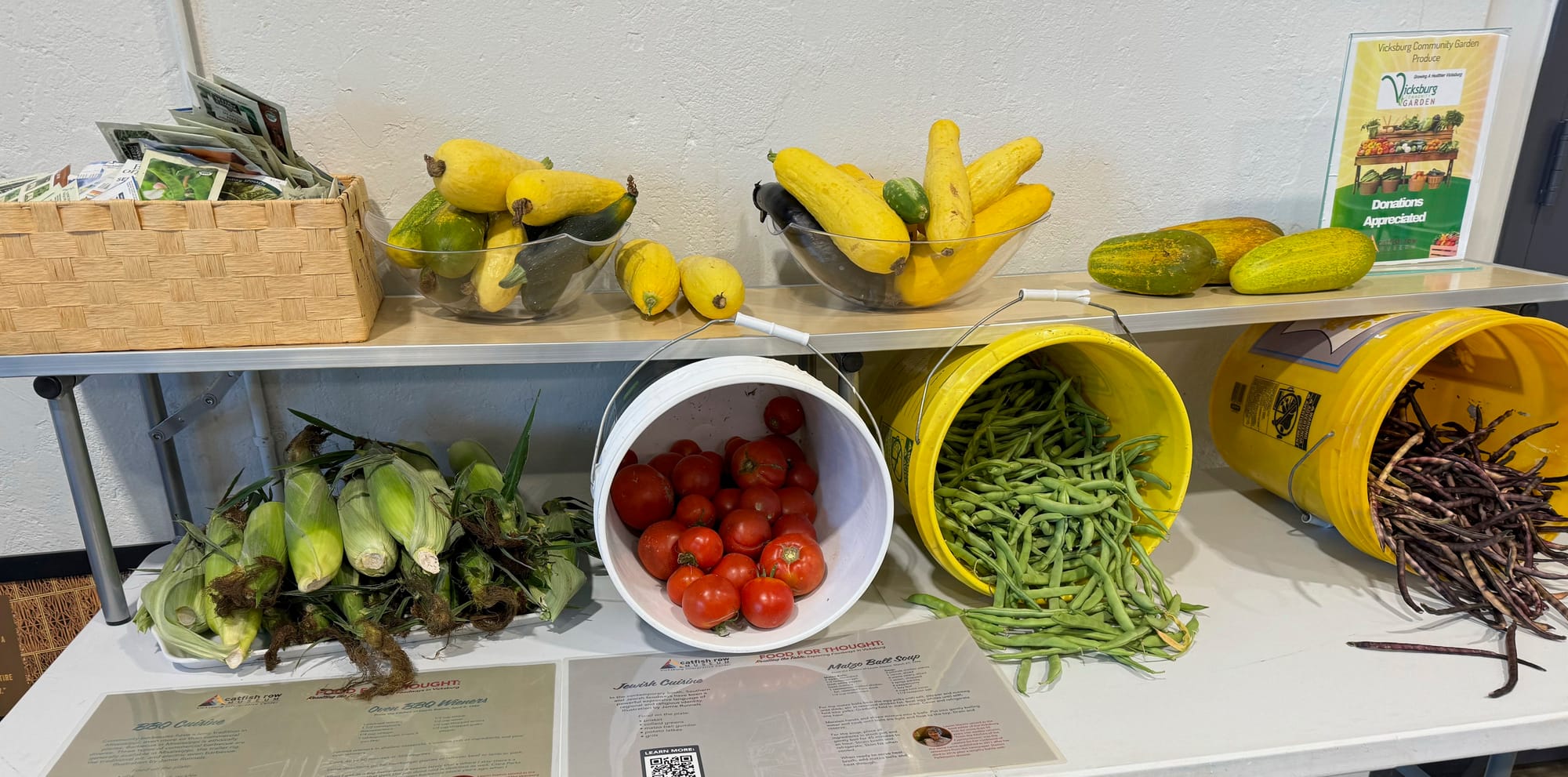 The Vicksburg Community Garden celebrated a plentiful harvest, with rows of corn, squash, tomatoes, peas, herbs, peppers, and watermelons ready for U-Pick Days in June 2024 in Vicksburg, Mississippi. photo provided ## Trump, Rollins oppose diversity initiatives On Jan. 20, Trump’s first day back in office, he signed an executive order ending support for DEI training and staff positions. Having a “chief diversity officer” or an “equity action plan” amounted to “immense public waste and shameful discrimination,” the order stated. “That ends today.” Days later, staff in the USDA’s finance office began searching for DEI-related grants to terminate. When Rollins took over Feb. 13, she directed staff to prioritize “merit” and “color-blind policies.” Any funding that appeared to contradict her directive was reported to her office, according to court records. By the department’s own admission in legal filings, a broad brush was used to define “DEI.” By April, the USDA had frozen funding for more than 300 projects. However, after a judge’s injunction, the USDA was forced to release some money. In early May, the USDA told the court that only 34 projects remained “frozen for DEI.” (The case is ongoing.) More cuts followed, however. In mid-June, Rollins announced that “more than 145 awards,” totaling about $148 million, were canceled. “Putting American Farmers First means cutting the millions of dollars that are being wasted on woke DEI propaganda,” Rollins said in a press release. 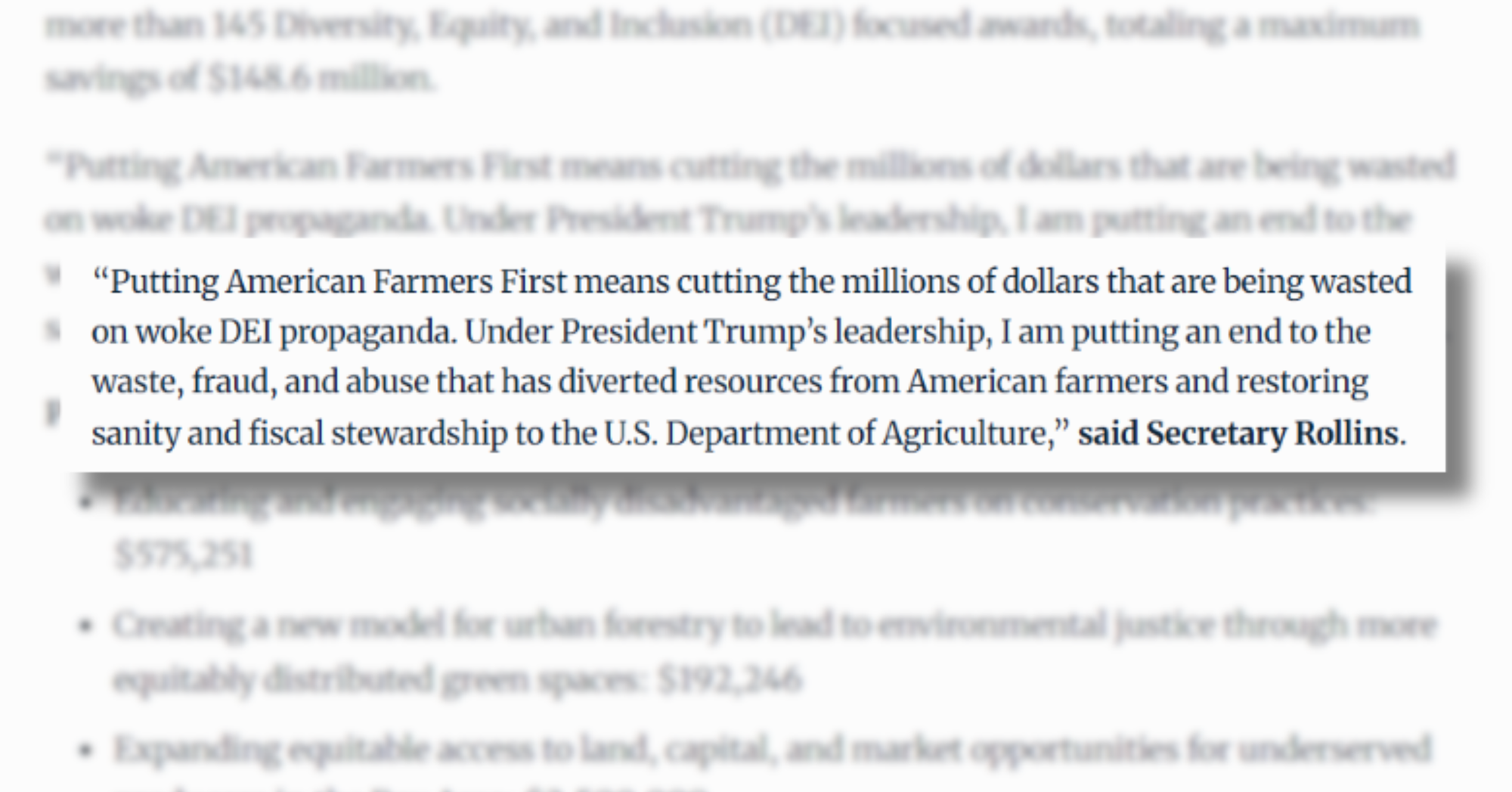 The administration has also attempted to import white farmers to the U.S. Trump has falsely claimed white farmers in South Africa, which used to operate a brutally racist system of apartheid, are facing a “genocide.” Then, the administration created a refugee program, which a political appointee acknowledged privately was intended just for the country’s white people, according to Reuters. Rollins has decried the mere mention of race or gender. Before becoming agriculture secretary, she chastised the “race-obsessed press” for commemorating the first time Black quarterbacks faced each other in the Super Bowl. Historically, Black players were not deemed smart enough to play the game’s most valuable position. Early in her tenure, Rollins singled out tomato seeds as evidence of DEI’s purportedly insipid creep into society. In a video posted to X, she showed seed packets adorned with the phrase, “Growing diversity, equity, inclusion and accessibility at USDA.” With a concerned look, Rollins said, “This is what we’re fighting.” She then threw the packets in a trash can. A day later, on a conservative radio show, Rollins cast blame on the Biden administration. “I guess they thought tomatoes were racist,” she said.  Sen. Raphael Warnock, D-Georgia Rollins has also dismissed diversity efforts related to hiring. During her nomination hearing, Sen. Raphael Warnock, a Georgia Democrat, asked her if she’d commit to recruiting more Black employees. Rollins did not answer directly and said she’d recruit the “best workforce in the history” of the USDA. (All of her high-level political appointees are white.)  U.S. Rep. Joshua Jackson, D-Illinois At other times, she’s said USDA hiring is now a “meritocracy.” At a June hearing, U.S. Rep. Joshua Jackson, an Illinois Democrat, asked her if the department had a written definition of merit. “I am not aware of that,” she replied. One person who appeared to have significant influence over USDA decision-making was Gavin Kliger, a DOGE operative who spearheaded funding cuts. Kliger’s resume shows no agricultural experience, and in emails to staff, he demonstrated a misunderstanding of how critical soil health is for farmers. Kliger has also promoted white supremacist and misogynistic content on X, according to Reuters. ## The USDA’s history of discrimination The USDA’s history of denying support to farmers of color long predates the current administration. In the 1930s, the department facilitated the creation of county committees that voted on how to disperse federal funds, which essentially guaranteed white farmers benefited. The system earned the USDA the nickname “[The Last Plantation](https://www.motherjones.com/food/2021/04/the-machine-that-eats-up-black-farmland/?ref=investigatemidwest.org).” (The system still exists. In 2023, the USDA released a report finding that, because minorities were often excluded from serving, the committees “often cripple the economic livelihood of minority farmers.”) In 1999, in the landmark Pigford v. Glickman case, a judge ruled the department denied loans to Black farmers because of their race and ordered restitution. In 2010, a second round of restorative payments were issued. In both cases, the USDA did not admit its discrimination. After Pigford, a series of lawsuits alleging USDA discrimination against women, Native American and Hispanic farmers followed. In 2011, the department announced a plan to resolve the claims. Under President Obama, Agriculture Secretary Tom Vilsack pushed a narrative that the department was addressing systemic racism. For instance, the USDA claimed the number of Black farmers had increased between 2007 and 2012\. According to an investigation by The Counter, a newsroom focused on agriculture and food, the figures were misleading. Internally, race was a third rail, regardless of which party controlled the White House, said Dodson, the recently retired USDA civil servant who started his career at the agency in the mid-1990s. [ ](https://public.flourish.studio/visualisation/24559443/?utm%5Fsource=embed&utm%5Fcampaign=visualisation/24559443) In 2013, he published a paper examining the USDA’s role in lending disparities. His analysis showed Black farmers typically have worse credit histories than white farmers — a result consistent with systemic racism — that hindered their eligibility for federal loans. When examining several years of data, he concluded there was “no evidence” of prejudicial behavior by USDA. Still, he said, his superiors yelled at him. “The pushback was so extreme,” he said. “It took me aback.” He dropped further inquiries. When Trump was elected the first time, the USDA’s lending program disproportionately backed white male farmers. Between 2017 and 2021, the department rejected fewer loan applications from whites, [according to data obtained by CNN](https://www.cnn.com/2021/12/15/politics/black-farmers-debt-relief-disparities/index.html?ref=investigatemidwest.org). At the same time, the department rejected far more loan applications from Black, Asian and Hispanic farmers. The first Trump administration also targeted young queer people interested in farming. In 2018, Trump officials pressured 4-H, a youth organization for beginning farmers, to drop a proposal welcoming LGBTQ members, [according to the Des Moines Register](https://www.desmoinesregister.com/story/news/investigations/2018/11/18/4-h-transgender-lgbt-iowa-john-paul-chaisson-cardenas-iowa-state-university-civil-rights/1572199002/?ref=investigatemidwest.org). A 4-H leader in Iowa who supported the proposal was fired. When Biden was elected, he placed more emphasis on race and gender. Dodson formed a team to research racial disparities, and in 2021 USDA surveyed, for the first time, agricultural producers’ sexual orientation and gender identity. In 2022, Congress passed the Inflation Reduction Act into law, which created the Discrimination Financial Assistance Program to directly pay Black farmers. (A group of white farmers contested the program in court.) Overall, though, the USDA has struggled to reckon with racial disparities. Once, during the Biden administration, when reviewing a study from another department agency about minority farmers, Dodson said his supervisor resisted its conclusions. When he asked why, the supervisor replied, “I just don’t think Black farmers are very good managers.” Dodson, like many USDA employees, grew up in rural America, and he heard similar comments. “You’ve got a culture at USDA that reflects that attitude,” he said. The effects can be felt on the ground. For Black farmers, attempting to get a loan from the USDA is like trying to negotiate in a different language, said Tiffany Bellfield El-Amin, the leader of the Kentucky Black Farmers Association. In recent years, more of her members have begun building a relationship with the local office of the USDA’s Natural Resources Conservation Service, which helps farmers maintain soil health, she said. The uptick correlates with a Black representative being available. As part of the USDA's DEI initiatives, the representative worked to establish cooperative agreements — for instance, the USDA might partner with a historically Black college to increase land access — that brought more Black farmers into the fold. “There’s a big language barrier between Black folks and these agencies,” she said. “I’m going to say this respectfully: I think folks in office know there’s a barrier and sometimes do not go outside themselves, which is why we have these DEI initiatives.” *John McCracken contributed to this story.* --- Citations & References ****Interviews** - Charles Dodson, May 19, 2025 - Tiffany Bellfield El-Amin, Kentucky Black Farmers Association, July 21, 2025 - Linda Fondren, Shape Up Mississippi, July 22, 2025 - Michaela Hoffelmeyer, University of Wisconsin-Madison, July 30, 2025 - Ike Leslie, farmer and researcher, Aug. 4, 2025 ****Government publications** - “[Agriculture Secretary Vilsack and Assistant Attorney General West Announce Process to Resolve Discrmination Claims of Hispanic and Women Farmers](https://web.archive.org/web/20160506024936/http://www.usda.gov:80/wps/portal/usda/!ut/p/c5/04%5FSB8K8xLLM9MSSzPy8xBz9CP0os%5FgAC9-wMJ8QY0MDpxBDA09nXw9DFxcXQ-cAA%5F1wkA5kFaGuQBXeASbmnu4uBgbe5hB5AxzA0UDfzyM%5FN1W%5FIDs7zdFRUREAZXAypA!!/dl3/d3/L2dJQSEvUUt3QS9ZQnZ3LzZfUDhNVlZMVDMxMEJUMTBJQ01IMURERDFDUDA!/?contentidonly=true&contentid=2011%2F02%2F0085.xml),” U.S. Department of Agriculture press release, Feb. 25, 2011 - “[The Pigford Cases: USDA Settlement of Discrimination Suits by Black Farmers](https://www.investigatemidwest.org/content/files/nationalaglawcenter-org/wp-content/uploads/assets/crs/rs20430.pdf),” Congressional Research Service, May 29, 2013 - “[Interim Report 2023: Recommendations made to the U.S. Department of Agriculture to advance equity for all](https://www.investigatemidwest.org/content/files/www-usda-gov/sites/default/files/documents/usda-ec-interim-report-2023.pdf),” U.S. Department of Agriculture Equity Commission report, Feb. 27, 2023 - “[Ending Radical And Wasteful Government DEI Programs and Preferencing](https://www.whitehouse.gov/presidential-actions/2025/01/ending-radical-and-wasteful-government-dei-programs-and-preferencing/?ref=investigate-midwest.ghost.io),” White House Executive Order, Jan. 20, 2025 - “[Prioritizing Unity, Equality, Meritocracy, and Color-Blind Policies in the United States Department of Agriculture](https://www.usda.gov/directives/sm-1078-001?ref=investigate-midwest.ghost.io),” U.S. Department of Agriculture Secretary’s Memorandum, Feb. 13, 2025 - “[Food Access Research Atlas](https://www.ers.usda.gov/data-products/food-access-research-atlas/go-to-the-atlas?ref=investigate-midwest.ghost.io)” data, U.S. Department of Agriculture, updated Feb. 20, 2025 - “[HHS and USDA Hold First Public MAHA Event, Outline Vision for Healthier America](https://www.usda.gov/about-usda/news/press-releases/2025/04/04/hhs-and-usda-hold-first-public-maha-event-outline-vision-healthier-america?ref=investigate-midwest.ghost.io),” U.S. Department of Agriculture press release, April 4, 2025 - “[USDA Cancels Biden Era Climate Slush Fund, Reprioritizes Existing Funding to Farmers](https://www.usda.gov/about-usda/news/press-releases/2025/04/14/usda-cancels-biden-era-climate-slush-fund-reprioritizes-existing-funding-farmers?ref=investigate-midwest.ghost.io),” U.S. Department of Agriculture press release, April 14, 2025 - “[Secretary Rollins Takes Bold Action to Put American Farmers First, Cuts Millions in Woke DEI Funding](https://www.usda.gov/about-usda/news/press-releases/2025/06/17/secretary-rollins-takes-bold-action-put-american-farmers-first-cuts-millions-woke-dei-funding?ref=investigate-midwest.ghost.io),” U.S. Department of Agriculture press release, June 17, 2025 - “[Secretary Rollins Terminates Biden’s Racial and Gender Discrimination in USDA Programs](https://www.usda.gov/about-usda/news/press-releases/2025/07/10/secretary-rollins-terminates-bidens-racial-and-gender-discrimination-usda-programs?ref=investigate-midwest.ghost.io),” U.S. Department of Agriculture press release, July 10, 2025 - “[Discrimination Financial Assistance Program](https://www.usda.gov/dfap-foia?ref=investigate-midwest.ghost.io),” U.S. Department of Agriculture webpage, undated - “[Grants & Cooperative Agreements](https://www.fsa.usda.gov/about-fsa/cooperative-agreements?ref=investigate-midwest.ghost.io),” U.S. Department of Agriculture webpage, undated ****News stories** - “[Love v. Vilsack: women farmers allege USDA discrimination](https://www.farmprogress.com/farm-business/love-v-vilsack-women-farmers-allege-usda-discrimination-100596?ref=investigate-midwest.ghost.io),” FarmProgress, July 1, 2011 - “[How Trump administration pressure to dump 4-H’s LGBT policy led to Iowa leader’s firing](https://www.desmoinesregister.com/story/news/investigations/2018/11/18/4-h-transgender-lgbt-iowa-john-paul-chaisson-cardenas-iowa-state-university-civil-rights/1572199002/?ref=investigate-midwest.ghost.io),” Des Moines Register, Nov. 18, 2018 - “[How USDA distorted data to conceal decades of discrimination against Black farmers](https://thecounter.org/usda-black-farmers-discrimination-tom-vilsack-reparations-civil-rights/?ref=investigate-midwest.ghost.io),” The Counter, June 26, 2019 - “[White farmers sue seeking government loan forgiveness](https://apnews.com/article/wisconsin-lawsuits-business-31e568255f85fb7655d20319d8dc271d?ref=investigate-midwest.ghost.io),” Associated Press, April 29, 2021 - “[The ‘Machine That Eats Up Black Farmland,’](https://www.motherjones.com/food/2021/04/the-machine-that-eats-up-black-farmland/?ref=investigate-midwest.ghost.io)” Mother Jones, May 2021 - “[Many Black farmers nationwide struggling to keep their farms afloat as they face disparities across the board](https://www.cnn.com/2021/12/15/politics/black-farmers-debt-relief-disparities/index.html?ref=investigate-midwest.ghost.io),” CNN, Dec. 15, 2021 - “[The decadeslong struggle to break NFL’s quarterback color barrier is subject of new book](https://abcnews.go.com/Sports/decadeslong-struggle-break-nfls-quarterback-color-barrier-subject/story?id=91167615&ref=investigate-midwest.ghost.io),” ABC News, Oct. 10, 2022 - “[BROOKE ROLLINS: This Super Bowl Sunday, The Race-Obsessed Press is Focused on the Least Important Thing](https://dailycaller.com/2023/02/12/brooke-rollins-this-super-bowl-sunday-the-race-obsessed-press-is-focused-on-the-least-important-thing/?ref=investigate-midwest.ghost.io),” Daily Caller, Feb. 12, 2023 - “[New evidence shows how badly NFL teams discriminate against Black QBs in the draft](https://www.sfgate.com/49ers/article/nfl-draft-analysis-racial-bias-quarterbacks-18355172.php?ref=investigate-midwest.ghost.io),” SFGATE, Sept. 11, 2023 - “[Can Billions in New Subsidies Keep Family Farm in Business](https://www.nytimes.com/2024/05/30/business/economy/small-farms-usda-biden.html?ref=investigate-midwest.ghost.io),” The New York Times, May 30, 2024 - “[Staffer with Elon Musk’s DOGE amplified white supremacists online](https://www.reuters.com/world/us/staffer-with-elon-musks-doge-amplified-white-supremacists-online-2025-02-07/?ref=investigate-midwest.ghost.io),” Reuters, Feb. 8, 2025 - “[Agriculture Secretary Nominee Brooke Rollins Testifies at Confirmation Hearing](https://www.c-span.org/program/senate-committee/agriculture-secretary-nominee-brooke-rollins-testifies-at-confirmation-hearing/654582?ref=investigate-midwest.ghost.io),” C-SPAN, Feb. 23, 2025 - [‘ECONOMIC TRANSITION’: Trump administration tries to calm recession fears](https://www.youtube.com/watch?v=k21W82bOup8&t=277s&ref=investigate-midwest.ghost.io),” Fox News, March 12, 2025 - “[USDA Trashes ‘Woke’ DEI Tomato Seeds After Bizarre Discover: ‘This Is What We’re Fighting,](https://www.breitbart.com/politics/2025/03/27/usda-trashes-woke-dei-tomato-seeds-after-bizarre-discovery-this-is-what-were-fighting/?ref=investigate-midwest.ghost.io)’” Breitbart, March 27, 2025 - “[Secretary of Agriculture Brooke Rollins On ‘Woke Seeds,’ Selling America’s Farm Products Abroad, and Forest Fires](https://hughhewitt.com/secretary-of-agriculture-brooke-rollins-on-woke-seeds-selling-americas-farm-products-abroad-and-forest-fires?ref=investigate-midwest.ghost.io),” [hughhewitt.com](http://hughhewitt.com/?ref=investigate-midwest.ghost.io), March 28, 2025 “[President Trump Participates in ‘Make America Healthy Again’ Commission Event](https://www.c-span.org/program/white-house-event/president-trump-participates-in-make-america-healthy-again-commission-event/660298?ref=investigate-midwest.ghost.io),” C-SPAN, May 22, 2025 - “[More white South Africans arrive in the US under a new refugee program](https://apnews.com/article/trump-south-africa-refugees-afrikaner-white-f5ed3aa615e0448157f8c4752d2a0cc7?ref=investigate-midwest.ghost.io),” Associated Press, June 2, 2025 - “[‘Farming in the dark’: Brooke Rollins’ leadership, Doge’s grip and the cost to American agriculture](https://www.investigatemidwest.org/farming-in-the-dark-brooke-rollins-leadership-doges-grip-and-the-cost-to-american-agriculture/),” Investigate Midwest, July 16, 2025 - “[Exclusive: US Diplomats asked if non-whites qualify for Trump refugee program for South Africans](https://www.reuters.com/world/africa/us-diplomats-asked-if-non-whites-qualify-trump-refugee-program-south-africans-2025-07-25/?ref=investigate-midwest.ghost.io),” Reuters, July 25, 2025 ****Other** - “[Racial/Ethnic Discrimination in USDA’s Direct Farm Lending Programs](https://ageconsearch.umn.edu/record/150492/?v=pdf&ref=investigate-midwest.ghost.io),” Charles Dodson conference paper, 2013 - “[Surveying queer farmers: How heteropatriarchy affects farm viability and farmer wellbeing in U.S. agriculture](https://www.researchgate.net/publication/370356402%5FSurveying%5Fqueer%5Ffarmers%5FHow%5Fheteropatriarchy%5Faffects%5Ffarm%5Fviability%5Fand%5Ffarmer%5Fwellbeing%5Fin%5FUS%5Fagriculture?ref=investigate-midwest.ghost.io),” Journal of Agriculture Food Systems and Community Development, April 2023 - [Declaration of Tyson Whitney](https://www.investigatemidwest.org/content/files/storage-courtlistener-com/recap/gov-uscourts-rid-59116/gov-uscourts-rid-59116-56-2.pdf), Woonsasqutucket River Watershed District v. USDA [lawsuit](https://www.courtlistener.com/docket/69736976/woonasquatucket-river-watershed-council-v-department-of-agriculture/?ref=investigate-midwest.ghost.io), filed March 13, 2025 - [Status report from Tyson Whitney](https://www.investigatemidwest.org/content/files/storage-courtlistener-com/recap/gov-uscourts-rid-59116/gov-uscourts-rid-59116-64-2.pdf), Woonasquatucket River Watershed District v. USDA [lawsuit](https://www.courtlistener.com/docket/69736976/woonasquatucket-river-watershed-council-v-department-of-agriculture/?ref=investigate-midwest.ghost.io), filed March 13, 2025 - “[For The Purpose of Receiving Testimony From the Honorable Brooke L. Rollins, Secretary, U.S. Deparment of Agriculture](https://agriculture.house.gov/calendar/eventsingle.aspx?EventID=7932&ref=investigate-midwest.ghost.io),” House Committee on Agriculture, June 11, 2025 - “[Diversity, equity and inclusion](https://www.merriam-webster.com/dictionary/diversity,%20equity%20and%20inclusion?ref=investigate-midwest.ghost.io),” Merriam-Webster definition, undated - “[Diversity, Equity, and Inclusion Progarms](https://www.britannica.com/topic/affirmative-action?ref=investigate-midwest.ghost.io),” Enclyclopaedia Britannica entry, undated ### A new dicamba lawsuit is likely around the corner URL: https://www.investigatemidwest.org/a-new-dicamba-lawsuit-is-likely-around-the-corner/ Last updated: 2025-09-15T15:27:34.000Z Less than two months ago, the Environmental Protection Agency[ announced](https://www.regulations.gov/document/EPA-HQ-OPP-2024-0154-1239?ref=investigatemidwest.org) its intent to *unconditionally* register three new[ dicamba-based](https://www.epa.gov/pesticides/dicamba?ref=investigatemidwest.org) pesticides for over-the-top usage on soybean and cotton crops. To say EPA has a checkered history in trying to get dicamba registered is an understatement. The federal courts have twice revoked EPA approval of dicamba. In 2020, the U.S. Court of Appeals for the 9th Circuit[ found](https://www.investigatemidwest.org/content/files/www-centerforfoodsafety-org/files/125-dicamba-opinion%5F35970.pdf) EPA conducted shoddy analysis that understated some risks and failed completely to acknowledge others: > *“...the EPA refused to estimate the amount of dicamba damage, characterizing such damage as ‘potential’ and ‘alleged,’ when record evidence showed that dicamba had caused substantial and undisputed damage.”* The ruling sent EPA back to the drawing board to make additional application restrictions to dicamba labels to prevent drift damage. But in the government's effort to speed up the registration process, the U.S. District Court of Arizona in Tucson[ found EPA cut corners](https://www.investigatemidwest.org/content/files/biologicaldiversity-org/campaigns/pesticides%5Freductions/2024-02-06-ecf-256-order-epa-def-intvnr-xmsjs-denied-pltfs-msj-granted.pdf), including violating public input requirements required by the Federal Insecticide, Fungicide and Rodenticide Act: > *“In this case, the EPA violated the statutory mandate in FIFRA for notice and comment for ‘new use’ registrations and failed to determine no additional data was necessary before issuing the 2020 unconditional registrations for OTT dicamba… The seriousness of this error is compounded by the finding in NFFC that the original registrations issued for OTT dicamba in 2016, amended in 2018, failed to consider risks to certain stakeholders, including those not using OTT dicamba.”* If you've come to the conclusion that EPA willingly ignores laws when it comes to dicamba, you're not alone. Now Big Ag corporations Syngenta, BASF and Bayer want to sell new dicamba products next growing season and have petitioned EPA for registrations. It is EPA's intent to unconditionally approve dicamba, along with a[ bevy of new restrictions](https://nationalaglawcenter.org/the-deal-with-dicamba-epa-proposes-unconditional-registration-for-over-the-top-use/?ref=investigatemidwest.org) to mitigate drift in over-the-top application. To bolster its case, EPA has published three publications considering potential risks to the public and environment — a[ Draft Ecological Risk Assessment and Biological Evaluation](https://www.investigatemidwest.org/content/files/aglaw-psu-edu/wp-content/uploads/2025/07/05-draft-bio-eval-dicamba-7-23-25.pdf),[ Human-Health Risk Assessment](https://www.investigatemidwest.org/content/files/aglaw-psu-edu/wp-content/uploads/2025/07/06-dicamba-human-health-risk-assess-7-23-25.pdf), and[ Benefits Assessment](https://www.investigatemidwest.org/content/files/aglaw-psu-edu/wp-content/uploads/2025/07/07-dicamba-benefits-assess-epa-7-21-25.pdf) [In summation, EPA claims dicamba is oh so safe](https://www.regulations.gov/document/EPA-HQ-OPP-2024-0154-1239?ref=investigatemidwest.org): > *“Considering the assessed risk to human health and the environment, and the associated economic, social, and environmental costs, and the benefits, consistent with the requirements of FIFRA section 3(c)(5), EPA proposes that dicamba use in DT cotton and DT soybean meets the regulatory standard under FIFRA and proposes to conclude that registering the proposed products would not cause unreasonable social or economic impacts or adverse effects on human health or the environment. The Agency proposes that the benefits of having a broad spectrum, non-selective foliar-applied herbicide for control of broadleaf weeds as a rotational tool, partnered with the mitigation measures for any risks, outweigh any potential risks of concern.”* By the way, conditional product label registrations typically are issued for just a few growing seasons to allow for tweaking, while *an unconditional label is good for 15 years* unless it's vacated by court ruling. Fifteen years? For dicamba? From the gang that ain’t shooting straight? Here's what is going to happen should the EPA go through with its dicamba registration plan this fall: Environmental advocates a whole lot smarter than I will go through EPA's registration process with a fine tooth comb and, given the agency's woeful track record, are likely to find discrepancies with FIFRA requirements. Lawsuits are sure to follow, perhaps with an expedited courtroom schedule given farmers will be trying to make crop planting decisions for 2026. [It’s the same plot that played itself out in the 2024 growing season](https://nationalaglawcenter.org/the-deal-with-dicamba-court-vacates-over-the-top-registration/?ref=investigatemidwest.org). The truth is there is little Big Ag, farmers or the courts can do to fully prevent dicamba from drifting where it's not welcome. And as long as that is true, dicamba usage will be contentious in a never-ending rinse and repeat cycle. --- ### RSVP for our free live panel on immigration farmwork URL: https://www.investigatemidwest.org/rsvp-for-our-free-live-panel-on-immigration-farmwork/ Last updated: 2026-09-11T03:04:35.000Z Thursday, Sept. 18 at noon CST — join experts on laws, labor, and policy. _This post is for subscribers only._ ### US grain growers face deepening losses URL: https://www.investigatemidwest.org/us-grain-growers-face-deepening-losses/ Last updated: 2026-09-23T18:12:15.000Z U.S. farmers are likely staring down another year in the red, faced with a familiar cycle: rising costs and weakening markets. After years of strong grain prices between 2021 and 2023, growing corn and soybeans is no longer profitable — a trend likely to continue and one that farm groups warn could spark a financial crisis for farmers. For corn, the average total cost of producing an acre jumped 26% between 2021 and 2022, peaking at a record $928\. Costs eased slightly to $888 per acre in 2024, while the average value of production slipped to $757 — leaving farmers with a $131 loss per acre. USDA forecast data for 2025 and 2026 shows that the cost of production for corn is projected to keep going up, with farmers expected to spend an average of $915 to grow an acre of corn in 2026 — up from $897 this year. The USDA also lowered the projected average price for 2025 from $4.20 for a bushel of corn to $3.90. Between 2021 and 2023, average corn and soybean prices stayed high, exceeding production costs. [Economists at the University of Illinois and Ohio State University](https://farmdocdaily.illinois.edu/2024/07/corn-and-soybeans-economics-in-2024-and-2025-back-to-the-new-old-normal.html?ref=investigatemidwest.org) point to several factors: China rebuilding its swine herd in 2020, the Russia-Ukraine war disrupting European supplies and driving uncertainty, and weak harvests in South America and the U.S. The current slump isn’t unprecedented: from 2014 to 2020, average corn prices also fell below production costs. But farm groups and [lawmakers](https://www.brownfieldagnews.com/news/grassley-concerned-about-low-crop-prices-higher-input-costs/?ref=investigatemidwest.org) warn the current downturn is especially concerning. With the combined issues of last year’s corn and soybean crops [still sitting in storage](https://www.oklahomafarmreport.com/okfr/2025/08/28/a-challenging-farm-economy-tops-afrs-agenda/?ref=investigatemidwest.org), uncertainty from the U.S.-China tariff war, no new farm bill in place, and federal relief from the new “Big Beautiful Bill” delayed until October 2026, farmers face an especially tough stretch ahead. The National Corn Growers Association has [sounded the alarm](https://ncga.com/stay-informed/media/the-corn-economy/article/2025/08/the-corn-economy-ncga-highlights-high-production-costs-amidst-economic-crisis?ref=investigatemidwest.org) about “the economic crisis hitting rural America,” while the American Soybean Association warned in a [letter](https://www.investigatemidwest.org/content/files/soygrowers-com/wp-content/uploads/2025/08/8-19-25-asa-letter-to-president-trump-on-china-final-1.pdf) to Trump that “U.S. soybean farmers are standing at a trade and financial precipice.” ### Immigration, farm ownership, and the fight over ag data URL: https://www.investigatemidwest.org/immigration-farm-ownership-and-the-fight-over-ag-data/ Last updated: 2026-09-11T03:04:27.000Z From Beardstown’s immigrant workforce to the sharp drop in Black farm ownership and a fight over ag statistics. _This post is for subscribers only._ ### 'Porkopolis' in peril URL: https://www.investigatemidwest.org/porkopolis-in-peril/ Last updated: 2026-09-11T03:04:27.000Z Revived by immigrant labor, this IL town is caught in the crosshairs of federal immigration crackdown policies _This post is for subscribers only._ ### First look: Immigration crackdown shakes a rural Illinois town URL: https://www.investigatemidwest.org/first-look-immigration-crackdown-shakes-a-rural-illinois-town/ Last updated: 2026-09-11T03:04:23.000Z In Beardstown, workers at JBS and DOT Foods describe what it means to lose jobs and stability under new immigration policies. _This post is for subscribers only._ ### Immigrants helped save this Illinois meatpacking town. Trump cut hundreds from its workforce. URL: https://www.investigatemidwest.org/immigrants-helped-save-this-illinois-meatpacking-town-trump-cut-hundreds-from-its-workforce/ Last updated: 2026-09-23T18:12:14.000Z *This story is supported by funding from the Chicago Region Food Systems Fund.* [*Esta historia también está disponible en español aquí.*](https://www.investigatemidwest.org/pork-lobbyist-helping-lead-nonpartisan-group-working-against-state-animal-welfare-laws/) In Beardstown, Illinois, the Cuban couple had spent the past year building a life they were proud of. Their arrival in the U.S. had followed a long and uncertain path: a northbound journey through Nicaragua, Honduras and Guatemala, followed by seven months in Monterrey, Mexico, as they waited for their appointment with Customs and Border Protection (CBP). Aware of the growing hostility toward immigrants in the U.S., they were determined to enter legally. In Cuba, they barely made ends meet — he worked in maintenance, she worked in a clothing store. But in the rural west central Illinois town, life started to feel promising. They found work last year as forklift operators at DOT Foods, the largest food redistributor in the country. The pay was decent and the benefits generous, and the couple had begun to set aside savings. Then, in June, they were abruptly let go. “We were on the right track,” the husband said in Spanish, seated in the living room of their one-bedroom rental. The couple asked Investigate Midwest not to use their names for fear of deportation. “We were comfortable in our jobs, earning a decent salary. And suddenly everything collapsed — the castle crumbled.” They are among hundreds of immigrants in Beardstown who arrived through humanitarian parole programs that have since been rescinded by the Trump administration, leaving them undocumented and out of work. Many of them were employed at DOT Foods and JBS, the world’s largest meat processor. These workers were part of a workforce that has long sustained both the town’s economy and its key role in the country’s food supply chain.  The JBS plant in Beardstown, Illinois, slaughters over 20,000 hogs each day. photo by Ben Felder, Investigate Midwest For decades, Beardstown has been a case study in how immigrants have revitalized once-decaying rural towns, particularly in the Midwest. But the Trump administration’s crackdown on both documented and undocumented immigration threatens the stability of communities that have long relied on foreign-born workers. The previous administration’s humanitarian parole initiatives — which allowed individuals to enter the U.S. temporarily to seek safety or escape political persecution — significantly increased the pool of authorized workers. That influx helped major food companies fill staffing gaps and keep operations running during pandemic-era labor shortages. Roughly 2.1 million immigrants power the nation’s food supply chain — planting, harvesting, processing and selling the food that ends up on American tables. So far, there is no evidence that Trump’s immigration agenda has created an “America First” labor market with higher wages to attract U.S.-born workers to slaughterhouses or farm fields. Instead, labor experts say the more likely outcome is an expansion of guestworker programs like H-2A and H-2B — [often criticized ](https://www.epi.org/publication/second-class-workers-assessing-h2-visa-programs-impact-on-workers/?ref=investigatemidwest.org)[for enabling exploitation](https://www.judiciary.senate.gov/press/dem/releases/senators-raise-concerns-over-h-2b-visa-abuses-that-enable-exploitation?ref=investigatemidwest.org) — or a shrinking workforce that leaves remaining workers stretched even thinner. “We’re not seeing any evidence yet of improved conditions for \[domestic\] workers,” said Daniel Costa, director of immigration law and policy research at the Economic Policy Institute. “Some employers, especially in certain industries, have been ready to make a push for more H-2A and H-2B visas… They see that the only way they are going to replace that workforce is with these programs.”  A billboard in Beardstown, Illinois, advertises job openings at DOT Foods. photo by Ben Felder, Investigate Midwest In Beardstown, it’s unclear how employers like JBS and DOT Foods will address the labor shortage. Neither company responded to requests for comment. Investigate Midwest spoke with dozens of workers, local residents, city officials and immigration advocates to examine how tougher immigration policies, including the rollback of parole programs, are impacting not just the local economy, but also the nation’s food system. Many Beardstown residents requested anonymity, fearing that speaking out could put them at risk of deportation. --- Just a few steps from the slow-moving waters of the Illinois River, the Western Illinois Dreamers Immigrant Welcome Center sits beside the weathered storefront of a local radio station in downtown Beardstown. Inside, “Know Your Rights” flyers in Spanish line the walls. A staff of three helps connect newly arrived migrants with legal services, food pantries, clothing banks and other local resources. Kate Cruz, who co-directs the center, said her office has heard from many of the recently terminated workers at DOT Foods and JBS. Most are scrambling to find legal pathways to stay in the country and return to work. Some are reaching out in fear. “We have more people coming in or calling who are fearful,” Cruz said. “Or they’re sending family members because they’re afraid that if they leave their homes, they’re going to be deported.” Many of these workers are from Haiti, another country that, like Cuba, was included in the Biden administration’s humanitarian parole program in response to ongoing political and humanitarian crises.  Kate Cruz co-directs the Western Illinois Dreamers Immigrant Welcome Center in Beardstown. photo by Ben Felder, Investigate Midwest Starting in 2021, the Biden administration expanded its use of parole authority, a long-standing legal tool that allows individuals to enter the U.S. temporarily for urgent humanitarian reasons or public benefit. Both Republican and Democratic administrations have used parole for decades. Under Biden, new programs were set up to grant parole to people fleeing crises in Afghanistan, Ukraine, Cuba, Haiti, Nicaragua and Venezuela. [ ](https://public.flourish.studio/visualisation/24163723/?utm%5Fsource=embed&utm%5Fcampaign=visualisation/24163723) The administration also extended parole to some migrants who scheduled appointments at the border using the CBP One app and met certain requirements after an interview, allowing them to enter legally through official ports — a strategy aimed at tracking arrivals and reducing illegal crossings. “Many people fled their home country because it just simply wasn't safe for them to stay there anymore,” said Sara Dady, an immigration attorney based in Rockford, Illinois. Haiti, like parts of Central America and Mexico, has also been plagued by gang violence and instability in recent years. Cruz said that at the beginning of the year, JBS hired hundreds of Haitian immigrants, most of whom have now been terminated. They want to stay in Beardstown, Cruz says, because it still feels safer than home despite their fear of deportation.  A mural on a building in downtown Beardstown, Illinois. photo by Ben Felder, Investigate Midwest But for the terminated workers, finding a way to remain in the U.S. without risking deportation will look different for everyone — and it means navigating a constantly changing immigration system that can be complex, costly and slow. For example, the Cuban couple hopes to remain in the U.S. under the Cuban Adjustment Act, a 1960s law that allows Cuban nationals to apply for permanent residency after one year of physical presence in the country. They applied with the help of an immigration lawyer they found online. But with both of them out of work, their savings are quickly being depleted by the legal fees, on top of rent and daily expenses. --- --- For Elizabeth Amezcua, 39, an immigrant from Mexico, hiring a lawyer is not an option right now. Without the money for legal help, she is left to navigate the system on her own. Amezcua was recently let go from the JBS slaughterhouse, where she worked as a cook in the facility’s cafeteria. The income supported her in Beardstown and helped provide for her son back in Mexico. She entered the U.S. nearly 18 months ago through the CBP One process, like the Cuban couple. She says she was granted parole that allowed her to stay legally for at least one more year. But after the Trump administration began dismantling parole programs — including converting the CBP One app that had allowed Amezcua to enter the country into a “self-deportation app” — she lost her job in June. “I don’t have any family here. I don’t have anyone to help me,” Amezcua said in Spanish. “But God is almighty. And I know He’s going to help all of us who were left without jobs.” On August 1st, a federal judge [blocked the Trump administration](https://www.politico.com/news/2025/08/01/immigration-humanitarian-parole-ruling-00488290?ref=investigatemidwest.org) from rapidly deporting immigrants who had been paroled into the country. ---  A Cargill-owned grain facility next to the Illinois River is Beardstown. photo by Ben Felder, Investigate Midwest For nearly two centuries, Beardstown’s economy has been rooted in agriculture, shaped from the start by immigration. In the early 19th century, Dutch immigrants drained the region’s marshlands, transforming it into farmland. By 1834, Beardstown had become a key river port shipping grain, hogs and provisions to downstate markets. With tens of thousands of hogs slaughtered each spring — more than in Chicago — it earned the nickname “Porkopolis,” home to the most extensive pork trade west of Cincinnati. Beardstown’s industrial rise continued into the mid-20th century. In 1967, Oscar Mayer opened a large meatpacking plant, employing over 800 workers, most of them white men from the area. Jobs at the plant were stable, unionized and paid well. The mayor of Beardstown, Tim Harris, remembers graduating from high school and dreaming of working at the Oscar Mayer plant.  Beardstown City Hall is next to the town square, which hosts community festivals and other gatherings. photo by Ben Felder, Investigate Midwest “It was fairly difficult to get a job there,” said Harris, sitting in his City Hall office across the street from the town square, where speakers play music and ads in Spanish for jobs at JBS. “Unless you really had an in with somebody, a reference, you usually didn’t get a job there.” But in the 1980s, industry consolidation, weakened labor unions and automation led to declining wages. By 1990, meatpacking jobs paid 24% less than the average manufacturing wage. When Oscar Mayer closed its plant in 1987, Beardstown had already lost hundreds of jobs from other factory shutdowns. As families moved away, the town’s future looked bleak. Cargill eventually bought the facility that same year and reopened it under a new model — cutting wages and benefits. But with the new jobs failing to attract the local population, which had dropped from 6,338 in 1980 to 5,270 in 1990, Cargill had to look elsewhere to build its workforce. The company turned to immigrant labor, first from Mexico and later from other countries. The shift transformed the plant’s workforce from nearly all-white to one with dozens of nationalities and languages; Beardstown went from a declining town, with shuttered storefronts and an aging population, into a [multicultural hub](https://www.npr.org/2007/07/03/11688844/small-midwest-town-copes-with-immigration?ref=investigatemidwest.org). But this transformation was not without tension. In 1995, just 45 miles north of Beardstown, the Ku Klux Klan held a rally to protest the hiring of immigrants at the Cargill plant.  Several historical markers, including a museum, pay tribute to Illinois native and former President Abraham Lincoln throughout the town of Beardstown, Illinois. photo by Ben Felder, Investigate Midwest Thirty years later, Beardstown’s nearly 6,000 residents make up a far more integrated community, and Mayor Harris welcomes newcomers. “We need workers. The whole country does,” Harris said. Beardstown’s story mirrors a broader transformation that has swept through the rural Midwest over the past four decades. Immigration, global corporate consolidation, and the relentless drive for efficiency have reshaped the meat industry and the communities built around it. The Beardstown slaughterhouse changed hands again in 2015, when it was purchased by JBS, a Brazilian conglomerate that is now the world’s largest meat company. The plant, which processed 7,000 hogs a day during the Oscar Mayer era, now slaughters over 20,000. According to USDA data, pork production in the U.S. increased by over 75% between 1980 and 2020, now topping 28 billion pounds annually. Over the same period, the number of plants fell and line speeds accelerated. Modern meat processing plants can slaughter over 1,100 hogs per hour. Industry profits have soared alongside this productivity boom, especially in recent years. The top meatpacking companies — including JBS and Tyson Foods — more than doubled their profit margins during the pandemic. However, the industry’s rapid growth and increasing profits have not always translated into improved working conditions for its frontline workers. Real wages have decreased since the 1980s and injuries remain common today. And now, under a Trump administration that benefited from industry donations, thousands of these workers are at risk of deportation.  A sign for the JBS plant near the entrance to Beardstown, Illinois. photo by Ben Felder, Investigate Midwest JBS subsidiary Pilgrim’s Pride, the second-largest poultry processor in the U.S, made a $5 million donation to Trump’s Inaugural Committee — the largest single contribution, far exceeding the $1 million given by corporations like Meta and Amazon. Some [critics argue](https://www.nytimes.com/2025/06/25/world/americas/brazil-meatpacker-jbs-trump-nyse.html?ref=investigatemidwest.org#:~:text=After%20years%20of%20attempts%20by,win%20favor%20from%20the%20administration.) that JBS’s political donations and aggressive lobbying helped clear the way for its recent listing on the New York Stock Exchange, despite a controversial track record that includes corruption and bribery scandals in Brazil. In the U.S., the company’s record has also drawn scrutiny. During the early months of the pandemic, JBS kept its plants open without proper safety measures, and they quickly became COVID-19 hotspots. At its Greeley, Colorado, plant, nearly 300 workers were infected and six died. By July 2020, the plant accounted for 65% of all COVID-19 cases in Colorado. Most of the affected workers were older immigrants. JBS did not respond to requests for an interview or comments on its political contributions, COVID-19 safety protocols, and the recent termination of immigrant workers on humanitarian parole. Neither JBS nor other major meat companies and industry groups have publicly opposed Trump’s immigration policies. However, the North American Meat Institute, a powerful trade group, has formally urged the administration to expand the H-2A visa program — originally intended for seasonal farmworkers — to include meat and poultry processors. “You've seen some action in Congress and the Appropriations Committee,” said Costa, with the Economic Policy Institute. “There are amendments being considered that would change the rules in the work visa program so that they'd apply for additional industries. So I do think that is going to be the main strategy.” --- About 740,000 immigrants on humanitarian parole were part of the U.S workforce between 2021 and 2024, according to FWD.us, a bipartisan immigration advocacy group. Of those, 30,000 worked in agriculture and 90,000 in manufacturing, including meatpacking and food processing. The organization projects that eliminating their work authorization, alongside other immigration policy changes, could increase prices for food, beverages and tobacco by 14.5% between 2024 and 2028. But the economic impact is only part of the story. In places like Beardstown, the new immigration policies have stoked anxiety and discouraged civic life. The annual celebration for Mexican Independence Day on Sept. 16, which draws hundreds to Beardstown’s town square with music, food and costume contests, has been cancelled. Even residents with visas or green cards say they’re hesitant to leave their homes.  A family event was held in the town square of Beardstown, Illinois, on July 12, 2025, which included food sponsored by JBS. photo by Ben Felder, Investigate Midwest While fears of deportation have increased under the Trump administration, for many immigrants, that fear is nothing new. Many advocates argue the system has been broken for decades: the Obama administration deported more immigrants than any U.S. president, and the largest workplace immigration raid in the country’s history happened under President George W. Bush at a meatpacking plant in Iowa. Martin Pineda has lived through these shifting policies. A native of Mexico, Pineda spent years working in strawberry fields in California and later at a Missouri slaughterhouse. When that plant closed, he moved to Beardstown to work at the slaughterhouse there — then owned by Cargill — and stayed for more than a decade. He left in 2007, after an immigration raid during the Bush administration led to the arrest of 62 undocumented night-shift workers and the company began enforcing stricter documentation checks. Pineda, who has a wife and three children, is outspoken in support of immigrant rights. In 2023, he traveled to Washington, D.C. to advocate on behalf of undocumented workers.  Martin Pineda working at an annual soccer tournament in Beardstown, Illinois, on July 12, 2025\. photo by Ben Felder, Investigate Midwest “We are contributing heavily to the economy and we don’t get any recognition,” Pineda said. “That’s what makes me sad about this country. In my case, I’ve worked more than 30 years, and I don’t have Social Security to retire.” In recent months, ICE agents have detained dozens of migrants in Chicago — at court appearances, during mandatory check-ins and in a high-profile South Loop operation that swept up at least 10 people. While there have been no confirmed reports of ICE activity in Beardstown or at the JBS plant, fear still lingers. Some residents are reluctant to go outside, scared by false rumors spreading quickly on Facebook and WhatsApp. But Pineda refuses to live in the shadows. Each summer, he organizes a youth soccer tournament that brings together over 280 children from different ethnic backgrounds. It’s become a much-anticipated event, held at the town’s soccer fields — owned by JBS — against a backdrop of cornfields. Pineda sees the tournament as more than just a game. It’s a show of resilience in a time of fear, and a reminder that immigrants contribute to a community in ways that go far beyond labor. “It’s a lot of work — but I enjoy it. I like doing something productive,” said Pineda about the tournament. “This is something I wish I could have done in my own country, but I couldn’t. So I’m doing it here, with the children in my community, in this town. Most of them are Latino, but we also have kids from other backgrounds — African, white. And like I said, I enjoy it. I’m a volunteer.” --- --- ****Sourcing & Methodology Statement** Investigate Midwest reporter Juan Vassallo spent several days in Beardstown, Illinois, conducting in-person reporting. He visited local restaurants, bars, a community center and a church, and spoke with city and community leaders, business owners, and numerous workers in the local food system. Some of these conversations included undocumented individuals; Investigate Midwest agreed to withhold their identities to protect them from potential deportation. ****Citations & References** ****Interviews** Cuban couple, July 14, 2025 Daniel Costa, Economic Policy Institute, Aug. 5, 2025 Elizabeth Amezcua, July 14, 2025 Jose Oliva, HEAL Food Alliance, May 20, 2025 Julia Albarracin, Western Illinois Dreamers, June 17, 2025 Kate Cruz, Western Illinois Dreamers, June 26, 2025 Kathleen Vannucci, Ahlgren Law, June 10, 2025 Leone Bacchieri, Working Family Solidarity, May 28, 2025 Martin Pineda, June 20, 2025 Phillip Connor, FWD.us, June 7, 2025 Rocio Kato, June 9, 2025 Sarah Mellor, The Immigration Project, June 11, 2025 Sara Dady, Dady Law Group, Aug. 5, 2025 Shelly Ruzicka, Arise Chicago, June 2, 2025 Tim Harris, Mayor of Beardstown, July 14, 2025 ****Resources and Data** FWD.us, “[New Immigration Policies Will Increase Prices for Americans](https://www.fwd.us/news/new-immigration-policies-will-increase-prices-for-americans/?ref=investigatemidwest.org),” June 25, 2025 FWD.us, “[CHNV Has Been a Huge Economic Success. The Trump Administration Should Abandon Its Effort to Fast‑Track the Revocation of Humanitarian Parole for More Than 500,000 People](https://www.fwd.us/news/chnv-has-been-a-huge-economic-success-the-trump-administration-should-abandon-its-effort-to-fast-track-the-revocation-of-humanitarian-parole-for-more-than-500000-people/?ref=investigatemidwest.org),” May 16, 2025 Faranak Miraftab, [Global Heartland: **Displaced Labor, Transnational Lives, and Local Placemaking*](https://www.google.com/books/edition/Global%5FHeartland/i0NNCwAAQBAJ?hl=en&gbpv=1&pg=PR3&printsec=frontcover&ref=investigatemidwest.org) (Bloomington: Indiana University Press, 2016) ### Inmigrantes sostienen un pueblo vital para la industria alimentaria. Trump recortó a cientos de su fuerza laboral. URL: https://www.investigatemidwest.org/inmigrantes-sostienen-un-pueblo-vital-para-la-industria-alimentaria-trump-recorto-a-cientos-de-su-fuerza-laboral/ Last updated: 2026-09-23T18:12:14.000Z *Esta nota cuenta con el apoyo del Chicago Region Food Systems Fund.* [*Read the story in English here.*](https://www.investigatemidwest.org/pork-lobbyist-helping-lead-nonpartisan-group-working-against-state-animal-welfare-laws/) En Beardstown, Illinois, la pareja cubana había pasado el último año construyendo una vida de la que se sentían orgullosos. Llegaron a Estados Unidos después de un camino largo e incierto: un viaje rumbo al norte a través de Nicaragua, Honduras y Guatemala, seguido de siete meses en Monterrey, México, mientras esperaban su cita con la Oficina de Aduanas y Protección Fronteriza (CBP, por sus siglas en inglés). Conscientes de la creciente hostilidad hacia los inmigrantes en EE.UU., estaban decididos a ingresar de manera legal. En Cuba apenas lograban subsistir. Él trabajaba en mantenimiento, ella en una tienda de ropa. Pero en este pueblo rural del centro-oeste de Illinois, la vida empezaba a parecer prometedora. El año pasado encontraron trabajo como operadores de montacargas en DOT Foods, el mayor redistribuidor de alimentos del país. El sueldo era decente, los beneficios generosos, y la pareja había comenzado a ahorrar algo de dinero. Hasta que, en junio, fueron despedidos. “Estábamos encaminados”, dijo el esposo, sentado en la pequeña sala de su apartamento. La pareja pidió a Investigate Midwest no revelar sus nombres por miedo a ser deportados. “Estábamos cómodos en nuestros trabajos, ganando un salario más o menos. Y de repente todo se derrumba — el castillo se derrumba.” Ellos están entre los cientos de inmigrantes en Beardstown que llegaron a través de programas de parole humanitario que han sido rescindidos por la administración de Trump, dejándolos indocumentados y sin empleo. Muchos trabajaban en DOT Foods y JBS, la mayor procesadora de carne del mundo. Estos trabajadores formaban parte de una fuerza laboral que por décadas ha sostenido tanto la economía local como el papel clave de Beardstown en la cadena de suministro alimentaria del país.  La planta de JBS en Beardstown, Illinois, procesa más de 20,000 cerdos al día. Foto de Ben Felder, Investigate Midwest Durante décadas, Beardstown ha sido un caso de estudio sobre cómo los inmigrantes han revitalizado pueblos rurales en decadencia, especialmente en el Midwest. Pero la ofensiva del gobierno de Trump contra la inmigración documentada e indocumentada amenaza la estabilidad de comunidades que han dependido por largo tiempo de trabajadores nacidos en el extranjero. Las iniciativas de parole humanitario de la administración anterior —que permitieron a individuos ingresar temporalmente a EE.UU. para buscar seguridad o escapar de la persecución política — ampliaron significativamente el número de trabajadores autorizados en el país. Ese flujo ayudó a grandes compañías de alimentos a cubrir vacantes y mantener las operaciones en marcha durante la escasez de mano de obra de la pandemia. Se calcula que unos 2.1 millones de inmigrantes sostienen la cadena de suministro alimentaria del país: siembran, cosechan, procesan y venden los alimentos que llegan a las mesas estadounidenses. Hasta ahora, no hay evidencia de que la agenda migratoria de Trump haya creado un mercado laboral “America First” con salarios más altos que atraigan a trabajadores nacidos en EE.UU. a los mataderos o al campo. En cambio, expertos laborales dicen que el resultado más probable será la expansión de programas de trabajadores huéspedes como las visas H-2A y H-2B —a menudo criticadas por facilitar la explotación— o una reducción de la fuerza laboral que sobrecargue aún más a los trabajadores que quedan. “No estamos viendo evidencia de mejores condiciones para los trabajadores \[domésticos\]”, dijo Daniel Costa, director de investigación en derecho y política migratoria del Instituto de Política Económica (EPI). “Algunos empleadores, especialmente en ciertas industrias, ya están presionando por más visas H-2A y H-2B… Ven que la única manera de reemplazar a esa fuerza laboral es con estos programas.”  Un cartel publicitario en Beardstown, Illinois, anuncia vacantes de empleo en DOT Foods. Foto de Ben Felder, Investigate Midwest En Beardstown, aún no está claro cómo empleadores como JBS y DOT Foods van a enfrentar la escasez de trabajadores. Ninguna de las compañías respondió a solicitudes de comentario. Investigate Midwest habló con decenas de trabajadores, residentes locales, funcionarios municipales y defensores de inmigrantes para examinar cómo las políticas migratorias más duras, incluido el desmantelamiento de programas de parole, están impactando no solo la economía local, sino también el sistema alimentario nacional. Muchos residentes de Beardstown pidieron anonimato, temiendo que hablar públicamente pudiera ponerlos en riesgo de deportación. --- A pocos pasos de las aguas tranquilas del río Illinois, el Western Illinois Dreamers Immigrant Welcome Center se ubica junto a la fachada desgastada de una emisora de radio local en el centro de Beardstown. Adentro, volantes de “Conozca sus derechos” en español, cubren las paredes. Un equipo de tres personas ayuda a conectar a los recién llegados con servicios legales, despensas de alimentos, bancos de ropa y otros recursos locales. Kate Cruz, co-directora del centro, dijo que su oficina ha recibido a muchos de los trabajadores despedidos recientemente en DOT Foods y JBS. La mayoría busca desesperadamente vías legales para permanecer en el país y volver a trabajar. Algunos acuden llenos de miedo. “Tenemos más gente que llega o llama con temor”, dijo Cruz. “O envían a familiares porque temen que si salen de sus casas, los vayan a deportar.” Muchos de estos trabajadores son de Haití, otro país que, al igual que Cuba, fue incluido en el programa de parole humanitario de la administración Biden en respuesta a crisis políticas y humanitarias.  Kate Cruz es la co-directora del Centro de Bienvenida para Inmigrantes Western Illinois Dreamers en Beardstown. Foto de Ben Felder, Investigate Midwest A partir de 2021, la administración Biden amplió el uso de la autoridad de parole, una herramienta legal de larga data que permite a individuos ingresar temporalmente a EE.UU. por razones humanitarias urgentes o de beneficio público. Tanto gobiernos republicanos como demócratas han usado el parole durante décadas. Bajo Biden, se crearon programas nuevos para otorgarlo a personas que huían de crisis en Afganistán, Ucrania, Cuba, Haití, Nicaragua y Venezuela. La administración también extendió el parole a algunos migrantes que agendaron citas en la frontera con la aplicación CBP One y cumplían ciertos requisitos tras una entrevista, lo que les permitía ingresar legalmente por puertos oficiales —una estrategia diseñada para rastrear los ingresos y reducir cruces ilegales. “Mucha gente huyó de su país porque simplemente ya no era seguro quedarse allí”, dijo Sara Dady, abogada de inmigración en Rockford, Illinois. Haití, al igual que partes de Centroamérica y México, también ha sido azotado por la violencia de pandillas y la inestabilidad en los últimos años. Cruz dijo que a inicios de año, JBS contrató a cientos de inmigrantes haitianos, la mayoría de los cuales ya han sido despedidos. Quieren quedarse en Beardstown, afirma Cruz, porque se sienten más seguros que en Haití, a pesar de su temor a la deportación.  Un mural en un edificio del centro de Beardstown, Illinois. Foto de Ben Felder, Investigate Midwest Pero para los trabajadores despedidos, encontrar una manera de permanecer en EE.UU. sin arriesgar la deportación será distinto para cada uno, y significa navegar un sistema migratorio en constante cambio que puede ser complejo, costoso y lento. Por ejemplo, la pareja cubana espera permanecer en el país bajo la Ley de Ajuste Cubano, una ley de los años 60 que permite a ciudadanos cubanos solicitar la residencia permanente después de un año de presencia física en EE.UU. Aplicaron con la ayuda de un abogado de inmigración que encontraron por internet. Pero con ambos desempleados, sus ahorros se agotan rápidamente entre los honorarios legales, la renta y los gastos diarios. --- --- Para Elizabeth Amezcua, de 39 años, inmigrante de México, contratar un abogado no es una opción en este momento. Sin dinero para asistencia legal, le toca navegar el sistema por su cuenta. Amezcua fue despedida recientemente del matadero de JBS, donde trabajaba como cocinera en la cafetería de la planta. Su ingreso la mantenía en Beardstown y también ayudaba a sostener a su hijo en México. Ingresó a EE.UU. hace casi 18 meses a través del proceso CBP One, como la pareja cubana. Dice que recibió parole que le permitía permanecer legalmente hasta al menos un año más. Pero después de que la administración Trump comenzó a desmantelar los programas de parole —incluida la conversión de la aplicación CBP One, que le permitió entrar al país, en una “aplicación de autodeportación”— perdió su trabajo en junio. “No tengo familia aquí. No tengo a nadie que me ayude”, dijo Amezcua. “Pero Dios es muy grande. Y sé que Él va a ayudarnos a todos los que nos quedamos sin trabajo.” El 1 de agosto, un juez federal impidió que la administración Trump deportara rápidamente a los inmigrantes que ingresaron al país con permisos de parole humanitario. ---  Una planta de granos de Cargill junto al río Illinois en Beardstown. Foto de Ben Felder, Investigate Midwest Durante casi dos siglos, la economía de Beardstown ha estado arraigada en la agricultura, moldeada desde el inicio por la inmigración. A comienzos del siglo XIX, inmigrantes holandeses drenaron los pantanos de la región, transformándolos en tierras agrícolas. Para 1834, Beardstown se había convertido en un puerto fluvial clave que enviaba granos, cerdos y provisiones a los mercados del sur del estado. Con decenas de miles de cerdos sacrificados cada primavera —más que en Chicago— se ganó el apodo de “Porkópolis”, hogar del comercio porcino más extenso al oeste de Cincinnati. El auge industrial de Beardstown continuó hasta mediados del siglo XX. En 1967, Oscar Mayer abrió una gran planta empacadora de carne, que empleaba a más de 800 trabajadores, en su mayoría hombres blancos de la zona. Los empleos en la planta eran estables, sindicalizados y bien remunerados. El alcalde de Beardstown, Tim Harris, recuerda haberse graduado de la secundaria soñando con trabajar en la planta de Oscar Mayer.  El Ayuntamiento de Beardstown está junto a la plaza principal, donde se realizan festivales comunitarios y otras reuniones. Foto de Ben Felder, Investigate Midwest “Era bastante difícil conseguir un trabajo allí”, dijo Harris, sentado en su oficina del Ayuntamiento frente a la plaza del pueblo, donde altavoces transmiten música y anuncios en español para empleos en JBS. “A menos que realmente conocieras a alguien, o tuvieras una referencia, normalmente no conseguías un trabajo allí”. Pero en los años 80, la consolidación industrial, el debilitamiento de los sindicatos y la automatización provocaron una caída en los salarios. Para 1990, los empleos en plantas empacadoras pagaban 24% menos que el salario promedio de la manufactura. Cuando Oscar Mayer cerró su planta en 1987, Beardstown ya había perdido cientos de empleos debido al cierre de otras fábricas. A medida que las familias se mudaban, el futuro del pueblo parecía sombrío. Ese mismo año, Cargill compró la instalación y la reabrió bajo un nuevo modelo: redujo salarios y beneficios. Pero como los nuevos empleos no atraían a la población local —que había caído de 6,338 en 1980 a 5,270 en 1990—, Cargill tuvo que buscar en otro lado para conformar su fuerza laboral. La empresa recurrió a mano de obra inmigrante, primero de México y después de otros países. Ese cambio transformó la fuerza laboral de la planta, que pasó de ser casi totalmente blanca a estar compuesta por decenas de nacionalidades e idiomas; Beardstown pasó de ser un pueblo en decadencia, con negocios cerrados y una población envejecida, a convertirse en un centro multicultural. Pero esta transformación no estuvo exenta de tensiones. En 1995, a solo 45 millas al norte de Beardstown, el Ku Klux Klan realizó un mitin para protestar contra la contratación de inmigrantes en la planta de Cargill.  Varios monumentos históricos, incluido un museo, rinden homenaje al nativo de Illinois y expresidente Abraham Lincoln en todo el pueblo de Beardstown, Illinois. Foto de Ben Felder, Investigate Midwest Treinta años después, los casi 6,000 residentes de Beardstown conforman una comunidad mucho más integrada, y el alcalde Harris da la bienvenida a los recién llegados. “Necesitamos trabajadores. Todo el país los necesita”, dijo Harris. La historia de Beardstown refleja una transformación más amplia que ha barrido el Midwest rural en las últimas cuatro décadas. La inmigración, la consolidación corporativa global y la implacable búsqueda de eficiencia han remodelado la industria cárnica y las comunidades que se construyeron en torno a ella. El matadero de Beardstown volvió a cambiar de dueño en 2015, cuando fue adquirido por JBS, un conglomerado brasileño que hoy es la mayor empresa cárnica del mundo. La planta, que procesaba 7,000 cerdos al día en la era de Oscar Mayer, ahora sacrifica más de 20,000. Según datos del USDA, la producción porcina en EE.UU. aumentó más de 75% entre 1980 y 2020, superando actualmente los 28 mil millones de libras anuales. Durante ese mismo período, el número de plantas disminuyó y la velocidad de las líneas de producción se aceleró. Las plantas modernas pueden sacrificar más de 1,100 cerdos por hora. Las ganancias de la industria se han disparado junto con este auge de productividad, especialmente en los últimos años. Las principales empacadoras de carne —incluidas JBS y Tyson Foods— más que duplicaron sus márgenes de ganancia durante la pandemia. Sin embargo, el rápido crecimiento de la industria y el aumento de las ganancias no siempre se han traducido en mejores condiciones laborales para sus trabajadores de primera línea. Los salarios reales han disminuido desde los años 80 y las lesiones siguen siendo frecuentes. Y ahora, bajo una administración de Trump que se benefició de donaciones de la industria, miles de estos trabajadores enfrentan el riesgo de deportación.  Un letrero de la planta de JBS cerca de la entrada a Beardstown, Illinois. Foto de Ben Felder, Investigate Midwest La subsidiaria de JBS, Pilgrim’s Pride, el segundo mayor procesador de pollo en EE.UU., hizo una donación de 5 millones de dólares al Comité Inaugural de Trump —la mayor contribución individual, muy por encima del millón donado por corporaciones como Meta y Amazon. Algunos críticos sostienen que las donaciones políticas de JBS y su cabildeo agresivo ayudaron a allanar el camino para su reciente inclusión en la Bolsa de Nueva York, a pesar de un historial controvertido que incluye escándalos de corrupción y sobornos en Brasil. En EE.UU., el historial de la compañía también ha generado muchas preguntas. Durante los primeros meses de la pandemia, JBS mantuvo abiertas sus plantas sin las medidas de seguridad adecuadas, y rápidamente se convirtieron en focos de contagio de COVID-19. En su planta de Greeley, Colorado, casi 300 trabajadores se contagiaron y seis murieron. Para julio de 2020, la planta concentraba el 65% de todos los casos de COVID-19 en Colorado. La mayoría de los trabajadores afectados eran inmigrantes mayores. JBS no respondió a solicitudes de entrevista ni a pedidos de comentario sobre sus contribuciones políticas, protocolos de seguridad durante el COVID-19 y los recientes despidos de trabajadores inmigrantes con parole humanitario. Ni JBS ni otras grandes compañías cárnicas y asociaciones del sector han criticado públicamente las políticas migratorias de Trump. Sin embargo, el Instituto de la Carne de América del Norte, un influyente grupo empresarial, ha instado formalmente a la administración a ampliar el programa de visas H-2A —originalmente destinado a trabajadores agrícolas temporales— para incluir a procesadores de carne y aves. “Se han visto algunas acciones en el Congreso y en el Comité de Asignaciones”, dijo Costa, del Instituto de Política Económica. “Se están considerando enmiendas que cambiarían las reglas en el programa de visas de trabajo para que apliquen a industrias adicionales. Así que creo que esa será la estrategia principal”. --- Unos 740,000 inmigrantes con parole humanitario formaron parte de la fuerza laboral de Estados Unidos entre 2021 y 2024, según FWD.us, una organización bipartidista de defensa de la inmigración. De ellos, 30,000 trabajaron en la agricultura y 90,000 en la manufactura, incluyendo el empaque de carne y el procesamiento de alimentos. La organización proyecta que eliminar su autorización de trabajo, junto con otros cambios en la política migratoria, podría aumentar los precios de alimentos, bebidas y tabaco en un 14.5% entre 2024 y 2028. Pero el impacto económico es solo parte de la historia. En lugares como Beardstown, las nuevas políticas migratorias han generado ansiedad y han desalentado la vida cívica. La celebración anual del Día de la Independencia de México, el 16 de septiembre, que atrae a cientos de personas a la plaza del pueblo con música, comida y concursos de disfraces, ha sido cancelada. Incluso residentes con visas o tarjetas de residencia dicen que dudan en salir de sus casas.  Martin Pineda trabajando en un torneo anual de fútbol en Beardstown, Illinois, el 12 de julio de 2025\. Foto de Ben Felder, Investigate Midwest Aunque los temores a la deportación han aumentado bajo la administración Trump, para muchos inmigrantes ese miedo no es nada nuevo. Muchos activistas argumentan que el sistema ha estado roto durante décadas: la administración Obama deportó a más inmigrantes que cualquier otro presidente de EE.UU., y la mayor redada laboral de inmigración en la historia del país ocurrió bajo el presidente George W. Bush en una planta empacadora de carne en Iowa. Martín Pineda ha vivido en carne propia estos vaivenes de la política. Originario de México, Pineda pasó años trabajando en los campos de fresa de California y luego en un matadero en Missouri. Cuando esa planta cerró, se mudó a Beardstown para trabajar en el matadero de allí —entonces propiedad de Cargill— y permaneció más de una década. Se fue en 2007, después de que una redada migratoria durante la administración Bush terminara con la detención de 62 trabajadores indocumentados del turno nocturno y la empresa comenzara a aplicar controles de documentación más estrictos. Pineda, que tiene esposa y tres hijos, es un firme defensor de los derechos de los inmigrantes. En 2023, viajó a Washington D.C. para abogar en nombre de los trabajadores indocumentados.  Martin Pineda trabajando en un torneo anual de fútbol en Beardstown, Illinois, el 12 de julio de 2025\. Foto de Ben Felder, Investigate Midwest “Estamos contribuyendo enormemente a la economía y no recibimos ningún reconocimiento”, dijo Pineda. “Eso es lo que me entristece de este país. En mi caso, he trabajado más de 30 años y no tengo Seguro Social para jubilarme”. En los últimos meses, agentes del Servicio de Inmigración y Control de Aduanas (ICE) han detenido a decenas de migrantes en Chicago —en comparecencias judiciales, durante presentaciones obligatorias y en un operativo de alto perfil en South Loop que detuvo al menos a 10 personas. Si bien no ha habido reportes confirmados de actividad de ICE en Beardstown o en la planta de JBS, el miedo persiste. Algunos residentes dudan en salir, asustados por falsos rumores que se difunden rápidamente en Facebook y WhatsApp. Pero Pineda se niega a vivir en las sombras. Cada verano organiza un torneo juvenil de fútbol que reúne a más de 280 niños de diferentes orígenes étnicos. Se ha convertido en un evento muy esperado, celebrado en las canchas de fútbol del pueblo —propiedad de JBS— con los maizales de fondo. Pineda ve el torneo como algo más que un juego. Es una muestra de resiliencia en tiempos de angustia y un recordatorio de que los inmigrantes contribuyen a una comunidad de maneras que van mucho más allá de su trabajo. “Es mucho trabajo, pero me gusta. Me gusta hacer algo productivo”, dijo Pineda sobre el torneo. “Esto lo hubiera querido hacer en mi país, pero no pude. Así que lo estoy haciendo aquí, con los niños de mi comunidad, en este pueblo. La mayoría son latinos, pero también tenemos niños de otros orígenes —africanos, blancos. Y como dije, lo disfruto. Soy voluntario”. --- --- ****Sourcing & Methodology Statement** ****Metodología** El reportero de Investigate Midwest, Juan Vassallo, pasó varios días en Beardstown, Illinois, realizando reportaje en persona. Visitó restaurantes locales, bares, un centro comunitario y una iglesia. Vassallo habló con líderes municipales y comunitarios, dueños de negocios y numerosos trabajadores del sistema alimentario local. Algunas de estas conversaciones incluyeron a personas indocumentadas; Investigate Midwest acordó mantener sus identidades en reserva para protegerlas de una posible deportación. ****Citations & References** ****Citas y Referencias** ****Entrevistas** Daniel Costa, Economic Policy Institute, 5 de agosto de 2025 Elizabeth Amezcua, 14 de julio de 2025 Jose Oliva, HEAL Food Alliance, 20 de mayo de 2025 Julia Albarracin, Western Illinois Dreamers, 17 de junio de 2025 Kate Cruz, Western Illinois Dreamers, 26 de junio de 2025 Kathleen Vannucci, Ahlgren Law, 10 de junio de 2025 Leone Bacchieri, Working Family Solidarity, 28 de mayo de 2025 Martin Pineda, 20 de junio de 2025 Pareja cubana, 14 de julio de 2025 Phillip Connor, FWD.us, 7 de junio de 2025 Rocio Kato, 9 de junio de 2025 Sarah Mellor, The Immigration Project, 11 de junio de 2025 Sara Dady, Dady Law Group, 5 de agosto de 2025 Shelly Ruzicka, Arise Chicago, 2 de junio de 2025 Tim Harris, Alcalde de Beardstown, 14 de julio de 2025 ****Recursos y Datos** FWD.us, “[New Immigration Policies Will Increase Prices for Americans](https://www.fwd.us/news/new-immigration-policies-will-increase-prices-for-americans/?ref=investigatemidwest.org),” 25 de junio de 2025 FWD.us, “[CHNV Has Been a Huge Economic Success. The Trump Administration Should Abandon Its Effort to Fast‑Track the Revocation of Humanitarian Parole for More Than 500,000 People](https://www.fwd.us/news/chnv-has-been-a-huge-economic-success-the-trump-administration-should-abandon-its-effort-to-fast-track-the-revocation-of-humanitarian-parole-for-more-than-500000-people/?ref=investigatemidwest.org),” 16 de mayo de 2025 Faranak Miraftab, [Global Heartland: **Displaced Labor, Transnational Lives, and Local Placemaking*](https://www.google.com/books/edition/Global%5FHeartland/i0NNCwAAQBAJ?hl=en&gbpv=1&pg=PR3&printsec=frontcover&ref=investigatemidwest.org) (Bloomington: Indiana University Press, 2016) ### Number of Black-owned farms has decreased drastically since 1900 URL: https://www.investigatemidwest.org/number-of-black-owned-farms-has-decreased-drastically-since-1900/ Last updated: 2025-09-02T19:14:51.000Z After the Civil War, the U.S. government promised 40 acres, either from abandoned plantations or unused land, to formerly enslaved Black people. But then President Andrew Johnson intervened. He pardoned Confederates, returning their land. It became a common theme. In the following decades, some Black farmers gained land through deals with white landowners: After being tenant operators, they could buy acreage, [according to a U.S. Department of Agriculture report](https://www.investigatemidwest.org/content/files/www-rd-usda-gov/files/rr194.pdf). But as Jim Crow laws proliferated in the early 19th century, more and more Black farmers were subject to oppressive farming contracts. In 1920, there were more than 900,000 Black-owned farms in the U.S., many in the South. It wouldn’t last. In the following decades, the number of Black-owned farms nosedived, according to Census of Agriculture data. As of 2022, only about 28,000 farms were owned by Black operators. While the total number of farms has also decreased over the past hundred years, Black farmers have suffered disproportionately. In 1920, Black-owned farms made up about 15% of all operations. In 2022, the figure was 1.5%. [ ](https://public.flourish.studio/visualisation/24559443/?utm%5Fsource=embed&utm%5Fcampaign=visualisation/24559443) Much of the decline has been attributed to the USDA, which used to have the nickname “The Last Plantation.” One Black farmer [told Mother Jones](https://www.motherjones.com/food/2021/04/the-machine-that-eats-up-black-farmland/?ref=investigatemidwest.org) the USDA was a “machine that eats up Black farmland.” The National Black Farmers Association has [documented the important events](https://www.blackfarmers.org/blog/timeline-black-farmers-and-the-usda-1920-to-present?ref=investigatemidwest.org). In 1965, the U.S. Commission on Civil Rights found the department, when providing financial assistance, discriminated against Black farmers. Twenty-five years later, a Congressional committee had similar conclusions. In 1997, the landmark Pigford lawsuit was filed, resulting in $1 billion in restitution payments two years later to Black farmers. But Johnson’s decision to return land to whites that the government had provided to Black farmers has had long-lasting consequences, [according to reporting by Mother Jones, Reveal and The Center for Public Integrity](https://www.motherjones.com/politics/2024/06/40-acres-and-a-lie/?ref=investigatemidwest.org). For instance, about 1,000 freed people received tracts of land on Skidaway Island, just off the coast of Savannah, Georgia. Now, [it’s a tony white enclave](https://www.motherjones.com/politics/2024/06/paradise-stolen-skidaway-island-plantation-landings/?ref=investigatemidwest.org). Cut off from resources such as land, Black farmers have struggled to obtain funding from the USDA to this day. [According to data obtained by NPR](https://www.npr.org/2023/02/19/1156851675/in-2022-black-farmers-were-persistently-left-behind-from-the-usdas-loan-system?ref=investigatemidwest.org), Black farmers are much more likely to be denied loans than their white counterparts. --- ***Notes on the data*:** Census of Agriculture data can be difficult to compare across time. The USDA has added different categories over the decades to more accurately reflect the make-up of America’s farmers. For instance, the USDA used to only record one operator per farm, which could mask the role of women, [according to the study, “How the USDA Changed the Way Women Farmers are Counted in the Census of Agriculture.”](https://ageconsearch.umn.edu/record/303018?v=pdf&ref=investigatemidwest.org) Now, multiple operators can be counted. The recording of farmers’ race was also inconsistent. The number of Black operators was not recorded in the 1935 and 1945 censuses, for example. Until relatively recently, farmers who were not white or Black were lumped together as “other.” This makes it difficult to draw conclusions about the presence of farmers of different backgrounds. ### Is the White House eroding trust in the agricultural marketplace? URL: https://www.investigatemidwest.org/is-the-white-house-eroding-trust-in-the-agricultural-marketplace/ Last updated: 2025-09-02T18:02:35.000Z You might recall in the wake of Donald Trump's first inauguration how POTUS, angry about discussion over the size of his swearing-in crowd,[ trotted out press secretary Sean Spicer to set the record straight](https://trumpwhitehouse.archives.gov/briefings-statements/statement-press-secretary-sean-spicer/?ref=investigatemidwest.org). Spicer dressed down the media, saying it was engaging “in deliberately false reporting,” and the facts indicated that “this was the largest audience to ever witness an inauguration — period — both in person and around the globe.” For his part, the[ POTUS declared](https://www.abc.net.au/news/2017-01-22/just-how-big-was-donald-trumps-inauguration-crowd/8201382?ref=investigatemidwest.org) "It looked like a million-and-a-half people ... it went all the way back to the Washington Monument.” Never mind that[ aerial images](https://www.bbc.com/news/world-us-canada-38707722?ref=investigatemidwest.org) and metro ridership statistics, suggested that the crowd size was significantly smaller than claimed . A few days later, Trump confidant Kellyanne Conway was asked to provide context for Spicer's claims on Meet The Press. In a heated back and forth with host Chuck Todd, Conway suggested don't believe what your lying eyes are telling you, believe us...[and introduced the world to “alternative facts.”](https://www.youtube.com/watch?v=B3xsgWHdyN4&ref=investigatemidwest.org) Shades of George Orwell's “1984.” Ever since that day, POTUS has blurred the boundaries between facts, opinions, perspectives and lies for political gain. There are hundreds of examples. For example,[ the day Trump doctored a map produced by the National Hurricane Center](https://www.investigatemidwest.org/opinion-weather-forecasting-isnt-a-political-game/) with a sharpie marker to change the track of Hurricane Dorian. [Alternative facts are a hallmark of the Trump presidency.](https://www.washingtonpost.com/politics/2021/01/24/trumps-false-or-misleading-claims-total-30573-over-four-years/?ref=investigatemidwest.org) And since regaining the White House, the Trump administration has increasingly run roughshod over facts and truth that get in the way of policy goals. [Distort the facts](https://www.cnn.com/politics/fact-check-trump-false-claims-debunked?ref=investigatemidwest.org)?[ Cook the numbers](https://www.yahoo.com/news/articles/trump-answer-numbers-doesn-t-004752746.html?guccounter=1&guce%5Freferrer=aHR0cHM6Ly93d3cuZ29vZ2xlLmNvbS8&guce%5Freferrer%5Fsig=AQAAAEp5S-A3%5F7ybwW0utLaACVz2%5Fe9bLC-xv0U3syaMsNSzra3VWTyVKHHVTnw9t-zDDsCt3zuZq5mgi3Ta26MoPr157ELALmbhFu-abOfCgL3H2qKMvWqv13jgLQNWlqjRDoCtWobMmnOKpBg9BjSerKBBoozH6vbgSkRTq2eG7hWE&ref=investigatemidwest.org)?[ Fire the messenger](https://apnews.com/article/trump-jobs-firing-f00e9bf96d0110519be9bf4f3ec89195?ref=investigatemidwest.org)?[ Pretend climate change doesn't exist?](https://www.nrdc.org/stories/how-trump-administration-bakes-climate-denial-us-policy?ref=investigatemidwest.org) Yes, yes, yes and heck yes. It's dizzying. For the White House, statistics are political weapons. Trumpet those you like. Manipulate or kill the ones you don't.[ Gaslight the public as needed](https://www.investigatemidwest.org/opinion-american-farmers-catching-on-to-gaslighting-gasbag/). Which takes me to agricultural numbers. It goes without saying that the business of U.S. agriculture runs on statistics, many produced by the[ National Agricultural Statistics Service.](https://www.nass.usda.gov/About%5FNASS/index.php?ref=investigatemidwest.org) NASS is the nation's boots on the ground, preparing hundreds of reports on every aspect of agriculture including production and supply, farm finances, labor and wages, chemical use, and demographics of the workforce to name just a few. Already this year, the White House has dipped its foot into messing with the numbers. In May, it[ blocked public consumption of the written analysis normally attached to the quarterly Agricultural Trade Forecast](https://www.politico.com/news/2025/06/04/trump-officials-farm-product-trade-deficit-forecast-00382549?ref=investigatemidwest.org). The[ report](https://www.investigatemidwest.org/content/files/www-fas-usda-gov/sites/default/files/2025-08/2025-may-quarterly.pdf) shows a projected trade deficit of $49.5 billion dollars. The missing analysis would have shed light on how USDA arrived at its projection. That analysis still hasn't been released to the public, and I doubt it will. [Needless to say the missing analysis set off alarms all across U.S. agriculture](https://farmpolicynews.illinois.edu/2025/06/integrity-of-usda-data-questioned-after-trade-report-redaction/?ref=investigatemidwest.org), causing the industry to brace itself for potential political monkeyshines in reports it has trusted for decades. Lose trust and it might be near impossible to make accurate projections on the value of agricultural products. Take corn, for example. Right now, lots of corn farmers in the U.S. might lose money marketing their 2025 crop. A few weeks ago,[ NASS forecast corn yield](https://www.nass.usda.gov/Newsroom/2025/08-12-2025.php?ref=investigatemidwest.org) “at a record high 188.8 bushels per acre, up 9.5 bushels from last year. NASS also forecasts record high yields in Idaho, Illinois, Indiana, Iowa, Minnesota, Missouri, South Carolina, South Dakota, Tennessee, Virginia, and Wisconsin.” Those numbers were deemed unbelievable by many market analysts. Making it even tougher for farmers to swallow was[ all that corn is expected to push ending stocks to a jaw dropping 2.117 billion bushels](https://www.usda.gov/oce/commodity/wasde/wasde0825.pdf?ref=investigatemidwest.org). Off those numbers,[ USDA lowered by 30 cents a bushel the average season-average corn price received by producers to $3.90](https://www.usda.gov/oce/commodity/wasde/wasde0825.pdf?ref=investigatemidwest.org). That's well under the cost of planting a corn crop in 2025 for many producers. You can bet if those statistics don't change through the balance of the growing season or marketing year, farmers without[ revenue protection insurance](https://www.extension.iastate.edu/agdm/crops/html/a1-54.html?ref=investigatemidwest.org) will be screaming to lawmakers for help. But what if the White House feels pressure from farmers over those crazy high NASS August corn projections? Would it be willing to conveniently lower yield? Would it increase demand beyond what might be reasonably expected? Just to appease folk in the White House political base? That fact that I can't unequivocally say no is disconcerting. And you can bet the agricultural industry is wondering the same thing. ### Pushing oats in corn country 🌽 URL: https://www.investigatemidwest.org/pushing-oats-in-corn-country/ Last updated: 2026-09-11T03:04:17.000Z A Quaker Oats factory in IA processes oats from ... Canada? Why? _This post is for subscribers only._ ### Midwest oat growers want a renaissance, but it will be hard without Big Ag URL: https://www.investigatemidwest.org/midwest-oat-growers-want-a-renaissance-but-it-will-be-hard-without-big-ag-2/ Last updated: 2026-09-23T18:12:13.000Z *Note: This story has been updated to reflect that Practical Farmers of Iowa is based in Ames, Iowa — not Des Moines. Investigate Midwest regrets the error.* CEDAR RAPIDS, Iowa – Few people outside Quaker Oats know exactly what the Cedar Rapids factory is making when a sweet, wholesome smell wafts from the plant north of downtown. Locals call it a Crunch Berry day because Quaker – the world’s largest cereal plant – [makes Cap’n Crunch’s Crunch Berries](https://www.tourismcedarrapids.com/blog/taste-the-crunch-berries/?ref=investigatemidwest.org), but the aroma could also be oats roasting for Oatmeal Squares or maple-flavored instant oatmeal. The oats fueling that sweet-smelling goodness come not from the rich Iowa soil near the plant, but from up to 1,000 miles away in Canada. For decades, the plumpest, most consistent oats came from the northern plains, but new field trials show food-grade oats can be grown in Iowa and Minnesota by farmers eager for an alternative to corn and soybeans. Buying domestic oats would help Quaker save freight costs and avoid [threatened tariffs](https://www.foodbusinessnews.net/articles/27915-oats-in-the-crosshairs-as-tariffs-supply-issues-loom?ref=investigatemidwest.org) on Canadian goods. It could also improve Midwest water quality and soil health ravaged by an endless corn/soy rotation. Expanding Midwest oat production offers economic and environmental benefits for farmers and local communities, advocates say.  Martin Larsen operates a combine harvester on August 3, 2025 in Byron, Minn. photo by Steven Garcia, Investigate Midwest But agricultural companies and commodity groups don’t have financial incentives tied to oats because oats don’t require hybrid seeds, crop insurance or as much fertilizer. These big players aren’t opposing oats, but they aren’t cheerleading either. The lack of support has left oat growers to be their own hype machines. “We can actually pick our varieties and our production practices to provide a better product than Canada, not only on a protein level, but on an environmental impact level,” said Landon Plagge, a Latimer, Iowa, farmer and oat advocate. In May, Plagge and other oat farmers in Iowa and Minnesota loaded 100,000 bushels of their oats into a rail car bound for Quaker’s factory in Cedar Rapids. Three months later, they’re still waiting to hear what the grain giant thought of the domestic product. ## Iowa is a ‘donut hole’ for oat research Baby boomers who grew up on Iowa farms remember growing oats to feed horses and other livestock. Iowans harvested more than 6 million acres of oats a year until the 1950s, according to Matt Liebman, an emeritus Iowa State University agronomy professor. But as Americans started eating more meat, demand increased for corn to feed the cattle, hogs and chickens. When ethanol was approved as a fuel additive in the 1970s, corn demand rose again. Now, [about 45% of corn](https://www.ers.usda.gov/topics/crops/corn-and-other-feed-grains/feed-grains-sector-at-a-glance?ref=investigatemidwest.org) nationwide becomes ethanol. Like kernels around a cob, industries popped up to serve King Corn. Specialty seed breeders, co-ops that sell fertilizer and consultants who tell farmers how much corn to feed their hogs all benefit from expansion of corn acres. Still, Iowans harvested nearly 40,000 acres of oats for grain in 2022, putting it eighth in the nation behind North Dakota, Minnesota, South Dakota, Wisconsin, Texas, Pennsylvania and New York, according to the [Census of Agriculture.](https://www.nass.usda.gov/Publications/AgCensus/2022/Full%5FReport/Volume%5F1,%5FChapter%5F2%5FUS%5FState%5FLevel/st99%5F2%5F024%5F024.pdf?ref=investigatemidwest.org) Oats harvested to feed animals and humans increased 12.6% in Iowa between 2017 and 2022. Iowa State University, a land-grant school with a powerhouse agriculture college, once had a distinguished oat breeding program. Kenneth Frey and J. Artie Browning developed a crown rust-resistant oat cultivar they shared with farmers as certified seed in 1968, according to the [Agronomy Department’s 125th Points of Pride.](https://www.cals.iastate.edu/content/department-agronomy-125th-points-pride?ref=investigatemidwest.org#:~:text=Kenneth%20Frey%20served%20on%20the,cultivar%20concept%20for%20disease%20resistance.) But Iowa State hasn’t had an oat breeder since 2007 and doesn’t do its own oat trials. The university did partner with Practical Farmers of Iowa, a sustainable agriculture nonprofit based in Ames\*, to [hold oat trials at four ISU research farms](https://practicalfarmers.org/research/oat-variety-trial-2024/?ref=investigatemidwest.org). “Iowa is the donut hole,” Liebman said, referring to oat research in neighboring states of Minnesota, South Dakota, Wisconsin and Illinois. Liebman, who retired in 2021, understands university budgets are tight and there’s no corporate constituency clamoring for oat research. “There's more money to be made in selling corn and soybeans,” he said, referring to ag companies. “With oats, you don't have to keep buying seed every year because it's not hybrid and it's not transgenic. It's much less lucrative.” He’d like to see ISU prioritize research of oats and other small grains because of the benefits to soil health and water quality. Glen Ritchie, who started as[ ISU’s Agronomy Department chair](https://www.cals.iastate.edu/news/2025/ritchie-selected-iowa-states-next-agronomy-department-chair?ref=investigatemidwest.org) in July, said he knows there is renewed interest in oats among Iowa farmers and that might affect research priorities. “We’re always looking for opportunities to provide the best value we can to the agricultural community in Iowa,” he said. “Oats are part of the discussions we’re having on that.”  Martin Larsen climbs aboard the combine harvester to continue harvesting grain from the field on August 3, 2025 in Byron, Minn. photo by Steven Garcia, Investigate Midwest ## He’s seen it happen Martin Larsen dipped his toe into small-grains farming in 2018, planting oats on a small swath of his farm near Byron, Minnesota. He was curious. Would his combine work for oat harvest? Could he get at least 38 pounds per bushel – the minimum threshold for food-grade oats? The answers were yes and yes. “I ramped up from there to the point I have a full three-crop rotation on 1,400 acres,” he said. Larsen has even invested in specialized equipment, including a header for his combine that strips the seeds from the top of the oat plant rather than running the whole stalk through the machine. This speeds harvest and keeps the stalk in place to reduce erosion. Other farmers want to know whether Larsen is making money from oats. “It’s always the thing we hear,” he said. “Soybeans, especially, can see an up to 10% yield bump because you’ve broken up the crop rotation.” Glyphosate-resistant water hemp vexes every Midwest corn farmer. When the weed wants to make its move in late spring, oats already have a lush green cover and the water hemp can’t compete. That means less weed pressure during the next corn round and less pesticide he has to apply, Larsen said. By planting red clover with the oats, the clover provides nitrogen to the soil, which feeds future corn crops with reduced fertilizer costs, he said. “So you really start to put all this together and it’s looking like the right thing for my farm,” he said. It’s also the right thing for protecting water quality, said Larsen, who is a conservation and feed lot technician for the [Olmsted County Soil and Water Conservation District.](https://www.olmstedcounty.gov/residents/soil-water-resources/soil-and-water-conservation-district?ref=investigatemidwest.org) The U.S. Environmental Protection Agency has [asked Minnesota to develop a plan](https://www.epa.gov/mn/southeast-minnesota-groundwater?ref=investigatemidwest.org) for reducing nitrate pollution to groundwater in southeastern Minnesota’s Driftless region. Nitrate in drinking water not only can cause blue baby syndrome, but [studies](https://pmc.ncbi.nlm.nih.gov/articles/PMC6068531/?ref=investigatemidwest.org) – including [some done in Iowa](https://pubmed.ncbi.nlm.nih.gov/11338313/?ref=investigatemidwest.org) – show a link between ingesting nitrate from drinking water and cancers including colorectal, thyroid, bladder and ovarian. “We have to raise something different than corn and soybeans or raise corn and soybeans differently if we’re going to affect nitrates,” Larsen said. “We have hundreds and hundreds of data points of groundwater samples below oats compared to corn and soybeans, and it's black and white that oats will reduce nitrates in groundwater.” Tests of groundwater under Larsen’s oat acres show up to 60% less nitrate than under corn acres.  Jess Offord cleans the combine harvester rotor which gets full of non-grain material from the field due to recent wet weather in the area on August 3, 2025 in Byron, Minn. photo by Steven Garcia, Investigate Midwest ## Farmers band together While running a grocery store in Latimer for eight years, Anne and Landon Plagge were always thinking about what customers wanted to buy. “We were on vacation in Europe and we saw the proliferation of oat products on the shelves there,” Landon Plagge said. “Our (U.S.) consumer patterns tend to mirror that.” The global market for oat milk was valued at more than $2 billion in 2020 and is [projected to climb through at least 2028](https://www.grandviewresearch.com/industry-analysis/oat-milk-market?ref=investigatemidwest.org), especially with new shelf-stable milk. Beyond oat milk, there is oat flour for people trying to avoid gluten, and oatmeal boosted with flax and chia for people trying to get more protein. Plagge decided he wanted to grow oats for the segment of the U.S. population that wants an allergen-free, pesticide-free product. [Grain Millers](https://www.grainmillers.com/?ref=investigatemidwest.org) processes oats in St. Ansgar, Iowa, near the Minnesota border, but they grind wheat and barley, too, so the oats can’t be completely free of allergens, Plagge said. He recruited about 70 farmers, mostly from Iowa and Minnesota, to invest in Green Acres Milling, a $55 million oat-processing plant in Albert Lea, Minnesota. The plant, scheduled to open next year, eventually will process 3 million bushels of oats a year. This equates to about 60,000 acres of oats within three years, Plagge said. “They put their own cash into making the mill a reality,” Plagge said of the investors – including Larsen – who will get a premium price for the oats they sell to Green Acres. The mill requires oat growers to use a cover crop and to grow oats as part of a rotation with other crops. “That gives us the control of the raw materials supply coming in so we can provide a sustainably-produced oat with a cover crop for our brands and a diverse rotation for our brands,” Plagge said.  A combine harvester operated by Martin Larsen (left) dumps freshly harvested oat grain into a cart attached to a tractor driven by Jess Offord (right) on August 3, 2025 in Byron, Minn. photo by Steven Garcia, Investigate Midwest ## Who’s buying? While Quaker is several generations removed from its [1870’s origin in Ravenna, Ohio](https://www.quakeroats.com/about-quaker-oats/quaker-history?ref=investigatemidwest.org), Seven Sundays founders Hannah and Brady Barnstable sold their first bag of muesli – like granola, but healthier – at a Minneapolis farmers market in 2011. “We love oats,” Brady Barnstable said. “We think they are a huge unlock to change the agricultural landscape in the Midwest.” [Seven Sundays](https://www.sevensundays.com/?ref=investigatemidwest.org) makes cereal and granola without dyes, artificial colors, allergens or refined sugars. They also buy only non-GMO crops grown without glyphosate. Their products, like Wildberry Protein Oats, have muscled their way onto grocery shelves, including at Midwest Costco stores. “We’ve been invited to the Costco Midwest managers meetings in the Chicago area to give presentations on what we’re doing in our supply chain to benefit soil health,” Barnstable said. But Costco wouldn’t stock Seven Sundays just for environmental brownie points, he said. “The decisions are driven by sales. Is it resonating with their shoppers? For Seven Sundays, it is.” Seven Sundays originally bought all its oats from Whole Grain Milling, in Welcome, Minnesota, but as they sold more muesli and cereal, Seven Sundays needed more suppliers, including some from Canada. By purchasing American oats, the company could avoid increased freight costs and skip tariff fears. “Our goal is to source as close to home as possible for all our ingredients,” Barnstable said. “I have heard that this new mill will have the capacity to provide us and many other customers with the oats we need to fill our full demand.”  Martin Larsen operates a combine harvester on August 3, 2025 in Byron, Minn. Photo by Steven Garcia, Investigate Midwest ## Public push for sustainable products But what about Quaker? The company and its parent, PepsiCo Inc., did not respond to several attempts to seek comment for this story. Just like Quaker doesn’t advertise what makes that sweet smell in Cedar Rapids, the firm isn’t saying exactly what factors into their oat sourcing. But we know price and availability of supplies are key drivers, according to [PepsiCo’s 2024 Annual Report.](https://www.investigatemidwest.org/content/files/www-sec-gov/Archives/edgar/data/77476/000130817925000292/pep4354281-ars.pdf) “Risk to our supply of certain raw materials is mitigated through purchases from multiple geographies and suppliers,” the report stated. Companies face pressure from consumers – particularly Millennials and Gen Z – who increasingly want to buy products that are good for people and the planet. [A 2024 survey by PwC](https://www.pwc.com/gx/en/news-room/press-releases/2024/pwc-2024-voice-of-consumer-survey.html?ref=investigatemidwest.org) showed consumers are willing to spend almost 10% more for sustainably-sourced or produced goods. PepsiCo and Cargill announced in July they will partner with Practical Farmers of Iowa to advance regenerative farming practices across 240,000 acres in Iowa. Farmers who sell their corn to Cargill – which produces ingredients for PepsiCo’s family of companies – will have access to advice, technical resources and incentive payments to “support their transition to regenerative practices,” the companies said in a [joint news release](https://www.cargill.com/2025/pepsico-cargill-joint-release?ref=investigatemidwest.org). Cargill and PepsiCo want to drive adoption of regenerative practices on 10 million acres by 2030, the news release said. News like this brings equal parts frustration and hope for Larsen, the Minnesota oat farmer waiting to hear back from Quaker about the May oat shipment. “It seems like buying oats from their backyard would fit their narrative.” --- ****Corrections** **\*This story has been updated to reflect that Practical Farmers of Iowa is based in Ames, Iowa — not Des Moines. Investigate Midwest regrets the error.* ****Citations & References** ****Interviews** Landon Plagge, Jan. 17, 2025 Matt Liebman, June 9, 2025 Brady Barnstable, June 20, 2025 Martin Larsen, July 8, 2025 Glen Ritchie, July 25, 2025 ****Statements** PepsiCo/Cargill, July 15, 2025[ https://www.cargill.com/2025/pepsico-cargill-joint-release](https://www.cargill.com/2025/pepsico-cargill-joint-release?ref=investigatemidwest.org) PepsiCo 2024 Annual Report[ https://investigate-midwest.ghost.io/content/files/www-sec-gov/Archives/edgar/data/77476/000130817925000292/pep4354281-ars.pdf](https://investigate-midwest.ghost.io/content/files/www-sec-gov/Archives/edgar/data/77476/000130817925000292/pep4354281-ars.pdf?ref=investigatemidwest.org) ****USDA records** 2022 U.S. Census of Agriculture[ https://www.nass.usda.gov/AgCensus/](https://www.nass.usda.gov/AgCensus/?ref=investigatemidwest.org) Corn and Other Feed Grains - Feed Grains Sector at a Glance, April 17, 2025[ https://www.ers.usda.gov/topics/crops/corn-and-other-feed-grains/feed-grains-sector-at-a-glance](https://www.ers.usda.gov/topics/crops/corn-and-other-feed-grains/feed-grains-sector-at-a-glance?ref=investigatemidwest.org) Practical Farmers of Iowa Oat Variety Trial 2024 results[ https://practicalfarmers.org/research/oat-variety-trial-2024/](https://practicalfarmers.org/research/oat-variety-trial-2024/?ref=investigatemidwest.org) ****Research/studies** “Drinking Water Nitrate and Human Health: An updated Review”, International Journal of Environmental Research and Public Health, July 23, 2018[ https://pmc.ncbi.nlm.nih.gov/articles/PMC6068531/](https://pmc.ncbi.nlm.nih.gov/articles/PMC6068531/?ref=investigatemidwest.org) “Municipal drinking water nitrate level and cancer risk in older women: the Iowa Women's Health Study” Epidemiology, May 2001[ https://pubmed.ncbi.nlm.nih.gov/11338313/](https://pubmed.ncbi.nlm.nih.gov/11338313/?ref=investigatemidwest.org) [Oat Milk Market Size: Share & Trends Report 2020-2028](https://www.grandviewresearch.com/industry-analysis/oat-milk-market?ref=investigatemidwest.org), Grand View Research “Consumers willing to pay 9.7% sustainability premium, even as cost-of-living and inflationary concerns weigh: PwC 2024 Voice of the Consumer Survey,” May 15, 2024, PwC[ https://www.pwc.com/gx/en/news-room/press-releases/2024/pwc-2024-voice-of-consumer-survey.html](https://www.pwc.com/gx/en/news-room/press-releases/2024/pwc-2024-voice-of-consumer-survey.html?ref=investigatemidwest.org) ****News stories** [“Oats in the crosshairs as tariffs, supply issues loom”](https://www.foodbusinessnews.net/articles/27915-oats-in-the-crosshairs-as-tariffs-supply-issues-loom?ref=investigatemidwest.org), Food Business News, March 18, 2025 ### Raids, visas, and the human cost: Inside our live panel on immigration and America's food systems URL: https://www.investigatemidwest.org/2025-immigration-panel-raids-reform-and-the-future-of-farm-labor/ Last updated: 2025-08-25T17:36:45.000Z Investigate Midwest will host its first live virtual panel on Sept. 18, bringing together leading voices in policy, labor, and immigrant advocacy to examine one of the most pressing questions facing America’s food system: ***What happens when immigration enforcement targets the very workers who help keep it alive?*** The conversation comes as Investigate Midwest launches a new grant-funded reporting series exploring how Trump-era immigration raids, stepped-up ICE enforcement, and delayed federal reform have reshaped the agricultural workforce — and the lives of noncitizen workers behind it. **[Confirmed panelists include:](#2025immigration-panelists)** - Katelin Cruz of Western Illinois Dreamers - Daniel Costa of the Economic Policy Institute - Jose Oliva of the HEAL Food Alliance - State Rep. Edgar Gonzalez, D-Chicago Ben Felder, editor in chief for Investigate Midwest, will moderate the event. "Few industries are as vulnerable to the sweeping policy changes underway around immigration as the agriculture sector, and that impact has been a focus for Investigate Midwest in recent months," said Felder. "This panel discussion not only adds to our coverage but also helps our readers better understand what Trump’s immigration policies mean for the nation’s food system and rural communities across the country." The discussion will cover H-2A visas, detention center closures, and how workers, employers, and communities across the Midwest are adapting to labor shortages and policy gridlock. “We want our readers to feel like they’re at the table for this conversation,” said Lauren Cross, assistant editor and audience engagement manager at Investigate Midwest. “These issues can feel complicated, but they’re also personal. They affect who grows our food, how it reaches us, and what it means for families across the country." ## Have a question for our panelists? Send it in ahead of time. --- # Meet the panelists  ## Katelin Cruz Katelin Cruz is co-director and community services block grant program manager with Western Illinois Dreamers. She earned an MBA in talent management from Benedictine University and teaches adult education for English language learners. Cruz is also a certified health care interpreter in Spanish and English and has extensive experience in language access, program management, and community advocacy. Her work focuses on serving and empowering migrant communities.  ### Daniel Costa Daniel Costa is the director of immigration law and policy research at the Economic Policy Institute, an economics think tank in Washington, D.C., where his research focuses on a wide range of labor migration issues. He is also a visiting scholar at the Global Migration Center at the University of California, Davis. Costa holds degrees from UC Berkeley, Syracuse, and Georgetown.  ### Jose Oliva Jose Oliva, born in Guatemala and raised in Chicago, has long championed food and worker justice. He co-founded and co-directed the Food Chain Workers Alliance, representing 350,000 workers, and now serves as campaigns director at the HEAL Food Alliance, a coalition of more than 2 million people in the food system. A James Beard Award recipient, he also co-chairs the Chicago Area Food System Fund and serves on the boards of the Growing Justice Fund and Woods Fund of Chicago.  ### Edgar Gonzalez Rep. Edgar Gonzalez, D-Chicago, is a state representative for Illinois' 23rd District. He was born and raised in Chicago’s Little Village neighborhood and attended Chicago Public Schools before graduating from Harvard University with a BA in Government and Economics. A former in-district constituent services staffer for Congressman J. Garcia, Gonzalez is the son of immigrants from Monterrey, Mexico. His father is an operating engineer and a member of IUOE Local 399 and his mother is a former member of SEIU Local 73. --- ## Ben Felder, moderator  Ben Felder is Investigate Midwest’s first editor in chief. He was hired in 2023 to cover agribusiness and the meat industry in Oklahoma. Felder previously worked for The Oklahoman as a political enterprise reporter blending narrative storytelling, data analysis and investigative reporting to cover the state’s political leaders, the influences behind them, and their impact on everyday Oklahomans. Originally from Kansas City, Missouri, and a graduate of Trevecca University in Nashville, Felder lives in Oklahoma City with his wife, Lori, and son, Satchel. ### Tariff escalations trigger another decline in US farm exports to China URL: https://www.investigatemidwest.org/tariff-escalations-trigger-another-decline-in-us-farm-exports-to-china/ Last updated: 2025-08-25T16:17:58.000Z The tariff wars waged by President Trump’s two administrations have reshaped U.S. agricultural trade with China. The first trade war, in 2018 and 2019, opened the door for South American countries to gain market share in soybean and corn sales to China. Unlike the first, this second trade war is global in scope. Its full repercussions remain to be seen, but the latest trade figures with China offer an early glimpse of what may lie ahead. Between June 2024 and June 2025, U.S. agricultural exports to China fell 39%, according to the U.S. Census Bureau’s USA Trade Online database. [Soybeans](https://www.fas.usda.gov/regions/china?ref=investigatemidwest.org) are the United States’ leading export to China, with Brazil the main competitor for [Midwestern farmers](https://extension.missouri.edu/programs/soybean/soybean-facts-and-figures?ref=investigatemidwest.org), followed by[ beef, beef products and cotton](https://www.fas.usda.gov/regions/china?ref=investigatemidwest.org). The top five markets accounted for [61% of U.S. agricultural exports in 2024](https://www.ers.usda.gov/data-products/ag-and-food-statistics-charting-the-essentials/agricultural-trade?ref=investigatemidwest.org). That year, Mexico overtook China and Canada to become the United States’ largest market while China dropped to third, importing $24.7 billion worth of U.S. agricultural products — a 15% decline compared to 2023\. That drop was driven by weaker soybean and corn sales amid rising South American competition. At the height of tensions last spring, Trump raised tariffs on Chinese imports to 145%. China retaliated with duties of 125% on U.S. goods. On Aug. 11, Trump [signed an executive order](https://www.whitehouse.gov/presidential-actions/2025/08/further-modifying-reciprocal-tariff-rates-to-reflect-ongoing-discussions-with-the-peoples-republic-of-china/?ref=investigatemidwest.org) extending the current tariff truce with China for another 90 days, pushing the expiration date to Nov. 10\. The move halted a planned escalation of tariffs, which are now capped at 30% on Chinese imports and 10% on U.S. exports. ### Cancer hits home in Missouri’s Bootheel URL: https://www.investigatemidwest.org/cancer-hits-home-in-missouris-bootheel/ Last updated: 2026-09-11T03:04:11.000Z Our new series follows residents of rural Missouri living at the crossroads of pesticide exposure, high cancer rates and dwindling medical care. _This post is for subscribers only._ ### Use of this 2,4-D weed killer is exploding in Illinois farming country URL: https://www.investigatemidwest.org/use-of-this-24-d-weed-killer-is-exploding-in-illinois-farming-country/ Last updated: 2026-09-23T18:12:12.000Z If you live in Champaign County, odds are you’re close to soybean fields – and to the weed killers sprayed on them. A [new analysis by Tufts University researchers](https://pmc.ncbi.nlm.nih.gov/articles/PMC12223063/?ref=investigatemidwest.org) found that 45% of the county’s residents [lived near heavy 2,4-D use in 2023](https://www.ncbi.nlm.nih.gov/core/lw/2.0/html/tileshop%5Fpmc/tileshop%5Fpmc%5Finline.html?title=Click%20on%20image%20to%20zoom&p=PMC3&id=12223063%5F41598%5F2025%5F6955%5FFig3%5FHTML.jpg&ref=investigatemidwest.org), nearly double the share in 2017\. Statewide, farmers applied more than 2 million kilograms of the chemical that year – over four times the level recorded just six years earlier. What worries experts is how much of this spray can end up beyond the fields. 2,4-D is known to drift off fields and seep into homes, where it can collect in dust and persist long after spraying. The study notes that in [an 11-state review of pesticide poisoning cases](https://pmc.ncbi.nlm.nih.gov/articles/PMC3237344/?ref=investigatemidwest.org), drift exposure accounted for the largest share of illnesses among farmworkers and nearby residents, with chlorophenoxy herbicides like 2,4-D linked to dozens of incidents. Researchers have linked it to hormone disruption, cancer and developmental harm in children – risks that grow as spraying ramps up across the state. Farmers applied 482,335 kilograms (about 1 million pounds) of 2,4-D to soybeans in 2017, compared with 2,190,914 kilograms (4.83 million pounds) in 2023 – a 341% increase, according to the study. Some counties saw jumps above 600% while the area of soybeans planted statewide has [remained relatively stable over time](https://pmc.ncbi.nlm.nih.gov/articles/PMC12223063/?ref=investigatemidwest.org). Once the fourth most-used pesticide on soybeans, 2,4-D has climbed to second place in Illinois, trailing only glyphosate. Researchers say the timing isn’t accidental: 2,4-D-resistant soybean varieties became widely available in 2019, encouraging greater use. Illinois, the nation’s top soybean producer, devotes more than 30% of its farmland to the crop. The surge has heightened potential exposure for people living near farm fields. In Champaign County, the study’s focus, nearly 99% of residents live within 1 kilometer (about two-thirds of a mile) of at least 10 acres of soybean crops. Researchers combined government crop maps, pesticide use reports, and census data to pinpoint where potential non-farm exposure is highest. They say the results could help health officials target testing, monitoring, and education efforts in the most affected areas. ### A food battle royal is brewing URL: https://www.investigatemidwest.org/a-food-battle-royal-is-brewing/ Last updated: 2025-08-19T15:23:39.000Z Corn is ubiquitous. Americans eat a lot of corn products. There's the obvious...corn tortillas, corn flakes and corn chips just to name a few. Beyond that the manufactured food industry uses processed corn in a majority of foods served to the public. Sweeteners like high fructose corn syrup. Thickeners like corn starch. Additives like dextrose, maltodextrin and xanthan gum. Corn oil. Not to mention corn's major use as animal feed. The United States Department of Agriculture’s Economic Research Service says[ Americans consumed 1.38 million bushels of corn, either directly or in processed products, in 2023](https://afdc.energy.gov/data/10340?ref=investigatemidwest.org#:~:text=The%20amount%20of%20corn%20consumed%20by%20Americans,animal%20feed%20and%20exports%20in%20recent%20years.). An oft quoted number bandied about by the corn industry, including the[ Nebraska Corn Board](https://nebraskacorn.gov/cornstalk/corn101/how-corn-productions-change-over-time-impacts-products/?ref=investigatemidwest.org), estimates that “about 75 percent of all the processed food in the United States contains corn.” Seemingly, corn is in everything. Of course that makes U.S. corn farmers very happy. Corn production in the U.S. has been on an[ upward trend](https://www.nass.usda.gov/Charts%5Fand%5FMaps/Field%5FCrops/cornyld.php?ref=investigatemidwest.org) for decades. And without all those corn products — well, corn prices would tumble and likely below production costs, making growing corn a losing proposition in the U.S. But now Health and Human Services Secretary Robert F. Kennedy Jr. is exploring whether it might be possible to upend the nation's consumption of corn and other products by creating what the Food and Drug Administration calls a uniform definition of ultra-processed foods. Earlier this month, the Center for Disease Control[ reported](https://www.cdc.gov/nchs/products/databriefs/db536.htm?ref=investigatemidwest.org) that, on average, U.S. adults get 53% of their daily calories from ultra-processed foods. For kids, even more — 63%. It's generally accepted that eating too many ultra-processed foods is bad for your health. A 2024 British Medical Journal[ review](https://www.bmj.com/content/384/bmj-2023-077310?ref=investigatemidwest.org) of 45 existing studies found that eating too many ultra-processed foods increases the risk of dying from any cause, and has ties to more than 30 health conditions including heart disease, mental health disorders and type 2 diabetes. But here's the rub.[ There isn't one standard definition of what comprises an ultra-processed food](https://pmc.ncbi.nlm.nih.gov/articles/PMC6389637/?ref=investigatemidwest.org). Most researchers recently have used the[ Nova classification system](https://www.news-medical.net/health/The-NOVA-Method-of-Food-Classification.aspx?ref=investigatemidwest.org), which ranks foods from unprocessed to ultra-processed. Generally speaking, ultra-processed foods are manufactured and often contain unnatural additives like emulsifiers or food color. They often are high in salt, fat and sugar. Ultra-processed foods go through[ numerous industrial steps](https://pmc.ncbi.nlm.nih.gov/articles/PMC10260459/?ref=investigatemidwest.org) before being shipped to the grocery store. Products produced from corn, we're looking at you. Last month's FDA notice in the[ Federal Register](https://www.federalregister.gov/documents/2025/07/25/2025-14089/ultra-processed-foods-request-for-information?ref=investigatemidwest.org) is asking the public to respond to a bushel basket of questions on what constitutes an ultra-processed food including: - What types of ingredients might be used to characterize a food as ultra-processed? - To what extent, if any, should the relative amount of an ingredient used in a food influence whether the food should be characterized as ultra-processed? - What physical, biological or chemical processes might be used to characterize a food as ultra-processed? Having that discussion is a good thing. For example, not all ultra-processed foods are associated with bad health outcomes — foods like yogurt, tofu and whole grain bread come to mind. Kennedy[ says](https://www.fda.gov/news-events/press-announcements/hhs-fda-and-usda-address-health-risks-ultra-processed-foods?ref=investigatemidwest.org), “Ultra-processed foods are driving our chronic disease epidemic. Defining ultra-processed foods with a clear, uniform standard will empower us even more to Make America Healthy Again.” Well, Mr. Kennedy, the corn industry will be oh so closely watching where this debate is going. USDA Secretary Brooke Rollins says she will “make certain the great men and women of the agriculture value chain are part of the conversation.” I expect it won't be long before Kennedy and Rollins get an ear full. Feds...best of luck. You're going to need it. ### Sunset on the Farm returns Sept. 14 to benefit Investigate Midwest URL: https://www.investigatemidwest.org/sunset-on-the-farm-iowawatch-investigatemidwest-2025/ Last updated: 2026-08-28T19:44:07.000Z On Sunday, Sept. 14, from 5 to 8 p.m., Investigate Midwest invites you to join in the fun at Walker Homestead, just outside Iowa City, during our annual fundraiser, Sunset on the Farm. This year’s gathering will feature unlimited wood-fired pizza and fresh salad, live music, a silent auction, and s’mores by the fire. Guests can sip local wine at the cash bar and head home with a you-pick sunflower. Tickets start at $28.52 and are available [here](https://www.eventbrite.com/e/sunset-on-the-farm-an-evening-to-support-investigate-midwest-iowawatch-tickets-1388141341119?aff=ebemoffollowpublishemail&ref=eemail&utm%5Fcampaign=following%5Fpublished%5Fevent&utm%5Fcontent=follow%5Fnotification&utm%5Fmedium=email&utm%5Fsource=eventbrite). Refunds are available up to seven days before the event. All proceeds support Investigate Midwest and our IowaWatch newsroom. For questions, please contact Mary Ungs-Sogaard, donor relations manager at mary.ungs-sogaard@investigatemidwest.org. #### Sunset at the Farm, details at a glance ****When:** Sunday, Sept. 14, 2025, 5–8 p.m. CST ****Where:** Walker Homestead, 3867 James Ave. SW, Iowa City ****Tickets:** From $28.52 (children under 5 free) ****What’s included:** Unlimited pizza and salad, live music, sunflower to take home ****Extras:** Silent auction, cash wine bar, and s’mores by the fire ### Study maps factory farm hotspots as federal court tosses emissions lawsuit URL: https://www.investigatemidwest.org/study-maps-factory-farm-hotspots-as-federal-court-tosses-emissions-lawsuit/ Last updated: 2025-08-18T22:04:17.000Z *This story was [originally published](https://www.thenewlede.org/2025/08/cafo-factory-farms-air-pollution/?ref=investigatemidwest.org) by The New Lede.* Roughly a quarter of the nation’s large cattle, dairy and hog farms are located in just 30 U.S. counties, a new satellite-mapping study has found. The research also links large farms — whether in these dense hotspots or scattered elsewhere — to elevated air pollution. The study supports concerns about the environmental impacts of factory livestock farms, which drive up air pollution levels by kicking up dust and ammonia in the massive amounts of manure onsite. It also comes on the heels of a [federal ruling](https://ecf.dcd.uscourts.gov/cgi-bin/show%5Fpublic%5Fdoc?2018cv2260-96&ref=investigatemidwest.org) last week that supported exemptions for animal feeding operations from letting state and local officials know about “dangerous” pollutants, including air emissions.  Chart by Communications Earth & Environment The ruling sided with the U.S. Environmental Protection Agency (EPA) and industry farm groups in continuing an exemption under the Emergency Planning and Community Right-to-Know Act, and tossed a lawsuit filed by environmental groups. The environmental groups alleged that the EPA “acted arbitrarily and capriciously by failing to consider the public’s right to access information” when the agency determined animal waste air emissions no longer needed to be reported. The new study, published in the peer-reviewed journal *[Communications Earth & Environment](https://www.nature.com/articles/s43247-025-02520-w?ref=investigatemidwest.org),* is the first to nationally map out the size and location of these farms — called animal feeding operations or AFOs (defined as a livestock operation where animals are kept and fed for more than 45 days in a year) — and estimate their contribution to nearby PM2.5 emissions.  Cattle graze at a ranch near Tahlequah, Oklahoma, on March 4, 2024\. photo by Ben Felder, Investigate Midwest PM2.5 are tiny particulate air pollutants 30 times smaller than the width of a human hair and inhalation of them has been linked to asthma, heart and lung problems and preterm births. “The meat you eat comes from somewhere. It takes up a lot of space and produces a lot of pollution,” Benjamin Goldstein, an assistant professor at the University of Michigan School for Environment and Sustainability and senior author of the new study, said in a statement. “And somebody else … has to bear that pollution.” While experts say the new study is underestimating total AFOs, it adds to evidence that these large livestock operations — which, when large enough, are called concentrated animal feeding operations or CAFOs — are densely clustered in communities and fouling the air around them. This study highlights “the inadequacy of existing pollution regulations … \[and\] demonstrates the urgent need for policy that limits the extreme concentration of concentrated animal feeding operations in rural communities,” Chris Hunt, deputy director of the Socially Responsible Agriculture Project (SRAP), said. ## Clustered in certain states, counties The researchers used existing federal and [community data](https://map.counterglow.org/?ref=investigatemidwest.org) of AFOs and went through satellite data of every U.S. county in the lower 48 states to locate the operations. Their totals are lower than federal estimates. “We’re not claiming this includes every AFO in the U.S., but it’s a large enough sample to draw conclusions with confidence,” Dimitris Gounaridis, an assistant research scientist at the University of Michigan School for Environment and Sustainability and co-author of the new study, said in a statement. Most of the cattle AFOs were in the Midwest and West, which together account for eight of the top 10 cattle AFO states. The top five states were California, Wisconsin, Nebraska, Idaho and Iowa. Overall, just 21 counties have 26% of the total cattle AFO operations, and many counties are packed with these industrial farms. “Five of the top ten counties (Tulare, Stanislaus, Merced, Kings in California, and Weld in Colorado) have more area dedicated to cattle AFOs than some of the top states,” the authors wrote. A majority of hog AFOs were in the Midwest and South. The top five states were Iowa, North Carolina, Minnesota, Oklahoma and Missouri. Just 28 U.S. counties have 41% of the hog AFOs, and the top ten states account for 86% of the total operations in the U.S. Dr. James A. Merchant, a professor emeritus at the University of Iowa departments of Occupational and Environmental Health and Internal Medicine, said the study is a useful sample of AFOs but “it is not clear if it is representative,” adding that the paper also doesn’t include large poultry farms, which are a potent source of ammonia and drive PM2.5 in AFO-dense areas. But he said that “focusing on PM2.5 is the right environmental exposure.” The researchers found PM2.5 levels were roughly 28% higher near cattle feeding operations and 11% higher near hog operations compared to similar counties without AFOs. Large livestock farms drive up PM2.5 levels through ammonia in the massive amounts of manure and dust. “It lingers in the air and can get really deep into your lungs and create scar tissue. It’s nasty stuff. There are really no safe levels of it,” Goldstein said. In addition, an estimated 1.3 million people who do not have health insurance live within 10 miles of these cattle and hog AFOs. “Industrial livestock operations have long been known to pose a serious threat to public health and the environment, causing pervasive — yet often overlooked — environmental injustice,” Hunt said. ## Challenge to industrial farm air pollution shot down Environmental groups have for years pushed for more air pollution regulation at AFOs — and last week that effort suffered a major blow. A federal judge shot down a lawsuit brought by Rural Empowerment Association for Community Help and nine other organizations, which were pushing for the EPA to mandate air emissions reporting from animal feeding operations. “Emissions generated from animal waste at CAFOs are highly toxic and are sickening communities across the country,” the original lawsuit stated. U.S. District Judge Timothy Kelly last week, however, wrote that Congress exempted air pollution from animal waste from needing an EPA notification under the Comprehensive Environmental Response, Compensation and Liability Act (CERCLA). “Congress’s CERCLA exemption for air emissions from animal waste at farms meant such releases were also exempted from \[the Emergency Planning and Community Right-to-Know Act\] … EPA had no leeway to consider the public’s right to access information,” Judge Kelly wrote. The study authors point out that the livestock industry has “stymied attempts” to include AFOs in air pollution regulations, arguing that links between these facilities and air pollution are inconclusive. “Our study clearly demonstrates the existence of this link. Residents, NGOs, and local governments should advocate for national regulations on PM2.5 emissions from AFOs based on our findings,” they wrote. ### Pesticide politics: Inside the corporate push to limit liability URL: https://www.investigatemidwest.org/pesticide-politics-inside-the-corporate-push-to-limit-liability/ Last updated: 2026-08-28T21:16:58.000Z [*Unyielding*](https://investigatemidwest.org/unyielding/?ref=investigatemidwest.org) *is a University of Missouri School of Journalism project for Investigate Midwest.* With billions of dollars at stake, Bayer has gone on the offensive. Billboards along major highways. A social media offensive. Tens of thousands of dollars in campaign donations in Missouri alone. And a major push in at least 11 states to change pesticide labeling laws.  Such efforts by the agricultural biotech company and others are tied to a chemical that, for years, was found on garage shelves throughout America and is still being applied to commercially-grown crops throughout the country. The battle over Roundup and glyphosate, the controversial chemical it contains, is a case study in how regulation, politics and big business are intertwined in the agricultural industry. When Germany’s Bayer AG bought Monsanto in 2018, the pharmaceutical and biotechnology company set aside over $16 billion to cover litigation liability associated with [thousands of U.S. lawsuits](https://usrtk.org/monsanto-papers/?ref=investigatemidwest.org) alleging its [glyphosate-based weed-killer Roundup](https://roundup.com/en-us/home?srsltid=AfmBOoq165aybZymqErjXmL2L6htDodcPSfDZ9VhFtez%5FTaVS5qbFcjM&ref=investigatemidwest.org) causes non-Hodgkin lymphoma cancer. The lawsuits often hinge on whether Roundup should have a warning label. After losing cases to cancer victims, [Bayer said](https://www.investigatemidwest.org/content/files/www-bayer-com/sites/default/files/2021-01/insiderinformation%5F2020-06-24%5Fe.pdf) in 2020 that it would pay more than $10 billion to address, through a mix of rulings and settlements, roughly 125,000 claims. [The chemical giant also said](https://www.bayer.com/media/en-us/bayer-provides-update-on-path-to-closure-of-rounduptm-litigation/?ref=investigatemidwest.org) that by 2023, it would replace its glyphosate-based products in the U.S. residential market with new formulations using alternative ingredients. Bayer Crop Science’s head of communications, Jess Christiansen, said the move was made [exclusively](https://www.bayer.com/en/roundup-ingredient-safety?ref=investigatemidwest.org) to manage litigation risk, as most legal claims have come from residential users, and not because of any safety concerns with glyphosate.  A farmer sprays pesticides on May 21, 2025, in Senath, Mo. photo by Michael Baniewicz, for Investigate Midwest Roundup, with [glyphosate as its main active ingredient](https://roundup.com/en-us/weed-grass-killers/what-s-in-roundup-ready-to-use-weed-grass-killer.html?srsltid=AfmBOoqp-RRtZKnR8touYw8ALCnC910V9xX1ua%5FVp8oFskjaklBI2gLa&ref=investigatemidwest.org), is still available for commercial purchase. Bayer has been involved in 181,000 Roundup cases in total, with 67,000 still open, a Bayer spokesperson said. As the cost of litigation soared, Bayer ramped up its support to alter pesticide labeling in states across the country. Legislation and litigation go hand in hand; what’s proposed in the statehouse has a direct impact in the courthouse. Legislation in Missouri and across states from [Montana](https://legiscan.com/MT/text/HB522/id/3126380/Montana-2025-HB522-Introduced.pdf?ref=investigatemidwest.org) to [Florida](https://www.flhouse.gov/Sections/Documents/loaddoc.aspx?FileName=%5Fh0129%5F%5F.docx&DocumentType=Bill&BillNumber=129&Session=2025&ref=investigatemidwest.org) has looked to address pesticide labeling and product liability. The bills stated that if a pesticide product is approved by the U.S. Environmental Protection Agency, or is consistent with the agency’s cancer classifications, it doesn’t need additional cancer warning labels. Proponents claim this legislation is about protecting access to pesticides, which they say are critical tools for farmers. Opponents claim it’s a litigation and liability immunity shield. ## The duty to warn While a few similar bills were proposed last year, Bayer and other companies greatly increased their lobbying efforts in 2025. Christiansen said these bills would ensure any pesticide registered with the EPA — and sold under a label consistent with the EPA’s own determinations — satisfies health and safety warnings. Because the EPA has not determined that glyphosate is linked to cancer, no such warning is required by the agency. On its own and through various coalitions, Bayer has supported legislation in about a dozen states. As of May, two states have signed pesticide labeling bills into law: [North Dakota](https://www.investigatemidwest.org/content/files/ndlegis-gov/assembly/69-2025/regular/documents/25-0622-01000.pdf) and [Georgia](https://www.legis.ga.gov/api/legislation/document/20252026/232025?ref=investigatemidwest.org), both of which received praise from Bayer. Bills have failed in several other states, including Missouri, where two identical pesticide bills backed by Bayer died when the session ended in May.  Community and environmental groups in Iowa voice their opposition to a bill inside the state capitol building in Des Moines on Feb. 10, 2025\. The bill would give legal protection to pesticide makers against lawsuits. photo by Julie Russell-Steuart, Food & Water Watch via Civil Eats Proponents and opponents of these bills cite the most common claim under product liability for these types of cases, but at different ends of the spectrum: the duty to warn. Failure to warn is [frequently raised](https://nationalaglawcenter.org/plaintiffs-pesticides-failure-to-warn-claims-in-pesticide-injury-lawsuits/?ref=investigatemidwest.org) in product liability lawsuits, such as those against Bayer. Plaintiffs commonly use this to allege a product manufacturer did not provide adequate warnings or instructions about a product’s safe use. A plaintiff then needs to prove that the manufacturer must have known or could have easily discovered risks associated with the product but failed to warn consumers, resulting in the plaintiff’s injury. Tort liability is the legal responsibility that comes from causing harm as a result of a wrongful act or omission. Bayer has argued that it does not have tort liability because the EPA has already assessed glyphosate and determined it is not a probable carcinogen. Some argue that a cancer warning is good for transparency and right-to-know reasons, said Penelope Fenner-Crisp, the former senior science advisor to the director, EPA Office of Pesticide Programs. But adding short statements to labels does not reflect the nuances associated with assessing chemical exposures. which is one reason the EPA does not require a cancer warning, Fenner-Crisp said. Christiansen said that “if a company like Bayer goes through this rigorous scientific process with the EPA, and we label the product how we're legally required to label it, then we've satisfied the duty for health and safety warning.” The stakes are high, and not just for Bayer. More than 25,000 lawsuits alleging glyphosate caused the plaintiffs’ non-Hodgkin lymphoma and failed to warn them about potential danger are pending in Cole County, Missouri, according to reporting by the [Missouri Independent](https://missouriindependent.com/2025/02/18/missouri-house-debate-shows-gop-split-over-bill-to-protect-pesticide-makers/?ref=investigatemidwest.org). In 2023, [three plaintiffs](https://www.courts.mo.gov/fv/c/Gunther%20Judgment.PDF?courtCode=19&di=2991162&ref=investigatemidwest.org) were awarded $1.56 billion, which was later reduced to $622 million. After Monsanto appealed, the court [upheld](https://www.courts.mo.gov/fv/c/Opinion.PDF?courtCode=WA&di=490332&ref=investigatemidwest.org) the original ruling in late May of this year. And Bayer isn’t the only litigation target; Syngenta has faced backlash from the chemical paraquat. Thousands are suing chemical giant [Syngenta](https://www.investigatemidwest.org/herbicide-paraquat-sygenta-legal-troubles-parkinsons-disease-health-claims-lawsuits/), which sells paraquat under the product name Gramoxone. Lawsuits allege the weedkiller led to Parkinson’s disease, which destroys motor functions. The company has disputed the allegations, stating that there is no connection between paraquat and Parkinson’s disease. Yet records released in litigation show Syngenta scientists found that paraquat had the potential to damage the brain and nervous system, [first reported by The Guardian](https://amp.theguardian.com/us-news/2023/jun/02/paraquat-parkinsons-disease-research-syngenta-weedkiller?ref=investigatemidwest.org). The [first federal trial](https://www.theguardian.com/us-news/2019/mar/05/monsanto-roundup-trial-cancer-weed-killer?ref=investigatemidwest.org) alleging that glyphosate in Roundup caused the plaintiff to develop non-Hodgkin lymphoma was in [*Hardeman v. Monsanto*](https://www.investigatemidwest.org/content/files/cdn-ca9-uscourts-gov/datastore/opinions/2021/05/14/19-16636.pdf), using failure-to-warn claims. The case made it all the way to the U.S. Supreme Court, which in 2022 [determined](https://www.investigatemidwest.org/content/files/www-justice-gov/d9/briefs/2022/06/08/monsanto-cvsg%5F5-9-22%5Fv-2.pdf) there was no need to reconsider the lower courts’ rulings in favor of Edwin Hardeman’s claim. Hardeman’s $25.2 million in damages [remained intact](https://www.wisnerbaum.com/toxic-tort-law/monsanto-roundup-lawsuit/?ref=investigatemidwest.org#:~:text=Hardeman%20v.,-Monsanto%20Co.&text=Edwin%20Hardeman%20filed%20a%20Roundup,U.S.%20District%20Judge%20Vince%20Chhabria.). “Our issue in the lawsuit was that Monsanto should not have concealed the truth and should have told consumers about the risk of cancer,” said Jennifer Moore, an attorney who represented Hardeman. Attorney Matt Clement, who represents roughly 100 cases against Bayer, said his concern with the legislation pushed in Missouri and elsewhere is that it would do away with failure to warn claims. These bills could prevent Missourians from suing chemical manufacturers relating to a lack of health-risk warnings, Clement said. However, it’s hard to determine how the courts would navigate litigation if such bills were enacted. The legislation backed by Bayer and other companies “would essentially take away the main claim that these folks have seeking compensation for their injuries,” Clement said. Ethan Duke, co-founder of the Missouri River Bird Observatory, spoke in opposition to Missouri [Senate Bill 14](https://www.investigatemidwest.org/content/files/www-senate-mo-gov/25info-bill/intro/sb14.pdf) in a Senate committee hearing in January. He said he is concerned about “protecting people's ability to stand up for themselves” through litigation rather than safeguarding the chemical manufacturers. Many testified that the warning labels serve a crucial role. “When you are in the business of selling an inherently dangerous product, product liability 101 says you need to have a warning label on it, otherwise you will be susceptible to litigation,” said Melissa Vatterott, director of policy and strategy for the Missouri Coalition for the Environment. “And so, if agrochemical companies are tired of class action lawsuits, then they should put a warning label on the product or change the ingredients so that it's not harmful.”  Rep. Adrian Plank, D-Columbia Rep. Adrian Plank, D-Columbia, agrees, saying litigation keeps corporations accountable. There is a narrative that multi-billion-dollar corporations are too big to fail, but “we have to understand that there's got to be a balance,” he said. While no Missouri pesticide labeling bills became law in the 2025 session, an identical bill, [House Bill 544](https://www.investigatemidwest.org/content/files/documents-house-mo-gov/billtracking/bills251/hlrbill/1163h-01p.pdf), did pass the House. Before that vote, Rep. Doug Clements, D-St. Ann, [cautioned against](https://sg001-harmony.sliq.net/00325/Harmony/en/PowerBrowser/PowerBrowserV2/20200831/-1/12215?ref=investigatemidwest.org) messing with the judicial process. “We're not talking about whether a chemical causes cancer or not. That's not our job. Our job is to legislate. We have an entire branch of government designed to handle that sort of thing,” Clements said. “So we need to stay out of it.” Christiansen said that legislative efforts take time and will continue. Keeping glyphosate-based Roundup on the market won’t be sustainable if litigation continues, she added. If farmers don’t have access to tools such as pesticide sprays, then the amount of food they can produce and the cost of production would affect consumers at the grocery store, Christiansen said. The legislation “is really in support of protecting access to products that go through really rigorous, scientifically backed processes.” Companies should be held accountable if they're doing something wrong, Christiansen said, but Bayer is not. “These bills are not blanket immunity. People should still absolutely have their day in court if they deserve that,” she said. “It just makes no sense, particularly in the case of Roundup, where it does not cause cancer.” ## Influencing the debate Modern Ag Alliance’s website home page displays a message at the heart of the industry’s push for legislative action: “Control weeds, not farming.” The Alliance’s site lists many benefits of glyphosate: - Pesticides save the average family of four up to 48% on their average grocery bill. - Glyphosate-based products are [Missouri farmers’ best tool](https://www.investigatemidwest.org/content/files/modernagalliance-org/wp-content/uploads/2024/10/maa%5Fmissouri%5Fone%5Fpager.pdf) for controlling weeds and using less land and resources. - The chemical saves Missouri farmers an estimated $358 million annually compared to “pricier alternatives.” Modern Ag Alliance was [founded by Bayer](https://modernagalliance.org/about-us/?ref=investigatemidwest.org). Residents in districts represented by nine conservative Missouri state senators who opposed the bills were sent politically charged [flyers](https://missouriindependent.com/2025/02/25/political-attacks-stiffen-opposition-to-missouri-bill-to-protect-pesticide-makers?ref=investigatemidwest.org). The campaign warned that chemicals from Communist China would pour into the state, if the legislation were enacted. Bayer officials said the company was not involved. The book “[Seed Money](https://www.bartelmore.com/work/seedmoney?ref=investigatemidwest.org),” written by environmental historian Bart Elmore, examines the influence of Monsanto (the company Bayer bought) over the food system. His booksuggests a “cozy relationship” between the regulated and regulators — chemical manufacturers and the EPA, respectively. In his book, such evidence includes when an arm of the [World Health Organization determined](https://www.iarc.who.int/featured-news/media-centre-iarc-news-glyphosate/?ref=investigatemidwest.org) that glyphosate was probably carcinogenic to humans in 2015, Monsanto officials s sent text messages to EPA officials. They were worried about the CDC's Agency for Toxic Substances and Disease Registry’s review of glyphosate, and “[pushed](https://www.wisnerbaum.com/documents/pdf/monsanto-documents/55-text-messages-detailing-monsantos-collusion-with-epa.pdf?ref=investigatemidwest.org)” the EPA to ensure both U.S. agencies were aligned in glyphosate assessments. “The point is, it's a broken system already, and the confluence of chemicals that are out there is the problem,” Elmore said in an interview with Investigate Midwest. John Madras, a Sierra Club member who testified against one of the Missouri bills, explained that the negotiation between EPA and the manufacturer sometimes involves a “give and take” on what the label says. “Reopening discussion on the label is a mammoth task,” Madras said. Fenner-Crisp said that it’s appropriate to have back-and-forth negotiations between the registrant and the agency. If both can talk about registering a chemical and its uses being approved, the registrant can understand what’s required and the EPA can communicate how it would interpret information presented. Since the 2018 acquisition of Monsanto, Bayer’s political influence has surged. Though Bayer does not make corporate contributions to political parties or politicians, the company has a political action committee. The Bayer PAC and other committees that list Bayer as the contributor name spent more than $151,000 in Missouri during the 2023-2024 election cycle, according to the Missouri Ethics Commission. Bayer CEO Bill Anderson, met with Missouri Gov. Mike Kehoe when the legislative session began this year as a “normal course of business,” Christiansen said. Rep. Dane Diehl, a fifth-generation farmer who sponsored the legislation, plans to [continue the effort](https://www.investigatemidwest.org/content/files/www-columbiamissourian-com/news/state%5Fnews/pesticide-bills-wither-again-in-missouri-legislature/article%5F4b1127c2-091c-4575-9994-4c99a4a99e9a-tncms-source-topstory.html) in the next legislative session in January 2026. Bayer officials are happy with how the legislation has progressed this year, Christiansen said, noting that in 2024, when the effort began in three states, none of the legislation passed. Vatterott, of the Missouri Coalition for the Environment, said lawmakers should resist corporate influence. “Legislators are voted in by the people, not corporations,” Vatterott said. “They should not be bending backward for corporations.” *Lillian Metzmeier and Ben Koelkebeck contributed to this report.* ---  “Unyielding” was produced by students at the University of Missouri School of Journalism. The team included researchers, reporters, data analysts, photographers and graphic designers. The students, most of whom were seniors who graduated in May 2025, included: **Reporters:** Mary McCue Bell, Alex Cox, Jonah Foster, Prajukta Ghosh, Adeleine Halsey, Ben Koelkebeck, Xander Lundblad, Lillian Metzmeier, Kyla Pehr, Seth Schwartzberg, Savvy Sleever and Mayci Wilderman. **Data and graphics**: Alex Cox, Yasha Mikolajczak and Mariia Novoselia **Photography**: Michael Baniewicz For questions about the project, please contact Mark Horvit, horvitm@missouri.edu. --- ****Citations & References** ****Interviews** Jess Christiansen, May 13, 2025 Jennifer Moore, april 5, 2025 Matt Clement, February, 20, 2025 Ethan Duke, Feb. 25, 2025 Melissa Vatterott, Feb. 19, 2025 Adrian Plank, Feb. 26, 2025 Bart Elmore, March 3, 2025 Dane Diehl, May 14, 2025 John Madras, Feb. 12, 2025 ****Data and reports** “[Monsanto Papers](https://usrtk.org/monsanto-papers/?ref=investigatemidwest.org),” usrtk.org “[Bayer announces agreements to resolve major legacy Monsanto litigation](https://www.investigatemidwest.org/content/files/www-bayer-com/sites/default/files/2021-01/insiderinformation%5F2020-06-24%5Fe.pdf),” 202, Bayer “[Bayer provides update on path to closure of Roundup litigation](https://www.investigatemidwest.org/content/files/www-bayer-com/sites/default/files/2021-01/insiderinformation%5F2020-06-24%5Fe.pdf),” 2021, Bayer [Montana HB522](https://legiscan.com/MT/text/HB522/id/3126380?ref=investigatemidwest.org) [Florida HB129 ](https://www.flhouse.gov/Sections/Documents/loaddoc.aspx?FileName=%5Fh0129%5F%5F.docx&DocumentType=Bill&BillNumber=129&Session=2025&ref=investigatemidwest.org) [North Dakota HB1318](https://www.investigatemidwest.org/content/files/ndlegis-gov/assembly/69-2025/regular/documents/25-0622-01000.pdf) [Georgia SB144](https://www.legis.ga.gov/api/legislation/document/20252026/232025?ref=investigatemidwest.org) “[Failure to warn claims in pesticide injury lawsuits](https://nationalaglawcenter.org/plaintiffs-pesticides-failure-to-warn-claims-in-pesticide-injury-lawsuits/?ref=investigatemidwest.org),” 2025, National Agriculture Law Center “[Missouri House debate shows GOP split over bill to protect pesticide makers](https://missouriindependent.com/2025/02/18/missouri-house-debate-shows-gop-split-over-bill-to-protect-pesticide-makers/?ref=investigatemidwest.org),” 2025, Missouri Independent [Daniel Anderson v. Monsanto Company](https://www.courts.mo.gov/fv/c/Gunther%20Judgment.PDF?courtCode=19&di=2991162&ref=investigatemidwest.org), 2023 ****Hardeman v. Monsanto, 2020** ### A farmer's fight: Cancer, chemicals and a return to organic living URL: https://www.investigatemidwest.org/a-farmers-fight-cancer-chemicals-and-a-return-to-organic-living/ Last updated: 2026-08-28T21:16:59.000Z [*Unyielding*](https://investigatemidwest.org/unyielding/?ref=investigatemidwest.org) *is a University of Missouri School of Journalism project for Investigate Midwest.* William Caplinger, a superintendent for a commercial construction company, runs an organic farm in Sulfur Springs, Arkansas, about one hour from Joplin, Missouri. He and his wife, Heather, raise all their food for consumption, completely chemical and pesticide-free. Caplinger has Stage 4 prostate cancer. His shift to all-natural started shortly after his diagnosis four years ago, at the age of 52\. The cancer has now metastasized to his chest. Caplinger’s doctors gave him eight to 10 years to live, but that hasn’t stopped him from seeking alternative treatments and fighting by implementing changes in every area of his life.  After losing more than five farming associates in his area over the years, and his personal experiences being exposed to farm chemicals, Caplinger is a full-fledged believer that farm chemicals cause cancer. The Caplingers’ farming journey began in Virginia over 20 years ago, starting with small animals and then moving into farming alfalfa, a forage crop typically harvested for livestock feed and turned into hay. After taking a short break from 2001 to 2003 to be missionaries in Vienna, Austria, they returned to the United States and settled down in Arkansas. They now run a 200-acre diversified farm with 68 acres in Arkansas and 134 in Missouri. Though he was able to get his diagnosis quickly, he said he had to travel four hours to get treatment in Oklahoma. During their first few years of farming, Caplinger used the pesticide paraquat, among others.  William Caplinger and his wife, Heather, in their home near Sulphur Springs, Arkansas, on Aug. 5, 2025\. photo provided. Some studies have found a positive association between thyroid cancer risk and paraquat exposure, as well as non-Hodgkin lymphoma. The EPA, however, classifies paraquat as a “Group E” chemical, which indicates evidence against carcinogenic associations for humans. Regardless, Caplinger said his cancer diagnosis was a sobering awakening to the dangers of farm chemicals. “It's hard to tell your family that your life is gonna be shortened because of what society has put on people, and it makes it tough that way,” Caplinger said as tears ran down his face. “...not knowing if in eight years, I'll be here to celebrate any grandkids or anything like that.” Since the diagnosis, he and Heather decided to fully omit all chemicals from their lives. They took it as a sign to rid their lives of chemicals in every conceivable way, from pesticides to hand soap to processed foods. They try to eat foods that are whole and Amish-grown or home-grown, with no additives or preservatives. Caplinger raises his own livestock for meat, eggs, milk and honey, including cows, pigs, chickens, ducks, quail and bees. The couple also has milk cows and grows their own vegetables without synthetic pesticides and herbicides, opting instead for natural alternatives like Epsom salt, soapy water (natural soaps), neem oil and diatomaceous earth. Despite all these efforts, Caplinger explained that they can only do so much to combat exposure to chemicals, due to environmental spread. “I can homestead and not use any chemicals, but my neighboring farmer can spray all day long,” he said. “You know, wind carries. It's not just water, it’s wind.” Caplinger is currently in remission and taking it day by day, but says he struggles mentally with what is to come. His faith helps him stay strong in the face of the brutal symptoms, he said.  William Caplinger at the medical offices near Sulphur Springs, Arkansas, on Aug. 5, 2025\. photo provided “God has kept me going and fighting. I have lost 80% of the hair on my body, and have lowered skin pigmentation, energy, libido and the ability to sleep at night due to hot flashes.” Resigned to “a lifetime of medicine,” he said he is doing alternative treatments to what his doctor recommended, including Ivermectin and fenbendazole. Some cancer patients in remission have turned to these alternative treatments in recent years. [Ivermectin](https://pmc.ncbi.nlm.nih.gov/articles/PMC11008553/?ref=investigatemidwest.org), originally an anti-parasitic drug for humans and animals, has shown potential anti-cancer effects in[ lab studies](https://www.sciencedirect.com/science/article/pii/S1043661820315152?ref=investigatemidwest.org). [One survey](https://www.mdpi.com/2039-4403/13/1/30?ref=investigatemidwest.org) in Ecuador found that about 19% of cancer patients used it alongside conventional therapies. [Fenbendazole](https://www.nature.com/articles/s41598-018-30158-6?ref=investigatemidwest.org), a dewormer for dogs, has also drawn attention for similar reasons, with anecdotal reports of tumor regression [in some cases](https://pmc.ncbi.nlm.nih.gov/articles/PMC3580766/?ref=investigatemidwest.org). Though neither drug is approved for cancer treatment, interest continues as patients seek out complementary options. For Caplinger, the journey is about more than just survival. It’s about reclaiming a way of life that reflects his faith and values. “God didn’t put us here to raise pesticides and everything. That’s something of science,” he said. “He’s not all about that all the time. And my eyes are focused on the fact that we can get rid of the world of pesticides. Go back to the way God intended, as the farm.” His farm isn’t just a place to grow food. It’s a symbol of his commitment to living differently — more simply, more naturally, and with greater care for what he puts into his body and the environment. While his cancer may be in remission, his fight continues in the choices he makes every day. “Farmers, we’re tough,” he said quietly. “But we can only hold out for so long.” ---  “Unyielding” was produced by students at the University of Missouri School of Journalism. The team included researchers, reporters, data analysts, photographers and graphic designers. The students, most of whom were seniors who graduated in May 2025, included: **Reporters:** Mary McCue Bell, Alex Cox, Jonah Foster, Prajukta Ghosh, Adeleine Halsey, Ben Koelkebeck, Xander Lundblad, Lillian Metzmeier, Kyla Pehr, Seth Schwartzberg, Savvy Sleever and Mayci Wilderman. **Data and graphics**: Alex Cox, Yasha Mikolajczak and Mariia Novoselia **Photography**: Michael Baniewicz For questions about the project, please contact Mark Horvit, horvitm@missouri.edu. --- ****Citations & References** ****Interviews** Caplingers, May, 2025 ****Data and reports** “[Ivermectin: A Multifaceted Drug With a Potential Beyond Anti-parasitic Therapy](https://pmc.ncbi.nlm.nih.gov/articles/PMC11008553/?ref=investigatemidwest.org),” NIH “[Ivermectin, a potential anticancer drug derived from an antiparasitic drug](https://www.sciencedirect.com/science/article/pii/S1043661820315152?ref=investigatemidwest.org),” 2021 “[Outcome of Ivermectin in Cancer Treatment: An Experience in Loja-Ecuador](https://www.mdpi.com/2039-4403/13/1/30?ref=investigatemidwest.org),” 2022 “[Fenbendazole acts as a moderate microtubule destabilizing agent and causes cancer cell death by modulating multiple cellular pathways](https://www.nature.com/articles/s41598-018-30158-6?ref=investigatemidwest.org),” 2018 “[Fenbendazole as a Potential Anticancer Drug](https://pmc.ncbi.nlm.nih.gov/articles/PMC3580766/?ref=investigatemidwest.org),” 2014 ### A cancer fight in rural Missouri: 'Being from a small town right now is saving my life.' URL: https://www.investigatemidwest.org/a-cancer-fight-in-rural-missouri-being-from-a-small-town-right-now-is-saving-my-life/ Last updated: 2026-08-28T21:17:00.000Z [*Unyielding*](https://investigatemidwest.org/unyielding/?ref=investigatemidwest.org) *is a University of Missouri School of Journalism project for Investigate Midwest.* Over the hum of blow dryers and the flurry of hairdressing shears, Bobbi Bibbs welcomed clients into Studio 119, a salon in the heart of downtown Kennett, for 19 years. As someone who worked “behind the chair,” all of her trims, dyes and big chops came with stories of life in the small Bootheel town where she was born and raised. In a tight-knit community like hers, Bibbs explained, you know nearly everyone who you pass on the street. “I feel like it’s another kind of branch of being a small town, because you get so connected with your people,” Bibbs said. “I’ve met every walk of life, I’ve met people that I’m still connected to, to this day, just from walking in my doors.” When she enrolled in beauty school, her vision was to run her own salon — her own safe space. In 2021, she decided to make it happen in Kennett.  Studio 119, a beauty salon, in downtown Kennett, Missouri. photo by Michael Baniewicz, for Investigate Midwest “I wanted to be able to make a positive space for people where they felt good,” Bibbs said. “It was a very, very positive area, (a) very uplifting area … I have young girls, so I wanted to make sure that young girls felt good about themselves.” Owning a fledgling small business can be tiring. Even still, the wave of fatigue Bibbs began to feel at the start of 2023 felt so unusual, so sudden. Bibbs persevered, pushing past her symptoms until they couldn’t be ignored. “I guess you could classify me as a workaholic,” she said. “I didn’t have time to be sick, I didn’t have time to feel bad, so I really didn’t think that I was sick.” She spoke with her doctor — in true small-town nature, one of her close friends — who set her up with a colonoscopy. Bibbs anticipated an in-and-out exam. Her partner, Ryan Brooks, would take her back home afterwards. She had a business to run, after all. As Bibbs’ sedation from her colonoscopy faded, she opened her eyes to find her doctor standing at the edge of the bed. From the expression he wore, she knew something was wrong. “He looked at me with such pity,” she said. “When he walked out of the room, I looked at Ryan, and I said, ‘I’m sick. I’ve got cancer.’ ” She was right. The test found colon cancer. Soon after, Bibbs learned that the cancer had metastasized to her liver, automatically bumping it up to stage four.  Bobbi Bibbs dabs her eye after finding out that she will be starting a new cancer treatment, which includes hair loss as a possible side effect, on May 21, 2025, at the Mercy Cancer Center in Cape Girardeau, Missouri. photo by Michael Baniewicz, for Investigate Midwest “That one was tough, just because I felt like, ‘I’m never going to be free,’ ” she said. When cancer metastasizes, entering the bloodstream or lymphatic system and spreading to other parts of the body, the chances of entering remission generally grow slimmer. Based on conversations with her medical providers, Bibbs said she’ll never enter “full-blown remission.” Instead, she hopes to achieve NED — no evidence of disease. “It’s called ‘no evidence of disease,’ because some way, shape or form, it’s always in there,” Bibbs said. “I’ll just carry it with me.” There’s no way around it: Cancer is an ugly truth. It forced Bibbs to close her salon, scramble to find health insurance and fight for the care she needed. But this isn’t Bibbs’ only truth. Positivity is imperative; without it, “your mind can tear you down quicker than your body will.” “I just try to be as positive about it as I can,” she said. “Because you can either have this and you can continue to live your life and try to be as normal as you can, or you can let it absolutely consume you.” After her diagnosis, Bibbs took to TikTok as @ablondescancerchronicles to tell her story, hoping to spread even “a sliver of positivity” to others. By chronicling her cancer journey online, Bibbs wants to encourage others to be proactive about their health. Her TikTok account is a mosaic of “get ready with me” videos, storytimes and candid reflections through which she shares her lived experiences. Her goal is to remind viewers they’re not alone and to inspire them — whether that means encouraging them to take their symptoms seriously or to keep fighting the good fight.  Bobbi Bibbs. photo by Michael Baniewicz for Investigate Midwest Even offline, Bibbs is a fierce advocate for regular health screenings. In February 2024, she pushed for her brother to go in for his first colonoscopy. “He kicked, he screamed, he acted like a total baby, and I was like ‘You gotta do this for me,’” she said. “And they removed three spots off his colon, and when he got the biopsy back, they told him (if he hadn’t come in), within a year, he’d be sitting right here by me.” ## There has to be something Kennett is nestled in the center of Dunklin County, a rural sprawl of agricultural land dotted with small communities. It’s also part of an L-shaped cluster of Southeast Missouri counties with some of the highest colorectal cancer rates in the state. Dunklin County’s colorectal cancer rate is nearly 1.5 times higher than the Missouri average. Bibbs said she’s mind-blown by the number of people she knows in the area who are sick. With information traveling farther and faster in the digital age, Bibbs wonders if that’s part of why she’s hearing more cancer stories now than she ever did when she was younger. But regardless of why, she believes “there has to be something” driving it. “The correlation of the amount of people that are sick in this area with pancreatic and colon cancer … You almost can’t fathom it,” she said. By supporting nearby friends with cancer and coming to terms with her own diagnosis, Bibbs has become deeply involved in the area’s “cancer community.” When you’re going through something like this, you become paired with the most unlikely people, she said. Bibbs and 27-year-old Kennett resident Andrew Brown are one such pairing. “Brown was diagnosed with cancer in 2023, after learning that a nearly 2-year-old spot on his pancreas, which doctors originally identified as a cyst, was actually a tumor.” After genetic testing, Brown found out he has a genetic mutation called Lynch syndrome, which can increase the risk of developing cancer before the age of 50.  The building formerly known as the Twin Rivers Regional Medical Center appears vacant with boarded-up windows on May 21, 2025, in Kennett, Missouri. photo by Michael Baniewicz, for Investigate Midwest Bibbs has grown close to Brown and his partner, Megan Williams, over the past few years. Bibbs is a big believer in the notion that “people need people,” and in a close-knit area like theirs, so many are willing to drop everything and help. In Kennett, where the only hospital in town has been closed since 2018, Bibbs said “you rely on your medical friends” for support. “I wouldn't know the things I know, if it wouldn't be for me having such a close-knit community, and having so many close friends that have medical backgrounds and knowledge,” she said. “Being from a small town right now is saving my life.” The connections Bibbs has forged in the Bootheel are incredibly sustaining. But at the same time, the lack of immediate health care access in her area doesn’t always feel sustainable for many in the community. ## ‘Everything’s a drive’ About an hour away from Kennett, David Wyman, the city administrator of Dexter, is cautiously eyeing the rates of diseases like cancer. “That's always something that we're concerned about,” Wyman said. “I don't know that it is restricted to just our part of the state; even that just seems like something that is becoming more prevalent, even nationwide.” Dexter is the largest community in Stoddard County, housing a bustling suburban/rural mix of approximately 12,000 people — about 8,000 within city limits and 4,000 just outside, according to Wyman. It’s also where Bibbs goes for care. “We are pretty blessed, considering our rural nature and the size of our community,” Wyman said, acknowledging Dexter’s urgent care services and the presence of Mercy Hospital Stoddard in Dexter. As a rural hospital, it can’t perform all functions, but it does have a 24-hour emergency room and a rotation of specialty doctors. Bibbs, who moved from Kennett to Poplar Bluff in October 2023, goes to Mercy in Dexter for some of her oncology treatments. “I’m thankful because there’s a hospital in Poplar Bluff … but everything’s a drive,” she said. “Everything’s a drive, and of course, it’s expensive.” Ryan typically drives Bibbsi to and from appointments. But not everyone has a Ryan — and not everyone has the luxury of accessible health care.  Ryan Brooks and Bobbi Bibbs listen to Dr. Andrew Moore as he provides a health update from the results of the PET scan conducted earlier on May 21, 2025, at the Mercy Cancer Center in Cape Girardeau, Missouri. Bibbs was diagnosed with stage four colon cancer in December 2023\. photo by Michael Baniewicz, for Investigate Midwest Twenty-one hospitals have closed in Missouri since 2014, according to [Missouri Hospital Association data](https://www.mhanet.com/mhaimages/advocacy/Missouri%5FHospital%5FClosures.pdf?ref=investigatemidwest.org) from October 2024, including Kennett’s former hospital, Twin Rivers Regional Medical Center. “The lack of health care, period, in this area is poor, horribly poor,” said Cheryl Bruce, executive director of the Dunklin/Stoddard County Caring Council. “Doesn’t matter if you need to go to the foot doctor or the ear doctor, and then back to cancer treatments. You’ve got to drive.” The Dunklin/Stoddard Caring Council, based in Kennett, provides transportation assistance to county residents in need of cancer care. When Kennett’s hospital closed, it left not just the city, but the entire county without a hospital, stripping the region of critical health care infrastructure. As a result, Kennett residents often travel to Cape Girardeau or Jonesboro, Arkansas, for medical care — drives that can take anywhere from one hour to an hour and a half. Brown has traveled from Kennett to Dexter for medical care once a week for nearly two years now. Some aspects of his treatment require an even longer drive to Cape Girardeau: procedures, scans and sometimes, emergencies where time is of the essence. “There was one instance where he had an infection set up after a procedure, and his temperature was through the roof,” Williams said. “It was climbing steadily with medicine not helping at all, and so getting him to Cape quickly was pretty scary. Definitely would have loved to have something much closer.” Bibbs’ own medical treatments pull her in different directions, too. For some general treatments, it’s a drive to Cape Girardeau. For surgeries, it’s a trip north to St. Louis. “You’re just everywhere,” she said. “You kind of have to drive everywhere because we don’t have a large enough facility in one area to do all of it.” ## ‘Dancing Queen’ For Bibbs, the 45-minute drive to the hospital in Dexter for treatment can be a daunting one. Her mind is “always going 100 miles an hour,” and if she’s not careful, it’ll wander to the worst places. “You gotta pump yourself up, you gotta get yourself ready,” she said. To escape her own thoughts, Bibbs often turns to music. One of her favorites? ABBA’s “Dancing Queen.” She came across the song in a TikTok video remembering a woman who had died from cancer. Ever since, she hears the song randomly. In the store, on shuffled playlists — everywhere. “My fight song, I guess,” Bibbs said. “Put on some music and dance it out. Sing it out, dance it out, scream it out, whatever.” Even after new rounds of treatment, Bibbs said she tries to navigate her life as though cancer isn’t part of it. She finds power in how she presents herself to the world, which is often in full glam and dressed to the nines. Sickness doesn’t dare supersede her style. “If you know me, you know I’m not going to go out looking as bad as I feel if I can help it,” she said in a TikTok.  Bobbi Bibbs looks at paperwork that shares the details of her new cancer treatment while her partner, Ryan Brooks, stands behind her on May 21, 2025, at the Mercy Cancer Center in Cape Girardeau, Missouri. photo by Michael Baniewicz, for Investigate Midwest Bibbs learned this from watching her nanny (grandmother), who shares her name. She held herself to a high standard, even while living with multiple sclerosis. “She always put herself together,” Bibbs said. “That’s probably where I got a lot of my grit from, because I saw her, my whole life, struggle, like have to really make herself get up … She was so strong, always.” Alongside Bibbs’ chic outfits and gleaming jewelry, she also wears a collection of more permanent accessories — her tattoos. “Why not decorate yourself, make yourself pretty, if that’s what you want to do, you know?” she said. Even her bad tattoos, she explains with a laugh, hold meaning for her. The art etched onto her skin, whether it’s a tiny rocket or a set of guitar strings, is a testament to who she is, and the people she loves most. The mantra “be still” rests on her arm, while designs for each of her children speckle her arms and torso. A mother of three, Bibbs said her kids are why she fights so hard every day. They’re her support — her life. “A lot of people, when you’re handed this, your immediate thought is ‘I’m going to die,’” she said. “When I look at my children, I think, ‘No, that’s why I want to live. I’m going to live — for them.’” Her oldest is 26; he’s her tough one, taking her treatment updates in stride and sending strength to his mother in spades. Bibbs’ daughters, 11 and 16, respectively, are her spitting images. She’s thankful that her 11-year-old is “just young enough to kind of not get it enough,” while her wish for her 16-year-old is for her to simply be a teenager. “I don’t want her worried about me and sick for me and sad for me — I want her to be a teenager,” Bibbs said. “I want her to live and kick and scream and scratch and claw and do all the things.” Through genetic testing, she confirmed that her children didn’t inherit an increased risk for her specific type of cancer. Despite that semblance of relief, she acknowledges that [early health screenings will still be important for them](https://www.tiktok.com/@ablondescancerchronicles/video/7431341386475015467?is%5Ffrom%5Fwebapp=1&sender%5Fdevice=pc&web%5Fid=7492830197979514414&ref=investigatemidwest.org). “I want them to know if (cancer) ever is laid on their doorstep, that they can kick its ass, just like I can,” Bibbs said. Just like her family, Bibbs’ Bootheel community immediately came to her defense after her diagnosis. If she’s ever in a funk, she said her friends will always come calling. “If I’m having a bad day, I can have a bad day — but I’m not going to have a bad week,” she said. “Because they’re going to make dang sure that I don’t … And that is one of the biggest blessings.” *Reporters Alex Cox and Xander Lundblad contributed to this story.* ---  [Unyielding](https://investigatemidwest.org/unyielding/?ref=investigatemidwest.org) was produced by students at the University of Missouri School of Journalism. The team included researchers, reporters, data analysts, photographers and graphic designers. The students, most of whom were seniors who graduated in May 2025, included: **Reporters:** Mary McCue Bell, Alex Cox, Jonah Foster, Prajukta Ghosh, Adeleine Halsey, Ben Koelkebeck, Xander Lundblad, Lillian Metzmeier, Kyla Pehr, Seth Schwartzberg, Savvy Sleever and Mayci Wilderman. **Data and graphics**: Alex Cox, Yasha Mikolajczak and Mariia Novoselia **Photography**: Michael Baniewicz For questions about the project, please contact Mark Horvit, horvitm@missouri.edu. --- ****Citations & References** ****Interviews** Bobbi Bibbs, April 24, 2025 David Wyman, April 25 Cheryl Bruce, April 24, 2025 ****Data and reports** “Metastatic cancer,” [Cleveland Clinic](https://my.clevelandclinic.org/health/diseases/22213-metastasis-metastatic-cancer?ref=investigatemidwest.org) “[Incidence Rates for Missouri by County](https://drive.google.com/file/d/1gPmiqICyblTAeCtj5YW8oP7BFhyyRF92/view?ref=investigatemidwest.org),” 2025 [State Cancer Profiles, Missouri](https://statecancerprofiles.cancer.gov/map/map.withimage.php?29&county&001&001&00&0&01&0&1&5&0&ref=investigatemidwest.org#results), National Cancer Institute “[What a closed rural hospital tells us about US health care](https://www.theguardian.com/us-news/2019/dec/27/missouri-twin-rivers-hospital-medical-center-healthcare-crisis-america-dying?ref=investigatemidwest.org),” 2019, The Guardian ### How dangerous is a pesticide? It depends on who you ask. URL: https://www.investigatemidwest.org/how-dangerous-is-a-pesticide-it-depends-on-who-you-ask/ Last updated: 2026-08-28T21:17:01.000Z [*Unyielding*](https://investigatemidwest.org/unyielding/?ref=investigatemidwest.org) *is a University of Missouri School of Journalism project for Investigate Midwest.* Missouri has nearly 27 million acres of farmland. Nearly all of it is blanketed by pesticides. Crop farming is integral to Missouri’s economy, and pesticides are meant to ease the process. But these substances also come with risks.  The level of risk differs depending on who you ask. And in many cases, the United States' position on regulating these products is more relaxed than in many other parts of the world. Such differences stem from a host of factors, including the way pesticides are tested, the rigor of the approval process, the standards to which pesticides are held, and — critics argue — the influence of big agricultural corporations on regulatory agencies and lawmakers. The U.S. system of regulation differs in key ways from some of its counterparts elsewhere in the world, from its reliance on safety testing conducted by the companies manufacturing the chemicals to its standards that, in some cases, permit the use of chemicals banned in other countries. Critics believe that the system benefits the sellers of pesticides and endangers the public, while advocates say the U.S. takes a more reasonable and realistic approach to risk. Before any pesticide can be used in the U.S., it must be registered with the Environmental Protection Agency under the Federal Insecticide, Fungicide, and Rodenticide Act.  The Environmental Protection Agency headquarters in Washington, D.C., in March 2024\. photo by Lyle Muller, Investigate Midwest The registration process calls for the EPA to evaluate the ingredients, the specific site or crop it will be applied to, the expected amount applied, and how it is to be stored and disposed of. These factors are considered for the potential environmental and human health effects from using the product. Risks to ground and surface water also are taken into account. This process examines the scientific research and risk assessments surrounding each pesticide to determine any potential harm, ensure the product label properly reflects these findings, and provides acceptable risk mitigation practices. The review process is reevaluated for each chemical every 15 years. Individual states are responsible for following EPA guidelines, but they are allowed to enact more stringent practices, known as primacy. Missouri’s pesticide use act closely mimics the EPA’s. The state act and the EPA make a distinction between three different classifications of pesticides: general use, minimum risk and restricted use. General-use pesticides are any pesticide that, when used as stated on the label, would “not generally cause unreasonable adverse effects on the environment,” according to the Missouri Pesticide Use Act. Minimum risk pesticides contain pre-established and tested chemicals listed by the EPA and could be expected to cause light to moderate negative health effects in the event of misuse. These effects can range from blistering rashes to symptoms of the common cold. This list contains chemicals like sodium chloride and even corn oil. Restricted-use pesticides are understood to possibly cause unacceptable negative effects to the environment and health risks to humans. In one restricted-use pesticide, paraquat, the negative effects can be as severe as death after a handful of days, even with treatment. While not all restricted-use pesticides are this lethal in as short an amount of time, the effects can still be drastic. These pesticides typically receive additional regulatory restrictions.  Sam Polly Sam Polly, director of pesticide safety education at the University of Missouri’s Extension program, previously worked as a commercial applicator. Polly recounts exposure stories of his own accidental experience with minimum risk pesticides that resulted in minor issues. When discussing restricted use pesticides, he shared the story of an applicator who dumped the paraquat he had left over into a coffee cup, planning to deal with it in the morning. But when he later went to dump the coffee mug, muscle memory took over. “He took a swig of paraquat. I think he lived for 14 days with all the greatest modern medical technology … He just gave up, his body just gave out,” Polly said. “You can’t afford to get one drop on you, much less a glug of it.” ## Checking the water Testing public drinking water is one of the most reliable methods for the state to test whether agricultural contaminants are reaching the public. The Missouri Safe Drinking Water law requires all bodies providing drinking water to the public to register through the state's natural resources department, and to submit water quality tests for contaminants listed in both state and federal laws.  Tena Potts writes down the results of water testing near Hood Bridge on April 22, 2025, at Smiley Creek in Tipton, Missouri. photo by Sophia Scheller, for Investigate Midwest “(Missouri is) different than most states because the way most states are set up with the EPA’s rules, the onus is on the water system to not only do the sampling, but also to find a contract lab that will analyze their samples,” said Eric Medlock, the monitoring section chief for the public drinking water branch of the Missouri Department of Natural Resources.. “In Missouri, we have a state statute that requires us (DNR) to provide analytical services for compliance monitoring.” An exception to this testing is glyphosate, a chemical used in the commercial version of the popular weedkiller, Roundup. According to Medlock, water systems using a chlorine treatment received a waiver to exclude them from glyphosate testing. This is because of the speed at which chlorine breaks down the glyphosate molecule, he said. For water systems without chlorination, they receive an initial test for the chemical. If it is negative, then a nine-year waiver is applied. ## Differing standards, different results The controversy over glyphosate gained national attention because of a series of lawsuits alleging a connection between the chemical and non-Hodgkin lymphoma, a form of lymphatic cancer. Versions of the household product sold in stores since 2023 have replaced glyphosate with a combination of other chemicals. Dennis Weisenburger, a retired hematopathologist, has researched the potential connection between non-Hodgkin lymphoma and glyphosate over the past decade. Weisenburger also has served as an expert witness in multiple trials that hinge on the discussion over that connection. Weisenburger conducted his own study, investigating instances of lymphoma in eastern Nebraska. “In the counties where there was intensive agricultural activity, there was also higher incidence of leukemia and lymphoma,” Weisenburger said. However, correlation does not necessarily equal causation, he said. Weisenburger continued his research and ran into Aaron Blair’s work, a chief epidemiologist at the National Cancer Institute, who was also studying potential contributors to lymphoma. Together, they worked on a case-control study in the Midwest to research other risks, including agricultural practices. In 2003, their published study concluded that in addition to considering individual and combined pesticide exposures in farmers, the specific chemicals in pesticides should be tested as risk factors for non-Hodgkin lymphoma. Weisenburger was also a part of a case-controlled study that analyzed data from the North America Pooled Project based out of the Occupational Cancer Research Centre in Canada. In 2019, NAPP released an analysis of a study that provided evidence of an association between glyphosate and non-Hodgkin lymphoma. ## Risk versus hazard The International Agency for Research on Cancer is an arm of the World Health Organization. In 2015, a working group of 17 experts from 11 countries published Monograph 112, which determined glyphosate to be a probable carcinogen. IARC’s study has been referenced in trials around the U.S. to support the argument that glyphosate could cause cancer. In June of this year, the results of a new international study confirmed the conclusions of Monograph 112. The EPA maintains its stance that glyphosate does not cause cancer. Its next required review of the chemical’s registration is expected to be completed by 2026. John McLaughlin is a professor emeritus with the Dalla Lana School of Public Health in Toronto, Canada. He is also a retired member of the research group s that worked on the IARC’s Monograph 112\. McLaughlin noted that after agencies receive hazard assessment recommendations from organizations like IARC, they conduct risk assessments of their own. McLaughlin explained the IARC’s approach to evaluating glyphosate focused on peer-reviewed studies from the larger scientific community, while the EPA relied more — but not exclusively — on unpublished studies commissioned and done by the chemical’s manufacturer or commercial applicants.  Tena Potts wades in the water near Hood Bridge on April 22, 2025\. photo by Sophia Scheller, for Investigate Midwest McLaughlin cited a publication in 2019 that revealed the studies used by the EPA mostly looked at glyphosate in its near-pure chemical form, or technical form, and were 99% negative for a risk from glyphosate. Out of the 51 studies used by the EPA, more than half were this type of study. In comparison, 70% of IARC’s peer-reviewed studies had a positive risk from glyphosate while looking more at mixtures of glyphosate, resembling products used in the field. Of the 118 studies used by IARC, 70 % were peer-reviewed. The study of pure glyphosate poses a challenge, as it is not the product commonly used. The majority of real-life exposure to glyphosate comes from glyphosate-based herbicides, products with an amount of glyphosate mixed in with other chemicals or solvents. These mixed products have been shown to change how glyphosate interacts with the body and are more toxic than pure glyphosate. “The thing that is important in real-world evidence is to look at real-world exposures,” said McLaughlin. “So it’s the product that’s used by people whether it’s in their home or occupation, that constitutes real-world exposure.” The other key difference in the materials used in the two review processes relates to the exposure method. The EPA primarily looked at exposure via contamination in food, while the IARC’s studies considered more examples of applicators with high rates of direct exposure. Robert Tarone worked as a statistician for the National Cancer Institute for 28 years, and has served as an expert witness in U.S. trials related to glyphosate use and NHL. He has published peer-reviewed articles criticizing IARC’s process and said that the working group chose to omit data in the final monograph. He said that IARC’s monograph on glyphosate is an “outlier finding.” One reason that researchers have proposed, Tarone said, is that while the IARC evaluated the hazard level of glyphosate, the EPA evaluated the level of risk. The difference between the two: hazard measures the potential for harm, while risk measures the likelihood in individual populations. In the case of glyphosate, hazard would mean the probability of it causing cancer, while risk would help determine whether cancer is a concern based on average exposure levels for humans. “Hazard is saying: look, at some exposure level, which may be enormous, this agent can cause cancer,” Tarone said. When an Investigate Midwest reporter reached out to IARC for an interview concerning glyphosate, they responded in an email, “We no longer give interviews on this topic.” The difference between regulation standards in the U.S. and other parts of the world is also highlighted by paraquat. It is classified as a restricted-use pesticide in the U.S., meaning it can be applied by a commercial applicator or someone supervised by one. In contrast, the European Union removed paraquat from its market in 2007 due to its nearly 50% fatality rate when consumed. McLaughlin said public perception of a chemical’s safety can be influenced by “junk science,” including research papers written by ghost writers paid by industry. This combines with the fact that industry, government agencies, governments and politicians put barriers to actually advancing real-world evidence that can be useful,” McLaughlin said. “Rather than to just try and sell a product and just wish that it’s ‘okay’ we \[industry, agencies and communities\] should actually be monitoring whether things are safe or not,” McLaughlin said. ## Stricter standards and better education Penelope Fenner-Crisp worked as a toxicologist at the EPA for 22 years, including 12 years as a senior manager in the Office of Pesticide Programs. In 1996, two laws that regulate pesticides — the Federal Fungicide, Insecticide and Rodenticide Act and the Federal Food Drug and Cosmetic Act — were updated. Previously, Congress asked the EPA to periodically update its findings, but “the agency didn't do a very good job doing that,” Fenner-Crisp said. “The agency has an obligation in the registration renewal process to plumb the literature deeply and not just pay attention only to the registration package that is put together by the company selling the pesticide … but everything else that may be out there,” Fenner-Crisp said. In 2020, the WHO released guidelines on pesticide legislation to help governments looking to alter or create new regulations or practices. The guidelines touch on a variety of elements from the regulatory to the application process. Recommendations included a pesticide-specific licensing system requiring a separate license for restricted use pesticides rather than only additional training, a licensing system to encourage the use of low-risk products and tying fine amounts to a neutral parameter like the cost-of-living index or the salary of a civil servant. Polly is also part of a larger pesticide safety education program around the country and in parts of Canada. In most states, the program oversees pesticide application and recertification training programs. Not all of the WHO recommendations would be applicable or possible in the U.S. today, but routine health assessments for pesticide applicators caught Polly’s attention. Implementing a regulation like this could provide researchers and regulatory bodies with additional data to base their decisions on. Polly was hopeful that if this regulation were to be implemented in the U.S., it would begin to address two of the biggest issues in the industry — accountability and transparency. “This is a really lousy way to run a society, suing each other, being suspicious of each other, not working together for a common cause. We all want food. We all want a viable economy,” Polly said. “I don’t think even these pro-chemical people want their grandkids getting cancer, but they’re not thinking it through clearly and they’re not being accountable or transparent.” Polly also thinks everyone needs pesticide training, not just licensed applicators. “The other issue that’s huge for me and has really slipped through some of the cracks even though it’s so big, and that’s just homeowners or general people,” Polly said. “They can just go buy stuff at Walmart or Home Depot or Lowe’s, and they have zero training.” Polly reiterated that even common household products like Lysol, when it is misused or overused, can possibly pose a risk that science has yet to study. Even products that may be familiar could have changed the formula, requiring different safety procedures, like Bayer’s removal of glyphosate from new formulations of Roundup. Outside of MU and Missouri, he has also worked with the Environmental Protection Agency to give webinars to teach people about pesticide safety. “I remember on that first one I did with EPA in Wichita, people were like ‘Wow Sam, we learned a lot,’ and that’s scary, because these people are in the industry and they learned a lot,” Polly said. One challenge with efforts to teach pesticide safety that Polly identified is applicators who do not pay attention or take the training seriously. Some of these applicators have been licensed for decades, and don’t think they have anything to learn. However, it only takes one time neglecting to read the label to misuse a pesticide, especially if it’s been months — or years — since they have last looked. “We have regulations in place, and they kind of get written on the book and not exactly followed,” Polly said. Polly emphasized the importance of education when it comes to pesticide safety, recommending it be balanced 50-50 with regulation efforts. “It’s going to take a new generation understanding the issues, being educated and trying to get the message out to people,” Polly said. *Mary McCue Bell contributed to this report.* --- [*Read the rest of the series.*](https://investigatemidwest.org/unyielding/?ref=investigatemidwest.org)  [Unyielding](https://investigatemidwest.org/unyielding/?ref=investigatemidwest.org) was produced by students at the University of Missouri School of Journalism. The team included researchers, reporters, data analysts, photographers and graphic designers. The students, most of whom were seniors who graduated in May 2025, included: **Reporters:** Mary McCue Bell, Alex Cox, Jonah Foster, Prajukta Ghosh, Adeleine Halsey, Ben Koelkebeck, Xander Lundblad, Lillian Metzmeier, Kyla Pehr, Seth Schwartzberg, Savvy Sleever and Mayci Wilderman. **Data and graphics**: Alex Cox, Yasha Mikolajczak and Mariia Novoselia **Photography**: Michael Baniewicz For questions about the project, please contact Mark Horvit, horvitm@missouri.edu. --- ****Citations & References** ****Interviews** Sam Polly, April 8, 2025 Eric Medlock, March 5, 2025 Dennis Weisenberg, April 17, 2025 John McLaughlin, May 2, 2025 Robert Tarone, May 1, 2025 Penelope Fenner-Crisp, April 21, 2025 ****Data and reports** “[Missouri Agriculture Outlook, 2025](https://www.investigatemidwest.org/content/files/ruralandfarmfinance-com/wp-content/uploads/2024/12/2025-missouri-agricultural-outlook-final-document.pdf),” Rural and Farm Finance Policy Analysis Center [Missouri ag highlights](https://agriculture.mo.gov/topcommodities.php?ref=investigatemidwest.org), Missouri Department of Agriculture “[Chemical and pesticide use](https://extension.missouri.edu/news/chemical-and-pesticide-use?ref=investigatemidwest.org),” 2019, Extension University of Missouri “[Summary of the Federal Insecticide, Fungicide, and Rodenticide Act](https://www.epa.gov/laws-regulations/summary-federal-insecticide-fungicide-and-rodenticide-act?ref=investigatemidwest.org),” EPA [Pesticide safety](https://www.epa.gov/safepestcontrol/why-we-use-pesticides?ref=investigatemidwest.org), EPA “[Minimum Risk Pesticide: Definition and Product Confirmation](https://www.epa.gov/minimum-risk-pesticides/minimum-risk-pesticide-definition-and-product-confirmation?ref=investigatemidwest.org#:~:text=Because%20EPA%20has%20determined%20that,40%20CFR%20152.25%28f%29%20),” EPA [Missouri Pesticide Use Act](https://www.investigatemidwest.org/content/files/agriculture-mo-gov/plants/pesticides/statute-changes.pdf), State Government of Missouri “[Non-Hodgkin lymphoma risk and organophosphate and carbamate insecticide use in the North American pooled projec](https://pmc.ncbi.nlm.nih.gov/articles/PMC6513687/?ref=investigatemidwest.org#:~:text=We%20used%20unconditional%20logistic%20regression,on%20associations%20with%20NHL%20subtypes.)t,” 2020, National Library of Medicine “[North American Pooled Project: pesticides, agricultural exposures, and cancer](https://www.occupationalcancer.ca/project/north-american-pooled-project/?ref=investigatemidwest.org),” Occupational Cancer Research Centre “[IARC Monographs on the Evaluation of Carcinogenic Risks to Humans Volume 112](https://publications.iarc.who.int/Book-And-Report-Series/Iarc-Monographs-On-The-Identification-Of-Carcinogenic-Hazards-To-Humans/Some-Organophosphate-Insecticides-And-Herbicides-2017?ref=investigatemidwest.org),” 2017, World Health Organization “[Carcinogenic effects of long-term exposure from prenatal life to glyphosate and glyphosate-based herbicides in Sprague–Dawley rats](https://ehjournal.biomedcentral.com/articles/10.1186/s12940-025-01187-2?ref=investigatemidwest.org),” 2025 “[How did the US EPA and IARC reach diametrically opposed conclusions on the genotoxicity of glyphosate‐based herbicides?](https://drive.google.com/file/d/1aCUlAZsV3KKGjnMODqrQtJKDUySgswMl/view?ref=investigatemidwest.org), 2019, Environmental Sciences Europe ### Long drives, longer waits and fading trust mark the new reality of rural health care URL: https://www.investigatemidwest.org/long-drives-longer-waits-and-fading-trust-mark-the-new-reality-of-rural-health-care/ Last updated: 2026-08-28T21:17:02.000Z [*Unyielding*](https://investigatemidwest.org/unyielding/?ref=investigatemidwest.org) *is a University of Missouri School of Journalism project for Investigate Midwest.* It’s been more than three years since the closure of Audrain Community Hospital, ending more than a century of continuous local care in Mexico, Missouri. Once a cornerstone of rural health in the region and the first community cancer center in the state, the [hospital shuttered in March 2022](https://www.facebook.com/AudrainCommunityHospital/photos/a.114417700734667/342873284555773/?type=3&ref=embed%5Fpost) after a series of management failures under Noble Health and its successor, Platinum Health. For the thousands who relied on it, the closure didn’t just change where they went for care, it changed the very rhythm of their lives. This same story has played out in rural counties throughout Missouri and the Midwest. [Twenty-one hospitals have closed in Missouri in the past 10 years](https://www.mhanet.com/mhaimages/advocacy/Missouri%5FHospital%5FClosures.pdf?ref=investigatemidwest.org), many in rural areas. Residents now must drive long distances for care, or make the decision that it’s just not worth traveling until the pain is too great or the symptoms too strong to ignore.  No one knows that better than Joseph Corrado. Corrado spent more than 40 years operating at Audrain. Now, he spends his time on the road, driving to Columbia three days a week, and to Jefferson City another two. His 2016 Cadillac Escalade, once a means of local commuting, has logged more than 6,000 miles this year alone. “Well, I mean, as a surgeon, it’s very, very difficult to not have a hospital,” Corrado said. “I can’t, you know, do your operation in the garage.” Corrado used to roll out of bed and get to the operating room in three minutes, often finding he’d beat the ambulance there. Before the closure, patients could see him in his Mexico office on Monday, and be on an operating table by Tuesday. Today, everything is more complicated and farther away. But what was lost wasn’t just convenience, it was trust, built across generations. Corrado said most of his patients didn’t want to go elsewhere for care. They preferred seeing someone they knew, someone local. After more than four decades in Mexico, he had developed a bond not just with individuals, but with entire families, treating grandparents, parents and now their children. His medical charts, he noted, are “42 years thick.” That kind of relationship made health care personal, Corrado said. “I can't go to Walmart without my patients coming up to me in aisle five and telling me, ‘Oh doctor, look at my incision.’” ## ‘A five-minute appointment takes half a day’ Rural areas of the state have higher poverty rates and older demographics, and about one in four rural Missourians rely on Medicaid. With fewer patients using private insurance, it has become harder for rural hospitals to offset losses. The unemployment rate also has grown in many rural areas with hospital closures, as these cities lose a major contributor to the local economy. For Elizabeth Berry, 72, and Randy Dickson, 63, not having a hospital means more than just not having a place to get the care you need. It adds another layer of difficulty when it comes to actually getting to the closest hospital, which, for most in the Mexico area, is about 40 miles away in Columbia. “You pretty much know, if you have an emergency, you are in serious trouble,” Dickson said in an interview. “It's a bad situation. And when you do get down there, it’s so crowded that you can’t get in. You have people who are being treated in the waiting area.” These struggles impact everyone in the area, but the impact is greatest on people who are older, can’t drive or have health issues, and are on their own. “The only way I can get there is in an ambulance, and I can’t afford it,” Dickson said. “So if I have an emergency, I just have to hope I don’t die before I get there.” Berry’s husband died after years of battling kidney failure and heart issues. She is still struggling to pay off the debt that came with his medical bills, exacerbated by the lack of local care. “He had to be airlifted a number of times or had to take an ambulance because of his issues, and I am still dealing with the bills that are coming in for transportation,” Berry said. Patients sometimes live with injuries and illnesses for long stretches of time before seeking medical attention. Due to the high cost of emergency medical transportation, some people, when injured, wait for it to heal instead of immediately seeing a doctor. This has created a layer of caution for a lot of people in Mexico, knowing “they are only going to a hospital if it is 'life or death,’” Dickson said, adding “if we had an emergency room with some good doctors, that would be so much better.” Angela and Steve Teeter travel weekly to Cape Girardeau for Steve to receive radiation and chemotherapy. He was diagnosed in early January with Stage 3B lung cancer, the disease having spread to his lymph nodes. On May 13, a spot was found on his brain, indicating the cancer had spread and leading to a Stage 4 diagnosis. The Teeters will need to drive an additional three and a half hours to St. Louis so he can receive radiation treatment. Angela walked through what a typical appointment looks like for Steve. “He's doing chemo now, and he goes weekly for the treatments every Friday, and they're usually anywhere from, I would say, on a short day, probably five hours, and then on a long day, probably like seven hours,” Angela said. “Once we go in, we do a blood draw, then we wait, and then we see the doctor, and then we wait, and then we start the infusion. In a month and a half, we will (have traveled) back and forth about 30 times. It's three hours there and back. So, you know, a five-minute appointment takes half a day.” With no nearby hospital, his initial diagnosis was delayed. “There was a lot of sickness going around, you know, flu and stuff like that. And so he went to the doctor, and they gave him antibiotics and a steroid, and then it kept on,” she said. “He kept coughing. And so he went back to the doctor a month or so later, and they did the same thing,” she said. But the coughing persisted, and she eventually brought him to urgent care to get an X-ray. “And then they found the tumor,” she said, “and sent him to the emergency room.” By the completion of Steve’s weekly chemotherapy in June, the Teeters traveled an estimated distance of 13,400 miles. ## ‘Padlocks on the doors’ In Audrain County, the hospital’s decline began quietly in early 2020, after Noble Health acquired it. Under their tenure, and later that of Platinum Health, chaos seeped into every corner of the operation. Vendors weren’t paid. Employee health insurance was dropped, without notice. [Scores of lawsuits mounted](https://www.courts.mo.gov/cnet/nameSearchResult.do?courtType=SW&countyCode=&newSearch=Y&essn=&courtCode=SW&lastName=Noble+Health&%5FinclAlias=on&firstName=&middleName=&caseType=All&yearFiled=&ref=investigatemidwest.org). “I’ll never forget the day they put the padlocks on the doors and said we're closed,” Corrado, the surgeon, said. “What do you mean we're closed?” Now, emergency care in Mexico often starts with a race against time. Patients are stabilized by the local ambulance district and rushed to the nearest available emergency room, typically in Columbia, 40 minutes away. There they can face hours-long wait times. A potential path forward has emerged. In October 2024, [Mexico city officials signed a letter of intent with Boone Health](https://www.investigatemidwest.org/content/files/www-columbiamissourian-com/news/local/mexico-officials-sign-letter-of-intent-with-boone-health-for-possible-hospital/article%5Fffe7a446-8afc-11ef-aae2-878b591f4600.html), entering exclusive talks to bring a critical access hospital back to town. The proposed three-year plan outlines a Medicare-certified facility with emergency services and outpatient care. But for now, it’s just that — a plan. Meanwhile, health care advocates warn the impact of a rural hospital closure goes far beyond emergency care. Heidi Lucas, executive director of the Missouri Rural Health Association, said the collapse of one service affects the entire system. “In rural health — really in health care altogether — it’s very much a continuum of care,” Lucas said. “If you're not addressing one section of it, it affects other portions. And you kind of have to look at all of them to move the needle in health care access.” Lucas and others point to the fragile financial state of rural hospitals. COVID-era relief funds gave many a temporary cushion, but those funds have long since dried up. One rural CEO told her he was “making about $0.36 for every dollar I spend.” Community Health Specialist Jennifer Eldridge of the University of Missouri extension program said the grant programs that once propped up rural health initiatives are vanishing, too. “I’m sad about their future,” she said. “They do depend on a lot of the grants … that I’m guessing may not exist anymore.” Eldridge recently attended a public health conference where some scheduled presenters never arrived. “They’d already lost their jobs,” she said. For farming communities especially, preventive care is becoming harder and harder to access. “You don’t really get a day off unless it rains,” Eldridge said. “And it’s hard to predict rain a month out.” Some residents, she added, simply don’t want to go. “I’ve been sitting with my extension council and they’ve told me they know people who would rather stay on their farm and die than drive to the city for health care.” For Corrado, the distance is not just a commute, it’s a constant reminder of what his town lost. “We had an excellent medical center,” he said. “We got all kinds of accolades and recognition and that’s all gone.” As the community waits to see if Boone Health’s proposal will materialize, Corrado keeps driving. The miles pile up. The surgeries continue. And the absence of a hospital in Mexico remains a wound that hasn't yet healed. --- [*Read the rest of the series*](https://investigatemidwest.org/unyielding/?ref=investigatemidwest.org)*.*  [Unyielding](https://investigatemidwest.org/unyielding/?ref=investigatemidwest.org) was produced by students at the University of Missouri School of Journalism. The team included researchers, reporters, data analysts, photographers and graphic designers. The students, most of whom were seniors who graduated in May 2025, included: **Reporters:** Mary McCue Bell, Alex Cox, Jonah Foster, Prajukta Ghosh, Adeleine Halsey, Ben Koelkebeck, Xander Lundblad, Lillian Metzmeier, Kyla Pehr, Seth Schwartzberg, Savvy Sleever and Mayci Wilderman. **Data and graphics**: Alex Cox, Yasha Mikolajczak and Mariia Novoselia **Photography**: Michael Baniewicz For questions about the project, please contact Mark Horvit, horvitm@missouri.edu. --- ****Citations & References** ****Interviews** Joseph Corrado, Feb. 13, 2025 Elizabeth Berr, March 13, 2025 Randy Dicksopn, March 13, 2025 Angela Teeter, April 14, 2025 Heidi Lucas, Feb. 20, 2025 Jennifer Eldridge, April 2025 ****Data and reports** “[Callaway and Audrian Community Hospitals Suspending Services as they Restructure](https://www.facebook.com/AudrainCommunityHospital/photos/a.114417700734667/342873284555773/?type=3&ref=embed%5Fpost),” 2022, Noble Health “[Missouri Health Care Availability and Outcomes Differ Regionally](https://extension.missouri.edu/publications/mx56?ref=investigatemidwest.org),” 2021, Extension University of Missouri “[Mexico officials sign letter of intent with Boone Health for possible hospital](https://www.investigatemidwest.org/content/files/www-columbiamissourian-com/news/local/mexico-officials-sign-letter-of-intent-with-boone-health-for-possible-hospital/article%5Fffe7a446-8afc-11ef-aae2-878b591f4600.html),” 2024, Columbia Missourian “[US Trauma and Disaster Response Centers](https://www.traumacenters.org/page/USTraumaDisasterCenters?ref=investigatemidwest.org),” Trauma Center Association of America “[Missouri Agriculture Outlook, 2025](https://www.investigatemidwest.org/content/files/ruralandfarmfinance-com/wp-content/uploads/2024/12/2025-missouri-agricultural-outlook-final-document.pdf),” Rural and Farm Finance Policy Analysis Center ### The unseen harvest: Pesticides, cancer and rural Missouri’s health crisis URL: https://www.investigatemidwest.org/the-unseen-harvest-pesticides-cancer-and-rural-missouris-health-crisis/ Last updated: 2026-08-28T21:20:27.000Z [*Unyielding*](https://investigatemidwest.org/unyielding/?ref=investigatemidwest.org) *is a University of Missouri School of Journalism project for Investigate Midwest.* KENNETT, MO. — Nestled in Missouri’s Bootheel is the small town of Kennett, the Dunklin County seat. With just over 10,000 residents, it’s a close-knit community where good-natured teasing is a common show of affection. Once a sprawling swampland, it has since been transformed into an expanse of flat, fertile fields where agriculture stands as the backbone of the region's economy. Kennett’s houses don’t get much taller than one story, and as visitors stroll down the main street, they’re welcomed by a mix of restaurants, boutiques and a cozy hair salon. These buildings are dwarfed in size by a silent, boarded-up hospital, its vacancy a remembrance of what the community has lost.  It’s the kind of community where if something tragic happens, everyone finds out. Bobbi Bibbs found this out the hard way. She discovered she had cancer in her colon in December 2023, which then metastasized to her liver, making it a stage four diagnosis. Bibbs isn’t alone. Dunklin County is among the 10 counties with the highest rates of that type of cancer in the state. This isn’t just a statistic, Bibbs said she can see it and almost can’t fathom it.  Bobbi Bibbs visits with her oncologist, Dr. Andrew Moore, on May 21, 2025, at the Mercy Cancer Center in Cape Girardeau, Missouri. photo by Michael Baniewicz, for Investigate Midwest “There are so many (cases) where we are from,” Bibbs said. “Like, it's got to be coming from somewhere.” Bibbs is surrounded by people who understand her struggles, many of whom work in the agriculture industry. In Dunklin County, there are hundreds of thousands of acres of crops — and most of that land is blanketed by pesticides. Estimates suggest that thousands of kilograms of pesticides are sprayed over Missouri cropland each year. In some places, wastewater sludge containing “forever chemicals” — per- and polyfluoroalkyl substances — is [applied on farmland as fertilizer](https://www.investigatemidwest.org/content/files/www-columbiamissourian-com/news/local/city-finds-forever-chemicals-in-fertilizer-sludge-continues-to-apply-to-crops/article%5Feb5a6f34-0da9-11ef-94ac-5f7c80d62f6c.html). Multiple scientific studies have explored a connection between pesticide use and cancer, pointing to a silent public health crisis hitting rural communities particularly hard. The University of Missouri, in partnership with Investigate Midwest, conducted a county-by-county analysis of cancer rates and pesticide use, using the most recently available data for pesticides that are repeatedly cited in research as likely to be associated with cancer risk. The six counties with the highest use of these pesticides per square mile are all located in the Bootheel, including Dunklin. Four of those counties are in the top 15 for overall cancer rates in Missouri. All counties with the highest rates of cancer are rural. So in Kennett, there are high rates of chemical usage, high rates of cancer — and the [nearest trauma center in the state is more than an hour and a half away.](https://www.traumacenters.org/page/USTraumaDisasterCenters?ref=investigatemidwest.org) In other words, it’s a typical rural town in Missouri. ## Green hills and kilograms of chemicals While Missouri has its share of rolling hills covered in trees and wild foliage, much of the land is well developed to suit the needs of farmers and their crops. There are about 27 million acres of Missouri farmland being cultivated and nearly 88,000 farms, according to the [Rural Farm & Finance Policy Analysis Center](https://www.investigatemidwest.org/content/files/ruralandfarmfinance-com/wp-content/uploads/2024/12/2025-missouri-agricultural-outlook-final-document.pdf). The biggest business in the state is agriculture, employing about 460,000 statewide, according to the [Missouri Department of Agriculture](https://agriculture.mo.gov/topcommodities.php?ref=investigatemidwest.org). Soybeans, corn and wheat are some of the crops that color most of the state’s landscape.  Spring crops sprout in Missouri farm fields in 2024\. photo by Eric Lee, St. Louis Public Radio Farming is a dangerous job that requires a good deal of heavy equipment and specialized tools. Those tools include chemicals. Isain Zapata is a data scientist who [researched the relationship between pesticides and the incidence of cancer](https://www.frontiersin.org/journals/cancer-control-and-society/articles/10.3389/fcacs.2024.1368086/full?mc%5Fcid=cad8e9f068&ref=investigatemidwest.org). He looked at the complex mixtures of pesticides tailored to specific crops that are sprayed in different regions. “When we look at those pesticides, it's not just one — it's all a cocktail,” Zapata said. “It's the whole rainbow of different colors.” He found that these colorful combinations are strongly linked to certain cancer rates across the nation. “Non-Hodgkin's lymphoma and leukemias are very intimately associated with pesticide use,” Zapata said. “But we also saw that the overall pesticide use has an effect on all the other non-obvious cancers.” Other research shows an association between certain pesticides and an increased risk of [brain, prostate](https://pmc.ncbi.nlm.nih.gov/articles/PMC2231435/?ref=investigatemidwest.org), [breast](https://pubs.acs.org/doi/10.1021/acs.est.3c08695?ref=investigatemidwest.org), [kidney](https://pmc.ncbi.nlm.nih.gov/articles/PMC2231435/?ref=investigatemidwest.org) and colon cancers. Pesticides are a classification of substances used to protect crops. This includes killing weeds, insects or even strengthening wood to prevent pests from harming the plant. Farmers typically apply pesticides to crops using methods such as aerial spraying or ground-based equipment. Serious risks are posed by pesticides because they can harm both human health and the environment. Exposure may lead to short-term or long-term health problems, while also contaminating soil and water, which may disrupt ecosystems and affect wildlife. But pesticides do what they do best. Zapata emphasizes that without pesticides, agriculture-based economies and the communities tied to them would suffer. “I am not in favor or against pesticides,” Zapata said. “I know we need them. I don't like them, but I know why they have to be there.” He said rural agricultural areas are home to an intense combination of factors that multiply the risk level. Farmers are under pressure to maintain or increase their productivity, and that comes at the cost of using compounds that carry health risks, Zapata said. Rural areas are often underserved by health care facilities, meaning there are often too few health providers and resources in those areas to monitor and manage the added risk of using pesticides. “It’s just the perfect storm,” Zapata said. “You combine several factors (heavy pesticide usage, poor regulation and monitoring, socioeconomic disparities), you’ve made it worse.” ## The million-acre highway Mike Milam is a local expert in pesticide application. Based in Kennett, he is a field specialist in agriculture and environment for MU Extension, serving Dunklin, New Madrid and Pemiscot counties. “I've had people tell me, especially the ones who don't like chemicals at all (that) our bodies weren't designed to breathe these chemicals,” Milam said. “And they're right about that.” The herbicide Roundup is the target of thousands of lawsuits claiming it causes cancer, putting it in the spotlight. Milam listed other chemicals that have caused concern, including paraquat, vydate and dicamba. Farmers and the workers hired to harvest crops frequently interact with chemicals. From mixing to pouring to spraying, they are there for all of it. They also encounter other farmers’ chemicals when a substance sprayed in one area drifts somewhere it was not intended to be. “I have known a situation (where) people out in the fields got sprayed, or they sprayed next to them, and then it drifted over. And things like that,” Milam said. “Matter of fact, when I was in graduate school, I was in a field down in Louisiana, and they were spraying right next to us. We actually had to leave the field.” Direct drift occurs when an applicator applies a pesticide and the wind blows it elsewhere, making monitoring weather conditions an integral part of the process. The stronger the wind, the stronger the potential is for drift. That said, farmers have a limited window to seed and fertilize their fields during planting season. Fluctuating weather conditions can make this even more difficult. This spring alone, the Bootheel faced tornadoes, [dust storms](https://www.weather.gov/pah/dusty?ref=investigatemidwest.org) and [historic flooding](https://www.brownfieldagnews.com/news/excessive-rains-flood-missouri-bootheel-fields/?ref=investigatemidwest.org), all of which have the potential to hinder field work. “We go out here, we can plant a crop, it looks beautiful, a flood wipes it out, and we gotta start back over,” said Sen. Jason Bean, R-Holcomb, a fifth-generation Bootheel farmer. Milam said that some farmers end up spraying their crops when conditions aren’t ideal. “The farmers aren't paying attention or just decide to go ahead and (apply) anyway because they need to get it done,” Milam said. “They are under a lot of stress, they're trying to get the crops in.” Jason Mayer, a fourth-generation Bootheel farmer and one of the directors for the Missouri Soybean Association, believes that, nine times out of 10, farmers are doing the right thing. In his mind, it is the “bad actors” going against best practices. Bean compares this to speeding on the highway. In his analogy, like drivers on the road minding the speed limit, most farmers follow the rules. Just as there will always be that driver blowing past everyone else in the left lane, there will be farmers who break the rules.  The Environmental Protection Agency headquarters in Washington, D.C. photo provided Agricultural regulators — such as the Missouri Department of Agriculture or EPA — serve as the cop on the side of the road in the metaphor. They step in when misuse is suspected. Environmental Protection Agency inspectors can show up at any time and ask to see a farmer’s records, Milam said. With millions of acres of farmland in Missouri, that’s one big highway to watch. So if agencies don’t catch someone breaking the rules, it can fall to local farmers to report their neighbors to the state pesticide control office. Bean emphasized that proper pesticide application isn't just about compliance, it's also in the farmer’s best interest. Misuse wastes costly chemicals, reduces crop effectiveness and decreases consumer trust in locally grown produce. “I'd say we're great stewards of the land,” Bean said. “We're going to continue that, because in the big picture, farmers want to produce for the world the safest, abundant product.” Milam said the key is to use the chemicals appropriately to minimize exposure. He said wearing personal protective equipment during application is a best practice. So doing things like wearing long pants, long-sleeved shirts, masks and goggles is essential for safe use. Bean does not believe pesticides cause or increase the risk of cancer. Mayer echoes this sentiment, emphasizing his lifelong experience around crops and chemical applications. “I’m 42 — knock on wood — today,” Mayer said. “I’m still relatively young, perfectly healthy, and I’ve been on the farm since I was 14." ## Waiting on a waiting room Striking up a conversation about health care in Kennett is bound to lead to one topic: the hospital. Kennett doesn’t have one anymore; Twin Rivers Regional Medical Center closed its doors in 2018. For quick stitch-ups or infection treatment, St. Bernards Urgent Care is open every day. It closes at 7:30 p.m., meaning that Kennett residents have to go elsewhere for their nighttime care. There are various options in nearby counties, or even in neighboring states, but if someone needs emergency care, for example, it’s a trek.  The building formerly known as the Twin Rivers Regional Medical Center is seen vacant with its windows boarded up on May 21, 2025, at 1st Street in Kennett, Missouri. After the hospital shut down in 2018, the city of Kennett has been without an around-the-clock healthcare option. photo by Michael Baniewicz, for Investigate Midwest While there’s a Mercy Hospital located in nearby Dexter with a rotation of specialty doctors, the closest Missouri trauma center to Kennett is in Cape Girardeau, about an hour and a half away. “(If) I have a heart attack at eight o’clock at night, or stroke, and if (the urgent care) was still open, they could give me that little fancy pill and help get me to the hospital to help,” said Cheryl Bruce, the executive director of the Dunklin/Stoddard Caring Council, an organization based in Kennett offering an assistive services program to Dunklin County residents with cancer. Kennett’s old hospital building is still standing on the town’s main drag. The windows are boarded up, and walking through the halls requires ducking wires and tiptoeing over glass shards. The current owner is in a zoning battle to turn the hospital into something. They haven’t been able to find buyers yet because they need various approvals from the city to do any work to make the building sellable. Kennett isn’t alone in facing minimal health care access. Since 2014, 21 hospitals have shut down statewide, including 12 in rural areas, according to the Missouri Hospital Association. Additionally, the Center for Healthcare Quality and Payment Reform’s [2023-2024 report](https://www.investigatemidwest.org/content/files/chqpr-org/downloads/rural%5Fhospitals%5Fat%5Frisk%5Fof%5Fclosing.pdf) found 26 rural hospitals in Missouri are at risk of closure due to financial strain — nine of them are at an “immediate risk.” The Twin Rivers CEO said in a 2018 statement that the hospital’s closure was part of an effort to consolidate operations with Poplar Bluff Regional Medical Center, [“as health care delivery evolves and medical innovation makes inpatient services less needed,.”](https://www.kfvs12.com/story/38073946/kennett-mo-medical-center-closing-june-11/?ref=investigatemidwest.org) KFVS12 TV reported at the time. It was a palpable loss for Kennett — people miss the hospital, Bruce said. “When the hospital closed, all anybody has ever talked about is, ‘Are we going to get another one?’ ” Bruce said. From 2020 to 2024, the Caring Council’s cancer assistive services program spent $22,650 helping over 400 people with transportation. For cancer care, folks in Kennett often travel an hour to Jonesboro, Arkansas, or an hour-and-a-half to Cape Girardeau in Missouri. Whatever kind of cancer care you need,, Bruce said, you’ve got to drive to get it. The lack of health care providers also means early detection of medical issues, including cancer, can be harder to get. Some health care transportation programs are available in rural areas, but Bruce said she sees a need in her community for more robust services. “I’m not asking for a bus system like in St. Louis or Kansas City or Jeff City,” Bruce said. “I’m just asking for access to care, whatever that means.” ## Sprayed on all sides Wherever you go in Kennett, there will be someone who’s called it home their whole life. Kennett’s City Clerk Jan McElwrath is one of those people. Aside from a brief stint at the University of Missouri, she’s spent nearly all of her 68 years in town. She came back for a classic reason: love. She got married, raised a family and built a life rooted in the same streets where she grew up. Over the decades, she’s seen businesses open and close, celebrated countless community milestones and weathered natural disasters. Through it all, McElwrath has observed one constant: despite differing beliefs and opinions, the people of Kennett always find a way to come together.  Cars drive past the Palace Theater on May 21, 2025, in Kennett, Missouri. photo by Michael Baniewicz, for Investigate Midwest “Our strength is our people, hands down,” she said. This is especially important when considering the unique challenges of rural living. An index created by the CDC shows that Dunklin is the county in Missouri least prepared to deal with economic or environmental challenges. According to Feeding America, [over 20% of Dunklin County is food insecure](https://allthingsmissouri.org/missouri-maps/?bbox=-10745686.94%2C4127028.95%2C-9384645.63%2C4866440.81&fs=1&l=%5B%7B%22id%22%3A%22arcgis-light-gray%22%2C%22v%22%3A1%2C%22lb%22%3A1%2C%22b%22%3A1%7D%2C%7B%22id%22%3A%2260985%22%2C%22op%22%3A0.7%2C%22v%22%3A1%7D%2C%7B%22id%22%3A%22r2%22%2C%22v%22%3A1%7D%2C%7B%22id%22%3A%22r8%22%2C%22op%22%3A0.4%2C%22v%22%3A1%7D%2C%7B%22id%22%3A%22r3%22%2C%22op%22%3A0.8%2C%22v%22%3A1%7D%2C%7B%22id%22%3A%22r6%22%2C%22op%22%3A0.9%7D%5D&st=food+deserts&ref=investigatemidwest.org), despite the fact that the region is covered in farmland. Milam said that this is largely because the farms in Dunklin are agronomic, which is when crops aren’t always grown for direct human consumption. “It would help a lot of people if they had fresh vegetables,” he explained. As manufacturing jobs moved out of many places in the Bootheel, Kennett felt the economic sting. Though Cim-Tek Filtration’s arrival two years ago brought back some manufacturing jobs, Kennett lost its Emerson Motor Company plant in 2006. One industry that remains is agriculture. The land is dotted with cotton, soybean and rice row crop operations. McElwrath calls the rows of cotton ready for picking “southern snow,” but to get that snow, farmers usually have to give plants a nudge with defoliants. Defoliation is a natural process, though it can be artificially induced when chemicals are applied to the plants to get them to open up, making the white cotton easier to harvest. McElwrath said it's hard to notice farmers defoliating at first. But then, suddenly, your sinuses sting, your eyes burn, maybe a headache creeps in. It always seems to hit around the same time every year, right when the county fair is going on — with the dust, the dry soil, the demolition derby — everything blending together. It’s not just that the defoliants make things happen quicker; they help make the cotton a higher grade — that means there is less debris affecting the final product. The grade determines the value. Many residents of Kennett recognize the need for defoliants and other agricultural chemicals. For some of them, that’s what puts food on the table. But then the time of year creeps around again, and they all experience that familiar sensation. “We're surrounded by agriculture,” McElwrath said. “We recognize (chemicals) as a risk, but our economy here is very dependent on agriculture.” --- [Read the rest of the series](https://investigatemidwest.org/unyielding/?ref=investigatemidwest.org).  [Unyielding](https://investigatemidwest.org/unyielding/?ref=investigatemidwest.org) was produced by students at the University of Missouri School of Journalism. The team included researchers, reporters, data analysts, photographers and graphic designers. The students, most of whom were seniors who graduated in May 2025, included: **Reporters:** Mary McCue Bell, Alex Cox, Jonah Foster, Prajukta Ghosh, Adeleine Halsey, Ben Koelkebeck, Xander Lundblad, Lillian Metzmeier, Kyla Pehr, Seth Schwartzberg, Savvy Sleever and Mayci Wilderman. **Data and graphics**: Alex Cox, Yasha Mikolajczak and Mariia Novoselia **Photography**: Michael Baniewicz For questions about the project, please contact Mark Horvit, horvitm@missouri.edu. --- ****Sourcing & Methodology Statement** For this project, Investigate Midwest analyzed the most current and complete data (from 2018) on pesticide use in the country called the [Pesticide National Synthesis Project](https://water.usgs.gov/nawqa/pnsp/usage/maps/?ref=investigatemidwest.org), from the U.S. Geological Survey, a primary federal source of science-based information on ecosystems, land use and more. The estimates are based on farm surveys of pesticide use and estimates of harvested crop acres, and the dataset provides low and high estimates for approximately 400 different compounds at the county level. This analysis included the low estimates of the 166 compounds that are used in Missouri agriculture. We analyzed kilograms of pesticide used per square mile to compare the concentration of pesticide application in counties across the state. To compare pesticide use with cancer rates, we used [State Cancer Profiles](https://statecancerprofiles.cancer.gov/incidencerates/index.php?ref=investigatemidwest.org), a collaboration between the National Cancer Institute and the CDC. The most up-to-date profiles are based on five years of incidence data, from 2017 - 2021\. This data provides annual age-adjusted rates of cancer (per 100,000 people) by county for different types of cancer, including colorectal and Non-Hodgkin lymphoma. Small numbers are suppressed, so not every county has a rate for every specific type of cancer. Several studies have used these data sources to explore the relationship between pesticide use and cancer risk in the United States. The team spoke with Isain Zapata, a data scientist who researched [the relationship between pesticides and incidence of cancer](https://www.frontiersin.org/journals/cancer-control-and-society/articles/10.3389/fcacs.2024.1368086/full?mc%5Fcid=cad8e9f068&ref=investigatemidwest.org). He looked at the complex mixtures of pesticides tailored to specific crops that are sprayed in different regions. Other research shows an association between certain pesticides and an increased risk of [brain, prostate](https://pmc.ncbi.nlm.nih.gov/articles/PMC2231435/?ref=investigatemidwest.org), [breast](https://pubs.acs.org/doi/10.1021/acs.est.3c08695?ref=investigatemidwest.org), [kidney](https://pmc.ncbi.nlm.nih.gov/articles/PMC2231435/?ref=investigatemidwest.org) and colon cancers, among others. Additional sources include the most recent [Missouri Hospital Profiles report](https://health.mo.gov/safety/healthservregs/pdf/MOhospbyCounty.pdf?ref=investigatemidwest.org) from the Missouri Department of Health and Senior Services; and the 2022 (and most recent) [Social Vulnerability Index](https://www.atsdr.cdc.gov/place-health/php/svi/svi-interactive-map.html?ref=investigatemidwest.org) from the CDC and the Agency for Toxic Substances and Disease Registry (ATSDR), which estimates communities’ vulnerability to external stresses including disaster and disease.Other data sets used to help shape the reporting include a study by Decision Innovation Solutions breaking down the state agricultural industry that was commissioned by [The Missouri Agricultural and Small Business Development Authority](https://www.investigatemidwest.org/content/files/www-decision-innovation-com/wp-content/uploads/2024/07/decision-innovation-solutions-case-studies-49.pdf); [the Health Resources and Services Administration’s finder tool for Health Professional Shortage Areas](https://data.hrsa.gov/tools/shortage-area/hpsa-find?ref=investigatemidwest.org); [the National Agriculture Statistics Service’s Agriculture Census’ estimation of crops planted](https://www.nass.usda.gov/AgCensus/?ref=investigatemidwest.org), and a list of pesticide applicator licenses obtained through the Missouri Sunshine Law. ****Citations & References** ****Interviews** Bobbi Bibbs, April 24, 2025 Isain Zapata, Feb. 14, 2025 Mike Milam, April 24, 2025 Jason Bean, April 24, 2025 Jason Mayer April 24, 2025 Cheryl Bruce, April 24, 2025 Jan McElwrath, April 24, 2025 ****Data and reports** [Dunklin County](https://collections.shsmo.org/manuscripts/columbia/C2366/dunklin-county?ref=investigatemidwest.org), State Historical Society of Missouri [Kennett, Missouri](https://datausa.io/profile/geo/kennett-mo?ref=investigatemidwest.org), Data USA [Bootheel Wetlands](https://mdc.mo.gov/magazines/conservationist/2005-10/bootheel-wetlands?ref=investigatemidwest.org#:~:text=Vast%20bottomland%20forests%20and%20swamps,of%20the%20Bootheel%20of%20Missouri), Missouri Department of Conservation “[Draining the Missouri Bootheel](https://www.glaubfm.com/blog/draining-missouri-bootheel?ref=investigatemidwest.org),” Glaub Farm Management “[Southeast Missouri from Swampland to Farmland](https://shop.shsmo.org/southeast-missouri-from-swampland-to-farmland-by-john-c-fisher/?ref=investigatemidwest.org),” McFarland Publishing “[City finds ‘forever chemicals’ in fertilizer sludge, continues to apply to crops](https://www.investigatemidwest.org/content/files/www-columbiamissourian-com/news/local/city-finds-forever-chemicals-in-fertilizer-sludge-continues-to-apply-to-crops/article%5Feb5a6f34-0da9-11ef-94ac-5f7c80d62f6c.html),” Columbia Missourian, June 5, 2024 “[US Trauma and Disaster Response Centers](https://www.traumacenters.org/page/USTraumaDisasterCenters?ref=investigatemidwest.org),” Trauma Center Association of America “[Missouri Agriculture Outlook, 2025](https://www.investigatemidwest.org/content/files/ruralandfarmfinance-com/wp-content/uploads/2024/12/2025-missouri-agricultural-outlook-final-document.pdf),” Rural and Farm Finance Policy Analysis Center [Missouri ag highlights](https://agriculture.mo.gov/topcommodities.php?ref=investigatemidwest.org), Missouri Department of Agriculture “[Comprehensive assessment of pesticide use patterns and increased cancer risk](https://www.frontiersin.org/journals/cancer-control-and-society/articles/10.3389/fcacs.2024.1368086/full?mc%5Fcid=cad8e9f068&ref=investigatemidwest.org),” 2024 [Pesticide exposure and increased breast cancer risk in women population studies](https://www.sciencedirect.com/science/article/pii/S0048969724031358?ref=investigatemidwest.org), 2024, Science of the Total Environment “[Farming, Pesticides, and Brain Cancer: A 20-Year Updated Systematic Literature Review and Meta-Analysis](https://pmc.ncbi.nlm.nih.gov/articles/PMC8431399/?ref=investigatemidwest.org),” 2021 “[Non-Hodgkin lymphoma risk and organophosphate and carbamate insecticide use in the north American pooled projec](https://pmc.ncbi.nlm.nih.gov/articles/PMC6513687/?ref=investigatemidwest.org#:~:text=We%20used%20unconditional%20logistic%20regression,on%20associations%20with%20NHL%20subtypes.)t,” 2020, National Library of Medicine [Pesticide safety](https://www.epa.gov/safepestcontrol/why-we-use-pesticides?ref=investigatemidwest.org), EPA “[Managing pesticide drift](https://edis.ifas.ufl.edu/publication/PI232?ref=investigatemidwest.org),” 2019 “[Kennett, MO medical center closing June 11](https://www.kfvs12.com/story/38073946/kennett-mo-medical-center-closing-june-11/?ref=investigatemidwest.org),” June 8, 2018, KFVS “[Rural Hospitals at Risk of Closing](https://www.investigatemidwest.org/content/files/chqpr-org/downloads/rural%5Fhospitals%5Fat%5Frisk%5Fof%5Fclosing.pdf),” Center for Healthcare Quality and Payment Reform “[Regional Ag Profile - The Missouri Bootheel,](https://acretrader.com/learn/agriculture-research/regional-ag-profile-the-missouri-bootheel?ref=investigatemidwest.org)” AcreTrader [Cancer rates by county, Missouri](https://docs.google.com/spreadsheets/d/1GwP0U-z-RSuHTNKgYJuOvS0G34YBiM2hDcW7rew2zbM/edit?gid=0&ref=investigatemidwest.org#gid=0) [Dunklin County, Missouri, profile](https://www.investigatemidwest.org/content/files/www-nass-usda-gov/Publications/AgCensus/2022/Online%5FResources/County%5FProfiles/Missouri/cp29069.pdf), U.S. Census [Estimated pesticide use by county](https://allthingsmissouri.org/missouri-maps/?bbox=-11157145.73%2C4106941.82%2C-9422898.97%2C5148605.15&fs=1&l=%5B%7B%22id%22%3A%22arcgis-light-gray%22%2C%22v%22%3A1%2C%22lb%22%3A1%2C%22b%22%3A1%7D%2C%7B%22id%22%3A%2243973%22%2C%22op%22%3A0.7%2C%22v%22%3A1%7D%2C%7B%22id%22%3A%22r2%22%2C%22v%22%3A1%7D%2C%7B%22id%22%3A%22r8%22%2C%22op%22%3A0.4%2C%22v%22%3A1%7D%2C%7B%22id%22%3A%22r3%22%2C%22op%22%3A0.8%2C%22v%22%3A1%7D%2C%7B%22id%22%3A%22r6%22%2C%22op%22%3A0.9%7D%5D&ref=investigatemidwest.org), Missouri “[Chemical and pesticide use](https://extension.missouri.edu/news/chemical-and-pesticide-use?ref=investigatemidwest.org),” University of Missouri [State Cancer Profiles, Missouri](https://statecancerprofiles.cancer.gov/map/map.withimage.php?29&county&001&001&00&0&01&0&1&5&0&ref=investigatemidwest.org#results), National Cancer Institute ### Immigration tracker: The latest on enforcement in the ag sector URL: https://www.investigatemidwest.org/immigration-tracker-the-latest-on-enforcement-in-the-ag-sector/ Last updated: 2026-09-23T18:12:08.000Z The Trump administration’s hardline immigration policies have led to workplace raids, public protests and disruptions within the agriculture industry. **Here’s the latest:** 🚨 Trump said he will release new rules and regulations soon on migrant farm labor. Trump said that his administration will continue to deport criminals but that he wants to “work with” farmers to find a solution for their workers. ([Politico](https://www.politico.com/news/2025/08/05/trump-teases-new-policy-for-migrant-farm-labor-00493683?ref=investigatemidwest.org)) 🚨 Federal immigration raids in California have caused a 3.1% dip in the state’s workforce, according to a new study from researchers at UC Merced. ([Investigate Midwest](https://www.investigatemidwest.org/california-worlds-fourth-largest-economy-hit-hard-by-fed-immigration-raids/)) 🚨 Over 500,000 immigrants have lost work authorization under Trump, squeezing the agriculture sector and likely driving up food prices. ([Investigate Midwest](https://www.investigatemidwest.org/over-500000-immigrants-lost-work-authorization-squeezing-ag-sector-and-likely-driving-up-food-prices/)) --- ⏱️ **Three-minute read: How we got here.** The nation’s agriculture sector relies heavily on undocumented workers. The percentage of undocumented farmworkers — those without legal status — was estimated to be at 42% in 2022, according to the USDA and the U.S. Department of Labor. The ag and meat industries also use many workers on government visas, a program that has surged in recent years. [ ](https://public.flourish.studio/visualisation/20308111/?utm%5Fsource=embed&utm%5Fcampaign=visualisation/20308111) Trump entered his second term directing immigration enforcement officers to deport more individuals, and in June, that effort began to impact agriculture and meatpacking operations. Immigration enforcement officers raided fields in California and a meatpacking plant in Omaha. Many leaders in the agriculture sector said the raids were making it hard for the food system to hire enough workers. “They hear that ICE is coming … they just don’t show up, they are scared to go to work,” Texas Agriculture Commissioner Sid Miller, a Republican, [told Fox 4 news in Dallas](https://youtu.be/fSUAdXrJvvY?ref=investigatemidwest.org), referring to undocumented workers on Texas farms. In response, Trump [proposed a temporary pass](https://youtu.be/9IhPPUrjohk?ref=investigatemidwest.org) for undocumented workers on farms and in meat-packing plants.  President Donald Trump speaks during a meeting with the House GOP conference on Nov. 13, 2024, in Washington. photo by Allison Robbert, AP Photo “Farmers, they know better, they work with them for years,” Trump said in a July speech. “We’ve got to work with the farmers … we are going to work with them, and we are going to work very strong and smart, and we are going to put you in charge, make you responsible and I think that’s going to make a lot of people happy. Now, serious radical right people, who I also happen to like a lot, they might not be quite as happy, but they will understand.” But a few days later, Trump’s border czar, Tom Homan, [told POLITICO](https://www.politico.com/news/2025/07/10/border-czar-tom-homan-says-there-will-be-no-amnesty-for-undocumented-farmworkers-00447831?ref=investigatemidwest.org) there will be “no amnesty” for undocumented farm workers and that the administration will not “greenlight” businesses “knowingly breaking immigration laws.” “No one hires an illegal alien out of the goodness of their heart,” Homan said. “They hire them because they can work them harder, pay them less, and undercut their competition with U.S. citizen employees." Reports of raids at farms and meatpacking plants have slowed, but not ended. And there have been no announced policy changes from the Trump administration. Republican lawmakers have increasingly called for changes to Trump's immigration policies that would allow workers to remain on farms and at plants. “If you try to deport all of them, you’re gonna crash the economy,” U.S. Rep. Marlin Stutzman, an Indiana Republican, [told the Wall Street Journal](https://www.wsj.com/politics/policy/immigration-law-agriculture-deportations-6d090129?st=QKj81B&ref=investigatemidwest.org). ### In your own words, why do you give to Investigate Midwest? URL: https://www.investigatemidwest.org/in-your-own-words-why-do-you-give-to-investigate-midwest/ Last updated: 2026-09-11T03:04:04.000Z Share why you choose to support our newsroom. _This post is for subscribers only._ ### Faster speed lines = increased efficiency, worker safety? URL: https://www.investigatemidwest.org/faster-speed-lines-increased-efficiency-worker-safety/ Last updated: 2026-09-11T03:04:01.000Z Could food safety be on the line with meat inspection shift? _This post is for subscribers only._ ### Former Tyson exec now oversees the safety of the U.S. meat supply URL: https://www.investigatemidwest.org/former-tyson-exec-now-oversees-the-safety-of-the-u-s-meat-supply/ Last updated: 2025-08-13T20:19:42.000Z This story was [originally published ](https://sentientmedia.org/former-tyson-executive-oversees-safety-of-us-meat-supply/?ref=investigatemidwest.org#:~:text=Justin%20Ransom%20helped%20launch%20Tyson's,charged%20with%20meat%20label%20oversight.)by Sentient Media. On July 3rd, Secretary of Agriculture Brooke Rollins announced a [new round of political appointments](https://sentientmedia.org/explainer-beef-climate/?ref=investigatemidwest.org) to the U.S. Department of Agriculture. Among them, Justin Ransom was named the administrator of the Food Safety and Inspection Service (FSIS), the agency charged with overseeing the safety of the U.S. meat and poultry supply. Up until his appointment, Ransom held a [senior leadership role at Tyson](https://www.linkedin.com/in/justin-ransom/?ref=investigatemidwest.org), where he played a key part in launching the company’s highly contested “[climate-friendly” beef brand called Brazen Beef](https://sentientmedia.org/math-of-climate-friendly-meat/?ref=investigatemidwest.org), a brand that has been pulled from the shelves and accused of misleading consumers with its [empty climate claims](https://sentientmedia.org/big-meat-rebrand-disinformation/?ref=investigatemidwest.org). While an executive branch appointee is permitted to work for an agency that regulates a former employer, Kedric Payne, who leads the ethics program at the Campaign Legal Center, tells Sentient, “there is a potential for ethics violations if the official does not recuse from decisions that could be conflict of interest with Tyson.” Part of Ransom’s role at FSIS involves overseeing claims on food labels, including those related to [climate, human health and animal welfare.](https://www.fsis.usda.gov/sites/default/files/media%5Ffile/documents/FSIS-GD-2024-0006.pdf?ref=investigatemidwest.org) Whenever Tyson, the largest meat producer in the U.S., releases a new product or modifies its packaging, it must obtain FSIS’s approval for the label — a requirement that could raise a conflict of interest. Ransom also previously held top positions at McDonald’s and OSI Group, a meat supplier that services many of the largest food brands that also fall under FSIS’s purview. “The appointment of Justin Ransom, a food industry insider who has spent years trying to weaken food safety requirements on behalf of paying clients such as Tyson's, to head the food safety program at the Department of Agriculture poses a conflict of interest,” [Craig Holman](https://www.citizen.org/about/person/craig-holman/?ref=investigatemidwest.org), an expert in governmental ethics at Public Citizen, tells Sentient. ## ‘A fox guarding the hen house’ The Food Safety and Inspection Service (FSIS) is tasked with “protecting the public’s health by ensuring the safety of meat, poultry, and egg products,” according to the [agency’s website](https://www.fsis.usda.gov/inspection/establishments/meat-poultry-and-egg-product-inspection-directory?ref=investigatemidwest.org). This involves enforcing bedrock public health and consumer safety laws, including the [1906 Federal Meat Inspection Act](https://www.fsis.usda.gov/policy/food-safety-acts/federal-meat-inspection-act?ref=investigatemidwest.org) that established sanitation [standards for meatpacking](https://sentientmedia.org/meat-industry-trump-deregulate-meatpacking-factory-farms/?ref=investigatemidwest.org) facilities, mandating inspections of all meat sold in the United States. FSIS also has the unique authority of approval of all meat, poultry and egg product labels on the front and back of packages. Carrie Apfel, the deputy managing attorney at the public interest law firm Earthjustice, expressed concern about the possibility of Tyson seeking approval from the FSIS for additional [labels with unsubstantiated claims](https://sentientmedia.org/humane-label-easy-to-get/?ref=investigatemidwest.org) about its meat products. “When you have an insider from the second largest meat company at the helm of that agency,” she says, “it's a bit of a fox guarding the hen house situation.” In 2022, under Ransom’s leadership, Tyson applied for a label on its Brazen Beef brand claiming that its production achieves a “10 percent greenhouse gas reduction,” which FSIS quickly approved. The approval drew [criticism from environmental groups](https://www.motherjones.com/politics/2024/05/usda-tyson-foods-label-brazen-beef-climate-friendly/?ref=investigatemidwest.org) that accused the federal agency of “rubberstamping” a misleading label. The Environmental Working Group (EWG) [petitioned the USDA to prohibit this label](https://www.investigatemidwest.org/content/files/static-ewg-org/upload/ewg%5Fpetition%5Fto%5Ffsis%5Fon%5Fcarbon%5Fclaims-%5Fgl-1-p8ng8g-%5Fgcl%5Fau-mtqyoda3odm5ms4xnzuyoty2nzc2-%5Fga-mtg1mda1otcyos4xnzuyoty2nzc2-%5Fga%5Fcs21gc49kt-cze3ntq0ntexmdgkbzqkzzekdde3ntq0ntixndkkajq4jgwwjgg1mdu4mtc0mjg.pdf), arguing that the claim about climate was not based on any third-party verified data and peddles false information to consumers. One [third of all greenhouse gas emissions](https://www.un.org/en/climatechange/science/climate-issues/food?ref=investigatemidwest.org) are fueled by global food systems, and research shows [beef is far worse for climate emissions](https://ourworldindata.org/environmental-impacts-of-food?insight=what-we-eat-matters-much-more-than-how-far-it-has-traveled&ref=investigatemidwest.org#key-insights) than any other food, no matter how that beef is produced. “There is no such thing as low-carbon beef. No food choice results in more greenhouse gas emissions than [beef](https://sentientmedia.org/explainer-beef-climate/?ref=investigatemidwest.org),” stated EWG in its [petition](https://www.investigatemidwest.org/content/files/static-ewg-org/upload/ewg%5Fpetition%5Fto%5Ffsis%5Fon%5Fcarbon%5Fclaims-%5Fgl-1-p8ng8g-%5Fgcl%5Fau-mtqyoda3odm5ms4xnzuyoty2nzc2-%5Fga-mtg1mda1otcyos4xnzuyoty2nzc2-%5Fga%5Fcs21gc49kt-cze3ntq0ntexmdgkbzqkzzekdde3ntq0ntixndkkajq4jgwwjgg1mdu4mtc0mjg.pdf) to the USDA. “However, many consumers viewing the Low-Carbon Beef label approved by USDA are likely to assume that beef bearing such a label will help reduce greenhouse gas emissions.” In September of 2024, [EWG sued Tyson](https://www.nytimes.com/2024/09/18/climate/tyson-beef-climate-lawsuit.html?ref=investigatemidwest.org), alleging that the climate claims related to the Brazen Beef brand were misleading marketing. EWG is represented by Apfel at Earthjustice, among other lawyers, and the case is still pending. As part of the pre-trial discovery process, attorneys have a chance to ask for documents and question witnesses. Earthjustice plans to question Ransom under oath as “[one of the witnesses](https://www.documentcloud.org/documents/26041238-2024-cab-005935/?ref=investigatemidwest.org) who we intend to depose in our lawsuit,” wrote Apfel in an email to Sentient. The lawsuit challenges both Tyson’s claim of producing beef with lower emissions and working toward ‘net zero emissions.’” “It’s just impossible for a meat company the size and scale of Tyson — with the production the scale of Tyson — to actually achieve the things that it says that it can achieve while making virtually no significant changes to its business model,” says Apfel of Tyson’s net zero targets. “Tyson never has and cannot possibly substantiate those claims.” Ransom’s role at Tyson as the senior director for sustainable food strategy was often public-facing, helping to market Tyson’s climate strategy. This included joining the [podcast Marketing Talk](https://www.youtube.com/watch?v=jOMG4Wm7DBE&ref=investigatemidwest.org) to discuss the launch of the Brazen Beef program in 2023\. “We believe agriculture and beef production specifically can be part of the climate solution, and it’s really about how do we characterize it as such,” Ransom said on the podcast. He described Brazen Beef’s origins as “a bit of a leap of faith backed by data.” ## Tyson under investigation by the FSIS The appointment of a former Tyson leader to the head of FSIS could pose broader conflicts of interest when it comes to regulating the U.S. meat supply in the public interest. As the largest meat company in the U.S., Tyson has frequently fallen under the agency’s scrutiny. For instance, the agency has [suspended some of Tyson’s slaughterhouses](https://www.investigatemidwest.org/content/files/www-fsis-usda-gov/sites/default/files/media%5Ffile/documents/nos-m244w-09122022.pdf) for failing to meet the very minimal standards for reducing animal cruelty outlined in the Humane Methods of Slaughter Act and the Federal Meat Inspection Act. As of late 2024, Tyson was under investigation by FSIS’s Packers and Stockyard Division, the office responsible for protecting livestock and poultry producers from “[unfair, unjustly discriminatory or deceptive practices](https://www.federalregister.gov/documents/2024/03/06/2024-04419/inclusive-competition-and-market-integrity-under-the-packers-and-stockyards-act?ref=investigatemidwest.org).” In December, Investigate Midwest found that there were [18,000 records pertaining](https://www.investigatemidwest.org/usdas-investigation-into-tyson-foods-has-collected-thousands-of-documents-would-donald-trump-end-it/) to an active investigation into “the business practices of Tyson Foods and its contract growers,” which the USDA didn’t confirm. FSIS didn’t respond to Sentient’s request to confirm whether this investigation remains ongoing, or requests about the conflicts of interests posed by Ransom’s appointment. Ransom did not respond to a request for comment. ## The risk of flaunting conflict of interest rules Ransom is the latest example of the Trump Administration’s [long pattern of political appointments ](https://www.citizen.org/article/tracker-trump-appointees-in-the-pocket-of-big-corporations/?ref=investigatemidwest.org)with potential conflicts of interest and close industry ties across the executive branch. However, the practice of appointing USDA officials with industry ties is not unique to Trump or Republicans. Former [President Biden’s appointment of Tom Vilsack](https://www.motherjones.com/food/2021/02/its-official-a-former-dairy-exec-now-runs-bidens-agriculture-department/?ref=investigatemidwest.org) to USDA Secretary (a position he also held under former President Obama) drew significant criticism at the time, as Vilsack had led a dairy industry trade group for the four years following Obama’s second term. There are no ethics rules that explicitly restrict Ransom’s appointment to the helm of an agency overseeing his recent employer, says Holman. “Trump explicitly [repealed Biden's ethics executive order](https://apnews.com/article/trump-revokes-ethics-rules-drain-swamp-b8e3ba0f98c9c60af11a8e70cbc902bd?ref=investigatemidwest.org) regulating conflicts of interest and replaced it with nothing.” As a result, there are also “very little restrictions on what Justin Ransom can and cannot do under the conflict of interest code” in his new appointment. > “Justin Ransom has two decades of experience in agriculture and food systems, and he is exceptionally qualified to lead FSIS. All administration officials abide by robust ethics requirements to avoid conflicts of interest.” > > Anna Kelly, White House Deputy Press Secretary, In an email to the Sentient “This administration is the first in well over a decade to abandon [conflict of interest regulations](https://www.congress.gov/crs-product/R44974?ref=investigatemidwest.org) in the appointment of senior administration officials,” wrote Holman in an e-mail to Sentient. During Trump’s first presidential term, the administration issued [ethics rules during the first month](https://www.investigatemidwest.org/content/files/www-govinfo-gov/content/pkg/DCPD-201700079/dcpd-201700079.pdf), but was subsequently found to have [violated its own rules](https://www.propublica.org/article/the-trump-administration-says-it-has-violated-its-own-ethics-pledge?ref=investigatemidwest.org) in numerous political appointments, according to an annual report issued by the Office of Government Ethics. There are federal laws governing conflicts of interests that could limit Ransom’s direct involvement in matters regarding Tyson, notes Payne of the Campaign Legal Center. He points to [18 U.S. Code § 208](https://www.oge.gov/web/oge.nsf/Resources/18+U.S.C.+%C2%A7+208:+Acts+affecting+a+personal+financial+interest?ref=investigatemidwest.org), a federal law prohibiting executive branch employees from “participating personally and substantially in a particular Government matter that will affect his own, as well as the financial interests of certain individuals with whom he has ties outside the Government.” Payne also pointed to the [regulations requiring](https://www.ecfr.gov/current/title-5/chapter-XVI/subchapter-B/part-2635/subpart-E/section-2635.502?ref=investigatemidwest.org) that executive branch employees seek approval for situations involving personal or business connections. “To determine whether or not there is the need for recusal, there's a pre-approval process,” says Payne, in which the agency ethics official should get “details from the official about the interactions with that former employer.” Payne is concerned, however, that these rules may not be enforced, citing a culture where those that try to enforce the rules may be fired. Payne points to the recent firing of Joseph Tirrell, the ethics chief at the Department of Justice, whose dismissal [appears to be a retaliatory move](https://www.theguardian.com/us-news/2025/jul/14/pam-bondi-fires-top-ethics-adviser?ref=investigatemidwest.org). “In this situation,” says Payne, “there may not be any guardrails to stop improper conduct.” ### FDA's proposed Standard of Ingredient elimination list is appropriate — so far URL: https://www.investigatemidwest.org/fdas-proposed-standard-of-ingredient-elimination-list-is-appropriate-so-far/ Last updated: 2025-08-13T16:08:44.000Z You may have never heard of[ benzoic acid](https://pubchem.ncbi.nlm.nih.gov/compound/Benzoic-Acid?ref=investigatemidwest.org). White, odorless and tasteless, it became the preservative of choice around 1900 for many U.S. ketchup producers. By 1910, it is [estimated](https://www.google.com/books/edition/%5F/hAq%5FEvcAIW4C?hl=en&gbpv=1&pg=PA77&ref=investigatemidwest.org) that sodium benzoate (benzoic acid’s salt) was an ingredient in $60 million worth of food products produced in the U.S. But as usage of sodium benzoate increased, a debate was raging over whether it was safe for human consumption. In 1901, the National Association of State Dairy and Food Departments debated the use of benzoates in packaged food, especially ketchup. Ketchup producers vigorously argued that their wares needed a preservative to prevent spoilage shortly after opening the bottle. Ultimately, the NASDFD reached a general consensus that one-twelfth of 1% sodium benzoate should be the standard, which a number of ketchup manufacturers approved. However, that was not the end of the debate. USDA chemist Harvey Wiley fiercely opposed the use of sodium benzoate. In 1904, Wiley recruited a dozen young men to ingest increasing amounts of either sodium benzoate or benzoic acid over a month. Only three finished the trial. The others became so sick they couldn't continue; issues included inflamed throats, dizziness, stomach pain and weight loss. Those opposing Wiley’s trial claimed it was nothing but tomfoolery because he gave the men benzoate in levels far exceeding that one-twelfth of 1% standard. Wiley went public with the trial in 1908, claiming sodium benzoate not only unsafe but charging ketchup makers used the preservative to hide inferior products. [The H. J. Heinz Company became a supporter of Wiley's research, launching a national advertising campaign against preservatives.](https://www.atlasobscura.com/articles/history-of-heinz-ketchup?ref=investigatemidwest.org) Still, in 1909 USDA gave sodium benzoate[ a seal of approval](https://www.ehso.com/foodadditivecron.htm?ref=investigatemidwest.org), which was almost immediately[ rejected by the Buffalo Medical Journal](https://pubchem.ncbi.nlm.nih.gov/compound/Benzoic-Acid?ref=investigatemidwest.org).[ Hokey Pokey anyone](https://www.youtube.com/watch?v=Zh2PalZFs0g&ref=investigatemidwest.org)? You must be wondering where all this is going. The debate over sodium benzoate last century occurred because there weren't national governmental standards defining a food product's ingredient composition and processing requirements. That all changed in 1939, when the Food and Drug Administration created[ Standards of Identity](https://www.fda.gov/food/nutrition-food-labeling-and-critical-foods/standards-identity-food?ref=investigatemidwest.org) for food as part of the 1938 Food, Drug, and Cosmetic Act. Up first were tomato products including canned tomatoes, tomato paste and tomato puree. The new national standards did not include sodium benzoate as an approved ingredient. [Which set off a food fight in the courts](https://law.justia.com/cases/federal/appellate-courts/F2/148/71/1503650/?ref=investigatemidwest.org) during which the SOI’s prohibition of sodium benzoate was eventually upheld. Ketchup producers modified their recipes, often opting to replace unripened tomatoes with ripened tomatoes and adding sugar and vinegar. Today there are roughly 250 food Standards of Identity in the U.S. covering an array of products primarily including dairy, baked goods and canned fruit and vegetables. The FDA doesn’t often decide to eliminate or modify an SOI.[ In 2022, the FDA canceled the SOI for french dressing.](https://www.fda.gov/food/hfp-constituent-updates/fda-revokes-standard-identity-french-dressing?ref=investigatemidwest.org)[ Last year, it ended the SOI for frozen cherry pie](https://www.fda.gov/about-fda/economic-impact-analyses-fda-regulations/frozen-cherry-pie-revocation-standard-identity-and-standard-quality-final-rule?ref=investigatemidwest.org). But now the FDA wants to turn up its standards elimination dial to 11\. In July,[ it proposed revoking 52 SOI's in one huge swoop](https://www.fda.gov/news-events/press-announcements/fda-revoke-52-obsolete-standards-identity-food-products?ref=investigatemidwest.org). Fifty-two.[ Roughly a fifth of all SOI's in the U.S](https://pennstatefoodsafety.blogspot.com/2025/07/fda-to-revoke-52-standard-of-identities.html?ref=investigatemidwest.org). FDA Commissioner Marty Makary[ said in a statement](https://www.foodingredientsfirst.com/news/fda-revokes-antiquated-food-standards.html?ref=investigatemidwest.org): > *“The FDA’s Standards of Identity efforts have helped ensure uniformity, boost consumer confidence, and prevent food fraud. But many of these standards have outlived their usefulness and may even stifle innovation in making food easier to produce or providing consumers healthier choices. Antiquated food standards are no longer serving to protect consumers. It is common sense to revoke them and move to a more judicious use of food standards and agency resources.”* When first hearing that number, I wondered if there was anything on the list that might set off a sodium benzoate type debate. But nothing the FDA is proposing is ringing any alarm bells. In fact, elimination of SOI's in the dairy industry may be especially helpful to cheese manufactures who find themselves[ boxed in by rigid specifications](https://www.federalregister.gov/documents/2025/07/17/2025-13424/proposal-to-revoke-18-standards-of-identity-for-dairy-products?ref=investigatemidwest.org). Ultimately, the FDA says it wants to review each and every SOI on the books in the U.S. Perhaps there will be opposition ahead. Perhaps the FDA has strategically plucked the low hanging fruit for the first round of SOI eliminations — the list is pretty non-controversial.[ By direct rule, FDA eliminated 11 SOIs for vegetables and canned fruits no longer sold in grocery stores.](https://www.ecfr.gov/recent-changes?search[hierarchy][chapter]=I&search[hierarchy][subchapter]=B&search[hierarchy][title]=21&search[last%5Fmodified%5Fafter]=2025-07-09&ref=investigatemidwest.org) Revoking SOIs that are no longer necessary or relevant makes sense. But I’ve got to think some of the remaining SOIs still must be important for food safety and consumer protection. If so, I would expect food safety advocates to make their voices heard should the FDA recommend their removal. One would hope. ### Faster lines, less federal oversight and rising risks at US pork and poultry plants URL: https://www.investigatemidwest.org/faster-lines-less-federal-oversight-and-rising-risks-at-us-pork-and-poultry-plants/ Last updated: 2026-08-28T21:17:05.000Z A pig’s head arrives in front of Christopher Lopez. He knows the drill: cut into the area behind the ears, find two small lymph nodes and incise them three or four times each. Check the nose and mouth for signs of disease — six to nine seconds to finish the inspection. Wash the gloves and sanitize the knives. One to two seconds to breathe. Another head is already coming. For a year and seven months, Lopez performed procedures like this for 10 hours a day, five to six days a week. It’s what he was trained for as a consumer safety inspector at the U.S. Department of Agriculture’s Food Safety and Inspection Service (FSIS). “I would have my fingers start to lock up because I was gripping my knives too hard,” Lopez said. “Even though we kept ourselves at a high standard of being clean, I felt dirty, so I didn’t like to eat. It’s hard to stay hydrated, because if I had to take a drink, I had to take off my gloves, and I don’t have a lot of time to do that.” At larger processing facilities, Lopez — who left his position in April — would help inspect thousands of animals a day for issues ranging from fecal matter to pathogens. The fast operation rates posed a challenge but were manageable, he said. “I would say I had enough time,” Lopez said. “Did I have as much time as I wanted? No, absolutely not.” Many swine and poultry plants across the U.S. are now increasing rates of processing and inspecting animals — or line speeds. The change is part of what government officials call a “modernized” inspection system, which also shifts carcass sorting duties from federal inspectors to company employees.  U.S. Secretary of Agriculture Brooke Rollins makes her first official address to employees at the USDA Headquarters in Washington, D.C, on Feb.14, 2025\. Four weeks later, she announced plans to make faster line speeds permanent for pork and poultry. photo by Paul Sale, USDA via Flickr In March, Agriculture Secretary Brooke Rollins [announced](https://www.usda.gov/about-usda/news/press-releases/2025/03/17/secretary-rollins-takes-action-streamline-us-pork-and-poultry-processing?ref=investigatemidwest.org) plans to extend modernization waivers and to make faster line speeds a federal standard under President Trump’s second administration. The move could permanently change the level of oversight FSIS inspectors have on the lines. The USDA has said increasing line speeds will help companies meet growing demand without “excessive government interference,” according to a March release. Pork and poultry industry groups backed the announcement almost immediately, and one company official told Investigate Midwest that privatizing certain responsibilities allows for more in-house accountability during inspections.  Paula Soldner, national joint council chairperson of a FSIS inspectors’ union. photo provided by Soldner However, critics of the change argue that federal inspectors play an essential role as independent watchdogs in privately run plants, and increasing line speeds with less federal oversight poses a significant risk to consumers, workers and animals. “To put it simply, the plant will control every aspect of it with minimal oversight,” said Paula Soldner, national joint council chairperson of a FSIS inspectors’ union. Shifts to modernization began in 1997 as FSIS permitted faster line speeds and fewer federal inspectors at a handful of swine and poultry slaughterhouses nationwide. In 2014, a new program began permitting poultry plants to modernize voluntarily, and an opt-in system for swine plants followed in 2019. As of August, [168 poultry plants](https://www.fsis.usda.gov/inspection/inspection-programs/inspection-poultry-products/modernization-poultry-slaughter?ref=investigatemidwest.org) and [18 swine establishments](https://www.fsis.usda.gov/inspection/inspection-programs/inspection-meat-products/modernization-swine-slaughter-inspection?ref=investigatemidwest.org) have converted to modernized models. Waivers for two poultry facilities and four pork plants are currently pending.  At modernized poultry plants, line speed caps have [risen](https://www.fsis.usda.gov/news-events/news-press-releases/constituent-update-february-23-2018-0?ref=investigatemidwest.org) from 140 to 175 birds per minute, and their swine counterparts face [no line speed limits](https://www.federalregister.gov/d/2019-20245/p-13?ref=investigatemidwest.org). All these establishments rely on their own employees to sort carcasses — the process of analyzing meat and trimming off defects — while government inspectors remain hands-off at the ends of the lines. Though FSIS [insists](https://www.fsis.usda.gov/news-events/news-press-releases/usdas-fsis-condemns-washington-post-false-reporting-critical-public?ref=investigatemidwest.org) the modernized system keeps federal inspectors in charge, just with fewer physical responsibilities, The Washington Post [reported](https://www.washingtonpost.com/national/usda-to-shift-some-inspector-tasks-to-pork-plant-workers--in-everything-but-name/2019/05/23/9808cc50-66af-11e9-82ba-fcfeff232e8f%5Fstory.html?ref=investigatemidwest.org) in 2019 that inspection duties are shifting to private companies under modernization — if not on paper, then in practice. At Wayne-Sanderson Farms, the nation’s third-largest poultry producer with over 26,000 employees, modernization efforts have led to a handoff of inspection responsibilities, according to Juanfra DeVillena, senior vice president of quality assurance and food safety. He confirmed company personnel have taken over initial inspection tasks and are now in charge of ensuring quality, while federal inspectors continue to oversee food safety. “FSIS is food safety inspection, and they were getting into areas that did not belong to them,” DeVillena said. “What FSIS did is they just switched their focus to what they should have always done, which is food safety, and put the quality oversight back into our operations.” In a statement to Investigate Midwest, a USDA spokesperson maintained that modernization is backed by “science and common sense.” “These reforms allow for greater efficiency while strengthening U.S. food production, reducing costs for producers and consumers, and supporting a more resilient supply chain,” the government spokesperson wrote. ### ‘Some of them can be sneaky’: Inspectors warn of food safety risks  Christopher Lopez, former FSIS consumer safety inspector. photo provided by Lopez From August 2023 to last April, Lopez worked as an inspector on and off the processing lines at 16 pork, poultry, beef or bison plants in three states. Multiple were modernized facilities, he said, including Pitman Farms, a Utah turkey establishment. There, company personnel sorted the carcasses, and as a federal inspector, Lopez observed their actions and screened every bird at the end of the line. There were benefits to this hands-off role, he said, like being able to “sit there and actually look at product and not have to focus on sharpening our knives.” That’s part of how FSIS framed the change in its modernization policy: by removing inspectors from hands-on duties, the agency [said](https://www.federalregister.gov/documents/2014/08/21/2014-18526/modernization-of-poultry-slaughter-inspection?ref=investigatemidwest.org) they could devote more time to evaluating carcasses online and completing offline verification tasks “that are more effective in ensuring food safety.” “Extensive research has confirmed that [modernized systems uphold the highest food safety standards](https://www.fsis.usda.gov/inspection/compliance-guidance/haccp/haccp-based-inspection-models-project?ref=investigatemidwest.org),” the USDA spokesperson wrote to Investigate Midwest. But under the poultry modernization program, only one federal inspector is stationed on each processing line, responsible for reviewing all carcasses sorted by plant employees. And problems arose for Lopez when the workers he oversaw consistently outnumbered him five to one. “Yes, we’re there, and we have the potential to see everything that’s going on, but in reality, it doesn’t always work out that way,” Lopez said. “You can’t look at five people and watch everything that they’re doing as well as pay attention to what you’re inspecting.” To Lopez, the success of a plant’s modernization depends on staffing levels. If line speeds increase, so should the number of plant workers and federal inspectors to maintain food safety standards, he said. A USDA spokesperson did not address questions from Investigate Midwest about how the agency enforces federal staffing standards at traditional plants, and how these regulations differ at modernized plants. Soldner, of the FSIS inspectors’ union, has visited several modernized slaughterhouses over the past few years. She said she noticed no glaring food safety concerns because all the facilities were “adequately staffed.” But even sufficient staffing may not be enough. According to Lopez, FSIS requires its inspectors to undergo “intensive” training prior to certification, where food safety is highlighted as the top priority. At the modernized plants where Lopez worked, he said private employees tasked with carcass sorting went through similar training, though he believes it was not nearly as rigorous. FSIS does not mandate any standardized training for company sorters. The agency instead encourages companies to conduct independent training based on federal guidelines for both [pork](https://www.fsis.usda.gov/sites/default/files/import/training-establishment-sorters-nsis.pdf?ref=investigatemidwest.org) and [poultry](https://www.fsis.usda.gov/sites/default/files/media%5Ffile/documents/FSIS-GD-2024-0003.pdf?ref=investigatemidwest.org), which are derived from FSIS inspector training protocols. At Wayne-Sanderson Farms, DeVillena said privately-hired sorters undergo annual recertifications using an [internal training manual](https://www.documentcloud.org/documents/26041738-wayne-sanderson-farms-2024-npis-carcass-sorting-training-manual/?ref=investigatemidwest.org) developed from federal guidelines. The training includes classroom lectures, on-the-job training, follow-up sessions and continuous monitoring. “I honestly don’t know the frequency in which the FSIS inspectors get trained, but I can tell you that for our group, it’s more strict because we own that process,” DeVillena said. “We gotta be able to defend it and validate it.” But Wayne-Sanderson’s approach is not industry standard — or federally mandated. Critics say that flexibility is the problem. Without enforceable, uniform training requirements, each company can decide how thoroughly its workers are prepared to identify contamination and disease. In [public comments](https://www.federalregister.gov/d/2019-20245/p-175?ref=investigatemidwest.org) on the 2019 swine modernization policy, several advocacy groups urged FSIS to establish official training for company sorters. Even industry members requested that the agency improve existing training guidelines. FSIS responded that its current guide was sufficient, and it would not be “prescribing specific sorter training or certification.” When Investigate Midwest asked why, the agency did not respond. Adequate training only goes so far, Lopez said. In his experience, even if carcass sorters were well-trained, their priorities as private personnel may have leaned toward keeping the lines moving. “Some of them can be sneaky about what they do,” Lopez said. In instances where he flagged a carcass for contamination but didn’t immediately take control of it, he said employees would sometimes make the contamination “mysteriously disappear” or mix the carcass in with others. “They might do it in the name of efficiency, but not necessarily in the name of food safety,” he added. In response to Lopez’s experiences at modernized plants, DeVillena said the structure of modernized inspection systems at Wayne-Sanderson Farms makes it “impossible” to hide defects. “Even if we wanted to do that, which we don’t want to, there’s no way for us to do that,” DeVillena said.  Juanfra DeVillena, senior vice president of quality assurance and food safety for Wayne-Sanderson Farms. photo provided by DeVillena DeVillena described two levels of FSIS oversight at his company: a carcass inspector stationed at the end of the line to catch external contamination like fecal matter, and a verification inspector who examines 10 carcasses in detail each hour, including internal checks, to make sure company employees do their jobs effectively. He emphasized that the latter inspector can open the carcasses, examine every surface and is not directly supervising the sorters’ work — but still has full access to verify product safety. However, other inspectors have described experiences similar to those of Lopez. In April 2020, Jill Mauer, a federal consumer safety inspector, filed a [declaration](https://www.documentcloud.org/documents/26017516-jill-mauer-lawsuit-declaration/?ref=investigatemidwest.org) as part of a 2019 lawsuit against the USDA over its swine modernization policy. In it, Mauer said she’d been working at a modernized pork plant in Austin, Minnesota, for 23 years prior. “I have witnessed slaughterhouse employees attempt to sneak defective carcasses past me,” her declaration stated. Diseased animals and defects like “toenails, hair, and abscesses are routinely allowed for human consumption” at the facility, Mauer wrote. Part of the problem, she said, was the short inspection time. At the modernized plant in Minnesota, “inspectors have about two seconds per pig to identify pathology and fecal contamination,” Mauer stated. Investigate Midwest reached out to her for comment, but she declined to speak on the record. Soldner, who worked as a FSIS inspector for 32 years prior to her full-time role at the inspectors’ union, said this window wasn’t nearly enough time for federal inspectors to spot hazards — even if private employees had already reviewed the carcasses. The shrinking role of inspectors on pork and poultry lines reflect a fundamental shift in oversight, she said. “When I came in in 1987, we regulated the industry,” Soldner told Investigate Midwest. “Now, industry regulates what FSIS inspectors have the ability to do.” ### Industry groups defend modernization Pork and poultry industries claim faster line speeds do not make food any less safe. When the USDA announced its plans to formally increase line speeds in March, the National Chicken Council, a trade association representing U.S. chicken companies, voiced its support. In a March 17 [release](https://www.nationalchickencouncil.org/usda-announces-plans-for-new-rulemaking-for-chicken-processing-line-speeds/?ref=investigatemidwest.org), the Council cited a 2021 [study](https://www.sciencedirect.com/science/article/pii/S0032579120307367?ref=investigatemidwest.org#!) concluding that faster line speeds do not predict higher salmonella contamination risk in young chicken processing plants. In a statement to Investigate Midwest, Tom Super, the Council’s senior vice president of public affairs, emphasized that modernization in poultry processing applies only to the speed of evisceration lines — the “highly automated” areas that involve organ removal, carcass cleaning and inspection. “Food safety outcomes are not determined by the speed of the evisceration line,” Super wrote. Instead, he said, they depend on maintaining strict protocols, using science-backed safety measures and ensuring consistent oversight. Investigate Midwest reached out to several other modernized swine and poultry companies for comment about faster line speeds and the reorganization of federal inspectors. None responded to multiple requests for comment. For years, industry groups have lobbied for faster line speeds, records show. In 2017, the National Chicken Council [petitioned](https://www.regulations.gov/docket/FSIS-2017-0045?ref=investigatemidwest.org) the government to permit faster line speeds in young chicken slaughterhouses. Shortly after, multiple trade associations and corporations shared nearly identical letters of support. In the letters, industry groups — including the Ohio Poultry Association, the Indiana State Poultry Association, Wayne-Sanderson Farms (then Wayne Farms) and House of Raeford Farms — celebrated the petition as a step forward in “promoting and enhancing FSIS inspection procedures” and “increasing industry efficiency.” Industry members wrote that they believe modernization would maintain food safety, citing a 2017 federal [report](https://www.investigatemidwest.org/content/files/www-fsis-usda-gov/sites/default/files/media%5Ffile/2021-02/preliminary-assessment-stakeholders.pdf) that found no increase in salmonella contamination at modernized poultry plants. “The data also demonstrated that inspectors are performing four times more off-line food safety verification tasks” in modernized plants than in their traditional counterparts, the letters stated. In one letter, House of Raeford Farms — one of the top poultry producers nationwide — highlighted the “competitive disadvantage” of line speed caps. Plants in other countries like Canada operate at higher line speeds, the company wrote, so eliminating domestic line speed limits would “put U.S. producers on more equal footing.”  FSIS ultimately [denied](https://www.investigatemidwest.org/content/files/www-fsis-usda-gov/sites/default/files/media%5Ffile/2020-07/17-05-fsis-response-letter-01292018.pdf) the National Chicken Council’s petition in January 2018, but said it intended to allow faster line speeds at young chicken plants that follow certain criteria “in the near future.” A month later, the agency published that criteria, permitting certain facilities to increase line speeds. Now, under Trump’s second administration, faster line speeds are on track to become the new federal standard for both pork and poultry. For plants with high daily outputs, Lopez, the former FSIS inspector, said that faster lines and shifting federal oversight could lead to food safety risks. But he sees potential in modernized systems, he said, especially at facilities that maintain sufficient staff and don’t overwhelm them with thousands of animals a day. “I think that some of the medium-sized establishments really could benefit from it,” Lopez said. “The large establishments just kind of take advantage of it.” ### Is speed or staffing to blame for increased worker injury? Data [shows](https://www.epi.org/blog/an-average-of-27-workers-a-day-suffer-amputation-or-hospitalization-according-to-new-osha-data-from-29-states-meat-and-poultry-companies-remain-among-the-most-dangerous/?ref=investigatemidwest.org) that meatpacking and poultry companies are among the most dangerous industries in America. Two government-commissioned studies published in January found that [81% of workers at evaluated poultry facilities](https://www.investigatemidwest.org/content/files/www-fsis-usda-gov/sites/default/files/media%5Ffile/documents/pulse%5Fpoultrystudy%5F250109%5Ffinal.pdf) and [46% of workers at evaluated swine plants](https://www.investigatemidwest.org/content/files/www-govinfo-gov/content/pkg/GOVPUB-A110-PURL-gpo236167/govpub-a110-purl-gpo236167.pdf) were at high risk of musculoskeletal disorders (MSD) like carpal tunnel syndrome. [PULSE\_PoultryStudy\_250109\_Final](https://www.investigatemidwest.org/content/files/investigatemidwest-org/wp-content/uploads/2025/08/pulse%5Fpoultrystudy%5F250109%5Ffinal.pdf) Many workers and advocates [say](https://www.theguardian.com/us-news/2025/apr/08/us-poultry-workers-injury-safety?ref=investigatemidwest.org) faster line speeds increase risk of injury. Jose Oliva — campaigns director at HEAL Food Alliance, a coalition of food and farm system workers — called the change a “total travesty” for plant employees. Prior to HEAL, Oliva served as director of the Food Chain Workers Alliance, which represents hundreds of thousands of workers in the food system. “Even though you are wearing protective equipment, that does not give you 100% protection,” Oliva said. “If (workers are) injured or cut themselves, if the injury is not too deep, they just continue to work. The line just keeps moving.” A policy brief from Johns Hopkins University [supports](https://www.foodsystemsjournal.org/index.php/fsj/article/view/1338?ref=investigatemidwest.org) this conclusion, according to Patti Truant Anderson, the brief’s author. “What we found in our review of literature was that there’s strong evidence that line speeds are associated with higher worker perceptions of injury risk, so they feel like it’s more unsafe when they’re made to work at these higher line speeds,” said Anderson, who is policy director at the Johns Hopkins Center for a Livable Future. Her analysis also found that line speeds are associated with “lower worker well-being and higher injury risk from repetitive tasks,” she said. Several reports by the U.S. Government Accountability Office, a federal watchdog agency, highlight these concerns. The assessments, published between 2005 and 2017, repeatedly note stakeholder concerns about worker safety with faster line speeds. When asked if GAO is investigating modernization in light of Rollins’ recent announcement, public affairs specialist Jasmine Berry Franklin told Investigate Midwest the agency has “nothing currently in the works.” --- [ ](https://public.flourish.studio/visualisation/24395843/?utm%5Fsource=embed&utm%5Fcampaign=visualisation/24395843) The National Chicken Council, however, points to results from the January study on poultry workers, which suggest no associations between evisceration line speeds and MSD risk. The identical study on swine workers found conflicting evidence: faster evisceration lines were linked to an increase in MSD risk at one facility, and a decrease at another. In the statement to Investigate Midwest, the USDA spokesperson cited the same studies, concluding “[no direct link between line speeds and workplace injuries](https://www.fsis.usda.gov/news-events/news-press-releases/constituent-update-january-10-2025?ref=investigatemidwest.org#:~:text=FSIS%20Releases%20Reports%20on%20Swine%20and%20Poultry%20Line%20Speed%20Studies).” The agency’s March 17 announcement to formalize faster line speeds also halted any further collection of worker safety data from modernized plants, calling the information “redundant.” According to Carisa Harris — principal investigator of both studies and director of the Northern California Center of Occupational and Environmental Health — evisceration line speeds aren’t the main determinant of worker safety. Instead, she said, the critical metric is piece rate: the number of animal parts handled per minute by each individual worker. While evisceration line speeds measure the speed at which the lines move in one stage of processing, piece rate takes into account both line speeds and staffing levels to determine the individual workload of each employee throughout the entire process. Both studies found a correlation between MSD risk and piece rate. [GOVPUB-A110-PURL-gpo236167 (1)](https://www.investigatemidwest.org/content/files/investigatemidwest-org/wp-content/uploads/2025/08/govpub-a110-purl-gpo236167-1.pdf) “There’s been so much attention on evisceration line speed, and our hope is that the conversation changes because that’s not the variable that’s going to help protect workers,” Harris said. “If we can talk about piece rate by area or by job, that would be a much more productive conversation to have.” The two studies weren’t without limitations. One, as Harris called it, was “healthy worker survivor bias” — the tendency for results to reflect only workers healthy enough to continue on. “Those who left employment due to work-related pain or the inability to keep up with the high pace of work were underrepresented,” the poultry report stated. The swine study echoed this limitation. Debbie Berkowitz, who served as chief of staff at the Occupational Safety and Health Administration from 2009 to 2014, said she believes evaluated plants may have also added staff during the study period to reduce individual workloads while under observation. “Because (the plants) knew they were being studied, they added workers to jobs, which meant that nobody was working harder and faster in the key jobs that they studied,” Berkowitz told Investigate Midwest.  The USDA spokesperson did not respond to a question about this phenomenon, but Harris acknowledged it was a concern — that plants may have temporarily improved working conditions during the study. However, she said her team regularly interviewed workers to assess whether the conditions they experienced during the studies matched their usual work environments. According to Harris, “very few” reported any differences. Lori Stevermer, a Minnesota pork producer and immediate past president of the National Pork Producers Council, reiterated that “increased line speeds are not a leading factor in worker safety” in a statement to Investigate Midwest. Super, of the National Chicken Council, said unsafe line speeds would be counterproductive for the industry itself. “If line speeds are set too fast, then tasks will not be performed properly and the result will be a costly de-valuing of the final poultry products,” Super wrote in the statement. “No benefit exists for plant management to operate production lines at speeds that are unsafe, and will not permit all work to be performed at high levels of skill and competence.” ### Where efficiency meets animal welfare Slaughterhouse operations are systematic. Animals undergo a step-by-step process that stuns, scalds, removes organs, washes, cuts and chills in a highly efficient fashion. However, protocol can go awry for a variety of reasons, ranging from worker error to machinery malfunction. And animal welfare advocates allege that it has, especially at modernized swine and poultry plants with increasing line speeds and shifting federal oversight.  Delcianna Winders, director of the Animal Law and Policy Institute at the Vermont Law and Graduate School. photo provided by Winders Delcianna Winders, director of the Animal Law and Policy Institute at the Vermont Law and Graduate School, said that faster line speeds result in more inhumane practices. “Animals who are not keeping pace with the line are handled violently by workers who are just trying to keep up,” Winders told Investigate Midwest. This involves “increased dragging of animals, hitting of animals and excessive electroshocking” leading up to slaughter, she said. Concerns like these helped fuel a 2019 [lawsuit](https://www.documentcloud.org/documents/26017515-farm-sanctuary-v-usda-lawsuit/?ref=investigatemidwest.org) filed by Winders and a group of animal welfare organizations, challenging the USDA’s swine modernization program. The lawsuit alleged, among other claims, that increasing line speeds and shifting responsibility from federal inspectors to slaughterhouse employees jeopardize humane handling. “Even downed pigs — animals too sick or injured to walk — were handled in this way, because, according to a supervisor, they ‘don’t have time’ to handle them more humanely,” the lawsuit stated. As part of the court case, advocates and inspectors submitted a series of declarations about personal experiences with modernization. One testimony came from Mauer, the consumer safety inspector who raised food safety concerns about her modernized pork plant in Austin, Minnesota. Mauer wrote that on multiple occasions, she noticed pig carcasses with water-filled lungs from the scald tank — a stage in the slaughter process where animals should be dead. “While there are a few reasons why tank water in the lungs may occur, tank water in hogs’ lungs is an indication that pigs were possibly still breathing at the time they entered the scalding tank,” her declaration stated. Improper execution at slaughterhouses isn’t a new complaint. In 2013, the Washington Post [reported](https://www.washingtonpost.com/politics/usda-plan-to-speed-up-poultry-processing-lines-could-increase-risk-of-bird-abuse/2013/10/29/aeeffe1e-3b2e-11e3-b6a9-da62c264f40e%5Fstory.html?ref=investigatemidwest.org) that nearly 1 million birds were boiled alive in U.S. poultry plants every year, based on USDA data. This was in part due to rapid line speeds, which can result in unsuccessful slaughter prior to scald tank immersion, the article found. But Super, of the National Chicken Council, maintained that modernization only changes the speeds of post-mortem evisceration lines. Leading up to and during slaughter, Super said, chicken processors consider animal welfare “the top priority,” and they “strictly adhere” to federal guidelines for humane handling.  Advocates remain critical. Michael Windsor — senior corporate engagement director at The Humane League, a nonprofit working to end farmed animal abuse — told Investigate Midwest in a statement that faster line speeds in any stage of processing add pressure to the entire system. “Any increase in line speeds — pre- or post-mortem — create a dangerous ripple effect that increases suffering for animals and hazards for workers,” Windsor stated. He added that consumers likely have a “limited sense” of what goes on behind closed doors at modernized plants. “When people think about food safety or animal welfare, they don’t necessarily picture the exhausted workers racing to keep pace with hundreds of birds per minute or the animals being improperly stunned and boiled alive,” Windsor wrote. “This lack of awareness isn’t accidental. The meat industry operates in secrecy, and USDA policies — like allowing company employees to replace federal inspectors — only deepen the opacity.” Four years after the 2019 lawsuit, the judge [dismissed](https://www.documentcloud.org/documents/26017517-decision-and-order-farm-sanctuary-v-usda/?ref=investigatemidwest.org) the case and upheld the federal swine modernization program. In a December 2023 ruling, the court found that FSIS had adequately considered humane handling impacts, which was all the law required. Winders said she believes courts generally defer to the judgment of administration agencies like the USDA. “It’s very hard to prevail against an agency because everything is going to be interpreted in their favor,” she said. Winders and her team stand firm on one claim, arguing modernization reduces federal oversight and endangers animal welfare. They’ve appealed the ruling, and an oral argument is approaching in the next few months. With formal laws on the horizon, Winders said issues surrounding modernization are only growing more critical — not just due to risks to animals, but also to workers and consumers. “It’s hard to disentangle the animal welfare concerns and human safety concerns,” she told Investigate Midwest. “They’re really intertwined.” --- ****Citations & References** ****Interviews** Patti Truant Anderson, John Hopkins Center for a Livable Future, June 24, 2025 Debbie Berkowitz, former Occupational Safety and Health Administration, June 24, 2025 Paula Soldner, National Joint Council of Food Inspectors Locals, June 25, 2025 Christopher Lopez, former U.S. Department of Agriculture’s Food Safety and Inspection Service, June 26, 2025 Delcianna Winders, Vermont Law and Graduate School, June 26 and July 16, 2025 Jose Oliva, HEAL Food Alliance, June 27, 2025 Carisa Harris, University of California, San Francisco, July 10, 2025 Juanfra DeVillena and Frank Singleton, Wayne-Sanderson Farms, Aug. 4, 2025 ****Email statements** Tom Super, National Chicken Council, July 3, 2025 Michael Windsor, The Humane League, July 3 and July 24, 2025 Lori Stevermer, National Pork Producers Council, July 7, 2025 Jasmine Berry Franklin, U.S. Government Accountability Office, July 25, 2025 Spokesperson, U.S. Department of Agriculture, July 31, 2025 ****Government publications** “[Inspection & Mission Training](https://www.fsis.usda.gov/inspection/inspection-training-videos/inspection-mission-training?ref=investigatemidwest.org),” U.S. Department of Agriculture’s Food Safety and Inspection Service “[§ 310.1 Extent and time of post-mortem inspection; post-mortem inspection staffing standards](https://www.ecfr.gov/current/title-9/chapter-III/subchapter-A/part-310/section-310.1?ref=investigatemidwest.org),” Electronic Code of Federal Regulations “[Building a Scientific, Risk-Based Meat and Poultry Inspection System](https://www.investigatemidwest.org/content/files/www-gao-gov/assets/t-rced-93-22.pdf),” U.S. Government Accountability Office, March 16, 1993 “[Risk-Based Inspections and Microbial Monitoring Needed for Meat and Poultry](https://www.investigatemidwest.org/content/files/www-gao-gov/assets/rced-94-110.pdf),” U.S. Government Accountability Office, May 19, 1994 “[HACCP-Based-Inspection Models Project](https://www.fsis.usda.gov/inspection/compliance-guidance/haccp/haccp-based-inspection-models-project?ref=investigatemidwest.org),” U.S. Department of Agriculture’s Food Safety and Inspection Service “[Weaknesses in Meat and Poultry Inspection Pilot Should Be Addressed Before Implementation](https://www.investigatemidwest.org/content/files/www-gao-gov/assets/gao-02-59.pdf),” U.S. Government Accountability Office, Dec. 17, 2001 “[Safety in the Meat and Poultry Industry, while Improving, Could Be Further Strengthened](https://www.investigatemidwest.org/content/files/www-gao-gov/assets/gao-05-96.pdf),” U.S. Government Accountability Office, Jan. 12, 2005 “[Salmonella Verification Sampling Program: Response to Comments and New Agency Policies](https://www.federalregister.gov/documents/2008/01/28/E8-1432/salmonella-verification-sampling-program-response-to-comments-and-new-agency-policies?ref=investigatemidwest.org),” Federal Register, Jan. 28, 2008 “[Evaluation of HACCP Inspection Models Project (HIMP)](https://www.investigatemidwest.org/content/files/www-fsis-usda-gov/sites/default/files/media%5Ffile/2020-10/evaluation%5Fhaccp%5Fhimp.pdf),” U.S. Department of Agriculture’s Food Safety and Inspection Service, August 2011 “[Food Safety and Inspection Service - Inspection and Enforcement Activities At Swine Slaughter Plants](https://www.investigatemidwest.org/content/files/usdaoig-oversight-gov/sites/default/files/reports/2022-03/24601-0001-41.pdf),” U.S. Department of Agriculture’s Office of Inspector General, May 2013 “[More Disclosure and Data Needed to Clarify Impact of Changes to Poultry and Hog Inspections](https://www.investigatemidwest.org/content/files/www-gao-gov/assets/gao-13-775.pdf),” U.S. Government Accountability Office, Aug. 22, 2013 “[Modernization of Poultry Slaughter Inspection](https://www.federalregister.gov/documents/2014/08/21/2014-18526/modernization-of-poultry-slaughter-inspection?ref=investigatemidwest.org),” Federal Register, Aug. 21, 2014 “[New Poultry Inspection System Conversion Numbers](https://www.fsis.usda.gov/inspection/inspection-programs/inspection-poultry-products/modernization-poultry-slaughter?ref=investigatemidwest.org),” U.S. Department of Agriculture’s Food Safety and Inspection Service “[Evaluation of HACCP Inspection Models Project (HIMP) for Market Hogs](https://www.investigatemidwest.org/content/files/www-fsis-usda-gov/sites/default/files/media%5Ffile/2020-10/evaluation-himp-market-hogs.pdf),” U.S. Department of Agriculture’s Food Safety and Inspection Service, November 2014 “[Additional Data Needed to Address Continued Hazards in the Meat and Poultry Industry](https://www.investigatemidwest.org/content/files/www-gao-gov/assets/gao-16-337.pdf),” U.S. Government Accountability Office, April 25, 2016 “[Update on Preliminary Analysis of Modernization of Poultry Slaughter](https://www.investigatemidwest.org/content/files/www-fsis-usda-gov/sites/default/files/media%5Ffile/2021-02/preliminary-assessment-stakeholders.pdf),” U.S. Department of Agriculture’s Food Safety and Inspection Service, October 2017 “[Better Outreach, Collaboration, and Information Needed to Help Protect Workers at Meat and Poultry Plants](https://www.investigatemidwest.org/content/files/www-gao-gov/assets/gao-18-12.pdf),” U.S. Government Accountability Office, Nov. 9, 2017 “[Constituent Update - February 23, 2018](https://www.fsis.usda.gov/news-events/news-press-releases/constituent-update-february-23-2018-0?ref=investigatemidwest.org),” U.S. Department of Agriculture’s Food Safety and Inspection Service, Feb. 23, 2018 “[Food Safety and Inspection Service’s Oversight of the New Poultry Inspection System](https://www.investigatemidwest.org/content/files/usdaoig-oversight-gov/sites/default/files/reports/2024-11/24601-0006-31.pdf),” U.S. Department of Agriculture’s Office of Inspector General, Dec. 19, 2018 “[USDA’s FSIS Condemns The Washington Post for False Reporting on a Critical Public Health Issue](https://www.fsis.usda.gov/news-events/news-press-releases/usdas-fsis-condemns-washington-post-false-reporting-critical-public?ref=investigatemidwest.org),” U.S. Department of Agriculture’s Food Safety and Inspection Service, April 8, 2019 “[Guideline for Training Establishment Carcass Sorters under the New Swine Slaughter Inspection System](https://www.fsis.usda.gov/sites/default/files/import/training-establishment-sorters-nsis.pdf?ref=investigatemidwest.org),” U.S. Department of Agriculture’s Food Safety and Inspection Service, September 2019 “[Modernization of Swine Slaughter Inspection](https://www.federalregister.gov/documents/2019/10/01/2019-20245/modernization-of-swine-slaughter-inspection?ref=investigatemidwest.org),” Federal Register, Oct. 1, 2019 “[New Swine Inspection System Conversion Numbers](https://www.fsis.usda.gov/inspection/inspection-programs/inspection-meat-products/modernization-swine-slaughter-inspection?ref=investigatemidwest.org),” U.S. Department of Agriculture’s Food Safety and Inspection Service “[Constituent Update - April 24, 2020](https://www.fsis.usda.gov/news-events/news-press-releases/constituent-update-april-24-2020?ref=investigatemidwest.org),” U.S. Department of Agriculture’s Food Safety and Inspection Service, April 24, 2020 “[FSIS Rulemaking Process for the Proposed Rule: Modernization of Swine Slaughter Inspection](https://www.investigatemidwest.org/content/files/usdaoig-oversight-gov/sites/default/files/reports/2024-11/24801-0001-41.pdf),” U.S. Department of Agriculture’s Office of Inspector General, June 23, 2020 “[FSIS Waiver of Regulatory Requirements](https://www.investigatemidwest.org/content/files/usdaoig-oversight-gov/sites/default/files/reports/2024-11/24601-0007-31finaldistribution.pdf),” U.S. Department of Agriculture’s Office of Inspector General, March 26, 2021 “[Special Alert: Constituent Update - May 26, 2021](https://www.fsis.usda.gov/news-events/news-press-releases/special-alert-constituent-update-may-26-2021?ref=investigatemidwest.org),” U.S. Department of Agriculture’s Food Safety and Inspection Service, May 26, 2021 “[Constituent Update - July 29, 2022](https://www.fsis.usda.gov/news-events/news-press-releases/constituent-update-july-29-2022?ref=investigatemidwest.org),” U.S. Department of Agriculture’s Food Safety and Inspection Service, July 29, 2022 “[Constituent Update - March 3, 2023](https://www.fsis.usda.gov/news-events/news-press-releases/constituent-update-march-3-2023?ref=investigatemidwest.org),” U.S. Department of Agriculture’s Food Safety and Inspection Service “[Constituent Update - March 31, 2023](https://www.fsis.usda.gov/news-events/news-press-releases/constituent-update-march-31-2023-0?ref=investigatemidwest.org),” U.S. Department of Agriculture’s Food Safety and Inspection Service, March 31, 2023 “[OSHA Should Determine How to Address Persistent Hazards Exacerbated by COVID-19](https://www.investigatemidwest.org/content/files/www-gao-gov/assets/gao-23-105104.pdf),” U.S. Government Accountability Office, June 2o, 2023 “[Special Alert: Constituent Update - November 28, 2023](https://www.fsis.usda.gov/news-events/news-press-releases/special-alert-constituent-update-november-28-2023?ref=investigatemidwest.org),” U.S. Department of Agriculture’s Food Safety and Inspection Service, Nov. 28, 2023 “[Special Alert: Constituent Update - February 27, 2024](https://www.fsis.usda.gov/news-events/news-press-releases/special-alert-constituent-update-february-27-2024?ref=investigatemidwest.org),” U.S. Department of Agriculture’s Food Safety and Inspection Service, Feb. 27, 2024 “[FSIS Guideline for Training Establishment Carcass Sorters in the New Poultry Inspection System (NPIS)](https://www.fsis.usda.gov/sites/default/files/media%5Ffile/documents/FSIS-GD-2024-0003.pdf?ref=investigatemidwest.org),” U.S. Department of Agriculture’s Food Safety and Inspection Service, June 2024 “[Constituent Update - November 15, 2024](https://www.fsis.usda.gov/news-events/news-press-releases/constituent-update-november-15-2024?ref=investigatemidwest.org),” U.S. Department of Agriculture’s Food Safety and Inspection Service, Nov. 15, 2024 “[Constituent Update - January 10, 2025](https://www.fsis.usda.gov/news-events/news-press-releases/constituent-update-january-10-2025?ref=investigatemidwest.org),” U.S. Department of Agriculture’s Food Safety and Inspection Service, Jan. 10, 2025 “[Secretary Rollins Takes Action to Streamline U.S. Pork and Poultry Processing](https://www.usda.gov/about-usda/news/press-releases/2025/03/17/secretary-rollins-takes-action-streamline-us-pork-and-poultry-processing?ref=investigatemidwest.org),” U.S. Department of Agriculture, March 17, 2025 “[Constituent Update - April 4, 2025](https://www.fsis.usda.gov/news-events/news-press-releases/constituent-update-april-4-2025?ref=investigatemidwest.org),” U.S. Department of Agriculture’s Food Safety and Inspection Service, April 4, 2025 ****Industry petitions & publications** “[Petition to Permit Waivers of the Maximum Line Speed Rates for Poultry](https://www.investigatemidwest.org/content/files/www-fsis-usda-gov/sites/default/files/media%5Ffile/2020-07/17-05-petition-national-chicken-council-09012017.pdf),” National Chicken Council, Sept. 1, 2017 [Letter of support for National Chicken Council petition](https://www.regulations.gov/comment/FSIS-2017-0045-21854?ref=investigatemidwest.org), Ohio Poultry Association, Dec. 12, 2017 [Letter of support for National Chicken Council petition](https://www.regulations.gov/comment/FSIS-2017-0045-24273?ref=investigatemidwest.org), Indiana State Poultry Association, Dec. 12, 2017 [Letter of support for National Chicken Council petition](https://www.regulations.gov/comment/FSIS-2017-0045-21847?ref=investigatemidwest.org), Wayne Farms, Dec. 12, 2017 [Letter of support for National Chicken Council petition](https://www.regulations.gov/comment/FSIS-2017-0045-21742?ref=investigatemidwest.org), House of Raeford Farms, Dec. 12, 2017 [Denial of National Chicken Council petition](https://www.investigatemidwest.org/content/files/www-fsis-usda-gov/sites/default/files/media%5Ffile/2020-07/17-05-fsis-response-letter-01292018.pdf), U.S. Department of Agriculture’s Food Safety and Inspection Service, Jan. 29, 2018 “[New Poultry Inspection System (NPIS) Training Manual](https://www.documentcloud.org/documents/26041738-wayne-sanderson-farms-2024-npis-carcass-sorting-training-manual/?ref=investigatemidwest.org),” Wayne-Sanderson Farms, April 2024 “[USDA Announces Plans for New Rulemaking for Chicken Processing Line Speeds](https://www.nationalchickencouncil.org/usda-announces-plans-for-new-rulemaking-for-chicken-processing-line-speeds/?ref=investigatemidwest.org),” National Chicken Council, March 17, 2025 “[NPPC Commends Sec. Rollins’ Announcement to Make Permanent Pork Plant Line Speeds Program](https://nppc.org/press-releases/nppc-commends-sec-rollins-announcement-to-make-permanent-pork-plant-line-speeds-program/?ref=investigatemidwest.org),” National Pork Producers Council, March 17, 2025 ****Research reports** “[Higher line speed in young chicken slaughter establishments does not predict increased Salmonella contamination risks](https://www.sciencedirect.com/science/article/pii/S0032579120307367?ref=investigatemidwest.org),” Poultry Science, February 2021 “[Swine Processing Line Speed Evaluation Study](https://www.investigatemidwest.org/content/files/www-govinfo-gov/content/pkg/GOVPUB-A110-PURL-gpo236167/govpub-a110-purl-gpo236167.pdf),” University of California, San Francisco, Jan. 9, 2025 “[Poultry Processing Line Speed Evaluation Study](https://www.investigatemidwest.org/content/files/www-fsis-usda-gov/sites/default/files/media%5Ffile/documents/pulse%5Fpoultrystudy%5F250109%5Ffinal.pdf),” University of California, San Francisco, Jan. 9, 2025 “[Increased Line Speeds at Swine Processing Plants Adversely Affect Food Workers](https://clf.jhsph.edu/publications/policy-and-practice-brief-2019-new-swine-inspection-system-line-speeds-and-workers?ref=investigatemidwest.org),” Johns Hopkins Center for a Livable Future, March 10, 2025 ****Court records** “[First Amended Complaint](https://www.documentcloud.org/documents/26017515-farm-sanctuary-v-usda-lawsuit/?ref=investigatemidwest.org),” **Farm Sanctuary v. USDA* (6:19-cv-06910), Feb. 18, 2020 “[Declaration of Jill Mauer](https://www.documentcloud.org/documents/26017516-jill-mauer-lawsuit-declaration/?ref=investigatemidwest.org),” **Farm Sanctuary v. USDA*, April 10, 2020 “[Decision and Order](https://www.documentcloud.org/documents/26017517-decision-and-order-farm-sanctuary-v-usda/?ref=investigatemidwest.org),” **Farm Sanctuary v. USDA*, Dec. 12, 2023 ****Other publications** “[USDA plan to speed up poultry-processing lines could increase risk of bird abuse](https://www.washingtonpost.com/politics/usda-plan-to-speed-up-poultry-processing-lines-could-increase-risk-of-bird-abuse/2013/10/29/aeeffe1e-3b2e-11e3-b6a9-da62c264f40e%5Fstory.html?ref=investigatemidwest.org),” The Washington Post, Oct. 29, 2013 “[Pork industry soon will have more power over meat inspections](https://www.washingtonpost.com/business/economy/pork-industry-soon-will-have-more-power-over-meat-inspections/2019/04/03/12921fea-4f30-11e9-8d28-f5149e5a2fda%5Fstory.html?ref=investigatemidwest.org),” The Washington Post, April 3, 2019 “[USDA to shift some inspector tasks to pork plant workers — in everything but name](https://www.washingtonpost.com/national/usda-to-shift-some-inspector-tasks-to-pork-plant-workers--in-everything-but-name/2019/05/23/9808cc50-66af-11e9-82ba-fcfeff232e8f%5Fstory.html?ref=investigatemidwest.org),” The Washington Post, May 24, 2019 “[An average of 27 workers a day suffer amputation or hospitalization, according to new OSHA data from 29 states](https://www.epi.org/blog/an-average-of-27-workers-a-day-suffer-amputation-or-hospitalization-according-to-new-osha-data-from-29-states-meat-and-poultry-companies-remain-among-the-most-dangerous/?ref=investigatemidwest.org),” Economic Policy Institute, March 30, 2023 “[‘They’re killing you’: US poultry workers fear faster lines will lead to more injury](https://www.theguardian.com/us-news/2025/apr/08/us-poultry-workers-injury-safety?ref=investigatemidwest.org),” The Guardian, April 8, 2025 ### Brazil surges in US beef imports, powered by JBS influence and declining domestic herd URL: https://www.investigatemidwest.org/brazil-surges-in-us-beef-imports-powered-by-jbs-influence-and-declining-domestic-herd/ Last updated: 2026-09-23T18:12:11.000Z Brazil has soared ahead in beef imports into the United States this year, while other countries scaled back amidst ongoing federal trade and tariff negotiations. Brazil has become a major importer of beef and veal products into the United States since 2020, benefiting from a [declining U.S. herd](https://www.investigatemidwest.org/droughts-complicated-by-climate-change-lead-to-historically-dwindling-us-beef-herd/) and its increased political influence from the country’s largest beef processor. In January, Brazil shipped a record 197 million pounds of beef to the United States — the highest single-month total from any country in over three decades, since the USDA began tracking imports. The country increased the pounds imported into the U.S. 26 times over, from 7 million pounds in January 2020. In July, President Trump announced a 50% tariff on Brazil, [a move the nation’s beef industry warned](https://www.reuters.com/world/americas/meatpackers-rethink-beef-exports-us-after-trump-tariffs-industry-lobby-says-2025-07-15/?ref=investigatemidwest.org) would stall incoming beef supply. JBS, the world’s largest meat company, headquartered in São Paulo, Brazil, just this year became a publicly traded company on the U.S. Stock Exchange, while also donating $5 million to Trump’s inauguration party. The company [has a sordid history of bribing federal officials](https://www.forbes.com/sites/chloesorvino/2025/05/13/jbs-meatpacking-history-of-bribery-prepares-ipo-batista-brothers-joesley-batista-wesley-batista/?ref=investigatemidwest.org) and its herd practices are linked to deforestation in Brazil. JBS became a major player in the U.S. when it acquired domestic beef packing plants in 2007. Brazilian beef has flooded U.S. markets while the nation’s own beef supply has stumbled, caused by droughts and the beef herd’s cyclical decline. ### Outrage in Iowa: Residents demand action to clean up dangerously polluted water URL: https://www.investigatemidwest.org/outrage-in-iowa-residents-demand-action-to-clean-up-dangerously-polluted-water/ Last updated: 2025-08-08T15:10:20.000Z *This story was [originally published](https://www.thenewlede.org/2025/08/outrage-in-iowa-dangerously-polluted-water/?ref=investigatemidwest.org#:~:text=DES%20MOINES%2C%20Iowa%20%E2%80%94%20Several%20hundred,the%20state's%20powerful%20agricultural%20industry.) by The New Lede.* DES MOINES, Iowa — Several hundred Iowa residents gathered in the state capital this week, calling on public officials – and each other – to take swift action against dangerously polluted water supplies that are closely linked to the state’s powerful agricultural industry. Some attendees drove for hours from rural farmsteads for the[ Aug. 4 event](https://harkininstitute.drake.edu/event/our-water-our-food-a-look-at-the-polk-county-water-quality-report/?ref=investigatemidwest.org), squeezing into a packed auditorium on the campus of Drake University to listen to a team of scientists detail[ new research](https://www.thenewlede.org/2025/07/iowa-farm-water-pollution-report/?ref=investigatemidwest.org) showing how multiple harmful pollutants flowing through Iowa watersheds are jeopardizing public and environmental health. The crowd cheered and applauded loudly as speakers outlined a need for new regulations on farm pollution, while discussion of a decision by public officials to[ slash funding](https://www.dtnpf.com/agriculture/web/ag/news/article/2023/05/03/touting-10-years-iowas-nutrient-plan?ref=investigatemidwest.org) for water quality monitoring devices drew a chorus of boos. Organizers said roughly 800 attended in person and another 400 participated online.  More than 600 people gather at Drake University in Des Moines, Iowa, on Aug. 4, 2025, to discuss the state's drinking water quality crisis. photo by Carey Gillam, The New Lede The forum focused on data in the research [report](https://www.investigatemidwest.org/content/files/www-polkcountyiowa-gov/media/lixlchbz/ciswra-currents-of-change%5Ffinal-scientific-assessment-of-source-water-research-report%5Fjun272025.pdf), which was commissioned by Polk County officials in Des Moines and released by county commissioners last month. It adds to years of mounting evidence that pesticides, fertilizers, manure and other contaminants from Iowa farms and livestock operations are contaminating waterways used for drinking water, fishing and swimming, and likely contributing to the rising cancer rates that are impacting families across the state. “Where do we want the state to be in 25 or 50 years?” Larry Weber, a University of Iowa scientist who helped author the water report, asked the audience. “When are we going to start to make the choices that put us in a position that move us in the right direction?” ## Seeking a 'course correction' Iowa has the[ second-highest rate](https://shri.public-health.uiowa.edu/2025/02/25/iowa-cancer-registry-issues-2025-cancer-in-iowa-report-highlights-cancer-survivor-needs/?ref=investigatemidwest.org) of cancer in the nation, and has become one of only two US states where cancer overall is increasing. Leukemia, as well as cancers of the pancreas, breast, stomach, kidney, thyroid and uterus, are among the different cancer types on the rise across Iowa, [according to](https://statecancerprofiles.cancer.gov/recenttrend/index.php?0&2219&0&9599&001&999&00&0&0&0&1&ref=investigatemidwest.org#results) the National Cancer Institute. Many of the chemicals and other pollutants contaminating water sources are scientifically linked to these cancers as well as other health problems. Nitrates, generated by fertilizer and manure, are a particular concern, routinely found in Iowa waters at levels above the[ 10 milligrams per liter](https://www.epa.gov/ground-water-and-drinking-water/national-primary-drinking-water-regulations?ref=investigatemidwest.org) federal regulators set as a safe standard. Babies are at risk for severe health problems when consuming nitrates in drinking water, and exposure to elevated levels of nitrates in drinking water has been linked by researchers to cancers of the blood, brain, breast, bladder and ovaries. Nitrate levels this summer in Iowa have been so far above federal standards that the utility serving 600,000 people in and around Des Moines[ restricted water use](https://www.dsm.city/news%5Fdetail%5FT2%5FR1042.php?ref=investigatemidwest.org) because the utility could not safely clear the high levels. Though the restrictions recently eased, on Aug. 5, the day after the forum, laboratory testing by the Central Iowa Water Works in Des Moines still showed unsafe levels of nitrates in water samples from the Raccoon River, one of the two main rivers that supplies the area’s drinking water. A spokeswoman said the utility was currently drawing from other water sources due to the nitrate levels in the river.  Lab technician Bill Blubaugh collects water samples from the Raccoon River on Aug. 5, 2025, for testing by Central Iowa Water Works in Des Moines, Iowa. photo by Carey Gillam, The New Lede State officials generally point the finger at smoking, alcohol use and other factors as driving the cancer rates, and have been reluctant to look too hard at agriculture, according to Adam Shriver, director of wellness and nutrition policy at the Harkin Institute at Drake who helped lead the drinking water forum this week. “That part of the conversation \[agriculture\] oftentimes gets pushed down and pushed away,” he said. “Iowa has a long history of basically putting the thumb on the scale when it comes to looking at issues related to agriculture and public health.” But public support for new regulations on agriculture appears to be growing, Shriver said. “People want a course correction. They are not satisfied with what is being done now,” he said. “They’re tired of being told ‘oh yeah everything is fine, don’t worry about it.’” ## 'Something in the water' Angela Connolly, a Polk County supervisor who has served in office since 1998 and who attended the Monday evening meeting, is among those whose patience has run out when it comes to Iowa’s water pollution problems. “This was the largest crowd I've ever seen on a single subject,” she said. “We have to show the political will. We have to go to the state house and demand change for water quality.”  Source: Central Iowa Water Works. Connolly said her 47-year-old daughter-in-law has suffered from breast and colon cancer, and she knows of several other people in their 40s also suffering from cancer. “I truly believe that there is something in the water and I want something done about it,” she said. With[ nearly 87,000 farms](https://www.iowafarmbureau.com/Farm-Facts?ref=investigatemidwest.org#:~:text=1%29%20Iowa%20Agriculture%3A%20A%20National,other%20state%20in%20the%20country.), Iowa is a key producer of many agricultural products, ranking first in the production of corn, pork and eggs, and within the top five states for growing soybeans and raising cattle. Of Iowa’s 35.7 million acres of total land, roughly[ 31 million is devoted to farming](https://www.lhf.org/learning-fields/crops/iowa-farm-facts/?ref=investigatemidwest.org#:~:text=35.7%20million:%20Acres%20of%20land,345%20acres:%20Average%20farm%20size). Agriculture contributes close to $160 billion to the state’s economy – roughly one-third of the state’s total economic output,[ according to](https://www.iowafarmbureau.com/Farm-Facts?ref=investigatemidwest.org#:~:text=1%29%20Iowa%20Agriculture%3A%20A%20National,other%20state%20in%20the%20country.) the Iowa Farm Bureau. Many farmers are among the voices calling for changes to help mitigate the pollution fouling the waterways. Those relying on private well water say they feel at particular risk from pollutants that are so prevalent in rural areas. Seth Watkins, who traveled 120 miles from his farm west of Des Moines to attend the drinking water forum, said he has altered his farming practices to reduce contributing contaminants to the watershed, but still worries about the water - not just for his family, but also for his livestock. He questions whether the chemicals contaminating the area contributed to the fact that both his children were born with health challenges. “It would be great if we could do this voluntarily, but I don't know any society in the history of mankind that has actually protected our natural capital without some level of enforceable regulation,” Watkins said. ## 'Going backwards' A particular point of concern when it comes to water contamination is the abundance of large concentrated animal feeding operations (CAFOs) across the state that regularly generate large quantities of manure, and related agricultural businesses such as slaughterhouses. Despite pleas from environmental groups, state officials have[ shown continued support](https://iowacapitaldispatch.com/briefs/water-advocates-challenge-dnr-final-decision-on-permit-for-cattle-facility-near-bloody-run-creek/?ref=investigatemidwest.org) for the animal operations. In one contamination case angering Iowans, [Agri Star Meat and Poultry](http://www.agristarmeat.com/?ref=investigatemidwest.org), which operates a beef and poultry slaughterhouse in Postville, Iowa, was found to have exceeded wastewater limits roughly 60 times, leading to “acutely toxic concentrations” of ammonia in area waterways. The operation also failed to comply with monitoring and reporting requirements, according to a[ July 30 announcement](https://www.iowaattorneygeneral.gov/newsroom/attorney-general-brenna-bird-announces-settlements-in-two-environmental-cases?ref=investigatemidwest.org) from the Iowa Attorney General’s office. The state has ordered the company to pay a $50,000 penalty and given it until the end of 2026 to come into compliance.The action by the state came after a local nonprofit sued Agri Star for allegedly violating water quality laws. In another agricultural contamination case, NEW Co-op is paying a $50,000 fine for an ammonia nitrogen release last year that caused a “significant” fish kill along 48 miles of the Nishnabotna River that flows as a tributary of the Missouri River in southwestern Iowa. As part of the settlement with the state, the company agreed not to violate Iowa’s water quality laws for three years. The fertilizer spill and fish kill sparked farmer Denise O’Brien, who lives with her husband on the farm he grew up on in Atlantic, Iowa, to join with others in her area to start the Nishnabotna Water Defenders. The nonprofit focuses on monitoring and protecting the water quality in their region and is training people to test water and push for polluter accountability.  More than 600 people gather at Drake University in Des Moines, Iowa, on Aug. 4, 2025, to discuss the state's drinking water quality crisis. photo by Carey Gillam, The New Lede O’Brien said her mother and sister died of cancer and several neighbors suffer from ovarian, breast and pancreatic cancers as well as Parkinson’s disease. She and her husband drove with neighbors an hour and a half to attend the forum. “Our public officials don't have a political will,” she said in an interview following the forum. “There's a lot of groundwork to do, not only testing water, but encouraging people to be involved politically, because people are just giving up ... we're going backwards now.” In concluding the water meeting, organizers asked attendees to sign up for training to help with both water quality monitoring and with public advocacy efforts, and an environmental group offered free water testing kits for people to collect nitrate readings in their communities. The audience responded with a standing ovation. The song “Bridge over troubled waters” played as they trailed out of the auditorium. ### Understanding Trump's tariffs and the trade gap URL: https://www.investigatemidwest.org/understanding-trumps-tariffs-and-the-trade-gap/ Last updated: 2026-09-11T03:03:54.000Z We explore the impact of tariffs on the trade gap. _This post is for subscribers only._ ### Mar-Jac Poultry, Chick-fil-A's chicken provider, fined for child labor URL: https://www.investigatemidwest.org/mar-jac-poultry-chick-fil-a-chicken-provider-illegal-child-labor/ Last updated: 2026-09-23T18:12:10.000Z #### Three things to know One of Chick-fil-A’s major poultry providers, Mar-Jac Poultry, was fined ****$385,000** for illegally employing children as young as 13 at its Alabama facility. ****14- and 15-year-olds** worked overnight shifts and performed hazardous tasks, including eviscerating poultry and operating forklifts. ****16-year-old Duvan Tomas Perez** died in 2023 while cleaning machinery at Mar-Jac’s Mississippi plant. He is one of two workers who died at the site in recent years. One of Chick-fil-A’s major poultry providers was recently fined for repeated child labor law violations, with children as young as 13 working at an Alabama-based facility. Chick-fil-A, the nation’s largest chicken sandwich quick service restaurant with 3,000 locations worldwide, buys chicken from Mar-Jac Poultry, according to legal filings. Last month, the U.S. Department of Labor fined Mar-Jac Poultry $385,000 after a child labor investigation found that the poultry processing company routinely hired children as young as 13 years old at its facility in Jasper, Alabama. The investigation also found that 14 and 15-year-olds performed hazardous tasks such as eviscerating poultry, operating forklifts and working on the plant’s kill floor, according to the DOL. These children were also working overnight shifts between 10 p.m. and 7 a.m., outside legally allowed hours. “Mar-Jac Poultry has repeatedly been found to put young workers at risk, resulting in the tragic death of a child at their Mississippi facility in 2023,” Wage and Hour Division Regional Administrator Juan Coria said in a DOL statement. Investigate Midwest repeatedly reached out to Chick-fil-A for comment on the DOL’s investigation and its current relationship with Mar-Jac Poultry, but the company has not responded. Mar-Jac Poultry, a privately-held company based in Gainesville, Georgia, owns slaughter plants in Mississippi, Georgia and Alabama. The company said in a statement that it has complied with the DOL, but claims it did not knowingly hire underage employees. “Mar-Jac only accepts job applications from individuals who are over 18, and is happy to agree with the U.S. Department of Labor to continue to do so. Our policy against hiring minors ensures that persons under 18 are not exposed to the risks inherent in certain hazardous occupations,” said Joel Williams, senior vice president of operations, in a statement. “With the resolution of this lawsuit Mar-Jac can focus on providing good jobs to adult workers and wholesome products to consumers.” The company declined to answer questions about how the settlement has impacted its customers and whether Chick-fil-A remained an active buyer. ## A history of harm The settlement between DOL and Mar-Jac Poultry comes after years of worker injuries and deaths at Mar-Jac facilities, including the death of 16-year-old Duvan Tomas Perez. Perez, a Guatemalan immigrant who was too young to be legally working at Mar-Jac Poultry’s Mississippi meatpacking facility, died while sanitizing a vertical conveyor belt when he was pulled into the machine’s moving gears and killed on July 14, 2023. Two years prior, Bobby Butler, 48, died at the same Mar-Jac Poultry processing plant after his arm was pulled into a moving machine made for eviscerating chickens. This year, Investigate Midwest[ published an investigation](https://www.investigatemidwest.org/osha-fined-a-poultry-plant-after-a-worker-died-while-the-case-was-appealed-another-worker-was-killed/) into how Mar-Jac Poultry and other companies have benefited from delays and a growing backlog of cases held by the commission that reviews responsible for reviewing company challenges to Department of Labor violations. Mar-Jac Poultry’s various facilities have paid nearly $1 million in workplace safety and wage violations since 2009, according to DOL filings, including its recent child labor violation fines. The number of child labor law violations has increased by [35% in the last decade](https://www.investigatemidwest.org/graphic-tyson-foods-under-investigation-for-employing-minors-amid-surge-in-us-child-labor-violations/), with monetary fines tripling in the same time. As investigations have risen, some federal lawmakers have [called for increased probes into the meatpacking industry for child labor](https://www.investigatemidwest.org/senator-demands-tyson-child-labor-probe-trumps-cuts-to-dol-could-make-that-difficult/). However, the agencies that investigate these claims have been hit by recent federal workforce reductions, which could impede those actions. https://videopress.com/v/hk573rZR?resizeToParent=true&cover=true&posterUrl=https%3A%2F%2Finvestigatemidwest.org%2Fwp-content%2Fuploads%2F2025%2F05%2Fsen.-josh-hawley-interview-5.15.25\_mp4\_std.original.jpg&preloadContent=metadata&useAverageColor=true In May, Investigate Midwest reporter John McCracken interviewed U.S. Senator Josh Hawley on his calls for a federal investigation into allegations of child labor at Tyson Foods’ facilities. Now, another major poultry company is in hot water: Mar-Jac Poultry, a poultry supplier for Chick-fil-A, that was recently fined for using 14-year-olds to eviscerate chickens in Alabama. --- ****Citations & References** ****Interviews and statements** U.S. Department of Labor statement, July 28, 2025 Mar-Jac Poultry statement and emails, July 31, Aug. 4, 2025 Chick-fil-a calls and emails, July 30, 31, Aug. 1, 4, 2025 ****Documents and news stories** [OSHA fined a poultry plant after a worker died. While the case was appealed, another worker was killed](https://investigate-midwest.ghost.io/osha-fined-a-poultry-plant-after-a-worker-died-while-the-case-was-appealed-another-worker-was-killed/?ref=investigatemidwest.org). Investigate Midwest, March 12, 2025 [Senator demands Tyson child labor probe. Trump’s cuts to DOL could make that difficult. ](https://investigate-midwest.ghost.io/senator-demands-tyson-child-labor-probe-trumps-cuts-to-dol-could-make-that-difficult/?ref=investigatemidwest.org)Investigate Midwest, May 28, 2025 [Tyson Foods under investigation for employing minors amid surge in US child labor violations. ](https://investigate-midwest.ghost.io/graphic-tyson-foods-under-investigation-for-employing-minors-amid-surge-in-us-child-labor-violations/?ref=investigatemidwest.org)Investigate Midwest, October 28, 2024 [These crop ag producers are repeatedly cited for child labor violations](https://investigate-midwest.ghost.io/these-crop-ag-producers-are-repeatedly-cited-for-child-labor-violations/?ref=investigatemidwest.org). Investigate Midwest, March 26, 2025 ### Raids, reform, and the future of farm labor URL: https://www.investigatemidwest.org/raids-reform-and-the-future-of-farm-labor/ Last updated: 2026-09-11T03:03:50.000Z Join us as we launch our first virtual panel this fall, exploring immigration policy, labor shortages and the politics reshaping agriculture. _This post is for subscribers only._ ### EPA vows to kill bedrock climate ruling for chump change URL: https://www.investigatemidwest.org/epa-vows-to-kill-bedrock-climate-ruling-for-chump-change/ Last updated: 2025-08-05T20:37:25.000Z  Dave Dickey, columnist Now we know the value the Environmental Protection Agency places on the bedrock foundation that enables the federal government to control engine exhaust —[ $54 billion a year](https://www.epa.gov/newsreleases/epa-releases-proposal-rescind-obama-era-endangerment-finding-regulations-paved-way?ref=investigatemidwest.org). EPA thinks $54 billion is way, way, WAY too much money to spend limiting emissions for cars and trucks and that all those pesky regulations are getting in the way for Americans to buy “safe and affordable cars.” Nevermind that the EPA’s own [regulatory impact analysis](https://www.cbsnews.com/news/epa-revoke-endangerment-finding-regulating-greenhouse-gases/?ref=investigatemidwest.org) says controlling car and truck greenhouse gas emissions will save consumers $820 billion at the gas station and provide a whopping $1.8 trillion in climate and public health benefits over the next 30 years. Now the EPA wants to throw all that away. For $54 billion, the EPA and its climate change denier administrator Lee Zeldin say it will rescind EPA's 2009 “[endangerment finding](https://www.epa.gov/climate-change/endangerment-and-cause-or-contribute-findings-greenhouse-gases-under-clean-air-act-0?ref=investigatemidwest.org),” which scientifically established that greenhouse gasses are a public health hazard of, well, biblical proportions: > *“Pursuant to Clean Air Act section 202(a), the Administrator finds that greenhouse gases in the atmosphere may reasonably be anticipated both to endanger public health and to endanger public welfare. Specifically, the Administrator is defining the ‘air pollution’’ referred to in CAA section 202(a) to be the mix of six long-lived and directly-emitted greenhouse gases: carbon dioxide (CO2), methane (CH4), nitrous oxide (N2O), hydrofluorocarbons (HFCs), perfluorocarbons (PFCs), and sulfur hexafluoride (SF6)... The Administrator has determined that the body of scientific evidence compellingly supports this finding.”* EPA's own 2009 acknowledgment that greenhouse gases are very, very bad stemmed from the 2007 5-4 Supreme Court ruling[ Massachusetts v EPA](https://supreme.justia.com/cases/federal/us/549/497/?ref=investigatemidwest.org). The court found EPA had the authority to regulate greenhouse gasses of motor vehicles as air pollutants under the Clean Air Act: > *“On the merits, the first question is whether §202(a)(1) of the Clean Air Act authorizes EPA to regulate greenhouse gas emissions from new motor vehicles in the event that it forms a ‘judgment’ that such emissions contribute to climate change. We have little trouble concluding that it does.”* The Supreme Court ruling also emphasized[ EPA could not refuse to regulate greenhouse gasses for strictly policy reasons](https://pmc.ncbi.nlm.nih.gov/articles/PMC1997251/?ref=investigatemidwest.org#:~:text=A%20five-to-four%20majority,and%20%283%29%20that%20the%20EPA) *unless* it found evidence that greenhouse gasses do not contribute to climate change or why doing so is inappropriate. The EPA previously denied 14 petitions filed between 2009 and 2019 seeking a reconsideration of the Endangerment Finding. But that's not how Zeldin sees it. In his Senate confirmation hearing,[ Zeldin was questioned about Massachusetts v EPA](https://earth.org/trumps-epa-pick-says-agency-authorized-not-required-to-regulate-greenhouse-gas-emissions/?ref=investigatemidwest.org). Zeldin said EPA was authorized but not required to regulate greenhouse gas emissions, presumably willing to give each and every one of those 14 petitions a serious look-see. And now Zeldin flat out argues EPA is not authorized by Congress to take on greenhouse gas emissions: “We do not have that power on our own to decide as an agency that we are going to combat global climate change because we give ourselves that power.” [The EPA proposed rule makes for some eye opening reading](https://www.epa.gov/regulations-emissions-vehicles-and-engines/proposed-rule-reconsideration-2009-endangerment-finding?ref=investigatemidwest.org), claiming the EPA “...now believe that GHG emission standards for new motor vehicles and engines may harm public health and welfare without having any measurable impact on the global climate change concerns identified in the Endangerment Finding.” EPA references the Supreme Court 2024 ruling in[ Loper Bright Enterprises v Raimondo](https://www.scotusblog.com/case-files/cases/loper-bright-enterprises-v-raimondo/?ref=investigatemidwest.org), which severely reduced the power of federal agencies to interpret Congressional laws: > *“Specifically, we propose that the major questions doctrine applies and precludes the EPA from asserting authority to regulate in response to global climate change concerns under CAA section 202(a). At a minimum, Congress did not clearly authorize the EPA to decide the Nation’s response to global climate change concerns by empowering the Agency to ‘prescribe … standards’ for certain air pollutants emitted by new motor vehicles and engines.”* Perhaps most shocking is that EPA says the endangerment finding: > *“...did not adequately balance the projected adverse impacts attributed to global climate change with the potential benefits to the United States of increased GHG concentrations, and increased CO2 concentrations in particular. Unlike virtually every other gas regulated under the CAA, CO2 is necessary for human, animal, and plant life, and advances public health and welfare by directly impacting plant growth and therefore the price and availability of food, the success of American agricultural and related industries, and the traditional capacity of the United States to export significant food supplies around the world for economic and humanitarian purposes.”* What? Extra carbon dioxide outweighs all the terrible effects of climate change? Imagine the U.S. without tailpipe emission standards. That's scary. Climate change fighters are incensed, including the[ Federation of American Scientists](https://fas.org/publication/fas-opposes-epa-proposal-revoke-endangerment-finding/?ref=investigatemidwest.org). World Resources Institute U.S. Director David Widawsky was[ blunt about EPA's intentions](https://www.wri.org/news/statement-us-epa-proposes-reverse-its-authority-limit-climate-pollution?ref=investigatemidwest.org): > “Every person in the country should be alarmed that EPA is proposing to walk away from its responsibility to protect America’s citizens and their wallets.” This will end up in the courts. My fear is that once a case is filed in federal district court the White House will[ immediately go to the Supreme Court](https://thehill.com/regulation/court-battles/5420857-trump-winning-streak-supreme-court/?ref=investigatemidwest.org) seeking an emergency ruling on the justices’ black box shadow docket. Right now, the fight is over gasoline tail pipe emissions. But an unfavorable ruling against climate change causes could have far-reaching consequences, including the nation's power grid and consumer products. And it will be very difficult for a future administration to undo such a ruling. Let's be frank. Zeldon and his climate change-denying EPA cohorts don't care about the long term future of the planet. Not when there's a measly $54 billion a year to divvy up. ### Record US farm trade deficit fuels legal fight over Trump’s tariff powers URL: https://www.investigatemidwest.org/record-us-farm-trade-deficit-fuels-legal-fight-over-trumps-tariff-powers/ Last updated: 2025-08-05T14:41:06.000Z As a federal appeals court[ considers whether President Trump’s tariffs over trade deficits are legally justified](https://www.agriculture.com/partners-appeals-court-weighs-congressional-intent-trade-deficits-in-challenge-to-trump-tariff-authority-11782960?ref=investigatemidwest.org), the latest USDA data offers context for the fight: the U.S. is headed for its largest agricultural trade deficit in history. While the data itself was released earlier this spring, the legal case unfolding underscores how critical that widening farm trade gap has become. Not just in economic terms, but in debates over presidential power, global competitiveness and the future of the country’s trade policy. Since 1976, farm exports reliably outpaced imports, helping support rural economies and positioning the U.S. as a global ag powerhouse. That’s no longer the case. [ ](https://public.flourish.studio/visualisation/24508870/?utm%5Fsource=embed&utm%5Fcampaign=visualisation/24508870) While the most recent monthly data extends only through May, the U.S. is on track for the largest agricultural trade deficit in recorded history. From January through May 2025, the U.S. imported $96.75 billion in agricultural goods while exporting just $72.25 billion — a $24.5 billion gap that exceeds the full-year shortfall recorded in 2023. The USDA projects a $49.5 billion agricultural trade deficit for all of fiscal year 2025\. That projection marks a sharp break from past patterns: in 1996, the U.S. posted a $31.85 billion farm trade surplus, according to historical USDA data. That’s a nearly $80 billion swing in the nation’s farm trade balance over the past three decades. The tipping point was in 2022, when imports started rising faster than exports. By 2023, the U.S. was running consistent monthly ag trade deficits – and this trend only deepened in 2024 and 2025. [ ](https://public.flourish.studio/visualisation/24504785/?utm%5Fsource=embed&utm%5Fcampaign=visualisation/24504785) As noted in a [June 2025 analysis by the American Farm Bureau Federation](https://www.fb.org/market-intel/u-s-heading-to-record-ag-trade-deficit?ref=investigatemidwest.org), industry experts warn that the U.S. is falling behind global competitors like Brazil and the European Union, both of which have ramped up trade agreements and expanded market access. While some analysts say this year’s sharp deficit may be temporary due to front-loaded imports ahead of Trump administration tariffs in April, others argue it reflects deeper issues, including stalled trade negotiations and a long-standing mismatch between U.S. production and global demand. [The Farm Bureau concluded](https://www.fb.org/market-intel/u-s-heading-to-record-ag-trade-deficit?ref=investigatemidwest.org) that closing the trade gap will require a more coordinated export strategy, expanded market opportunities, and policy tools better aligned with today’s global landscape. ## What’s being challenged in court? The growing deficit is increasingly becoming central to the [high-stakes legal fight](https://www.agriculture.com/partners-appeals-court-weighs-congressional-intent-trade-deficits-in-challenge-to-trump-tariff-authority-11782960?ref=investigatemidwest.org) over how much power presidents have in setting trade policy without direct Congressional approval. The case before the federal appeals court challenges Trump’s [use of the International Emergency Economic Powers Act (IEEPA)](https://www.reuters.com/legal/government/us-appeals-court-scrutinizes-trumps-use-tariffs-trade-deadline-looms-2025-07-31/?ref=investigatemidwest.org), a 1977 law designed to let presidents freeze assets or sanction hostile nations during emergencies, to impose sweeping tariffs. While courts have previously upheld emergency tariff powers, the current challenge argues that Trump’s actions go far beyond that and violate the Constitution’s separation of powers. Judges are also weighing the “[major questions doctrine](https://www.congress.gov/crs-product/IF12077?ref=investigatemidwest.org),” which holds that big economic decisions require clear authorization from Congress. ### We did it! Thank you URL: https://www.investigatemidwest.org/we-did-it-thank-you/ Last updated: 2026-09-11T03:03:49.000Z We exceeded our goal, thanks to you. _This post is for subscribers only._ ### Midnight tonight! Nearly there... URL: https://www.investigatemidwest.org/midnight-tonight-nearly-there/ Last updated: 2026-09-11T03:03:48.000Z $5,000: We can do this with your help. _This post is for subscribers only._ ### Jack Link's spends millions to shape food policy URL: https://www.investigatemidwest.org/jack-links-spends-millions-to-shape-food-policy/ Last updated: 2026-09-11T03:03:46.000Z Sasquatch + protein obsession = Big policital bucks _This post is for subscribers only._ ### California — world's fourth-largest economy — hit hard by fed immigration raids URL: https://www.investigatemidwest.org/california-worlds-fourth-largest-economy-hit-hard-by-fed-immigration-raids/ Last updated: 2025-07-30T17:09:05.000Z Federal immigration agents descended on California farms in early June, targeting farmworkers from blueberry fields to vegetable packing facilities. This focus on rural communities followed a burst of indiscriminate workplace raids in urban Los Angeles, causing scores of noncitizens statewide to avoid leaving home, causing a 3.1% dip in the state’s workforce, according to a new study from researchers at UC Merced. The report notes that only two moments in recent history compare to the June 2025 drop: the Great Recession and the COVID-19 pandemic. In this case, the state’s private-sector workforce shrank in just one month, faster than the 3.3% rise in unemployment seen during the entire first year of the Great Recession. The consequences of the recent downturn have rippled throughout California’s economy, which could have far-reaching effects for the rest of the U.S., according to the study. “If a worker doesn't go to work on a farm, that's produce that may end up rotting in the field and might never find its way to grocery store shelves,” said Edward Flores, a sociologist and faculty director of the Community and Labor Center, the largest rural labor center in the U.S. “There's multiple jobs in the supply chain that can be affected.” Researchers analyzed monthly employment data from the U.S. Census Bureau and found that employment by noncitizen workers dipped 7.2% between May and June due to the aggressive immigration enforcement. The results of the study should prompt policymakers to take heed, according to the researchers. This downturn also affected the workforce of U.S. citizens. Researchers suggest that as noncitizen caregivers stayed home due to the raids, California families relying on their care (paid or unpaid) may have left the labor force as well to fill those critical gaps. The job losses hit women the hardest, who are more likely to work in caregiving roles. [ ](https://public.flourish.studio/visualisation/24443786/?utm%5Fsource=embed&utm%5Fcampaign=visualisation/24443786) While 198,428 noncitizens avoided work during the week of June 8, Flores said an additional concern is for those working in the worst conditions with the fewest worker protections. Many, he said, may be trapped in forced labor “because of the threat of retaliation, the lack of a safety net, the lack of legal status, and the threats that may be levied by an employer,” Researchers note that while they're still studying the national economic implications of ICE raids, the large-scale operations seen in California in June have since ceased. This followed a July federal judge's order prohibiting ICE from racial profiling. The order came a day after 361 immigrant farmworkers were arrested — the largest federal immigration operation since Trump took office — and one fleeing farmworker died after falling from a greenhouse. The study authors suggested that policymakers examine how to protect workers who shelter in place during heightened immigration enforcement and infuse cash into the economy where revenue was lost. In the case of the Great Recession in 2007 and 2008 and during the COVID-19 pandemic, lawmakers invested in one-time stimulus or disaster relief spending. ### Jack Link's beef: How the snack giant is lobbying Trump and fighting the MAHA movement URL: https://www.investigatemidwest.org/jack-links-lobbying-trump-snap/ Last updated: 2026-09-23T18:12:09.000Z Jack Link’s, the world’s largest manufacturer of meat snacks, has spent years integrating itself into the country’s cultural and political arenas. Riding a wave of protein-crazed consumers and a booming snack industry, the company’s iconic Sasquatch marketing campaign has helped its products become a staple in gas stations, grocery checkout lines and school vending machines. The company has also spent years cultivating deep political ties, funneling millions to Trump and nurturing a relationship with the president that has led to White House access. Trump has been a strong supporter of the meat industry and welcomed Jack Link’s officials to a White House event during his first term. However, the Trump administration's "Make America Healthy Again" movement is currently pushing for healthier eating standards and for states to restrict processed foods in their nutrition programs. Now, Jack Link's and the processed meat industry are caught between conflicting ideologies within the Trump administration and a battle over the future of food policy.  Judith McGeary “There’s very much a conflict within this administration about the role of corporate power and public health,” said Judith McGeary, executive director of the Texas-based sustainable agriculture and farmer advocacy group Farm and Ranch Freedom Alliance. In May, the federal MAHA commission, led by Health and Human Services Secretary Robert F. Kennedy Jr., recommended in a new report that Americans consume fewer sugary drinks, snacks and processed foods. While the report didn’t specifically mention processed meat snacks, it grabbed the attention of snack giants like Jack Link’s and other corporate agriculture groups, which are opposed to any additional regulations or changes to the food industry, McGeary said. The report did note that low-income children and families consume more processed meat than their peers and that these products have been classified as carcinogens linked to serious health risks.  Health and Human Services Secretary Robert F. Kennedy Jr. makes remarks at an event announcing the Make America Healthy Again Commission on May 22, 2025, in the East Room of the White House. photo by Joyce N. Boghosian, The White House Kennedy, along with U.S. Department of Agriculture Secretary Brooke Rollins, has encouraged states to restrict what foods can be purchased with benefits from the Supplemental Nutrition Assistance Program, known as SNAP. States, from West Virginia to California, have responded by approving bans that limit purchases of sugary beverages, snacks and foods with dyes and artificial ingredients. Jack Link’s responded by hiring a lobbying firm, a move that paid off when it faced increased regulations during Trump’s first term. ## Jack Link’s benefits from political, consumer trends Minong, Wisconsin — a small, rural village in the state’s northwestern tip, home to taverns, gravel roads, rows of northern Wisconsin pine trees, and plenty of grazing land for beef cattle — is one of dozens of small towns across the state with roots in the cattle and lumber industries. Minong is also home to a Bigfoot-sized footprint of Jack Link’s that is hard to ignore. Jack Link’s, owned by Link Snacks, is a $2 billion, privately-owned company with dual headquarters in Minong and downtown Minneapolis, a few hours away.  Jack Link's has dual corporate headquarters in Minong, Wisconsin, and Minneapolis, pictured here on July 3, 2025\. photo by Steven Garcia, for Investigate Midwest The company employs roughly 4,000 people worldwide. Jack Link’s leadership has long served on local college and hospital boards and, in 2016, broke ground the Jack Link’s Aquatic & Activity Center in Minong. What started in the late 1980s as a family-owned jerky company has evolved into a global enterprise with offices and production plants in Canada, Australia, Mexico and Brazil.  John and Troy Link. provided Troy Link, son of company founder and current board member John “Jack” Link, has led the company’s global expansion since he became CEO in 2013. Link has also developed a relationship with the Trump administration over the years by hosting private fundraising events and donating to his campaigns. Last year, Link also donated half a million dollars to America PAC, a political action committee founded and operated by Elon Musk, according to Federal Elections Committee filings. This donation placed Link amongst a highly influential group of donors and prominent technology and cryptocurrency industry moguls, such as Tyler and Cameron Winklevoss. Link donated $1.3 million during Trump’s 2020 re-election bid and also welcomed the president to a private fundraiser in July 2020 at his Florida mansion. As a whole, the Link family has donated roughly $2.3 million to candidates, committees and state parties in the last decade. The majority of this occurred during the 2020 and 2024 Trump campaigns. In 2018, the company was invited to the White House as part of a “Made In America” exhibition, where each state showcased a single business with products made in the country. Troy Link did not respond to repeated requests for comment regarding the relationship of Jack Link’s and the Trump administration. This relationship with politicians has served the company in the past. In Trump’s first term, Jack Link’s lobbied for beef jerky and meat snack sticks to qualify for the nation’s Child Nutrition Programs, such as school meals. An Obama-era rule prohibited the reimbursement of beef jerky and dried meat products for school food purchases in 2011\. When the rules were revisited under Trump in 2018, Jack Link’s argued in documents submitted to the USDA that dried meat products should receive the same crediting and treatment as other meat, like hamburgers and chicken strips. “These food products should be held to the same standard as any other meat product when determining eligibility,” a Jack Link’s attorney wrote. “Currently, this is not the case because USDA has arbitrarily disqualified dried meat products from the program.” A bipartisan trio of Wisconsin federal officials came to the aid of Jack Link’s during this regulatory update, with Democratic U.S. Sen. Tammy Baldwin, Republican Sen. Ron Johnson, and former Congressman and current U.S. Department of Transportation Secretary Sean Duffy writing in support of this change soon after. “We are concerned that (Food and Nutrition Service) has overstepped in excluding this entire product class from consideration,” the officials wrote in a February 2018 letter. “Therefore, we respectfully request USDA to reevaluate this categorical exclusion.” Link family members donated a combined $73,000 to the authors of the letter. The lobbying effort worked. The Food and Nutrition Service announced in December 2018 that beef jerky and dried meat products were now eligible for reimbursement as part of school snacks and meals. Jack Link’s currently markets its snacks directly to school food purchasers.  The Jack Link's corporate headquarters in Minneapolis. photo by Steven Garcia, for Investigate Midwest The addition of school contracts and other market growth helped fuel the company’s expansion. In recent years, Jack Link’s has broken ground on new manufacturing facilities across the country and purchased jerky companies from Tyson Foods and British packaged goods giant Unilever. The company also launched Lorissa’s Kitchen, a healthy meat snack brand fronted by Troy’s spouse, Lorissa, and sold at Walmart and Costco nationwide. The brand differentiates itself from Jack Link’s by selling snacks “without added preservatives, nitrites or MSG and allergen-free products,” according to company media statements. During the 2024 Republican National Convention, Link also appeared on a Fox News business segment to argue that inflation under Biden was making it more expensive for consumers to purchase snacks. “Buying snacks should not be a luxury item; this should be an everyday occurrence,” Link said. “We just need to put more money back into the consumer’s pocket.” ## Protein snacks boom amidst calls to reduce meat consumption As Jack Link’s worked to build a close relationship with the Trump administration, meat consumption was booming, especially thanks to right-wing influencers. Online personalities, such as podcast hosts Joe Rogan and Jordan Peterson, have advocated for all-meat diets, including raw meat and eggs. The connection between meat consumption and conservative politics dates back decades, according to food studies researcher Adrienne Bitar. “Higher meat consumption has always been understood as sort of more conservative,” said Bitar, author of “Diet and the Disease of Civilization.” “Where it comes up in the alt-right is the idea that the feminizing effects of civilization are unnatural, restrictive, repressive, and to liberate yourself from the accoutrements of civilization means to follow your appetite, with the hunger for meat being one of those appetites.” Meat snacks sales increased 40% from 2019 to 2022, according to an industry report. The desire for more protein-dense snacks has risen across the entire food sector, from protein-packed popcorn to chocolate muffins. However, the nation’s protein consumption far outpaces that of similar nations and needs to be reassessed, according to grocery experts and leading nutritionists. “Unless you're a competitive athlete or competitive bodybuilder, you're probably eating too much protein,” said Errol Schweizer, publisher of The Checkout Grocery Update, a grocery industry publication, and former vice president of grocery for the multinational supermarket Whole Foods.  As protein rises in popularity among consumers, many nutritionists say Americans need more fruits and vegetables in their diet. photo by Mónica Cordero, Investigate Midwest Schweizer said the popularity of protein snacks has ebbed and flowed with American consumers, following the trends of certain diets and lifestyles over the past few decades. U.S. consumers are “obsessed” with protein intake, he said, and typically have diets that consist of fewer fresh fruits, vegetables, fiber and healthy fats. Schweizer’s observations align with the nation’s blueprint for diet and nutrition. Updated every five years, the Dietary Guidelines for Americans helps shape national standards nutrition labeling, school meals and chronic disease prevention. In October 2024, the Dietary Guidelines Advisory Committee, a 20-person group of nutrition experts, released its recommended updates to both the USDA and the HHS. Now those two agencies will review recommendations and public comments to set the final dietary guidelines later this year. Since 2000, the panel has consistently urged Americans to cut back on red and processed meats in favor of lean meat, seafood and plant-based proteins. The committee’s 2024 report recommends diets “lower in red and processed meats, sugar-sweetened foods and beverages, refined grains and saturated fats.” The country’s leading meat industry group, The Meat Institute, whose members include Jack Link’s and other major meatpacking and meat snack companies, has argued against the committee’s recommendations. “The Meat Institute is extremely concerned that consumers will inaccurately perceive meat and poultry products as poor dietary choices, which may lead to a variety of unintended consequences, including nutritional deficiencies in certain sub-populations,” the Virginia-based group wrote to the HHS in February. The National Pork Board, the pork checkoff organization based in Clive, Iowa, wrote to the health department in February, stating that recommendations to reduce consumption of red meats are short-sighted and efforts to push foods such as legumes and beans over meats “does not seem to be supported by a robust body of evidence.” “The elevation of plant-based protein sources over lean meats could inadvertently discourage the consumption of nutrient-dense lean meats, thus increasing the risk of nutritional deficiencies,” the letter stated. In its inaugural report, the MAHA Commission wrote that the Dietary Guidelines for Americans has a “history of being unduly influenced by corporate interests,” noting how a past attempt to reduce the push for reducing intake of processed meats has been met with backlash and scientific discrediting from the meat industry. ## Processed food industry fortifies as feds debate SNAP, diet guidelines In late June, Oklahoma Gov. Kevin Stitt, flanked by Kennedy in the state capitol, announced a sweeping set of executive orders to remove processed foods and foods with additives from the state’s nutrition programs.  Oklahoma Gov. Kevin Stitt “For far too long, we have settled for food that has made us sicker as a nation,” said Stitt at a June press event. “In Oklahoma, we’re choosing common sense, medical freedom, and personal responsibility. President Trump and Secretary Kennedy have led the charge nationally; I’m grateful for their support as we Make Oklahoma Healthy Again.” Other states have followed suit with Arkansas, Indiana, West Virginia and California enacting bans on processed foods from SNAP purchases, or are exploring ways to reduce ultra-processed foods in the state, often with the support of Kennedy and Rollins and other federal leaders. However, Joelle Johnson, deputy director for the food and nutrition consumer advocacy group Center for Science in the Public Interest, said despite growing debates about ultra-processed foods in the nation’s food programs, there is a lack of clear guidance from the federal government to retailers and food purchasers about what would and wouldn’t qualify as being ultra-processed. “I would be surprised if we see bans of ultra-processed foods in SNAP, beyond candy and sweetened beverages, anytime soon,” she said. Still, major snack and processed food companies, including Jack Link’s, are bracing for any changes that could harm their sales. Consumer Brands Association, a Virginia-based organization representing major packaged food companies, including Tyson Foods and Coca-Cola, spent $42 million in lobbying over the past decade, focusing on issues including SNAP funding and dietary guidelines, among other issues. Since 2023, the organization has worked with lobbyist Clete Willems, the deputy assistant of international economics during Trump’s first term and a former Obama administration official, according to lobbying disclosure documents. Conagra Brands, the publicly-traded, packaged food conglomerate that owns major brands such as Slim Jims, Orville Redenbacher, Bird’s Eye Frozen Foods and Reddi-Whip, spent over half a million dollars in the past year lobbying federal officials and has spent $4.6 million in lobbying in the past decade. Conagra and Consumer Brands Association did not respond to repeated requests for comment. In April, Link Snacks, the parent company of Jack Link’s, hired lobbying firm Bockorny Group, which has also represented the meatpacking company Agri-Beef Co. and pork industry publication National Hog Farmer. This was the first time the beef jerky giant has lobbied federal officials.  The Jack Link's corporate headquarters as seen on July 3, 2025\. photo by Steven Garcia, for Investigate Midwest Lobbyists working for Jack Links include Pete Lawson, a former VP for Ford Motors and staff attorney for Virginia Democratic congressman Jim Moran, and Eric Bohl, a former staffer for the congressional offices of Missouri republicans Vicky Hartzler and Jason Smith, who worked on the 2014 Farm Bill. This year, Link Snacks has spent $25,000 on lobbying the federal government to support “protein snacks in SNAP program” as well as issues with the Dietary Guidelines for Americans, according to lobbying disclosure documents. --- ****Citations & References** ****Interviews & statements** Judith McGeary, executive director Farm and Ranch Freedom Alliance, July 1, 2025 Adrienne Bitar, author of Diet and the Disease of Civilization, July 1, 2025 Errol Schweizer, publisher of The Checkout Grocery Update, June 13, 2025 Joelle Johnson, deputy director Center for Science in the Public Interest, June 5, 2025 Marion Nestle, former chair of New York University’s nutrition and food studies department, June 10, 2025 [Fox News “The Bottom Line” Panel](https://www.youtube.com/watch?v=bdxis%5FTl%5Fk0&ref=investigatemidwest.org), Jul 16, 2024 HHS Supports State Legislation Banning Harmful Food Dyes From School Lunches in West Virginia, March 28, 2025 The Meat Institute Letter to HHS, Feb. 10, 2025 National Pork Board Letter to HHS, Feb. 5, 2025 Consumer Brands Association Lobbying Registration, April 27, 2023 ****Government records and documents** [Scientific Report of the 2025 Dietary Guidelines Advisory Committee](https://www.dietaryguidelines.gov/2025-advisory-committee-report?ref=investigatemidwest.org) Link Snacks Lobbying Disclosure Registration March 31, 2025 Make America Healthy Again Commission Report May 22, 2025 WI Delegation letter on CN Program credibility, Feb. 1, 2018 Jack Link’s letter to FNS, Jan. 18, 2018 Crediting Shelf-Stable, Dried and Semi-Dried Meat, Poultry, and Seafood Products in the Child Nutrition Programs, April 2019 ### Human powered, human centered. This is YOUR moment. URL: https://www.investigatemidwest.org/human-powered-human-centered-this-is-your-moment/ Last updated: 2026-09-11T03:03:41.000Z Just $721 to go by midnight July 31. _This post is for subscribers only._ ### 3 Days To GO! URL: https://www.investigatemidwest.org/3-days-to-go/ Last updated: 2026-09-11T03:03:40.000Z We need $925 to meet goal. Let's do this! _This post is for subscribers only._ ### California’s Prop. 12 facing tough new challenges URL: https://www.investigatemidwest.org/californias-prop-12-facing-tough-new-challenges/ Last updated: 2025-07-28T19:45:30.000Z Having failed time and again in the courts to find[ California's Proposition 12](https://www.cde.ca.gov/ls/nu/fd/mb-fdp-03-2022-a.asp?ref=investigatemidwest.org) unconstitutional on Commerce Clause arguments, Big Meat is looking toward a new two-pronged strategy from USDA and Congress to terminate the law. Prop. 12 requires any pork producers wanting to do business in California to house their sows in 24 square feet of living space. In state. Out of state. Makes no difference. The first comes from[ pig-happy Iowa](https://www.ers.usda.gov/data-products/charts-of-note/chart-detail?chartId=108733&ref=investigatemidwest.org). U.S. Iowa Sen. Joni Ernst in April introduced the[ Food Security and Farm Protection Act](https://www.congress.gov/bill/119th-congress/senate-bill/1326/text?ref=investigatemidwest.org) that promises to “prevent States and local jurisdictions from interfering with the production and distribution of agricultural products in interstate commerce, and for other purposes.” Specifically, Ernst's bill would allow just about any individual, business or government entity to sue seeking permanent injunction and damages for loss against agricultural products sold across state lines. And here's the kicker. Once filed, a court would have no choice but to immediately issue a preliminary injunction unless the defendant can show it's likely to prevail at trial and the injunction “...would cause irreparable harm...” If the bill was enacted, a flotilla of plaintiffs would be beating down on district courts with lawsuits in hand opposing Prop. 12\. Guaranteed. But I highly doubt the bill has any chance of making it to the POTUS desk all by itself. It will need to be attached to something else. And that something is the[ delayed Farm Bill that Congress needs to get out the door by the end of the year](https://farmpolicynews.illinois.edu/2025/07/ag-legislators-look-ahead-to-skinny-farm-bill-this-fall/?ref=investigatemidwest.org). Democrats are suggesting the Farm Security and Farm Protection Act is an example of[ ready, shoot, aim](https://www.dtnpf.com/agriculture/web/ag/livestock/article/2025/07/14/democratic-senators-oppose-prop-12?ref=investigatemidwest.org). U.S. California Sen. Adam Schiff has [sent a letter](https://www.investigatemidwest.org/content/files/www-schiff-senate-gov/wp-content/uploads/2025/07/july-2025-prop-12-q3-letter.pdf) to Senate Agriculture Chair John Boozman and ranking member Amy Klobuchar to ignore GOP attempts to incorporate in the farm bill language prohibiting state or local governments from imposing standards on agricultural products produced in other states: > “This legislation would have a sweeping impact if passed — threatening countless state laws and opening the floodgates to unnecessary litigation. The bill is particularly draconian in that it aims to negate state and local laws when there are no federal standards to take their place, creating an overnight regulatory vacuum.” Schiff makes it clear that Ernst and the GOP want to take down Prop. 12: > “The Food Security and Farm Protection Act was introduced with the primary goal of undermining these standards — particularly California's Proposition 12, in response to the Supreme Court's recent decision upholding that law, and Massachusetts's Question 3… The demand for Proposition 12 and Question 3 compliant products has been met. Countless farmers who wanted to take advantage of this market opportunity invested resources and made necessary modifications to be compliant.” Whether or not the FSFPA or something like it survives what appears to be a Congressional slobber-knocker is anyone's guess. But there's an even more immediate threat to Prop. 12's survival. Up to now, those opposing Prop. 12 have primarily filed lawsuits focused on porcine housing standards. But Prop. 12 also [includes laws regulating poultry housing standards](https://fsns.com/navigating-california-prop-12-a-guide-for-producers-and-distributors/?ref=investigatemidwest.org). And selling eggs in California[ requires acquiring certification as well as meticulous recordkeeping](https://regulations.justia.com/states/california/title-3/division-2/chapter-10/article-1/section-1320-1/?ref=investigatemidwest.org): > “...any person engaged in business in the state as an egg producer, or any out-of-state egg producer that is keeping, maintaining, confining, and housing an egg-laying hen for the purposes of egg production for human food as shell eggs or liquid eggs for commercial sale in California, shall hold a valid certification issued pursuant to Article 5 of this Chapter as a certified operation.” No certification? Forget it. Earlier this month the Department of Justice filed a [lawsuit](https://links-1.govdelivery.com/CL0/https:%2F%2Fwww.justice.gov%2Fopa%2Fmedia%2F1407446%2Fdl%3Finline=%26utm%5Fmedium=email%26utm%5Fsource=govdelivery/1/01000197f1b91573-45505283-2791-4ed6-8b72-b2b40c1bb2d9-000000/xtV0PctZ7-Heh52RRL6wWJ6Z2181bPgQUmbBCZ0zlgQ=413?ref=investigatemidwest.org) suggesting Prop. 12 is violating the U.S. Constitution's[ Supremacy Clause](https://constitution.congress.gov/browse/essay/artVI-C2-1/ALDE%5F00013395/?ref=investigatemidwest.org). The DOJ claims Prop. 12 has resulted in artificially inflated egg prices for U.S. consumers. And the DOJ believes the[ Egg Products Inspection Act](https://www.fsis.usda.gov/policy/food-safety-acts/egg-products-inspection-act?ref=investigatemidwest.org) allows Congress to void state or local laws imposing requirements different from or in addition to those mandated by the that act: > “This language ‘sweeps widely’ and ‘prevents a State from imposing any additional or different — even if non-conflicting — requirements that fall within the scope of the EPIA… Proposition 12 imposes standards of quality and condition on eggs by prohibiting the sale within California of any shell egg or liquid eggs that have certain inherent properties — namely, eggs or liquid eggs that are the product of an egg-laying hen that ‘was confined in a cruel manner,’ as defined by California law.” [On the face of it, blaming Prop. 12 for higher egg prices is nonsense](https://www.investigatemidwest.org/usdas-scramble-to-control-bird-flu/). Egg prices in the U.S. are mostly driven by supply and demand issues.[ Higher egg prices earlier this year were driven by Avian Influenza, which decimated chicken farms](https://www.nerdwallet.com/article/finance/why-are-eggs-so-expensive?ref=investigatemidwest.org#:~:text=Why%20are%20eggs%20so%20expensive,flu%20outbreak%20in%20U.S.%20history.). As poultry farms were restocked through the spring, egg prices started falling, although more quickly at wholesale than retail. Efforts to kill Prop. 12 on dormant Commerce Clause arguments have gone nowhere. But whether Prop. 12 runs afoul of the Supremacy Clause — that hasn't been litigated. The DOJ may have a case. I think the goal now is for the Department of Justice to convince the courts to issue a preliminary injunction against Prop. 12 — which could very well include pausing regulations on pork. And after that? Likely another multi-year slog back to the Supreme Court. ### Don’t let their voices disappear URL: https://www.investigatemidwest.org/dont-let-their-voices-disappear/ Last updated: 2026-09-11T03:03:38.000Z help us continue to give voice to the voiceless _This post is for subscribers only._ ### 7 days left. Let’s do this. URL: https://www.investigatemidwest.org/7-days-left-lets-do-this/ Last updated: 2026-09-11T03:03:38.000Z We're headed into the home stretch for the mini-match campaign. _This post is for subscribers only._ ### OSHA: ADM failed to prevent dust explosion URL: https://www.investigatemidwest.org/osha-adm-failed-to-prevent-dust-explosion/ Last updated: 2026-09-11T03:03:37.000Z Investigating the safety failures behind the ADM explosion. _This post is for subscribers only._ ### We show our work. You make it possible! URL: https://www.investigatemidwest.org/we-show-our-work-you-make-it-possible/ Last updated: 2026-09-11T03:03:32.000Z Join us in celebrating our journey and your support. _This post is for subscribers only._ ### Over 500,000 immigrants lost work authorization, squeezing ag sector and likely driving up food prices URL: https://www.investigatemidwest.org/over-500000-immigrants-lost-work-authorization-squeezing-ag-sector-and-likely-driving-up-food-prices/ Last updated: 2025-07-21T19:41:30.000Z [ ](https://public.flourish.studio/visualisation/24163723/?utm%5Fsource=embed&utm%5Fcampaign=visualisation/24163723) The Trump administration’s termination of work permits for more than 530,000 immigrants could have far-reaching economic consequences for the country’s agricultural sector, potentially deepening labor shortages and leading to higher food prices. According to a recent analysis by FWD.us, a bipartisan immigration advocacy group, the rollback of humanitarian parole programs and other immigration policies could sharply reduce the workforce in several U.S. industries that rely on immigrant labor. Under the Biden administration, immigrants from Cuba, Haiti, Nicaragua, and Venezuela — four countries grappling with ongoing humanitarian crises — were allowed to enter the U.S. temporarily under a humanitarian parole system that required a background check and financial sponsor. But earlier this year, the Trump administration ended these programs. The Supreme Court upheld the move. As a result, hundreds of thousands of immigrants lost their legal right to work and are now considered undocumented. FWD.us estimates that around 740,000 workers from those countries and others had been employed under humanitarian parole. Of those, at least 30,000 worked on farms, and another 90,000 held jobs in manufacturing — including meatpacking and food processing plants. The potential labor shortfall in these essential industries could ripple through the economy. Using a model developed by Francesc Ortega, a professor of economics at the City University of New York, FWD.us projects that the current administration’s recent and proposed immigration policies could drive a 14.5% increase in prices for food, beverages and tobacco products between 2024 and 2028 — on top of existing inflation. [ ](https://public.flourish.studio/visualisation/24127305/?utm%5Fsource=embed&utm%5Fcampaign=visualisation/24127305) “We used economic modeling to estimate the impact that some of President Trump’s immigration policies would have on prices for the average American household,” said Phillip Connor, senior demographer at FWD.us. “When large parts of the workforce are removed, the demand for goods and services stays the same, but there are fewer workers to produce them. That imbalance is what drives prices up.” Some employers have already begun layoffs. In recent months, companies like [Walmart](https://www.bloomberg.com/news/articles/2025-06-03/walmart-cuts-some-florida-jobs-after-immigration-rulings?embedded-checkout=true&ref=investigatemidwest.org) and [JBS](https://www.meatpoultry.com/articles/32194-iowa-mayor-says-200-jbs-employees-visas-revoked?utm%5Fsource=MEAT%2BPOULTRY+Morning+Dispatch&utm%5Fmedium=Newsletter&oly%5Fenc%5Fid=3003D6489878C4X) began terminating workers who lost their work authorizations following the Supreme Court decision. The ruling comes amid a contradictory and evolving set of signals from the Trump administration regarding immigrant labor in the agricultural sector. This month, Trump floated the idea of granting temporary permits for undocumented workers on farms and in meatpacking plants. Yet, in recent months, there have been multiple reports of ICE raids on farms, and a [meatpacking plant in Omaha was also targeted](https://www.investigatemidwest.org/deportations-threaten-south-omaha-neighborhood-built-by-meatpacking-and-immigrants/). ### During latest dust explosion, ADM’s prevention systems were insufficient, OSHA found URL: https://www.investigatemidwest.org/during-latest-dust-explosion-adms-prevention-systems-were-insufficient-osha-found/ Last updated: 2026-08-28T21:17:08.000Z https://videopress.com/v/HXfYeW1x?resizeToParent=true&cover=true&autoPlay=true&loop=true&muted=true&persistVolume=false&posterUrl=https%3A%2F%2Finvestigatemidwest.org%2Fwp-content%2Fuploads%2F2025%2F07%2Fadm-explosion-zoom-slow\_2\_mp4\_avc\_240p.original.jpg&preloadContent=metadata&useAverageColor=true A dust explosion rocked ADM's facility in Decatur, Illinois on July 28, 2024\. video provided by the Decatur Fire Department via a public records request *Note: This story was updated at 4:25 p.m. July 21, 2025 with a statement from OSHA.* When a tower at its flagship facility in Decatur, Illinois, exploded in July 2024, Archer Daniels Midland’s measures to prevent grain dust explosions were not adequate, according to a federal government investigation. The Occupational Safety and Health Administration investigation is the latest to find ADM struggling to maintain a workplace free from the risk of potentially deadly dust explosions. Earlier this year, Investigate Midwest [detailed](https://www.investigatemidwest.org/i-know-i-have-a-dust-problem-adm-repeatedly-failed-to-prevent-potentially-deadly-grain-explosions/) how ADM’s safety lapses preceded a series of explosions that killed one and severely injured 15 others in the past several years. In records recently released through a Freedom of Information Act request, OSHA said employees, realizing a fire had started in the tower, began to evacuate the facility and called the Decatur Fire Department. Video obtained from the fire department shows the explosion bursting through the top of the tower.“Luckily,” OSHA concluded, “the employees and employer had recognized the fire condition prior to the explosion event and evacuated the building. This action avoided exposure to the catastrophic effects of the explosion.” Despite the findings and ADM’s recent history of dust explosions, OSHA [did not fine](https://www.osha.gov/ords/imis/establishment.inspection%5Fdetail?id=1764837.015&ref=investigatemidwest.org) the company. The agency said in a statement it does not “strictly rely” on prior inspections to establish violations or penalties. The agency can use a “history of previous violations” to determine fines, [according to its governing documents](https://www.osha.gov/laws-regs/oshact/section%5F17?ref=investigatemidwest.org). “OSHA must evaluate each inspection on its own merit relative to the applicability of OSHA standards, hazards identified, employees exposed and employer recognition of the hazards,” it said. Jackie Anderson, an ADM spokesperson, said in a statement to Investigate Midwest that safety is the company’s highest priority. “ADM’s response to last July’s incident at the Decatur East plant demonstrates the effectiveness of our efforts,” she said. “Our emergency protocols worked as intended, and no one was injured. Additionally, OSHA did not issue any citations following a thorough inspection. Instead, OSHA highlighted some recommendations for the East Plant, and we are addressing them.” David Horn, a Decatur city councilmember who has criticized ADM over safety issues, encouraged the company to make safety investments. "It is incumbent upon companies to do all that they can to reduce risk to employees and property,” he said in a statement to Investigate Midwest. “Explosions such as the ones that have occurred at ADM lead to serious injuries, significant property damage, and more broadly could damage the reputation of the city as a safe place for people to work." Facilities like ADM’s generate large amounts of dust as grain is moved quickly by conveyor belts and elevators. Any spark — which could be created by malfunctioning equipment, for example — could then set off a massive conflagration. The 2024 explosion was ADM’s 15th overall — and the Decatur facility’s seventh — since 2018\. ADM has about 200 facilities in North America, and in a given year, many of them have had no workplace safety incidents, the company has reported. However, the number of dust explosions ADM has experienced in recent years exceeds that of other companies in the industry. The Decatur facility is ADM’s North American headquarters, which includes corporate offices. OSHA [requires](https://www.osha.gov/laws-regs/regulations/standardnumber/1910/1910.272?ref=investigatemidwest.org) facilities like ADM’s to address potential dust explosions in one of two ways: a chemical suppression system that suffocates nascent fires, or the collection of highly flammable dust generated inside the plant. The tower, a grain elevator, was not equipped with a chemical suppression system. “Such a system or series of systems would have likely prevented the equipment damage and building damage,” OSHA found. The tower had a dust collector, but OSHA identified issues with it. It was installed in 1987, and ADM could not provide OSHA with design or installation records. In the event of an explosion, the dust collector was also set up to vent flames toward “potentially occupied areas,” OSHA found. OSHA did not determine the exact cause of the 2024 explosion. In the records provided to Investigate Midwest, the sequence of events prior to the blast is redacted. Companies can request that information deemed a trade secret be withheld from public records. The Decatur facility has experienced a series of dust explosions in different parts of the plant since 2018. Following one explosion in the eastern half of the plant that year, OSHA fined the company about $13,000\. The agency found ADM had not implemented “preventive maintenance procedures” prior to the blast, according to records OSHA recently released to Investigate Midwest. For instance, it did not perform a regularly scheduled inspection of the chemical suppression system, and it had not developed procedures to “inspect safety … equipment.” OSHA documented similar issues related to a 2019 blast. ADM had not analyzed the risk explosive dust posed to the Decatur facility, and, although a technician noted parts on the suppression system needed replacing, they were not. After that explosion, ADM installed a new prevention system, but it could not provide OSHA with documentation that showed it was “operational or effective.” Then, in 2023, two explosions again battered the facility, one on the eastern portion and another on the western side. A total of 11 people were severely injured. OSHA determined ADM had not inspected a chemical suppression system since late 2016\. It also had not developed a written plan to keep the work area free of dust. The OSHA cases related to the 2023 explosions are ongoing, as ADM contests the fines. OSHA initially fined the company more than $300,000 for the first explosion, in April 2023, but that has been decreased to about $200,000 as ADM and the agency tussle over the amount. In late 2024, one man injured in one of the 2023 explosions [sued](https://www.investigatemidwest.org/adm-sued-by-man-severely-injured-in-2023-explosion/) the company. The case was dismissed in May, according to court records. Not all ADM facilities have documented histories of explosions. In 2021, for instance, OSHA inspected an ADM grain storage facility in Toledo, Ohio. It’s a much smaller operation than the Decatur headquarters, but it performs similar functions and has similar equipment. To prevent explosions, OSHA found, employees received annual training on dust explosions, performed routine maintenance and tracked when areas were cleared of dust. --- ****Citations & References** ****Statements** David Horn, July 14, 2025 Jackie Anderson, ADM, July 17, 2025 ****OSHA records** Occupational Safety and Health Administration [inspection narrative](https://www.documentcloud.org/documents/25998013-e9-release-1359803-adm-redacted/?ref=investigatemidwest.org), 2018 (Decatur, IL) Occupational Safety and Health Administration [inspection narrative](https://www.documentcloud.org/documents/25998014-g9-release-1544865-adm-redacted/?ref=investigatemidwest.org), 2021 (Toledo, OH) Occupational Safety and Health Administration [inspection narrative](https://www.documentcloud.org/documents/25996370-a9-released-record-1764838-archer-daniels-midland-redacted/?ref=investigatemidwest.org), 2024 (Decatur, IL) “[Inspection: 1359803.015 - Archer-Daniels-Midland Company](https://www.osha.gov/ords/imis/establishment.inspection%5Fdetail?id=1359803.015&ref=investigatemidwest.org),” OSHA inspection detail “[Inspection: 1764837.015 - Archer-Daniels-Midland Company](https://www.osha.gov/ords/imis/establishment.inspection%5Fdetail?id=1764837.015&ref=investigatemidwest.org),” OSHA inspection detail “[Inspection: 1696750.015 - Archer-Daniels-Midland Company](https://www.osha.gov/ords/imis/establishment.inspection%5Fdetail?id=1696750.015&ref=investigatemidwest.org),” OSHA inspection detail “[Inspection: 1664999.015 - Archer-Daniels-Midland Company](https://www.osha.gov/ords/imis/establishment.inspection%5Fdetail?id=1664999.015&ref=investigatemidwest.org),” OSHA inspection detail “[1910.272 - Grain Handling Facilities](https://www.osha.gov/laws-regs/regulations/standardnumber/1910/1910.272?ref=investigatemidwest.org),” OSHA Standards ****Local records** City of Decatur (Illinois) Fire Department videos Circuit Clerk of Macon County (Illinois) court records for [Antonio McElrath v. Archer Daniels Midland Company](https://www.documentcloud.org/documents/25246155-adm%5Fexplosion%5Fcomplaint%5F10152024?ref=investigatemidwest.org) filed Oct. 15, 2024 ****News stories** “[ADM sued by man severely injured in 2023 explosion](https://www.investigatemidwest.org/adm-sued-by-man-severely-injured-in-2023-explosion/),” Investigate Midwest, Oct. 22, 2024 “[‘I know I have a dust problem’: ADM repeatedly failed to prevent potentially deadly grain explosions](https://www.investigatemidwest.org/i-know-i-have-a-dust-problem-adm-repeatedly-failed-to-prevent-potentially-deadly-grain-explosions/),” Investigate Midwest, May 21, 2025 ### US ag under Sec. Brooke Rollins URL: https://www.investigatemidwest.org/us-ag-under-sec-brooke-rollins/ Last updated: 2026-09-11T03:03:30.000Z Understand the changes at USDA with Brooke Rollins and DOGE. _This post is for subscribers only._ ### A warming climate is changing growing conditions, shifting planting zones northward URL: https://www.investigatemidwest.org/a-warming-climate-is-changing-growing-conditions-shifting-planting-zones-northward/ Last updated: 2025-07-16T17:40:14.000Z CRAWFORDSVILLE, Iowa — A few years ago, Holly Jones started studying the micro-climate and the topography on her family farm in Crawfordsville, Iowa, about 40 miles south of Iowa City. Jones said learning more about the landscape of her fifth generation flower farm helped her recognize some of the ways weather and climate change could affect her operation. “There are some areas of our land that are a little higher than others,” Jones said. “That's going to impact, for example, when we're looking out for frost advisories or frost concerns really early in the season or the end.” Around this time, the U.S. Department of Agriculture updated its plant hardiness zones map, which divides the United States into 13 zones based on average annual minimum temperatures in a given time period. Todd Einhorn, an associate professor in the Department of Horticulture at Michigan State University, said simply put plant hardiness zones help gardeners and farmers determine which plants are [most likely to survive winters](https://www.gardeningknowhow.com/planting-zones/what-do-hardiness-zones-mean.htm?ref=investigatemidwest.org#:~:text=The%20USDA%20plant%20hardiness%20map,to%20%2D29%20C.%29.&text=Hardiness%20refers%20to%20how%20well,cover%2C%20precipitation%2C%20and%20elevation.) in a specific location. Jones’ farm, called Evergreen Hill, is currently in zone 5b. The USDA found that for her area the temperature had increased by one degree Fahrenheit between 2012 and 2023 – a trend experts say will continue in the Upper Midwest. In response to the changing climate and her deeper understanding of her land Jones created “crossover plans” for the farm, planting flower varieties with overlapping bloom times. If one species is late to flower or runs its course early, she has other plants that can fill in as the farm’s “focal flower” at any given time. Jones works to be transparent with customers about whether they can have certain flowers by a specific date when she takes orders. She said she and her team have learned that they must be flexible when it comes to farming in a changing climate since she does not have control over growing conditions. “We can prepare as much as we want, but there's so much variability now in growing, especially in the ways that we grow that you just have to be prepared to pivot and adapt,” Jones said. Jones won’t be the only one adapting. Plant [hardiness zones are shifting northward](https://www.climatecentral.org/climate-matters/warming-planting-zones-2025?utm%5Fmedium=email&utm%5Fcampaign=CM%20Warming%20Planting%20Zones%202025%20EN&utm%5Fcontent=CM%20Warming%20Planting%20Zones%202025%20EN+CID%5F46bdfff61e9bf4025b972c5829f69d2a&utm%5Fsource=Climate%20Central%20Email%20Campaign%20Monitor&utm%5Fterm=READ%20THE%20RELEASE%20%20CONTACT%20EXPERTS%20%20FIND%20REPORTING%20RESOURCES) nationwide as the country continues to warm, affecting farmers, gardeners and producers across the country. The biggest changes in the coming decades are predicted to be in the Upper Midwest. The Midwest produces 27% of the nation’s agricultural goods. ## What are plant hardiness zones? The USDA Plant Hardiness Zone map has 13 zones, which serve as guidelines for growers on what kind of plants will grow well in their area. “Hardiness zones are meant to at least delineate which species or cultivars of species could be planted based on their survival,” Einhorn said, who specializes in plant hardiness science, particularly with fruit tree species. Each zone covers about 10 degrees - for example, Iowa lies primarily in zone 5, which means its coldest temperatures range from -20 degrees to -10 degrees Fahrenheit on average. Each zone is further divided into five degree half zones - the northern half of Iowa is in 5a, the southern half in 5b. Madelynn Wuestenberg, an agricultural climatology extension specialist with Iowa State University, said that plant hardiness zones are defined by their average coldest temperatures. The averages are calculated over 30 years. In 2023, using new averages, the USDA updated the map, moving about half of the country up by half a plant zone, meaning average minimum temperatures rose by zero to five degrees in the affected places. ## Why are the zones shifting north? Climate Central, a non-profit researching climate change and how it affects people, analyzed [243 locations around the United States](https://www.climatecentral.org/climate-matters/warming-planting-zones-2025?ref=investigatemidwest.org) and found that about 67% of the locations studied based on National Oceanic and Atmospheric Administration data have already shifted to warmer planting zones from the mid-1900s to present. The researchers found that the Northwest and the Southwest, along with Alaska, have been the most affected to date. With unabated climate change about 90% of locations examined will likely shift to warmer planting zones by the middle of this century. The Upper Midwest is predicted to be affected most. Wuestenberg said winter temperatures in the Midwest are becoming warmer on average, compared to decades past. “What we saw from the 1981 to 2010 climatology versus the 1991 to 2020 climatology is we're really starting to see warming across the U.S.,” Wuestenberg said. “And this has been observed for a long time, and really it's a pretty consistent overall warming, but the specific amount of warming varies region to region across the U.S.” Of the cities with the highest predicted temperature change between now and mid-century, a majority of the top 25 are in the Mississippi River Basin. Madison, Wisconsin, for example, is projected to switch from zone 5b to 6a as the average coldest temperature is expected to increase by 8.4 degrees Fahrenheit.  Using data from the National Oceanic and Atmospheric Administration, Climate Central analyzed how rising temperatures might change growing conditions around the country. They found that if climate change continues unabated, 90% of their studied cities will shift to warmer planting zones by mid-century, including Madison, Wisconsin. graphic courtesy of Climate Central Jefferson City, Missouri will likely change from zone 6b to zone 7b, as the area’s average cold temperatures are projected to increase by 8.3 degrees Fahrenheit.  Using data from the National Oceanic and Atmospheric Administration, Climate Central analyzed how rising temperatures might change growing conditions around the country. They found that if climate change continues unabated, 90% of their studied cities will shift to warmer planting zones by mid-century, including Jefferson City, Missouri. graphic courtesy of Climate Central In Dubuque, Iowa the average coldest temperatures are expected to rise by 8.3 degrees Fahrenheit and producers will go from zone 5a to 6a. Average cold temperatures in Cedar Rapids, Iowa are on course to warm by 8.2 degrees Fahrenheit and the region is expected to jump an entire planting zone to 6a.  Using data from the National Oceanic and Atmospheric Administration, Climate Central analyzed how rising temperatures might change growing conditions around the country. They found that if climate change continues unabated, 90% of their studied cities will shift to warmer planting zones by mid-century, including Cedar Rapids, Iowa. graphic courtesy of Climate Central The shift in plant hardiness zones could force some growers across the country to select plants that are adapted to a wider and warmer range of temperatures to survive warmer winters and earlier frosts and thaws. In some cases, that could mean new opportunities. Dean Colony runs Colony Acres Family Farm in North Liberty, Iowa. On his 200-acre farm, he grows pumpkins, corn, soybeans and zinnias. His farm is currently in plant hardiness zone five, but Colony said it could be a matter of time before Iowa is able to produce peaches like Missouri and Kentucky can. “How many more years is it going to be? I mean, we could grow peaches in Iowa, but it seems like they grow them way better down there,” Colony said. “So is it a matter of time before that comes here.” Wuestenberg said one challenge with the shifting zones is that they are based on climatological averages and do not take atypical and significant frost or freeze events into account, which can be challenging for producers. ## Who will be most affected? Wuestenberg said gardeners and fruit tree producers will likely be more concerned about the shifting zones, rather than row crop producers. Fruit trees and vines need a certain number of chilling hours, which is the minimum period of cold weather a fruit tree needs to blossom. For example, Einhorn said most apple trees require about a thousand chilling hours in the winter to break their dormancy period and bloom in the spring. But with winters warming, even by a few degrees, apple trees will want to break dormancy earlier.. “Instead of being at 30 degrees Fahrenheit in the winter, maybe now the days are at 34 \[degrees Fahrenheit\] and that little bit of warming actually has a humongous effect on a tree,” Einhorn said. The apple trees could start flowering in late February or early March. “Unfortunately, what can happen is overall, winter may have been warmer, but we still might get a March, April frost. And once that happens, those buds, those flowers, are exposed to that cold temperature, and then it kills them,” Wuestenberg said. This could lead to reduced fruit yields later in the season. But Einhorn said there are ways that producers can work within the unpredictable conditions. For example, there are various methods for raising temperatures for trees during a freeze, including using fans to pull warm air out of the atmosphere and running water over plants. There are also research efforts underway breeding new plants that have either delayed blooms or can withstand the new conditions. Meanwhile, farmers will continue to adapt. Jones, the flower farmer, has noticed strong winds and storms coming through the Eastern Iowa region. She’s planted sunflowers in windier areas of the farm because they can withstand stronger gusts. More delicate flowers go near trees for natural protection. She also uses netting to help stabilize flowers from winds, rains and storms. “At the end of the season, we're at the mercy of our climate and the weather,” Jones said. “And that can greatly impact what we have in any given season.” *This story is a product of the*[ *Mississippi River Basin Ag & Water Desk*](http://www.agwaterdesk.org/?ref=investigatemidwest.org)*, an independent reporting network based at the*[ *University of Missouri*](https://journalism.missouri.edu/2023/07/mississippi-river-basin-ag-water-desk-expands-coverage-of-local-environment-and-agriculture-news-with-new-grant/?ref=investigatemidwest.org) *in partnership with*[ *Report for America*](http://www.reportforamerica.org/?ref=investigatemidwest.org)*, with major funding from the Walton Family Foundation.* ### ‘Farming in the dark’: Brooke Rollins’ leadership, DOGE’s grip and the cost to American agriculture URL: https://www.investigatemidwest.org/farming-in-the-dark-brooke-rollins-leadership-doges-grip-and-the-cost-to-american-agriculture/ Last updated: 2026-08-28T21:20:32.000Z Brooke Rollins believes she is waging a new American Revolution, leading a crusade against Biblical darkness and guiding U.S. agriculture into a “golden age.” In her first six months as the nation’s top agriculture official, Rollins has reshaped the U.S. Department of Agriculture’s focus — “more farmer, less climate,” she summarized. Her leadership will make farmers more prosperous than ever before, she proclaimed. “This is making America and American agriculture great again,” she told Congress. But her management has left many within USDA unmoored and frightened. Mass firings have purged scientists, whose discoveries underpin modern agriculture, from seeds to soil management. Indiscriminate terminations will likely deter younger, qualified candidates from joining the effort to address agriculture’s pressing challenges, such as adapting to climate change and containing animal diseases like bird flu. Rollins-approved funding freezes and cancellations have squeezed small farmers and risked their trust. Rural communities could be kneecapped: Rollins has proposed cutting resources for broadband initiatives and [Rural Development](https://www.investigatemidwest.org/trump-says-he-loves-farmers-hes-dismantlintheg-the-agency-helping-their-communities-survive/), the agency that invests in farmers’ communities. The divestment of staff, science and sustainability programs at USDA isn't just a budget cut; it could be a direct threat to the nation’s food system. Experts warn of far-reaching consequences: unsafe food for consumers, more invasive and economically damaging pests for farmers, and an agriculture industry forced to adapt to climate change with less scientific insight. "We might see more farming in the dark, essentially," said Michal Happ, a climate change and rural community expert at the Institute for Agriculture and Trade Policy. Investigate Midwest spoke with multiple agricultural experts and more than 30 current and former USDA employees to better understand Rollins' leadership style, her impact on the department and the profound consequences her administration will have for farmers, rural families and consumers. What emerged was a picture of a leader who has brought sweeping changes and largely embraced President Trump’s agenda of downsizing the federal government. However, Rollins has also been tasked with managing Trump policies that she has privately rebuked and cuts made before she assumed office. Trump tapped Rollins to head the massive federal department at a crucial time for American agriculture. Farmers are grappling with changing weather patterns, shifting trade policies, and even internal administration critiques of pesticide use — a report from Health Secretary Robert Kennedy Jr.’s "Make America Healthy Again" commission, which Rollins applauded, slammed farms' pesticide reliance. Trump has praised Rollins’ performance. In mid-April, as an aside during a press conference, Trump thanked her for lowering egg prices. “Brooke Rollins, secretary of agriculture, did a great job,” he said. During his first term, she maneuvered into his inner circle and, [as Politico reported](https://www.politico.com/news/magazine/2024/10/25/brooke-rollins-trump-transition-afpi-00184083?ref=investigatemidwest.org), has quickly become “one of the most powerful conservatives in the country.” Rollins has said her mission is to be the voice of farmers in Trump’s cabinet. She appears to have pull with the president, but questions remain about her influence over decisions affecting the USDA and its staff. Elon Musk’s Department of Government Efficiency, or DOGE, appeared to wield significant control over department operations, at least until recently. It influenced everything from policy language to which USDA offices remain open, according to court records and Rollins’ hearing testimony. In a statement to Investigate Midwest, the USDA rejected any characterization that Rollins was not solely responsible for department actions. “The claims you cite are absurd and without merit,” it said. “Secretary Rollins was appointed by President Trump to lead the Department and to insinuate that anyone other than the Constitutionally directed cabinet officer is making the decisions at USDA is unwarranted.” She’s also been sandwiched between Trump’s signature policy, an extreme stance on immigration, and the reality of agriculture’s labor force. > "We might see more farming in the dark, essentially." > > Michal Happ, a climate change and rural community expert at the Institute for Agriculture and Trade Policy Because of immigration raids, some farms’ labor pools have been depleted, and, already, some fields have not been harvested. Farmers have pleaded for relief. In early June, Rollins pushed Trump to pause enforcement on farms, [The New York Times reported](https://www.nytimes.com/2025/06/14/us/politics/trump-immigration-raids-workers.html?ref=investigatemidwest.org). After the news broke, Rollins proclaimed she was in lockstep with Trump. Raids on farms resumed days later, but Trump recently expressed support for giving farmers discretion over undocumented workers. “Brooke Rollins brought it up, and she said, ‘So, we have a little problem. The farmers are losing a lot of people,’ and we figured it out, and we have some great stuff being written,” he said during a July 4 speech. On July 8, Rollins said undocumented farmworkers would receive "no amnesty." Farming is inherently risky. Making a living depends on good weather and profitable markets. Farmers try to limit variables, but Rollins' first months have added disorder into the food system, said Mike Lavender, a policy expert for the National Sustainable Agriculture Coalition. "All of it is this theme of creating needless uncertainty and confusion amongst people who are trying to do the exact opposite in order to be successful in their livelihoods, support their families and ultimately support their communities," he said. The USDA did not directly answer questions about Rollins’ tenure, and, in a statement, it said she was cleaning up a mess left by her predecessor, Tom Vilsack. “Secretary Rollins is working to reorient USDA to put Farmers First and be more effective and efficient at serving the American people,” the department said. “President Biden and Secretary Vilsack left USDA in complete disarray, including hiring thousands of employees with no sustainable way to pay them.” In congressional hearings, Rollins said the USDA, which has lost more than 15,000 employees, has enough staff to fulfill its mission. Trump's desire to make new deals with trading partners — which is causing confusion and financial anxiety for farmers — will create stability for agricultural producers, Rollins has said. “I do believe, with every fiber of my being, that this era of unlimited or unprecedented prosperity for the ag community is just around the corner,” Rollins told Congress in June. “I’m just really, really sure of that.” Rollins has painted the present as being “[strikingly similar](https://dailycallernewsfoundation.org/2023/12/15/brooke-rollins-revisiting-the-boston-tea-party-250-years-later/?ref=investigatemidwest.org)” to the time of the American Revolution, a period she often invokes in speeches. She has also cast her leadership in Biblical terms, citing Romans 13:12, saying she wears an “armor of light” in her current position. "There is just a lot of darkness — not with this White House or my current boss, President Trump, or our cabinet, but the government in general," Rollins [told Decision Magazine](https://decisionmagazine.com/fighting-for-the-soul-of-america/?ref=investigatemidwest.org), a religious publication, during an interview last month. The USDA did not answer when asked if Rollins views rank-and-file employees as part of the "darkness." But her management of employees varies drastically from her two predecessors, Vilsack and Sonny Perdue, Trump’s first agriculture secretary. Perdue was a veterinarian and, as governor of Georgia, had led a large bureaucracy, experience that translated into running a complex federal department in a “thoughtful, analytical way,” said Kevin Shea, a USDA employee for 45 years under Republican and Democrat administrations. “The first Trump administration at USDA was run very professionally,” Shea said. Now, however, “the USDA political leadership seems to be particularly scornful of its career workforce.” For instance, very little information filters down to employees. Leadership has not effectively communicated what it wants, so it's been a "gradual process of learning what is and is not OK," said Ethan Roberts, president of AFGE Local 3247, a union representing government employees, and a nine-year USDA employee. Agency staff used to plan months or years ahead, but that's difficult now because they don't know if they'll still have jobs or if the office will exist, said one current employee who requested anonymity for fear of reprisal. Her two predecessors regularly sent department-wide emails that communicated their goals and priorities, current and former employees said. Rollins seems to have a different audience in mind. "She just posts on X what she's doing," said Laura Dodson, the vice president of AFGE Local 3403 and a longtime USDA employee. X, the social media company owned by Musk, requires an account to view posts. "It just seems everything's coming from DOGE and whatever the White House is saying about federal employees." The first Trump administration also instituted funding freezes and reduced staff, including relocating USDA offices out of Washington, D.C. One of the affected agencies was the Economic Research Service, which provides insights into markets the industry relies on. In 2019, Dodson and her colleagues were called into a conference room. If their job description was called, they would remain where they had established their lives. The others, the vast majority, would be relocated to Kansas City, Missouri. Employees started crying. Despite that episode from Trump’s first term, Dodson said, the tone of his second stint is markedly different as DOGE, overseen by Musk until May, has wantonly carved up federal agencies. "They still maintained a veneer of respectability. They were trying to do this for the greater good," she said about the USDA under Perdue. "Now, with people like Elon Musk, it's clear this is not the pursuit of efficiency. It's the pursuit of cruelty."  ## DOGE slashes a scared staff Before Rollins was sworn in, DOGE and USDA’s new political appointees began slashing. Budget officers received a flowchart instructing them to block any money from the Inflation Reduction Act or the Infrastructure Investment and Jobs Act, two major economic infusions during the Biden presidency, [The New York Times reported](https://www.nytimes.com/2025/02/19/us/politics/trump-foreign-aid-freeze.html?ref=investigatemidwest.org). Judges have ruled the freezes illegal. Officials, including new chief of staff Kailee Buller, submitted plans for mass firings to Musk’s quasi-governmental organization, court records show. DOGE thought it needed reworking. Then, on Feb. 13, Buller met with Noah Peters, a DOGE operative in the White House. Buller “shared her experiences terminating the employees ‘cause that process was underway at Agriculture,” Peters said. Rollins took over that night, and, the next day, thousands received termination notices. When Congress pressed her on the mass firings, Rollins shifted responsibility. “That happened before I was sworn in,” she said. While job cuts and funding freezes were pursued, there appeared to be little knowledge of the USDA’s work. ## DOGE slashes a scared staff Before Rollins was sworn in, DOGE and USDA’s new political appointees began slashing. Budget officers received a flowchart instructing them to block any money from the Inflation Reduction Act or the Infrastructure Investment and Jobs Act, two major economic infusions during the Biden presidency, [The New York Times reported](https://www.nytimes.com/2025/02/19/us/politics/trump-foreign-aid-freeze.html?ref=investigatemidwest.org). Judges have ruled the freezes illegal. Officials, including new chief of staff Kailee Buller, submitted plans for mass firings to Musk’s quasi-governmental organization, court records show. DOGE thought it needed reworking. Then, on Feb. 13, Buller met with Noah Peters, a DOGE operative in the White House. Buller “shared her experiences terminating the employees ‘cause that process was underway at Agriculture,” Peters said. Rollins took over that night, and, the next day, thousands received termination notices. When Congress pressed her on the mass firings, Rollins shifted responsibility. “That happened before I was sworn in,” she said. While job cuts and funding freezes were pursued, there appeared to be little knowledge of the USDA’s work. For instance, school nutrition researchers were told to flag any studies that included the word “class” — an attempt to discover funding for diversity, equity and inclusion, a Trump target, said one employee who asked for anonymity for fear of reprisal. Another time, DOGE's main liaison to the USDA, Gavin Kliger, requested that the word "tracking" be added to the list of words to flag in grants that could be terminated, according to an email included in a lawsuit. "Tracking the exact carbon output of soybean yields does not provide a direct benefit to farmers," he reasoned in an email to staff, "and we can reallocate that funding in a way that more directly benefits farmers." Kliger's LinkedIn resume does not show any experience in agriculture. He graduated from the University of California-Berkeley in 2020 and has worked exclusively for tech and artificial intelligence companies. He has[ helped slash](https://www.propublica.org/article/cfpb-gavin-kliger-doge-conflict-of-interest-consumer-financial-protection-bureau?ref=investigatemidwest.org) staff and funding at other agencies, including the Consumer Financial Protection Bureau. It's unclear how he came to this understanding about carbon tracking. Carbon is essential to soil health, producing higher yields. Knowing how much carbon is escaping their soil can help farmers adopt better soil management techniques. This not only helps farmers grow more [efficiently](https://www.investigatemidwest.org/content/files/www-climatehubs-usda-gov/sites/default/files/wlic-fact-sheet-1%5Fcarbonfarming.pdf) but helps keep the planet from warming. Soy industry groups have expressed the importance of tracking carbon footprints. Also, under a Biden-era rule, measuring carbon output helps put money directly in farmers' pockets — they [can sell their output](https://www.farmprogress.com/crops/farmers-how-to-actually-get-paid-for-carbon?ref=investigatemidwest.org) on carbon offset markets. Despite this misguided reasoning, Kliger appears to have had considerable influence at the USDA. In the same email, he said he wanted to surpass DOGE's goal of cutting $120 million in climate-focused grants by a certain date. "I spoke with the Secretary tonight who was supportive of these initiatives - working on getting a memo formalized for her signature in parallel," he wrote.  Above is an excerpt from an email exchange between USDA staff and DOGE's main USDA liaison, Gavin Kliger, in which he said he wanted to surpass DOGE's goal of cutting $120 million in climate-focused grants by a certain date. Kliger did not respond to requests for comment to his USDA email address. The USDA did not respond when asked about the email or how much influence Kliger had. “All decisions made at the USDA are at the direction of secretary Rollins to best fulfil (sic) president trumps (sic) agenda,” the department said. Kliger appears to have moved on. The USDA said his access to the [National Finance Center](https://www.nfc.usda.gov/?ref=investigatemidwest.org), which manages employee payroll, has been “deactivated due to lack of use. … We would refer you to” the Small Business Administration. While voices with no agricultural experience have been elevated, those with expertise — USDA employees — have been pushed aside and silenced, current and former employees said. One skirmish between DOGE and the USDA's rank-and-file has involved the Trump administration's return-to-office policies. Some Republican leaders and Musk have claimed that allowing employees to work remotely is a waste. In 2020, the COVID-19 pandemic forced remote work for staffers at the Farm Service Agency, which helps farmers access federal funding. As the year progressed, Perdue, the agriculture secretary at the time, considered calling workers back to the office. However, an internal study found that employees had actually been more efficient, said Charles Dodson, a 30-year FSA veteran who retired late last year. Despite that, Trump ordered remote workers back to offices when he retook the presidency. At the same time, DOGE began canceling leases of local offices around the country. At a May hearing, members of Congress accused Rollins of being unaware that local FSA offices were being closed. Rollins did not deny the accusation. Then at a June hearing, she said the General Services Administration, a DOGE target, was behind the closures. (Some offices have since reopened.) On the ground, the situation has caused confusion and consternation for USDA employees. When one employee reported to a new office, they were told they weren't on the list of transfers. How could they follow the order to report to an office if they weren't allowed in? Another USDA employee, a researcher, was ordered to report to a Forest Service trailer in the woods. And another employee, [according to NPR](https://www.npr.org/2025/03/26/nx-s1-5338945/federal-workers-return-to-office-chaos?ref=investigatemidwest.org), was told to report to a shed where a boat was stored. The USDA has also intimidated its workforce, current and former employees said. According to Roberts, the department veteran and union representative, USDA scientists have been instructed to deflect questions from university researchers — their frequent collaborators — about the agency's internal affairs. "They're being told to say those things for fear it looks like the USDA is silencing them," he said, "which they are." Surveillance also has increased. While the government has used software to monitor employee emails for years, the Trump administration has altered it to detect emails sent to a personal or college account. As part of a leak investigation, one staffer was placed on administrative leave after emailing their personal account, even though it did not contain the leaked material officials were looking for. The USDA did not respond to a question about the leak investigation. Some employees have responded by doing only what is asked of them, not going above and beyond. Dodson, the retiree, recounted what a current staffer told him: "I'm afraid to do anything else. I just want to survive and not get fired."  ## Navigating agriculture’s latest challenges In May, after thousands had been forced to leave the USDA, Rollins reassured Congress the department had adequate staffing to perform its mission. For instance, she said, no one from the Animal and Plant Health Inspection Service, or APHIS — which includes veterinarians and staff battling invasive diseases and pests — had left. They were “key, critical components,” she said. The comment shocked APHIS employees. Two weeks earlier, several hundred employees who helped keep pests out of the U.S. accepted the administration’s deferred resignation offers, which would pay them to not work for months. (Some returned after the offers were rescinded.) Overall, roughly 15% of APHIS’s 8,000 employees have departed following the administration’s attempts to cut headcount, [according to DTN](https://www.dtnpf.com/agriculture/web/ag/blogs/ag-policy-blog/blog-post/2025/05/05/15-000-employees-leaving-usda-white?ref=investigate-midwest.ghost.io). That includes about 400 from the agency’s Plant Protection and Quarantine division, which keeps invasive species out of the U.S., and about 350 veterinarians, said Shea, the longtime USDA employee who was the agency’s leader under Presidents Obama, Trump and Biden. The cuts will have a ripple effect, particularly during emergencies, he said. To respond, employees will be moved from their regular duties, leaving others to pick up the slack. ## Navigating agriculture’s latest challenges In May, after thousands had been forced to leave the USDA, Rollins reassured Congress the department had adequate staffing to perform its mission. For instance, she said, no one from the Animal and Plant Health Inspection Service, or APHIS — which includes veterinarians and staff battling invasive diseases and pests — had left. They were “key, critical components,” she said. The comment shocked APHIS employees. Two weeks earlier, several hundred employees who helped keep pests out of the U.S. accepted the administration’s deferred resignation offers, which would pay them to not work for months. (Some returned after the offers were rescinded.) Overall, roughly 15% of APHIS’s 8,000 employees have departed following the administration’s attempts to cut headcount, [according to DTN](https://www.dtnpf.com/agriculture/web/ag/blogs/ag-policy-blog/blog-post/2025/05/05/15-000-employees-leaving-usda-white?ref=investigatemidwest.org). That includes about 400 from the agency’s Plant Protection and Quarantine division, which keeps invasive species out of the U.S., and about 350 veterinarians, said Shea, the longtime USDA employee who was the agency’s leader under Presidents Obama, Trump and Biden. The cuts will have a ripple effect, particularly during emergencies, he said. To respond, employees will be moved from their regular duties, leaving others to pick up the slack. The lack of staff is a major obstacle, Shea said. "There couldn't be a worse time to lower our guard," he said. "APHIS cannot do its job with that level of personnel. It simply cannot do it. I've never been more concerned about the agency's ability to carry out its mission going forward." The USDA has implemented a hiring freeze, but in April it exempted APHIS. The agency has posted job listings online. “Secretary Rollins will not compromise the critical work of the Department,” the USDA said. The exempted positions “carry out functions that are critical to the safety and security of the American people, our national forests, the inspection and safety of the Nation’s agriculture and food supply system.” Another challenge Rollins has faced is trade, the lifeblood of U.S. agriculture. When Trump returned to office, he generated chaos in the agricultural markets by starting a trade war and implementing higher tariffs. In response, Rollins has embarked on a global tour to establish new trade partners. She has announced a few “Make Agriculture Great Again trade wins.” She recently proclaimed that Namibia, an African country, agreed to accept frozen poultry from the U.S. The Biden administration had opened the market after allaying the country’s concerns about bird flu. Also, she declared Costa Rica accepting U.S. dairy a win for Trump. An industry trade group [said](https://www.idfa.org/news/idfa-statement-on-expanded-market-access-to-costa-rica-for-u-s-dairy?ref=investigatemidwest.org) the “win has been several years in the making.” Rollins has said repeatedly that the agricultural trade deficit — the U.S. imports more products from overseas than it exports — is bad for the country. The tariffs were intended to address the deficit, but the narrative hit a snag in early June. [Politico reported](https://www.politico.com/news/2025/06/04/trump-officials-farm-product-trade-deficit-forecast-00382549?ref=investigatemidwest.org) the USDA had delayed a regularly scheduled report because it showed Trump's tariffs could exacerbate the trade deficit. Days later, Rollins defended the delay. "I want to be sure every piece of research we move out is the best, the best-cited, etc.," she told Congress. (The hearing was about a week after news broke that the MAHA report, which Rollins supported, cited nonexistent studies.) Perhaps the most pressing issue facing Rollins is helping the agriculture industry as it grapples with climate change, which is altering how farmers grow food and commodities. Rollins, however, has denied the planet is warming. Her husband is an executive at an oil and gas company, and in a 2018 speech, she said "research of CO2 being a pollutant is just not valid," according to[ Inside Climate News](https://insideclimatenews.org/news/26112024/new-agriculture-secretary-brooke-rollins-fossil-fuel-ally/?ref=investigatemidwest.org). More recently, she led the America First Policy Institute, which pushes Trump's agenda. She employed another Trump loyalist, Carla Sands, who once said the idea of climate change is "Marxism to control humanity,"[ according to Politico](https://www.politico.com/news/2024/10/19/climate-change-trump-adviser-00184464?ref=investigatemidwest.org). In January, before Rollins was sworn in, USDA employees were directed to "unpublish any landing pages (on the USDA's website) focused on climate change," according to court records. Research involving climate change has also been effectively banned, current employees said. If studies include words such as "climate," "clean energy," "sustainable construction" or dozens of others, the research will not be funded. Climate change is having profound effects on agriculture. For instance, the Corn Belt — considered the prime region for growing the valuable commodity used in everything from soft drinks to gasoline — is inching northward. In decades, instead of Iowa and Illinois, Minnesota and the Dakotas could be America's breadbasket, researchers have [predicted](https://www.scientificamerican.com/article/farmers-must-adapt-as-u-s-corn-belt-shifts-northward/?ref=investigatemidwest.org). More recent [research](https://www.cnn.com/2025/06/18/climate/food-crops-heat-rain?utm%5Fmedium=social&utm%5Fsource=blueskyCNN&utm%5Fcontent=2025-06-18T17:36:08&Date=20250618&Profile=cnn) shows that, as the world keeps warming and farming gets harder, U.S. corn production could fall by 40% by century's end. If the USDA ignores climate issues, farmers could be struggling alone, said Happ, of the Institute for Agriculture and Trade Policy. "They want to adapt to what's going on," he said. "They want to still have their land there and steward it for the next generation or two. Without those resources, they're going to just have to figure it out on their own." The USDA did not respond when asked about Rollins' household's financial stake in fossil fuels. At a congressional hearing, Rollins agreed with a representative who said sound policy follows sound science. The USDA did not respond when asked why the USDA was not following climate change science.  ## Promises of healthy food waylaid In March, Rollins cancelled more than $1 billion in funding that paid small farmers to supply fresh meat and produce to schools and food banks. Supporters of the initiatives — named the Local Food for Schools and Child Care and Local Food Purchasing Assistance programs — said they helped local economies and supplied nutritious meals to growing kids. In a Fox News appearance, Rollins argued the funding was non-essential because it was a COVID-era program. The funding has helped farmers in most states, [according to the USDA’s website](https://www.ams.usda.gov/selling-food-to-usda/lfs/exec-summaries?ref=investigatemidwest.org). Nullifying those programs undercut another initiative of the Trump administration, the MAHA push to castigate processed foods and promote healthy products, said Debbie Friedman, with the Food Insight Group, which studies food system infrastructure. At the press conference releasing the MAHA report, Rollins referred to herself as a “MAHA mom.” "While the MAHA concept is terrific," said Friedman, specifically referencing its stance on improving the food supply, "the action steps they're taking are the exact opposite. It's all talk." Rollins has also overseen a divestment in food safety research. The USDA has forced out 98 of 167 food safety scientists at the Agricultural Research Service, a department arm that studies how to prevent deadly pathogens, such as E. coli or Salmonella, from entering the food supply. Foodborne illnesses could become more prevalent because the work the scientists were doing will likely just end, said Roberts, the union representative who works for the Agricultural Research Service. "Who knows what we've lost? What discoveries or products that were going to be invented that we'll just never see?" Roberts said. "We'll be stuck with the tools we have now." A robust food safety system, with research and vigilant monitoring, is necessary to help prevent foodborne illnesses, which not only can hospitalize consumers but also have long-lasting health consequences, said Barbara Kowalcyk, a longtime food safety researcher who is now at George Washington University. In a 2013 [study](https://pubmed.ncbi.nlm.nih.gov/24011832/?ref=investigatemidwest.org), Kowalcyk and her colleagues showed foodborne infections could lead to, among other conditions, chronic kidney disease, arthritis and cognitive deficits. An example of science and government oversight working in concert to save lives stems from a deadly outbreak in the 1990s, she said. After eating undercooked hamburgers at Jack in the Box, more than 700 people fell ill and four children died. The scandal put the USDA's food safety system under an intense microscope, and the department changed how it protected America's meat supply. Instead of eyeing and smelling a carcass, the USDA began testing for pathogens, a monumental task to implement. The original testing procedure was first developed in the 1960s and refined over the decades. Since the USDA's Food Safety and Inspection Service began using the system — named Hazard Analysis and Critical Control Point — cases of foodborne illness from beef have declined dramatically. "Lots of effort went into that," Kowalcyk said. "We don't see the same level of outbreaks in ground beef that we used to." Rollins plans on altering the USDA’s, and the country’s, future through her actions. Cutting funding to farmers, axing scientists, instilling fear in remaining employees — it’s about changing the country’s course. “It isn’t just about the next four years,” she [told Breitbart in May](https://www.breitbart.com/politics/2025/05/20/exclsuve-agriculture-secretary-takes-breitbart-inside-a-trump-cabinet-meeting-you-can-just-feel-that-unanimity/?ref=investigatemidwest.org). “It’s about the next 250 years.” But it could all backfire on farmers, rural communities and consumers, said Lavender, with the national sustainable agriculture coalition. “The draining of expertise at USDA,” he said, “whether that's scientific expertise or just expertise of people who have been there for a period of time and have built up knowledge — it will ultimately come home to roost.” --- --- ****Sourcing & Methodology Statement** Investigate Midwest interviewed more than 30 current and former USDA employees, many of whom requested anonymity for fear of retaliation. We also reviewed records from several lawsuits filed against the USDA. ****Citations & References** ****Interviews** Ethan Roberts, May 14, 2025 Laura Dodson, May 15, 2025 Charles Dodson, May 19, 2025 Michael Happ, Institute for Agriculture and Trade Policy, June 20, 2025 Debbie Friedman, Food Insight Group, June 20, 2025 Mike Lavender, National Sustainable Agriculture Coalition, June 27, 2025 Barbara Kowalcyk, George Washington University, June 30, 2025 Kevin Shea, July 8, 2025 ****Government publications** “[Climate-Smart Agriculture: Soil Health & Carbon Farming](https://www.investigatemidwest.org/content/files/www-climatehubs-usda-gov/sites/default/files/wlic-fact-sheet-1%5Fcarbonfarming.pdf),” U.S. Department of Agriculture fact sheet, 2020 “[Agency Relocations: Following Leading Practices Will Better Position USDA to Mitigate the Ongoing Impacts on Its Workforce](https://www.investigatemidwest.org/content/files/www-gao-gov/assets/d23104709.pdf),” Government Accountability Office, December 2022 “[FACT SHEET: Biden-Harris Administration Secures Access to Foreign Markets for American Agriculture](https://ustr.gov/about-us/policy-offices/press-office/press-releases/2024/april/fact-sheet-biden-harris-administration-secures-access-foreign-markets-american-agriculture?ref=investigatemidwest.org),” Office of the United States Trade Representative press release, April 10, 2024 “[Historical Economic Impact Estimates of New World Screwworm in the United States](https://www.investigatemidwest.org/content/files/www-aphis-usda-gov/sites/default/files/nws-historical-economic-impact.pdf),” U.S. Department of Agriculture ready reference guide, January 2025 “[Brooke Rollins Sworn in as 33rd U.S. Secretary of Agriculture](https://www.usda.gov/about-usda/news/press-releases/2025/02/13/brooke-l-rollins-sworn-33rd-us-secretary-agriculture?ref=investigatemidwest.org),” U.S. Department of Agriculture press release, Feb. 13, 2025 “[Secretary Rollins Announces Aggressive International Travel Agenda to Expand Market Access for American Agricultural Exports](https://www.usda.gov/about-usda/news/press-releases/2025/03/28/secretary-rollins-announces-aggressive-international-travel-agenda-expand-market-access-american?ref=investigatemidwest.org),” U.S. Department of Agriculture press release, March 28, 2025 “[Make Agriculture Great Again Trade Win: Secretary Rollins Secures Greater Market Access with Costa Rica for U.S. Dairy Industry](https://www.usda.gov/about-usda/news/press-releases/2025/05/28/make-agriculture-great-again-trade-win-secretary-rollins-secures-greater-market-access-costa-rica-us?ref=investigatemidwest.org),” U.S. Department of Agriculture press release, May 28, 2025 “[Secretary Rollins Announces Bold Plan to Combat New World Screwworm’s Northward Spread](https://www.usda.gov/about-usda/news/press-releases/2025/06/18/secretary-rollins-announces-bold-plan-combat-new-world-screwworms-northward-spread?ref=investigatemidwest.org),” U.S. Department of Agriculture press release, June 18, 2025 “[New World Screwworm Domestic Readiness and Response Policy Initiative](https://www.investigatemidwest.org/content/files/www-usda-gov/sites/default/files/documents/nws-visit-policy-brief.pdf),” U.S. Department of Agriculture document, June 18, 2025 “[MAKE AGRICULTURE GREAT AGAIN TRADE WINS: President Trump Secures Win for American Poultry Producers, Expands Market Access to Namibia](https://www.usda.gov/about-usda/news/press-releases/2025/07/01/make-agriculture-great-again-trade-wins-president-trump-secures-win-american-poultry-producers?ref=investigatemidwest.org),” U.S. Department of Agriculture press release, July 1, 2025 “[New World Screwworm](https://www.aphis.usda.gov/livestock-poultry-disease/cattle/ticks/screwworm?ref=investigatemidwest.org),” U.S. Department of Agriculture webpage, updated July 2, 2025 “[FY 2026 Budget Summary](https://www.investigatemidwest.org/content/files/www-usda-gov/sites/default/files/documents/2026-usda-budget-summary.pdf),” U.S. Department of Agriculture, undated ****Court records** [Butterbee Farm v. United States Department of Agriculture](https://www.courtlistener.com/docket/69733481/butterbee-farm/?ref=investigatemidwest.org) (1:25-cv-00737) [Sustainability Institute et al v. Trump](https://www.courtlistener.com/docket/69762768/the-sustainability-institute-v-trump/?ref=investigatemidwest.org) (2:25-cv-02152), [declaration](https://www.documentcloud.org/documents/25992490-147-10/?ref=investigatemidwest.org) from USDA chief of staff and [USDA emails](https://www.documentcloud.org/documents/25982807-67-2/?mode=document&ref=investigatemidwest.org#document/p12) submitted as evidence [American Federation of Government Employees, AFL-CIO v. United States Office of Personnel Management](https://www.courtlistener.com/docket/69655364/american-federation-of-government-employees-afl-cio-v-united-states/?ref=investigatemidwest.org) (3:25-cv-01780), transcript of Noah Peters deposition [Northeast Organic Farming Association of New York, Natural Resources Defense Council, and Environmental Working Group v. U.S. Department of Agriculture](https://www.courtlistener.com/docket/69665792/northeast-organic-farming-association-of-new-york-v-us-department-of/?ref=investigatemidwest.org) (1:25-cv-01529), [complaint](https://www.investigatemidwest.org/content/files/storage-courtlistener-com/recap/gov-uscourts-nysd-637399/gov-uscourts-nysd-637399-1-0.pdf) ****News stories** ****“**[A Texas group that rejects warming is favored by Trump](https://www.eenews.net/articles/a-texas-group-that-rejects-warming-is-favored-by-trump/?ref=investigatemidwest.org),” E&E News, Jan. 1, 2019 “[Farmers Must Adapt as U.S. Corn Belt Shifts Northward](https://www.scientificamerican.com/article/farmers-must-adapt-as-u-s-corn-belt-shifts-northward/?ref=investigatemidwest.org),” E&E News, May 26, 2020 “[Farmers: How to actually get paid for carbon](https://www.farmprogress.com/crops/farmers-how-to-actually-get-paid-for-carbon?ref=investigatemidwest.org),” FarmProgress, Jan. 26, 2024 “[As American Farms Face More Drought, Storms and Flooding, a New Agriculture Secretary Will Have to Reckon With Climate Change](https://insideclimatenews.org/news/26112024/new-agriculture-secretary-brooke-rollins-fossil-fuel-ally/?ref=investigatemidwest.org),” Inside Climate News, Nov. 26, 2024 “[This possible Trump adviser says electric cars, walkable cities and even talking about climate change are harmful](https://www.politico.com/news/2024/10/19/climate-change-trump-adviser-00184464?ref=investigatemidwest.org),” Politico, Oct. 19, 2024 “[Trump Loves Her. His Allies Don’t Trust Her](https://www.politico.com/news/magazine/2024/10/25/brooke-rollins-trump-transition-afpi-00184083?ref=investigatemidwest.org).” Politico, Oct. 25, 2024 “[Congressional Republicans dial up multiple bills to cull telework flexibility](https://www.govexec.com/pay-benefits/2025/01/congressional-republicans-dial-multiple-bills-cull-telework-flexibility/402150/?ref=investigatemidwest.org),” GovExec, Jan. 15, 2025 “ ‘[Everyone’s nervous’ — U.S. farmers gather in San Antonio ahead of mass deportations](https://www.tpr.org/economy-and-labor/2025-01-26/everyones-nervous-us-farmers-gather-in-san-antonio-ahead-of-mass-deportations?ref=investigatemidwest.org),” Texas Public Radio, Jan. 26, 2025 “[Telework at issue as USDA workers told to go back to office](https://www.agri-pulse.com/articles/22319-telework-at-issue-as-usda-workers-told-to-go-back-to-office?ref=investigatemidwest.org),” Agri-Pulse, Feb. 2, 2025 “[GSA emerges as a major target for DOGE](https://www.washingtonexaminer.com/news/3317677/gsa-major-target-doge/?ref=investigatemidwest.org),” Washington Examiner, Feb. 12, 2025 “[Mass firings decimate U.S. science agencies](https://www.science.org/content/article/mass-firings-decimate-u-s-science-agencies?ref=investigatemidwest.org),” Science, Feb. 18, 2025 “[U.S. gene banks, key to new crops, hobbled by Trump job cuts](https://www.science.org/content/article/u-s-gene-banks-key-new-crops-hobbled-trump-job-cuts?ref=investigatemidwest.org),” Science, Feb. 24, 2025 “[Elon Musk warns that gov’t employees still working from home will be put on leave this week](https://nypost.com/2025/02/24/us-news/elon-musk-warns-that-govt-employees-still-working-from-home-will-be-put-on-leave-this-week/?ref=investigatemidwest.org),” New York Post, Feb. 24, 2025 “[Mass terminations have cut USDA ‘off at the knees,’ ex-employees say](https://www.investigatemidwest.org/mass-terminations-have-cut-usda-off-at-the-knees-ex-employees-say/),” Investigate Midwest, Feb. 25, 2025 “[Action Alert! USDA Terminates $660M Program for Local Food in Schools and Child Care](https://www.farmtoschool.org/news-and-articles/action-alert-usda-terminates-660m-program-for-local-food-in-schools-and-child-care?ref=investigatemidwest.org),” National Farm to School Network release, March 11, 2025 “[USDA cancels $1 billion in funding for schools and food banks to buy food from local suppliers](https://www.cbsnews.com/news/usda-cancels-local-food-purchasing-food-banks-school-meals/?ref=investigatemidwest.org),” CBS News, March 13, 2025 “[DOGE lease cancellations: Which government offices could be closed this year and when](https://apnews.com/article/doge-lease-cancellations-list-2b19594b17bb66cfc3122dd82c5663b8?ref=investigatemidwest.org),” Associated Press, March 14, 2025 “[Federal workers ordered back to office find shortages of desks, Wi-Fi and toilet paper](https://www.npr.org/2025/03/26/nx-s1-5338945/federal-workers-return-to-office-chaos?ref=investigatemidwest.org),” NPR, March 26, 2025 “[Ahead of Trump’s ‘Liberation Day,’ USDA Secretary Talks Trade, Tariffs, and Potential Farmer Compensation](https://www.agriculture.com/ahead-of-trump-s-liberation-day-usda-secretary-talks-trade-tariffs-and-potential-farmer-compensation-11706963?ref=investigatemidwest.org),” Successful Farming, April 1, 2025 “[American farmers have a voice in Washington again](https://www.foxnews.com/opinion/american-farmers-have-voice-washington-again?ref=investigatemidwest.org),” Fox News Opinion (written by Brooke Rollins), April 9, 2025 “[Ag Secretary Brooke Rollins misleads on trade deficit by cherry picking data, relying on projection](https://www.politifact.com/factchecks/2025/apr/09/brooke-rollins/ag-secretary-brooke-rollins-misleads-on-trade-defi/?ref=investigatemidwest.org),” PolitiFact, April 9, 2025 “[Several hundred workers who keep invasive pests out of the US accept Trump’s buyouts](https://www.investigatemidwest.org/several-hundred-workers-who-keep-invasive-pests-out-of-the-us-accept-trumps-buyouts/),” Investigate Midwest, April 17, 2025 “[Trump participates in swearing in of Dr. Oz](https://www.youtube.com/watch?v=PdxzNapY3IQ&ref=investigatemidwest.org),” Associated Press video on YouTube, April 18, 2025 “[After forcing resignations, USDA tries to walk back staff cuts and calls frontline workers ‘vital,’](https://www.investigatemidwest.org/after-forcing-resignations-usda-tries-to-walk-back-staff-cuts-and-calls-frontline-workers-vital/)” Investigate Midwest, April 24, 2025 “[More Than 15,000 Employees Leaving USDA as White House Proposes More Budget Cuts](https://www.dtnpf.com/agriculture/web/ag/blogs/ag-policy-blog/blog-post/2025/05/05/15-000-employees-leaving-usda-white?ref=investigatemidwest.org),” DTN/The Progressive Farmer, May 5, 2025 “[DOGE Aide Who Helped Gut CFPB Was Warned About Potential Conflicts of Interest](https://www.propublica.org/article/cfpb-gavin-kliger-doge-conflict-of-interest-consumer-financial-protection-bureau?ref=investigatemidwest.org),” ProPublica, May 7, 2025 “[Trump says he loves farmers. He’s dismantling the agency helping their communities survive](https://www.investigatemidwest.org/trump-says-he-loves-farmers-hes-dismantlintheg-the-agency-helping-their-communities-survive/).” Investigate Midwest, May 14, 2025 [USDA Offices, Including FSA and NRCS, Disappear From DOGE’s Lease Termination List](https://www.agriculture.com/usda-offices-including-fsa-and-nrcs-disappear-from-doge-s-lease-termination-list-11744557?ref=investigatemidwest.org),” Successful Farming, May 29, 2025 “[The MAHA Report Cites Studies That Don’t Exist,](https://www.notus.org/health-science/make-america-healthy-again-report-citation-errors?ref=investigatemidwest.org)” NOTUS, May 29, 2025 “[Trump-backed pesticide report led by RFK Jr. draws fire from agrochemical industry](https://www.investigatemidwest.org/trump-backed-pesticide-report-led-by-rfk-jr-draws-fire-from-agrichemical-industry/),” Investigate Midwest, June 4, 2025 “[Trump officials delayed farm trade report over deficit forecast](https://www.politico.com/news/2025/06/04/trump-officials-farm-product-trade-deficit-forecast-00382549?ref=investigatemidwest.org),” Politico, June 4, 2025 “[Trump Shifts Deportation Focus, Pausing Most Raids on Farms, Hotels and Eateries](https://www.nytimes.com/2025/06/13/us/politics/trump-ice-raids-farms-hotels.html?ref=investigatemidwest.org),” The New York Times, June 13, 2025 “[Inside Trump’s Extraordinary Turnaround on Immigration Raids](https://www.nytimes.com/2025/06/14/us/politics/trump-immigration-raids-workers.html?ref=investigatemidwest.org),” The New York Times, June 14, 2025 “[Rollins insists she’s aligned on immigration agenda as Trump protects farmworkers](https://www.agri-pulse.com/articles/23058-rollins-insists-shes-aligned-on-immigration-agenda-as-trump-protects-farmworkers?ref=investigatemidwest.org),” Agri-Pulse, June 15, 2025 “[Trump officials reverse guidance exempting farms, hotels from immigration raids](https://www.washingtonpost.com/immigration/2025/06/16/trump-farms-hotels-immigration-raids/?ref=investigatemidwest.org),” Washington Post, June 16, 2025 “[Children born now may live in a world where the US can only produce half as much of its key food crops](https://www.cnn.com/2025/06/18/climate/food-crops-heat-rain?Date=20250618&Profile=cnn&ref=investigatemidwest.org),” CNN Climate, June 18, 2025 “[Abandoned by Trump, a farmer and a migrant search for a better future](https://www.washingtonpost.com/investigations/interactive/2025/trump-farmers-grants-freeze-usda-migrants/?itid=hp-top-table-main%5Fp001%5Ff005&ref=investigatemidwest.org),” Washington Post, June 21, 2025 “[Immigration raids leave crops unharvested, California farms at risk](https://www.reuters.com/business/immigration-raids-leave-crops-unharvested-california-farms-risk-2025-06-30/?ref=investigatemidwest.org),” Reuters, June 30, 2025 “[Texas cattle industry braces for screwworm threat as deadly parasite spreads from Mexico](https://www.msn.com/en-us/science/ecology/texas-cattle-industry-braces-for-screwworm-threat-as-deadly-parasite-spreads-from-mexico/ar-AA1Hy8Wg?ref=investigatemidwest.org),” Nexstar Media, July 2, 2025 “[Trump signals deference to farmers on immigrant workers](https://thehill.com/homenews/administration/5385223-trump-farmers-immigration-undocumented-workers/?ref=investigatemidwest.org),” The Hill, July 4, 2025 ****Sources for Brooke Rollins’ comments** “[Brooke Rollins: Revisiting The Boston Tea Party 250 Years Later](https://dailycallernewsfoundation.org/2023/12/15/brooke-rollins-revisiting-the-boston-tea-party-250-years-later/?ref=investigatemidwest.org),” Daily Caller News Foundation, Dec. 15, 2023 “[Agriculture Secretary Nominee Brooke Rollins Testifies at Confirmation Hearing](https://www.c-span.org/program/senate-committee/agriculture-secretary-nominee-brooke-rollins-testifies-at-confirmation-hearing/654582?ref=investigatemidwest.org),” C-SPAN, January 23, 2025 “[Secretary Rollins Delivers Opening Remarks at USDA Headquarters](https://www.usda.gov/about-usda/news/press-releases/2025/02/14/secretary-rollins-delivers-opening-remarks-usda-headquarters?ref=investigatemidwest.org),” U.S. Department of Agriculture press release, Feb. 14 “[‘ECONOMIC TRANSITION’: Trump administration tries to calm recession fears](https://www.youtube.com/watch?v=k21W82bOup8&t=277s&ref=investigatemidwest.org),” Fox News video on YouTube, March 12, 2025 “[Budget Hearing - U.S. Department of Agriculture](https://appropriations.house.gov/schedule/hearings/budget-hearing-us-department-agriculture?ref=investigatemidwest.org),” U.S. House of Representatives Appropriations Committee, May 7, 2025 “[Exlusive — Agriculture Secretary Brooke Rollins Takes Breitbart Inside a Trump Cabinet Meeting: ‘You Can Just Feel That Unanimity,’](https://www.breitbart.com/politics/2025/05/20/exclsuve-agriculture-secretary-takes-breitbart-inside-a-trump-cabinet-meeting-you-can-just-feel-that-unanimity/?ref=investigatemidwest.org)” Breitbart, May 20, 2025 “[Secretary Rollins Applauds President Trump’s Leadership to Make America Healthy Again](https://www.usda.gov/about-usda/news/press-releases/2025/05/22/secretary-rollins-applauds-president-trumps-leadership-make-america-healthy-again?ref=investigatemidwest.org),” U.S. Department of Agriculture press release, May 22, 2025 “[President Trump Participates in ‘Make America Healthy Again’ Commission Event](https://www.c-span.org/program/white-house-event/president-trump-participates-in-make-america-healthy-again-commission-event/660298?ref=investigatemidwest.org),” C-SPAN, May 22, 2025 “[For The Purpose of Receiving Testimony From the Honorable Brooke L. Rollins, Secretary, U.S. Department of Agriculture](https://agriculture.house.gov/calendar/eventsingle.aspx?EventID=7932&ref=investigatemidwest.org),” U.S. House of Representatives Committee on Agriculture, June 11, 2025 “[Q&A with Brooke Rollins: Fighting for the Soul of America](https://decisionmagazine.com/fighting-for-the-soul-of-america/?ref=investigatemidwest.org),” Decision Magazine, June 1, 2025 “[GOP Governors Join Trump Admin. Officials on Protecting American Agriculture from Foreign Threats](https://www.c-span.org/program/news-conference/gop-governors-join-trump-admin-officials-on-protecting-american-agriculture-from-foreign-threats/662188?ref=investigatemidwest.org),” C-SPAN, July 8, 2025 ****Other** “[Long-term consequences of foodborne infections](https://pubmed.ncbi.nlm.nih.gov/24011832/?ref=investigatemidwest.org),” PubMed, July 25, 2013 “[The outbreak that changed meat and poultry inspection systems worldwide](https://pmc.ncbi.nlm.nih.gov/articles/PMC6951920/?ref=investigatemidwest.org),” PubMed, Sept. 19, 2018 “[Letter to the Appropriations Committee from the Employee Unions of the USDA](https://www.investigatemidwest.org/content/files/www-afge-org/globalassets/documents/generalreports/2025/letter-to-the-appropriations-committees-from-the-employee-unions-of-the-usda-5-12-25.pdf),” AFGE, NTEU, AFSCME, May 12, 2025 “[Examining U.S. Soy’s Carbon Footprint](https://solutions.ussec.org/wp-content/uploads/2025/06/CarbonFootprint%5FGeneral%5FAMS%5F06.24.2025.pdf?ref=investigatemidwest.org),” U.S. Soybean Export Council report, 2025 “[IDFA Statement on Expanded Market Access to Costa Rica for U.S. Dairy](https://www.idfa.org/news/idfa-statement-on-expanded-market-access-to-costa-rica-for-u-s-dairy?ref=investigatemidwest.org),” International Dairy Foods Association, May 28, 2025 ### Who profits when you buy ice cream or butter at the store? URL: https://www.investigatemidwest.org/who-profits-when-you-buy-ice-cream-or-butter-at-the-store/ Last updated: 2025-07-15T20:22:21.000Z Nothing beats ice cream on a hot summer afternoon. But while you’re savoring that frozen treat, it’s worth asking: how much of what you paid actually reaches the farmer who produced the milk? The answer might surprise you: Dairy farmers earn a far smaller share from ice cream than from butter. That’s because milk undergoes a transformation between the farm and the grocery store, becoming products like ice cream, butter and cheese. Food processors, manufacturers, wholesalers, retailers and food service providers each play a role through marketing, packaging and processing. These added costs account for a significant portion of what consumers pay at checkout. The “farm share” reflects the farmer’s cut of that final price, a ratio of what they receive for the raw milk compared to what the product sells for in stores, according to data from the USDA’s Economic Research Service [Price Spreads from Farm to Consumer](https://www.ers.usda.gov/data-products/price-spreads-from-farm-to-consumer?ref=investigatemidwest.org) data product. Take ice cream, for example. It’s made by [blending milk and cream with other ingredients](https://www.usdairy.com/news-articles/how-is-ice-cream-made?ref=investigatemidwest.org), such as sugar, egg yolks, and stabilizers, along with additional add-ins like chocolate, vanilla and strawberries. The complexity of this process adds multiple layers of cost. As a result, in 2024, farmers received just 19% of the retail price of ice cream, according to data from the USDA. By contrast, butter delivers a much higher return to farmers. Made simply by [whisking cream into a product](https://www.usdairy.com/news-articles/how-to-make-homemade-butter?ref=investigatemidwest.org) that remains more than 80% milk fat, butter requires far less processing. That difference matters: in 2024, farmers earned 57% of what consumers paid for butter. In 2023, [the five leading milk-producing states —](https://www.ers.usda.gov/topics/animal-products/dairy/background?ref=investigatemidwest.org) California, Wisconsin, Idaho, Texas, and New York — accounted for more than half of the nation’s annual milk supply, underscoring their central role in the country’s dairy industry. ### Ag chemical risks: What our reports expose URL: https://www.investigatemidwest.org/ag-chemical-risks-what-our-reports-expose/ Last updated: 2026-09-11T03:03:26.000Z Fuel our efforts to uncover threats to public health. _This post is for subscribers only._ ### Investigate with us: Cancer and pesticide exposure URL: https://www.investigatemidwest.org/investigate-with-us-cancer-and-pesticide-exposure/ Last updated: 2026-09-11T03:03:24.000Z Be part of our research journey into health risks. _This post is for subscribers only._ ### Help us report on cancer in farming communities URL: https://www.investigatemidwest.org/help-us-report-on-cancer-in-farming-communities/ Last updated: 2025-07-09T18:07:03.000Z Cancer rates are growing in many farming communities. [Multiple studies](https://www.frontiersin.org/journals/cancer-control-and-society/articles/10.3389/fcacs.2024.1368086/full?ref=investigatemidwest.org) indicate a potential link to widespread pesticide use. **Investigate Midwest is investigating that potential link**. This project involves an in-depth analysis of health and pesticide data, investigating the influence of pesticide companies and exploring how state and federal laws are falling short. However, this project also aims to connect with those families and individuals who have been most affected by this growing public health crisis. ### What happened to America’s meat recalls? Pandemic-era dip still lingers. URL: https://www.investigatemidwest.org/what-happened-to-americas-meat-recalls-pandemic-era-dip-still-lingers/ Last updated: 2025-07-09T17:42:42.000Z [ ](https://public.flourish.studio/visualisation/24015353/?utm%5Fsource=embed&utm%5Fcampaign=visualisation/24015353) Kraft Heinz recently distributed more than 367,000 pounds of turkey bacon that may be contaminated with listeria. On July 2, the U.S. Department of Agriculture’s Food Safety Inspection Service [announced](https://www.fsis.usda.gov/recalls-alerts/kraft-heinz-foods-company-recalls-turkey-bacon-products-due-possible-listeria?ref=investigatemidwest.org) a recall of three Kraft Heinz products under the Oscar Mayer brand, produced between April 24 and June 11\. The company had shipped the items nationwide and abroad to the British Virgin Islands and Hong Kong. FSIS categorizes listeria contamination as Class I, a recall of products that could cause serious health consequences or death. Listeriosis, the possible resulting infection, can lead to fevers, muscle aches, fatigue, stiff neck, confusion, loss of balance and seizures. Officials said no adverse reactions have been linked to Kraft Heinz’ recalled turkey bacon. But that isn’t always the outcome. In 2024, hospitalizations and deaths from contaminated food more than doubled from the previous year, according to [Food Safety Net Services](https://fsns.com/food-recalls-in-2024-revealing-the-statistics/?ref=investigatemidwest.org). Pathogens like listeria and salmonella were the top causes of FSIS and Food and Drug Administration recalls, accounting for 39% of all 2024 cases. For over a century, FSIS has overseen recalls like this — cases of adulteration or misbranding involving everything from mixed meats to individual species in the meat, poultry and egg industry. But recall numbers haven’t been consistent across species and years, especially within the past decade, data shows. “The number of recalls is likely to fluctuate over any given period of time, due to the number of variables that affect whether a recall is necessary to remove adulterated or misbranded product from commerce,” a USDA spokesperson said in a statement to Investigate Midwest. [ ](https://public.flourish.studio/visualisation/24036972/?utm%5Fsource=embed&utm%5Fcampaign=visualisation/24036972) When the COVID-19 pandemic brought the nation to a standstill in 2020, FSIS recalls sank to a historic low. Reasons for this dip were unclear, according to a 2021 [NPR](https://www.npr.org/2021/12/28/1064951518/food-recalls-pandemic-covid-usda-fda?ref=investigatemidwest.org) article. Some experts speculated to NPR at the time that the low numbers indicated a safer food supply, while others worried it meant more risks were going unnoticed. An FSIS spokesperson told NPR the drop was because fewer cases were reported to the agency that year. In the years since COVID, America has largely bounced back, and FSIS recalls are slowly following suit. According to agency data, the recall numbers for major species like pork, beef and poultry are creeping upward. Pork products, for example, plummeted from 19 recalls in 2019 to four cases in 2020 — a 79% decline. In the years following, the species has seen an almost-linear increase, with nine pork recalls in 2021, 14 in 2022 and 18 in 2023. “Over the last few years, FSIS has pushed for more accountability from industry to produce safe and wholesome products,” the USDA spokesperson said. While recent recall numbers are trending upward, they remain far below pre-pandemic levels. In 2019, FSIS reported 144 recalls. That number plunged to 31 in 2020 and has only partly recovered, reaching 65 in 2023 — less than half of the 2019 total. Food Safety Inspection Service continues to request recalls for products deemed adulterated or misbranded. Less than a week before the Kraft Heinz recall, FSIS [announced](https://www.fsis.usda.gov/recalls-alerts/gaisers-european-style-provisions-inc--recalls-ready-eat-meat-and-poultry-bologna?ref=investigatemidwest.org) yet another major recall of more than 143,000 pounds of bologna due to misbranding. Seven bologna products, produced by Gaiser’s European Style Provisions, Inc. between March 20 and June 20, contained undeclared pork, beef or chicken ingredients. The latest recalls come during a tumultuous time for food safety policy. In March, the Trump administration eliminated two food safety committees: the National Advisory Committee on Meat and Poultry Inspection and the National Advisory Committee on Microbiological Criteria for Foods. “The termination of these two important advisory committees is very alarming and should serve as a warning to consumers that food safety will not be a priority at USDA in the foreseeable future,” Brian Ronholm, food policy director at Consumer Reports, told [Meat+Poultry](https://www.meatpoultry.com/articles/31581-trump-administration-eliminating-two-food-safety-committees?ref=investigatemidwest.org) in March. ### Oklahoma’s Juan Vassallo talks rural environmental battles, overlooked stories URL: https://www.investigatemidwest.org/oklahomas-juan-vassallo-talks-rural-environmental-battles-overlooked-stories/ Last updated: 2026-09-11T03:03:19.000Z Be the first to know about our next investigation. _This post is for subscribers only._ ### Right-to-repair advocates score a small win at John Deere's expense URL: https://www.investigatemidwest.org/right-to-repair-advocates-score-a-small-win-at-john-deeres-expense/ Last updated: 2025-07-08T19:37:49.000Z  Dave Dickey, columnist The writing is on the wall. Should John Deere choose to defend itself in court rather than attempt to reach a settlement, it very much may be handed a massive spanking by the Justice Department, which alleges the company’s repair restrictions violate federal and state antitrust laws. See [here](https://www.investigatemidwest.org/opinion-big-tractor-needs-to-give-farmers-back-their-rigs/), [here](https://www.investigatemidwest.org/column-its-time-to-put-an-end-to-tractor-dealer-embedded-software-license-agreements/) and [here](https://www.investigatemidwest.org/is-john-deeres-day-of-reckoning-soon-at-hand/). In a nutshell, the Justice Department claims Deere is scamming farmers by forcing them to exclusively use Deere dealers to repair their combines and tractors when they stop running. The feds have a case. As it turns out, it takes proprietary diagnostic software to fix broken Deere tractors. Software that Deere refuses to sell to DIY farmers or independent repair shops. Deere likes it that way because it provides the company a significant after-market revenue stream. The four-count Federal Trade Commission lawsuit isn't playing around, alleging Deere monopolized the restricted repair services market, violated the FTC Act by using an unfair method of competition, and violated both Minnesota and Illinois antitrust laws. John Deere lawyers threw spaghetti at the court walls, hoping something would stick and keep it from having to defend its software at trial. Among the arguments Deere makes are that the feds’ claims of unfair competition and monopolization are factually and legally insufficient. And for good measure — just in case the unfair competition argument went south — Deere challenged the FTC's constitutional structure, whether states that joined in the Justice Department's case have standing, as well as the timeliness of the states’ claims. The [ruling](https://www.investigatemidwest.org/content/files/aglaw-psu-edu/wp-content/uploads/2025/06/1-opinion-ftc-v-deere-6-9-25.pdf) by Judge Iain D. Johnson, of the District Court for the Northern District of Illinois-Western Division, rejected all of Deere's legal posturing. Johnson writes that at this stage of the case — a motion for judgment on the pleadings — he has to accept the Justice Department allegations as factual: > *“The Governments say there's a throughline between Deere's practices: farmers have no alternatives because of the system created by Deere, which charges supracompetitive prices because of the lack of any alternatives. In technologizing its equipment, Deere makes farmers reliant on Deere's own ADVISOR software. And, in only licensing that software to its authorized Dealers, Deere forces farmers to visit those shops instead of using closer, cheaper options.”* Johnson also noted Deere reaps massive profits from its parts business, which relies on those authorized dealers’ repairs. And Johnson says “because only Deere can create and license the ADVISOR \[repair\] tool, it entirely controls who (and how many) Dealers may perform restricted repairs and, by extension, how much the Dealers can charge.” Which suggests Deere might have a significant uphill climb to refute the Justice Department. This isn't Johnson's first rodeo in handling Deere's software litigation. In late 2023, he [rejected](https://www.reuters.com/legal/litigation/deere-must-face-us-farmers-right-to-repair-lawsuits-judge-rules-2023-11-27/?ref=investigatemidwest.org) Deere's attempt to dismiss consolidated lawsuits filed by farmers alleging that Deere conspired to restrict services for repair. In its most recent failed motion for judgment on the pleadings, Deere recycled some of the same arguments it made in 2023, to which Johnson responded: > *“Sequels so rarely beat their originals that even the acclaimed Steve Martin couldn’t do it on three tries. See Cheaper by the Dozen II, Pink Panther II, Father of the Bride II. Rebooting its earlier production, Deere sought to defy the odds. To be sure, like nearly all sequels, Deere edited the dialogue and cast some new characters, giving cameos to veteran stars like Humphrey’s Executor. But ultimately the plot felt predictable, the script derivative. Deere I received a thumbs-down, and Deere II fares no better.”* In the immediate aftermath of Johnson's ruling no one was talking publicly. Not John Deere. Not the Justice Department. Perhaps behind the scenes, the feds and Deere are talking to each other. The Justice Department is seeking a permanent injunction against Deere, as well as an order to make the company's full-function service ADVISOR software available to all owners of Deere large tractors and combines. Back in January when the outgoing Biden administration filed suit against Deere,[ the company said publicly](https://www.dtnpf.com/agriculture/web/Ag/equipment/article/2025/01/16/deere-says-ftc-repair-lawsuit-facts?ref=investigatemidwest.org): > *“The complaint is based on flagrant misrepresentations of the facts and fatally flawed legal theories and it punishes innovation and procompetitive-product design. John Deere will vigorously defend itself against this baseless lawsuit."* Which is what you would expect. But I wonder if Deere higher-ups privately feel the same way. Are they willing to legally go to the mattresses, all the way to the Supreme Court? I feel as though this isn't the type of case the Justice Department will drop if it loses at the district court. That the Trump Justice Department hasn't flat out dropped the case is telling. The feds appear squarely in the farmers’ camp. It's likely John Deere lobbyists are working overtime to get lawmakers to put pressure on the Justice Department to drop the case. How might that play out? Are Deere and the Justice Department exploring a settlement? I imagine there are many moving pieces — many of which have nothing to do directly with the proceedings in Johnson's court. Right-to-repair advocates were applauding Johnson's ruling that the antitrust law case can go forward, but whether farmers who own Deere rigs ultimately get access to the software they need to independently fix them is still far from settled. ### Millions of rows. One goal: accountability. URL: https://www.investigatemidwest.org/millions-of-rows-one-goal-accountability/ Last updated: 2026-09-11T03:03:16.000Z Polluted water, lost livelihoods and environmental risks. _This post is for subscribers only._ ### Wisconsin pig farmer holds on at Wonderfarm as Washington breaks a promise URL: https://www.investigatemidwest.org/wisconsin-pig-farmer-holds-on-at-wonderfarm-as-washington-breaks-a-promise/ Last updated: 2025-07-07T13:54:10.000Z KLEVENVILLE, Wis. — Two piglets jostled in the barnyard as Jess D'Souza stepped outside. Neither youngster seemed to be winning their morning game of tug-of-war over an empty feed bag. Jess approached the chicken coop. She swung open the weathered door. The flood of fowl scampered up a hill to a cluster of empty food bowls. Groans resembling bassoons and didgeridoos leakedfrom the hog house as groggy pigs stirred. Jess often greets them in a singsong as she completes chores. Hi Mama! Hi Babies! She asks if she can get them some hay. Or perhaps something to drink? The swine respond with raspy snorts and spine-rattling squeals. Jess unfurled the hose from the water pump as pigs trudged outdoors into their muddy pen. “Is everybody thirsty? Are you all thirsty? Is that what’s going on?” That morning, Jess slipped a Wisconsin Farmers Union beanie over her dark brown hair and stepped into comfy gray Dovetail overalls — “Workwear for Women by Women.” The spring wind was still crisp. Bare tree branches swayed across the 80-acre farm. She filled a plastic bucket, then heaved the water over a board fence into a trough.  Jess D'Souza, owner of Wonderfarm, pours water for pigs at Wonderfarm during her morning chores, on April 8, 2025, in Klevenville, Wis. photo by Joe Timmerman, Wisconsin Watch Growing up, the Chicago native never imagined a career rearing dozens of Gloucestershire Old Spots pigs in Klevenville, Wisconsin — an agricultural enclave surrounded by creeping neighborhoods of the state’s capital and surrounding communities. She can watch the precociously curious creatures from her bedroom window much of the year. Their skin is pale, dotted with splotchy ink stains. Floppy ears shade their eyes from the sun like an old-time bank teller’s visor. Jess spends her days tending to the swine, hoisting 40-pound organic feed bags across her shoulder and under an arm. Some pigs lumber after her, seeking scratches, belly rubs and lunch. Juveniles dart through gaps in the electric netting she uses to cordon off the barnyard, woods and pastures up a nearby hill. She knows she shouldn’t view her pigs like pet dogs, but she coos at them when she works. Right until the last minute.  Wonderfarm’s silo stands above the farm on April 8, 2025, in Klevenville, Wis. photo by Joe Timmerman, Wisconsin Watch  Jess D'Souza, owner of Wonderfarm, installs new electric fencing as she prepares to move her pigs, April 8, 2025, in Klevenville, Wis. photo by Joe Timmerman, Wisconsin Watch Jess hadn’t anticipated politics would so dramatically affect her farm. Last year, Jess doubled the size of her pig herd, believing the government’s agriculture department, the USDA, would honor a $5.5 million grant it awarded to Wisconsin. Under the Biden administration, the agency gave the Mississippi River’s 10 border states more than $109 million for two years to run the Local Food Purchase Assistance program, or LFPA, which helped underserved farmers invest in local food systems and grow their businesses. In Wisconsin, the state, Indigenous tribes and several farming groups developed a host of projects that enabled producers to deliver goods like plump tomatoes and crisp emerald spinach to food pantries, schools and community organizations across all 72 counties. The Trump administration gutted the program in March, just as farmers started placing seed orders. For her part, Jess must anticipate the size of her pork harvests 18 months in advance. She banked on program funding as guaranteed income. This was supposed to be the year Jess, 40, broke a profit after a decade of toiling. She has never paid herself. Jess chuckles as she admits she worries too much. She’s an optimist at heart but mulls over questions that lack readymade answers: How will she support herself following her recent divorce? How are her son and daughter faring during their tumultuous teens? How will she keep the piglets from being squished by the adults? Now, if she can’t find buyers for the four tons of pork she expects to produce, will she even be able to keep farming? The world, she thinks, feels like it’s on fire.  A piglet nurses at Wonderfarm in Klevenville, Wis., on April 8, 2025\. photo by Joe Timmerman, Wisconsin Watch --- In childhood, Jess, the elder sibling, strove to meet her parents’ expectations. School was her top priority. Academic achievement would lead to a good job, material comfort and happiness. She realized only as an adult that her rejection of this progression reflected a difference in values, not a personal deficiency. She almost taught high school mathematics after college, but didn’t like forcing lukewarm students to learn.  Jess D'Souza, who raises Gloucestershire Old Spots pigs at Wonderfarm in Klevenville, Wis., looks out the window of her home on April 8, 2025\. photo by Joe Timmerman, Wisconsin Watch Jess moved in 2005 to Verona, Wisconsin, where she planted fruit trees and vegetable gardens in her suburban yards. But a yard can only produce so much. She wanted chickens and ducks and perennial produce. Jess can’t pinpoint a precise moment when she decided to farm pigs. She attended workshops where farmers raved about Gloucestershires. The mamas attentively care for their offspring. Jess wouldn’t have to fret that the docile creatures would eat her own kids. Pigs also are the source of her favorite meats, and the breed tastes delicious. Her housemate wanted to harvest one. It took almost 3 ½ years to name the farm after Jess and her then-husband located and purchased the property in 2016. She hiked it during a showing and discovered a creek and giant pile of sand in the woods that for her children could become the best sandbox ever. What did the place encapsulate, she mused.  Jess D'Souza, owner of Wonderfarm in Klevenville, Wis., pets Candy, a female breeding pig, while installing new fencing as she prepares to move her pigs on April 8, 2025\. photo by Joe Timmerman, Wisconsin Watch She chronicled life on “Yet to be Named Community Farm” across social media: Photographs of piglets wrestling in straw piles next to lip-smacking pork entrees. Also, lessons learned. “I like to tell people I’m a recovering perfectionist, and farming is playing a large part in that recovery,” Jess posted to Facebook. She can’t develop the perfect plan in the face of unpredictability. Farmers must embrace risk. Maybe predators will infiltrate the hen house, the ends of a fence don’t quite align or a mama will crush her litter. On the farm, life and death meet. Some days, Jess can only keep the dust out of her eyes and her wounds bandaged. Years later, the creatures living on the land still insist she take a moment to pause. Jess once encountered a transparent monarch chrysalis. She inspected the incubating butterfly’s wings, noticing each tiny gold dot. The farm instills a sense of wonderment. When the idea for a name emerged, she knew. Wonderfarm. In March, a thunderstorm crashed overhead, and Jess couldn’t sleep. Clicking through her inbox at 5 a.m., she had more than five times her usual emails to sift through. The daily stream of news from Washington grew unbearable. Murmurings that LFPA might be cancelled had been building. President Donald Trump’s administration wasted no time throttling the civil service since he took office in January. Billionaire Elon Musk headed a newly created Department of Government Efficiency that scoured offices and grants purportedly seeking to unearth waste and fraud. The executive branch froze payments, dissolved contracts and shuttered programs. Supporters cheered a Republican president who promised to finally drain the swamp. Detractors saw democracy and the rule of law cracking under hammer blows. But agriculture generally gleans support from both sides of the aisle, Jess thought. Although lawmakers disagree over who may claim to be a “real” farmer versus a mere hobbyist, surely the feds wouldn’t can the program. Like the lightning overhead, the news shocked. LFPA “no longer effectuates agency priorities,” government officials declared in terse letters sent to states and tribes nationwide. The termination of more than $61 million awarded to river border states left Jess and thousands of producers and recipients in a lurch. The cut coincided with ballooning demand at food banks and pantries, while Congressional Republicans pushed legislation to shrink food assistance programs. LFPA is a relic of a bygone era, Agriculture Secretary Brooke Rollins said in May. She smiled as she touted the administration’s achievements and defended agency reductions before Congressional appropriations subcommittees. Sen. Tammy Baldwin, D-Wis., pressed the secretary, asking if the department will reinstate “critical” food assistance programs. One in five Wisconsin children and one in 10 adults — often elderly, disabled or employed but struggling — are unable to or uncertain how they will obtain enough nutritious food. “Those were COVID-era programs,” Rollins said, shaking her head. “They were never meant to go forever and ever.” But LFPA also strengthened local food infrastructure, which withered on the vine as a few giant companies — reaching from fields to grocery aisles — came to dominate America's agricultural sector. The pandemic illustrated what happens when the country’s food system grinds to a halt. Who knows when the next wave will strike? Nearly 300 Wisconsin producers participated in LFPA over two years. A buyer told Jess their organization could purchase up to $12,000 of pork each month — almost as much as Jess previously earned in a year. Wisconsin’s $8 million award was among the tiniest of drops in the USDA’s billion-dollar budget. The agency’s decision seemed illogically punitive. Only a few months earlier, Biden’s agriculture department encouraged marginalized farmers and fishers to participate so underserved communities could obtain healthy and “culturally relevant” foods like okra, bok choy, and Thai chilis. Then the Trump administration cast diversity, equity and inclusion programs as “woke” poison.  Jess D'Souza, owner of Wonderfarm in Klevenville, Wis., looks through stored meat in her basement after finishing the morning chores on April 8, 2025\. photo by Joe Timmerman, Wisconsin Watch Cutting LFPA also clashes with Health Secretary Robert F. Kennedy Jr.’s Make America Healthy Again initiative and his calls to ban ultra-processed foods. Farmers and distributors wondered what goods pantries would use to stock shelves instead of fresh produce. Boxed macaroni? The aftershocks of the canceled award spread through Wisconsin’s local food distribution networks. Trucks had been rented, staff hired and hub-and-spoke routes mapped in preparation for three more years of government-backed deliveries. For a president who touts the art of the deal, pulling the plug on an investment that neared self-sufficiency is just bad business, said Tara Turner-Roberts, manager of the Wisconsin Food-Hub Cooperative. Wisconsin’s governor accused the Trump administration of abandoning farmers, and the attorney general joined 20 others, including Illinois and Minnesota’s, suing to block grant rescissions. Meanwhile, participants across the country and state lawmakers, such as those in Louisiana, asked the agriculture department and Congress to reinstate the program. Should that fail, they implored legislators to fill the gap, which Illinois lawmakers did. Producers continue to seek local solutions. Jess is too. Jess alternately texted on her cell phone and scanned a swarm of protesters that gathered across the Wisconsin State Capitol’s lawn. She had agreed to speak before hundreds, potentially thousands, of people and was searching for an organizer. Madison’s “Hands off!” rally reflected national unrest that ignited during the first 75 days of Trump’s term. In early April, a coalition of advocates and civil rights groups organized more than 1,300 events across every state.  Jess D’Souza delivers a speech on April 5, 2025, at the "Hands off!" protest in downtown Madison. photo by Bennet Goldstein, Wisconsin Watch Jess pulled out a USDA-branded reusable sandwich bag, which she had loaded with boiled potatoes to snack on. She and her new girlfriend joined the masses and advanced down State Street to the University of Wisconsin-Madison campus. A hoarse woman wearing a T-shirt covered in peace patches and a tie-dye bandana directed the marchers. She led them in a menagerie of greatest protest hits during the 30-minute walk past shops, restaurants and mixed-use high-rises. “Money for jobs and education, not for war and corporations!” her metallic voice crackled through a megaphone. Trump’s administration had maligned so many communities, creating a coherent rallying cry seemed impossible. The chant leader hurriedly checked her cell phone for the next jingle in a dizzying display of outrage. “The people, united, will never be defeated!” “Say it loud! Say it clear! Immigrants are welcome here!” Jess leaned into her girlfriend, linking arms as they walked. They ran into a friend with violet hair. Jess grinned sheepishly, trying not to think about the speech. “You’ll be fine,” her friend said. The chant captain bellowed. “Hands off everything!” A black police cruiser flashed its emergency lights as the walk continued under overcast skies. An hour later, Jess stood atop a cement terrace, awed by the sea of chatter, laughter and shouts that swamped the plaza. A friend took her photo. Jess swayed to the chant of “Defund ICE!” A protestor walked past, carrying a sign bearing the silhouette of Trump locking lips with Russian President Vladmir Putin. Someone passed Jess a microphone. The crowd shouted to the heavens that “trans lives matter!”A cowbell clanged. She grinned. “I don’t want to slow us down,” Jess began. She described her dilemma as the crowd listened politely. The government broke its commitments. She struggles to pay bills between unpredictable sales. Some farm chores require four working hands. Jess only has two.  Jess D'Souza, owner of Wonderfarm, installs new fencing as she prepares to move her pigs, April 8, 2025, in Klevenville, Wis. photo by Joe Timmerman, Wisconsin Watch) “LFPA kind of gave me hope that I'd be able to keep doing the thing that I love,” she said. Bystanders booed as she recounted the night of the fateful email. Jess chuckled and rocked on her foot, glad to see friends in the audience. “The structures around us are crumbling,” she said, shrugging. “So let's stop leaning on them. Let's stop feeding them. Let’s grow a resilient community.” The crowd whooped. It’s hard for Jess to stomach meat on harvest days. Naming an animal and later slaughtering it necessitates learning how to grieve. Jess had years to practice. The meat processor’s truck rumbled up the farm driveway at 7 a.m. in late April. Jess spent the previous week sorting her herd, selecting the six largest non-breeding swine. She ushered them to either side of a fence that bisected the barnyard. It took roughly 30 minutes for the two butchers to transform a pig into pork on Jess’ farm. The transfiguration occurred somewhere between the barnyard, the metal cutting table and the cooler where the halved carcasses dangle from hooks inside the mobile slaughter unit.  Mitch Bryant of Natural Harvest butchering uses an electrical stunner on a pig on April 29, 2025 — harvest day at Jess D’Souza's Wonderfarm in Klevenville, Wis. photo by Patricio Crooker for Wisconsin Watch The butchers unpacked their gear in the gentle morning glow. Jess carried a plastic tray of eggs, squash shavings and mango peels to the pen. The snack helps lure anxious pigs during the harvest. It’s also a final gift for the one they are about to give. The butchers employed an electrical stunner that resembles a pair of barbecue tongs. A coiled cord connects the contraption to a battery that releases an electric current. When pressed to a pig’s head, the animal seizes and passes out. The butchers cut its chest before it awakens. An hour into the harvest, Jess guided more swine from a trailer, where a cluster slept the previous night, along with a seventh little pig that wasn’t headed to the block. A male began to urinate atop a dead female — possibly mating behavior. Jess smacked his butt to shoo him away. She regretted it. He bolted across the yard, grunting and sidestepping whenever Jess approached. “Just leave him for the next round,” one of the butchers said.  Shaun Coffey of Natural Harvest butchering works at Jess D’Souza's pig farm in the unincorporated community of Klevenville, Wis., on April 29, 2025\. photo by Patricio Crooker for Wisconsin Watch Jess remembers her first on-farm slaughter years ago when a female spooked and tore through the woods. Jess kept her as a breeder. The agitated male disappeared behind the red barn. He sniffed the air as he peeked around the corner. The standoff lasted another hour. One of the butchers returned with a 20-gauge shotgun. He unslung it from his shoulder, then walked behind the building. Jess turned away. She covered her ears. A rooster crowed. The crack split the air. The other worker hauled the pig across the barnyard, leaving a glossy wake in the dirt. Jess crossed the pen, shoulders deflated, and stepped over the dividing fence to feed the others. A 6-month-old trotted over to her. Jess squatted on her haunches and extended a gloved hand. “Are you playing?” she asked. “Is that what is happening?”  Farmer Jess D'Souza greets a pig at Wonderfarm in the unincorporated community of Klevenville, Wis., on April 29, 2025 — a harvest day. photo byPatricio Crooker for Wisconsin Watch The May harvest never happened. Nearly all the females were pregnant, even though they aren’t designated breeders. Jess will postpone the slaughter day for now. She needs to decide whether to raise her spring piglets or sell them. It all depends on how quickly she can move product, but she’s leaning toward keeping them. The pork from April’s butchering is on ice as she works her way down a list of potential buyers. She still serves people in need by selling a portion to a Madison nonprofit that distributes Farms to Families “resilience boxes.” Jess marks the days she collects her meat from the processor. She defrosts, say, a pack of brats and heats them up for dinner. She celebrates her pigs. Jess and her farming peers are planning for a world with less federal assistance. One idea: they would staff shifts at the still-under-construction Madison Public Market, where fresh food would remain on site 40 hours a week. No more schlepping meat from cold storage to a pop-up vendor stand. She dreams of a wholesale market where buyers place large orders. One day maybe. No government whims or purse strings. Like seeds that sprout after a prairie burn, some institutions will survive the flames, she thinks. Perhaps it doesn’t have to be the ones in Washington. Those that remain will grow anew. *This story is part of a partnership with the* [*Mississippi River Basin Ag & Water Desk*](https://agwaterdesk.org/?ref=investigatemidwest.org)*, an editorially independent reporting network based at the University of Missouri School of Journalism in partnership with Report For America and funded by the Walton Family Foundation.* ### 'It doesn’t have to be this way' – Scientists confirm Iowa farm pollution is creating dire health risks URL: https://www.investigatemidwest.org/it-doesnt-have-to-be-this-way-scientists-confirm-iowa-farm-pollution-is-creating-dire-health-risks/ Last updated: 2025-07-04T02:01:35.000Z *This story was originally published by [The New Lede](https://www.thenewlede.org/2025/07/iowa-farm-water-pollution-report/?ref=investigatemidwest.org).* Agricultural operations across Iowa are a leading cause of significant water pollution problems in the state, posing dire risks to public and environmental health, according to [a new scientific report](https://www.investigatemidwest.org/content/files/www-polkcountyiowa-gov/media/lixlchbz/ciswra-currents-of-change%5Ffinal-scientific-assessment-of-source-water-research-report%5Fjun272025.pdf) that is sparking heated debate in the key US farm state. The 227-page “Central Iowa Source Water Research Assessment” (CISWRA) was formally released by Polk County, Iowa, officials on July 1 after months of what multiple sources said were intentional actions by public officials to suppress details of the report. The report caps a two-year-long research review by a team of 16 scientists that focused on pollution patterns in two “essential” rivers fed from a watershed running from southern Minnesota through the central part of Iowa to the state capital of Des Moines. Those rivers, the Des Moines and the Raccoon, are the primary source of drinking water for roughly 600,000 people and are considered important recreational state assets, but the rivers are commonly laden with harmful contaminants that include phosphorus and nitrogen, bacteria from animal and human waste, pesticides and other chemicals. Much, though not all, of the contamination is tied to agriculture, according to the report. Among multiple recommendations, the report calls for the top US corn-growing state to diversify into production of crops that require fewer chemical inputs, and for limits on the density of livestock. With[ nearly 87,000 farms](https://www.iowafarmbureau.com/Farm-Facts?ref=investigatemidwest.org#:~:text=1%29%20Iowa%20Agriculture%3A%20A%20National,other%20state%20in%20the%20country.), Iowa ranks first not only for corn production but also for pork and egg production, and is within the top five states for growing soybeans and raising cattle. Agriculture is a key engine for the state’s economy. ### “A huge public health threat” Environmentalists and some public officials welcomed the report, which they see as a data-driven catalyst for an overhaul in policies that could improve water quality and environmental and human health. But they say they fear Iowa’s longstanding political allegiance to agricultural interests will continue to thwart such efforts. “There is a huge public health threat,” said Polk County Administrator John Norris, who helped initiate the study. Polk County, which has its county seat in Des Moines and is the state’s most populous county, provided funding to the study. “It affects business and the economy too. This report tells us exactly where the problem is coming from,” Norris said. “Now it is up to us to have the courage to tackle it.”  Norris was placed on paid leave of absence earlier this year after battling with the county’s board of supervisors. He would not comment about why he was forced out but said the farm industry holds significant power in Iowa, and nationally. “There are huge institutional forces in our way. They have been in charge of agricultural policy for a long time,” he said. Iowa has the second-highest rate of cancer in the nation, and is only one of two US states where cancer is increasing. Leukemia, as well as cancers of the pancreas, breast, stomach, kidney, thyroid and uterus, are among the different cancer types on the rise across the state,[ according to](https://statecancerprofiles.cancer.gov/recenttrend/index.php?0&2219&0&9599&001&999&00&0&0&0&1&ref=investigatemidwest.org#results) the National Cancer Institute. Agricultural pollution is among the factors [suspected of causing](https://www.thenewlede.org/2025/06/seeking-answers-to-a-cancer-crisis-in-iowa-researchers-question-if-agriculture-is-to-blame/?ref=investigatemidwest.org) the high cancer rates. Separate from the water pollution study, [an initiative to study ](https://www.thenewlede.org/2025/06/seeking-answers-to-a-cancer-crisis-in-iowa-researchers-question-if-agriculture-is-to-blame/?ref=investigatemidwest.org)the relationship between environmental risk factors and cancer rates is underway, led by the Iowa Environmental Council and the[ Harkin Institute](https://harkininstitute.drake.edu/who-we-are/?ref=investigatemidwest.org) at Drake University. In a [Polk County Board of Supervisors meeting Tuesday](https://www.polkcountyiowa.gov/board-of-supervisors/meeting-agendas-and-minutes/?ref=investigatemidwest.org), several people spoke out about what they said was a history of political unwillingness to address mounting problems with agricultural pollution, and called for public officials to take the findings of the new report seriously. “If we can move the terms of the debate away from politics and onto science, I have no doubt that there are policies and practices that are proven to work in other places that can work in Iowa too,” said Mike Tramontina, a member of the executive committee of the Sierra Club in Iowa. “It doesn’t have to be this way. Our rivers can be cleaned up.” In the meeting, Matt McCoy, chair of the Polk County Board of Supervisors, said the problems identified were “not new” but were timely given the high level of nitrates being dealt with currently. “Clean water should be a bipartisan issue. The solutions to address this problem are … within our grasp.” McCoy told The New Lede there was no effort to manipulate or suppress the release of the report. ### Chief concerns Among the chief concerns are nitrogen and phosphorus present in the waterways at levels that are among the highest in the nation, according to the report. Fully 80% of the nitrogen and phosphorus in central Iowa stem from agricultural sources, including from corn growers who consider nitrogen a key tool for boosting yields. Levels of nitrates, a form of nitrogen, have been so high recently in the key Iowa rivers that public health officials have [banned about 600,000 businesses and homeowners](https://www.ciww.gov/news-1/ciww-issues-lawn-watering-ban-effective-immediately?ref=investigatemidwest.org) from watering lawns to limit demands on utility operations seeking to filter the nitrates from drinking water. Even as the report was being released, nitrate levels recorded this week in Iowa waterways were well above the federal limit of 10 milligrams per liter for drinking water. Some areas were showing levels at more than double the limit. When pregnant women are exposed to nitrates in drinking water, it raises the risks of problematic birth outcomes, including low birth weights and pre-term birth. Babies can suffer severe health problems when consuming nitrates in drinking water, and a growing body of literature [indicates potential associations](https://www.health.state.mn.us/communities/environment/water/contaminants/nitrate.html?ref=investigatemidwest.org#:~:text=Consuming%20too%20much%20nitrate%20can%20be%20harmful%E2%80%94especially%20for%20babies.&text=Consuming%20too%20much%20nitrate%20can%20affect%20how%20blood%20carries%20oxygen,highest%20risk%20of%20getting%20methemoglobinemia.) that include an [increased risk of cancer](https://www.ncbi.nlm.nih.gov/pmc/articles/PMC6068531/?ref=investigatemidwest.org). Farmer use of weed killers and other pesticides is also a contributor to the water pollution problems, posing risks to the environment and to public health as pesticides are often found in surface water during spring and early summer. “Due to their extensive use, pesticides are contaminants of significant concern for Iowa,” the report states. Pesticide use in the state has increased over the last few decades, with glyphosate herbicide ranking as Iowa’s most widely used pesticide applied through traditional spraying, followed by acetochlor and atrazine, according to the report. Neonicotinoid pesticides are also prevalent in Iowa, used as seed coatings on most corn and soybean seeds planted in the state, the report said. Each of the pesticides is linked in scientific research to human and/or environmental harms.  Another significant threat is seen in the large amounts of manure generated from Iowa’s expansive livestock operations, also known as Concentrated Animal Feeding Operations, or CAFOs. The manure is often spread onto fields as fertilizer but surplus manure leaches into waterways, along with pathogens and pharmaceuticals that can be present in animal waste. “In parts of the watersheds, manure produced exceeds the capacity of surrounding lands to absorb it as fertilizer. This surplus manure becomes waste, contributing to the contamination of surface and groundwater,” the report states. “The amount of nitrogen excreted on a statewide basis is 800,000 tons annually, which is approximately 50 times the amount excreted by humans in Iowa.” The agricultural pollution, as well as other pollution sources, have been triggering increasing algal blooms in central Iowa’s waterways, the report notes. Certain algal blooms produce toxins that can harm fish and other aquatic life, humans and animals. One such type of toxin, microcystin, has been found throughout the watershed for the last 20 years. Microcystin is a “potent liver toxin and possible human carcinogen,” [according to the US Environmental Protection Agency.](https://www.epa.gov/national-aquatic-resource-surveys/indicators-cyanotoxins-microcystin?ref=investigatemidwest.org#:~:text=Microcystin%20is%20a%20potent%20liver,bodies%20with%20persistent%20cyanobacteria%20blooms.) Also of concern – both antibiotics and antibiotic-resistant bacteria have been found in Iowa’s waterways, the report notes. ### A 'water quality disaster' The report makes a number of specific recommendations, including advancing regenerative agricultural practices, reducing pesticide use, better management of manure disposal, improved erosion control, and development of dual water delivery systems to increase the capacity of utilities to treat nitrate contamination in drinking water supplies. “We need everyone to make improvements on the land they own, whether on the farm or in the city,” [said Claire Hruby](https://www.thenewlede.org/2025/07/iowa-pollution-waterways-study-qa/?ref=investigatemidwest.org), an assistant professor of environmental science and sustainability at Drake University and one of the science advisors for the report. “And we need everyone who votes to hold our legislature accountable to make sure that long-term public health and the economic well-being of our communities is a priority.” Larry Weber, another science advisor on the report and director of the IIHR-Hydroscience and Engineering research center at the University of Iowa, said the findings of the report demonstrate that “we are on the verge of an environmental water quality disaster in this state.” Still, he said he has little hope that the recommendations in the report will be followed, noting that Iowa lawmakers have cut funding for a monitoring network focused on reducing nutrient loss and water pollution. The monitoring network is now supported by private foundation funding, but that money will run out next year. “Agriculture is such a dominant force,” he said. “I think industry and politics will prevail.” ### Brooke Rollins' agenda, immigration crackdowns and pesticide worries. URL: https://www.investigatemidwest.org/brooke-rollins-agenda-immigration-crackdowns-and-pesticide-worries/ Last updated: 2026-09-15T18:57:04.000Z Here's our vision for the rest of the year. _This post is for subscribers only._ ### SNAP use has declined in nearly every state. The program now faces its largest budget cut. URL: https://www.investigatemidwest.org/snap-use-has-declined-in-nearly-every-state-the-program-now-faces-its-largest-budget-cut/ Last updated: 2026-09-23T18:12:08.000Z Most U.S. states have experienced a decline in the number of households using the federal Supplemental Nutrition Assistance Program, known as SNAP, over the last decade. Only 14 states have seen an increase in the number of households using the food assistance program, according to U.S. Department of Agriculture data for fiscal years 2015 to 2024. Rural states have seen major drops in the number of households using the program, with Iowa, Mississippi, Arkansas and Tennessee seeing the most significant declines. The decline in the program’s use comes as it faces one of its largest budget cuts ever. Congressional Republicans have announced nearly $290 billion in cuts to the program over the next decade as a part of ongoing federal budget negotiations for a reconciliation package dubbed by President Donald Trump as the “big, beautiful bill.” [ ](https://public.flourish.studio/visualisation/24015485/?utm%5Fsource=embed&utm%5Fcampaign=visualisation/24015485) The Senate Agriculture Committee recently announced the inclusion of language in ongoing budget battles that would force some costs onto states, a move lambasted by many Democratic governors across the country. “If states are forced to end their SNAP programs, hunger and poverty will increase, children and adults will get sicker, grocery stores in rural areas will struggle to stay open, people in agriculture and the food industry will lose jobs, and state and local economies will suffer,” the governors wrote in a June 2025 letter to Congressional leaders. The recent proposal could also put SNAP benefits in jeopardy for millions of adults as Congress seeks to expand work requirements for able-bodied adults aged 55 to 64, a requirement currently stopped at 54 years old. ### Brooke Rollins’ agenda, immigration crackdowns and pesticide worries: our next focus URL: https://www.investigatemidwest.org/brooke-rollins-agenda-immigration-crackdowns-and-pesticide-worries-our-next-focus/ Last updated: 2025-07-02T17:25:01.000Z It’s Fourth of July week, which means we’ve officially entered the second half of the year. At Investigate Midwest, we began 2025 with a renewed focus on covering the incoming Trump administration, including his appointments that have the greatest impact on the nation’s food system. One story investigated efforts by Robert F. Kennedy Jr., President Trump's pick for Health and Human Services secretary, to reduce pesticide use. [Big Ag has pushed back on that effort](https://www.investigatemidwest.org/trump-backed-pesticide-report-led-by-rfk-jr-draws-fire-from-agrichemical-industry/), but pesticide critics who see a connection with growing health problems are hopeful. Another story focused on Secretary of Agriculture Brooke Rollins and her confirmation hearing when she said she believed concerns that the nation’s food system would be disrupted by mass deportations were “[hypothetical](https://www.investigatemidwest.org/trump-ag-secretary-nominee-says-food-issues-from-mass-deportations-are-hypothetical/).” We’ve also covered massive funding cuts to the U.S. Department of Agriculture — “It’s really crippling the agency,” [one former employee said](https://www.investigatemidwest.org/mass-terminations-have-cut-usda-off-at-the-knees-ex-employees-say/). Last month, immigration raids appeared to intensify at farms and meatpacking plants. We [investigated one raid at a South Omaha meatpacking plant](https://www.investigatemidwest.org/mass-terminations-have-cut-usda-off-at-the-knees-ex-employees-say/) and examined how immigrant workers had contributed to the community's continued status as a top meat-processing region. ## But for all the strong work our team has produced over the past six months, I’m even more excited about what’s to come. Investigate Midwest will have a deep dive into Rollins' first five months as agriculture secretary and how she is shaping the nation’s food system at such a critical time. We will also have more coverage on the impact that Trump’s immigration policies are having on agricultural communities. And the growing health concerns over pesticides and industrial farm pollution have long been a focus for us. However, we have a special project in the works for later this year that will help deepen our understanding of these issues. Investigative reporting has never been more crucial, particularly in the agricultural sector. While we’ve tried to rise to that challenge in the past six months, we have even more in store over the next six. ### The financial challenges of farmers in four charts URL: https://www.investigatemidwest.org/the-financial-challenges-of-farmers-in-four-charts/ Last updated: 2025-07-02T16:59:08.000Z Last month, Investigate Midwest's Monica Cordero explored why President Donald Trump's second trade war could hit U.S. farmers harder than his first. Her story reported on the various financial challenges farmers face. Here are four charts from that story that highlight those challenges: Net farm income declined for two consecutive years after peaking in 2022. “We’ve seen net returns to crop producers fall back to levels we hadn’t seen since before COVID,” said Patrick Westhoff, director of the Food and Agricultural Policy Research Institute (FAPRI) at the University of Missouri. This is in part due to declining grain prices. For example, soybeans — a major U.S. export and a pillar of the Midwest economy — have lost 34% of their value on the international market. However, while farmers make less from many of their products, their expenses have also increased. Many of the most commonly used fertilizers have increased in cost by double-digit percentages over the last five years. Meanwhile, agricultural loan interest rates have soared to historic highs. At the same time, loan repayment rates have dropped. “Loan repayment has dropped,” said Chad Hart, a professor of economics at Iowa State University. “A lot of this action is due to just the general decline in crop income over the past couple of years, which started before the trade fight.” You can read more about this data in our recent story on how Trump's second trade war is hurting farmers. ### Clean air, water and food. It all starts here. URL: https://www.investigatemidwest.org/clean-air-water-and-food-it-all-starts-here/ Last updated: 2026-09-11T03:03:10.000Z Join us in our mission for a healthier world _This post is for subscribers only._ ### Can farmers survive second Trump trade war? URL: https://www.investigatemidwest.org/can-farmers-survive-second-trump-trade-war/ Last updated: 2026-09-11T03:03:08.000Z Exploring the challenges ag producers face in ongoing trade disputes. _This post is for subscribers only._ ### Proposed changes to the Endangered Species Act face an uncertain future URL: https://www.investigatemidwest.org/proposed-changes-to-the-endangered-species-act-face-an-uncertain-future/ Last updated: 2025-06-24T21:45:05.000Z The April[ posting](https://www.federalregister.gov/documents/2025/04/17/2025-06746/rescinding-the-definition-of-harm-under-the-endangered-species-act?ref=investigatemidwest.org) in the Federal Register by the U.S. Fish and Wildlife Service and the National Oceanic and Atmospheric Administration was a bombshell. The feds are proposing to eliminate the regulatory[ Endangered Species Act's](https://www.fws.gov/law/endangered-species-act?ref=investigatemidwest.org) definition of “harm.” Full stop. The ESA declares that it is illegal to “take” any member of a protected species and then goes on to say, “The term 'take' means to harass, harm, pursue, hunt, shoot, wound, kill, trap, capture, or collect, or to attempt to engage in any such conduct.” The[ U.S. Code of Federal Regulations](https://www.ecfr.gov/current/title-50/chapter-I/subchapter-B/part-17/subpart-A/section-17.3?ref=investigatemidwest.org) specifically defined harm “in the definition of 'take' ” in the ESA to mean “an act which actually kills or injures wildlife. *Such act may include significant habitat modification* (italics added) or degradation where it actually kills or injures wildlife by significantly impairing essential behavioral patterns, including breeding, feeding or sheltering.” Eliminating “harm” from the ESA's definition of “take” — excluding “significant habitat modification” —[ one environmental group says would be “callous and reckless](https://www.kucb.org/2025-04-17/destroying-endangered-species-habitat-wouldnt-count-as-harm-under-proposed-trump-rule?ref=investigatemidwest.org).” I am sure environmental groups fear the proposed modification to the ESA will make it difficult, if not impossible, to file some lawsuits – such as the one litigated over the[ rusty patch bumblebee](https://www.investigatemidwest.org/opinion-score-one-for-the-rusty-patch-bumblebee/). If habitat modifications no longer constitute harm it will be far easier for the gas, timber and oil industries to obtain permits. Fewer projects will be red-lighted or required to do mid-build modifications to account for at-risk species. It's a big freaking deal. A seismic shift in how the U.S. protects plants and animals. And one that was litigated by the U.S. Supreme Court almost three decades ago. In[ *Babbitt v. Sweet Home Chapter of Communities for a Great Oregon*](https://supreme.justia.com/cases/federal/us/515/687/?ref=investigatemidwest.org), the Supremes applied the Chevron doctrine to rule in favor of the Secretary of the Interior's preferred definition of harm that includes "significant habitat modification or degradation where it actually kills or injures wildlife" over the plaintiffs' challenge that Congress did not specifically intend the word “take” to be applied to habitat: ***“*** *We need not decide whether the statutory definition of ‘take' compels the Secretary's interpretation of 'harm,' because our conclusions that Congress did not unambiguously manifest its intent to adopt respondents' view and that the Secretary's interpretation is reasonable suffice to decide this case. See generally Chevron U. S. A. Inc. v. Natural Resources Defense Council, Inc.,*[ *467 U. S. 837*](https://supreme.justia.com/cases/federal/us/467/837/?ref=investigatemidwest.org) *(1984). The latitude the ESA gives the Secretary in enforcing the statute, together with the degree of regulatory expertise necessary to its enforcement, establishes that we owe some degree of deference to the Secretary's reasonable interpretation.”* Justice John Paul Stevens’s majority opinion in Chevron set the legal precedent: > *“Sometimes the legislative delegation to an agency on a particular question is implicit rather than explicit. In such a case, a court may not substitute its own construction of a statutory provision for a reasonable interpretation made by the administrator of an agency.”* If the Chevron doctrine rings a bell, that is because [it wasn't all that long ago the Supreme Court blew it to smithereens](https://www.nrdc.org/stories/what-happens-if-supreme-court-ends-chevron-deference?ref=investigatemidwest.org). In its[ Federal Register filing](https://www.federalregister.gov/documents/2025/04/17/2025-06746/rescinding-the-definition-of-harm-under-the-endangered-species-act?ref=investigatemidwest.org), the FWS now argues “the existing regulatory definition of 'harm,' which includes habitat modification, runs contrary to the best meaning of the statutory term 'take.' We are undertaking this change to adhere to the single, best meaning of the ESA.” The Fish and Wildlife Service cites Supreme Court Justice Antonin Scalia’s minority opinion in[ Babbett](https://supreme.justia.com/cases/federal/us/515/687/?ref=investigatemidwest.org) (1995) to make its case: > *“If ‘take’ were not elsewhere defined in the Act, none could dispute what it means, for the term is as old as the law itself. To ‘take,’ when applied to wild animals, means to reduce those animals, by killing or capturing, to human control. To define ‘harm’ as an act or omission that, however remotely, ‘actually kills or injures’ a population of wildlife through habitat modification is to choose a meaning that makes nonsense of the word that ‘harm’ defines — requiring us to accept that a farmer who tills his field and causes erosion that makes silt run into a nearby river which depletes oxygen and thereby ‘impairs \[the\] breeding’ of protected fish has ‘taken’ or ‘attempted to take’ the fish. It should take the strongest evidence to make us believe that Congress has defined a term in a manner repugnant to its ordinary and traditional sense.”* The FWS gave the public just one month to provide comments to this “harm” and “take” word salad. It received more than 375,000 responses. The public is engaged and watching. You can bet if the Fish and Wildlife Service proposal is finalized as is in the Federal Register, there will be years of litigation ahead. Tooth and nail. ### High temperatures browbeat US as regulators discuss new heat protection rule for workers URL: https://www.investigatemidwest.org/high-temperatures-browbeat-us-as-regulators-discuss-new-heat-protection-rule-for-workers/ Last updated: 2025-06-24T21:40:08.000Z [  ](https://public.flourish.studio/visualisation/23921840/?utm%5Fsource=embed&utm%5Fcampaign=visualisation/23921840) This week, swaths of the U.S. are dealing with [high temperatures](https://www.usatoday.com/story/news/weather/2025/06/23/us-high-temperatures-heat-index-map/84319864007/?ref=investigatemidwest.org) and warnings of heat stroke, a potentially deadly condition. The heat wave comes just as federal regulators have convened public [hearings](https://www.osha.gov/heat-exposure/rulemaking?ref=investigatemidwest.org) on a Biden-era proposal aimed at preventing deaths related to heat illness among U.S. workers. Farmworkers are among those most at-risk, according to a [study](https://www.ncbi.nlm.nih.gov/pmc/articles/PMC8861180/?ref=investigatemidwest.org) by the National Institute of Health. They often wear pants and long sleeves to protect themselves from pesticides while laboring, and some employers push workers to their limits. “I’ve had bosses who, if they see you resting for a few minutes under a tree to recover yourself, think you’re wasting your time and send you home without pay,” one worker [told Investigate Midwest](https://www.investigatemidwest.org/poor-regulatory-safeguards-leave-farmworkers-suffocating-in-the-face-of-increasing-heat-waves/) in 2023 about working in 100-plus degree heat. A [2015 study](https://pmc.ncbi.nlm.nih.gov/articles/PMC4657558/?ref=investigatemidwest.org) found agricultural workers died of heat stress at a rate of about three deaths per 1 million workers — a rate much higher than the construction industry. Since 2015, 28 farmworkers have died from heat stroke, according to Occupational Health and Safety Administration data. That’s roughly one-fifth of the heat-related deaths OSHA recorded during that time span. In July 2024, the Biden administration [proposed](https://www.investigatemidwest.org/biden-admin-unveils-first-ever-heat-protections-for-workers-heres-what-to-know/) new standards related to heat, including requiring employers to provide training, water and more breaks as the temperature increased. Public comment on the ruling ended in January. The public hearings are the next step in the process. Republican lawmakers and the business community have decried the proposal. In a public comment, the U.S. Chamber of Commerce, a powerful pro-business lobbying group, [said](https://www.regulations.gov/comment/OSHA-2021-0009-25350?ref=investigatemidwest.org) Biden’s proposal “would result in OSHA micromanaging” the workplace. The future of the proposal is unclear. Some industries, such as construction, might want President Trump to approve a version of the rule in case a Democrat wins election in 2028, [according to Bloomberg Law](https://news.bloomberglaw.com/daily-labor-report/biden-era-worker-heat-rule-inches-to-finish-line-under-trump?ref=investigatemidwest.org). “There are political considerations, so it’s conceivable that what they will do is promulgate a rule, but the rule will be watered down,” Michael Duff, a professor of law at St. Louis University School of Law, told Bloomberg. The government experts behind the rule worked for the National Institute for Occupational Safety and Health, an agency within the Centers for Disease Control and Prevention. The institute studied factors that affected workplace safety. The “entire team” of heat experts was fired this month, though, as part of the Trump administration’s purges of federal employees, [according to E&E News](https://www.eenews.net/articles/trump-fired-the-heat-experts-now-he-might-kill-their-heat-rule/?ref=investigatemidwest.org). “If it stays the way it is right now, no one is going to be doing heat,” an institute worker told E&E News — possibly hamstringing the heat protection proposal. The proposal is badly needed to protect the men and women who harvest Americans’ food, farmworker advocates have argued. As part of its public comment, Farmworker Association of Florida [submitted the testimony](https://www.regulations.gov/comment/OSHA-2021-0009-0671?ref=investigatemidwest.org) of a 44-year-old woman working in the state’s nurseries. She said her employer does not train workers on how to deal with heat stress, and younger coworkers have fainted because they do not know how to protect themselves. “You can put water on your head and face to cool yourself down,” she said, but, some days, the provided water runs out. ### Trump’s tariffs are hurting U.S. agriculture. Some farmers still support them. URL: https://www.investigatemidwest.org/trumps-tariffs-are-hurting-u-s-agriculture-some-farmers-still-support-them/ Last updated: 2025-06-24T20:21:14.000Z BELZONI, Miss. — For Pepper Roberts, running a successful farm comes down to managing risk and planning for potential challenges. While other farmers sold their crops last fall, Roberts used grain bins to store half of his corn harvest, betting that he’d get a better price once corn supplies grew scarce. In January, Roberts sold the corn at an inflated rate, which helped cover bills left over from last year. The funds also provided a financial buffer for the current growing season. “The Good Lord blessed me,” said Roberts, who grows soybeans, cotton, corn and other grains on a 6,250-acre farm in Belzoni, Mississippi. “There's opportunities out there for \[every farm\]—it doesn't matter what size.” Like many other farmers, Roberts is now preparing for a year of uncertainty and tight margins. Since returning to the White House, President Donald Trump has enacted sweeping tariffs on imported goods, igniting trade disputes and disrupting global markets. Farmers were already facing high input costs and falling crop prices entering 2025, and many relied on government aid to offset losses last year. Despite these headwinds, however, Roberts steadfastly supports the tariffs. “In the long run, it’s going to be the best thing that ever happened,” he said, predicting that the levies will pressure trade partners like China to negotiate new purchasing agreements with the U.S. Roberts is not alone. Though there’s been plenty of backlash from the agricultural sector, Trump’s tariffs have also drawn support from a subset of farmers, who see them as a means of regaining an edge in an increasingly competitive global economy. A May [survey](https://www.investigatemidwest.org/content/files/ag-purdue-edu/commercialag/ageconomybarometer/wp-content/uploads/2025/06/may-2025-ag-economy-barometer.pdf) of 400 U.S. producers found that 70% believe the tariffs will strengthen their industry in the long term. The same poll found that just 43% of respondents think the levies will hurt their earnings this year, down from 56% a month earlier. Respondents were based around the country and ran operations that grossed above $500,000 annually, according to the survey authors. Much of this support reflects the belief that the tariffs will lead to better trade deals for American farmers. China is a top destination for U.S. agricultural exports like soybeans, and getting it to buy a set amount of crops each year would guarantee a market for producers without the threat of competition, one economist explained. That certainty, in turn, would stabilize commodity crop prices. A new trade deal with China “locks in a source of demand” for U.S. farm products, said Will Maples, a professor at Mississippi State University’s Department of Agricultural Economics. That guaranteed demand is essential for the 10 states bordering the Mississippi River, where agriculture exports collectively surpassed $57 billion in 2023\. Though some Mississippi farmers worried the tariffs could backfire and worsen market conditions, others said they would be willing to weather a difficult year or two for increased trade opportunities down the road. “Coming into all of this, we were already facing a downturn in the ag economy,” Maples said. “\[If\] you think about … Trump's base, most of these guys probably voted for him. So it seems like they are willing to give him \[the\] benefit of the doubt in the short term.” **A High-Stakes Gamble** Trump’s trade war has proven divisive for American farmers—a group that overwhelmingly backed the president during last year’s election, according to a county-level [analysis](https://www.investigatemidwest.org/trump-election-farming-counties-trade-war/) by Investigate Midwest. When the White House imposed tariffs on most foreign imports earlier this year—including a staggering 145% tax on Chinese goods—many farmers and trade groups sounded the alarm, warning that the levies would raise supply costs domestically and threaten U.S. crop sales overseas. China retaliated with its own tariffs throughout the spring, though both countries have since scaled back their steepest duties.  Pepper Roberts grows soybeans, cotton, corn and other grains on his 6,250-acre farm in Belzoni, Mississippi. He plans to stick to his usual crop rotation this year despite the market headwinds created by the Trump administration’s tariffs. photo by Nick Judin, Mississippi Free Press In May, a federal court declared many of the president’s tariffs illegal. A separate court allowed them to remain in place while the administration appeals the decision. As of June 11, the U.S. and China have reportedly reached a tentative accord to deescalate their trade dispute without inking a significant deal. [According to the New York Times,](https://www.nytimes.com/2025/06/11/us/politics/us-china-trade-deal-trump.html?partner=slack&smid=sl-share&ref=investigatemidwest.org) some tariffs will remain in place on both sides. As the administration continues to adjust the size and scope of its levies, the agricultural sector has already sustained losses. China has canceled mass shipments of American farm products, and industry groups warn that a lengthy trade dispute could further reduce demand for U.S. exports. China has been steadily developing agricultural markets in other parts of the world, primarily Brazil, explained Mike McCormick, president of the Mississippi Farm Bureau Federation. “They're developing a lot of farmland there, and \[China is\] buying a lot of their products,” McCormick said. Of particular concern to McCormick is China’s growing reliance on Brazilian soybeans, which are used as livestock feed. Soybeans remain the U.S.’ largest agricultural export to China, and they’re mostly grown around the Mississippi River Basin, with Illinois, Iowa and Minnesota accounting for nearly 40% of the nation’s total production in 2022\. But Brazil has dominated China’s soybean import market for more than a decade. Should Chinese demand for soybeans increase amid a prolonged trade standoff with the U.S., experts say Brazil is uniquely positioned to fill that void. “Brazil could convert an additional 70 million acres of pasture land into crop production without knocking down a single acre of forest,” said Joe Janzen, an agricultural economist at the University of Illinois Urbana-Champaign. That’s over 80% of the total soybean acreage grown in the U.S. last year.  Pepper Roberts’ family has been farming in Belzoni, Mississippi, since the 1930s. He’s part of a subset of farmers who support the Trump administration’s tariffs on foreign goods, believing they will lead to better trade deals for U.S. producers. photo by Nick Judin, Mississippi Free Press Proponents of Trump’s trade policies hope the tariffs will bring China back to the negotiating table, culminating in a trade deal similar to the one announced during the president’s first term. In January 2020, Trump and China inked an agreement that called for China to purchase $80 billion in U.S. agricultural products through 2022\. Crop prices soared in the next two years, though Maples at MSU stressed that market forces beyond the agreement—namely higher global spending in the latter stages of the pandemic—contributed to the increases. The problem with Trump’s more expansive and erratic tariff strategy this time is that it risks alienating trade partners and further destabilizing markets, which in turn would drive down crop prices, Maples explained. Farmers base yearly planting decisions on what they can reasonably expect to earn for each crop, and the president’s on-again, off-again tariffs have made these projections significantly more tenuous. “You can't plan well when there's so much uncertainty,” said Maples. “As long as we keep dealing with this, it's going to be hard for prices to recover.” **Planning for pain** Roberts plans on sticking to his usual crop rotation this year despite the tariff-fueled uncertainty. The rotation has “paid for itself” in past years, he said, and he’s hoping to squeeze enough profit out of this year’s cycle to balance out expenses. He also has some savings from past years to fall back on if things go south. “You can't hit a grand slam every year,” Roberts said. “We all want the biggest profit we can ever make, but when I cross \[the\] break-even point, I'm ready to lock something in.” Other farmers are more bearish about their prospects this season. In Clarksdale, Mississippi, Cliff Heaton has struggled to keep up with ballooning production costs on his 15,000-acre farm, where he grows cotton, corn, soybeans and other grains. Consecutive years of falling crop prices on top of high input costs created a perfect storm for Heaton, who suffered record losses in 2024\. “I lost more money last year than I've lost in my entire life put together,” he said. “And it looks like this year's heading in the same direction.” Heaton said he supports the goal of securing better trade deals for U.S. producers, but he worries farmers may not survive the tariffs and their financial fallout without ample government assistance. He says recent market conditions have forced some of his friends to give up farming, and he’s considering a 40% reduction in operations if conditions don’t improve by harvest time.  Pepper Roberts, pictured above, is preparing for a year of uncertainty and tight margins as the Trump administration’s tariffs disrupt agricultural markets. photo by Nick Judin, Mississippi Free Press “Inflation is taking its toll on us in our industry, and we're not seeing \[improvements\] on our sales side,” said Heaton. He says particularly for products without a significant domestic market, like cotton, “as long as we're dependent on selling into a world market … we need help.” On March 18, U.S. Department of Agriculture Secretary Brooke Rollins announced that her agency would distribute up to $10 billion in subsidies to help farmers bounce back from 2024\. The funds, authorized by Congress at the end of last year, have helped Mississippi farmers reduce outstanding debts and secure crop loans for the current growing season, according to McCormick. As Trump fights to preserve his tariffs in court, McCormick said his members may be willing to “stand a little bit of pain” if the trade dispute leads to new markets. “We just gotta hope that we can get better deals and … a quick resolution,” he said. Maples worries that pain could prove too great for some local producers, especially those who are new to the industry and lack the capital to withstand an extended tariff onslaught. The trade dispute could fast-track retirement plans for some older farmers in the state, he added. These farm closures would have ripple effects across entire communities, affecting people and companies that rely on their business, Maples concluded. “A bad farm economy hurts rural America at the end of the day,” he said. *Nick Judin contributed reporting.* *This story is a product of the* [*Mississippi River Basin Ag & Water Desk*](http://www.agwaterdesk.org/?ref=investigatemidwest.org)*, an independent reporting network based at the* [*University of Missouri*](https://journalism.missouri.edu/2023/07/mississippi-river-basin-ag-water-desk-expands-coverage-of-local-environment-and-agriculture-news-with-new-grant/?ref=investigatemidwest.org) *in partnership with* [*Report for America*](http://www.reportforamerica.org/?ref=investigatemidwest.org)*, with major funding from the Walton Family Foundation.* ### Why Trump's second trade war could be worse for US farmers URL: https://www.investigatemidwest.org/why-trumps-second-trade-war-could-be-worse-for-us-farmers/ Last updated: 2026-08-28T21:17:11.000Z For April Hemmes, a fourth-generation farmer on land her family has worked for almost 125 years in north-central Iowa, life is guided by a simple philosophy: “Prepare for the worst and hope for the best.” It’s a mindset that has helped her navigate extreme weather, market shocks and trade disputes. But this year, Hemmes said, feels different: President Trump’s recent tariff hikes on nearly all major U.S. trading partners have escalated a trade war, fueling uncertainty that is hard to prepare for. “If there’s all this uncertainty out there, how can we plan? We need a path forward,” Hemmes said. “It’s like changing a tire while we’re still driving down the road.” U.S. farmers had to navigate a trade war during Trump’s first term, but did so after years of rising commodity prices and government aid. During the first trade war, Hemmes, a soybean and corn farmer, was able to reduce her debt and invest in new equipment, giving her a cushion and leaving her in “pretty good shape.” However, this second Trump trade war comes at a time when farmers are in a more vulnerable financial position. Over the last four years, grain prices have been on a downward trend. Soybeans — a major U.S. export and a pillar of the Midwest economy — have lost 34% of their value on the international market. Net farm income, while still above pre-pandemic levels, declined for two consecutive years after peaking in 2022.\* At the same time, input prices for fertilizer, fuel and other essential supplies have surged over the past five years, squeezing farmer profit margins and putting added strain on operations. “The big difference between the first trade war and now is our input prices. They’re a lot higher than they were,” Hemmes said. Borrowing has also become significantly more expensive for farmers, as the average interest rates charged on loans for land purchases and farm operations have increased by over 40% since 2020. “I’ve never seen a time where the level of policy uncertainty is as high as it is right now,” said Patrick Westhoff, director of the Food and Agricultural Policy Research Institute (FAPRI) at the University of Missouri. “You have all the normal uncertainties that farmers face just because of weather and so on. Now you’ve got this huge policy uncertainty as well. It may turn out well, or it may turn out very badly, and we just don’t know right now.” Westhoff said the financial health of farmers facing this second trade war varies by sector, with crop producers in a challenging position, while the cattle sector is faring better thanks to higher prices. “We’ve seen net returns to crop producers fall back to levels we hadn’t seen since before COVID,” Westhoff said. At the same time, he said, fixed costs are much higher, and land and machinery prices are up. “At some point, something has to change. Either they have to get more income or they have to reduce some expenses.” Fertilizer is one of a farmer’s most significant expenses and has sharply increased. Ammonium fertilizer, used heavily for corn, increased by more than 15% over the past five years. Phosphorus and potassium, essential for soybeans, rose by over 10%, according to Farmdoc, a research initiative from the University of Illinois’ Department of Agriculture and Consumer Economics. Diesel, vital for equipment and transport, has seen the second-largest price hike. “Farmers spend a lot of money before we even put a seed in the ground. We have to borrow a lot of money before we even plant,” Hemmes said. Farmers have made it through the year relatively well, Hemmes added, mainly because most purchases for the harvest were made the previous year, before the trade tensions arose. “We’re kind of holding our breath for this fall… that’s when it will hurt the most farmers,” Hemmes said. ## Bigger bills, tighter margins and loans farmers can’t repay By late 2024, farmers were finding it much harder to borrow money. Bankers reported farms had less cash on hand and weren’t expecting enough income in 2025.  Chad Hart, professor of economics at Iowa State University in Ames, Iowa. photo provided Chad Hart, a professor of economics at Iowa State University, said farmers are in a tough spot: high costs and low crop prices force them to take on more loans, but it’s getting harder to pay them back. Farmers are applying for more loans than they did a year ago, according to the [Federal Reserve Bank of Chicago](https://www.chicagofed.org/publications/agletter/2025-2029/may-2025?ref=investigatemidwest.org), which tracks agricultural lending in Iowa, Michigan and most of Illinois, Indiana and Wisconsin. At the same time, the index of repayment rates for non-real-estate farm loans has declined year-over-year for the sixth consecutive quarter, suggesting that many farmers are struggling to catch up, even as they take on more debt to stay afloat. “Loan repayment has dropped,” Hart said. “A lot of this action is due to just the general decline in crop income over the past couple of years, which started before the trade fight.” Meanwhile, agricultural loan interest rates have soared to historic highs, well above the levels farmers faced during Trump’s first trade war, making credit more expensive just when many need it most. Part of the pressure stems from a political clash in Washington. Trump has repeatedly urged the Federal Reserve to lower interest rates, arguing that Americans need cheaper credit. He has even threatened to remove Federal Reserve Chair Jerome Powell. However, the central bank, designed to operate independently, has resisted political pressure. Federal Reserve officials say they are weighing the inflationary risks of the tariffs and prefer to wait for more economic data before adjusting rates. They also worry that yielding to White House demands could damage the institution’s credibility. Hart said the current downturn isn’t solely the result of tariffs, but rather the outcome of several compounding pressures. As the Federal Reserve raised interest rates to curb inflation, borrowing costs for farmers also rose. Combine those higher financing costs with falling commodity prices from oversupply, and now renewed tariff concerns, and “you get a recipe for a depressed market,” he said. ## A fragile truce on tariffs is likely temporary After months of economic fallout, the U.S. and China reached a temporary truce that took effect June 11, cutting tariffs from record highs of [145% to 55% on Chinese goods](https://truthsocial.com/@realDonaldTrump/posts/114664632971715644?ref=investigatemidwest.org) and 10% on U.S. exports. Although tensions with China have eased, tariffs on other major trading partners, [announced in April,](https://x.com/WhiteHouse/status/1907533090559324204?ref=investigatemidwest.org) have only been paused until [July 9](https://www.whitehouse.gov/presidential-actions/2025/04/modifying-reciprocal-tariff-rates-to-reflect-trading-partner-retaliation-and-alignment/?ref=investigatemidwest.org). The truce is widely seen as fragile and temporary. Hemmes said one of the consequences of the first trade war was that it opened the door for South American countries to enter the Chinese market, especially Brazil, which has become its leading soybean supplier. Although the U.S. no longer sells the same volume of soybeans as before, *“*you cannot discard how much China buys,”even as the industry works to diversify its markets in other Asian countries, Hemmes said. “We need trade with Mexico and Canada, too,” Hemmes added. “That’s why I think the reciprocal tariffs are going to hurt us more. We get fertilizer from Canada, ag chemicals from China, at least some of them. We get parts and products made in Mexico.” > 'Our deal with China is done... Relationship is excellent!' - President Donald J. Trump [pic.twitter.com/6NbYDtxuAk](https://t.co/6NbYDtxuAk?ref=investigatemidwest.org) > > — The White House (@WhiteHouse) [June 11, 2025](https://twitter.com/WhiteHouse/status/1932790048904155458?ref%5Fsrc=twsrc%5Etfw&ref=investigatemidwest.org) As planting season got underway in April, many farmers were on edge about the ripple effects of U.S. trade policy. A majority of farmers said they expected current tariffs to hurt their bottom line this year, according to the[ Ag Economy Barometer](https://ag.purdue.edu/commercialag/ageconomybarometer/?ref=investigatemidwest.org) from Purdue University and the CME Group, which surveyed 400 producers from April 14 to 21. Farmers expressed particular concern about rising costs and limited availability of key supplies, especially fertilizer, crop chemicals and machinery parts. However, while 44% said they anticipated a negative impact on farm income in 2025, and 53% feared continuing supply disruptions, 70% said they still believed that higher tariffs could ultimately strengthen the U.S. agricultural economy. The same study, conducted a month later, also found that producers were more optimistic about both current conditions and future expectations. “One of the drivers behind this month’s shift in farmer sentiment appeared to be a much more positive view of the U.S.’s long-run agricultural trade prospects,” the report said. This shift in tone may reflect what Financial Times commentator Robert Armstrong calls TACO, short for [Trump Always Chickens Out](https://www.ft.com/content/e81ae481-fbb6-47e7-bd6b-c7d76ca5ab69?accessToken=zwAGOEB55swYkdPoGuSB-7ZH59O9a8fXbKWraQ.MEUCIQDLi9tUqY9BC6kvYK8ugpwllwYxd4ROgR%5FeHbtSAfg10QIgWheyrnPiZoYSUagU9KzAImwOQTRXyukWdDBLtUaU7b0&sharetype=gift&token=ff521720-29cf-4f79-945b-aba6dfc604dc&ref=investigatemidwest.org). The term describes a pattern in Trump’s trade policy: announcing sweeping tariffs that trigger economic shock, panic and stock market drops, only to reverse course later with pauses or reductions that help markets rebound. “I think markets have become a bit skeptical about what’s actually going to happen,” Westhoff said. “So we saw in the case of the USMCA countries, Mexico and Canada, that, at least right now, tariffs don’t apply to them when it comes to agricultural products.” He added that with those countries and the European Union — three of the most important trading partners for the U.S. farm sector — trade remains unchanged on the agricultural front. However, Westhoff warned that the market reaction could be severe if the high tariffs move forward. “If we get to July 9, or whatever the magic date ends up being, and we do indeed impose those very high tariffs and countries respond,” he said, “then we’re going to see a big market disruption.” \* *Note: This story originally said net farm income had declined three consecutive years. It has been updated to reflect net farm income declined for two consecutive years, after peaking in 2022\. We regret the error.* --- ****Citations & References** ****Interviews and emails** April Hemmes, April 29, 2025, June 17, 2025, June 18, 2025 Patrick Westhoff, May 2, 2025, Jun 6, 2025, Jun 17, 2025 Chad Hart, June 13, 2025, June 18, 2025 Jennifer Ifft, May 1, 2025 Michael Langemeier, May 2, 2025 David Ortega, April 22, 2025 ****Documents/re** **ports** [First Quarter Midwest Farmland Values Moved Up Slightly from a Year Ago](https://www.chicagofed.org/publications/agletter/2025-2029/may-2025?ref=investigatemidwest.org), Federal Reserve Bank of Chicago [Ag Economy Barometer](https://ag.purdue.edu/commercialag/ageconomybarometer/?ref=investigatemidwest.org), The Purdue University/CME Group ****Data** [2025 U.S. Agricultural Market Outlook,](https://fapri.missouri.edu/publications/2025-us-agricultural-market-outlook/?ref=investigatemidwest.org) The Food and Agricultural Policy Research Institute (FAPRI) at the University of Missouri. [Trends in General Inflation and Farm Input Prices](https://farmdocdaily.illinois.edu/2025/05/trends-in-general-inflation-and-farm-input-prices-3.html?ref=investigatemidwest.org), **farmdoc daily, May 2, 2025.* Seventh District [agricultural banks and on farmland values](https://www.chicagofed.org/research/data/ag-conditions/index?ref=investigatemidwest.org) in the Seventh District, Federal Reserve Bank of Chicago, May 15, 2025 ### Dig deeper with us. Your gift goes twice as far. URL: https://www.investigatemidwest.org/dig-deeper-with-us-your-gift-goes-twice-as-far/ Last updated: 2026-09-11T03:03:02.000Z Behind every story is a community that matters. _This post is for subscribers only._ ### Investigate Midwest welcomes two new interns for summer 2025 URL: https://www.investigatemidwest.org/investigate-midwest-welcomes-two-new-interns-for-summer-2025/ Last updated: 2025-06-23T21:03:26.000Z This summer, Investigate Midwest has welcomed two interns who bring fresh eyes and sharp skills to our work covering food, agriculture, and rural America. Our interns are supported with generous funding from David Jackson via the Gary Marx Journalism Fund. [](https://investigatemidwest.org/author/melissa-dai/?ref=investigatemidwest.org) [Melissa Dai](https://investigatemidwest.org/author/melissa-dai/?ref=investigatemidwest.org) is Investigate Midwest’s 2025 summer reporting intern. She’s a rising senior at Northwestern University, where she’s pursuing a career in investigative journalism. Previously, Dai worked as an investigative intern at NBC Chicago, where she exposed scams and fought for consumer resolutions. She’s published two long-form investigations with MindSite News — republished by The Appeal and Capital B News — about flawed police responses to mental health crises. She also produces feature stories for her university’s paper, The Daily Northwestern. Dai brings a passion for human-centered, data-driven storytelling to her work at Investigate Midwest. [](https://investigatemidwest.org/author/juleannadeshetler/?ref=investigatemidwest.org) [Juleanna DeShetler](https://investigatemidwest.org/author/juleannadeshetler/?ref=investigatemidwest.org) is an audience engagement intern at Investigate Midwest. From crafting social posts to digging into digital trends, she works to ensure stories about agriculture and rural America reach the people who need them most. Juleanna is a firm believer that good journalism deserves more than good reporting — it deserves smart strategy, sharp visuals, and a plan to be seen. Juleanna is a recent graduate of Eastern Michigan University, where she earned her Bachelor of Science in Journalism and Digital Media Production. With both interns on board, our newsroom continues to invest in the next generation of watchdog journalists and audience strategists while staying grounded in the values that guide our work: independence, accountability, and impact. “It’s exciting to bring in two interns who are already thinking critically about impact, access, and accountability," said Lauren Cross, assistant editor/audience engagement manager for Investigate Midwest. "Melissa and Juleanna are helping us strengthen our mission while gaining meaningful experience in nonprofit investigative journalism." **Want to see what they’re working on?** Sign up for our newsletter, follow us on social media, and support the future of investigative journalism in agriculture and rural America. **Why support us?** We're an independent, nonprofit newsroom committed to holding Big Ag and government accountable to the public. ### Trump's deportation push: How will US ag manage? URL: https://www.investigatemidwest.org/trumps-deportation-push-how-will-us-ag-manage/ Last updated: 2026-09-11T03:03:00.000Z Immigration raids hit the ag sector, pause ... and restart leaving farming communities reeling _This post is for subscribers only._ ### USDA data highlights monopoly risk in rural grocery markets URL: https://www.investigatemidwest.org/usda-data-highlights-monopoly-risk-in-rural-grocery-markets/ Last updated: 2025-06-18T17:04:21.000Z [ ](https://public.flourish.studio/visualisation/23801342/?utm%5Fsource=embed&utm%5Fcampaign=visualisation/23801342) If you live in a small town, you probably have fewer grocery stores than you did 30 years ago — and fewer choices inside them. Independent grocers have disappeared, replaced by big national chains that now decide what’s on the shelves, how much it costs, and who gets to profit. In 1990, the top four grocery chains controlled just 13% of nationwide sales. By 2019, the top four retailers — Walmart, Kroger, Costco, and Ahold Delhaize — controlled 34% of U.S. grocery sales, [according to the USDA](https://www.investigatemidwest.org/content/files/ers-usda-gov/sites/default/files/%5Flaserfiche/publications/106795/eib-256-v-40605.pdf). That concentration hasn’t gone unnoticed. Just last year, the Federal Trade Commission and nine states [sued to block a $25 billion merger between grocery giants Kroger and Albertsons](https://hpj.com/2024/02/26/ftc-sues-to-block-supermarket-merger/?ref=investigatemidwest.org), arguing that the deal would harm both shoppers and workers by reducing competition, increasing prices, and consolidating power into fewer hands. The merger has since unraveled, but only after a court battle and mounting public pressure. In rural counties, market concentration more than doubled between 1990 and 2019, according to USDA data. One way to measure concentration is the Herfindahl-Hirschman Index (HHI), a tool used to track monopoly risk. In rural areas, HHI scores jumped from 3,104 to 5,584 — more than twice the threshold where federal antitrust regulators start to worry about competition. According to a 2023 USDA report, the USDA considers anything above 2,500 is considered highly concentrated. Now that trend may speed up. The White House has proposed nearly $7 billion in USDA budget cuts, including $721 million from [Rural Development programs](https://www.investigatemidwest.org/trump-says-he-loves-farmers-hes-dismantlintheg-the-agency-helping-their-communities-survive/) — the ones that help small towns open grocery stores and other local businesses. One program on the chopping block is the Rural Business-Cooperative Service. Loan funding for community facilities and rural businesses would also drop by 45%, with no new grant dollars offered. At the same time, the administration’s “Make America Healthy Again” initiative discusses improving nutrition, but proposes cuts to the very programs that help people buy food, including Women, Infants, and Children (WIC), school meal equipment, and farm-to-school efforts. The bottom line? Rural communities already hit hardest by grocery consolidation are now facing even more roadblocks. ### Make American Healthy Again Commission won't target glyphosate URL: https://www.investigatemidwest.org/make-american-healthy-again-commission-wont-target-glyphosate/ Last updated: 2025-06-17T19:12:35.000Z It's fair to say Big Ag in general, and in particular, pesticide producers — most notably those that manufacture chlorpyrifos and glyphosate — have been freaking out over a Making America Healthy Again Commission strategy report due out later this summer. On the surface, the concerns certainly seem justified. U.S. Health and Human Services Secretary Robert F. Kennedy, Jr. has fought against the pesticide industry for years, and he was one of Dewayne Johnson's attorneys in a 2018 groundbreaking case against Roundup producer Monsanto. [In that case](https://law.justia.com/cases/california/court-of-appeal/2020/a155940.html?ref=investigatemidwest.org), a California jury found that Roundup contributed to Johnson's non-Hodgkin's lymphoma and that Monsanto had a legal responsibility to provide a product warning label.[ Ultimately, Johnson received $78 million dollars in compensatory and punitive damages](https://www.npr.org/2018/11/01/662812333/groundskeeper-accepts-reduced-78-million-in-monsanto-cancer-suit?ref=investigatemidwest.org). But the verdict also[ opened a floodgate of cancer cases](https://www.nytimes.com/2023/12/06/business/monsanto-bayer-roundup-lawsuit-settlements.html?ref=investigatemidwest.org) against Monsanto and then Bayer, which bought the company in 2018. So when the POTUS signed an[ executive order](https://www.whitehouse.gov/presidential-actions/2025/02/establishing-the-presidents-make-america-healthy-again-commission/?ref=investigatemidwest.org) this past February establishing the Make America Healthy Again Commission and tasked it with producing a report that, in part, shall “...assess the threat that potential over-utilization of medication, certain food ingredients, certain chemicals, and certain other exposures pose to children…,” herbicide producers' panic levels were probably initially through the roof.[ DEFCON 1.](https://www.military.com/military-life/defcon-levels.html?ref=investigatemidwest.org) The MAHA Commission issued an[ introductory report](https://www.investigatemidwest.org/content/files/aglaw-psu-edu/wp-content/uploads/2025/05/5-maha-announcement-5-22-25.pdf) in late May. And ... it wasn't an all-out assault on the pesticide industry. On the other hand, it didn't do much to staunch the fears of Bayer and its herbicide producing kin. The[ report](https://www.investigatemidwest.org/content/files/www-whitehouse-gov/wp-content/uploads/2025/05/maha-report-the-white-house.pdf) noted that there are links between increases in childhood obesity, pre-diabetes, cancer, mental disorders and food allergies with the food people eat, the medications they take, and the chemicals they are exposed to. Specifically, the MAHA report says that “more than 8 billion pounds of pesticides are used each year in food systems around the world, with the U.S. accounting for roughly 11% or more than 1 billion pounds,” and that “over 40,000 chemicals are registered for use in the U.S.” The report also asserts that “pesticides, microplastics, and dioxins are commonly found in the blood and urine of American children and pregnant women — some at alarming levels.” [It wasn't a New York minute before Big Ag was all up in the MAHA Commission's grill](https://www.northernag.net/agriculture-groups-outraged-by-maha-commission-report/?ref=investigatemidwest.org). In the aftermath of the report's release, Kennedy — the long-time crusader against agricultural chemicals — told the pesticide industry that it had nothing to worry about. Speaking at a Senate Appropriations Committee hearing[ Kennedy testified,](https://www.cbsnews.com/news/rfk-jr-tells-farmers-gop-not-to-worry-pesticides-report/?ref=investigatemidwest.org) “I have said repeatedly throughout this process, that we cannot take any step that will put a single farmer in this country out of business. There's a million farmers who rely on glyphosate. One hundred percent of corn in this country relies on glyphosate. We are not going to do anything to jeopardize that business model." The MAHA Commission is now in the process of producing a Make Our Children Healthy Again Strategy due out in late summer and building on the May findings. I'm sure Bayer executives are wondering whether it can take Kennedy at his word. But I think MAHA won't upend Big Ag reliance on glyphosate. First, it's the Environmental Protection Agency, and not HSS, that sets limits on glyphosate and other pesticides. HSS oversees research EPA consults to regulate chemicals. EPA bent over backwards in its efforts to re-register glyphosate, but was sued by the Center for Food Safety, a case the feds lost. The U.S. Court of Appeals for the Ninth Circuit[ ruled](https://www.investigatemidwest.org/content/files/www-centerforfoodsafety-org/files/ca9%5Fglyphosate-decision%5F82995.pdf) “that EPA did not adequately consider whether glyphosate causes cancer and shirked its duties under the Endangered Species Act (ESA).” The ruling sent the EPA back to the drawing board to evaluate the merits of glyphosate. But after the agency missed a 2022 glyphosate assessment deadline, Congress set a new[ October deadline](https://www.epa.gov/pesticide-reevaluation/upcoming-registration-review-actions?ref=investigatemidwest.org) for EPA to complete a new registration review of glyphosate. I expect the MAHA Commission won't be eager to wade in on the ongoing controversy. Second, Kennedy must also know that if he pushes too hard against glyphosate he'll be facing political heat from Big Ag, as well as USDA Agriculture Secretary Brooke Rollins, who publicly offered up a[ nothing burger](https://www.usda.gov/about-usda/news/press-releases/2025/05/22/secretary-rollins-applauds-president-trumps-leadership-make-america-healthy-again?ref=investigatemidwest.org) after the MAHA Commission May release: “I look forward to continuing to work with Secretary Kennedy and other members of the MAHA Commission to improve our nation’s health.” Behind the scenes, I assure you that if Kennedy flip-flops on glyphosate, Rollins will have no problem taking up the issue with POTUS. That's a debate Kennedy would lose. Bigly. No, if glyphosate were ever to go away it would not be because the feds put the kibosh on it, but because of a Supreme Court ruling against glyphosate or Big Ag discovering something better. Bayer, reset your panic button back to DEFCON 5. ### Join the 4.37% Making a Difference: Donate Now URL: https://www.investigatemidwest.org/join-the-4-37-making-a-difference-donate-now/ Last updated: 2026-09-11T03:02:54.000Z Be part of the change. Contribute today. _This post is for subscribers only._ ### WA farmworkers fear reporting sexual harassment to federal anti-discrimination agency under Trump URL: https://www.investigatemidwest.org/wa-farmworkers-fear-reporting-sexual-harassment-to-federal-anti-discrimination-agency-under-trump/ Last updated: 2025-06-16T18:15:07.000Z Marlen, a 35-year-old mother from Mexico, knows what farmworkers like her are supposed to do if they’re sexually harassed on the job: Tell the harasser to stop, document it, then report it to company leadership. If none of that works, get legal help. This could mean filing a complaint with the U.S. Equal Employment Opportunity Commission, the government agency [responsible for enforcing federal employment discrimination laws](https://www.eeoc.gov/overview?ref=investigatemidwest.org). Marlen leads training sessions in Spanish for other Latina farmworkers in Central Washington about sexual harassment, following guidance drawn from the EEOC. In agricultural areas like Yakima County, where [more than half the population is Hispanic or Latino](https://www.census.gov/quickfacts/fact/table/yakimacountywashington/RHI725223?ref=investigatemidwest.org), many victims are immigrants who speak little English while many perpetrators are supervisors with the power to punish those who report them or refuse their demands. So at the end of 2023, when Marlen’s supervisor at a large fruit farm in the Yakima Valley started leering at her, making crude comments about women’s bodies like “nice camel legs,” and filming her as she stood on a ladder cutting tree branches, she reported it to a manager, she said. Then she was assigned to more physically demanding jobs, such as digging holes in rocky ground and moving heavy wooden posts — work that typically only men would do and that isolated her from co-workers, according to her documentation of the incidents. “It makes me feel like it was wrong of me to report him,” Marlen said in Spanish. She asked to go by her first name for this article because she still works for the company. “Like I made a mistake, when the one who made the mistake was him.” But if things get worse for Marlen, she probably wouldn’t report it to the EEOC, the commission that for nearly three decades has defended immigrant farmworkers like her against workplace sexual harassment and abuse — no matter their immigration status. “What are they going to do with the information we give them? Are they going to help us or make things worse for us?” she said. “I feel like — not just in cases of harassment, but with anything happening with someone right now — people won’t report it because of fear.” As the Trump administration’s immigration crackdown reaches into agricultural communities across the country and the EEOC shifts priorities to align with those of the president, it’s unclear to these farmworkers and their attorneys whether the agency will continue to protect them. In one of several actions contributing to [a growing fear that the EEOC is being politicized by President Trump](https://www.nytimes.com/2025/04/22/business/eeoc-trump-dei-law-firms.html?ref=investigatemidwest.org), the commission’s Trump-appointed acting chair, Andrea Lucas, [announced in February](https://www.eeoc.gov/newsroom/eeoc-acting-chair-vows-protect-american-workers-anti-american-bias?ref=investigatemidwest.org) that the commission will help deter illegal migration by enforcing employment antidiscrimination laws against employers that “illegally prefer non-American workers.” And in the name of protecting women from workplace sexual harassment, Lucas [also vowed to roll back](https://www.eeoc.gov/newsroom/removing-gender-ideology-and-restoring-eeocs-role-protecting-women-workplace?ref=investigatemidwest.org) the Biden administration’s “gender identity agenda.” The commission then [moved to dismiss several lawsuits](https://www.nytimes.com/2025/03/05/business/eeoc-trans-workers-discrimination.html?ref=investigatemidwest.org) against companies alleging discrimination against transgender and nonbinary workers. The commission declined to comment when InvestigateWest asked if workers can continue filing complaints without fear that their immigration status will be used against them. “The EEOC was playing a very critical role in being able to protect survivors of workplace sexual harassment, including egregious rape. The sense that we’re getting is that they’re no longer going to be that kind of an agency,” said Blanca Rodriguez, deputy director of advocacy for Columbia Legal Services, a nonprofit legal aid program in Washington. “They’re going to be an agency that immigrant communities are going to fear. And that is not only going to do harm during the Trump administration, but for years to come.”  Mount Adams rises in the distance beyond the Yakima Valley, in Yakima, Wash. photo by Elaine Thompson, AP photo While it’s unclear whether the federal commission would in fact share people’s immigration information with other agencies like Immigration and Customs Enforcement, the uncertainty alone is deterring farmworkers from reporting sexual harassment and abuse to government and legal organizations, according to attorneys and advocates in the region. The Northwest Justice Project, a nonprofit law firm that represents low-income people in Washington, recorded 16 cases involving sexual harassment of a farmworker in 2024\. It had 21 such cases in 2023 and 17 in 2022\. So far in 2025, as Trump returned to the White House, the firm has recorded only two cases (although the Northwest Justice Project cautioned this could be an undercount because the data is not yet fully entered in its system). These cases may also take a back seat as the Washington Attorney General’s Office, an alternative to the federal government for combating sexual violence against farmworkers, spends more of its limited resources pushing back against the Trump administration’s actions, leaving these workers with few — if any — options for recourse. The state Attorney General’s Office has[ sued the Trump administration more than a dozen times](https://www.seattletimes.com/seattle-news/politics/trump-lawsuit-tracker-wa-legal-challenges-to-the-presidents-orders/?ref=investigatemidwest.org) over issues like birthright citizenship, gender-affirming care for youth, education funding and health funding. “It's a terrible outcome if we have to spend all of our energy responding to the federal government, and thus leaving workers in Washington without any protection because the EEOC may not do its job,” said the office’s Civil Rights Division Chief Colleen Melody. “Resources are a major concern, and burnout will be a huge concern if we don't get additional resources to help do this work.” ## ‘There is no trust’ In 1991, a federal court case in California shaped the future of undocumented workers’ rights. In a victory for immigrant rights, [the judge ruled](https://www.nytimes.com/1991/03/06/us/judge-upholds-job-rights-of-undocumented-aliens.html?ref=investigatemidwest.org) that undocumented workers are covered under [Title VII](https://www.eeoc.gov/statutes/title-vii-civil-rights-act-1964?ref=investigatemidwest.org), a section of the Civil Rights Act of 1964 that prohibits discrimination against employees based on national origin, race, sex and more. The ruling opened the door for millions of immigrant workers to file discrimination charges with the EEOC. For William Tamayo, a now retired attorney who represented the plaintiff, a woman from Mexico, it was just the beginning of a trailblazing career protecting immigrants from sex-based discrimination. When Tamayo joined the EEOC as a regional attorney in 1995, the agency had never before sued an agricultural company over sexual harassment of a farmworker. “Largely, the presence of the federal government was the immigration service. So I had to figure out, ‘How would they trust me and trust the EEOC?’” Tamayo said. “It was really hard work.” His first major breakthrough came in 1999\. One of the nation’s largest lettuce growers, Tanimura & Antle, [settled a case](https://www.eeoc.gov/newsroom/eeoc-and-tanimura-antle-settle-sexual-harassment-case-agricultural-industry-0?ref=investigatemidwest.org) with the EEOC involving a single mother from El Salvador who said that a hiring official forced her to have sex to get a seasonal job picking crops. Since then, the EEOC has brought more than 50 agricultural companies to court over such allegations, primarily under Tamayo’s leadership, leading to improved sexual harassment trainings and over $35 million awarded to farmworkers throughout the country. This doesn’t include the many cases resolved through mediation and settlements before a lawsuit was filed. Allegations range from pervasive verbal harassment to violent assaults: A woman whose supervisor held pruning shears to her throat and repeatedly raped her at a tree farm in Oregon’s Willamette Valley. Managers and employees at a California raisin company who, for over a decade, groped and demanded sex from female workers. A pregnant woman whose manager, after she rejected his almost daily sexual advances at a fruit packing warehouse in Central Washington, fired her husband and assigned her to lift 40-pound boxes without help. In most cases, the women who reported sexual violence also reported consequences for doing so — they lost their jobs, were demoted, isolated from co-workers. Sexual harassment and retaliation are illegal under federal and state law. Yet [studies estimate](https://journals.sagepub.com/doi/abs/10.1177/15248399241305393?ref=investigatemidwest.org) that 65% to 80% of farmworker women in the U.S. agricultural industry experience workplace sexual harassment. The nationwide issue, spotlighted by a 2013 PBS Frontline documentary, [“Rape in the Fields,”](https://www.pbs.org/wgbh/frontline/article/female-workers-face-rape-harassment-in-u-s-agriculture-industry/?ref=investigatemidwest.org) has been especially scrutinized in California, Washington and Oregon, which have among the highest employment levels in agricultural industries of all states, according to the[ U.S. Bureau of Labor Statistics](https://www.bls.gov/oes/2023/may/oes452092.htm?ref=investigatemidwest.org). The commission’s commitment to protecting people’s immigration information is key to farmworkers’ ability to speak out about sexual abuse and harassment, according to Tamayo, who retired from the EEOC in 2021 after 20 years as a regional attorney and another six years as district director overseeing investigations across the western United States. “Certainly, if the EEOC started asking about immigration status, that would be the end of these farmworker cases,” he said. “It has nothing to do with whether she was raped or not.” Attorneys like Rodriguez and Michael Meuter, vice president of legal affairs and general counsel at California Rural Legal Assistance, say their farmworker clients in Washington and California are now deciding not to file sexual harassment charges with the commission. The level of fear among immigrant clients is unmatched even compared to the first Trump administration when anti-immigrant rhetoric escalated, they say. “I think during the last administration, it was harder to get cases approved for litigation. But I think partly because Bill Tamayo — people who care about immigrant workers like him — were still at the EEOC, I still saw the EEOC conduct investigations,” Rodriguez said. “Things are completely different now. There is no trust at all in the EEOC.” ## Shrinking options Despite the successes that the EEOC had under Tamayo’s leadership, filing complaints with the commission has never been a silver bullet. Strict filing deadlines, language barriers and fear of reporting have long stood in the way of farmworkers facing sexual harassment on the job, attorneys say. Of 8,191 sexual harassment charges resolved through the EEOC in fiscal year 2024, 26.7% were closed for administrative reasons like untimeliness, according to [the commission’s enforcement and litigation statistics](https://www.eeoc.gov/data/enforcement-and-litigation-statistics-0?ref=investigatemidwest.org). Nearly half (47%) were dismissed because the commission didn’t find reasonable cause to support the discrimination claim. In Oregon, the EEOC hasn’t litigated a farmworker sexual harassment case since 2013, court records show. Reporting to the commission, however, can still prove beneficial because it preserves workers’ Title VII rights — they receive a [“Right to Sue” notice](https://www.eeoc.gov/filing-lawsuit?ref=investigatemidwest.org) when the agency closes its investigation, enabling them to file their own Title VII lawsuits. In states with stronger worker protections like Washington, California and Oregon, farmworkers can instead take complaints to their state governments, an option that might feel safer for immigrants who distrust the current federal administration. But those routes have limitations as well. In Washington, for example, the[ Washington State Human Rights Commission](https://www.hum.wa.gov/?ref=investigatemidwest.org) enforces [state law](https://app.leg.wa.gov/rcw/default.aspx?cite=49.60&ref=investigatemidwest.org) prohibiting sexual harassment. While the state commission itself doesn’t bring cases to court, it can negotiate agreements with companies and refer cases to the state Attorney General’s Office.  Marlen, a farmworker in Yakima from central Mexico, said her supervisor started sexually harassing her at the end of 2023\. If the harassment gets worse, she said she would not report it to the U.S. Equal Employment Opportunity Commission for fear of what the federal agency would do with people’s immigration information. photo by Jake Parrish, InvestigateWest “We want every farmworker — regardless of immigration status, job type, or background — to know that they have the right to live and work free from sexual harassment and discrimination,” said Washington State Human Rights Commission Executive Director Andreta Armstrong in an email statement to InvestigateWest. But workers have just a six-month window from the date of the harm to file a complaint with the state commission, and a backlog of cases means that complaints can take years to be investigated. Of 44 sexual harassment complaints against agricultural companies received by the Washington commission since 2015, just eight ended in resolutions through settlements or agreements with their employers, according to InvestigateWest’s review of data provided by the agency. Nearly 70% of cases were closed for administrative reasons or after the commission found “no reasonable cause.” Another avenue that has proven committed to combating sexual violence against farmworkers — the Washington Attorney General’s Office — is also narrowing under the Trump administration. Since launching its civil rights unit in 2015, the office has sued five different agricultural companies on behalf of farmworkers who alleged sexual harassment or sexual abuse on the job. Although state law protects everyone from sexual harassment, regardless of immigration or citizenship status, many farmworkers still fear that coming forward may put them at risk for attention by immigration officials, said Melody, the office’s civil rights division chief. This fear has been “noticeably true” since the 2024 election, Melody added. “Witnesses tell us that they have a story to tell, but they’re afraid and unwilling to come forward and tell it,” she said. “They may have family members who are impacted. They may have colleagues who are impacted, and they fear that coming forward may expose any of those people to retribution.” For immigrant farmworkers who are weighing the risks of speaking out, Melody recommends they ask questions like: Will my immigration status be necessary for this investigation? Will it be shared? With whom will it be shared? “In the Washington State Attorney General’s Office, the answer is, ‘We almost always don’t need to know, and we don’t share it with anyone,’” she said. “I’m not sure what the answer is at the EEOC right now.” ## ‘Farmworker women’s voices are key’ On a Saturday morning in May, Marlen gathered with seven other women in a classroom in Sunnyside, a small city in the heart of the Yakima Valley. Over a table of tamales and coffee, they painted bandanas for the [BASTA Coalition of Washington](https://bastacoalition.org/?ref=investigatemidwest.org), which provides sexual harassment trainings for farmworkers in the state. They filled the white cloth with messages in Spanish and English like, “Farmworker women’s voices are key!” The women, who each found agricultural work in Central Washington after leaving Mexico, spoke about how to weigh the importance of reporting sexual harassment against people’s fear of losing their jobs or being deported for doing so. Marlen said the harassment she experienced in the apple orchards has improved recently, after she took some time off from work for a family matter. A few months ago, when she was being isolated from her co-workers in what she believes was retaliation for reporting her supervisor, she would’ve said she regretted reporting the harassment. But now, despite the risks, she stands by her decision. “There comes a time when you get overwhelmed and say, ‘Why did I report it? I should’ve just kept quiet,’” Marlen said. “But if tomorrow it happens to my daughter, I feel like no — someone has to make the change.” That decision, however, may not be right for everyone. BASTA, which means “enough” in Spanish, currently lists the EEOC as a resource for workers facing sexual harassment. The coalition’s director, Isabel Reyes-Paz, said they might need to reconsider that recommendation, or at least provide a caveat: “We don’t know what’s going to happen with the current administration. We can’t guarantee that your legal status information is protected or not,” Reyes-Paz said. The coalition is also grappling with federal funding cuts, as grants that it had relied on to grow — like those administered by the Department of Labor to support women’s employment —[ are being slashed](https://www.motherjones.com/politics/2025/05/doge-womens-grant-construction-manufacturing-cancelled/?ref=investigatemidwest.org). “What are we going to do?” one woman said in Spanish at the meeting in May. “How are we going to encourage them to seek help if we’re also thinking the same thing? We’re all afraid.” *This story was originally published by [InvestigateWest](https://www.investigatewest.org/?ref=investigatemidwest.org), a nonprofit newsroom dedicated to change-making investigative journalism. Sign up for their [Watchdog Weekly](https://www.investigatewest.org/pnw/NewsletterSubscription/Page?ref=investigatemidwest.org) newsletter to receive stories like this one in your inbox.* ### Deportations threaten South Omaha neighborhood built by meatpacking and immigrants URL: https://www.investigatemidwest.org/deportations-threaten-south-omaha-neighborhood-built-by-meatpacking-and-immigrants/ Last updated: 2026-09-23T18:12:06.000Z On June 10, dozens of masked federal agents filed into the Glenn Valley Foods meatpacking plant in South Omaha, presenting a warrant to company officials to conduct an immigration raid. As agents entered the production floor, stunned workers in hard hats and hair nets were told in Spanish to raise their hands. *“Manos arriba!”* The next day, production at the chicken and steak plant dropped 80%, according to company officials. At least 74 of the plant’s nearly 140 workers had been arrested and taken to a detention facility. Many of the workers who weren’t arrested were afraid to return to work. “It’s just this overwhelming sense of helplessness,” said Ron Hug, an Omaha councilmember who represents the city’s southside, a hub for both meatpacking plants and immigrants. In the days that followed, Hug said he heard of other plants, restaurants and businesses struggling to find and hire workers. Many in the community are legal residents, but there’s still fear, Hug said. Asked what would happen to South Omaha if a significant portion of immigrants left, Hug had a stark prediction. “Two words: Ghost town,” Hug said. This month, President Donald Trump’s immigration crackdown began targeting the agriculture sector. U.S. Immigration and Customs Enforcement raids were reported at strawberry fields in California, a dairy farm in New Mexico and a family-owned farm in western New York. Farm operators said the raids risked disrupting the nation's food supply, which relies on undocumented residents for [more than 40% of its workforce](https://www.investigatemidwest.org/graphic-as-trump-policy-changes-loom-nearly-half-of-farmworkers-lack-legal-status/). Undocumented workers also make up a substantial part of the meat industry, [with some estimates as high as 50%](https://erb.umich.edu/2021/11/11/covid-19s-effect-on-domestic-farmworkers/?ref=investigatemidwest.org). In South Omaha, the Glenn Valley Foods raid was especially profound, as immigrants have long been a part of the community’s social fabric. European immigrants arrived more than 100 years ago to build Omaha into the largest meat-producing city in the world. More recently, Mexican and Central American immigrants have helped sustain the meatpacking facilities still based in southern Omaha. Evelia, who did not want her last name published because she is not a legal resident, said her uncle was arrested in the Glenn Valley raid. Her family received a text from him while being detained in a company breakroom and before being transported to a Nebraska detention center. “This was kind of the worst nightmare for him … and all of us, really,” Evelia told Investigate Midwest. “It was a good job, but I don’t know who is going to do it,” other than immigrants. ## A century of immigrants, a day of raids: Omaha's meatpacking legacy More than 150 years ago, western Nebraska became an ideal location for large ranches that could raise cattle on the prairie’s high-quality grass. Nebraska-raised beef was in high demand in the Chicago stockyards, but cows lost weight on the more than 500-mile journey. In 1883, Wyoming rancher Alexander Swan led a group of investors to establish a stockyard in South Omaha, which was still its own city. “The location was perfect,” a Nebraska State Historical Society [article states](https://history.nebraska.gov/the-birth-of-the-south-omaha-stockyards/?ref=investigatemidwest.org). “Omaha was surrounded by plenty of grass and corn, and the Missouri River provided both ample water and a swift-moving stream to haul waste away — a stark contrast to the slow-moving Chicago River that regularly backed up with rank sewage, creating an immense health hazard.” A wave of immigrants from Poland, Ireland, Hungary and other European countries provided much of the labor. By the mid-1900s, Omaha was the largest meat-producing city in the world. But as the meat industry underwent automation and consolidation in the 1960s, employment in the packing industry declined. Over the past few decades, immigrants from Mexico and Central America have spurred new economic growth in South Omaha, particularly along South 24th Street. The stockyards closed in 1999, but the community remains home to at least 17 meatpacking facilities, including Glen Valley Foods, according to the USDA’s [Meat, Poultry and Egg Product Inspection Directory](https://www.fsis.usda.gov/inspection/establishments/meat-poultry-and-egg-product-inspection-directory?ref=investigatemidwest.org). On the day of the Glenn Valley Foods raid, Omaha city officials said they initially heard rumors of arrests at multiple meatpacking facilities. Douglas County Commissioner Roger Garcia, who represents parts of South Omaha, hastily left a meeting when he heard about the raids. Garcia went to a nearby JBS plant before realizing Glenn Valley Foods was the only target. "First, we want to know who's been detained and how many, and then we want to help with legal ... (there’s) bound to be children without parents, spouses without husbands and wives," [Garcia told KETV](https://www.ketv.com/article/nebraska-leaders-react-to-immigration-raids-in-omaha/65026064?ref=investigatemidwest.org). "There's gonna be a lot of hurt in this community today, and we're gonna help them as best we can." As workers were led away from Glenn Valley Foods, several protesters threw rocks at government vehicles and jumped on their hoods, [according to video from the Nebraska Free Press](https://flatwaterfreepress.org/ice-raids-hit-omaha-meatpacking-plants/?ref=investigatemidwest.org). Several community groups rallied to provide support to impacted families, including the Center for Immigrant and Refugee Advancement, a Nebraska-based nonprofit, which sent legal teams to various detention facilities to try to meet with arrested workers. “We will do everything within our power to reconnect families,” the nonprofit said in a statement. “Although these circumstances are difficult, we’re relieved that they are still in our jurisdiction, where we will be able to provide them direct legal support.” On Sunday, U.S. Immigration and Customs Enforcement said more than 60 detainees were still at a jail facility in nearby Lincoln, while 19 others were transferred or deported. ## Trump pivots on deportations after pushback Last week, Trump acknowledged he’s received pushback from the agriculture sector over his immigration raids. After promising “changes” in a social media post, ICE ordered its agents to stop actions that target undocumented individuals not associated with a known crime. “Effective today, please hold on all work site enforcement investigations/operations on agriculture (including aquaculture and meat packing plants), restaurants and operating hotels,” Tatum King, a senior ICE official, wrote in a Thursday email, which was first reported by the [New York Times](https://www.nytimes.com/2025/06/13/us/politics/trump-ice-raids-farms-hotels.html?ref=investigatemidwest.org). Trump said he remained committed to achieving the “single largest Mass Deportation Program in History” but wanted agents to focus on large cities, like Los Angeles and Chicago, [according to a social media post](https://www.mediaite.com/politics/trump/by-notice-of-this-truth-trump-decrees-ice-mass-deportation-focus-on-deadly-inner-cities-and-dem-power-center/?ref=investigatemidwest.org). Nebraska Gov. Jim Pillen blamed the Biden administration for last week’s raid in Omaha and said he supported Trump’s efforts. “Under the Biden Administration, the country’s immigration policy absolutely failed the American people for four years,” Pillen, a Republican, said in a statement. “We have to address the issue of illegal immigration, and I support the work of our federal partners to ensure that the law is followed and I remain supportive of President Trump’s efforts to secure the border.”  Gov. Jim Pillen The operators of Glenn Valley Foods said they had complied with the law by utilizing the federal government’s E-Verify system to confirm their employees' eligibility to work in the country. Meat processors have long complained about a shortage of workers and have urged lawmakers to expand their access to immigrants. Farms can hire guest workers through the H-2A program, which has grown in popularity. Between 2018 and 2023, H-2A applications increased by 72%, according to a report by the U.S. Government Accountability Office. However, meat facilities are not eligible to hire through the program. Last year, a bipartisan committee of U.S. House members [recommended](https://www.investigatemidwest.org/content/files/agriculture-house-gov/uploadedfiles/alwg%5Ffinal%5Freport%5F-%5F3-7-23.pdf) extending the H-2A program to meatpacking facilities and other year-round agricultural businesses. Julie Anna Potts, president and CEO of the Meat Institute, said the nation’s meat processing industry needed immigration reforms. “Our members, together with their suppliers and others in the meat and poultry supply chain need changes to the H-2A visa program and modernization of E-Verify to ensure the processing sector has access to a consistent, year-round, legal workforce,” Potts said.  Omaha Councilman Ron Hug Hug, the council member for South Omaha, said the nation’s immigration system needs improvements, but last week’s raid was a step in the wrong direction. “I'm all for arresting criminals and nobody wants a criminal on the streets of Omaha,” said Hug, whose grandmother immigrated to Omaha from Poland and worked in the city’s meat industry. “But unfortunately, in this raid, they caught up individuals who have immigration issues, but are good, hard-working, honest family people, whose only real crime is that they wanted a better life for their family. “I think the system clearly is broke. Anywhere you go in the country, I don’t care what industry it is, we need workers.” --- ****Citations & References** ****Interviews and statements** Ron Hug, City of Omaha, June 15, 2025 Evelia, June 15, 2025 [Center for Immigrant and Refugee Advancement](https://ciraconnect.org/june-12-update-ice-raids-in-omaha/?ref=investigatemidwest.org), June 12, 2025 [Nebraska Gov. Jim Pillen](https://governor.nebraska.gov/gov-pillen-issues-statement-omaha-ice-operations?ref=investigatemidwest.org), June 11, 2025 Julie Anna Potts, The Meat Institute, June 13, 2025 ****Reports** “[H-2A Visa Program: Agencies Should Take Additional Steps to Improve Oversight and Enforcement](https://www.gao.gov/products/gao-25-106389?ref=investigatemidwest.org),” U.S. Government Accountability Office report, Nov. 14, 2024 “[Agricultural Labor Working Group](https://investigate-midwest.ghost.io/content/files/agriculture-house-gov/uploadedfiles/alwg%5Ffinal%5Freport%5F-%5F3-7-23.pdf?ref=investigatemidwest.org),” March 7, 2024 [Video of Glenn Valley Foods raid](https://www.youtube.com/watch?v=JsMYMwvaUus&ref=investigatemidwest.org), ICE, June 10, 2025 ****News articles** “[US immigration raid of Omaha meat plant cuts staff, fuels food production worries](https://www.reuters.com/world/us/us-immigration-raid-omaha-meat-plant-cuts-staff-fuels-food-production-worries-2025-06-11/?ref=investigatemidwest.org),” Reuters, June 12, 2025 “The Birth of the South Omaha Stockyards,” Nebraska State Historical Society “[Nebraska leaders react to immigration raid in Omaha Tuesday](https://www.ketv.com/article/nebraska-leaders-react-to-immigration-raids-in-omaha/65026064?ref=investigatemidwest.org),” KETV, June 10, 2025 “[Immigration raid rocks Nebraska meatpacking plant; protesters and law enforcement clash](https://flatwaterfreepress.org/ice-raids-hit-omaha-meatpacking-plants/?ref=investigatemidwest.org),” Nebraska Free Press, June 10, 2025 “[Trump Shifts Deportation Focus, Pausing Most Raids on Farms, Hotels and Eateries](https://www.nytimes.com/2025/06/13/us/politics/trump-ice-raids-farms-hotels.html?ref=investigatemidwest.org),” New York Times, June 13, 2025 ****Data** “[Irregular immigration status dominates US farm labor force trends](https://investigate-midwest.ghost.io/graphic-as-trump-policy-changes-loom-nearly-half-of-farmworkers-lack-legal-status/?ref=investigatemidwest.org),” USDA and the U.S. Department of Labor “[COVID-19 Supply Chain Impact on Farmworkers and Meat Processing Workers](https://papers.ssrn.com/sol3/papers.cfm?abstract%5Fid=3897402&ref=investigatemidwest.org),” SSRN, July 2021 “[Meat, Poultry and Egg Product Inspection Directory](https://www.fsis.usda.gov/inspection/establishments/meat-poultry-and-egg-product-inspection-directory?ref=investigatemidwest.org),” USDA, June 2025 ### Big Poultry’s Oklahoma water grab🐔 URL: https://www.investigatemidwest.org/big-poultrys-oklahoma-water-grab/ Last updated: 2026-09-11T03:02:52.000Z The Sooner State's water law is 'designed to deplete the aquifer' _This post is for subscribers only._ ### Oklahoma's loophole: How Tyson’s water use goes unchecked URL: https://www.investigatemidwest.org/oklahomas-loophole-how-tysons-water-use-goes-unchecked/ Last updated: 2026-08-28T21:20:34.000Z As Jill Trapp steered her pickup truck down the red dirt roads of southeast Oklahoma, she raised a hand to greet a passing neighbor — a calf roper who once made it to the National Finals Rodeo. She drove on, passing a modest cowboy church where Sunday sermons share space with country music and the smell of brisket. Then, rising among the cedar and elm trees, came a familiar and unwelcome sight: a row of long, gray, windowless chicken houses, each longer than two football fields. “I try not to dwell on it. I pretend they’re not here,” Trapp said. But soon her truck jolted as it rolled through a pothole — one of many left behind by the constant flow of semitrucks hauling hundreds of thousands of chickens through the area. In this corner of the state, the poultry industry is hard to ignore. Within a roughly 25-mile radius of the southeast Oklahoma town of Idabel, there are 59 industrial poultry farms — more than half built in the last 15 years, typically larger than older operations. Together, they raise nearly 7.4 million birds at maximum capacity. All but six grow chickens for Tyson Foods, the largest meat company in the country; the other six farms supply Pilgrim’s Pride, a Colorado-based, multinational food company. https://videopress.com/v/cF2dEyZo?resizeToParent=true&cover=true&posterUrl=https%3A%2F%2Finvestigatemidwest.org%2Fwp-content%2Fuploads%2F2025%2F06%2Fbradphillips\_mp4\_avc\_240p.original.jpg&preloadContent=metadata&useAverageColor=true Drone footage of a 20-house poultry operation behind Forest Grove Public School in Idabel, Oklahoma. video footage provided by Brad Phillips, McCurtain County resident Beyond the usual concerns these farms raise — pollution and odors from the massive amounts of waste they generate, problems that have sparked lawsuits in Oklahoma and other states — residents in McCurtain County have another worry: the aquifer. The region’s rapid growth — driven by poultry farms, marijuana farming, and a tourism boom in Hochatown — is putting mounting pressure on local water supplies. And locals are starting to wonder just how much strain the aquifer water can take. Industry-friendly laws and nominal penalties have allowed companies like Tyson to operate with little accountability. Minimal oversight from state agencies often means residents have little information about whether the industrial poultry farms are polluting or depleting the region’s groundwater. “I'm concerned that we're going to overuse our waters and not have sustainability for the future,” said Charlette Hearne, a prominent water rights advocate based in Broken Bow. ## Dust, flies, and trucks thundering through the night When Trapp and her husband built their home about 20 years ago, they were drawn to the area’s remoteness and lush landscape — the perfect place, they thought, to start a family and raise cattle and backyard chickens. But five years after settling in, a man knocked on their door. He told them he had purchased the property next door and planned to build six large chicken houses. He also asked them not to raise any chickens, warning they could infect his flock and jeopardize his business. “This initial disappointment didn’t compare to what happened in the last 15 years,” Trapp said last month at a community meeting in Idabel, attended by more than 150 people, including officials from the Oklahoma Water Resources Board. She went on to describe the overpowering smells that fill her backyard whenever one of the farm’s chicken houses is cleaned out, the swarms of flies and layers of dust that settle on the walls of her house, and the noise from trucks hauling birds throughout the night. “Each contract grower is required to comply with federal, state, and local laws, including the Oklahoma law to have a farm-specific Nutrient Management Plan (NMP),” a Tyson Foods spokesperson said in a statement. “The terms of each NMP include requirements for storage and disposition of poultry litter, as required under the Oklahoma Registered Poultry Feeding Operations Act. The NMPs are developed with measures designed to prevent discharge.” The May 1 meeting primarily focused on a proposed 12-building chicken farm, which, if built, would become the second-largest poultry operation in the area. The farm’s owners requested a permit from the Oklahoma Water Resources Board to use approximately 86 million gallons of water per year, equivalent to the average water usage of 785 four-person households. Unlike most other chicken farms in Oklahoma, the cluster of farms in McCurtain County sits atop a regulated aquifer, the Antlers. These farms use water from the aquifer for bird consumption, sanitation and cooling the chicken houses. The current limit for permitted water withdrawals from the Antlers aquifer is 2.1 acre-feet per acre, or more than 680,000 gallons of water for each acre of land — the highest allocation of any groundwater basin in the state. State officials set that limit in 1995 by dividing the aquifer’s estimated total volume by the acreage above it.  A meeting in Idabel, Oklahoma on May 1, 2025, organized by Brad Phillips, drew an estimated 150 people to protest a PFO seeking a groundwater permit. photo by Juan Vassallo, Investigate Midwest “Our law is designed to deplete the aquifer. It is designed to mine the water for economic purposes,” said Sara Gibson, general counsel for the Oklahoma Water Resources Board, during the meeting. For Hearne, this admission makes one thing clear: Oklahoma’s water laws need to be updated to reflect the state’s growth and protect its natural resources. She points to the Arbuckle-Simpson aquifer — adjacent to the Antlers — as a success story. In the 1980s, local advocates pushed for federal recognition of the aquifer as the region’s only viable drinking water source — a designation that later helped residents push for a comprehensive hydrological study and block a plan to export water. That study led to a significant change: the aquifer’s withdrawal limit dropped from 2.0 acre-feet to just 0.2 — the lowest in the state. To Hearne, it’s a straightforward lesson of how science should guide water policy. “You’ve got to know your monthly, daily, seasonal variations before you can issue permits properly,” she said. But perhaps the biggest shock for those at the meeting came with the revelation that most poultry operations typically don’t apply for water permits at all. ## The ‘domestic use’ loophole lets industrial farms pump water without permits — and without limits Lobbying by the poultry industry in the 1990s led to a loophole where a permit isn’t required if a property owner claims the water is for “domestic use” rather than a business. “If the farm is doing business as Bob and Mary Jo Smith, they don’t need a permit. If they’re doing business as Smith Poultry LLC, they do,” Gibson explained. While the 63 industrial poultry farms in McCurtain County are owned by individual farmers, they raise chickens under contract with corporations like Tyson Foods and Pilgrim’s Pride, which tightly control their operations. Only four currently have water permits, with a fifth pending for the planned 12-house chicken facility. Not only does “domestic use” allow a farm to operate without a water permit, but the operation can pull more than twice the amount of water from the aquifer compared to what is allowed under an agricultural use permit. In practice, the situation is even murkier. Many farms registered as LLCs — which should have permits — also lack them, a gap that Gibson says she is working with Oklahoma Department of Agriculture, Food and Forestry (ODAFF) to address. The few farms that have applied for permits have likely done so to exceed the limits allowed under domestic use. -  -  -  -  -  -  Meanwhile, water usage is essentially unlimited: the OWRB relies on an honor system for water reporting — the four poultry farms in McCurtain County with water permits reported zero use in 2024 —, and the agency has never revoked a permit or penalized anyone for exceeding their allowed water usage. “The water used on farms is required to be obtained from lawfully acquired sources,” a Tyson Foods spokesperson said. Last year, Gov. Kevin Stitt vetoed a bill that would have required metering devices on all groundwater wells across the state — a move praised by the agriculture industry and the Oklahoma Farm Bureau. The Republican governor rejected the bill despite concerns over intensifying droughts and the agriculture industry’s heavy water use, particularly in northwest Oklahoma. The region recently experienced its [second-driest period in over a century](https://www.oklahomafarmreport.com/okfr/2025/03/25/drought-intensifies-in-oklahoma-as-rainfall-deficit-deepens/?ref=investigatemidwest.org#:~:text=%E2%80%9CThe%20last%20time%20Medford%20received,departure%20maps%20tell%20the%20story.). And its main water source, the Ogallala Aquifer, has been [significantly depleted by Seaboard Foods](https://www.investigatemidwest.org/parched-in-the-panhandle/). Even if there were stricter rules and required metering, there may not be enough money for enforcement or aquifer studies, according to Gibson. The OWRB’s annual budget — excluding supplemental funds for water and wastewater infrastructure and other programs — has ranged from $5 million to over $8 million in recent years. The agency said it has fewer than 20 staff members to review an average of 250 permit applications and amendments each year, investigate issues and conduct fieldwork. “We used to have field offices around the state. We don’t have those anymore,” Gibson said.  A poultry farm operation near Garvin, Oklahoma, pictured on May 1, 2025\. photo by Juan Vassallo, Investigate Midwest ## E. coli in the well — who’s accountable? Many attendees at the meeting expressed concerns not only about water quantity but also water quality. OWRB does not evaluate water quality before issuing a permit — it does not test for drinking water contaminants or assess the potential impact of runoff. And if an aquifer is suspected of being contaminated by a poultry farm, oversight falls to ODAFF. Following the May 1 meeting in Idabel, Trapp decided to test her well water. The results came back positive for E. coli. The lab notified her that the presence of the bacteria posed a “primary health concern,” though it could not determine the source of the contamination. Asked whether proximity to a poultry farm could be the cause, Teena Gunter, general counsel at ODAFF, responded: “\[E. coli\] is not common in well water near poultry farms,” she said. “Poultry farms are considered no-discharge facilities. So for anything to run off from that process would be a major violation.” But Jayme Cannon, an environmental scientist with the Oklahoma Department of Environmental Quality, says well owners living near poultry farms should be concerned about bacteria like E. coli. “If E. coli is consistently present in the well, yes, that is a cause for concern.” Cannon said. “E. coli is an acute health risk and if it is present in water, the water should not be used for drinking or consumption.” Last year, an Oklahoma conservation group [found elevated levels](https://www.investigatemidwest.org/oklahoma-governor-signs-bill-shielding-poultry-companies-from-lawsuits-over-chicken-litter-pollution/) of E. coli and enterococcus in parts of eastern Oklahoma with a high concentration of poultry farms — an indication of animal feces contamination. Trapp plans to retest her water to rule out contamination caused by recent storms. But even if the bacteria returns, proving it came from the Tyson farm next door would be difficult — and past violations by poultry farms have rarely led to serious penalties. In 2023, ODAFF fined 14 poultry farms between $100 and $300 each for failing to submit or submitting late their litter management reports. The highest fine, $600, was issued to a farm that failed to renew its license or file any reports for three years. It was the only enforcement action taken by the agency. “Agencies are limited in what they can do because of the authorities they've been granted by the legislature,” said Shanon Phillips, director of the water quality division at the Oklahoma Conservation Commission.  A meeting in Idabel, Oklahoma on May 1, 2025, as residents met with the Oklahoma Water Resources Board with concerns about protecting the local aquifer from industrial poultry farms. photo by Juan Vassallo, Investigate Midwest A bill passed last year increased the fines ODAFF can impose to $1,000 and gave the agency more authority to act when poultry farms break the rules. But the same bill also granted poultry companies legal protection, shielding them from lawsuits as long as they comply with regulations. That’s troubling, critics say, because even when farms follow the rules, [pollution continues to be a problem](https://www.investigatemidwest.org/oklahoma-governor-signs-bill-shielding-poultry-companies-from-lawsuits-over-chicken-litter-pollution/). In 2005, then-Attorney General Drew Edmondson sued a group of poultry companies over elevated phosphorus levels in the Illinois River watershed caused by chicken litter used as fertilizer. Rainfall and irrigation washed phosphorus from the litter into nearby streams and rivers, fueling algae blooms and degrading water quality. After 18 years of litigation, a U.S. District Judge ruled in favor of Oklahoma, holding poultry companies — including Tyson Foods — responsible for polluting the watershed. The companies pushed back, citing improvements since 2005\. But at a hearing last year, six scientific experts testified that chicken litter pollution remains a serious problem. They presented data showing rising phosphorus levels, with some arguing that a ban on the use of chicken litter as fertilizer [may be the only solution.](https://www.investigatemidwest.org/oklahoma-ag-expert-witnesses-push-chicken-waste-ban-amid-federal-lawsuit/) ## The same system that broke previous farmers now recruits new ones During this year’s state legislative session, Sen. George Burns, R-Pollard, introduced two bills aimed at stopping the growth of the poultry industry in his district after hearing from his constituents. One bill proposed a moratorium on all new poultry farm applications, while the other would have required poultry farm owners to provide proof of residency. “These people are from Vietnam. They are getting 1% loans. They come in here and put these mega operations all over southeast Oklahoma — and they are illegal,” Burns said during a February Agriculture Committee hearing. He later referred to the farms as “filthy operations.” But the senator did not present any evidence that the poultry farms were operating illegally or that their owners were undocumented residents. Both bills ultimately failed in committee. The bills, even if passed, would not have addressed the water concerns voiced by residents of McCurtain County. Brad Phillips, who has lived on his land in McCurtain County since he was 10 years old, challenged the groundwater permit for the planned mega chicken farm next to his property. He and one of the applicants, Duc Minh Tran, appeared at a hearing at the Oklahoma Water Resources Board offices in Oklahoma City. “We're always about three weeks from a drought… it seems like in these more recent times my stock ponds go drier quicker,” Phillips said during his testimony. Tran, who speaks limited English, gave brief responses during questioning. But after the hearing, his attorney, Bryan Nowlin, said Tran is an American citizen, is following the law, and wants to pursue the American dream by building a successful business.  A hearing by the Oklahoma Water Resources Board on May 8, 2025, for the contested PFO groundwater permit application at the OWRB building in Oklahoma City, Oklahoma. photo by Juan Vassallo, Investigate Midwest Across the country, a growing share of poultry farmers are Asian immigrants, particularly Vietnamese and Laotian. Sen. Burns’ remarks reflect the suspicions of some McCurtain County residents, many of whom have either filed for bankruptcy as poultry farmers or know others who have. They question why a new wave of growers is willing to take on millions in debt to build farms for the same companies that drove others into financial ruin. These tensions have been exacerbated by reports of [undocumented workers and labor exploitation](https://www.propublica.org/article/oklahoma-illegal-marijuana-farm-workers-inside-story-china-immigrants?ref=investigatemidwest.org) at marijuana farms, many operated by Asian immigrants. Investigate Midwest could not independently verify whether immigrant farmers receive low-interest loans, special bonuses or subsidies. But many appear to operate under the same contract system that has long exploited chicken farmers. Amanda Hitt, a lawyer who has spent more than a decade representing whistleblowers in the food system, urged the USDA to collect updated demographic data on poultry contract growers after working with clients who speak little or no English and have been subjected to exploitative, and often misleading contracts. “They're asked to just sign documents and they just go ahead. They don't know what they're signing. They don't know why they're signing. They just sign it,” Hitt said. “They're very willing to take orders and directives and do more than their white counterparts.” Jack Brown, who lives near the town of Valiant, has been a poultry farmer for Tyson since 1995\. Last year, the company told him that his chicken houses were too old and they were ending his contract. He said the early years were profitable. But then the company started penalizing him, withholding chickens for six months at a time for two consecutive years, without explanation. They kept demanding upgrades, which he made — spending $200,000 — until he could no longer afford to keep up. “When I built my (chicken) house it cost $250,000,” Brown said. “Now it costs nearly $1 million. So I couldn’t keep up with the technology and production.” With his main source of income gone, Brown, a retired electrician, has returned to work refurbishing turbines. Brown knows some of the newer Asian poultry farmers in the area and maintains friendly relationships with them — as does Jill Trapp, despite her frustrations with the Tyson farm next door. Trapp, whose neighboring poultry farm is owned by a Vietnamese man, describes a warm relationship with her neighbor. They exchange Christmas gifts, and she chats with his son when he visits, since he speaks fluent English. Her issue isn’t with the farmers themselves — it’s with the companies behind them. “Corporations just have this individual to make it look like they’re a little chicken farmer, but they’re not,” Trapp said. “Big corporations, the big chicken houses and marijuana farms come in and they all dig wells… Now, that's not a very untypical thing in agriculture. But they're not individuals anymore.” --- ****Citations & References** ****Interviews** Amanda Hitt, April 24, 2025 Brad Phillips, March 18, 2025 Charlotte Hearne, April 7, 2025 Jack Brown, April 5, 2025 Jeri Fleming, Grand River Dam Authority, May 12, 2025 Jessica Correll, Oklahoma Water Resources Board, May 23, 2025 Jill Trapp, March 20, 2025 Sara Gibson, Oklahoma Water Resources Board, May 28, 2025 Teena Gunter, Oklahoma Department of Agriculture, Food and Forestry, May 30, 2025 Tinecia Hearne, May 28, 2025. ****Documents and Data** [List of registered PFOs in Oklahoma](https://docs.google.com/spreadsheets/d/1epUImMUV7Al-1bqEmD9LT1tcg9t3cDcX/edit?usp=sharing&ouid=102457263792964806241&rtpof=true&sd=true&ref=investigatemidwest.org), March 26, 2025 [Presentation by OWRB](https://drive.google.com/file/d/1OoUxGhs0LiXEBOgUm7lwPjtQwKNKVmxE/view?usp=drive%5Flink&ref=investigatemidwest.org), May 1, 2025 ### The dormant US Commerce Clause is again being litigated URL: https://www.investigatemidwest.org/the-dormant-us-commerce-clause-is-again-being-litigated/ Last updated: 2025-06-11T21:42:13.000Z All across the nation, states are busy writing laws banning the sale and or manufacture of[ cultivated meat](https://gfi.org/science/the-science-of-cultivated-meat/?ref=investigatemidwest.org) produced directly from animal cells grown in bioreactors. In 2022, [the U.S. Food and Drug Administration](https://www.congress.gov/crs-product/R47697?ref=investigatemidwest.org) greenlighted two companies — UPSIDE Foods and GOOD Meat — to sell cultivated chicken. The following year, USDA's Food and Inspection Service issued grants of inspections clearing the way for public sale. Cattle producers have wasted no time in lobbying the federal government and their state legislatures to put a stop to the fledgling cultivated meat industry, citing concerns regarding potential competition and the possibility the public will not understand the difference between meat grown in a lab and conventional meat. A number of states already have passed or are considering restrictions: - In March, Mississippi approved[ House Bill 1006](https://billstatus.ls.state.ms.us/2025/pdf/history/HB/HB1006.xml?ref=investigatemidwest.org) making it “unlawful for any person to manufacture, sell, hold for sale, offer for sale or distribute any cultivated food product in this state.” Conviction carries a fine not to exceed $500 and jail time in a county slammer of up to three months. - Last month, Montana approved[ House Bill 401](https://bills.legmt.gov/?ref=investigatemidwest.org#/laws/bill/2/LC1338?open%5Ftab=bill) making it “unlawful for a person to manufacture for sale, sell, hold or offer for sale, or distribute cell-cultured edible product in this state.” In signing the bill, Montana Gov. Greg Gianforte[ all but made the signing an existential issue](https://news.mt.gov/Governors-Office/Governor%5FGianforte%5FBans%5FLab-Grown%5FMeat%5Fin%5FMontana?ref=investigatemidwest.org), saying, “By signing House Bill 401 into law, I am proud to defend our way of life and the hardworking Montana ranchers who produce the best beef in the world.” - Also in May, Nebraska banned the production, sale, promotion, and distribution of cultivated meat in the state. In signing[ LB246](https://nebraskalegislature.gov/bills/view%5Fbill.php?DocumentID=59262&ref=investigatemidwest.org), [Gov. Jim Pillen said,](https://www.nationalhogfarmer.com/market-news/nebraska-sixth-state-to-ban-lab-grown-meat?ref=investigatemidwest.org) “We need to be willing to protect and preserve our state’s vital ag industry as well as our consumers. These products are grown from harvested cells in bioreactor machines. The health consequences are unknown and so are the long-term effects to consumers.” - [On July 1, a two-year moratorium on cultivated meat will begin in Indiana](https://foodinstitute.com/focus/the-state-of-cultivated-meat-nebraska-indiana-approve-bans/?ref=investigatemidwest.org) and[ Illinois has introduced legislation](https://legiscan.com/IL/text/HB0015/id/3044291?ref=investigatemidwest.org) banning cultivated meat, citing threats to public health and safety.[ Oklahoma is also considering a ban](https://oklahomavoice.com/2025/03/25/saying-oklahomans-can-eat-real-meat-lawmakers-move-to-ban-lab-grown-alternatives/?ref=investigatemidwest.org). The good news for UPSIDE Foods is that every single one of these state laws banning cultivated meat may be unconstitutional. Last year, UPSIDE Foods and the Institute for Justice[ filed a lawsuit](https://ij.org/press-release/institute-for-justice-files-lawsuit-challenging-floridas-ban-on-cultivated-meat/?ref=investigatemidwest.org) against the state of Florida,[ the first in the nation to ban cultivated meat](https://floridaphoenix.com/2024/07/01/selling-lab-grown-meat-in-florida-could-now-get-you-jailed/?ref=investigatemidwest.org). UPSIDE Foods claimed Florida Senate Bill 1084 runs foul of the U.S. Constitution's dormant Commerce Clause that prohibits laws favoring in-state businesses over out-of-state competitors. Florida moved to have the lawsuit tossed out of court. But in late April, U.S. District Court for the Northern District of Florida Chief District Judge Mark E. Walker said UPSIDE Foods[ has a case](https://www.investigatemidwest.org/content/files/aglaw-psu-edu/wp-content/uploads/2025/05/5-order-mtd-upside-v-simpson-4-25-25.pdf): > ***“*** *The question remains as to whether conventional meat and cultivated meat are actually in the same market or in competition with one another. But on a motion to dismiss, it is sufficient that Plaintiff has alleged that the two are competing products and that barring cultivated meat from coming into Florida benefits Florida’s in-state conventional meat industry.”* State of Florida government officials may now be regretting all the dumb things they have said supporting UPSIDE Foods' constitutional challenge. In signing the legislation,[ Florida Gov. Ron DeSantis said](https://www.flgov.com/eog/news/press/2024/governor-desantis-signs-legislation-keep-lab-grown-meat-out-florida?ref=investigatemidwest.org), “Today, Florida is fighting back against the global elite’s plan to force the world to eat meat grown in a petri dish or bugs to achieve their authoritarian goals. Our administration will continue to focus on investing in our local farmers and ranchers, and we will save our beef." Local farmers and ranchers? Our beef? Florida, ya got a constitutional issue brewing which has direct implications for other states rushing to ban cultivated meat. If UPSIDE Foods can convince Walker that Florida's motivation for the law was to prevent competition, it's a simple hop, skip and a jump to Florida appealing the case. Should the case reach the U.S. Supreme Court, it is possible it will[ take on the dormant Commerce Clause issue](https://www.investigatemidwest.org/california-prop-12-alive-and-kickin-but-expect-future-litigation/) just as it did in considering[ National Pork Producers v. Ross](https://www.investigatemidwest.org/content/files/www-supremecourt-gov/opinions/2/21-468%5F5if6.pdf) in 2023. In that case, the Supremes left open the possibility for future consideration of the Commerce Clause. I wouldn't be surprised if UPSIDE Foods v. Wilton Simpson becomes the vehicle for ultimately finding it unconstitutional. UPSIDE Foods may win the battle but lose the war. ### H-2A visas for white South African workers have surged 1,300% since 2011 URL: https://www.investigatemidwest.org/h-2a-visas-for-white-south-african-workers-have-surged-1300-since-2011/ Last updated: 2025-06-11T21:30:27.000Z Every year, hundreds of thousands of foreign workers come to the U.S. to fill temporary agricultural labor shortages through the H-2A program — a system first introduced in 1986 to address shortages in farmwork. From 2011 to 2024, the use of the program grew more than 400%, with nearly 90% of visas going to workers from Mexico. But the fastest-growing group is from South Africa – and predominantly white, according to private and federal lawsuits. While South Africans consist of only 3% of the program, their numbers have climbed by 1,300% according to data from the State Department between 2011 and 2024, and the rate of increase far outpaces any other nationality. The rapid rise has collided with legal scrutiny. Since 2022, the Mississippi Center for Justice, a law firm focused on advancing racial and economic justice, has filed seven [lawsuits](https://mississippitoday.org/2022/06/29/delta-farm-underpay-black-farmers/?ref=investigatemidwest.org) on behalf of Black farmworkers in Mississippi, alleging they were paid less than temporary workers from abroad who were mostly white men from South Africa. Each of those lawsuits were settled out of court with significant compensation and back pay, according to attorney Rob McDuff, who represented the plaintiffs. The latest case, [filed in May](https://mscenterforjustice.org/black-farmworkers-allege-discrimination-lost-wages-and-abuse-of-worker-visa-program-to-deny-equal-treatment-to-u-s-workers/?ref=investigatemidwest.org), is still pending. “This is the latest version of an age-old problem in America, in terms of the treatment of Black farmworkers,” McDuff said. The Department of Labor, under the Biden administration, conducted its own investigation following those initial lawsuits and found 44 additional agricultural employers in Mississippi to be in violation of the H-2A [program’s law](https://www.dol.gov/agencies/whd/agriculture/h2a?ref=investigatemidwest.org). By 2023, the department’s Wage and Hour Division had [recovered](https://www.dol.gov/newsroom/releases/whd/whd20230628?ref=investigatemidwest.org) $505,000 in back wages for 161 workers whose rights were violated. Employers were also required to pay an additional $341,838 in civil money penalties. The South African Chamber of Commerce in the USA, a non-partisan, independent organization and business association, promotes the work program to its citizens. After the lawsuits, the organization worked with the U.S. Ambassador to South Africa to make the H-2A program more [inclusive and diverse](https://sachamberusa.com/making-the-h-2a-program-more-inclusive-and-promote-diversification/?ref=investigatemidwest.org#:~:text=Brigety%20II%20at%20the%20US,diversification%20is%20a%20joint%20priority.). The federal government tracks the country of origin for visa holders, but does not collect data on which businesses hire those workers. Agricultural companies in the southeast host the largest number of H-2A workers in the nation. Because South Africans speak English and their growing and harvest seasons are the opposite of North America’s, they make attractive candidates. “You can get any nationality you want in H-2A, and we chose South Africans because their English is better,” Joel Brown, a farmer in Missouri, told [Farm Progress](https://www.farmprogress.com/management/pros-and-cons-of-h-2a-guest-farmworkers?ref=investigatemidwest.org). “There are a lot of large farms in South Africa, and some of these guys are coming off those farms.” ### Michigan’s toxic legacy: How a chemical plant’s error poisoned farms and generations of families URL: https://www.investigatemidwest.org/michigans-toxic-legacy-how-a-chemical-plants-error-poisoned-farms-and-generations-of-families/ Last updated: 2025-06-11T15:47:14.000Z ST. LOUIS, Mich. — As a boy, Gary Smith would ride his bike with friends down a dirt road to a pit used by a chemical company to incinerate hazardous waste. “It was a place to throw stuff, look around,” he said on an overcast May afternoon overlooking the pit site. “I know a few people that would hunt here … this is where they’d get their deer every year.” Now that burn pit is part of a 1.5 acre scar in the landscape that provides enduring evidence of how extensively industrial pollution can wreak lasting harm throughout a community, even after decades of cleanup efforts. The federal government [has been working ](https://cumulis.epa.gov/supercpad/SiteProfiles/index.cfm?fuseaction=second.Cleanup&id=0502194&ref=investigatemidwest.org#bkground)with state and local officials for decades to reverse the harm caused by the Michigan Chemical Corporation, later named the Velsicol Chemical Corporation, spending hundreds of millions of dollars on mitigation efforts after toxics generated at the plant spread through the community of 7,400 people and far beyond. The plant closed in 1978 but the pollution persisted.  A sign at the edge of the Velsicol Superfund site warns of hazardous contamination and restricted access. photo taken May 29, 2025\. photo by Brian Bienkowski, The New Lede Last year, the Biden Administration [earmarked additional funds](https://www.epa.gov/newsreleases/epa-announces-cleanup-will-begin-velsicol-chemical-corporation-michigan-part-president?ref=investigatemidwest.org) for ongoing cleanup activities targeting the continued presence of hazardous DDT, a long-banned pesticide, and polybrominated biphenyls (PBBs), an ingredient in flame retardants. Despite this influx of federal funds, a new study [released in April](https://ehp.niehs.nih.gov/doi/pdf/10.1289/EHP15012?ref=investigatemidwest.org) underscores the long legacy of persistent contaminants. Researchers found evidence that exposure to PBB made at the plant raised the risks of breast cancer, miscarriages and other health problems, and that the pollution will continue to impact the lives and health of grandchildren and great-grandchildren of people exposed long ago. The findings come as the Trump administration is rolling back many environmental protection laws, drawing criticism from citizen groups and public health advocates who say deregulation will allow for more pollution and endanger more lives. “Our community is a cautionary tale,” said Jane (Keon) Jelenek, an author and local expert on the cleanup who is currently secretary for a citizen task force that monitors the government cleanup efforts. ## Generational impacts The poisoning was a long time in the making. Velsicol produced an array of chemical compounds and products at its 54-acre site in St. Louis from 1936 to 1978 along the banks of the Pine River. In addition to polluting the land and river with DDT, in 1973 one of the company’s products, a flame retardant containing PBB, was mistakenly added to livestock feed for cows, chickens, geese and hogs. The feed was distributed to farms across the state.  Jane (Keon) Jelenek, a local author and founding member of Pine River Superfund Citizen Task Force, stands near the entrance to the former Velsicol plant Superfund site. photo by Brian Bienkowski, The New Lede Cows across the state started experiencing cascading health issues — including decreased appetite and milk production; birth defects; abnormal hooves, hair and skin; weight loss and sterility. In 1976, public health officials from the state of Michigan started the “Michigan Long-Term PBB Study cohort” to track the health of three groups: farmers or people who ate PBB-contaminated food, later generations of people whose parents were PBB-exposed, and workers from the Velsicol plant where the chemicals were produced. The cohort includes about 7,500 people across the state of Michigan, including the children and grandchildren of the original participants. Emory University took over the [study cohort in 2012](https://greatlakesecho.org/2012/02/22/michigan-passes-pbb-health-study-on-to-emory-university/?ref=investigatemidwest.org). The review released in April culled through 79 studies of the cohort to understand the main health impacts over the past 50 years. Among the findings was evidence that people exposed to PBB via breast milk or through the placenta while developing in the womb suffer from more health problems than those that ate contaminated meat, eggs and dairy or other foods, or worked at the plant. Researchers found increased breast cancer risk for highly exposed women, and decreased levels of crucial hormones for women who were exposed during childhood. One study suggested highly exposed women were about 2.5 times more likely to have breast cancer than those with low or no exposure. But many of the most prominent impacts were found in people whose parents had consumed the pollutants. Women born to exposed parents, for example, had increased risk of earlier puberty and periods, and miscarriages. For example, one study found that women who breastfed from mothers with high PBB exposure had their first period nearly a year earlier than women who were not breastfed by their mothers. Men born to exposed parents had increased risk of problems with genital development. Since PBB can cross the placenta and binds to fat (so it would show up in breast milk), these two groups were likely directly exposed. “The experience of this unique cohort adds to the growing evidence that effects of endocrine-disrupting chemicals – and environmental exposures generally – depend both on the dose and timing of exposure relative to developmental windows, with the most damaging effects resulting from exposures during fetal development and before puberty,” the authors wrote. If someone is exposed as an adult, there are “fewer hormonal changes going on in their bodies,” so the health effects may not be as pronounced as those exposed as children, said John Kaufman, an epidemiologist who co-authored the study as a Ph.D. student at Emory University. There is also an epigenetic effect, which refers to changes in how genes are expressed. These changes can be passed down generations, leaving people susceptible to health issues even if they were never exposed to the toxic culprit that caused the changes in the first place.  Downtown St. Louis, Michigan, as seen in a photo taken May 29, 2025\. photo by Brian Bienkowski, The New Lede “Over the last five to seven years, we’ve looked at changes in gene expression \[in the cohort\] and while the research is limited, so far it does seem that those exposed as teenagers or children have more impacts to gene expression,” Kaufman said. Compounding the contamination and health hazards, DDT and its breakdown compounds — known to cause breast cancer, diabetes, fertility issues and developmental problems in children and also produced at the Velsicol plant — have extensively contaminated the Pine River, the riverbanks and flood plains.  A fish consumption advisory sign near the Pine River in St. Louis, Michigan, warns residents of lingering contamination in a photo taken May 29, 2025\. photo by Brian Bienkowski, The New Lede “They've taken out tons of contamination but the frustrating thing is how long this takes,” said Ed Lorenz, a retired professor of history and political science at nearby Alma College. “You know there are still exposures and there's always a worry there's a little left where they’ve remediated.” **Long-running mess** The burn pit Smith rode his bike to as a youth is now tucked between fairways on the Hidden Oaks Golf Course. The central feature of the pit is a cement cap covering about an acre with pipes sticking out of it, part of a treatment system that removed more than 274,000 pounds of contamination from the ground over the past few years by heating and vaporing polluted dirt and water and hauling some off-site. Smith, a retired, lifelong St. Louis resident, no longer pokes around the former burn pit out of a child's curiosity. Now, at 74, he routinely checks on the site to make sure the federal government and their contractors are making progress in cleaning up one of the worst and longest-running toxic messes in the country.  A “no swimming” sign is posted along the banks of the Pine River in St. Louis, Michigan, in a photo taken May 29, 2025\. photo by Brian Bienkowski, The New Lede  A monitoring buoy in the Pine River near the former Velsicol plant site, shown in a photo taken May 29, 2025\. photo by Brian Bienkowski, The New Lede In 1998, Smith co-founded the Pine River Superfund Citizen Task Force, which started out as an attack dog pleading with the state and feds to clean up their community and has evolved into a community voice that is in near-constant contact with those responsible for cleanup. On a recent day, Smith drove his white Ford F-150 through the neighborhood that borders the former plant site. Workers buzzed around, wearing yellow vests and hard hats as they maneuvered large equipment.  Contractors move dirt at the Velsicol Superfund site during active remediation, in a photo taken May 29, 2025\. photo by Brian Bienkowski, The New Lede Years ago, crews dug up the yards of residents in a 12-block area near the former plant after complaints about birds dropping dead and the discovery of high levels of DDT. Though large amounts of soil were removed, Smith is skeptical about the thoroughness of the remediation efforts. “Over the years the state and federal agencies talked about different stakeholders in the area … including themselves,” he said, adjusting his gray and tan Grand Canyon cap. “They are not the stakeholders, we’re the stakeholders.” He also has ongoing concerns about the impacts of the pollution on the Pine River, saying that Velsicol had done some remediation at the site and river but did a poor job. “They \[Velsicol\] left a bunch of shit in the river,” Smith said. The DDT findings helped kickstart more federal help and river cleanup starting in 1998, and DDT levels in fish have dropped an estimated 98%. But the advisories remain in place.  David Shark, an EPA spokesperson, said they are still removing 20,000 gallons per week of contaminated water from the river. The town changed its drinking water source, and crews continue to treat and remove dirt at the plant site and at the burn pit. But the pollutants wind their way through the area's unique geology, and seep into groundwater, complicating cleanup. Shark said a dense, oily liquid containing DDT metabolites and other pesticides was the main hazardous pollutant on the plant site and the burn pit, but over the last eight years more than 675,000 pounds of contaminated vapor, water and the oily liquid were removed from the sites, leaving “no concerning hotspots.”  Contractors work to build a metal wall between the Pine River and the Velsicol Superfund site, in a photo taken May 29, 2025\. photo by Brian Bienkowski, The New Lede One of this summer’s main projects is construction of a metal wall between the former plant site and the Pine River, designed to stop any remaining pollution from flowing from the site into the river. On a recent May afternoon, workers maneuvered a massive auger dangling from a crane to help drive in pilings for the wall. Smith watched the crane with skepticism. “I’m worried about that mound of dirt between the old wall and the new wall,” he said, referring to a failed slurry wall that Velsicol had installed decades earlier. Velsicol filed for bankruptcy in 1978 so taxpayers have paid for the bulk of the cleanup. ## Funding in jeopardy The site has had steady funding through the federal Superfund program, with a massive boost from the [Biden administration’s Infrastructure Law over the past couple years.](https://www.epa.gov/newsreleases/epa-announces-cleanup-will-begin-velsicol-chemical-corporation-michigan-part-president?ref=investigatemidwest.org) However, the future of EPA staff and funding are in jeopardy under the Trump administration, which calls for a [$254 million cut](https://news.bloomberglaw.com/environment-and-energy/trumps-epa-shifts-to-make-superfund-cleanups-a-central-mission?ref=investigatemidwest.org) to Superfund funding in its 2026 budget. This cut is part of a broader aim of a [55% reduction](https://www.environmentalprotectionnetwork.org/20250502%5Fbudget-cuts/?ref=investigatemidwest.org#:~:text=President%20Trump's%20proposal%20to%20cut%20EPA%20by,waste%20sites%2C%20and%20advancing%20environmental%20justice%20initiatives.) in the agency’s budget — the largest proposed cut to the agency’s budget ever — that critics say will “cripple” its ability to clean up sites like the one in St. Louis. “This is a reckless and short-sighted proposal that will lead to higher levels of toxic pollution in the air we breathe and water we drink across the nation,” Michelle Roos, executive director of the Environmental Protection Network, said in a statement. Shark said the EPA has mapped out the remaining work in St. Louis, but “funding actions are an unknown variable, and a traditional timeline \[for total cleanup\] cannot be applied precisely.” He said the agency estimates anywhere from 8 to 15 years to complete the remaining cleanup at the main plant site, but did not give a timetable for the burn pit or river. The budget reductions are part of a broader strategy of deregulation at the agency and across the federal government, including reducing rules for other more modern pollutants that behave like PBB and DDT, lingering in the environment and linked to cancers and hormonal problems. The EPA, for example, will [rescind limits](https://www.thenewlede.org/2025/05/epa-dropping-drinking-water-limits-on-four-toxic-pfas/?ref=investigatemidwest.org) set under President Biden in April 2024 on four types of PFAS found in drinking water. Susan Hoffman, who was co-author of the recent review of health impacts in St. Louis during her Ph.D. studies at Emory University, said that while their research focused mostly on the long-banned PBB, it offers insight into other similar chemicals. “Whether it's older chemicals like PBBs banned for years, or newer flame retardants or PFAS, every day people are exposed to these chemicals through products they use, their workplaces, the food they eat,” Hoffman said. “PBB is a unique chemical in some ways – but serves as a model for multi-generation impacts from other chemicals.” ## Financial and emotional toll Residents have expressed gratitude for the government cleanup efforts, but wish for public assistance for health care. St. Louis city manager Kurt Giles said he is not aware of any current or former efforts to offer clinical or health care support to any of the impacted residents. Former resident Jim Hall, who grew up a few blocks from the chemical plant, has no direct evidence that the health problems that devastated his family are connected to the plant. But he believes they are. Not only was his childhood home close to the facility, but his grandparents, whom he’d often stay with, lived even closer. Hall delivered newspapers and mowed lawns in his youth — often riding his bicycle through, or pushing a mower through, dust generated by the facility. “I remember the trucks rolling by with this dust coming off them and they were delivering it out to the landfill,” said Hall, who no longer lives in the community. In 2003, Hall’s wife gave birth to a daughter with multiple health problems. The girl, who they named Jerra, suffered from neuromuscular scoliosis and a rare heart defect, dying at the age of two.  A children’s playground sits just across the river from the Velsicol Superfund site in St. Louis, Michigan, in a photo taken May 29, 2025\. photo by Brian Bienkowski, The New Lede In 2013, blood testing offered by Emory University found high PBB levels in Hall’s blood, he said. The testing came five years after Hall found a lump in his throat while driving and later had lumps removed from his thyroid. “There’s research about what this stuff can do and how it can create birth defects and miscarriages and everything else and how the father can pass it on,” he said. “With my numbers it makes a greater chance that something like that could have happened.” Hall said the medical bills overwhelmed him but the emotional toll is more costly. “I literally spent thousands of dollars just on the financial side, but how much did it cost emotionally?” he asked. “You can't put a price on burying your daughter, you can't put a price on holding her when she takes her last breath.” ## 'Where all my memories are'  A mural brightens a downtown building in St. Louis, Michigan, in a photo taken May 29, 2025\. photo by Brian Bienkowski, The New Lede Many in the community have grown weary of worrying about — and talking about — the contamination and the cleanup, and are looking to the future. Giles, the city manager, expressed optimism that “there is an end in sight in the not too distant future” for the cleanup, and said the city is looking to extend a riverwalk along the Pine River once pollution containment is finished. Smith would like to see an amphitheater on the former plant site and have bands — preferably blues bands — play along the riverfront. Jelenek, who has written two books about the contamination and cleanup efforts, is also hopeful. She has deep roots here along the Pine River, with family ties going back to the mid-1800s. “There’s been a lot of work done,” she said, standing just outside the entrance to the former Velsicol plant site. “We’re hoping we’re in the home stretch.” Near Jelenek sits a bench put in by the Citizen Task Force bearing an engraved, weathered message: > *“We declare our mutual aim. That our river and land be restored to their natural condition. Safe for any use.”* Hall, too, is still fond of St. Louis and gets back every so often. His daughter’s grave lies in a cemetery there. “It’s home,” he said. “That's where all my memories are.” ### You count on our reporting. Now we need your support. URL: https://www.investigatemidwest.org/you-count-on-our-reporting-now-we-need-your-support/ Last updated: 2026-09-11T03:02:48.000Z Help us unlock $5,000 for fearless investigative reporting. _This post is for subscribers only._ ### Trump’s pesticide paradox URL: https://www.investigatemidwest.org/trumps-pesticide-paradox/ Last updated: 2026-09-11T03:02:45.000Z Trump allies clash over new children's health report _This post is for subscribers only._ ### This newsroom footnotes its facts. Here’s why. URL: https://www.investigatemidwest.org/this-newsroom-footnotes-its-facts-heres-why/ Last updated: 2026-09-11T03:02:39.000Z You shouldn’t have to guess how a news story came together. _This post is for subscribers only._ ### Trump-backed pesticide report led by RFK Jr. draws fire from agrichemical industry URL: https://www.investigatemidwest.org/trump-backed-pesticide-report-led-by-rfk-jr-draws-fire-from-agrichemical-industry/ Last updated: 2026-08-28T21:20:35.000Z A new report linking pesticide overuse to children's health issues has ignited a battle within President Donald Trump's circle of support, pitting powerful agrichemical giants against some organic food advocates. Last month, the Make America Healthy Again commission, chaired by Health and Human Services Secretary Robert F. Kennedy Jr., published [a report on declining childhood health metrics](https://www.documentcloud.org/documents/25957573-maha-master-docdocx-1/?ref=investigatemidwest.org). One of the leading culprits, according to the report, was the more than 1 billion pounds of pesticides used annually on the nation's crops. “This administration has done something that no other administration has ever done, which is to acknowledge the impact of toxic chemicals and products in our environment and in our society that are contributing to our physical and mental and reproductive health crisis,” said Zen Honeycutt, executive director of Moms Across America, a nonprofit that has called for a ban on dozens of pesticides.  Zen Honeycutt, executive director of Moms Across America The organization and others like it have mobilized around Kennedy’s Make America Healthy Again campaign. Referred to by some as “[MAHA moms](https://www.theguardian.com/lifeandstyle/2025/jan/13/rfk-jr-moms-health-trump?ref=investigatemidwest.org),” the coalition of health advocates has become fierce supporters of Trump. While the MAHA report stated pesticides are commonly found in the bloodstream of America’s children — “some at alarming levels” — Honeycutt wished the report had gone further. She also believes the report downplayed the amount of scientific research already showing links between pesticides and cancer, reproductive health harm and respiratory damage. “But what gives me hope is what Trump has said and what Kennedy is saying and what the science shows,” Honeycutt said. “If they continue to honor their word … and they acknowledge that pesticides are contributing to human health conditions, then the only steps to be taken will be to at least reduce the exposure of these chemicals to human beings.” However, Trump is facing opposition to the report from another key constituency — farmers. “It is deeply troubling for the White House to endorse a report that sows seeds of doubt and fear about our food system and farming practices,” said Zippy Duvall, president of the American Farm Bureau Federation. Pesticides — used to control weeds and insects — are used by most farmers. The Farm Bureau and several agrichemical groups said any effort to reduce pesticide use would decrease food production and harm farm income. “This report will stir unjustified fear and confusion among American consumers, who live in the country with the safest and most abundant food supply,” said Alexandra Dunn, president and CEO of CropLife America, a national organization representing many large agrichemical companies, including Bayer, Corteva Agriscience and Syngenta. Pesticide companies are in a position to push back on the MAHA report, especially after years of increased spending on federal lobbyists and political donations. Bayer, the maker of the weedkiller Roundup, has faced an onslaught of lawsuits claiming its glyphosate product is to blame for thousands of cancer cases. In 2020, the company agreed to pay nearly $11 billion to more than 120,000 people who claimed the herbicide caused their cancer. The company has increased its federal lobbying and political spending in recent years, and has also pushed for state-level laws that would shield it from further lawsuits. Trump’s campaign and presidency have received millions of dollars in donations from the world's largest agrichemical companies. The White House did not respond to a question about political contributions and its potential influence. ## Trump could further restrict pesticide use on his own During Trump’s first term, deregulation was a central theme for both his environmental and agriculture agencies. His EPA overturned an Obama-era ban on chlorpyrifos despite [science linking the pesticide to numerous childhood health issues](https://www.reuters.com/article/business/healthcare-pharmaceuticals/trump-epa-allows-use-of-controversial-pesticide-idUSKCN1UD35C/?ref=investigatemidwest.org). In his second term, Trump has cut funding for scientific research at numerous agencies, including the U.S. Department of Agriculture. The Environmental Protection Agency is also considering a proposal to prevent states from requiring warning labels on pesticides, [including glyphosate](https://www.ehn.org/trumps-epa-moves-to-block-state-pesticide-warnings?ref=investigatemidwest.org).  Pesticide exposure is an issue in agricultural areas where pesticide use is ubiquitous. photo courtesy of Meyer Agri-Air However, when the MAHA report was released, Kennedy attempted to portray the president as someone willing to further regulate the pesticide industry. “(Trump is) blamed for giving money to billionaires, we hear about that all the time, but he is on the side of the middle class, the working class, the poor in this country,” Kennedy said at a May 22 MAHA commission meeting as the president sat smiling to his right.  Health and Human Services Secretary Robert F. Kennedy Jr. makes remarks at an event announcing the MAHA (Make America Healthy Again) Commission on May 22, 2025, in the East Room of the White House. photo by Joyce N. Boghosian, The White House “I’ve met every president since my uncle was president, and I’ve never seen a president (like Trump), Democrat or Republican, that is willing to stand up to industry when it's the right thing to do.” George Kimbrell, co-executive director of the Center for Food Safety, which has advocated for stronger pesticide regulations, called the MAHA report a “baby step” in the right direction and acknowledged the tone over pesticide regulations could be shifting. “Going back my entire career, 20-plus years now of doing this work, it doesn't matter if it's a Democratic administration or a Republican administration, they have been beholden to and done the wishes of the pesticide industry,” Kimbrell told Investigate Midwest. “So, this is a unique moment where … there's a chance that there could be some positive change in terms of responsible oversight for these toxins.” While some pesticide opponents hope the MAHA report encourages congressional action, Kimbrell said there are several steps within Trump’s control.  George Kimbrell, co-executive director of the Center for Food Safety. The Center for Food Safety, along with several other organizations, has asked the EPA to cancel all registrations of glyphosate herbicide, after the agency failed to demonstrate it can meet the required Federal Insecticide, Fungicide and Rodenticide Act safety standard. Dicamba herbicides are banned this year from over-the-top applications, but Monsanto and other companies have asked the EPA to approve them for next year. “That’s a simple thing the administration can do, just don’t reapprove it,” Kimbrell said. Pesticide opponents want to see policies and more funding devoted to organic farming practices. However, the Trump administration has moved to limit farmer resources to organic and climate-smart practices, including [the removal of climate data](https://www.investigatemidwest.org/farmers-depend-on-climate-data-theyre-suing-the-usda-for-deleting-it/) from the U.S. Department of Agriculture’s website, which organic farmers have relied on. Following a lawsuit by the Northeast Organic Farming Association of New York, the USDA agreed to return the data. ## MAHA report spotlights economic challenges in moving beyond pesticides While spotlighting the dangers of pesticides, the MAHA report also acknowledged that “American farmers rely on these products” and that the economic impact of removing pesticides must be considered. Honeycutt, with Moms Across America, wondered why the pesticide section of the report was the only one to highlight economic challenges with imposing new policies. “It is understood that the farming industry needs to be able to operate profitably, but I find it counter to the intent of this report that this is the only section, out of the dozens of contributing factors to health concerns, in which this type of wording is being used,” [Honeycutt wrote](https://www.momsacrossamerica.com/maha%5Fcommission%5Fassessment%5Freport?ref=investigatemidwest.org). Pesticide opponents note that organic crop sales have quadrupled since 2001, topping $20 billion in 2021, according to the USDA.  Harriet Behar, a farm services consultant for the Organic Farmers Association, said she disagrees with the notion that farmers need pesticides to be profitable. “We've figured out ways to produce high-quality and abundant food without the use of glyphosate,” Behar said. For 35 years, Behar worked as an organic farm inspector. As she met new organic farmers, she would always ask why they chose to go organic. “And the farmer would say, ‘My uncle died of cancer, my wife was a breast cancer survivor, my child had leukemia,’ ” Behar said. “They see the connection between the pesticide uses and they just didn't want to continue, so they went organic.” --- ****Citations & References** ****Interviews and statements** [Zippy Duvall](https://www.fb.org/news-release/farm-bureau-statement-on-maha-report?ref=investigatemidwest.org), American Farm Bureau Federation president, May 22, 2025 Zen Honeycutt, Moms Across America, May 31, 2025 Harriet Behar, Organic Farmers Association, May 29, 2025 George Kimbrell, Center for Food Safety, May 30, 2025 [RFK speaking at the Make America Healthy Again commission meeting](https://www.youtube.com/watch?v=GKtlj4QXTFw&ref=investigatemidwest.org), May 22, 2025 Alexandra Dunn, CropLife America, May 23, 2025 ****Documents and Data** “[Establishing the President’s Make America Healthy Again Commission](https://www.whitehouse.gov/presidential-actions/2025/02/establishing-the-presidents-make-america-healthy-again-commission/?ref=investigatemidwest.org),” The White House, Feb. 13, 2025 “[The MAHA Report](https://www.documentcloud.org/documents/25957573-maha-master-docdocx-1/?ref=investigatemidwest.org),” The White House, May 22, 2025 “[Petition to Cancel all Registration of Glyphosate Herbicide](https://www.investigatemidwest.org/content/files/www-epa-gov/system/files/documents/2024-04/12-13-23%5Fglycancelpet%5Ffinal.pdf),” Center for Food Safety, 2023 “[Executive Order 14212: Establishing the President’s Make America Healthy Again Commission](https://www.investigatemidwest.org/content/files/www-govinfo-gov/content/pkg/FR-2025-02-19/2025-02871.pdf),” Feb. 13, 2025 [CropLife America membership list](https://www.croplifeamerica.org/members?ref=investigatemidwest.org), May 31, 2025 [Bayer total political contributions](https://www.opensecrets.org/orgs/bayer-ag/totals?id=D000042363&ref=investigatemidwest.org), OpenSecrets ### Rare Illinois dust storm shows how far climate shifts are reaching URL: https://www.investigatemidwest.org/rare-illinois-dust-storm-shows-how-far-climate-shifts-are-reaching/ Last updated: 2025-06-04T13:00:00.000Z On May 16, 60-mile-per-hour wind gusts swept across central Illinois, developing into a dust storm near Bloomington and Champaign, which reduced visibility to zero, damaged some soy and corn crops, and knocked over trees. As the dust storm moved north, a warning was issued for Chicago and northwest Indiana. It had been [40 years since](https://www.weather.gov/lot/2025%5F05%5F16%5FDustStorm?ref=investigatemidwest.org) the city had experienced a dust storm. “If you ever tried to imagine what the Dust Bowl was like in the 1930s, all you had to do was be in central Illinois that Friday afternoon,” [said Ken Ferrie](https://www.agweb.com/news/business/conservation/unexpected-impact-illinois-dust-storm-hits-corn-soybeans?ref=investigatemidwest.org), a field agronomist for Farm Journal. While unusual in Illinois, dust storms have become increasingly common in the U.S., according to data from the National Centers for Environmental Information. Climate change has contributed to an increase in the frequency and intensity of these events, [according to the federal agency](https://www.ncei.noaa.gov/news/changing-extremes-and-human-health?ref=investigatemidwest.org). Between 1996 and 2010, 512 dust storms were recorded across the U.S., averaging 34 per year. However, from 2011 to 2024, the total number of dust storms reached 1,223 for an annual average of 87. Caused by strong winds that lift dust from dry soil, dust storms can reduce visibility and cause traffic accidents, create respiratory problems, and spread agricultural chemicals into nearby waterways. The increase has been especially sharp in key agricultural states. Over the past decade, Arizona has led all states with 395 dust storms. The next highest states were California, Kansas and Texas. Scientists believe regions with heavy row-crop use are especially vulnerable to dust storms as those fields are often bare after harvest and natural buffers, such as trees, have been removed. “These are man-made ecological disasters, driven by a form of agriculture that exploits and depletes the land, leaving millions of acres of soil exposed and eroding for half the year," said Robert Hirschfeld, director of water policy at Prairie Rivers Network, a nonprofit focused on clean water and soil. “We can’t keep farming this way. The scale of the problem is far too big to solve with taxpayer-funded incentives alone. If we want real change, we have to move beyond voluntary conservation and start requiring practices that keep soil in place and pollution out of our water.” ### Trump’s budget bill is on the verge of transforming how America eats URL: https://www.investigatemidwest.org/trumps-budget-bill-is-on-the-verge-of-transforming-how-america-eats/ Last updated: 2025-06-04T11:55:25.000Z In early May, [after some equivocation](https://www.politico.com/live-updates/2025/05/09/congress/trump-pours-cold-water-on-tax-hike-for-wealthy-00337562?ref=investigatemidwest.org), President Donald Trump briefly endorsed the idea to hike taxes on the wealthiest Americans in his budget proposal to Congress. Economists were [quick to point out](https://www.axios.com/2025/05/09/trump-tax-rich-millionaires?ref=investigatemidwest.org) the meager impact a new millionaire tax bracket would have on the ultra-rich, particularly in the context of other proposed tax cuts that would offset any pain points for them. Still, the backlash from Republican members of Congress was swift. They spurned the proposal and instead [advanced breaks for wealthier Americans](https://www.washingtonpost.com/business/2025/05/28/gop-tax-bill-trump-millionaire-tax/?ref=investigatemidwest.org). Last week, that version of Trump’s “big, beautiful” tax bill narrowly [passed the U.S. House of Representatives](https://grist.org/politics/house-republican-tax-bill-inflation-reduction-act-repeal-clean-energy-tax-credits/?ref=investigatemidwest.org) and headed to the Senate. Tax policy isn’t the only way that this bill proposes to further widen the gap between the wealthy and the poor. Though the more than 1,000-page megabill will look somewhat different once it advances through the Senate, analysts say that there are three food and agricultural provisions expected to remain intact: an unprecedented cut to the nation’s nutrition programs; an increase of billions in subsidies aimed at industrial farms; and a rescission of some Inflation Reduction Act funding intended to help farmers deal with the impacts of climate change. If they do, the changes will make it harder for Americans to afford food and endure the financial toll of climate-related disasters. They will also make it more difficult for farmers to adapt to climate change — from an ecological standpoint and an economic one. Overall, the policy shifts would [continue Trump’s effort](https://grist.org/food-and-agriculture/trump-usda-food-system-agriculture-first-100-days/?ref=investigatemidwest.org) to transform the nation’s food and agricultural policy landscape — from one that keeps at least some emphasis on the country’s neediest residents to one that offers government help to those who need it least. Ever since the inception of the federal food stamps program in 1939, [when it was created](https://www.usda.gov/about-usda/news/blog/commemorating-history-snap-looking-back-food-stamp-act-1964?ref=investigatemidwest.org#:~:text=USDA%20Policies-,Commemorating%20the%20History%20of%20SNAP:%20Looking%20Back%20at%20the%20Food,of%201964%2C%20President%20Johnson%20said:) during the Great Depression to provide food to the hungry while simultaneously stimulating the American economy by encouraging the purchase of surplus commodities, what’s now known as the Supplemental Nutrition Assistance Program, or SNAP, has been falsely portrayed as a contributor to unemployment rates and politicized as an abuse of taxpayer dollars. A vast body of research has found the opposite: roughly 42 percent of [SNAP recipients are children](https://www.cbpp.org/research/food-assistance/snap-helps-struggling-families-put-food-on-the-table-0?ref=investigatemidwest.org#:~:text=A%20large%20majority%20of%20SNAP,half%20of%20the%20poverty%20line.), more than half of [adult recipients](https://www.cbpp.org/research/food-assistance/snap-provides-critical-benefits-to-workers-and-their-families?ref=investigatemidwest.org) who can work are either employed or actively seeking employment; [the program’s improper payments](https://www.mercatus.org/research/research-papers/reducing-waste-and-fraud-snap?ref=investigatemidwest.org) are most often [merely mistakes made by government workers or eligible households](https://www.cbpp.org/research/food-assistance/millions-of-low-income-households-would-lose-food-aid-under-proposed-house?ref=investigatemidwest.org), not cases of [outright fraud](https://sgp.fas.org/crs/misc/R45147.pdf?ref=investigatemidwest.org); and the benefits [keep millions of Americans out of poverty](https://www.urban.org/research/publication/snap-increase-kept-29-million-people-out-poverty-after-thrifty-food-plan?ref=investigatemidwest.org#:~:text=Nationally%2C%20Wheaton%20finds%20the%20following,by%206%20percent%20in%202021.). Right now, more than [40 million](https://www.ers.usda.gov/topics/food-nutrition-assistance/supplemental-nutrition-assistance-program-snap/key-statistics-and-research?ref=investigatemidwest.org) Americans are enrolled in SNAP, an anti-hunger program written into the farm bill and administered through the Department of Agriculture’s Food and Nutrition Service. The federal government has always fully paid for benefits issued by the program. States operate the program on a local level, determining eligibility and issuing those benefits, and pay part of the program’s administrative costs. How much money a household gets from the government each month for groceries is based on income, family size, and a tally of certain expenses. An individual’s eligibility is also constrained by “work requirements,” which limit the amount of time adults can receive benefits without employment or participation in a work-training program. The Congressional Budget Office estimated that the cuts to SNAP now being proposed could amount to nearly $300 billion through 2034\. An Urban Institute [analysis](https://www.urban.org/research/publication/expanded-snap-work-requirements-would-reduce-benefits-millions-families?ref=investigatemidwest.org) of the bill found that the cuts would be achieved by broadening work requirements to apply to households with children and adults up to the age of 64; limiting states’ ability to request work-requirement waivers for people in high unemployment areas; and reducing the opportunities for discretionary exemptions. But most unprecedented is how the bill shifts the financial onus of SNAP’s costs onto states — increasing the administrative costs states have to cover to [up to 75 percent](https://civileats.com/2025/05/13/house-budget-plan-would-cut-snap-spending-increase-funding-for-commodity-agriculture/?ref=investigatemidwest.org#:~:text=Thompson%20%28R%2DPennsylvania%29%20revealed%20a%20plan%20to%20dramatically,for%20commodity%20farms%20by%20about%20$60%20billion.), as well as mandating that states pay for a portion of the benefits themselves. If the Senate approves the proposed approach to require states to cover some SNAP costs, the Budget Office [report](https://www.cbo.gov/publication/61426?ref=investigatemidwest.org) projects that, over the next decade, about 1.3 million people could see their benefits reduced or eliminated in an average month. The burden of these changes to federal policy would only cascade down, leading to a variety of likely outcomes. Some states might be able to cover the slack. But others won’t, even if they wanted to: Budget-strapped states would then have to [choose between reducing benefits](https://www.cbpp.org/research/food-assistance/imposing-snap-food-benefit-costs-on-states-would-worsen-hunger-hurt-states?ref=investigatemidwest.org) or sharing the costs with cities and counties. Ultimately, anti-hunger advocates warn, gutting SNAP will undoubtedly [increase food insecurity](https://www.cbpp.org/research/food-assistance/by-the-numbers-house-republican-reconciliation-bill-takes-food-assistance?ref=investigatemidwest.org) across the nation — at a time when persistently high food costs are among [most Americans’ biggest economic concerns](https://www.pewresearch.org/short-reads/2025/05/15/5-facts-about-food-costs-in-america/?ref=investigatemidwest.org). As communities in all corners of the country endure stronger and more frequent climate-related disasters, the slashing of nutrition programs would also likely decrease the amount of [emergency food aid](https://grist.org/food-and-agriculture/hunger-was-already-bad-enough-then-beryl-hit/?ref=investigatemidwest.org) that would be available after a heatwave, hurricane, or flood — funding that has already been reduced by [federal disinvestment](https://grist.org/food-and-agriculture/our-people-are-hungry-usda-federal-food-aid-cuts/?ref=investigatemidwest.org). Sweeping cuts to SNAP would also constrain how much income small farmers nationwide would be able to earn. That’s because SNAP dollars are used at [thousands](https://www.usda.gov/about-usda/news/blog/2023/08/10/modernizing-snap-transactions-local-farmers?ref=investigatemidwest.org) of farmers markets, farm stands, and pick-your-own operations throughout the country. Read Next Groups like the environmental nonprofit GrowNYC helped launch the use of SNAP dollars at farmers markets in New York almost two decades ago, and have [since built matching dollar incentives into their business model](https://www.grownyc.org/greenmarket/ebt/nutritionprograms?ref=investigatemidwest.org) to encourage shoppers at the organization’s greenmarket and farmstand locations to spend their monthly food aid allotments on fresh, locally grown produce. The program “puts money in the farmers pockets,” said Marcel Van Ooyen, CEO of GrowNYC, and “helps low-income individuals access healthy, fresh, local food. It’s a double-win.” He expects to see the bill’s SNAP cuts result in a “devastating” trend of shuttering local farmers’ markets across the nation, which, he said, “is going to have a real effect both on food access and support of the farming communities.” While the ethos of [this bill](https://www.congress.gov/bill/119th-congress/house-bill/1/text?ref=investigatemidwest.org) can be gleaned by counting up the proposed cuts to social safety nets like SNAP, looking at the legislation from another perspective — where Trump wants the government to spend *more* — helps to make it clearer. These dramatic changes to nutrition programs would be accompanied by a massive increase in commodity farm subsidies. The budget bill increases subsidies to commodity farms — ones that grow crops like corn, cotton, and soybeans — [by about $50 billion](https://www.cbo.gov/publication/61420?ref=investigatemidwest.org). Commodity farmers “typically have larger farms,” according to Erin Foster West, a policy campaigns director specializing in land, water, and climate at National Young Farmers Coalition. A trend of consolidation toward fewer but more industrial farm operations [was already underway](https://grist.org/food-and-agriculture/climate-takes-its-toll-on-the-cherry-capital-of-the-world/?ref=investigatemidwest.org). Less than [6 percent of U.S. farms](https://www.nass.usda.gov/agcensus/?ref=investigatemidwest.org) with annual sales of at least $1 million sold more than three-fourths of all agricultural products between 2017 and 2022\. The Trump plan might just help that trend along. Earlier this year, the USDA issued about a third of the $30 billion authorized by Congress in December through the American Relief Act [to commodity producers](https://www.fsa.usda.gov/resources/programs/emergency-commodity-assistance-program?ref=investigatemidwest.org) who were affected by low crop prices in 2024\. Because the program [significantly limited who could access](https://grist.org/food-and-agriculture/the-20-billion-question-hanging-over-americas-struggling-farmers/?ref=investigatemidwest.org) the funding, it funneled financial help away from smaller farmers and into the pockets of industrial-scale operations. An April [report](https://www.aei.org/research-products/report/examining-support-for-us-farmers-the-2025-ad-hoc-economic-assistance-programs/?ref=investigatemidwest.org#scrollSection8) by the conservative think tank American Enterprise Institute concluded the $10 billion bailout for commodity farmers “was probably not justified.” Later in their report, the American Enterprise Institute authors note that lobbyists representing commodity farms have already begun pushing for more subsidies because of the fallout of the [Trump administration’s tariffs](https://grist.org/food-and-agriculture/what-trumps-escalating-trade-wars-mean-for-your-grocery-bill/?ref=investigatemidwest.org). Then they pose a question: “Does the Trump administration need to give farmers further substantial handouts, especially when it is doing nothing for other sectors and households significantly affected by its policy follies?” The budget bill, with its $50 billion windfall for commodity farms, may be its own answer. This September will mark the deadline for the second consecutive year-long extension that Congress passed for the farm bill, the legislation that governs many aspects of America’s food and agricultural systems and is typically reauthorized every five years without much contention. Of late, legislators have been unable to get past the deeply politicized struggle to agree on [the omnibus bill](https://grist.org/food-and-agriculture/the-election-could-shape-the-future-of-americas-food-system/?ref=investigatemidwest.org)’s nutrition and conservation facets. The latest farm bill was the 2018 package. The farm bill covers everything from nutrition assistance programs to crop subsidies and conservation measures. A number of provisions, like crop insurance, are permanently funded, meaning the reauthorization timeline does not impact them. But others, such as beginning farmer and rancher development grants and local food promotion programs, are entirely dependent upon the appropriations within each new law. Trump’s tax plan contains a slick budgeting maneuver that takes unobligated climate-targeted funds from the agricultural conservation programs in President Joe Biden’s 2022 Inflation Reduction Act, or IRA, and re-invests that money into the same farm bill programs. The funding boost provided by the IRA was designed to reign in the [immense emissions footprint of the agricultural industry](https://grist.org/food-and-agriculture/can-we-eat-our-way-out-of-the-climate-crisis/?ref=investigatemidwest.org), while also helping farmers deal with the impacts of climate change by providing funding for them to protect plants from severe weather, extend their growing seasons, or adopt cost-cutting irrigation methods that boost water conservation. On its surface, the inclusion of unspent IRA conservation money in the tax package may seem promising, if notably at odds with the Trump administration’s public campaign to all but vanquish the Biden-era climate policy. Erin Foster West, at the National Young Farmers Coalition, calls it “a mixed bag.” By proposing that the IRA funding be absorbed into the farm bill, Foster West says, Trump creates an opportunity to build more and longer-term funding for “hugely impactful and very effective” conservation work. On the other hand, she notes, the Trump megabill removes the requirements that the unspent pot of money must fund climate-specific projects. Foster West is wary that the removal of the climate guardrails could lead to more conservation money funneling into [industrial farms and planet-polluting animal feeding operations](https://civileats.com/2022/04/19/the-field-report-federal-conservation-funding-eqip-crp-ethanol-dietary-guidelines-h-2a-visas-farmworkers/?ref=investigatemidwest.org). The House budget package also omits many of the food and agricultural programs affected by the federal funding freeze that would typically have been included in a farm bill. Those [include programs offering support](https://sustainableagriculture.net/blog/release-budget-bill-steamrolls-farm-bill-future-slashing-billions/?ref=investigatemidwest.org) to beginning farmers and ranchers, farmer-led sustainable research, rural development and farm loans, local and regional food supply chains, and those that help farmers access new markets. None of these were incorporated into the Republican megabill. “It’s just a disinvestment in the programs that smaller-scale, and beginning farmers, younger farmers, tend to use. So we’re just seeing, like, resources being pulled away,” said Foster West. Moreover, up until now, several agricultural leaders in Congress have expressed confidence about passing a new [“skinny” farm bill](https://www.politico.com/live-updates/2025/05/14/congress/house-agriculture-committee-approves-300-billion-in-nutrition-spending-cuts-00350900?ref=investigatemidwest.org), to address all programs left out by reconciliation, before September. Provisions in the Trump budget bill may erode that confidence. By gutting funding for SNAP and increasing funding for commodity support, two leading Republican farm bill priorities, [the need for GOP legislators to negotiate for a bipartisan bill](https://www.farmaid.org/issues/farm-policy/the-latest-updates-on-the-2023-farm-bill/?ref=investigatemidwest.org) diminishes. Inherent to the farm bill are provisions set to incentivize Congress to break through its own gridlock. If neither a new farm bill nor an extension is passed ahead of its deadline, some commodity programs revert to a 1930s and 1940s law, which helps trigger what is colloquially known as the “dairy cliff” — after which the government must buy staggering volumes of milk products [at a parity price set in 1949 and risk spiking](https://www.npr.org/sections/money/2012/12/27/168147765/understanding-the-milk-cliff?ref=investigatemidwest.org) milk prices at the supermarket. Trump’s tax package would suspend this trigger until 2031. Under Trump’s vision, encoded in the tax bill, U.S. food and agriculture policy would “cannibalize” itself, according to Mike Lavender, policy director at the National Sustainable Agriculture Coalition. The policies meant to make better food more available to more people, and support the producers that grow it, in other words, could make way for a world in which fewer people will be able to farm — and to eat. “It’s an irresponsible approach to federal food and farm policy,” Lavender said. “One that does not support all farmers, does not support the entire food and farm system.” ### Who’s protecting kids from illegal labor now? URL: https://www.investigatemidwest.org/whos-protecting-kids-from-illegal-labor-now/ Last updated: 2026-09-11T03:02:38.000Z Discover the latest wrinkle in protecting children from illegal labor practices _This post is for subscribers only._ ### Senator demands Tyson child labor probe. Trump’s cuts to DOL could make that difficult. URL: https://www.investigatemidwest.org/senator-demands-tyson-child-labor-probe-trumps-cuts-to-dol-could-make-that-difficult/ Last updated: 2026-09-23T18:12:06.000Z Despite rising child labor violations and new Senate demands to investigate the nation’s largest meat processor, the U.S. Department of Labor remains silent on whether it has the staff to conduct future probes amidst a major reduction in its workforce. At a May 22 congressional hearing, newly appointed Labor Secretary Lori Chavez-DeRemer said 2,700 department employees have taken a deferred resignation program offered to nearly all federal employees as a part of Trump administration-led staff reductions. However, she said enforcement staff with the Wage and Hour Division, who are responsible for investigating child labor, are exempt from the program. “At the Department of Labor, our goal is to fully enforce the law and make sure that we are using the full enforcement capability of the Department of Labor to crack down if someone is knowingly breaking that law, and we will double down to do that,” Chavez-DeRemer said. https://videopress.com/v/hk573rZR?resizeToParent=true&cover=true&autoPlay=true&playsinline=true&preloadContent=metadata&useAverageColor=true Sen. Josh Hawley, R-Missouri, spoke with Investigate Midwest reporter John McCracken on May 15, 2025 about whistleblower allegations that Tyson Foods is using illegal child labor in its factories. Federal agencies that enforce labor, [environmental](https://www.investigatemidwest.org/epa-environmental-justice-staff-ousted-amid-ongoing-industrial-ag-complaints/) and [agricultural](https://www.investigatemidwest.org/mass-terminations-have-cut-usda-off-at-the-knees-ex-employees-say/) laws have seen layoffs, budget cuts and attacks on federal workers in recent months under the Trump administration. Jessica Looman, former administrator for the Wage and Hour Division under the Biden administration, said she worries ongoing cuts to staff and budgets will have a chilling effect on the division's ability to carry out its work. “Enforcing federal child labor laws is one of the most important things that the Wage and Hour Division of the U.S. Department of Labor does and it's critical that they have the resources to be able to do that work,” Looman said in an interview with Investigate Midwest.  An excerpt from Sen. Josh Hawley’s letter to Labor Secretary Lori Chavez DeRemer, dated May 6, 2025\. The letter in full is available to read below. The Wage and Hour Division has roughly 1,400 full-time employees and a budget of $260 million as of fiscal year 2024, according to DOL budget documents and interviews with former staff. The agency has around 700 investigators tasked with enforcing federal child labor and other labor laws. In its 2025 budget proposal under the Biden administration, the Wage and Hour Division requested 50 additional full-time employees to continue investigating child labor. “Over the last decade, WHD enforcement capacity has decreased from more than 1,000 on-board investigators to just over 720 investigators — one of the lowest levels in fifty years,” the document states. The DOL would not answer direct questions from Investigate Midwest about how federal budget cuts and deferred resignations have impacted the Wage and Hour Division, or how these changes would affect its ability to conduct child labor investigations.  An excerpt from DOL Acting Administrator Donald M. Harrison III's response addressed to Sen. Josh Hawley, R-Missouri, dated May 12, 2025\. The letter in full is available to read below. The concerns over cuts to staff responsible for child labor investigations come as multiple senators are calling for more investigations into potential child labor in meatpacking plants. This month, U.S. Sen. Josh Hawley, a Republican from Missouri, sent a letter to DOL Secretary Chavez-DeRemer demanding an investigation into Tyson Foods, the nation’s largest poultry processing company. Hawley said he was contacted by a whistleblower who previously worked for the company and claimed to have seen underage workers at a processing plant employed by a third-party contracting service, as well as hearing from other coworkers that underage workers were working at the facility. “They're using child labor, they're using illegal immigrant labor and they're basically participating in an illegal human trafficking ring,” Hawley said in an interview with Investigate Midwest. “This has got to stop.” https://videopress.com/v/cGY3T9Oy?resizeToParent=true&cover=true&playsinline=true&preloadContent=metadata&useAverageColor=true Sen. Josh Hawley, R-Missouri, speaks to Tyson Food's alleged use of child workers at a confirmation hearing earlier this year for Labor Secretary Lori Chavez-DeRemer, video courtesy of [C-SPAN](https://www.c-span.org/clip/public-affairs-event/user-clip-sen-josh-hawley-speaks-at-a-confirmation-hearing-for-labor-secretary-lori-chavez-deremer/5164217?ref=investigatemidwest.org) Tyson Foods is still under investigation for the use of child labor at two of its facilities in Arkansas, according to a DOL statement from March. In a letter sent to Hawley, the Department of Labor confirmed the company is under investigation for child labor, but did not detail specific facilities. “We do not allow the employment of anyone under the age of 18 in any of our facilities, and we do not facilitate, excuse, or in any other way participate in the use of child labor by third parties,” a Tyson spokesperson said in a statement to Investigate Midwest. Hawley and Democratic New Jersey Sen. Cory Booker reintroduced legislation in March to prevent companies with child labor violations from obtaining federal contracts and funding. Nearly half of all child labor violations in the past two decades have come from agriculture industries, with the number of child labor violations increasing 35% in the past 10 years, according to DOL data. While crop production accounts for most[ of these violations](https://www.investigatemidwest.org/these-crop-ag-producers-are-repeatedly-cited-for-child-labor-violations/), major meatpacking companies, such as [Tyson Foods](https://www.investigatemidwest.org/graphic-tyson-foods-under-investigation-for-employing-minors-amid-surge-in-us-child-labor-violations/), JBS USA, Perdue Farms, Cargill and [Mar-Jac Poultry](https://www.investigatemidwest.org/osha-fined-a-poultry-plant-after-a-worker-died-while-the-case-was-appealed-another-worker-was-killed/) have been fined and investigated for violating federal child labor laws in the past decade. In 2023, the Wage and Hour Division announced that Packers Sanitation Service, a company formerly based out of Wisconsin and now headquartered in Atlanta, employed more than 100 children – ages 13 to 17 – at 13 meatpacking plants across the country. The company was fined $1.5 million for child labor law violations. ## Some worry Trump’s cuts could harm future enforcement efforts “With cuts going on in the Trump administration, we certainly have a fear that there's going to be even less capacity and less appetite for enforcing child labor laws,” said Todd Larson, co-executive director for environmental and labor advocacy group GreenPeace, part of a coalition working to prevent child labor in meatpacking and food processing.. While it’s unclear how child labor in the U.S. will be affected by federal cuts, international enforcement already has seen an impact. The quasi-governmental Department of Government Efficiency, or DOGE, cut $240 million in funding for the Department of Labor’s International Labor Affairs Bureau in March, according to [POLITICO](https://www.politico.com/newsletters/weekly-shift/2025/03/31/labor-groups-reel-from-dols-international-cancellations-00259991?ref=investigatemidwest.org). The office investigates global use of child labor in supply chains, as well as labor performed under human trafficking or coercion. In a letter to the DOL, Democratic members of the House Ways and Means Subcommittee called on the agency to reinstate funding to the bureau to prevent goods made under child labor conditions from entering the country’s supply chain and competing with the U.S. labor force. “American trade policy relies on critical federal programs working overseas to challenge unfair competition from governments that commit egregious abuses in global supply chains,” the letter states. “By eliminating these and other technical assistance projects, the Administration is surrendering an essential tool for leveling the playing field and holding our trade partners accountable.” [2025-05-06-hawley-letter-tyson-whistleblower-re-child-labor (1)](https://www.investigatemidwest.org/content/files/investigatemidwest-org/wp-content/uploads/2025/05/2025-05-06-hawley-letter-tyson-whistleblower-re-child-labor-1.pdf) [Hawley Response Signed (1)](https://www.investigatemidwest.org/content/files/investigatemidwest-org/wp-content/uploads/2025/05/hawley-response-signed-1.pdf) --- ****Citations & References** ****Interviews and statements** Jessica Looman, former administrator for the Wage and Hour Division, May 23, 2025 Todd Larson, GreenPeace, May 23, 2025 Sen. Josh Hawley March 15, 2025 Tyson spokesperson May 22, 2025 DOL Secretary Lori Chavez-DeRemer May 22, 2025 Department of Labor spokesperson March 3 and May 19, 2025 ****Documents** May 6, 2025 letter from Sen. Josh Hawley to DOL Secretary Lori Chavez-DeRemer May 12, 2025 response letter from Wage and Hour Division to Sen. Hawley [March 2025 letter](https://lindasanchez.house.gov/media-center/press-releases/ways-and-means-members-dont-cut-programs-protect-american-workers-trade?ref=investigatemidwest.org) to Department of Labor from Ways and Means Trade Subcommittee [U.S. Department of Labor press release](https://www.dol.gov/newsroom/releases/whd/whd20230217-1?ref=investigatemidwest.org), More than 100 children illegally employed in hazardous jobs, federal investigation finds; food sanitation contractor pays $1.5M in penalties, Feb. 17, 2023 [Fiscal Year 2025 Congressional Budget Justification](https://investigate-midwest.ghost.io/content/files/www-dol-gov/sites/dolgov/files/general/budget/2025/cbj-2025-v2-09.pdf?ref=investigatemidwest.org), Wage and Hour Division [Preventing Child Labor Exploitation in Federal Contracting Act](https://www.congress.gov/bill/119th-congress/senate-bill/920/text?s=1&r=34&ref=investigatemidwest.org), introduced March 10, 2025 ### Tomatoes become latest flashpoint in US-Mexico trade tensions URL: https://www.investigatemidwest.org/tomatoes-become-latest-flashpoint-in-us-mexico-trade-tensions/ Last updated: 2025-05-28T16:21:42.000Z Tomatoes, found in everything from tacos to soups, are suddenly at the center of a new cost concern, not because of crop failure, but because of tariffs. The Trump administration’s plan to impose steep levies on fresh Mexico-grown tomatoes, which supply most of the U.S. market, could drive up prices for restaurants, grocers, and families alike. On April 14, the Commerce Department announced it would begin imposing a[ 20.91% tariff on most tomatoes imported from Mexico](https://www.trade.gov/press-release/us-department-commerce-announces-intent-withdraw-2019-suspension-agreement-fresh?ref=investigatemidwest.org) starting July 14\. The decision ends a 2019 agreement that had suspended earlier trade penalties, with officials arguing the pact failed to protect American producers from a competition surge from low-cost Mexican tomatoes. “The current agreement has failed to protect U.S. tomato growers from unfairly priced Mexican imports, as Commerce has been flooded with comments from them urging its termination,” the department said in a [release](https://www.trade.gov/press-release/us-department-commerce-announces-intent-withdraw-2019-suspension-agreement-fresh?ref=investigatemidwest.org). “This action will allow U.S. tomato growers to compete fairly in the marketplace.” Nearly nine out of 10 tomatoes imported into the United States last year came from Mexico, according to trade figures from the U.S. Census Bureau. Canada, the second-largest supplier, accounted for just 13%, a distant runner-up in a market dominated by its southern neighbor. Tomatoes, although technically a fruit, are one of the most widely consumed vegetables in the country, with 31.4 pounds per person, according to the [U.S. Department of Agriculture](https://www.ers.usda.gov/data-products/chart-gallery/chart-detail?chartId=58340&ref=investigatemidwest.org). U.S. tomato growers once dominated the market, supplying 80% in 1994\. Today, Mexico controls over 65% of the market, and the U.S. share has dropped to just above 30%, according to the [Florida Tomato Exchange](https://floridatomatoexchange.com/issues/international-trade/?ref=investigatemidwest.org). Meanwhile, Florida and California together account for more than[ two-thirds of the nation’s fresh-tomato acreage](https://www.agmrc.org/commodities-products/vegetables/tomatoes?ref=investigatemidwest.org#:~:text=Florida%20edged%20out%20California%20as,total%20U.S.%20fresh%2Dtomato%20acreage.). “Unless we even the playing field in terms of fair pricing, you’re not going to have a domestic industry for fresh tomatoes in the very near future,” Robert Guenther, the Florida Tomato Exchange’s executive vice president, said in an interview with the [Associated Press](https://apnews.com/article/tomatoes-tariffs-duties-mexico-20526c2691a35b1bff53c2dedb0fa4f5?ref=investigatemidwest.org). Mexico is seeking to negotiate the new tariff on its tomato exports, which was imposed over allegations of dumping. In response, the Mexican government has pointed out that it, too, has active trade cases accusing the United States of selling chicken and pork legs in Mexico at unfairly low prices. “There is no substitute for Mexican tomatoes in the U.S., except perhaps a small percentage that comes mainly from Florida. But the volume of tomatoes exported to the U.S. cannot be replaced by any other source,” President Claudia Sheinbaum of Mexico, said during her [morning press conference in April](https://www.youtube.com/watch?v=8jAa8Yyp9KQ&ref=investigatemidwest.org). ### How Big Ag thwarted wetlands protections in Illinois and Iowa URL: https://www.investigatemidwest.org/how-big-ag-thwarted-wetlands-protections-in-illinois-and-iowa/ Last updated: 2025-05-28T13:00:00.000Z *This story was [originally published ](https://grist.org/food-and-agriculture/wetlands-protections-sackett-agricultural-lobbying-illinois-iowa-farm-bureau/?ref=investigatemidwest.org)by Grist.* Two years ago this week, the Supreme Court’s decision in Sackett v. the Environmental Protection Agency significantly limited the agency’s ability to use the 1972 Clean Water Act to safeguard the nation’s wetlands from pollution and destruction. The decision determined that wetlands — waterlogged habitats that help filter water and sequester carbon — must be indistinguishable from larger bodies of water to be eligible for protection under the law. The move effectively eliminated federal protection for most freshwater wetlands in the United States. The Sackett decision shifted responsibility onto states to protect their wetlands from being demolished in the name of development. Although about half of all states already had their own wetland protection laws on the books, the other half had no state-level wetland protections, according to [the Tulane Institute on Water Resources Law and Policy](https://www.tulanewater.org/%5Ffiles/ugd/32079b%5F2dd358f90e7b4dc19abe83ca5d193fe8.pdf?ref=investigatemidwest.org). A [report from the Union of Concerned Scientists](https://www.investigatemidwest.org/content/files/www-ucs-org/sites/default/files/2024-12/wetlands-full-report.pdf) found that wetlands in Illinois, Iowa, and other states in the Upper Midwest are particularly vulnerable to overdevelopment due to weak statewide regulations. Illinois appears to be well positioned to protect its wetlands. It’s a blue state with Democratic supermajorites in both state legislative chambers and a governor friendly to [climate policy](https://grist.org/climate-energy/illinois-signs-landmark-clean-energy-law/?ref=investigatemidwest.org). But last year, a wetlands protection bill never made it to the General Assembly for a vote. And Illinois State Senator Laura Ellman, the primary sponsor of the bill, is pessimistic about pushing the same bill through the legislature this year. One major opponent stands in the way: the Illinois Farm Bureau. “If the Farm Bureau is against it, a lot of legislators from downstate will be against it,” Ellman told Grist. “I think a lot of planets would have to align before we could get this bill passed this session.” The Illinois Farm Bureau belongs to the American Farm Bureau Federation, a national organization that bills itself as the “unified national voice of agriculture.” The federation, which boasts nearly 6 million members, is a conservative-leaning group that lobbies for policies that typically limit the government’s ability to restrict farmers’ activities. As such, the group often views wetland rules as overstepping — and its state chapters wield their influence to cut such measures short, according to lawmakers in Illinois and Iowa, two of the nation’s largest agricultural producers. Since the Sackett decision, a handful of states have tried to fill in the gap in federal protections [with mixed results](https://www.investigatemidwest.org/content/files/www-eli-org/sites/default/files/files/eli-2024-state-wetland-reports-es%5F0.pdf). Only one state — Colorado — so far has succeeded in passing legislation [restoring its wetlands protections](https://cleanwater.org/2024/05/23/year-sackett-v-epa-colorado-becomes-first-state-restore-protections-wetlands-and-streams?ref=investigatemidwest.org) to a pre-Sackett level. Illinois presents an interesting test case: Can agricultural states push wetlands protections through when conservative-leaning lobbying groups oppose regulation? Ellman’s bill is “definitely in a precarious situation this year,” said Jennifer Walling, who runs the Illinois Environmental Council, an organization that advances environmental policy statewide. “This is something that makes so much sense. It should be bipartisan support, and yet it’s getting a lot of challenges.” Wetlands are soggy, muddy interstitial ecosystems like swamps, marshes, and bogs that often bridge the gap between dry land and larger bodies of water. The unifying feature across these landscapes is that they’re all some degree of waterlogged: The ground can be fully flooded or just saturated, and these conditions can vary seasonally. As a result of that water content, wetlands have specialized soils that store plenty of carbon, says Siobhan Fennessy, a professor at Kenyon College and wetland ecologist. Globally, inland wetlands [occupy only about 6 percent](https://www.nature.com/articles/s41467-024-44888-x?ref=investigatemidwest.org) of the Earth’s land surface but are estimated to hold about [30 percent](https://www.nature.com/articles/ncomms13835?ref=investigatemidwest.org) of the world’s soil carbon. That’s significant, since “there’s more carbon in soils globally than there is in the atmosphere,” Fennessy said. In the United States, wetlands account for less than 6 percent of the surface area of the lower 48 states, approximately half of what existed at the time of the American Revolution. In addition to storing carbon, these sparse habitats provide critical ecological functions like soaking up excessive rains to mitigate flood risks and recharging groundwater. But wetlands have been under attack by corporate interests and those who want fewer bureaucratic hurdles when developing land. The Sacketts, the Idaho couple who gave the 2023 Supreme Court decision its name, engaged in a 16-year legal battle against the EPA to build a lake home despite objections from the agency that doing so violated the Clean Water Act. The case concerned home building, but agricultural groups joined in the chorus of opposition. The Illinois Farm Bureau, alongside 19 other state Farm Bureaus, signed onto the American Farm Bureau Federation’s amicus brief backing the plaintiffs’ argument that the federal government was overstepping the jurisdiction of the Clean Water Act by regulating wetlands not obviously connected to larger bodies of water. The Trump administration has stepped up efforts to reduce federal protections for waterways. As part of the EPA’s so-called “[greatest day of deregulation](https://www.epa.gov/newsreleases/epa-launches-biggest-deregulatory-action-us-history?ref=investigatemidwest.org)” earlier this year, agency administrator Lee Zeldin announced plans to further limit the scope of the Clean Water Act by more narrowly defining “waters of the United States.” The law firm that represented the Sacketts — Pacific Legal Foundation—is now suing the U.S. Department of Agriculture over a program known as Swampbuster, which gives farmers public funds in exchange for conserving wetlands on their land.  Wetlands pictured in Iowa. photo by Lauren Mills, IowaWatch Together, these developments have empowered agribusiness groups to “take actions that are profoundly contrary to the public interest,” said Dani Replogle, a staff attorney of the Food and Water Watch, one of the defendants in the Swampbuster case. In Illinois, despite solid Democratic majorities in the state legislature, plans to enshrine wetland protections after the Sackett decision haven’t gotten far. In February of this year, Illinois State Senator Laura Ellman introduced [SB 2401](https://www.ilga.gov/legislation/BillStatus.asp?GA=104&DocTypeID=SB&DocNum=2401&GAID=18&SessionID=114&LegID=162419&ref=investigatemidwest.org), or the Wetlands Protection Act, to the state senate. It was her second time bringing the bill to the state legislature, following its failure to reach a vote last year. Ellman envisioned the measure as a response to the 2023 Supreme Court decision. It would create a process by which landowners would have to apply for and receive a permit before developing on wetlands. “It was originally a wetlands and streams act,” Ellman told Grist. But in early conversations with the Illinois Farm Bureau, she received feedback that the way she defined streams in the bill was too vague. The group voiced concern that the bill was too far-reaching and placed an unfair burden on landowners. At that point, she decided, “Okay, we’re just going to focus on wetlands.” Even after the change, Ellman remembered the Illinois Farm Bureau “turning on their jets”: She and other lawmakers were flooded with calls urging them to oppose the wetland bill. She thinks the unified show of opposition reflects the organizing power of Illinois’ nearly 100 county-level farm bureaus. The Illinois Farm Bureau has also wooed city and suburban legislators via its Adopt-A-Legislator program. “People go down and spend the day touring farms and learning about agriculture,” said Illinois State Representative Anna Moeller. “I know a lot of my colleagues really enjoy that.” As an example, the Menard County Farm Bureau posted photos on [Facebook post](https://www.facebook.com/share/19PiANQGKg/?mibextid=wwXIfr) last summer from a cookout in central Illinois hosted by Senate President Don Harmon and State Representative Camille Y. Lilly, both Chicago-area Democrats. According to Lilly’s official [Facebook account](https://www.facebook.com/replilly78/posts/-beef-up-the-block-is-back-and-youre-invited-join-state-rep-camille-lilly-and-th/1109137297691647/), she’s hosting the cookout again later this summer. Chris Davis, director of state legislation for Illinois Farm Bureau, told Grist that Ellman’s bill remains “extraordinarily broad and vague in terms of what scope of wetlands it would regulate.” If the bill were to pass, he said it would be “extremely difficult” to assess its impact on farmers — despite the bill exempting agriculture from the permitting process. Under the legislation, farmers would be able to perform activities like ranching, plowing, seeding, and harvesting and drain wetlands and other waterways in the process without a permit. Ellman said that other factors besides agricultural lobbying could also kneecap her measure. A [November 2024 memo](https://capitolfax.com/2024/11/22/manar-gives-state-agencies-budget-guidance-cut-cut-cut/?ref=investigatemidwest.org) from Governor JB Pritzker’s office directed all state agencies to oppose legislation that would add to Illinois’ multibillion dollar budget shortfall. The state’s department of natural resources estimated it will cost approximately $3 million to stand up the wetlands permitting program. The state of Illinois’ budget for 2025 is more than $50 billion. Alex Gough, a press secretary for Pritzker, told Grist that the governor “will carefully review this legislation, should it reach his desk.” But environmental advocates say preserving these ecosystems is paramount. “We should be able to respond to rollbacks of the Clean Water Act that threaten our water quality here,” said Robert Hirschfeld, with the Illinois-based Prairie Rivers Network. Across the Mississippi River in Iowa, attempting to pass wetland protections hasn’t been any easier. Today, only about 5 percent of Iowa’s original wetlands still remain, according to the Iowa Department of Natural Resources. New research from the Natural Resources Defense Council found that today, Iowa has about 630,000 acres of wetlands that likely fall under the Clean Water Act’s current regulatory definitions. Still, the environmental organization determined that [18 to 97 percent of Iowan wetlands could be at risk of destruction](http://nrdc.org/resources/mapping-destruction?ref=investigatemidwest.org) in the aftermath of Sackett. In Iowa, the state Farm Bureau influenced the outcome of another bill that would have helped conserve certain wetlands, according to lawmakers. HSB 83, a measure introduced in January, would have made it easier for counties to finance projects reconnecting wetlands and floodplains and restoring winding bodies of water known as oxbow lakes as a means of mitigating flood risk. Typically, when counties borrow money by issuing bonds to do these kinds of major projects, voters must approve the debt. HSB 83 would have added wetland conservation to the list of essential county purposes for which leaders do not need to seek voter approval. The measure was introduced by State Representative Megan Jones, a Republican, whose district experienced [severe flooding last summer](https://www.kcci.com/article/iowa-floods-severe-flooding-destroys-dozens-of-homes-in-spencer/61503735?ref=investigatemidwest.org). The bill never made it out of committee, and the legislative session ended earlier this month without it getting to a vote. Several organizations [registered in support of the measure](https://www.legis.iowa.gov/lobbyist/reports/declarations?ga=91&ba=HSB83&ref=investigatemidwest.org), according to the state legislature website, including the Nature Conservancy and the Iowa Farmers Union, an agricultural group that supports conservation efforts. But only one group registered in opposition to the bill, and that was the Iowa Farm Bureau. The organization “had concerns that by allowing these projects, property taxes would increase on farmers,” said State Representative Adam Zabner, a Democrat who supported the bill. After the Iowa Farm Bureau voiced its opposition at a committee hearing, according to Zabner, it became clear the bill would not have the votes to pass. “They were the group that sunk it.” The Iowa Farm Bureau did not respond to multiple requests for comment. “It’s just their policy,” said Pam Mackey-Taylor, a lobbyist who represents the Iowa chapter of the Sierra Club, which supported the bill. The Iowa Farm Bureau doesn’t “like any farmland being taken out of production. They don’t like those kinds of heavy-handed regulations, so to speak, affecting private property.” She also pointed out that many state legislators in Iowa are farmers themselves, and may not have wanted to “go that far” with the measure this year. Zabner added that the flood mitigation measure could come back in the next legislative session. But, he said, “I am very skeptical, if the Farm Bureau continues to oppose it, that it could get done, unfortunately.” The Illinois and Iowa Farm Bureaus are especially influential, according to Austin Frerick, a fellow at the Thurman Arnold Project at Yale University who wrote the book *[Barons: Money, Power, and the Corruption of America’s Food Industry](https://islandpress.org/books/barons?ref=investigatemidwest.org#desc)*. The Iowa Farm Bureau reported $1.71 billion in assets in 2023 and spends hundreds of thousands on [lobbying efforts](https://www.opensecrets.org/federal-lobbying/clients/summary?cycle=2025&id=D000022919&ref=investigatemidwest.org) every year, according to public disclosures. “Illinois and Iowa are in a league of their own,” said Frerick. Hirschfeld, from the Prairie Rivers Network, argued that agribusiness interests like the Farm Bureau have the effect of blocking progressive environmental policy. He compared Iowa and Illinois, specifically — two states with incredibly different politics, but equally active Farm Bureaus. “Iowa can be all red, top to bottom,” he said. Illinois, on the other hand, has a “democratic supermajority.” But “when it comes to ag policy, what is the difference?” If Illinois’ wetland bill fails again, it might confirm his fears: “There’s just not a difference.” ### FDA needs additional state help to do its job URL: https://www.investigatemidwest.org/fda-needs-additional-state-help-to-do-its-job/ Last updated: 2025-05-28T12:22:33.000Z Let's be honest. The Food and Drug Administration is a huge dumpster fire when it comes to complying with federal food inspection laws. In January of this year, the U.S Government Accountability Office[ reported](https://www.gao.gov/products/gao-25-107571?ref=investigatemidwest.org) that FDA has not met its domestic and foreign inspection targets since fiscal year 2018\. That’s six years and counting. Some years the inspection numbers are gosh awful. For instance, in fiscal year 2021 FDA failed to inspect about 49% of high-risk domestic facilities by the legally required date. That was a huge improvement over fiscal year 2019 when the rate was just 7%. And no, that is not a typo. The FDA[ Food Safety Modernization Act](https://www.fda.gov/food/guidance-regulation-food-and-dietary-supplements/food-safety-modernization-act-fsma?ref=investigatemidwest.org) requires FDA to inspect every high-risk domestic food facility at least once every three years and each non high-risk facility at least once every five years. So the FDA isn't doing such a swell job of protecting us from food contamination. Why? The GAO reports significant workforce issues: > *“FDA officials acknowledged that the agency was not capable of meeting its domestic or foreign inspection targets given its existing workforce capacity and resources. FDA has taken steps to identify the staff and resources it needs to meet its domestic inspection targets, but has not done so for its foreign inspection efforts. Specifically, as of July 2024, FDA’s foreign cadre — the group of investigators dedicated to conducting foreign inspections — totaled 20 individuals… FDA officials were not able to tell us whether 20 investigators is an appropriate size for its foreign cadre, or whether the current workload ratio between the foreign and domestic cadres is optimal for conducting the highest possible number of annual foreign inspections.”* Bottom line: FDA doesn't have enough inspectors to meet its legally required inspection targets. My guess is it's a problem of both hiring and retention. And it may get worse real soon. As of July 2024, nearly 25% of FDA inspectors were eligible to retire. It takes *two years* to train a new investigator. > *And it may get worse real soon. As of July 2024, nearly 25% of FDA inspectors were eligible to retire. It takes* two years *to train a new investigator.* FDA should be holding weekly job fairs in every state of the nation. And Congress should be making food safety a front line issue. Yet none of that is happening. What is happening is increasingly state governments are doing FDA's legally mandated food inspections. The GAO reports FDA has had contracts with 43 states and Puerto Rico to do about a third of routine inspections in recent fiscal years. Now the White House is[ proposing](https://essfeed.com/fda-budget-cuts-could-shift-food-safety-burden-to-states-but-are-they-ready/?ref=investigatemidwest.org) to shift all routine food inspections to state oversight. Overall, states have done an admirable job of backstopping the FDA. Currently, states are inspecting about 90% of produce facilities and half of all[ manufactured food facility inspections](https://www.fda.gov/food/regulatory-program-standards-food/manufactured-food-regulatory-program-standards-mfrps?ref=investigatemidwest.org). A majority of the inspections are conducted by state agricultural departments. Steve Mandernach, executive director of the nonprofit advocacy group[ Association of Food and Drug Officials](https://www.afdo.org/team/?ref=investigatemidwest.org), [says](https://www.citizentribune.com/lifestyles/health/fda-may-shift-routine-food-inspections-to-states/article%5Fbff3ee9c-282d-5ff2-9add-cf64c4a2a01b.html?ref=investigatemidwest.org) "FDA audits have determined state inspections to be high quality, and the costs show them to be a good economic value.” So the White House plan has potential. There are huge ifs. I wouldn't even be writing this column if Congress had provided adequate funding and oversight for FDA inspections in the first place. Successful implementation demands adequate funding — specifically, whether federal state contracts will include enough additional dollars to offset increased state costs. But there are other considerations, including to what degree do states have the necessary infrastructure to do inspections alone? Will the FDA have the necessary dollars for program oversight and, if necessary, to conduct re-inspections? The White House, whether it intended to or not, has given Congress an opportunity to fix the United States’ food safety issues. States would focus on all routine inspections, freeing FDA to give particular attention to foreign food inspections and high risk domestic inspections such as infant baby formula. Win win. The devil is in the details. History shows that Congress hasn't done enough to protect the public from[ food borne illnesses](https://www.fsis.usda.gov/food-safety/foodborne-illness-and-disease?ref=investigatemidwest.org). Lawmakers, please do the right thing for the public good. ### ADM: Dust, death, danger in our food supply system URL: https://www.investigatemidwest.org/adm-dust-death-danger-in-our-food-supply-system/ Last updated: 2026-09-11T03:02:32.000Z Critical news on food system safety issues _This post is for subscribers only._ ### Recruited with the promise of a US cultural exchange, graduates ended up trapped in a factory farm. URL: https://www.investigatemidwest.org/recruited-with-the-promise-of-a-us-cultural-exchange-graduates-ended-up-trapped-in-a-factory-farm/ Last updated: 2025-05-21T20:00:00.000Z *This story was originally published by [The Sentient](https://sentientmedia.org/cultural-exchange-trapped-in-a-factory-farm/?ref=investigatemidwest.org).* At the end of their studies at San Carlos University in Guatemala City, Fredy Alvarado Contreras, Sergio Escobar Gonzalez and Dennis Najera Barillas were recruited to participate in a special opportunity: a year-long internship at a swine operation, where they would learn from experts, partake in American cultural activities and agronomy courses and receive free housing, [according to a new lawsuit](https://www.investigatemidwest.org/content/files/farmstand-org/wp-content/uploads/2024/11/2024-11-25-015-alvarado-first-amended-complaint.pdf). The plaintiffs came on [a J-1 visa](https://j1visa.state.gov/?ref=investigatemidwest.org): a State Department visa commonly awarded to foreigners coming here for educational or research programs. Yet according to the lawsuit, plaintiffs instead worked dangerous jobs in hog processing facilities and discovered that most of the other promises — from free housing to cultural exchange — were a “sham.” Before their first paycheck, the plaintiffs had to shell out thousands of dollars, relying on loans and selling their belongings. “My hope in coming to the U.S. on a J-1 visa was to share my culture and learn about U.S. culture. I wanted to improve as a person, as a professional, and economically. I wanted to improve my job prospects and get a certificate to help with that,” said Sergio Escobar Gonzalez, one of the plaintiffs in this action, via a [press release](https://farmstand.org/big-ag-facility-deceived-j-1-visa-holders-into-becoming-cheap-labor-exchange-visitors-allege/?ref=investigatemidwest.org) from the legal advocacy nonprofit FarmSTAND. The lawsuit was filed against Livingston Enterprises Inc. (LEI), a company that operates in Nebraska and Kansas, and Worldwide Farmers Exchange, a California-based nonprofit. A number of employees at both organizations are also named in the suit. The plaintiffs are represented by FarmSTAND, Legal Aid of Nebraska and Georgia-based law firm Radford Scott LLP. Work visa programs, like the H-2A program, allow immigrants to temporarily fill agricultural labor shortages in the United States. H-2A programs are controversial and rife with exploitation, [a recent investigation](https://prismreports.org/2023/04/14/h2a-visa-wage-theft-exploitation/?ref=investigatemidwest.org) by the nonprofit newsroom Prism shows. In December, a Connecticut farm that employs H-2A visa holders was served a [class-action lawsuit for violating labor conditions](https://law.yale.edu/yls-today/news/farmworkers-sue-abuse-migrant-worker-program-connecticut-farm?ref=investigatemidwest.org). The J-1 visa, on the other hand, strictly prohibits using visa-holders to fill a labor need or [engage in work that a U.S. worker](https://www.americanimmigrationcouncil.org/research/exchange-visitor-program-and-j-1-visas?ref=investigatemidwest.org#:~:text=J%2D1%20visas%20cannot%20be,not%20to%20supplant%20other%20workers.) could be hired for. In theory, these visas are supposed to provide educational work and study opportunities, and are often awarded to visiting professors and scholars. But unlike H-2A visas, which are for temporary agriculture positions, these can cover up to 12 months in the United States. “Animal agriculture is year-round, so they can't avail themselves of those visas,” Amal Bouhabib, a senior staff attorney for FarmSTAND, tells Sentient. A recent report by the Southern Poverty Law Center has [documented the exploitation of J-1 visas](https://www.splcenter.org/resources/reports/culture-shock-exploitation-j-1-cultural-exchange-workers/?ref=investigatemidwest.org) by employers seeking cheap labor; and this lawsuit suggests the agricultural sector is not exempt from the practice. Luring visa holders to work in concentrated feeding operations with promises of a cultural and educational experience via the J-1 visa program is deceptive and exploitative, the lawsuit alleges. ## Sold on a fake, (bedbug-ridden) promise To pay for the approximately $2,535 program fees, Gonzalez sold his car and took out a loan with a monthly interest of around 15 percent. Contreras depleted his savings account, borrowed cash from his parents and put some of the fees on a credit card. They then purchased their approximately $660 flights to Lincoln, Nebraska. When Gonzalez and Contreras got to their housing there — which they were charged for via a paycheck deduction — they found that they would be living in four-person “makeshift windowless rooms in a former Walmart,” the lawsuit alleges. For the approximately 40 men living in the building, there was one kitchen with one working stove. The lawsuit also alleges that all common areas, including bathrooms, had 24/7 video camera monitoring. Two months into living there, a bed-bug infestation broke out, according to the allegations in the suit. Their paychecks also did not reflect what they were promised, the plaintiffs allege. To meet the hourly wage they were promised at recruitment — after deductions for housing and a lower hourly rate — Contreras and Gonzalez would have needed to work 70-90 hours a week. They ended up agreeing to a 56-hour a week schedule, which they say their manager advised them to do, citing that most Guatemalans did that, but they could earn more money by working more. ## Recent grads made to do a gruesome job, without training In the swine processing facilities, Contreras and Gonzalez were asked to “process” newborn piglets. “This included, among other things, applying a tattoo gun to their ears to give them identifying marks, and cutting off their tails with scissors,” the lawsuit states. The defendants were not trained in this practice. “When the piglets Plaintiff Escobar Gonzalez was tattooing began to bleed profusely, Plaintiff Escobar Gonzalez did not receive any instruction or guidance from anyone at LEI as to whether he was performing the task correctly. Even after some of the piglets bled out and died, LEI still didn’t make any effort to instruct Plaintiffs.” Contreras was also instructed to assist a sow in birthing piglets. The complaint states that he received no formal training in tasks such as administering oxytocin, a hormone used to induce labor. In one instance, Contreras gave one sow two doses, causing her to suffer from a prolapsed uterus and die. Livingston Enterprises Inc., where the plaintiffs worked, raises [36,000 sows and 1.2 million weaned pigs](https://livingstonent.com/?ref=investigatemidwest.org) for production per year. They mention the J-1 visa program on their website, which [they describe as an experience for “trainees”](https://web.archive.org/web/20241110171051/https:/livingstonent.com/trainee-program/) to “not only to learn about our farm practices, but to also experience American culture.” LEI did not respond to Sentient’s multiple requests for comment. The plaintiffs were also instructed to power-wash the barns without instruction or sufficient personal protective equipment. They were only given goggles and an N-95 face mask that they would use for up to three weeks. According to the claims in the lawsuit, this is especially dangerous. The task can cause “the debris to be forcibly ejected into the air in a toxic spray of feces and blood particles and highly concentrated chemicals like hydrogen peroxide that can enter a worker’s mouth, eyes, ears, nose or skin if the worker is not properly protected.” Because of this, Gonzalez developed hives, which the lawsuit alleges were brushed off by his manager as allergies, and Contreras developed impaired vision and eye pain, even wearing goggles. When Contreras took a day off from work due to these ailments, the Visa Program Administrator/HR Assistant told him that his boss “was punishing him for missing a day of work,” by making Contreras subsequently power wash for three days in a row. As for the “cultural exchange” promise, the lawsuit alleges that while the plaintiffs were informed of goings on in town, like a bake sale at a local school, the events were during work hours. And, “if Plaintiffs wanted to go anywhere or do anything in their time off, they had to request a company car, a request that was frequently denied,” the lawsuit states. “After several months, unable to handle the isolation, Plaintiffs Escobar Gonzalez and Alvarado Contreras and others pooled together some of their earnings to buy a car together,” the lawsuit alleges. [Worldwide Farmers Exchange’s “About Us” page](https://web.archive.org/web/20240620233129/https:/worldwidefarmers.org/coming-to-the-us/) describes the long-lasting benefits of the program. “For many WFE participants, the true value of the exchange comes in the friendships made, the cultural experiences shared, and the professional connections that last a lifetime.” In response to a request for comment, Worldwide Farmers Exchange Executive Director Ashley Medulan, who is also a defendant in the suit, wrote to Sentient that while the organization cannot comment on the specifics of pending litigation, “we remain confident in our position and will respond appropriately through the legal process. Our organization is committed to upholding the highest standards of integrity and compliance, and we will continue to operate with transparency and professionalism as this matter proceeds.” ## Threats of ICE detainment and retaliation, suit alleges When Contreras and Gonzalez asked to lower their hours to a 45-hour a week schedule, they say their boss refused, telling them that the 45-hour schedule was ‘only for Americans. They were then transferred to a different facility, in an apparently retaliatory move. When Contreras asked to do some of the tasks he was initially promised, like learn about the industry, he was told that he was not there to learn, but to do “whatever we tell you to do.” The workers were also unable to leave the arrangement without consequence. They were told that “if they left early or tried to leave the program, they could be picked up by ICE, they could be detained. One of the threats was that they would never be able to work in the U.S. again,” Bouhabib says. The plaintiffs were essentially trapped. “That is really what the federal trafficking statute tries to get at,” Bouhabib says. “You’re not necessarily being physically bound, but the number of ways the pressure can be exerted to coerce someone into staying where they don't want to stay and do the work they shouldn't be doing.” The complaint alleges that the companies involved in recruiting the plaintiffs were experienced users of the J-1 visa program, and thus would have known that the visa cannot be used to replace laborers, let alone exploit them. The plaintiffs’ attorneys are making claims under a range of statutes, including the Trafficking Victims Protection Act, the Fair Labor Standards Act, the Migrant and Seasonal Agricultural Worker Protection Act, Nebraska wage and employment laws and Title VII of the Civil Rights Act of 1964\. The plaintiffs are seeking compensatory, punitive and declaratory relief, as well as an end to the abuse of the J-1 visa program. ## A new pattern of J-1 visa abuse in the US One recent study found that [between 2018 and 2020, 45 percent of surveyed J-1 visa holders](https://polarisproject.org/labor-trafficking-on-specific-temporary-work-visas-report/?utm%5Fsource=chatgpt.com) reported that the work they performed did not align with what was promoted during recruitment, and that threats of deportation were a common form of exploitation. From [illegally detaining J-1 visa holders](https://www.theguardian.com/us-news/2025/apr/28/trump-immigration-people-detained-deported-cases?ref=investigatemidwest.org) to asking undocumented immigrants to “self-deport,” the Trump administration has been imposing a host of new immigration practices. The exploitation of the J-1 visa is a way for organizations to get around the system, says Jeannie Economos, Pesticide Safety and Environmental Health Project Coordinator at the Farmworker Association of Florida, a labor advocacy group. While the administration cracks down on undocumented immigrants, visas are a way for companies “to have cheap labor and fewer restrictions,” she says. Economos, who has worked at the organization for 25 years, says she first noticed J-1 visas being used for agricultural work in the past few years. She says she knows of one operation that replaced their permanent, undocumented employees with J-1 “interns.” “It's supposed to be an internship, and I think that's kind of stretching it a little bit,” she says. In an internship model, you would expect the students to spend some time in the classroom and some out in the field, she says, which is what they had been told their experience would be. It’s also common to hope for more, Economos says. “They come to learn, they come for an ‘internship,’ but they also have hopes of possibly coming back someday when they graduate in their home country, maybe finding a job here.” This is why many J-1 visa-holders are afraid to speak out against their employers, Economos adds. They are threatened with not only deportation, but also potentially being barred from returning to the U.S. — threats Contreras and Gonzalez say they experienced in Nebraska. “All of this mess right now is because we have a broken immigration system that's getting increasingly worse, literally day by day, if not hour by hour,” she says. “It’s a way to circumvent that.” As of last month, [more than 525 student and faculty visa holders](https://www.cnn.com/2025/04/09/us/us-immigration-student-visas-revoked?ref=investigatemidwest.org) have had their visas revoked this year, according to CNN. Also last month, [the Washington Post reported on a leaked memo](https://www.washingtonpost.com/national-security/2025/04/14/state-department-budget-cuts-trump-rubio/?ref=investigatemidwest.org) signaling that Trump’s 2026 fiscal year budget would include major cuts to the State Department, including the elimination of “all educational and cultural programs administered by the State Department.” Bouhabib says the case highlights an important, often underscored element of the industrialized food system: Many operations rely on foreign, exploited labor to keep prices low and maintain high profits. “Big agriculture is abusing these visas,” she says. The attorneys are still waiting to hear back on a [Freedom of Information Act request](https://www.investigatemidwest.org/content/files/farmstand-org/wp-content/uploads/2025/04/2025-04-16-farmstand-v-state.pdf), filed with the U.S. Department of State in June 2024. At the time of publication, [LEI is still promoting their J-1 “trainee” program](https://livingstonent.com/trainee-program/?ref=investigatemidwest.org) on their website. ### Pesticide manufacturers ask lawmakers for immunity from lawsuits by sick farmers URL: https://www.investigatemidwest.org/pesticide-manufacturers-ask-lawmakers-for-immunity-from-lawsuits-by-sick-farmers/ Last updated: 2025-05-21T18:43:44.000Z LA MOTTE, Iowa — Ray Bickel spent over a decade driving a truck through giant corn and soybean fields in Clinton County, Iowa, applying pesticides. He says it was good work, while it lasted. In 2017, he had a heart attack. The doctors ran tests to find out what caused it and found something else. “He was diagnosed with chronic lymphocytic leukemia, which is blood and bone marrow cancer. And he was diagnosed with stage three rectal cancer,” his wife, Margarette Bickel, said. Doctors suggested it could be because of his years working with Roundup, a widely-used herbicide. Now he is one of many farmers suing the maker, Monsanto, which is owned by Bayer. “It was a very successful chemical,” Ray Bickel said, claiming it did the job — controlling weeds and producing good crops. “It worked well for the farmers. I actually liked to spray it.” Bickel worked with Roundup from 1974 to 1988 at various farms, according to his complaint. Farmers use herbicides like Roundup to kill weeds, preventing them from destroying crops. They plant genetically modified corn and soybeans that are resistant to the chemical, and when it’s sprayed, the weeds die while the crops flourish. Herbicides like Roundup are widely used on American corn and soybean farms.  Ray Bickel, who has cancer, after one of his chemotherapy treatments. The Bickel family believes that his cancer is related to his years of spraying the pesticide Roundup. photo courtesy of the Bickel family "Roundup, glyphosate, has been a major, if not the only, product that we use. It helps preserve the soil, helps keep the water cleaner, and so we need to have that,” said Dave Struthers, district five director for the Iowa Soybean Association. “It's been a low-cost, effective product. We need to keep using it.” But in recent years, Bayer, which now manufactures Roundup, has faced approximately 181,000 lawsuits claiming that this pesticide, particularly its main ingredient, glyphosate, causes personal injuries, including cancer. To combat the onslaught of litigation, Bayer has been pushing legislation in nine states, including Iowa and Missouri, that would shield the company from liability. Bickel filed a lawsuit against Bayer in 2024, claiming his exposure to it caused him to get cancer. While the process has just started, his family hopes to get justice, if not reclaim lost time. Margarette Bickel said the cancer has already taken years off his life. “It is terminal, so we know what's going to happen at some point,” she said. ## Proposed law shields manufacturers Currently, the label on Roundup does not include warnings about potential carcinogenic effects or requirements to use personal protective equipment beyond regular clothing. The label reflects the Environmental Protection Agency’s determination that glyphosate is safe, which the agency decided in a review process that included looking at studies submitted by Bayer as well as those found in available literature. Most of the civil lawsuits against Bayer argue that the company failed to warn Roundup users of potential cancer risks. Applicators like Bickel can spend more than 12 hours a day spraying Roundup for many days straight during the growing season. "It didn't have a warning on there about this could cause cancer or anything like that,” said Bickel. “So, I don’t know — I might not have gotten too many instructions about safety." Without clear warnings, he assumed he didn’t need to take precautions as the chemical settled on his skin during application. "It didn’t have an odor, so you assumed that it wouldn’t hurt you,” Bickel said. “I don’t know — water doesn’t have an odor and it doesn’t hurt you, so I guess we assumed Roundup was the same way.” “Failure to warn” suits rely on state liability laws. The pesticide immunity bills being introduced around the country would offer protection from that argument as long as the labeling on pesticides is otherwise compliant with federal regulations. Immunity bills have been proposed in Florida, Iowa, Mississippi, Missouri, Oklahoma, Tennessee, and Wyoming. Similar bills have already been signed into law in North Dakota and Georgia. The legislation would make it harder for people to sue pesticide companies, even if they believe a product caused serious health problems. Opponents of the immunity bill want explicit warning labels to protect users like Bickel: a warning that the product may cause cancer, not to get it on your skin, and to wear adequate protection when spraying it. "Educating farmers on the safe use of herbicides — what protective gear you have to wear, under what circumstances, and that type of thing — that's really where we ought to be spending our energy, rather than saying this group of folks can't use evidence in a court when they're sick or they've gotten ill," said Aaron Lehman, president of the Iowa Farmers Union, which is against the bill. Lehman says granting pesticide manufacturers immunity would be unjust. "It's unfair that a pesticide company would get to hide behind that label when we don't get that opportunity as farmers,” said Lehman. “If we do something wrong, we're liable on our farms, right? \[The bill\] definitely favors and tilts the playing field away from farmers toward the pesticide makers.” Bayer officials deny that Roundup causes cancer. The company also says the proposed bills only apply to labeling issues, and people would still be able to sue the company for product failures or warranty issues. "This does not provide blanket immunity for pesticide manufacturers. It just doesn’t. It’s very, very specific to the way a product is labeled," said Jessica Christiansen, head of Bayer’s crop science communications. Bayer has blanketed Midwest states with pro-Roundup billboards, radio and television advertisements touting its benefits, and warning that limiting its usage would impact food security and raise prices on groceries. In Iowa and Missouri, the bills failed to pass during the states’ respective 2025 legislative sessions, which just ended. But they could return next year. Meanwhile, Bayer has spent at least $10 billion to settle claims. Bayer Chief Executive Bill Anderson recently [said the company could halt glyphosate production](https://www.wsj.com/business/farmers-favorite-weedkiller-nears-its-end-bayer-warns-324da1e6?ref=investigatemidwest.org) altogether because the expenses associated with Roundup litigation are piling up. "Frankly, given the huge market that Monsanto and Bayer have for Roundup in the state of Iowa, I really don't see that happening," said James Cook, lawyer for Bickel and other Iowa plaintives. But even if Bayer did shutter production, it wouldn’t necessarily mean glyphosate would go away – more likely, it would just come from China.  A tractor sits idle in a corn field in rural Guthrie County, in Iowa. The use of the pesticide glyphosate is widespread in Iowa. Last session, the state legislature considered a bill that would shield pesticide manufacturers from liability in some lawsuits where plaintiffs claim they were not warned about a pesticide’s potential effects on their health. photo by Darrell Hoemann, Investigate Midwest ## Cancer link with glyphosate is contentious The EPA reviews the science around the potential health and environmental effects for pesticides, including whether a product causes cancer, every 15 years. The agency’s findings determine what goes on a label. EPA has found glyphosate to be safe, but the agency is updating its human health evaluation after a court required it to do so. Bayer officials have said glyphosate does not cause cancer. They pointed to a 2018 peer-reviewed [paper](https://pubmed.ncbi.nlm.nih.gov/29136183/?ref=investigatemidwest.org) called the Agricultural Health Study, published in the Journal of the National Cancer Institute. That study followed pesticide applicators’ health through surveys and found no link between solid tumors or lymphoid malignancies and glyphosate. Lynelle Phillips, an assistant teaching professor in the Department of Public Health at the University of Missouri, evaluated the Agricultural Health Study cited by Bayer. "There were a lot of flaws in that study,” Phillips said, noting her opinions are her own and don’t represent the university. For example, initial survey results only spanned about six years “and usually for non-Hodgkin's lymphoma, you need at least 10—more like 20 to 30—years to go by,” Phillips said. A second survey was done a decade later, but the response rate was low, Phillips said, which doesn’t make for reliable data. Some of the other studies Bayer uses to back its safety claims might be unreliable, as well, Cook said. "If you look at the studies Bayer submitted to the EPA when the label was being developed and the product was approved for the market, they were, for the most part, studies that were requested and endorsed by Bayer and Monsanto,” Cook said. Because there is disagreement about glyphosate’s safety even in the scientific literature, Phillips said looking at papers that review various studies can be helpful. For example, a [2021 meta-analysis of different studies by Dennis D. Weisenburger ](https://www.clinical-lymphoma-myeloma-leukemia.com/article/S2152-2650%2821%2900151-8/fulltext?ref=investigatemidwest.org)found that “the epidemiologic studies provide ample evidence for an association between exposure to \[glyphosate\] and an increased risk of non-Hodgkin lymphoma.” “It does seem to be carcinogenic," said Phillips. The International Agency for Research on Cancer, an agency within the World Health Organization responsible for cancer research, also analyzed available peer-reviewed studies from the scientific literature. They found that glyphosate is probably carcinogenic to humans.  Ray and Margarette Bickel. Bickel is one of thousands of people suing Monsanto. Most of the suits allege the company failed to warn users about glyphosate’s potentially dangerous health effects, something the manufacturer denies. photo courtesy of the Bickel family According to the IARC report, which was published in 2017, the most observed link is with non-Hodgkin lymphoma, but the analysis says some studies do show an association with other illnesses, including the type of cancer Bickel has. Both Weisenburger’s and the IARC’s analyses included the Agricultural Health Study in their analyses. As the debate continues on paper, Ray Bickel is dealing with the fact of cancer in his body. Bickel had his latest scan on April 9, and a tumor was found on his liver. His cancer is now considered stage four, which means it has spread, and he is undergoing chemotherapy. Sitting at his home, surrounded by corn fields, his family can’t believe lawmakers considered passing an immunity law for glyphosate manufacturers. They think glyphosate is the source of Bickel’s illness. "How in their right mind can any lawmaker pass this and say, ‘It’s ok, you don’t have to worry about the damage if you cause him cancer, take his life, end it years early and leave behind a wife and family and kids,’” said Margarette Bickel. “What gives them the right to do that?" Avery Martinez contributed reporting to this story. *This story is a product of the* [*Mississippi River Basin Ag & Water Desk*](http://www.agwaterdesk.org/?ref=investigatemidwest.org)*, an independent reporting network based at the* [*University of Missouri*](https://journalism.missouri.edu/2023/07/mississippi-river-basin-ag-water-desk-expands-coverage-of-local-environment-and-agriculture-news-with-new-grant/?ref=investigatemidwest.org) *in partnership with* [*Report for America*](http://www.reportforamerica.org/?ref=investigatemidwest.org)*, with major funding from the Walton Family Foundation.* ### ‘I know I have a dust problem’: ADM repeatedly failed to prevent potentially deadly grain explosions URL: https://www.investigatemidwest.org/i-know-i-have-a-dust-problem-adm-repeatedly-failed-to-prevent-potentially-deadly-grain-explosions/ Last updated: 2026-08-28T21:20:38.000Z #### Key takeaways ****Improvements slow-walked**. ADM leadership has at times been slow to address a critical component of grain explosions: the accumulation of highly flammable dust. After a 2022 blast in Nebraska, ADM blamed the presence of dust on its maintenance contractors. A longtime safety executive admitted the plant’s manager had been trying to improve dust maintenance prior to the incident: “I’m going to say something that our attorney isn’t going to like. (The manager) has been trying to get rid of the maintenance company for quite some time.” ****An outlier.** ADM has had at least eight grain explosions between 2018 and 2024, according to Purdue University research. Only two other companies in the agriculture industry have had more than one grain explosion during that time period. ****Little accountability**. In 2019, federal safety officials found numerous failures led to an explosion at an ADM facility in Illinois, but it issued no fine. Years later, the same issues — poor maintenance — led to an explosion that hospitalized workers with severe burns. Around 6:30 p.m. on Christmas Eve in 2022, flames ripped through the bowels of an industrial facility in Fremont, Nebraska. Elevators were scorched. Conveyor belts collapsed. Metal doors melted. As smoke filled the sky, employees scrambled to escape. One dialed 911. “The plant’s on fire,” he hurriedly breathed. “Is everybody out of there?” The dispatcher asked. “Working on it.” Local fire crews extinguished the blaze at the Archer Daniels Midland plant about three hours later. Equipment failure likely created a spark. But the product upon which ADM built an empire was most responsible for the destruction: grain. Processing grain generates a highly explosive byproduct, dust. Industry guidelines recommend, and experts encourage, that companies install machines to capture airborne dust and routinely clean dusty areas. A few days after the explosion, ADM assured the community it was qualified to handle the emergency. “Safety is always our top priority,” a spokesperson told the Fremont Tribune. “ADM has extensive processes and procedures in place.” A federal safety inspector found a different story. About two weeks after the explosion, the inspector arrived and immediately spotted the problem: Dust-coated walls and pipes. As the inspector collected samples, the plant manager grew irate. “I know I have a dust problem,” the plant manager confided. Near the top of the Fortune 500, with annual profits exceeding several billion dollars each year, ADM has long dominated American grain processing. It underpins the agriculture and food industries, producing feed for livestock and artificial sweeteners for Coca-Cola. It has touted its safety record, and it recently highlighted that it was named “one of America’s most responsible companies.” However, despite its vast resources and awareness of the risks, ADM has failed to prevent a series of recent grain explosions, according to interviews with experts and a review of federal, state, and local records obtained by Investigate Midwest. Disregarding industry best practices and government warnings, the company has allowed dust to accumulate to unsafe levels, has failed to maintain equipment designed to prevent explosions properly, and has not developed procedures for safely removing dust. In total, one person has died and 15 employees and first-responders have suffered life-changing injuries. The death occurred in Iowa in 2019\. After a fire had started in a grain silo, ADM allowed fire crews to blast the product with water. Research going back decades showed the best way to handle a silo fire was to close all openings so it could burn out. Pressurized water only generates grain dust, creating fuel for the fire. ADM employees had no idea. As firefighters hosed the fire from the silo’s roof, it blew. Two government investigations concluded ADM’s mismanagement was at least partly responsible for the death. ADM has denied this. The same year, a section of ADM’s North American headquarters in Decatur, Illinois, exploded. Again, mismanagement contributed, the Occupational Safety and Health Administration found. ADM had not studied how destructive dust could be. Contractors had flagged incorrectly installed parts and parts needing replacement on the facility’s dust collectors, but no maintenance was performed. Two more explosions rocked the facility in 2023\. OSHA found the same problems: poor maintenance. Eleven workers suffered third-degree burns across their faces and bodies. ADM is contesting the government fines. Between 2018 and 2024, ADM has had eight grain explosions, or about 13% of all such incidents in the agriculture industry, according to Purdue University research. Only two other companies have had more than one during that time period. Investigate Midwest also identified a handful of other grain fires at ADM facilities. John Newquist, a former OSHA administrator who now trains companies on dust explosion prevention, said there’s little doubt ADM had policies in place addressing the problem. “The real, million-dollar question is, Why didn’t they follow their own program? This is one of the 500 largest companies in the United States,” he said. “They have everything to do it right. They have the money. They have the resources. There is no excuse for a big, billion-dollar company to have any dust explosions.” Over the past six months, Investigate Midwest has repeatedly sought comment from ADM, first contacting spokeswoman Jackie Anderson in early November. She declined an interview request but asked for specific questions. Despite two rounds of detailed, written inquiries and repeated follow-ups since then, she has not responded. In corporate documents, ADM has said safety is a top concern. Most years, about 80% of its locations, including about 200 North American processing facilities, have recorded no worker safety incidents, the company reported. After the 2023 explosions, ADM admitted in corporate records its “safety performance did not meet our expectations,” though it did not mention the incidents specifically. “Our people are our lifeblood,” ADM has said. “We are refocusing our efforts in both occupational and process safety in support of our vision of Safe or We Don’t Do it. We remain committed to fostering a safe working environment for all of our employees and contractors. ADM added it was “enhancing efforts” related to maintenance activities, risk management and employee health. Preventing dust buildup can be challenging, said Kingsly Ambrose, a Purdue University professor and authority on grain dust explosions. Facilities process large volumes of grain, which is jostled around as it’s transported up and around the building. This flings grain dust into the air. “When it gets suspended in air, that’s the major challenge,” Ambrose said. In that scenario, even a small fire can lead to a massive conflagration. “If anyone sees dust,” he said, “better to clean it up immediately.” ADM has, at times, been slow to address maintenance issues. A stark example is the aftermath of the Christmas Eve explosion in Nebraska, which has not been previously reported. Newquist said the discussions detailed in the OSHA investigation are "rare" — company managers and executives are generally more tight-lipped. After getting upset, the plant’s manager, Eric Stanley, took the safety inspector to his office. Stanley, who told the inspector he was “under intense pressure” from his bosses, unburdened himself. He had not stopped working in the week since the fire, he said, and he knew the facility was behind on dust maintenance. Eventually, Stanley told the inspector he was “happy” OSHA was now investigating. When asked why, the inspector later wrote, “Stanley stated that (ADM) is finally doing things that needed to be done. (He) indicated that he has brought things to their attention in the past and no action was being taken.” After OSHA’s visit, the plant was shut down for about a week. Soon after, ADM fired the facility’s maintenance contractor, A-Lert Construction Services, a Kansas-based company that installs and maintains dust collection systems. When the inspector interviewed an A-Lert manager, he seemed salty at the dismissal. ADM did not fix anything “until it was broken,” the manager said. A-Lert did not respond to requests for comment. ADM did not comment on A-Lert’s responsibilities. A-Lert’s performance later became a central issue at a meeting — it’s unclear where, based on reports — between OSHA and ADM. The inspector, Stanley and an ADM corporate lawyer were present. Also attending was a longtime safety executive, David Frazelle. His tenure at ADM began in 1979\. Over the years, he traveled the country to hand out safety awards, and he defended ADM against OSHA oversight. In one case, OSHA fined the company $7,000 for exposing workers to an unsafe manlift. Before an administrative law judge, Frazelle successfully argued the manlift was exempt from OSHA protections. At the time of the meeting, he was the executive in charge of safety for all of ADM’s milling operations, the places most at risk for dust explosions. Frazelle said A-Lert employees lacked strong mechanical skills and were unqualified to work at the Fremont facility. Then, he acknowledged Stanley had told the truth: The plant manager had been raising the alarm for a while. “I’m going to say something that our attorney isn’t going to like,” Frazelle said, according to the inspector’s notes. “Eric has been trying to get rid of the maintenance company for quite some time.” Frazelle retired in February. Asked for comment, he replied to an Investigate Midwest email with a screenshot of ADM’s media relations webpage. ## A century of dust explosions Dust explosions have plagued the industry for at least a century, almost as long as ADM has existed. In 1919, a Cedar Rapids, Iowa, starch factory blew, killing 43\. Five years later, 42 died at a corn processor in Pekin, Illinois. In 1927, ADM formed its grain division. Deadly incidents continued throughout the 20th century. In the late 1980s, a rash of explosions prompted OSHA to act. A new rule forced companies to practice preventative maintenance, write housekeeping policies and create escape plans. The agency also defined how much dust was considered safe, an 1/8 of an inch. “If you can write dust on the floor, that’s too much dust,” said Newquist, the former OSHA administrator. Since the rule, the number of dust explosions, and the number of deaths, has decreased dramatically, according to OSHA. Still, dangers exist. In 2008, at the Imperial Sugar Company in Savannah, Georgia, managers had allowed “massive accumulations” of sugar dust to build up. The explosion killed 14 and injured dozens. OSHA fined the company more than $6 million. Experts said, overall, facilities that generate dust have made strides in preventing incidents. In the past decade, the agriculture industry has averaged about eight explosions per year, according to Purdue University figures. It’s a good sign the average isn’t changing, Ambrose said. At times, though, he’s surprised at the lack of knowledge of some of the industry insiders he trains. “They never knew that dust could explode,” he said. ADM has its own history of incidents. In 1998, five men were injured at its Decatur facility. They were investigating a smoldering fire inside a piece of equipment, and, when they opened it, the full blast hit them. Explosions also occurred in 2005, 2007, 2008 and 2011\. Few injuries were reported, but one man died. In 2013, ADM aimed to improve its overall safety management, which included a “focus on serious and potentially serious events,” according to corporate documents. In June 2016, it announced it had just had its safest year in company history. Adding to the good news, a press release proclaimed ADM had reduced all workplace incidents by two-thirds in the past decade. In the press release, ADM’s president and CEO, Juan Luciano, said workplace safety had become a “cornerstone of our culture, but our work won’t be complete until we have eliminated 100 percent of the incidents and injuries companywide. We have an ongoing journey to zero.” It was important to take time, he continued, “to reflect on what we’ve done well and also what we can do better in the future.” While ADM was trumpeting its safety culture, its negligence, OSHA found, was laying the groundwork for a devastating dust explosion. Months after Luciano’s statement, a maintenance contractor inspected a chemical suppression system at the Decatur facility. The system was critical to preventing explosions. It was linked to an indoor bucket elevator, which shot grain upward and flung dust into the air. If the suppression system sensed an ignition, it would suffocate the fire, preventing destruction. The National Fire Protection Association, which sets industry standards, requires the system to be inspected every three months. But no one else would inspect the system for years, with life-altering consequences.  ADM facilities in Decatur on March 6, 2015\. photo by Darrell Hoemann, Investigate Midwest ## ADM allowed first-responders to douse a smoldering silo. It was a fatal choice. Two hours before sunrise on Saturday, Jan. 5, 2019, at ADM’s Clinton, Iowa, facility, a group of contractors arrived at a row of six concrete silos along the Mississippi River. Each silo was about 100 feet tall, 24 feet wide and more than a foot thick. Typically, about a thousand workers bustled around the facility, but on weekends, there was a skeleton crew, including contractors. What they found that morning would prove deadly. Inside one of the silos, wet, processed corn had crusted into a hardened bridge. The contractors had been blasting the blockage with water for months, trying to break it apart. The night before, they’d opened the silo’s hatches, allowing air to flow through. As they began again that morning, they noticed the corn material tumbling out — it was black, burnt. The product had self-ignited. When stored, organic material can produce its own heat. Any exposure to oxygen can start a fire. Silo fires have been a known risk for decades, and a growing body of research prior to 2019 showed what factors caused them and how to prevent smoldering burns from turning into destructive explosions. In 1988, Pennsylvania researchers published a study with a succinct conclusion: “Do nothing to increase the level of oxygen or air inside the silo,” the authors wrote. “Opening the top hatch cover to dump water or foam inside can create an explosive mixture.” Simply, the best way to handle a silo fire is to close any openings and let it burn itself out. No one at the ADM facility that day knew that. ADM did not answer questions about what its corporate safety team understand about silo fires or whether any plant personnel were trained on how to handle them safely. Small fires had occurred in the silos before, but ADM did not answer questions about what lessons were learned. Alerted to the fire, ADM plant managers quickly gathered to determine how to proceed. They asked the contractors to douse the fire, but the contractors refused, citing lack of training. Around the same time, managers announced the emergency over the radio and called the Clinton Fire Department. At 5:52 a.m., fire trucks arrived, and first-responders huddled with plant management about 500 feet north of the smoking silo. ADM has hotly contested what happened next. Two independent investigations, by a state office and a federal agency, concluded firefighters were given inaccurate information that determined their response. They were not told the silo contained potentially explosive corn material. Instead, they understood it housed a less flammable product. An explosion was also unlikely, they were told, because contractors had been soaking the material for months. ADM has denied the findings. In a later court case, company lawyers deposed a firefighter who said ADM staff told him the silo could blow because of “corn dust.” The company claims the firefighter did not tell his supervisors. ADM has not disputed what happened after, as detailed by the two government investigations. As smoke filtered from the silo, the fire department and plant management continued to debate the best approach. Firefighters noticed a hatch about 13 feet off the ground, large enough for a person to squeeze through. Could they pump water through it? An ADM manager cautioned against it, arguing the burning product could spill onto those who opened the hatch. Then, it was decided water would be pumped from the roof of the silo, through a top hatch. The fire department’s ladders could not reach the roof. Two men would have to summit the silo, shouldering 50 feet of hose, and connect the nozzles. Eric Hosette, 33, and Adam Cain, 23, prepared themselves. An ADM employee guided the firefighters along a catwalk that led to the silo’s roof. With no respirator, the smoke overcame him. He was forced to turn back several feet from their destination. He pointed to the roof and rushed away. Hosette and Cain walked through a gray haze of smoke and dust to reach the opening. They began pumping. On the ground, a new ADM manager arrived. He told the assembled crew the burning bridge was likely below the hatch, the one firefighters had originally wanted to open. Firefighters could likely extinguish the fire in relative safety. As the manager spoke, around 8:45 a.m., gray smoke turned white. Then, a roar. Hosette was hurled toward the ground and landed near the river. His colleagues rushed to revive him as a helicopter was called. At the hospital, he died from his injuries. Attention then turned to Cain. ADM employees and firefighters searched the area but were unable to find him. After about 30 minutes of searching, a contractor told firefighters the hatch had a viewport. No one had volunteered this information before. When firefighters peered through, they saw Cain sitting semiconscious on the bridge, among chunks of the roof. Cain was hospitalized for three weeks. He declined an interview request, saying he wanted to move on. Hosette’s widow could not be reached. The Iowa Occupational Safety and Health Administration completed its investigation in early 2019\. The National Institute for Occupational Safety and Health, the Centers for Disease Control and Prevention’s worker safety arm, released its report in January. (The pandemic delayed its release, a spokesperson said.) Iowa OSHA found ADM had failed to prepare its plant personnel to handle the emergency. Managers who assumed responsibility during the incident were “not properly trained.”  ADM facilities in Decatur on March 6, 2015\. photo by Darrell Hoemann, Investigate Midwest They did not effectively organize the company’s response, including assigning staffers to roles they were not qualified for, such as guiding firefighters to the silo’s roof. Because of poor training, “vital information” — such as the silo’s destructive contents or the presence of a viewport — was not communicated to first-responders. ADM commissioned its own third-party investigation from Exponent, which specializes in workplace safety reviews. The report, obtained by Investigate Midwest, did not examine the company’s role in the explosion. Instead, it examined the explosion’s root cause: Water pumped through the silo’s top hatch. (Its author, Sean Dee, who spoke at two ADM-sponsored events before his investigation, did not respond to requests for comment.) The report concluded the buildup of combustible gas in the silo was the explosion’s likely cause, but the presence of dust “could not be ruled out.” In this scenario, the water stirred up the grain dust. Side hatches left open overnight likely fanned the flames, but the water generated ample fuel. In April 2019, Iowa safety inspectors explained their findings to plant management and lawyers. During the meeting, ADM “expressed concern regarding the penalty size,” inspectors noted. The company was fined about $56,000, less than many plant workers’ yearly wages. As Iowa’s investigation concluded, ADM faced questions about its actions at another facility, about 200 miles south. ### At ADM’s flagship plant, dangerous dust problems were ignored Two days after the April meeting in Iowa, federal safety inspectors visited ADM in Decatur. The campus, on the Sangamon River’s banks, is almost two square miles and provides the city’s only skyline. A few thousand employees and contractors work there. The inspectors were investigating a series of failures that had led to a fireball blowing a hole in a grain elevator. Missed opportunities to prevent the destruction stretched back to the previous summer. During an inspection, a technician noted that parts on a dust collector needed replacing. On another dust collector, parts were incorrectly installed. Six months later, a technician inspected the same collectors, and discovered the same problems. Yet another dust collector was also likely malfunctioning, but, the technician told the feds, he was “allowed very little time to investigate” the problem. Also, ADM had not analyzed the risk dust posed to its facility, which is considered an industry best practice. The company didn’t even have guidelines written down for how to analyze such a risk, inspectors found. Without a policy, ADM was missing a “critical step” in determining how to prevent dust explosions. ADM’s response to the explosion was haphazard as well, safety inspectors discovered during their April visit. After the blast, the company installed two chemical suppression systems, which could snuff out flames. However, it was unclear if the systems were “operational and effective.” Nothing documented their proper installation. Despite the litany of issues, accountability proved elusive. In a July 2019 letter, federal officials informed ADM that “no OSHA standards generally apply to the majority of the concerns.” In cases where specific violations aren’t on the books but an unsafe environment exists, OSHA can wield what’s called the “general duty clause.” Essentially, it ensures employers provide an overall safe workplace. The standard is rarely invoked. In this case, OSHA officials decided it was “not considered appropriate at this time” to use the general duty clause. There would be no citations, no fines. “In the interest of workplace safety and health,” an official told ADM at the time, “I recommend that you voluntarily take the necessary steps to eliminate or materially reduce any employee exposure” to dust explosions. ADM did not answer Investigate Midwest’s questions about what new safety measures it implemented following OSHA’s admonishment. In 2022, ADM’s corporate leadership unveiled a new slogan for its facilities: “Safe or We Don’t Do it.” The company announced, “We have improved our investigation work processes with a goal to prevent repeat incidents.” The new focus was almost immediately put to the test. ## Back-to-back explosions rock the Decatur plant Around 2:50 p.m. on April 20, 2023, Antonio McElrath clocked into work on the western half of the Decatur campus. His job was in an area where grain flew through conveyor belts and bucket elevators, stirring up dust. By the time he entered, dust littered the interior. For ADM workers, nothing about the situation seemed amiss, according to a lawsuit McElrath later filed. The outgoing shift did not indicate anything was unusual. But unknown to McElrath, the dust had already reached dangerous levels. Later in the workday, employees discovered a bucket elevator was smoking. It was outfitted with a chemical suppression system, which theoretically could suffocate any nascent fire. But the system had not been inspected since late 2016\. If it had been, inspectors would have found it was inoperable. As smoke filled the area, McElrath was directed where to stand by his immediate supervisor, according to his lawsuit. The bucket elevator was opened. An influx of oxygen hit the smoldering grain. He heard a deafening pop. He suffered third-degree burns across his face, torso and legs. Doctors placed him in a coma for three weeks. “He has lifelong injuries,” his lawyer said. Two other men were hospitalized with severe burns. One suffered permanent damage to his arms, hands and fingers. Another’s entire body was torched. (The men could not be reached for comment through their workers compensation attorneys.) While their coworkers recovered, plant employees had a short reprieve. Around 7 p.m. on Sept. 10, 2023, a building processing soybeans was torn open. The explosion was one of the worst in the agriculture industry in recent years. Eight employees were injured. Helicopters rushed at least four to trauma centers. One man was transported 150 miles east to Indianapolis for specialized burn treatment, according to the Decatur Herald & Review. Another man’s lungs were burned. A single mother of two suffered burns on her back. (None of the workers could be reached for comment.) A month later, OSHA fined ADM $325,000 for the April explosion. The company’s failure to inspect the chemical suppression system for several years was a major reason for the hefty fine. Also, OSHA mandated the company develop a “written housekeeping plan” — which it first suggested the company do after its 2019 explosion — to ensure dust does not reach dangerous levels. ADM is contesting the fine, which is currently at about $200,000\. While the fine amount is debated, OSHA’s investigation into the April 2023 explosion remains open. The agency fined ADM about $50,000 for the September 2023 explosion, and that investigation also remains open, as ADM contests the fine. (Detailed accounts about how the explosions started are not available until the investigations are administratively closed.) David Horn, a Decatur city council member, said, if “systemic issues” plague ADM’s operations, the company must address them. But assessing the quality of ADM’s safety oversight will be challenging if the company is not sharing information publicly, Horn said. The only communication between the company and the city about the explosions appears to be a single email exchange. Gregory Webb, an ADM lobbyist, forwarded the company’s public statement about the September explosion to Decatur Mayor Julie Moore-Wolf. She replied, in full, “Thank you!” When asked about her communication with ADM, Moore-Wolf said, “My initial concerns were about the injured workers, and their progress toward recovery. I do not recall specific dates or details of communications regarding the accident.” Without a full accounting of the changes ADM is pursuing, it can be difficult to trust the company’s actions, Horn said. “I think it would create greater confidence among our city residents to hear from ADM: This is what happened, these are the steps that we have taken since then and this is why these types of incidents won’t happen again.” --- ****Corrections** An earlier version of this story misspelled longtime ADM safety executive David Frazelle's name. We apologize for the error. ****Sourcing & Methodology Statement** Investigate Midwest reviewed data collected by Purdue University’s Kingsly Ambrose on dust explosions in the agricultural industry. The data includes the company and plant location. We then requested the Occupational Safety and Health Administration investigations into each incident. To identify other incidents not included in Purdue’s data, we searched for local news articles and confirmed grain or dust was involved by requesting records from local fire departments. Some fires could not be linked to grain and they are not included in our count. For instance, the Christmas Eve fire in Fremont, Nebraska, was not part of the Purdue data. After finding a story from the Fremont Tribune newspaper on the fire, we requested OSHA’s investigation. The investigator took hundreds of photos and three videos of the inside of the plant, which we requested through the Freedom of Information Act. Under FOIA, companies can block the release of information deemed “confidential” to the business, and ADM did so. We also requested the Fremont Fire Department’s investigation into the fire and recordings of 911 call logs. To report the incident in Clinton, Iowa, which was well-covered by local newsrooms in 2019, we obtained the investigation by the state OSHA. We also relied on a “line of duty death report” from the CDC, which was released in January. The death reports are produced after a firefighter dies. (The Trump administration has [disbanded](https://www.propublica.org/article/trump-cuts-firefighter-deaths?ref=investigatemidwest.org) the unit that investigates firefighter deaths.) For the incidents in Decatur, Illinois, we relied on previously released records. OSHA destroys records after five years (a normal aspect of the government’s record retention policies), so 2018 and 2019 investigations into explosions at the Decatur facility were not available. OSHA’s investigations into the 2023 explosions remain open as the company contests the fines so those are also unavailable. However, in a [press release](https://www.osha.gov/news/newsreleases/region5/10182023?ref=investigatemidwest.org), OSHA released administrative court records and a letter to ADM describing its findings related to the April 2023 explosion. One of the injured men filed a lawsuit describing his experience the day of the April 2023 explosion. We also obtained records from the Illinois Workers’ Compensation Commission that described workers’ injuries in both 2023 explosions. Efforts to reach the injured workers were unsuccessful. ****Citations & References** ****Interviews** John Newquist, Nov. 22, 2024 Kingsley Ambrose, Nov. 22, 2024 David Horn, Jan. 14, 2025 Email communication with Jackie Anderson, ADM spokesperson, starting Nov. 13, 2024 Email communication with David Frazelle, March 17, 2025 Email communication with Julie Moore-Wolf, April 28, 2025 ****Federal government records** “[OSHA Celebrates 40 years of accomplishments in the Workplace](https://www.investigatemidwest.org/content/files/web-archive-org/web/20120328194337/http-/www-osha-gov/osha40/oshatimeline.pdf),” Occupational Safety and Health Administration timeline, 2010 “[Imperial Sugar Company Dust Explosion and Fire](https://www.csb.gov/imperial-sugar-company-dust-explosion-and-fire/?ref=investigatemidwest.org),” U.S. Chemical Safety Board, undated “[US Department of Labor announces Imperial Sugar will pay more than $6 million and implement extensive safety and health abatement measures](https://web.archive.org/web/20240614115843/https://www.osha.gov/news/newsreleases/trade/07072010),” OSHA news release, July 7, 2010 Occupational Safety and Health Review Commission [record](https://www.investigatemidwest.org/content/files/web-archive-org/web/20190721162642/https-/www-oshrc-gov/assets/1/6/10-1362-686.pdf), 2011 [OSHA letter to ADM](https://www.documentcloud.org/documents/25600075-23-2234-chi-1371014-hal/?ref=investigatemidwest.org), July 2, 2019 [OSHA letter to ADM](https://www.documentcloud.org/documents/25600067-23-2234-chi-adm-1664999-finalcit/?ref=investigatemidwest.org), Oct. 17, 2023 “[US Department of Labor investigation finds ADM failed to inspect, test critical safety systems in explosion that injured 3 workers at Decatur facility](https://www.osha.gov/news/newsreleases/region5/10182023?ref=investigatemidwest.org),” OSHA News Release, Oct. 18, 2023 Occupational Safety and Health Administration inspection narrative, 2023 (Fremont, NE) [Line of Duty death report](https://www.documentcloud.org/documents/25599833-face201901/?ref=investigatemidwest.org), National Institute for Occupational Safety and Health, January 2025 ****State government records** Iowa Occupational Safety and Health Administration [narrative](https://www.documentcloud.org/documents/25600070-1387624-narrative/?ref=investigatemidwest.org), 2019 Illinois Workers Compensation Commission records, 2023 ****Local government records** Fremont (NE) Fire Department reports Fremont Fire Department 911 call recordings Emails between ADM and Decatur, IL, mayor, 2023 to 2025 ****Court records** “Kellene Hosette, Eric Hosette and Adam Cain v. Archer-Daniels-Midland Company, Bill Whitters Construction Co and BWC Industrial Services” court case, filed June 12, 2020 [Antonio McElrath v. Archer Daniels Midland Company](https://www.documentcloud.org/documents/25246155-adm%5Fexplosion%5Fcomplaint%5F10152024?ref=investigatemidwest.org), filed Oct. 15, 2024 ****Data** Grain explosion data collected by Purdue University, 2018-2024 ****News stories** “5 injured in ADM explosion,” Associated Press, Jan. 12, 1998 (accessed through Lexis Nexis) “Worker dies of injuries from grain elevator explosion,” Associated Press, Feb. 16, 2005 (accessed through Lexis Nexis) “Man hurt in ADM explosion files suit,” The Columbus Telegram, Sept. 23, 2008 (accessed through Lexis Nexis) “Grain elevator blast rocks Destrehan; No one hurt; Cause under investigation,” Times-Picayune, Oct. 31, 2008 (accessed through Lexis Nexis) “ADM milling celebrates 5 years with no lost work hours,” Carthage Press, Nov. 19, 2010 (accessed through Lexis Nexis) “No injuries at Christmas Eve fire at ADM,” Fremont Tribune, Dec. 28, 2022 “[5 workers remain hospitalized after explosion at ADM plant in Decatur](https://herald-review.com/news/local/crime-courts/adm-explosion-decatur-injuries/article%5Fd7bd8310-5041-11ee-88b3-2fd0fd1ba47e.html?ref=investigatemidwest.org),” Decatur Herald & Review, Sept. 11, 2023 “[Archer Daniels Midland](https://fortune.com/company/archer-daniels-midland/?ref=investigatemidwest.org),” Fortune, undated ****ADM records** “[ADM Celebrates Safety Record with 10th Annual Event](https://investors.adm.com/news/news-details/2016/ADM-Celebrates-Safety-Record-with-10th-Annual-Event/default.aspx?ref=investigatemidwest.org),” ADM press release, June 13, 2016 2016 Corporate Sustainability Report “[ADM Named One of America's Most Responsible Companies by Newsweek](https://www.adm.com/en-us/news/news-releases/2024/12/adm-named-one-of-americas-most-responsible-companies-by-newsweek/?ref=investigatemidwest.org),” ADM press release, Dec. 4, 2024 2016 Corporate Sustainability Report 2023 Corporate Sustainability Report “[ADM Statements Regarding East Plant Incident](https://www.adm.com/en-us/news/adm-statement2/?ref=investigatemidwest.org),” ADM press release, Sept. 11, 2023 ****Academic research** “[Extinguishing Silo Fires](https://conservancy.umn.edu/server/api/core/bitstreams/e5c7970f-d33f-4e31-9270-2f827857baa6/content?ref=investigatemidwest.org),” Northeast Regional Agriculture Engineering Service, January 1988 “[Explosion from a smoldering silo fire](https://aiche.onlinelibrary.wiley.com/doi/abs/10.1002/prs.11628?ref=investigatemidwest.org),” Process Safety Progress, Nov. 6, 2013 “[Silo explosion from smoldering combustion: a case study](https://www.researchgate.net/publication/313801781%5FSilo%5Fexplosion%5Ffrom%5Fsmoldering%5Fcombustion%5FA%5Fcase%5Fstudy?ref=investigatemidwest.org),” Canadian Journal of Chemical Engineering, February 2017 “[Combustible Dust: Food That Goes Boom](https://www.investigatemidwest.org/content/files/www-iisc-org/filesimages/PDC/2018/Handouts/2c-combustible-dust-food-that-goes-boom-merrill-childs.pdf),” Iowa-Illinois Safety Council, April 12, 2018 ****Other** “[Ingredient Suppliers](https://www.coca-colacompany.com/sustainability/sustainable-agriculture/ingredient-suppliers?ref=investigatemidwest.org),” Coca-Cola Company website David Frazelle LinkedIn page “[Remembering the lost: 100 years since the Corn Products Refining Company tragedy](https://pekinpubliclibrary.org/remembering-the-lost-100-years-since-the-corn-products-refining-company-tragedy/?ref=investigatemidwest.org),” Pekin Public Library, Jan. 4, 2024 ### New screwworm threat halts cattle imports from Mexico, fueling beef supply worries URL: https://www.investigatemidwest.org/new-screwworm-threat-halts-cattle-imports-from-mexico-fueling-beef-supply-worries/ Last updated: 2025-05-21T11:14:03.000Z The number of cattle on U.S. farms has shrunk to its smallest size in more than 70 years. With a temporary halt on cattle imports from Mexico, the beef supply may tighten further, and prices are expected to rise heading into the summer grilling season. Agriculture Secretary Brooke Rollins announced a pause on all cattle imports from Mexico on May 11, citing the detection of New World screwworm — a parasitic fly that lays eggs in open wounds, where larvae feed on living tissue and can kill livestock. (The Trump administration laid off hundreds of employees from the USDA agency responsible for keeping such pests out of the U.S., but is [now attempting to rehire many of them](https://www.investigatemidwest.org/after-forcing-resignations-usda-tries-to-walk-back-staff-cuts-and-calls-frontline-workers-vital/), calling their work “vital”.) It's unclear how long the import ban will last, but a longstanding ban could further shrink the U.S. cattle supply chain. “Depending on how long the border is closed, tighter cattle supplies could contribute to higher beef prices in the coming months,” said Darrell Peel, a livestock marketing specialist and a professor of agricultural economics at Oklahoma State University. The number of cattle in the U.S. has been declining for decades, this year dropping to 86.7 million – the lowest level since 1951\. It marks the sixth consecutive year of inventory decline. Still, beef production hasn’t necessarily followed suit, as improvements in breeding and feeding have resulted in heavier animals that yield more meat per head. But with demand for beef remaining strong, consumers are likely to feel the impact in the checkout line [this summer.](https://www.usatoday.com/story/graphics/2025/05/15/beef-prices-may-throw-smoke-on-summer-grilling/83599039007/?ref=investigatemidwest.org) Beef prices have been climbing steadily for years. The average price for a pound of ground beef has increased more than 4% since January, and 53% since 2019, according to data from the Federal Reserve Bank of St. Louis. ### WOTUS: A narrowing EPA definition is reshaping the Clean Water Act URL: https://www.investigatemidwest.org/wotus-a-narrowing-epa-definition-is-reshaping-the-clean-water-act/ Last updated: 2026-09-14T19:13:52.000Z Debra Shankland was a kid when the Cuyahoga River in Ohio caught fire in 1969. “I saw the dead fish, I smelled it,” the retired biologist and environmental educator told a room of U.S. Environmental Protection Agency (EPA) representatives on Wednesday. Shankland was one of many speakers at the latest listening session led by the EPA as the agency crafts a new definition for the long controversial language “waters of the United States” contained in the Clean Water Act. The interpretation of that phrase, commonly shorthanded as WOTUS, can have massive implications for the health of small streams, remote wetlands, creeks and other waters. The EPA, along with the Army Corps of Engineers, [released a memo](https://www.investigatemidwest.org/content/files/www-epa-gov/system/files/documents/2025-03/2025cscguidance.pdf) in March that narrowed the scope of what waters receive protection. The listening session this week is part of a larger public comment period on the agency actions to re-shape federal water regulation after years of confusion and debate. The government is aiming to officially clarify and establish a "definition that is simple and durable and withstands the test of time," EPA administrator Lee Zeldin said. While Shankland urged the EPA to keep broad protections in place and pointed out the critical functions of wetlands, she was followed and preceded by several speakers from the coal and building industries that mirrored submitted public comments from agricultural representatives applauding the EPA’s moves. Such changes will remove uncertainty that has “plagued” industries for decades, Susan Asmus, senior vice president of regulatory affairs at the National Association of Home Builders, wrote in a public comment to the EPA. Ted McKinney, CEO of the bipartisan National Association of State Departments of Agriculture, said in an interview that state regulators are in the best position to protect water, and reduced federal interference will be a boon to both farmers and water quality. However, some tribes say narrowing Clean Water Act protections will further erode an already limited ability to protect their waters and would ignore geographic differences in water use and flow. And environmental and water advocates say it will lead to more pollution and flooding — at a time when the [Trump administration is already cutting drinking water regulations.](https://www.thenewlede.org/2025/05/epa-dropping-drinking-water-limits-on-four-toxic-pfas/?ref=investigatemidwest.org) “Removing a large number of both wetlands and streams from those basic protections will bring us back to a period of water insecurity that Americans have forgotten and probably do not want to relive,” Jim Murphy, director of legal advocacy for the National Wildlife Federation, said in an interview. ## Clean Water Act controversy The Clean Water Act, established in 1972, protects the “waters of the United States,” but doesn’t explicitly say what waterways are included in that protection. While there have been various legal opinions and challenges over the years, for decades — under both Republican and Democratic administrations — it was generally interpreted that all surface waters had protection. If someone wanted to dump pollutants into, build on, or divert water, they needed permission from the federal government to ensure it wouldn’t affect water quality or ecosystems. “The Clean Water Act is probably one of the most successful and significant environmental laws that we have,” Murphy said. “It really turned around what was a crisis in water quality back in the late 60s and early 70s.” Shankland attested to this in her comments to the EPA. After the Clean Water Act passage, she witnessed the turnaround of the Cuyahoga River and nearby Lake Erie. “Now you go down there, all along the river and Lake Erie … it’s an economic powerhouse,” she said.  An aerial view of broken wetlands in Plaquemines Parish, Louisiana, where the Mississippi River meets the sea. photo by Kezia Setyawan, WWNO Wetlands and out-of-the way streams are at the heart of the tug of war. After the first Trump administration significantly weakened [clean water protections](https://www.nytimes.com/2019/09/12/climate/trump-administration-rolls-back-clean-water-protections.html?ref=investigatemidwest.org), the U.S. Supreme Court weighed in via the [Sackett v. EPA](https://www.investigatemidwest.org/content/files/www-supremecourt-gov/opinions/2/21-454%5F4g15.pdf) case saying the Clean Water Act covered streams, oceans, rivers, lakes but only “adjacent wetlands that are indistinguishable from those bodies of water due to a continuous surface connection.” This put many remote and seasonal streams, wetlands and other bodies of water outside the scope. The Biden administration’s EPA [adopted this interpretation](https://www.federalregister.gov/documents/2023/09/08/2023-18929/revised-definition-of-waters-of-the-united-states-conforming?ref=investigatemidwest.org) in a broad way — with wetlands only needing a physical connection to a river, lake or ocean to fall under the Clean Water Act. The administration also interpreted the law through a regional lens — for example, what constitutes a “relatively permanent” body of water looks different in the arid Southwest compared to the humid Northeast. In response, [27 states joined lawsuits](https://news.bloomberglaw.com/environment-and-energy/wetlands-face-challenges-on-multiple-fronts-after-sackett-ruling?ref=investigatemidwest.org) challenging the Biden administration. “The feds were in what we called overreach mode,” McKinney said. The March memo from the current Trump EPA and Army Corps scrapped the Biden guidelines, removing protections for wetlands that are connected to larger bodies of water via ditches, pipes and culverts.  The Environmental Protection Agency headquarters in Washington, D.C., in March 2024\. photo by Lyle Muller, Investigate Midwest “What they appear to want to do is to take the terms in the Sackett decision and give them the narrowest possible meaning,” Murphy said. The action by the EPA is in line with calls from various industries who complain that broad interpretations of the WOTUS definition hurt their interests. “It’s time to bring this issue in line with the Supreme Court Decision, Sackett v EPA” and end “unnecessary burdens on landowners and local communities,” Wes Brooks, deputy assistant administrator for the EPA’s Office of Water, said at the opening of Wednesday’s listening session. ## Pollution and flooding impacts All lakes, rivers and larger bodies of water start somewhere — most often in small streams and wetlands. “Pollution flows downstream,” Murphy said. “Nationwide about 50% of the flow in our mainstream rivers and larger lakes — a lot of which are direct sources of public drinking water — come from streams that are almost certainly no longer protected” if regulations are reduced, Murphy said. Heavy farming states already struggle with impaired waters, mostly due to agricultural runoff. For example, roughly 56% of Iowa’s rivers and streams and more than 67% of its lakes are listed as impaired under the Clean Water Act, according to the [most recent state data](https://programs.iowadnr.gov/adbnet/Assessments/Summary/2022?%5Fgl=1%2Anjww5n%2A%5Fgcl%5Fau%2ANjA5ODM4MTQ5LjE3NDcxNDY3OTk.&ref=investigatemidwest.org). The EPA [forced the state last year](https://www.epa.gov/newsreleases/epa-takes-action-iowas-2024-list-impaired-waters?ref=investigatemidwest.org) to add seven additional rivers to its impaired list — all due to excess nitrate pollution, which largely comes from fertilizer and manure.  An aerial view of Muscatine, Iowa, on the Mississippi River. photo by Nick Rohlman, The Gazette Many of the impaired rivers — including segments of the Cedar River, Des Moines River, Iowa River, Raccoon River and South Skunk River — are drinking water sources and are contaminated with nitrates, which are linked to birth defects and cancers. In a [separate federal fight over wetlands](https://www.thenewlede.org/2025/03/federal-hearing-to-take-up-hotly-debated-issue-of-wetlands-protections/?ref=investigatemidwest.org), an Iowa farm owner is challenging a U.S. Department of Agriculture Farm Bill provision — called the “Swampbuster law” — that prohibits farmers from using designated wetlands on their property if they want to be eligible for crop insurance subsidies, farm loans and other federal benefits. Stuart Swanson, president of the Iowa Corn Growers Association, [wrote the EPA ](https://www.regulations.gov/comment/EPA-HQ-OW-2025-0093-0169?ref=investigatemidwest.org)recommending that neither ditches nor farmland that has reverted to wetlands be covered under the Clean Water Act. Swanson also recommended that ditches be excluded, in part, because they protect farms from flooding. However, a more narrow Clean Water Act could have the opposite effect: wetlands are sponges that hold more than [one million gallons of floodwater per acre](https://www.investigatemidwest.org/content/files/www-epa-gov/sites/default/files/2016-02/documents/functionsvaluesofwetlands.pdf). If wetlands become paved over or drained that flood water could inundate communities, already dealing with an [increase in severe flooding events](https://www.epa.gov/climate-indicators/climate-change-indicators-coastal-flooding?ref=investigatemidwest.org) due to a changing climate. “For people not as concerned about the places where ducks and dragonflies and other things live, drinking water and flooding are probably two of the most immediate places that they will see impacts,” Murphy said. Narrowing the Clean Water Act doesn’t necessarily mean more pollution, according to McKinney. “The government closest to the people is the best form of government,” McKinney said, adding that about 40% of the National Association of State Departments of Agriculture members are Democrats and that bloc has “largely been leading the way with their frustration” over the Clean Water Act. McKinney acknowledged that farm states like Iowa and Indiana (where he previously served as director of the state’s Department of Agriculture) have farm pollution issues but federal involvement isn’t solving it. “States and landowners have to step up,” he said. ## Tribal protections Tribes across the U.S. have raised concerns about what a more narrow Clean Water Act definition would mean for their water and rights. Only 83 of the 574 federally recognized tribes are currently authorized to review federal permits and licenses under the Clean Water Act. Further restricting what qualifies as a protected water body would only further limit tribal involvement, Ken Norton, chair of the National Tribal Water Council and member of the Hoopa Valley Tribe, said in an interview. “We already have tribes with no protection,” Norton said. “This is becoming more and more apparent under this \[Trump\] administration that is weakening the Endangered Species Act and other restrictions, promoting economic development adjacent to tribal lands.” Tribes in dry, arid regions would be especially impacted, as part of the EPA’s apparent aim is to restrict protections for streams that only flow some times of the year, which are more common — and more vital — in drier Southwest regions.  A stream in Iowa polluted by swine manure. photo by Dana W. Kolpin, U.S. Geological Survey “Establishing a uniform flow number that is equally applicable to the arid western region, the Great Lakes region, and the New England Forest would be scientifically inaccurate," Norton and Tabitha Langston, chair of the National Tribal Caucus, wrote in a comment to the EPA. Melissa Kay, a Tribal Water Institute Fellow with the Native American Rights Fund, said in an interview that tribal perspectives vary. Alaska, for example, is full of wetlands, which creates problems in building homes, creating housing insecurity among some tribes. However, in the Southwest, The Pueblo of Laguna Tribe relies on several rivers — the Rio San Jose, the Rio Puerco, Encinal Creek and the Rio Paguate — that are all fed by streams that are not running year-round, so it could lose protection for these vital resources. “A one-size-fits-all \[approach\] doesn’t account for historical differences and the differentiations across the different parts of the U.S.,” Kay said. Any Clean Water Act changes that impact other tribal resources such as fish, hunted game or culturally important plants could impact treaty rights — which are not negotiable. “If tribes have treaty rights for some resource, what happens off the reservation still affects that resource, so the federal government is still under obligation to protect that,” Daniel Cordalis, an attorney with the Native American Rights Fund, said in an interview. ## We 'are not polluters' Meanwhile many agricultural, mining, homebuilding and ranching groups say they want clarity from the Clean Water Act as well as a narrowing of its scope. “The definition of WOTUS has changed multiple times over decades, and has led to significant regulatory uncertainty for family farmers and ranchers,” Rob Larew, president of the National Farmers Union, wrote in a comment to the EPA. Larew said the Union supported “exemptions for normal agricultural activities” and “opposes broadening the definition of what waters are jurisdictional under the (Clean Water Act).” Texas & Southwestern Cattle Raisers Association president Carl Ray Polk, Jr. wrote that their members “are not polluters.” “Generations of ranching families have raised livestock and managed natural resources, often in dry, rugged regions where intermittent creeks and playas are a far cry from navigable waters,” Polk, Jr. wrote. The next EPA listening session is [May 19 for small businesses.](https://www.epa.gov/wotus/public-outreach-and-stakeholder-engagement-activities?ref=investigatemidwest.org) ### Trump guts rural agency URL: https://www.investigatemidwest.org/trump-guts-rural-agency/ Last updated: 2026-09-11T03:02:27.000Z Critical changes affecting rural communities _This post is for subscribers only._ ### Trump says he loves farmers. He’s dismantling the agency helping their communities survive. URL: https://www.investigatemidwest.org/trump-says-he-loves-farmers-hes-dismantlintheg-the-agency-helping-their-communities-survive/ Last updated: 2026-09-23T18:12:05.000Z In 2016, Tillman County, a politically deep red area in southwest Oklahoma with a population of less than 7,000 and dropping, lost its hospital. Emergency services calls skyrocketed, and health outcomes deteriorated. Trey Caldwell, the area’s Republican state representative, said his office found at least three people died after long ambulance rides. “They would have survived,” he said, “if they could have gotten immediate emergency care right then and there.” But hope for the community dotted with dairy farms arrived in 2023, when construction started on a new hospital. Breaking ground required state and federal law changes, funding from former President Joe Biden’s administration and, perhaps most importantly, seed money from the U.S. Department of Agriculture’s Rural Development agency. “The last thing you want to do is saddle that hospital with a lot of debt,” Caldwell said. “That USDA funding mechanism was massive. It really helped move the needle.” But former agency officials worry fewer projects like the hospital could be built in rural America as the Trump administration and Elon Musk’s DOGE have targeted Rural Development for large staffing cuts. With fewer employees in rural communities assisting local leaders with their funding needs, there is concern Trump’s chainsawing of the federal workforce could leave rural America without a robust safety net.  In August 2024, lawmakers and community leaders celebrated the groundbreaking of the new Comanche County Memorial Hospital in Frederick, Oklahoma. photo provided by the Oklahoma Department of Commerce “We invest in so many businesses in rural America, and when you have fewer businesses, you have fewer jobs and fewer economic opportunities,” said Basil Gooden, who led Rural Development during Biden’s last year in office. “It’s not going to happen overnight. It’s going to take a little while before people realize things have really broken.” In a statement, the USDA said Biden officials left the USDA “in complete disarray, including hiring thousands of employees with no sustainable way to pay them. … Fortunately, President Trump is taking strong action to support farmers.” Rural Development is how the federal government ensures rural areas aren’t left behind as those residents move to cities for higher living standards. It funds broadband infrastructure and helps lifelong renters buy homes in population-losing communities. Former agency officials said keeping rural areas attractive is essential to national security. Consumers have grown accustomed to the convenience of fully stocked grocery store shelves and freezers, and the country’s fuel supply increasingly uses ethanol grown in Midwestern corn fields. To keep the supply chain running, some people have to live in areas often bereft of modern-day necessities, such as hospitals or high-speed internet. Investing in rural communities is critical to ensure a long-term agricultural workforce, especially as the average age of U.S. farmers increases rapidly. That means the people growing America’s food and fuel need access to quality grocery stores, childcare and health care. “Farming ranks among the most hazardous occupations, making access to emergency medical services and hospitals a critical infrastructure need,” said Bette Brand, who led the agency during Trump’s first term. “Ensuring that rural families can live and work safely is fundamental to maintaining a stable food supply and sustaining agricultural productivity.” The number of projects Rural Development has funded each year has trended downward for years, but it began to nosedive in 2021, agency data shows. Biden officials pointed to the loss of about 2,000 agency employees, out of a total of about 6,000, during the first Trump administration. “Our investments have gone down because we just don’t have the staffing that we used to have,” Gooden said. “We don’t have the people on the ground. That’s very detrimental.”  Bette Brand, then-administrator for USDA Rural Development, speaks during a panel at the agency's headquarters in Washington D.C., on June 12, 2018\. photo by Preston Keres, USDA Gooden hired about 800 more staffers during his tenure, he said, but they were probationary employees, the classification the administration has targeted for dismissal. More than 500 of the employees were let go in the administration’s mass terminations at the USDA in February. To date, more than 1,500 Rural Development staffers have left, the USDA said — likely leaving the agency with fewer staffers than at the end of the first Trump administration. That’s roughly 10% of the 15,000 total USDA employees who have left the department. Brand said the agency made meaningful gains in efficiency in Donald Trump’s first term. Continuing to improve efficiency, DOGE’s stated goal, is important, she said, but the recent job cuts risk destabilizing rural communities, which have largely supported Trump’s candidacies. “There’s a persistent undercurrent of stress among federal employees that’s slowing the pace of loans and program implementation,” she said. “That doesn’t mean change isn’t needed, but the way it’s executed matters.” She likened the agency to an ocean liner that’s left port. “It’s as if the agency is mid-voyage — charting a course and making progress — and someone dropped anchor without warning,” she said. “You don’t stop a ship of that size without consequences. The abruptness disrupts momentum, strands key personnel and risks throwing off balance the very systems rural communities rely on. Reform is necessary, but if the process causes collateral damage to people who are simply doing their jobs, it could create long-term harm.” Brand added reforms must produce lasting results to justify the disruption. “If you're going to put the agency — and the communities it serves — through this kind of turbulence, the outcomes better be meaningful and durable,” she said. “Otherwise, the cost to individuals and local economies may never be recouped.” In an early March speech, Brooke Rollins, Trump’s agriculture secretary, announced she would release a plan to restore rural prosperity in the “coming weeks.” No plan has been released yet, but she said it would improve the agency’s efficiency. On Trump’s 100th day, Rollins [released](https://www.usda.gov/about-usda/news/press-releases/2025/04/30/first-100-days-trump-administration-secretary-rollins-puts-farmers-first?ref=investigatemidwest.org) her own list of accomplishments, which included taking “leadership to make rural America prosper again.” It linked to her previous statement about her unreleased plan. In a statement to Investigate Midwest, the USDA said “more information … will be released soon.” Rollins also said the USDA would “invite the private sector” to participate in the endeavor, and she specifically mentioned satellite internet. Musk owns Starlink, which provides satellite internet. The White House has said Musk has pledged to avoid potential conflicts of interest, [according to NBC News](https://www.nbcnews.com/politics/trump-administration/white-house-handling-elon-musk-potential-conflicts-interest-rcna197486?ref=investigatemidwest.org). Across the country, [only 55% of farms](https://www.investigatemidwest.org/graphic-high-speed-internet-access-for-farmers-varies-by-state/) have broadband access, and Starlink has been pushed as an alternative in rural areas because it relies on satellites instead of traditional cable infrastructure. But the federal official who led the government’s broadband program pilloried Starlink in a resignation letter in March, [according to Politico](https://www.politico.com/news/2025/03/16/official-exits-commerce-department-musk-warning-00232278?ref=investigatemidwest.org). “Stranding all or part of rural America with worse internet so that we can make the world’s richest man even richer is yet another in a long line of betrayals by Washington,” the official, Evan Feinman, wrote. Asked if the USDA saw a conflict of interest in Rollins pushing satellite internet, the department did not answer directly. It said its programs are “technology neutral” and it will allow communities to decide what technology “is best for their project.” In her March speech, Rollins added her plan will “restore more power to … local leaders who know (their) communities better than anyone in Washington.” It’s unclear how Rollins’ plan differs from Rural Development’s existing role. The agency was designed to spur private investment in underserved areas, with the USDA acting as a lender of last resort that cannot compete with banks. Former officials said local communities largely drive what projects are funded. The federal employees working in state Rural Development offices are also members of the communities in which they operate. For instance, in South Dakota, local developers have received grants to update rural water systems. “It’s South Dakotans doing the work, and it’s South Dakotans who care about making sure that they’ve got clean water for their community,” said Nikki Gronli, a Biden political appointee who led the agency’s state office. “We are a place that is often forgotten,” she added. “I think the best people to do the work here are South Dakotans because they care. It’s personal for them. I don’t see some large developer coming from Chicago or L.A. that’s going to want to invest in South Dakota with our small population.” Out of 39 people in the South Dakota office, nine were fired in February and a few others have accepted retirement offers, Gronli said. In a matter of months, the office has been reduced to 26 staffers.  USDA Secretary Brooke Rollins speaks during a roundtable at the agency's headquarters on May 7, 2025, in Washington D.C., photo by Tom Witham, USDA Recently, Rollins said federal workers who assist farmers with direct loans would not be terminated, [according to the North Dakota Monitor](https://northdakotamonitor.com/2025/04/22/us-ag-secretary-hears-concerns-about-federal-staff-cuts-during-north-dakota-visit/?ref=investigatemidwest.org). Employees with the Farm Service Agency, a separate USDA division from Rural Development, or those on the “frontline or with the farmers” would be spared, she said. When asked if Rural Development was included in the definition of “front line,” given its importance to farmers’ lives, the USDA pointed to an [April 22 declaration](https://www.usda.gov/directives/sm-1078-008?ref=investigatemidwest.org) in which Rollins exempted “national security and public safety” positions from the hiring freeze. “As the memo states, ‘Food Security is National Security,’ and Secretary Rollins will not compromise this critical work,” the USDA said in a statement. The memo lists dozens of positions that are exempted, including firefighters and food inspectors. None are related to Rural Development. ## First Trump administration instituted agency cuts Trump has often declared his love for farmers and rural communities, but, like now, his first administration targeted Rural Development for job cuts. Months into the first Trump administration, then-Agriculture Secretary Sonny Perdue proposed restructuring the USDA, including abolishing the undersecretary for Rural Development position. In the USDA hierarchy, an undersecretary is just below the department’s top leader. Several undersecretary positions exist, and they can be seen as commitments to important aspects of the USDA’s mission. Undersecretaries oversee farm production, food safety and natural resources, for example. Perdue established an undersecretary of international trade, a priority of the first Trump administration. At the time, advocates worried the move signaled less investment in rural America. The administration’s hiring freeze, implemented in January 2017, also affected Rural Development, and the agency reduced headcount by consolidating administrative duties, such as human resources. Leadership at the agency turned over a few times before Brand was tapped to head it in early 2020, right before the COVID-19 pandemic started. “That leadership transition made it difficult for us to stay on target on some of these bigger priorities,” she said. In her new role, Brand fielded complaints from state offices. “You would hear it quite often from states that said, ‘Well, I need more people. I need more help,’” she said. “But the real question was whether the issue was staffing levels or whether better technology and systems could help existing staff be more effective.” She said modernizing operations was key to meeting demands. In her opinion, if IT systems were stronger, field staff could spend more time in the field. When the pandemic forced the department to work remotely, Brand, who worked for decades in the farm credit industry, worried about customer service, but, she said, “our customers didn’t notice a difference.” Although Trump and Musk have alleged that many federal employees are lazy, Brand had the opposite experience during Trump’s first term. During the pandemic, one employee in a rural area did not have high-speed internet at his house. However, he could connect to broadband at the end of his long driveway. He built a shack there so he could work remotely, Brand said. ## Trump actions reverse Biden staffing additions When Biden officials took over the agency, they heard a similar complaint as Brand: “One of the things I heard right away from one of our veteran employees was we need more people,” said Gronli, South Dakota’s former state director.  Oklahoma state Rep. Trey Caldwell, R-Lawton As the pandemic still raged, Robert Lyons, a political appointee in Washington, joined the USDA’s office in late 2021\. Following the previous administration’s reduction in staff, “there were less people doing more work,” he said. “Everyone was rolling up their sleeves and doing what felt like two to three jobs.” Many employees did not document their overtime, Lyons said. “We had to tell them, ‘Hey, we need Congress to understand that when they allocate funding, this is the amount of work that's actually going into processing these grants and meeting with the community,’ ” he said. Fewer staffers, especially at the state level, could translate into frustrating experiences on the ground. Bert Cunningham, the city manager of Bowie, a town of about 6,000 in north Texas, said he recently applied for a grant to extend a waterline. He had little personal interaction with agency employees, which delayed the process as he tried to navigate the agency’s website. “It’s all email with Rural Development,” he said. The attractive part is that the USDA offers better terms than banks or other lenders, Cunningham said. It could forgive up to 40% of a loan, he said. Eventually, Cunningham found an engineering firm that frequently works with the USDA. He said that approach has been more successful. In the last year of Biden’s presidency, the agency pushed to hire more workers in state offices. Many of them were younger workers who, the thought was, would become the next generation of Rural Development leaders as USDA’s older workers naturally retired. After Trump was elected, members of his transition team asked Rural Development leaders questions focused on its workforce: How many worked remotely? Where were they located? In the opinion of Gooden, Biden’s last head of Rural Development, the questions were not focused on the agency’s mission. “That was surprising to me,” he said. “Whenever I go into an organization, I want to know what keeps folks up at night.” Soon after inauguration day, Trump officials illegally placed a freeze on funding that Congress, the branch of government that controls America’s purse strings, had appropriated. The flow of Rural Development funding stopped. As payments to farms stopped, state offices had little information to share. In response to the rejection of a reimbursement payment for a Maryland farm in early February, a Rural Development staffer said, “We will need to wait and see if the hold will be lifted, for now we cannot process the reimbursement,” [according to records submitted in a lawsuit against Trump’s funding freeze](https://www.investigatemidwest.org/content/files/storage-courtlistener-com/recap/gov-uscourts-rid-59116/gov-uscourts-rid-59116-26-1.pdf). On April 15, a judge ruled the USDA’s freeze was illegal and ordered funding to resume. At a May 7 Congressional hearing, Rep. Rosa DeLauro, a Connecticut Democrat, said funding for several programs, including for broadband, were still frozen. Rollins did not dispute it. She said the USDA was complying with court orders and funding for many programs would be made available by the end of May. ## Proposed cuts to Medicaid could imperil new hospital Oklahoma has long struggled with health care access. By 2020, Oklahoma had the second-highest uninsured rate in the country, [according to Oklahoma Watch](https://oklahomawatch.org/2021/06/28/the-long-winding-road-to-medicaid-expansion-in-oklahoma/?ref=investigatemidwest.org), and Tillman County had one of the highest uninsured rates in the state. About 18% of its several thousand residents had no insurance. The first step, then, in bringing a new hospital to the area was Oklahoma’s expansion of Medicaid access. In June 2020, voters approved a ballot initiative that increased how much a family could make and still be eligible for the program. Since 2021, an additional 330,000 people have received benefits, according to the state. Expanding Medicaid was a “godsend” for rural hospitals, said Rich Rasmussen, the Oklahoma Hospital Association’s president. It opened up a new revenue stream, as the state now reimburses hospitals for care at a level closer to private insurance. “Medicaid has the ability to close the gap for these rural hospitals,” he said.  State Rep. Trey Caldwell and U.S. Rep. Tom Cole, both on the right, celebrate the opening of a new hospital in Frederick, Oklahoma. photo provided by the Oklahoma Department of Commerce But another obstacle presented itself at the federal level, said Caldwell, the Oklahoma state representative. Because facilities in rural areas primarily serve small populations with many low-income and senior patients, they often require federal grants to remain operable. To qualify for the funding, the facilities must be designated as “critical access hospitals.” They need to provide 24/7 emergency care. They also need to be at least 35 miles from another critical access hospital. The hospital’s location was too close — by several hundred feet, Caldwell said. “We started looking at all the loopholes about the road requirements,” he said. “We started putting together a plan.” He lobbied James Lankford, Oklahoma’s Republican U.S. Senator, who began pushing for a rule change, Caldwell said. Chuck Schumer, the current Senate minority leader for the Democrats, also advocated for the Centers for Medicare and Medicaid Services to loosen its rules, as rural New York hospitals had faced similar problems, according to his office. In 2022, CMS clarified the distance requirement for critical access hospitals. Originally, hospitals needed to be at least 35 miles apart via a “primary road.” The definition was narrowed down to be more specific, which allowed the future hospital in Tillman County to be eligible for federal funding. At the same time, revenue streams to build the hospital were secured. Caldwell and a few other state representatives shepherded legislation that increased funding for rural hospitals. Money from the American Rescue Plan Act, a Biden economic stimulus to address the COVID-19 pandemic, was also tapped. U.S. Rep. Tom Cole, a Republican that represents Tillman County and chairs the powerful appropriations committee, wrangled $6 million for the $15 million project from Rural Development. The agency’s state lead, Ken Corn, a Biden appointee and a former state senator, was also a “huge help,” Caldwell said. Corn declined to comment. Cole said the state Rural Development office was instrumental in jumpstarting the hospital. “I’m hardly an advocate for the Biden administration,” he said, “but the local people that we had working in the ag department were critical to this. Oklahoma is not an area that Joe Biden was going to do particularly well in, and yet the USDA stepped up.”  Rep. Tom Cole, R-Oklahoma Oklahoma has voted for Trump by a two-to-one margin three times. His support in Tillman County has been even greater. Caldwell said it’s his understanding the hospital’s construction has not been affected by the Trump administration’s funding freeze. Comanche County Memorial Hospital, which will run the new Tillman County facility, said the project “remains fully supported.” But another Trump initiative could affect the hospital’s long-term viability. Trump has advocated for slicing Medicaid funding to pay for tax cuts for the wealthy. On Monday, House Speaker Mike Johnson released the GOP’s tax plan, which includes Medicaid cuts. The nonpartisan Congressional Budget Office estimated 8.6 million people would lose health care under the proposal, [according to the Associated Press](https://apnews.com/article/medicaid-cuts-trump-tax-cuts-bill-1e2b12a91a3d12ceb0420ce7053de58e?ref=investigatemidwest.org). If Medicaid is slashed, that would erase a significant income source for all hospitals, impact their financial sustainability and scuttle any new projects under development, Rasmussen said. Not only would health care access suffer, but local communities would lose many jobs, further hurting their economies. “These small hospitals would not be able to survive without that program,” he said. Asked about cutting Medicaid, Caldwell, who chairs the state’s appropriations committee, said it was a significant concern because the state would face a budget shortfall. Medicaid access is “in our state constitution,” he said. “If the feds pull back, we will be legally obligated to make it whole. We’ll have to find cuts in other spots of the budget.” Speaking before the GOP’s budget was released Monday, Cole said reining in government spending was necessary to deal with the government’s budget deficit. The potential effect on the Tillman County hospital “depends on how the cuts are done,” he said. “Everybody worries about” cuts to Medicaid, Cole said, “but this gets down to focusing on things that are essential, and I’m comfortable that that’s what we’ll do.” Comanche, the hospital, said Medicaid cuts would have a “minimal” effect. “A significant portion of Tillman County’s population is eligible for Medicare, which is reimbursed under a different structure,” a spokeswoman said. “As a result, the hospital’s financial outlook remains stable.” While Congress debates Medicaid cuts — and the potential fate of the Tillman County hospital — Caldwell takes pride in the work he and others did to revive a hospital. He drove by it recently, and the construction “warmed my heart,” he said. “It’s going to save people’s lives,” he said. “There are going to be people over the next 50 years who get to spend extra time with their loved ones because that hospital is there.” --- ****Citations & References** ****Interviews** Bert Cunningham, March 27, 2025 Basil Gooden, March 28, 2025 Nikki Gronli, April 1, 2025 Robert Lyons, April 1, 2025 Bette Brand, April 4, 2025 Rich Rasmussen, April 7, 2025 Tom Cole, April 8, 2025 Trey Caldwell, April 14, 2025 Email correspondence with U.S. Department of Agriculture spokesperson, May 13, 2025 Email correspondence with Comanche County Memorial Hospital spokeswoman, May 13, 2025 ****Government publications** “[Memorandum for Heads of Executive Departments and Agencies](https://investigate-midwest.ghost.io/content/files/trumpwhitehouse-archives-gov/sites/whitehouse-gov/files/omb/memoranda/2017/m-17-18-federal-civilian-hiring-freeze.pdf?ref=investigatemidwest.org),” U.S. Office of Management & Budget, Jan. 31, 2017 “[Report to Congress: Report on the Proposed 2017 Reorganization of the Department of Agriculture to Establish an Under Secretary for Trade and Foreign Agricultural Affairs](https://investigate-midwest.ghost.io/content/files/web-archive-org/web/20170512170921/https-/www-usda-gov/sites/default/files/documents/report-proposed-2017-reorg-usda-under-secretary-trade-foreign-agricultural-affairs.pdf?ref=investigatemidwest.org),” U.S. Department of Agriculture report, May 11, 2017 [State of the State’s Health Report](https://stateofstateshealth.ok.gov/Data/County?ref=investigatemidwest.org), Oklahoma State Department of Health report, 2017 “[Medicaid Expansion](https://oklahoma.gov/ohca/about/medicaid-expansion/expansion.html?ref=investigatemidwest.org),” Oklahoma Health Care Authority webpage, updated May 30, 2023 “[USDA Organization chart](https://investigate-midwest.ghost.io/content/files/www-usda-gov/sites/default/files/documents/usda-organization-chart.pdf?ref=investigatemidwest.org),” U.S. Department of Agriculture website, updated Sept. 24, 2024 “[Secretary Rollins Previews Her Vision for Restoring Rural Prosperity](https://www.usda.gov/about-usda/news/press-releases/2025/03/04/secretary-rollins-previews-her-vision-restoring-rural-prosperity?ref=investigatemidwest.org),” U.S. Department of Agriculture press release, March 4, 2025 “[In the First 100 Days of the Trump Administration, Secretary Rollins Puts Farmers First](https://www.usda.gov/about-usda/news/press-releases/2025/04/30/first-100-days-trump-administration-secretary-rollins-puts-farmers-first?ref=investigatemidwest.org),” U.S. Department of Agriculture press release, April 30, 2025 “[Remarks by President Trump in Joint Address to Congress](https://www.whitehouse.gov/remarks/2025/03/remarks-by-president-trump-in-joint-address-to-congress/?ref=investigatemidwest.org),” The White House website, March 6, 2025 “[Exemption of National Security and Public Safety Positions from the Federal Civilian Hiring Freeze](https://www.usda.gov/directives/sm-1078-008?ref=investigatemidwest.org),” U.S. Department of Agriculture Secretary Memorandum, April 22, 2025 ****News articles** “[Prognosis is grim for rural hospitals in Oklahoma](https://www.oklahoman.com/story/news/politics/state/2017/03/19/prognosis-is-grim-for-rural-hospitals-in-oklahoma/60607232007/?ref=investigatemidwest.org),” The Oklahoman, March 19, 2017 “[What is a Critical Access Hospital, or CAH?](https://dailyyonder.com/what-is-a-critical-access-hospital-or-cah/2021/02/05/?ref=investigatemidwest.org)” The Daily Yonder, Feb. 5, 2021 “[The Long, Winding Road to Medicaid Expansion in Oklahoma](https://oklahomawatch.org/2021/06/28/the-long-winding-road-to-medicaid-expansion-in-oklahoma/?ref=investigatemidwest.org),” Oklahoma Watch, June 28, 2021 “[Plan in the works to build critical access hospital in Tillman County](https://www.kswo.com/2022/10/04/plan-works-build-critical-access-hospital-tillman-county/?ref=investigatemidwest.org),” KSWO, Oct. 3, 2022 “[High-speed internet access for farmers varies by state](https://investigate-midwest.ghost.io/graphic-high-speed-internet-access-for-farmers-varies-by-state/?ref=investigatemidwest.org),” Investigate Midwest, May 15, 2024 “[Memorial Health of Tillman County Critical Access Hospital to reopen](https://www.southwestledger.news/news/memorial-health-tillman-county-critical-access-hospital-reopen?ref=investigatemidwest.org),” Southwest Ledger, Aug. 27, 2024 “[Trump support grew in America’s top farming counties despite first-term trade war](https://investigate-midwest.ghost.io/trump-election-farming-counties-trade-war/?ref=investigatemidwest.org),” Investigate Midwest, Nov. 13, 2024 “[A second fedederal judge has ruled to block the Trump administration’s spending freeze](https://www.npr.org/2025/03/06/nx-s1-5312069/trump-federal-funding-freeze-court-order?ref=investigatemidwest.org),” NPR, March 6, 2025 “[Trump says he feels ‘very badly’ for fired federal workers but ‘many of them don’t work at all,](https://www.nbcnews.com/politics/doge/trump-feels-badly-fired-federal-workers-many-dont-work-rcna196068?ref=investigatemidwest.org)’” NBC News, March 12, 2025 “[Top broadband official exits Commerce Department with sharp Musk warning](https://www.politico.com/news/2025/03/16/official-exits-commerce-department-musk-warning-00232278?ref=investigatemidwest.org),” Politico, March 16, 2025 “[How the White House is handling Elon Musk and potential conflicts of interest](https://www.nbcnews.com/politics/trump-administration/white-house-handling-elon-musk-potential-conflicts-interest-rcna197486?ref=investigatemidwest.org),” NBC News, March 21, 2025 “[US ag secretary hears concerns about federal staff cuts during North Dakota visit](https://northdakotamonitor.com/2025/04/22/us-ag-secretary-hears-concerns-about-federal-staff-cuts-during-north-dakota-visit/?ref=investigatemidwest.org),” North Dakota Monitor, April 22, 2025 “[EPA allows high-ethanol gasoline to be used all year](https://thehill.com/policy/energy-environment/5271270-epa-high-ethanol-gasoline-e15/?ref=investigatemidwest.org),” The Hill, April 28, 2025 “[What’s in Trump’s big bill? Money for migrant clampdown but tax breaks and program cuts hit ‘bumps,’](https://apnews.com/article/trump-big-bill-tax-cuts-medicaid-1c893945b416419d806dacb6d24b895a?ref=investigatemidwest.org)” Associated Press, May 5, 2025 “[House Republicans unveil Medicaid cuts that Democrats warn will leave millions without care](https://apnews.com/article/medicaid-cuts-trump-tax-cuts-bill-1e2b12a91a3d12ceb0420ce7053de58e?ref=investigatemidwest.org),” Associated Press, May 12, 2025 ****Data** U.S. Department of Agriculture, Rural Development [data on grants and loans](https://docs.google.com/spreadsheets/d/1jdl1wQyJs4HLjcM7PfVrHowBG-VTiZFrQaS-lOzAUmw/edit?usp=sharing&ref=investigatemidwest.org) “[Tillman County, Oklahoma](https://www.census.gov/quickfacts/fact/table/tillmancountyoklahoma/PST045224?ref=investigatemidwest.org),” U.S. Census Bureau QuickFacts, undated ****Other** “[Trump Administration Undertaking Historic Reorganizing of USDA, But to What End](https://sustainableagriculture.net/blog/trump-admin-historic-usda-reorg/?ref=investigatemidwest.org)?” National Sustainable Agriculture Coalition blog, Sept. 15, 2017 [Woonasquatucket River Watershed Council v. Department of Agriculture (1:25-cv-00097)](https://www.courtlistener.com/docket/69736976/woonasquatucket-river-watershed-council-v-department-of-agriculture/?ref=investigatemidwest.org) lawsuit, filed March 13, 2025 “[Lankford applauds federal rule change he pushed for that protects access to rural Oklahoma hospitals](https://www.lankford.senate.gov/news/press-releases/lankford-applauds-federal-rule-change-he-pushed-for-that-protects-access-to-rural-oklahoma-hospitals/?ref=investigatemidwest.org),” U.S. Senator James Lankford’s office press release, Nov. 4, 2022 “[Schumer announces, after years of fighting to protect federal critical access status for rural Delaware County hospitals, feds have now official changed rules so impacted rural NY hospitals can keep designation to receive over $35 million in reimbursements & maintain critical services in upstate’s most underserved rural communities](https://www.schumer.senate.gov/newsroom/press-releases/schumer-announces-after-years-of-fighting-to-protect-federal-critical-access-status-for-rural-delaware-county-hospitals-feds-have-now-officially-changed-rules-so-impacted-rural-ny-hospitals-can-keep-designation-to-receive-over-35m-in-reimbursements-and-maintain-critical-services-in-upstates-most-underserved-rural-communities?ref=investigatemidwest.org),” U.S. Senator Chuck Schumer’s office press release, Nov. 23, 2022 “[Rural Hospital Closures](https://www.shepscenter.unc.edu/programs-projects/rural-health/rural-hospital-closures/?ref=investigatemidwest.org),” University of North Carolina The Cecil G. Sheps Center for Health Services Research, October 2023 “[Oklahoma](https://www.270towin.com/states/oklahoma?ref=investigatemidwest.org),” [270towin.com](http://270towin.com/?ref=investigatemidwest.org), undated “[Tillman County, Oklahoma, elections, 2024](https://ballotpedia.org/Tillman%5FCounty,%5FOklahoma,%5Felections,%5F2024?ref=investigatemidwest.org),” Ballotpedia, undated ### US farmland continues folding to foreign-owned interests URL: https://www.investigatemidwest.org/us-farmland-continues-folding-to-foreign-owned-interests/ Last updated: 2026-09-23T18:12:04.000Z Nearly every state in the country has seen an increase in foreign interests owning farmland since 2014, according to USDA data. Foreign countries and interests own more than 45 million acres of farmland in the country, which [accounts](https://www.thepacker.com/news/industry/usda-foreign-farmland-ownership-slightly?ref=investigatemidwest.org) for just over 3% of the nation’s private farmland, but the number of agricultural acres owned by foreign interests increased by 67% from 2014 to 2023. The USDA tracks foreign investors "who acquire, transfer, or hold an interest in" U.S. agricultural land. While Texas, Colorado and Maine have the largest amount of foreign-owned agricultural land in the U.S., other states have seen dramatic increases in the past 10 years. Foreign-owned farmland in Nebraska increased five times since 2014 – from more than 153,000 acres to 936,000 in 2023\. In Oklahoma, foreign-owned ag land has nearly quadrupled in the same time – increasing from more than 371,000 to 1.8 million over that same time period. Half of the states have imposed laws that ban foreign ownership, but [approaches vary by state](https://nationalaglawcenter.org/foreign-investments-in-ag/?ref=investigatemidwest.org). Congress has proposed specific bans on companies with ties to China, North Korea, Russia, and Iran. North Korea owns no U.S. farmland while Iranian and Russian interests hold roughly 3,000 acres as of 2023, the majority of which is owned by Iran, according to USDA data. China only owns a sliver of land in the U.S., according to USDA data. China owns less than 1% compared to Canada, which owns one-third of farmland in the country. Chinese-owned companies held more than 277,000 acres of U.S. farmland in 2023, with the bulk controlled by Syngenta Seeds, Smithfield Foods – a pork processor – and a private solar panel firm. Speaking earlier this year at the Ag Leaders dinner in Iowa, an annual gathering of agricultural industry, state commissioners and federal officials, USDA Secretary Brooke Rollins [said](https://www.desmoinesregister.com/story/money/agriculture/2025/04/02/ag-secretary-brooke-rollins-chinese-owned-farmland-a-threat-to-national-security/82757168007/?ref=investigatemidwest.org) her agency and President Donald Trump are targeting Chinese-owned farmland bans, calling it a threat to national security and economic prosperity. ### It's past time for SCOTUS to rule on ag-gag laws URL: https://www.investigatemidwest.org/its-past-time-for-scotus-to-rule-on-ag-gag-laws/ Last updated: 2025-05-12T21:16:34.000Z Big Meat is at it again. Begging the courts – any court – to carve out a First Amendment exemption that would prevent trespassers at processing plants and production facilities from recording and disseminating illegal or unethical activity. To date the Supreme Court hasn't been sympathetic with Big Meat's plight. **Kansas** In 2022, The high court reviewed[ Animal Defense Fund v. Kelly](https://www.investigatemidwest.org/content/files/www-rcfp-org/wp-content/uploads/2020/08/2021-08-19-tenth-circuit-opinion-in-aldf-v-kelly.pdf). Plaintiffs filed a complaint arguing the Kansas Farm Animal and Field Crop and Research Protection act was unconstitutional. [The act](https://www.calt.iastate.edu/blogpost/another-federal-appeals-court-finds-animal-facilities-access-law-unconstitutional?ref=investigatemidwest.org) made it a criminal offense to use fraud or deception to gain access to animal facilities with intent to damage the facility including taking pictures by photograph, video camera or by any other means. The federal district court ruled the law violated the First Amendment and barred Kansas from enforcing the provisions. The Tenth Circuit Court[ upheld the lower court](https://www.investigatemidwest.org/content/files/aglaw-psu-edu/wp-content/uploads/2021/11/aldf-v-kelly-opinion-8-19-21.pdf): *“The Act’s broad proscriptions include prohibiting speech, such as a statement made to obtain the consent of the owner of an animal facility to exercise control over it. The Act thus regulates not only what ALDF investigators may or may not do, but what they ‘may or may not say.’"* Kansas Gov. Laura Kelly and Attorney General Dereck Schmidt's[ petition for a writ of certiorari](https://www.investigatemidwest.org/content/files/www-supremecourt-gov/DocketPDF/21/21-760/200228/20211117122743894%5Faldf-cert-petition.pdf) sought to overturn the Tenth Circuit, but the Supreme Court refused to take up the case. Strike one. **North Carolina** In 2023, the U.S. Supreme Court reviewed a complaint first filed in 2016 by People for the Ethical Treatment of Animals (PETA) and other animal advocacy groups, challenging the constitutionality of the[ North Carolina Property Protection Act](https://www.ncleg.net/Sessions/2015/Bills/House/PDF/H405v4.pdf?ref=investigatemidwest.org). The law made it a civil violation for: - An employee who intentionally enters the nonpublic areas of an employer's premises for a reason other than a bona fide intent of seeking or holding employment or doing business with the employer and thereafter without authorization records images or sound occurring within an employer's premises and uses the recording to breach the person's duty of loyalty to the employer. - Knowingly or intentionally placing on the employer's premises an unattended camera or electronic surveillance device and using that device to record images or data. In PETA, et al. v. Stein, et al. plaintiffs challenged the law on First Amendment grounds. Specifically they claimed the First Amendment prohibited North Carolina from creating tort law against employees who secretly record information in nonpublic areas of an employer's property and then reveal that information to the public, breaching a duty of loyalty to the employer. The Fourth Circuit Court[ ruled](https://www.investigatemidwest.org/content/files/aglaw-psu-edu/wp-content/uploads/2023/03/peta-v-stein-appellate-court-opinion-2-23-23.pdf) that plaintiffs actions were newsgathering activities, amounting to capturing videos or recordings in both public and private farm spaces – and as such, were protected under the First Amendment. > *“...while we agree that an employer could freely choose to deny entry to journalists who seek to secretly record its inner workings, it does not follow that a State can create ‘new categories of unprotected speech’ to punish those journalists. The First Amendment limits the government; the government does not limit the First Amendment. Even granting that whole categories of speech can go unprotected, the challenged subsections would nonetheless implicate the First Amendment because they discriminate based on speaker and viewpoint.”* The Supreme Court then denied *two* writs associated with the case,[ one from North Carolina Attorney General Josh Stein et al.](https://www.investigatemidwest.org/content/files/aglaw-psu-edu/wp-content/uploads/2023/06/peta-v-stein-stein-writ-of-certiorari-5-24-23.pdf), and[ the other from the North Carolina Farm Bureau Federation](https://www.investigatemidwest.org/content/files/aglaw-psu-edu/wp-content/uploads/2023/06/peta-v-stein-ncfbf-writ-of-certiorari-5-26-23.pdf). Strike Two. But Big Meat remains undaunted. In March, the U.S. District Court for the Southern District of Iowa upheld[ state law](https://www.investigatemidwest.org/content/files/www-legis-iowa-gov/docs/code/727-8a.pdf) that "imposes enhanced penalties for recording while trespassing." It's the latest twist in the long ongoing case[ Animal Legal Defense Fund v. Reynolds](https://www.courtlistener.com/docket/60120636/animal-legal-defense-fund-v-reynolds/?ref=investigatemidwest.org). On remand from the Eighth Circuit Court, the district court affirms what amounts to a First Amendment carve out for recordings made during an unlawful trespass.[ The court found that such recordings](https://www.investigatemidwest.org/content/files/aglaw-psu-edu/wp-content/uploads/2025/04/2-order-sd-iowa-animal-legal-defense-fund-3-19-25.pdf): > *“...exacerbates privacy and property intrusions by creating a permanent record that transforms a temporary physical invasion into an enduring breach that transcends both time and space,”* The district court goes on to say: > ***“*** *The First Amendment indeed protects the right to gather and disseminate information on matters of public concern, but that protection is qualified when the gathering method involves unlawful conduct, especially when the information could be otherwise obtained lawfully.”* The ruling will soon again be before the Eighth Circuit Court. Of course this ongoing debate over ag-gag laws is all because of the Supreme Court's inexplicable reluctance to settle First Amendment ag-gag/trespass law cases brewing all across the country. When federal district courts do strike down ag-gag laws it is often because they fail a[ strict scrutiny standard](https://www.mtsu.edu/first-amendment/article/1966/strict-scrutiny?ref=investigatemidwest.org) requiring narrow jurisprudence to the stated purpose of protecting private property rights. Federal judges have also found ag-gag laws out of bounds because they are not[ content-neutral](https://supreme.justia.com/cases/federal/us/491/781/?ref=investigatemidwest.org). These sound like constitutional issues to me. What is needed is clarity regarding a smorgasbord of state ag-gag laws. And at the end of the day only the SCOTUS can do so. It needs to act forthwith. ### The fight to change Illinois’ food systems URL: https://www.investigatemidwest.org/the-fight-to-change-illinois-food-systems/ Last updated: 2026-09-11T03:02:21.000Z Understand the pressing changes needed in food systems. _This post is for subscribers only._ ### Lawmakers tried to reform Illinois’ food system. Here’s why it failed. URL: https://www.investigatemidwest.org/lawmakers-tried-to-reform-illinois-food-system-heres-why-it-failed/ Last updated: 2026-08-28T21:20:40.000Z M.J. Kellner’s royal blue and golden yellow semi-trucks are a common sight throughout central Illinois. Every week, the wholesale food company delivers thousands of pounds of grocery items to state-owned facilities, including prisons, mental health centers, rehabilitation institutions and veterans homes. The company boasts that many of its customers are within a 100-mile radius of its Springfield headquarters. But most of the food M.J. Kellner delivers comes from well beyond state lines. In fact, of all the food consumed in Illinois, 95% of it comes from outside the state. The Good Food Purchasing Program (GFPP), proposed during this year’s Illinois General Assembly, would have required food vendors like M.J. Kellner to provide more information about how and where they source their food. House Bill B3701 and Senate Bill 2187 would have significantly changed state food procurement practices, which advocates say are outdated and divert millions of public dollars out of state each year, instead of going to local farmers. The bills would have also raised standards for food companies’ labor, environmental and animal welfare practices. However, state lawmakers did not pass the bills before a key legislative deadline in April.  State Sen. Willie Preston, D-Chicago, represents Illinois’ 16th District and is chair of the Black Caucus. Preston is sponsoring a bill that changes Illinois' procurement code. “That is what you call a missed opportunity,” said Sen. Willie Preston, D-Chicago, the Senate bill’s sponsor. State institutions purchase and serve hundreds of thousands of meals daily, worth tens of millions of dollars in contracts. Advocates for the purchasing program want state agencies to send more public money to small local producers and distributors, especially those that provide fair wages and safe working conditions. State agencies use dozens of private food distributors, but for the Department of Corrections, the state's largest food buyer, nearly 70% goes to just two: M. J. Kellner and Advanced Commodities, Inc. The vast majority of those contracts, worth more than $156 million combined since 2021, supply food for the nearly 30,000 people incarcerated in Illinois. M.J. Kellner did not respond to requests for comment. Most of the companies are wholesale distributors. They buy large food quantities from producers, often at a large discount, and sell them to institutions, restaurants and other businesses. Several state agencies opposed the bill, including the Illinois Department of Central Management Services, the agency responsible for most food purchases. CMS, the Department of Agriculture and other agencies testified against the Good Food Purchasing Program at the House Agriculture Committee on March 18\. Agency officials said at the hearing that the policy would add additional red tape to an already complex process. State Rep. Sonya Harper, a Chicago Democrat and chair of the House Agriculture and Conservation Committee, said state officials had ample time to address issues with her and should not have waited until the eleventh hour to raise objections. “This bill has been out there,” said Harper, who was a sponsor of the House bill. “If you had an issue with it, you guys know how it goes. Send me some language that would make it better. Let's have that conversation before the day that I come to committee.” With the bills dead, Harper filed a House [joint resolution](https://www.ilga.gov/legislation/BillStatus.asp?DocNum=27&GAID=18&DocTypeID=HJR&LegId=163487&SessionID=114&GA=104&ref=investigatemidwest.org) that, if passed, will extend the life of the task force and encourage, but not require, state agencies to share details about their food purchasing practices.  Illinois State Rep. Sonya Harper, a Chicago Democrat and chair of the House Agriculture and Conservation Committee, speaks on May 23, 2024 on the Illinois House floor. photo by Jennifer Bamberg, Investigate Midwest ## Harvesting expertise: Corporate logistics meets local foods Clint Bland’s commercial organic family farm in central Illinois is just a 5-minute drive from Jacksonville Correctional Facility, one of the state’s 27 adult prisons. He also raises beef and poultry, and began selling to several local school districts around central Illinois in 2024 as part of various local and federal programs that help schools buy more locally produced food. But when asked if he’d ever thought about trying to sell his products to Jacksonville Correctional Center, Bland said he didn’t know where to start. “I don't even know who to contact,” Bland said. “It's been hard enough just figuring out who the buyers are in certain schools. It’s hard to get a seat at the table, you know.” Bland spent nearly a decade working in upper management for a major corporate food redistributor called Dot Foods, a sort of middleman for the middleman in the food supply chain. The company buys truckloads of food from manufacturers and then sells smaller quantities to smaller distributors. In 2016, he and his wife started farming in Jacksonville, and in 2022, he turned farming into a full-time job. Inspired to strengthen the local food scene in his area, Bland later started an aggregation and distribution company for local producers called Farmers Alliance for Regional Marketing and Sales, or The Farms of Illinois for short. “Farmers are often not the best at customer service, they're not the best at delivery and invoicing and billing. They're not the best at all these things,” Bland said. “They just want their hands in the soil.” State agencies are required to award food contracts to the lowest compliant bidder who also meets established specifications. But in 2022, lawmakers allowed public schools to hire vendors that source local food products, even if the cost was higher. Going with just the lowest bid forced schools to accept meals of substandard quality, which resulted in garbage cans full of uneaten food and ultimately, wasted money, advocates of the change said. In September 2023, Pawnee Community Unit School District No. 11 started buying and serving locally grown vegetables and locally raised beef and chicken. State Rep. Wayne Rosenthal, R-Springfield, recently visited the school and said that the cost of purchasing local foods is often the same, if not cheaper, than the prior vendor. “(There’s not) much difference (in price) one way or the other,” Rosenthal said. “The big difference is the kids are eating the food. They're not throwing it away. And to me, that's a big plus.” ## Local food programs terminated: Farmers feel left in the dust Advocates for the local purchasing program say state support is especially important following the Trump administration's cuts to two key federal programs: IL-EATS and the Resilient Food Systems Infrastructure. The IL-EATS program funneled $43 million in federal dollars last year to the state health department to contract with local farmers to supply food banks. The program represented around 30% of all sales for The Farms of Illinois, but was cut by Trump in March. Since then, Bland has laid off an employee with the potential for more cuts. “All these farmers are depending on us, too,” he said. “I have a tremendous responsibility. I feel tremendous weight to make sure that I don't fail them.” Ed Dubrick, a small pasture poultry farmer in Cissna Park who also farms vegetables with his wife, said local farmers struggle to compete in a consolidated market where large distributors are able to sell products well below the price it takes to produce them. “The (IL-EATS) program had really hit its stride and was making a difference in the lives of both farmers and the nutrition insecure in our state,” Dubrick said. The Resilient Food Systems Infrastructure (RFSI) program provided federal funds for infrastructure, such as refrigerated trucks, walk-in coolers, wash stations and commercial dehydrators and dry racks — critical tools that help farmers access better market opportunities. The Trump administration eliminated the $6.5 million program in March. Critics of Trump’s actions argue the cuts also contradict his push for U.S. farmers to sell more of their products domestically, particularly as an escalating trade war threatens to disrupt the export market. “Get ready to start making a lot of agricultural product to be sold INSIDE of the United States…Have fun!” Trump recently posted on social media. Jackie de Bautista, executive director of Farmers Rising, a nonprofit agricultural education organization, was furious when she read the president’s post in March. “The ridiculousness of this statement is that shifting an entire food industry production system from row crops to local food requires a transition period,” de Bautista said. “The irony in that statement is that this work was already happening and was finally being supported and incentivized by our federal government (before being abruptly cut).” Bland still devotes a small portion of his farmland to commodity crops like corn and soybeans. So when the USDA pulled the plug on two programs that had helped him grow his local food business, he was surprised to find a check from the same agency in his mailbox. This time, it was to compensate him for increased fertilizer and pesticide costs and falling commodity prices. For Bland, it made one thing obvious: the system still props up commodity agriculture, but not local food. He said the priorities of the USDA are out of balance. “All of a sudden we got local food going away, and the government saying that that's not important,” Bland said, “but prices got too low for you on your commodity, so we're going to give you free money.” ## Raising standards: Policy aims to elevate labor standards for all The Good Food Purchasing Program prioritizes five values: supporting local economies, fair labor conditions and compensation, nutritious whole foods with minimal harmful ingredients, animal welfare standards, and environmental sustainability through ecological sourcing and menu planning. Full transparency would be essential at every level of the supply chain, advocates said. Under the policy, suppliers would eventually be required to share sourcing data — tracing products from farm to plate — and make that data public. The program would prioritize companies that pay their workers a “livable wage,” encouraging state agencies to grant contracts to companies with higher scores. For example, Tyson Foods, which sells meat to M.J. Kellner, [has repeatedly been cited](https://www.investigatemidwest.org/graphic-tyson-foods-under-investigation-for-employing-minors-amid-surge-in-us-child-labor-violations/) for child labor violations, including some tied to fatal incidents. Smithfield, another M.J. Kellner supplier and the world’s largest pork producer, has faced [multiple complaints](https://www.investigatemidwest.org/epa-environmental-justice-staff-ousted-amid-ongoing-industrial-ag-complaints/) that the company disproportionately exposes low-income, rural, military, and Black communities to air and water pollution from the company’s biogas operations. The program would require full supply chain transparency from all suppliers, making middlemen like M.J. Kellner show where their food comes from, how it gets from the farm to the plate, how much the company spent on it and at what quantity. This can be easier said than done. A [2023 report](https://procuringfoodjustice.org/?ref=investigatemidwest.org) produced by Food Chain Workers Alliance and HEAL Food Alliance, two coalitional groups consisting of workers and producers, revealed that after 10 years of similar food purchasing programs operating in cities like Los Angeles and Chicago, institutions were only able to obtain a sliver of their supply chain sourcing data — and they rarely shared this limited information with the public. Cook County adopted the GFPP in 2018\. In theory, county procurement decision-makers should examine working conditions for food warehouse workers. But a 2023 survey found that more than half of the food chain workers in the Chicagoland area still earned wages too low to feed their families, and three-quarters lacked employer-provided health care. Workers who spoke up about their rights were fired or suspended. Roger Cooley, executive director of the Chicago Food Policy Action Council, which crafted and advocated for the state bill, said that the point isn’t necessarily to cancel or not renew contracts with existing vendors if they’re not doing a good job, but to raise standards when shortcomings are identified. And if a food company has OSHA violations, a state department can “go back to that supplier and be like, ‘Look, either you address these OSHA violations and give us a clear plan for it, or we're going to have to shift our purchasing to somebody else,’” Cooley said. “It’s more of a carrot than a stick method,” said Cooley, referencing the fact that this is an incentive process, not a mandate. “This is a long process. It's not going to happen overnight." ## State food contracts: A past source of controversy in Illinois politics Food contracts have been a source of controversy in the state’s political history. In April 2002, while Rod Blagojevich was campaigning for governor, Archer Daniels Midland executives gifted the 46-year-old Democrat candidate two seats on one of the company’s private jets. In October, they gave him use of a private plane. Both were listed as campaign donations on Secretary of State records. After Blagojevich was elected, ADM executives continued to funnel money into his committee. In 2005, the company was awarded a lucrative contract to supply soy-based products to the Department of Corrections. By 2009, dozens of people incarcerated in state prisons filed lawsuits against IDOC, alleging that soy was served in nearly every cooked item at every meal and was responsible for making the plaintiffs sick with gastrointestinal issues, allergic reactions, heart problems, and thyroid dysfunction. The lawsuits were all dismissed. In 2009, Blagojevich was impeached, removed from office and sentenced to 14 years in federal prison on federal corruption charges for various pay-to-play schemes, none of which involved ADM. The company received nearly $5 million from the state to provide soy products from 2005 to 2013. In 2019, IDOC dietary departments announced they planned to move away from soy-heavy menus, “which will save money on production and reduce lawsuits filed against the department,” according to a [fiscal report](https://www.investigatemidwest.org/content/files/idoc-illinois-gov/content/dam/soi/en/web/idoc/reportsandstatistics/documents/idoc-fy19-annual-report.pdf) that year. Since the former governor’s arrest, Illinois’ procurement law has gone through a series of fine-tuning efforts to root out corruption and conflicts of interest, including a 2008 bill Blagojevich himself signed into law, prohibiting public officials from accepting contributions from contractors. Before it passed, his campaign committee collected between $50,000 and $100,000 from companies seeking state contracts in a blitz of fundraising. In 2021, the Illinois Department of Corrections began purchasing commissary items in a more [centralized way](https://www.bidbuy.illinois.gov/bso/external/bidDetail.sdo?bidId=21-426DOC-CENTO-B-20808&parentUrl=activeBids&ref=investigatemidwest.org), which led to disruptions in the delivery of goods. Commissary items are a critical lifeline for incarcerated people who don’t want to, or can’t, eat the meals. According to a [2022 survey](https://www.investigatemidwest.org/content/files/static1-squarespace-com/static/5beab48285ede1f7e8102102/t/62cefcf53e7a7c2bc20853a5/1657732342718/jha-2022-online-commissary-survey-report.pdf) of people incarcerated at Illinois Department of Corrections facilities, 70% of respondents indicated that they relied on purchasing commissary items to supplement at least half of all of their food. One respondent commented, “No one likes the food in prison. Some of these people have been locked up for 20 years or more. They never eat the state food.” Gwyn Troyer, Associate Director from the John Howard Association, the not-for-profit prison watchdog organization that conducted the survey, said that food is an overlooked need in a system beleaguered with challenges like delayed maintenance, lockdowns, and medical and mental healthcare issues. “There is no public accounting of how state funds are spent,” Troyer said, “or expertise provided regarding how Illinois might better invest in food in prisons to promote health and wellbeing.” She said the organization calls for greater transparency and oversight regarding state spending for food in prisons. Troyer said that the concerns she hears mostly relate to food portions, inadequate nutrition, particularly related to medical and religious diets. The Illinois Department of Corrections spent over $56 million on food in 2024, according to an Investigate Midwest analysis of publicly available data, a 70% increase from 2021 to 2024. A spokesperson for IDOC said in a written statement that the increase is due to inflation and improvements to meals, which include larger servings of fresh produce, whole muscle meat, and “revised meals” at Adult Transition Centers. An analysis of state records show that DOC spending on MJ Kellner contracts has increased more than tenfold since 2021, making up a significant share of DOC contracts overall. “Since the 2022 survey,” the spokesperson wrote, “IDOC has added a Registered Dietitian to its team,” whose role is to improve the overall quality of meals. The spokesperson said that the department’s master menu is being updated to emphasize nutrition, product availability, and general preferences.  Illinois Gov. JB Pritzker talks with volunteer Tod Satterthwaite at Sola Gratia Farm in Urbana, Illinois on March 19, 2025\. Farmers and environmental leaders who saw agriculture funding cuts were also in attendance. photo by Jennifer Bamberg, Investigate Midwest ## Politics, procurement and price tags: What killed the food reform bill The Good Food Purchasing Program not only stalled this year in committee, it lacked clear support from current Gov. JB Pritzker, who faces challenging budget constraints amid federal funding cuts. When asked if he would support the bill at a farm event in Urbana, Pritzker said that with the state facing losses of approximately $11 billion due to federal cuts, there is a lot pulling on the state budget. “In a world where we've got to worry about keeping our rural hospitals open when we lose what I think we may in Medicaid, it's going to be triage,” he said. “Something is going to close.” Cooley, of the Chicago Food Policy Action Council, doesn’t believe that the proposed program would raise costs.  Rodger Cooley, executive director of the Chicago Food Policy Action Council. photo provided “We have seen over and over again, no matter what the year is, those budget concerns come up and are given as one of the main reasons for not moving forward on this policy,” Cooley said. “Oftentimes, departments and agencies feel like they’re under the gun, underfunded, and under-resourced, and adding anything new is a stretch for them.” Scratch cooking, equipment upgrades and choosing local, seasonal ingredients can keep budgets down, Cooley added. School kitchens in Chicago and Pawnee conduct taste tests to figure out what the students’ preferences are, reducing waste. Beyond Green, a Chicago-based company, helps train institutional staff on how to cook large quantities from scratch without increasing costs. The company even weighs the portions before it's served to students and weighs the trash afterwards to see how much is thrown away. “They’re super dialing it in,” Bland said. A representative from the Illinois Department of Agriculture, which opposed the bill, testified at a March hearing that his agency doesn’t have the technical know-how to administer a formal food procurement process, and that the bill would significantly delay food procurement at state-operated facilities. Tyler Bohannon, the legislative liaison for the Illinois Department of Agriculture, said that his department opposes the bill because his agency doesn't have the technical know-how to administer a formal food procurement process, and it could significantly delay ordering food. “Finally,” he said at the hearing, “the Department of Agriculture cannot support any proposal that would have a substantial fiscal impact on the FY 26 budget.” Ron Wilson, deputy director of Central Management Services and head of the Bureau of Strategic Sourcing, said at the March 18 hearing that the bill failed to account for the additional red tape it would create. “The opposition that CMS has to this bill has nothing to do with the fresh food. Everybody, I think, is on board with that's the way to go. If we could do that, that would be fantastic,” Wilson said. “The issue the CMS currently has is the procurement aspect of this.” In a written statement to Investigate Midwest, a spokesperson from CMS said that centralized purchasing has been the state’s approach since at least 2004. “This is standard practice across most large-scale governmental units and is considered a best practice as it takes advantage of economies of scale and significantly reduces redundant work requirements,” the statement said. --- ****Citations & References** ****Interviews/statements** State Rep. Wayne Rosenthal, March 24, 2025 State Rep. Sonya Harper, March 24, 2025 Marty Travis, April 2, 2025 Kiara Jackson, April 14, 2025 Jose Oliva, April 16, 2025 Clint Bland, April 25, 2025 Gov. JB Pritzker, “Stand Up for Illinois" tour, April 2, 2025 Rodger Cooley, March 21 and April 8, 2025 Good Food Purchasing Program Press Conference, April 8, 2025 Joint CMS and IDOC statement, May 1, 2025 Gwyn Troyer, email, May 5, 2025 House Agriculture & Conservation Committee Subject Matter Hearing on Federal Cuts, March 11, 2025 House Agriculture & Conservation Committee Hearing, March 18, 2025 Senate Procurement Committee Hearing, March 27, 2025 ****Documents and reports** [Local Food Systems in Central Illinois: An Economic Impact Analysis](https://ir.library.illinoisstate.edu/cgi/viewcontent.cgi?article=1008&context=mte&ref=investigatemidwest.org), Ill. State University, 2009 [State of Illinois Vendor Functional Manual #23 V1.1](https://www.investigatemidwest.org/content/files/pathway2procurement-illinois-gov/content/dam/soi/en/web/cpo-pathway-to-procurement/documents/bidbuy-documents/23-bidbuy-vendor-seller-functional-manual-v1-final.pdf), Chief Procurement Office for General Services [Procuring Food Justice: Grassroots Solutions for Reclaiming our Public Supply Chain](https://procuringfoodjustice.org/?ref=investigatemidwest.org), Food Chain Workers Alliance and HEAL Food Alliance, 2023 [Adoption and Implementation of Good Food Purchasing Program Standards](http://media.legistar.com/chic/meetings/3EF9EEC0-F3C0-453D-AA9F-AB9C551CA5EB/Amended%20Agenda,%2010-03-2017.pdf?ref=investigatemidwest.org), Chicago City Council, 2017 [USDA Expediting $10 Billion in Direct Economic Assistance to Agricultural Producers](https://www.usda.gov/about-usda/news/press-releases/2025/03/18/usda-expediting-10-billion-direct-economic-assistance-agricultural-producers?ref=investigatemidwest.org), USDA, 2025 [Adult Individuals in Custody on December 31, 2024](https://www.investigatemidwest.org/content/files/idoc-illinois-gov/content/dam/soi/en/web/idoc/reportsandstatistics/documents/factsheets/cy24-fact-sheet.pdf), Illinois Department of Corrections, 2025 [Feds: Blagojevich blew past Ryan corruption](https://www.nbcnews.com/id/wbna30048406?ref=investigatemidwest.org), NBC News, 2009 [The Sangamon County board and Pawnee Schools advance concept of farm-to-school meals](https://www.investigatemidwest.org/content/files/www-pawneeschools-com/vimages/shared/vnews/stories/6505f6b1e59b9/farm-to-table-press-release.pdf), Sangamon County, 2023 [JHA Update on IDOC Commissary Issues](https://www.investigatemidwest.org/content/files/static1-squarespace-com/static/5beab48285ede1f7e8102102/t/61ae55b61dbf312bd20a0fe9/1638815159147/jha-commissary-dec-2021-final.pdf), John Howard Association, 2021 [FY2024 IDOC Budget](https://illinoiscomptroller.gov/financial-reports-data/expenditures-state-spending/detail-object?ObjtSel=1360&ObjtGrpSel=&ObjtCatSel=&ObjtTypeSel=&ObjtClsSel=&GroupBy=Agcy&FY=24&Type=A&ref=investigatemidwest.org), Illinois State Comptroller, 2025 [2022 Online Commissary Survey](https://www.investigatemidwest.org/content/files/static1-squarespace-com/static/5beab48285ede1f7e8102102/t/62cefcf53e7a7c2bc20853a5/1657732342718/jha-2022-online-commissary-survey-report.pdf), John Howard Association, 2022 [IDOC Fiscal Year 2019 Annual Report](https://www.investigatemidwest.org/content/files/idoc-illinois-gov/content/dam/soi/en/web/idoc/reportsandstatistics/documents/idoc-fy19-annual-report.pdf), IDOC, 2019 [Update on Commissary Situation and Launch of JHA Online Survey](https://www.investigatemidwest.org/content/files/static1-squarespace-com/static/5beab48285ede1f7e8102102/t/621654cb688fdc784f92cdaa/1645630668057/feb-2022-update-on-commissary-and-launch-of-survey.pdf), John Howard Association, 2022 Food expenditures using detail object code 1360 in the Illinois Comptroller's database Vendor bidding records using from the Bid-Buy system, maintained by the Chief Procurement Office for General Services ### Bayer's full court press to end glyphosate lawsuits heats up URL: https://www.investigatemidwest.org/bayers-full-court-press-to-end-glyphosate-lawsuits-heats-up/ Last updated: 2025-05-07T16:14:06.000Z Up to now there has been one colossal failure after another in Bayer AG's efforts to end all lawsuits claiming glyphosate — the active ingredient in the company's weedkiller Roundup — can cause cancer, primarily non-hodgkin's lymphoma. Plaintiffs in state courts all across America cite a 2015 International Agency for Research on Cancer study that found glyphosate was[ “probably carcinogenic to humans.”](https://www.investigatemidwest.org/content/files/www-iarc-who-int/wp-content/uploads/2018/07/monographvolume112-1.pdf) Bayer vehemently disagrees. And in 2019, the Environmental Protection Agency[ issued a ruling](https://www.epa.gov/newsreleases/epa-takes-action-provide-accurate-risk-information-consumers-stop-false-labeling?ref=investigatemidwest.org#:~:text=EPA%20will%20no%20longer%20approve,and%20Rodenticide%20Act%20%28FIFRA%29.) that said the study was “a false claim that does not meet the labeling requirements of the Federal Insecticide, Fungicide, and Rodenticide Act,” and that it “will no longer approve product labels claiming glyphosate is known to cause cancer.” That hasn't stopped Roundup lawsuits. No siree. That's because FIFRA prohibits the sale of any pesticide that is “misbranded.” Under FIFRA, misbranded warning labels fail to contain a warning or caution statement that may be necessary to protect health and environment. Plaintiffs argue in state courts that Bayer and the EPA's failure to warn about the potential cancer risks on Roundup labels amounts to FIFRA defined misbranding. And up until recently, the courts have agreed with that assessment. - In 2021, the Ninth Circuit Court of Appeals in[ Hardeman v. Monsanto](https://law.justia.com/cases/federal/appellate-courts/ca9/19-16636/19-16636-2021-05-14.html?ref=investigatemidwest.org) found the glyphosate label misbranded. - Bayer had no luck pressing its case last year before the 11th Circuit Court of Appeals either. In[ John Carson v. Monsanto](https://law.justia.com/cases/federal/appellate-courts/ca11/21-10994/21-10994-2024-02-05.html?ref=investigatemidwest.org), the court ruled for the plaintiff, concluding “that FIFRA does not expressly preempt Carson’s failure-to-warn claim.” But last August, Bayer struck paydirt at the Third Court of Appeals. The court disagreed with the earlier Ninth and 11th Court of Appeals rulings. In Schaffner v. Monsanto Corporation, the[ appellate court found](https://law.justia.com/cases/federal/appellate-courts/ca3/22-3075/22-3075-2024-08-15.html?ref=investigatemidwest.org): > *“Because regulations promulgated to implement FIFRA require the health warnings on a pesticide’s label to conform to the proposed label approved by the EPA during the registration process (the ‘Pre Approved Label’), and because during Roundup’s registration process the EPA approved proposed labels omitting a cancer warning following an extensive review of scientific evidence concerning Roundup’s possible carcinogenicity, we conclude that the alleged state-law duty to include the Cancer Warning on Roundup’s label (the ‘Pa. Duty to Warn’) imposes requirements that are different from those imposed under FIFRA, and that it is therefore preempted by FIFRA.”* Then in February, another case went against Bayer. In[ John L. Durnell v. Monsanto Company](https://www.investigatemidwest.org/content/files/aglaw-psu-edu/wp-content/uploads/2025/04/9-opinion-durnell-v-monsanto-ed112410-2-11-25.pdf), the Missouri Court of Appeals upheld a $1.25 million jury verdict to a plaintiff arguing that Roundup caused his non-Hodgkin's lymphoma. Given opposing opinions at the appellate court, last month Bayer filed a[ petition](https://www.investigatemidwest.org/content/files/aglaw-psu-edu/wp-content/uploads/2025/04/1-petition-monsanto-scotus-4-4-25.pdf) for a writ of certiorari in the Supreme Court to rule on whether FIFRA preempts state failure-to-warn claims targeting the Missouri Court of Appeals verdict: > *“The Court should resolve this split now. The legal issues have been exhaustively ventilated and explored from every angle in lengthy opinions from multiple federal and state appellate courts. There is no material chance the split will resolve itself, as the Third and Eleventh Circuits have each denied en banc review. And as this case exemplifies, the consequences are enormous. More than 100,000 cases have been filed seeking to hold Monsanto liable based on a supposed link to cancer that the EPA has exhaustively studied and rejected as unfounded.”* Bayer[ has paid out approximately $11 billion](https://www.lawsuit-information-center.com/roundup-lawsuit.html?ref=investigatemidwest.org) to settle glyphosate lawsuits. Bayer estimates there are still 67,000 active lawsuits. Obviously, much hinges on whether the Supreme Court grants cert. Certainly frustration is mounting among the Bayer brass. The Wall Street Journal reports Bayer may stop producing Roundup unless it gets court protection. Bayer Chief Executive Officer Bill Anderson’s[ patience is wearing thin](https://farmpolicynews.illinois.edu/2025/04/bayer-ceo-warns-that-company-may-stop-making-roundup/?utm%5Fsource=newsletter&utm%5Fmedium=email&utm%5Fterm=Mon+Apr+21+2025&utm%5Fcampaign=farmdoc+Weekend+Roundup+Sat+Apr+19+2025): “We’re pretty much reaching the end of the road. We’re talking months, not years.” In March, Bayer announced plans to internally separate the glyphosate business from the rest of its crop protection division. Should the courts fail to intervene on Bayer's behalf that might be a first step toward Bayer attempting to sell off its glyphosate business. Rodrigo Santos, head of Bayer's crop science division,[ didn't flat out deny the possibility for a sale](https://www.reuters.com/business/healthcare-pharmaceuticals/bayer-eyes-exit-popular-roundup-amid-us-legal-risks-2025-03-07/?ref=investigatemidwest.org): "We're going to continue to discuss in the future, evaluating all the alternatives that we have for the business. That's always what we do." I think the writing is on the wall. Bayer earned $2.8 billion last year from glyphosate sales. Anderson says Bayer is barely breaking even on sales, and litigation is costing the company up to $3 billion a year. That's not sustainable, even for pharmaceutical giants. Something's got to give. ### Trump says, “Groceries (even eggs!) are down.” The numbers tell a different story. URL: https://www.investigatemidwest.org/trump-says-groceries-even-eggs-are-down-the-numbers-tell-a-different-story/ Last updated: 2026-09-23T18:12:02.000Z During his campaign for the presidency, Donald Trump centered on the increasing price of groceries to attack Joe Biden and Kamala Harris. If elected, Trump said he would “defeat inflation” and bring food prices down. Trump has the same message now that he’s in office. In April, he [posted](https://truthsocial.com/@realDonaldTrump/posts/114352766082542122?ref=investigatemidwest.org) on his Truth Social account, “groceries (even eggs!) are down.” [ ](https://public.flourish.studio/visualisation/22936203/?utm%5Fsource=embed&utm%5Fcampaign=visualisation/22936203) But food prices, including those of eggs, continue to rise. Grocery prices have sharply increased since the 1950s, [according to data from the Federal Reserve Bank of St. Louis](https://fred.stlouisfed.org/series/CUSR0000SAF11?ref=investigatemidwest.org), and that trend has continued through the first three months of 2025. Lately, food prices have even increased beyond the rate of inflation for all consumer items. However, in 2024, consumers experienced some relief — prices [continued to rise](https://www.investigatemidwest.org/food-inflation-eased-in-2024-but-trumps-tariffs-loom/), but not as fast as in previous years. Egg prices reached an average of $6.23 per dozen in March, a record high, [according to the Federal Reserve Bank](https://fred.stlouisfed.org/series/APU0000708111?ref=investigatemidwest.org). Data for April will be released in May so it’s possible prices have gone down in the past month, [according to CNN](https://www.cnn.com/2025/04/23/politics/price-of-eggs-gas-trump-fact-check/index.html?ref=investigatemidwest.org). As food prices increase, some consumers are resorting to buy now-pay later loans to purchase groceries, [according to CNBC](https://www.cnbc.com/2025/04/26/americans-groceries-buy-now-pay-later-loans.html?ref=investigatemidwest.org). The loans are an alternative to credit cards and do not charge interest. They allow consumers to split purchases into several smaller payments. However, consumers can be charged high fees if they pay the loan back late, [according to CNBC](https://www.cnbc.com/2025/04/26/americans-groceries-buy-now-pay-later-loans.html?ref=investigatemidwest.org). ### 13 EPA civil rights complaints, including one targeting poultry farm pollution, in limbo URL: https://www.investigatemidwest.org/13-epa-civil-rights-complaints-including-one-targeting-poultry-farm-pollution-in-limbo/ Last updated: 2025-05-06T16:20:04.000Z *This story was originally published by [The Sentient](https://sentientmedia.org/epa-civil-rights-stalls-under-trump/?ref=investigatemidwest.org).* Since the beginning of President Trump’s second term, the Environmental Protection Agency has not been allowed to accept new civil rights complaints or issue any findings of discrimination for existing complaints, according to former and current agency staff who spoke with Sentient. These informal directives have limited the EPA’s capacity to enforce [Title VI of the Civil Rights Act](https://www.epa.gov/external-civil-rights?ref=investigatemidwest.org) — a provision of the law that requires recipients of federal funding not to discriminate, whether intentionally or not. In the past, the provision has been used to [challenge government-sanctioned environmental racism](https://www.npr.org/2017/05/03/526655831/a-forgotten-history-of-how-the-u-s-government-segregated-america?ref=investigatemidwest.org), including the rubber-stamping of polluting industries in neighborhoods that are majority Black, Indigenous or people of color. These latest restrictions on civil rights investigations have coincided with more sweeping, disruptive changes hitting the EPA’s environmental justice offices, which were [ordered to close on March 12th](https://www.epa.gov/newsreleases/epa-terminates-bidens-environmental-justice-dei-arms-agency?ref=investigatemidwest.org). While the agency’s civil rights office has been spared so far, its enforcement has been weakened — frustrating staffers, communities and civil rights lawyers. “This is a moment of uncertainty. I can promise that we are committed to civil rights and environmental justice, and we will continue that fight. But I can’t say more than that at this moment because so much is in flux,” Debbie Chizewer tells Sentient. Chizewer is an attorney at Earthjustice who has represented communities in filing Title VI complaints to the EPA.  During the first few weeks of Trump’s return to the White House, the Office of Environmental Justice and External Civil Rights’ management was provided with no instructions on how to proceed with their mandate to administer and investigate civil rights complaints, so they instructed staff to take the route of least resistance — pausing nearly all activities associated with civil rights oversight. For a period, the EPA’s civil rights division was under a near-total [ban on external communication](https://sentientmedia.org/trump-halts-government-agency-communication/?ref=investigatemidwest.org) — including with other agencies, EPA regional staff, complainants and lawyers representing complaints, according to two sources with close knowledge of the office. The communications freeze ended in February and the office’s staff began engaging again with complainants and lawyers, moving forward with existing investigations that had been stalled, according to the same two sources, who asked for anonymity out of fear of reprisal. However, as of late March, the EPA’s civil rights team was still barred from opening up new investigations, while also restricted in how it carries out these investigations. The office is not allowed to draw any conclusions, known as “findings,” based on evidence gathered over the course of its investigations. This includes findings of discrimination, a determination that an EPA funding recipient violated Title VI of the Civil Rights Act. The office is allowed to review complaints, but if the complaint meets the criteria for opening an investigation, staff aren’t allowed to accept it, according to the same sources. For now, the complaints are languishing in the agency’s queue, with no timeline for when they will be processed. The office’s management also began meeting with, and running decisions about the complaint process by, Travis Voyles, the assistant deputy administrator of the EPA appointed by the Trump Administration. “My fear is that they are never going to let the work proceed,” a former EPA staff member, who asked for anonymity out of fear of reprisal, tells Sentient. The source also expressed concern over how the Civil Rights Act, including Title VI, is being [weaponized to threaten withholding funding](https://www.thecrimson.com/article/2025/3/28/title-vi-federal-funding-legal-experts/?ref=investigatemidwest.org) from institutions that do not comply with the Trump Administration — an unprecedented use of this provision that has not once been used to withhold funding in the EPA’s history. “Especially with this spate of actions targeting unexpected entities like law firms and universities, I can see a world where complaints against state agencies that are let’s say ‘friendly’ to the administration would be rejected but complaints against agencies that are ‘unfriendly’ to the administration might be allowed to go forward,” says the source. The EPA’s enforcement of Title VI of the Civil Rights Act — distinct from its enforcement of environmental laws — largely target local and state government-sanctioned discriminatory practices on the basis of race, color and national origin. This offers a rare legal tool for fighting a quiet, insidious form of discrimination, often called [environmental racism](https://sentientmedia.org/the-smell-of-money-film/?ref=investigatemidwest.org) — as communities of color tend to be disproportionately exposed to pollution and other environmental hazards. As climate change worsens, Black communities in particular are [more likely to suffer](https://www.mckinsey.com/institute-for-economic-mobility/our-insights/impacts-of-climate-change-on-black-populations-in-the-united-states?ref=investigatemidwest.org) from property damage, flooding, displacement and health consequences from heat and toxic exposures. The agency has long struggled with fully enforcing this provision of the Civil Rights Act — just take a glance at where [waste incinerators are located in every U.S. city](https://www.centernyc.org/urban-matters-2/an-interactive-map-shows-where-cities-still-burn-waste?ref=investigatemidwest.org), the communities in Alabama’s ‘Black Belt’ still [lacking access to sanitation services](https://www.newyorker.com/magazine/2020/11/30/the-heavy-toll-of-the-black-belts-wastewater-crisis?ref=investigatemidwest.org), the hog farms in North Carolina that are [more than four times](https://www.foodandwaterwatch.org/2024/05/01/epa-suit-factory-farm-pollution-harms/?ref=investigatemidwest.org) likely to be sited in a Black community — but now the future of the agency’s Title VI enforcement is even more uncertain as the Trump Administration launches an attack on civil rights, which it tends to call DEI, across agencies. Historically, the EPA has rarely issued findings of discrimination. Instead, the potential for a finding was used as a bargaining chip to negotiate a stronger resolution agreement, a mutual agreement outlining steps for alleged violators of Title VI — often state and local agencies that receive EPA funding — to come into compliance with the law, without any penalty. “In many situations, having the \[EPA\] come in and issue findings would add pressure to the funding recipient — the state or other actor — to come to the negotiating table with a serious offer to change practices,” says Earthjustice’s Chizewer. “So having a policy that excludes that possibility could reduce the pressure on the funding recipient.”  photo provided by Port Arthur Community Action Network via The Sentient ## Informal directives limiting EPA’s civil rights enforcement There are currently 30 active civil rights complaints at various stages of the EPA’s process for reviewing, investigating and resolving alleged violations of Title VI, filed by largely Black, Hispanic and Indigenous communities across the country to seek relief from environmental contamination and health hazards. These include Black and Indigenous residents in North Carolina surrounded by hog and poultry farms that spill animal waste into the rivers and groundwater, Black residents in Port Arthur, Texas [living nearby a Koch-owned plant](https://grist.org/project/accountability/koch-oxbow-port-arthur-texas-clean-air-act-pollution/?ref=investigatemidwest.org) that rains sulfur that coats their neighborhoods in yellow and black dust and a Black neighborhood in Hartford, Connecticut that suffers from flooding and sewage overflow every summer — to name just a few of the communities still awaiting justice before the EPA. Compared to the EPA’s environmental justice offices, which have placed [160 employees on paid leave,](https://www.cnn.com/2025/02/06/politics/epa-workers-administrative-leave/index.html?ref=investigatemidwest.org) the agency’s Office of External Civil Rights Compliance (OECRC) has remained mostly in-tact: two probationary employees were terminated and then placed on administrative leave; a student intern was terminated; one employee resigned willingly and another employee has been reinstated after being erroneously terminated for environmental justice activities, according to two sources familiar with the matter. Even though the EPA’s small office of under 20 staff is still mostly preserved, its capacity to carry out its work is still disrupted by these informal directives. Marianne Engelman Lado, a civil rights attorney who served as the acting principal deputy of the Office of Environmental Justice and External Civil Rights (OEJECR) during the Biden Administration, spoke on record, telling Sentient that “in terms of career leadership and direction, the office has already been diminished,” referring to the civil rights division. Just prior to her leaving the agency, Lado says that the process to hire a new director of the EPA office tasked with handling external civil rights compliance had begun. But since Trump’s second term began, that effort was effectively halted. [How-to-Track-Civil-Rights-Complaints-Made-to-the-EPA via The Sentient](https://www.investigatemidwest.org/content/files/investigatemidwest-org/wp-content/uploads/2025/05/how-to-track-civil-rights-complaints-made-to-the-epa.pdf) “Since that time, as I understand it, the offer to the director has been retracted,” says Lado, with no progress made to fill the role. “There is no effort to have a permanent director, to my knowledge.” The director position is currently listed as “vacant” on the EPA website. There is little clarity right now, however, Lado stresses, and many speculative moving pieces. “In order to reorganize, any agency needs to take steps such as notify Congress, work with the unions,” says Lado. “I have not yet heard that the administration has taken those steps.” Beyond that, “it’s not clear what will happen to those portions of the office that have a statutory mandate,” which includes its civil rights division, says Lado.  photo provided by Port Arthur Community Action Network via The Sentient The shuttering of the environmental justice office was something that EPA staff were bracing for, given that this is outlined in Project 2025, the blueprint for the current administration. This office was [established early on in the Biden Administration](https://www.epa.gov/newsreleases/epa-launches-new-national-office-dedicated-advancing-environmental-justice-and-civil?ref=investigatemidwest.org), bringing together environmental justice and the office tasked with civil rights under one umbrella. Lado anticipates that the civil rights division will be preserved, given its statutory obligations, but potentially moved to a new location within the federal government. Other federal civil rights enforcement teams have faced deeper cuts. The Department of Education’s civil rights office, which is the largest civil rights office in the government, [recently laid off at least 240 employees](https://www.propublica.org/article/education-department-civil-rights-division-eroded-by-massive-layoffs?ref=investigatemidwest.org) — nearly half of the office’s total staff. The Department of Homeland Security’s civil rights team has placed 100 staffers on leave, effectively dismantling the office’s capacity to enforce civil rights. However, these offices have not been ordered to close, which would be more difficult given their statutory and regulatory obligations. Instead, the Trump Administration is gutting the civil rights divisions from within. “They diminished it. They harmed it. They made it more difficult for that office to do its work,” says Lado, speaking about the cuts to the DOE’s civil rights office. Regardless of the cuts however, federal agencies are obligated to enforce the Civil Rights Act. The EPA, for instance, is regulatorily required to review and process complaints. “I’ve sued EPA successfully on this, when they were taking [decades to resolve complaints](https://earthjustice.org/case/challenging-epa-s-failure-to-investigate-civil-rights-complaints?ref=investigatemidwest.org),” says Lado, who previously worked as a lawyer at Earthjustice, representing Title VI complaints. “They have an obligation to resolve these complaints in a timely way.” ## An attack on Title VI that began under Biden Over the past several years, rightwing pressure has been building to urge the EPA to back off from enforcing Title VI. Last year, a group of [Republican attorney generals from 23 states](https://capitalbnews.org/states-ask-epa-halt-civil-rights-rules-regulating-pollution/?ref=investigatemidwest.org) petitioned the EPA to rescind a key part of its Title VI regulations, requiring disproportionate racial impacts to be considered in environmental decisions. This was prompted by a 2023 court case in Louisiana, which the agency lost, barring it from enforcing disparate impacts in Louisiana. The decision ended up having a much wider chilling effect in how the agency proceeded with Title VI enforcement. “This \[Louisiana\] case shifted the internal culture of agencies reviewing Title VI complaints,” says Mia Montoya Hammersley, an attorney and the director of the Vermont Law School’s Environmental Justice Clinic. Even before Trump’s election, she says, the EPA began shifting away from considering disparate impacts, in light of the prospect of legal challenges in other states. The EPA’s Title VI enforcement began to shift to be more narrowly focused on intentional discrimination, which is more challenging to prove. Many cases of environmental racism tend to involve governmental neglect and more indirect actions that enable polluting companies. “It’s just very disheartening to see not just this, but many tools geared towards addressing disparate harm being chipped away,” adds Montoya Hammersley. “This is really aligned with this larger cultural shift that we’re seeing towards color-blind regulatory structures.” Chizewer views the Trump Administration’s current attacks on civil rights as part of a larger, coordinated effort to erode civil rights protections, drawing upon similar narratives to redefine what counts as discrimination and how it is enforced. “I see the current actions of the administration as the logical progression of the arguments that we’ve seen over the last several years that are designed to undermine civil rights and environmental justice,” she says. She sees a parallel in the language of the current executive decisions and the EPA petition filed by attorneys general, including the “notion that efforts to protect communities that are experiencing disproportionate harm is some form of its own racism.” ## Dozens of complaints left in the lurch As the Trump Administration has moved to [delete portions of federal websites](https://www.cbsnews.com/news/trump-officials-pausing-most-federal-government-websites-friday/?ref=investigatemidwest.org), Sentient has created a copy of the EPA’s Title VI complaint docket, which includes copies of complaints, rejections and resolutions. (It’s available in editable form [as a zip file](https://drive.google.com/file/d/1jNRK-oFmoXuAFv6RNc1VcET9N8KtkJKe/view?usp=drive%5Flink&ref=investigatemidwest.org), or non-editable as [a Google Sheet.](https://docs.google.com/spreadsheets/d/1tWbiWV6ngvZroNTWnSDgw6wn2MaCgA1ycFHNZzM-peU/edit?gid=0&ref=investigatemidwest.org#gid=0)) Spanning between 2010 and 2025, the docket confirms that the EPA has not accepted any new complaints since Trump took office. Though the agency has moved to reject five Title VI complaints under the new administration, 13 complaints have been left in the queue, awaiting a review. There are also 9 active investigations, including one from David Ludder, a civil rights lawyer who filed a complaint against the city of Dothan, Alabama, where a [landfill is set to expand to over 500 acres,](https://www.wdhn.com/news/local-news/houston-county/city-of-dothan/dothan-looks-to-move-forward-with-landfill-expansion-despite-complaints-from-residents/?ref=investigatemidwest.org) saddling largely Black neighborhoods with more pollution. Ludder says he has not received an update from the EPA since Trump took office and is not confident that the ongoing investigation will prompt substantial change for Dothan communities. “‘I think the program is virtually — I don’t want to say dead, because it could be revived someday — but it’s in a coma,” says Ludder, in an interview. “It probably won’t be revived under the current administration.” Instead, he says he plans to pursue other avenues for protecting the environment, including an ongoing [state lawsuit over the landfill.](https://www.enviro-lawyer.com/2024.10.09%5FThird%5FAm%5FComplaint?ref=investigatemidwest.org) The EPA has reached three informal resolution agreements with agencies accused of violating Title VI, outlining how the agency will come into compliance. Arriving at resolution agreements is a primary objective of the EPA’s civil rights division, which is required to “attempt to resolve complaints informally whenever possible,” according to the agency’s [regulatory requirements](https://www.ecfr.gov/current/title-40/chapter-I/subchapter-A/part-7/subpart-E/section-7.120?ref=investigatemidwest.org) for Title VI enforcement. While three resolutions may look like a mark of progress, these agreements don’t always indicate that a community’s concerns have been addressed. In actuality, the results may be more like watered-down resolutions to move complaints more quickly out of the system. This was a pattern that was encouraged under the first Trump Administration, according to a former EPA staffer who asked for anonymity because he still works for the federal government. “Just because the case is closed, it doesn’t necessarily address the complaint or the issues, right? And I saw that a lot,” the source tells Sentient. “It essentially could be a slap on the hand.” This pattern appears to have continued with a recent [resolution agreement reached on March 12th](https://www.investigatemidwest.org/content/files/www-epa-gov/system/files/documents/2025-03/02r-21-r3-rec-resolution-letter-and-ira.pdf) with the EPA Philadelphia’s Department of Public Health over issuance of a new air permit for a gas-fueled electricity generator at the Wayne Junction rail station. The plant has been protested by locals for a decade for polluting the predominantly Black neighborhood of Nicetown, which has one of the [highest rates of childhood asthma](https://www.investigatemidwest.org/content/files/www-phila-gov/media/20201230141933/healthofthecity-2020.pdf) hospitalizations in the city. “If you go along the rail line, and you go up the rail line into Chestnut Hill, the air is fine. At the same time, the air down in Wayne Junction is not,” says Peter Winslow, who is an activist with the [interfaith group POWER that filed the Title VI complaint](https://www.investigatemidwest.org/content/files/www-epa-gov/system/files/documents/2022-06/02r-21-r3-complaint%5Fredacted.pdf) in 2021\. He was initially hopeful that this process would result in long-sought relief for residents. “They were much better under Biden, and we had good communication. With the Trump Administration, that all got shut down.” he says. He says he used to be able to call the agency to talk informally about his complaint, but this stopped once Trump returned to office — coinciding with the period when the civil rights division was not allowed to communicate with the public. His hopes were ultimately dashed when he received an email with the resolution agreement — one that sidestepped most of the community’s concerns and requests. “Much of what the city has agreed to do are things that were not part of our complaint at all,” says Winslow. “They have improved their process for grievances and in terms of their employment practices and providing information to people in languages other than English and with disabilities, which is a very good thing to do, but is not what we were complaining about.” Winslow was hoping the resolution agreement would result in a plan for the regional transit authority to reduce pollution in Nicetown, among other relief. ## No relief yet over hog farm pollution In North Carolina, the EPA is in the process of negotiating with the state’s environmental agency over [a complaint concerning the permitting of hog farms](https://www.investigatemidwest.org/content/files/www-epa-gov/system/files/documents/2022-06/05rno-21-r4-complaint%5Fredacted.pdf). These farms are highly concentrated in a region known as the Black Belt, which the complaint describes as “the crescent-shaped swath of dark, fertile soils stretching from Virginia to Mississippi where large numbers of African Americans were enslaved on plantations before the Civil War.” Many Black residents have lived along North Carolina’s eastern plains for generations, alongside Indigenous tribes. But this region is becoming less and less livable as longtime residents become overcrowded by the more than 2,000 industrial hog operations in the area that raise around 9 million hogs. These many [millions of hogs produce 10 billion gallons of waste](https://e360.yale.edu/features/turning-hog-waste-into-biogas-green-solution-or-greenwashing?ref=investigatemidwest.org) per year, sprayed on fields as fertilizer, but in practice also seeping into the streams and groundwater supply. The waste is also flushed into open air pits, known as lagoons, that emit methane, ammonia and other pollutants.  photo by Kelly Guerin, We Animals via The Sentient “This is a rural part of the state where the majority of folks rely on well water for drinking water, and a lot of people just don’t trust their water. They live close to hog operations. Their water tastes funny,” says Blakely Hildebrand, an attorney at the Southern Environmental Law Center, who is representing the North Carolina NAACP and North Carolina Poor People’s Campaign. The complaint challenges the permitting of four new operations to collect methane from the lagoons and use it as “biofuel,” injecting it into natural gas pipelines. While billed as an environmental solution by the hog industry, the complainants contend that “industry-sponsored biogas projects exacerbate this long-standing environmental injustice by increasing the risks of the polluting lagoon and sprayfield system.” Three of the operations are sponsored by Align RNG, a joint venture of [Smithfield Foods](https://sentientmedia.org/smithfield-foods-owned-by-china/?ref=investigatemidwest.org) and Dominion Energy. “You can’t let your children go outside and play like you should because of the air in Duplin and Sampson Counties,” says Deborah Maxwell, the president of the North Carolina NAACP. “Talking about particulate matter going across people’s yards, the inability to even sit outside and hang your clothes out, which is a Southern tradition.” Hildebrand says that she’s received “no indication” from the EPA that they are no longer engaged in the information resolution processes, and she remains “hopeful” about reaching a resolution. “We are proceeding as we have been until we hear otherwise from EPA,” she says. As the administration continues its efforts to undermine civil rights, Marianne Engelman Lado is holding onto hope too. “It is particularly sad to see this wrecking ball aimed at environmental justice. It will not be successful,” she says. “The communities that are overburdened are going to continue the struggle for justice, and many states will pick up the ball.” *Note: Sentient reached out to the EPA for comment and was directed to the March 12 press release referenced above.* ### The big business of killing birds URL: https://www.investigatemidwest.org/the-big-business-of-killing-birds/ Last updated: 2026-09-11T03:02:17.000Z A deep dive into the culling of poultry flocks infected with bird flu _This post is for subscribers only._ ### Underage workers, millions of dollars and trucks full of dead chickens — inside the business of killing in response to bird flu URL: https://www.investigatemidwest.org/underage-workers-millions-of-dollars-and-trucks-full-of-dead-chickens-inside-the-business-of-killing-in-response-to-bird-flu/ Last updated: 2026-09-23T18:12:00.000Z When a poultry farm tests positive for bird flu, the clock starts. Within the first 72 hours, farmers start depopulating, an industry term for killing contaminated flocks. Despite the sweltering heat inside the barns, hired workers wear gloves, face masks and other protective equipment and repetitively pick up flailing, sick chickens and place them into a metal container filled with carbon dioxide. In a few minutes, the chickens are dead. In other cases, workers seal the barn doors and crank up the temperature, causing the birds to die from heat stroke, or flood the barn with a suffocating foam. In a few hours, most of the chickens are dead and workers begin to haul thousands, if not millions, of lifeless caracasses out to dump trucks. The stench of death seeps into workers' clothes, sweat and even the water they’re supposed to shower in. This is the business of killing chickens during the ongoing bird flu epidemic. And business is booming. As the virus spreads and drives up grocery prices by shrinking the nation’s supply of eggs and meat, bird disposal companies, environmental waste businesses and large poultry producers have received millions of federal dollars to kill flocks, compost their bodies and clean barns across the country. However, the scale and urgency of these recent depopulation events have left room for worker protections to fall through the cracks, Investigate Midwest has found. A review of thousands of pages of state depopulation inspection records and conversations with dozens of people who work behind the scenes has revealed: - Underage workers, in some cases, have been hired to kill poultry flocks, handle dead carcasses and clean industrial poultry farms. - Workers sometimes lack personal protective equipment or receive damaged gear, despite the risk of the virus jumping from animals to people. - Dealing with a federal backlog, some farms have used killing methods considered inhumane because it can be quicker and cheaper. “The biggest factor in agricultural safety is the urgency,” said Bethany Alcauter, director of research and public health for the National Center for Farmworker Health, a Texas-based nonprofit that advocates for worker safety and health. “Everything has to get done in a short amount of time and that really can be problematic because there's not the same amount of time to adequately train workers.” The current bird flu outbreak is also the first time in the nation’s history that the U.S. Department of Agriculture has put a single federal contractor in charge of responding to outbreaks when a business or state agriculture department can’t handle a farm’s depopulation request. In the past, the USDA would train emergency response contractors across the country to deal with outbreaks in their state and region. This practice changed with the most recent outbreak when the USDA awarded a contract to Patriot Environmental Services to be the single provider of federal depopulation services. The use of a single federal contractor has caused delays when a farm requests assistance from the federal government to depopulate a flock, according to depopulation consultants, veterinarians and state agriculture agencies interviewed.  An excerpt of an email exchange between reporter John McCracken and CDPHE spokesperson David Ellenberger regarding the results of a CDPHE farmworker survey. ## No interpreters. **No PPE.** Just blood stains and feathers. In July 2024, hundreds of workers descended on two poultry farms in rural Colorado, an hour northeast of Denver, to kill over 3 million egg-laying chickens. Two of the state’s largest egg companies had tested positive for bird flu and their flocks needed to be destroyed. Officials with the Colorado Department of Public Health and Environment (CDPHE), the USDA and the Centers for Disease Control were onsite at both outbreaks to monitor for symptoms of human exposure to the virus and to spot behavioral health concerns — that is, the psychological impact of performing high-volume animal killings in hazardous, often distressing conditions. CDPHE forms obtained by Investigate Midwest through public records requests show agency workers interviewing primarily Spanish-speaking workers. A behavioral health worker wrote in a daily report that USDA staff approached farm management and asked if they could meet with full-time farm employees to discuss working conditions, to which management said “absolutely not.”  “They did not have the ability to go to the workers with us and did not have anyone who could be an interpreter for us,” the behavioral health worker wrote in a report, referring to USDA employees onsite. A separate behavioral health official wrote that they witnessed workers with torn or missing PPE, PPE not being utilized, and saw “animal matter, including blood stains and feathers” on workers’ torn PPE.  The same behavioral health official noted that culling and disposal workers were required to shower at the entrance and exit of the barn, but workers said several people were not showering because the “water has a dead chicken smell” and “the horrible smell stays on the skin.” One of the July 2024 outbreaks was at an Opal Foods commercial egg facility in Roggen, Colorado, where 1.8 million egg-laying hens were killed. Opal is a private company headquartered in Neosho, Missouri, and partially owned by Indiana-based Rose Acre Farms, the nation’s second-largest egg production company. Opal Foods has received $24 million in payments from the USDA to cover the cost of the lost flocks since 2022, a federal response known as “indemnity payments.” The other outbreak occurred at Morning Fresh Farms, half an hour away in Platteville, Colorado, where 1.2 million egg-laying chickens were killed. Morning Fresh is a subsidiary of Versova Holding, the nation’s fifth-largest egg-production company, which employs more than 2,000 people and purchased Morning Fresh in 2023.  Morning Fresh received nearly $7 million in indemnity payments in 2022 and 2023, but federal data does not list them, or their parent company as a recipient of funds in 2024. Depopulation workers on both farms spent hours each day picking up chickens, putting them in metal rolling carts and filling the carts with carbon dioxide. This process subdues and kills the birds in a few minutes but poses a danger to workers because of the repeated exposure chicken handlers have to sick birds, according to the American Veterinary Medical Association, a nonprofit that set guidelines for depopulation methods with the USDA in 2019. ## Underage labor flagged during bird flu response in Colorado Colorado Department of Public Health and Environment employees surveyed contract workers at both Colorado facilities to monitor for symptoms of bird flu and in a subsequent report, the Centers for Diseases Control showed workers self-identifying as young as 15. The Colorado Youth Employment Opportunity Act prevents workers under 18 from performing hazardous work such as euthanasia and disposal of animal carcasses unless performed in certain programs, such as student-learning initiatives, agricultural education opportunities like 4-H, and work apprenticeship training, according to a department spokesperson. The Colorado health agency confirmed with Investigate Midwest that workers under the age of 18 were present based on self-reported answers to survey questions and conversations with farm staff. The department did not provide the specific ages of workers, citing state privacy records laws. Investigate Midwest also received records through the Freedom of Information Act for Occupational Health and Safety Administration, or OSHA, inspections done at both facilities in July and August 2024. The records included the names of four contract labor companies interviewed by OSHA, two of which matched company names provided by the Colorado Department of Public Health. All four contract labor companies denied using employees under the age of 18. Aaron Garcia, owner of Atlas Labor and Staffing Solutions, which was hired during the Colorado outbreak, said his company and other contractors were working at both egg farms around the same time, given their proximity to each other and similar outbreak timeframes. Garcia said he has heard of agriculture contract companies hiring underage workers throughout the bird flu epidemic, but his company has not done so. He said his company, based in Iowa, was paid to provide laborers who cleaned and disinfected barns and provide laundry services for workers' uniforms. For a few days, his crew picked up dead birds and placed them in disposal trucks. He said all of his workers’ ages were verified through federal E-Verify services. “It's illegal, in the first place, and it does affect the reputation of the guys that are actually trying to do it right and follow the laws,” he said. Brian Mouw, a manager with D&H Poultry Services based in Sibley, Iowa, who was contracted to work at Opal Foods during the July 2024 outbreak, said all of their employees' ages are verified before being hired. [OSHA compliance inspection report for Opal Foods / D&H Poultry Service](https://www.investigatemidwest.org/content/files/investigatemidwest-org/wp-content/uploads/2025/04/dh-poultry-service%5F1761995%5Fredacted-1.pdf) “The other 200-275 people were with three other contractors hired by Opal, it could’ve been them,” he said in an email to Investigate Midwest. “They didn’t work under us.” Khali Depardo, chief operating officer at 5280 Staffing, a Colorado-based staffing agency listed on OSHA documents as a contractor for Morning Fresh Farms, said his company “does not hire anyone under the age of 18, at any time.” A spokesperson for Express Employment Professionals, an Oklahoma-based staffing agency also listed as a contractor in OSHA documents, said its Greeley, Colorado, office does contract work with Morning Fresh Farms but was not contracted to provide labor related to bird flu depopulation. “Express Employment Professionals of Greeley, CO., has not employed individuals under 18 years old at Morning Fresh Farms,” the staffing agency spokesperson said in an email. [OSHA compliance health narrative report for 5280 Productions LLC ](https://www.investigatemidwest.org/content/files/investigatemidwest-org/wp-content/uploads/2025/04/5280-productions-llc%5F1773083%5Fredacted.pdf) Investigate Midwest provided its findings of potential underage workers and their tasks to the Colorado Department of Labor and Employment. An agency spokesperson said it was unaware of any underage labor working on commercial egg farms. “Without a full investigation, we are unable to definitively determine whether the work at issue was ‘hazardous’ under Colorado law, and if so was otherwise permissible, and we cannot opine on federal law as that is outside of our authority,” the spokesperson said.  Workers clean a truck at the site of Minnesota poultry depopulation event in 2015\. photo provided by Dan Hougentogler Asked about the Colorado case, a U.S. Department of Labor spokesperson said it “is not clear” whether the specific case violates federal laws. Federal child labor regulations prohibit workers under the age of 16 from conducting certain hazardous tasks while working on farms, such as working with pesticides and chemicals, but makes no mention of the gases and tactics used to kill poultry during depopulation. The commercial egg companies behind culling events in July of 2024 denied the use of child labor as well as the hiring of contractors who used child labor. “Morning Fresh Farms holds the highest standards for ensuring all employees are eligible to work,” a company spokesperson said in a statement provided to Investigate Midwest. “Our company has no awareness of any underage labor issues by contracting companies working on our farm during our response to highly pathogenic avian influenza.” Versova Holdings, parent company to Morning Fresh Farms, did not respond to repeated requests for comment. “Opal Foods, LLC is a separate, independent company in which Rose Acre Farms has partial ownership,” said a spokesperson for Rose Acre Farms, parent company of Opal Foods. “We do not know all the details nor can we speak to Opal Foods’ internal operations, but Rose Acre Farms is not aware of any instances of underage hiring at Opal Foods, LLC. You should however direct your questions regarding this issue to Opal Foods.” Opal Foods did not respond to repeated requests for comment. ## The USDA’s one-contractor system. Efficient or overloaded? Over 168 million birds have been depopulated in the U.S. since early 2022, the majority of which have been at commercial operations. When a flock is killed, the USDA can compensate producers for the loss of revenue and the cost to depopulate. Currently, operators are paid a flat fee for depopulation and disposal fees, regardless of whether the farm handles the killing on their own or hires a contractor. Producers are reimbursed $1.62 per bird for egg-laying chickens, $2.95 per meat chickens, $4.50 for turkeys and just over $5 per duck, as of February 2025, according to USDA documents. When a farm doesn’t have the resources or money to kill a flock on its own, the state’s agriculture department is contacted. If the state does not have access to equipment or labor, a USDA-approved contract company steps in and kills the birds. Patriot Environmental Services is the nation’s only federal contractor able to provide depopulation services when requested by the USDA. The company is a subsidiary of the national environmental cleanup company Crystal-Clean and is headquartered in Los Angeles, California, with 18 locations across the country. Parent company Crystal-Clean works with oil spills and waste management and is owned by the private equity firm J.F. Lehman & Company. Crystal-Clean was fined $1.1 million in 2023 by the U.S. Department of Justice and the U.S. Environmental Protection Agency for failure to have proper permitting and handling of hazardous waste materials. Patriot Environmental Services has received more than $18 million in USDA poultry depopulation contracts since the beginning of the most recent outbreak, a figure that accounts for nearly a quarter of all depopulation contracts, technical assistance payments, research and grant funding related to bird flu funded by the federal government. This money has been paid to private companies, state agencies, universities and research groups related to poultry depopulation. Federal contracts and grants related to poultry depopulation during the ongoing outbreak have exceeded the total amount spent during the 2014 to 2015 outbreak of bird flu, from $68 million to $73 million and counting.  Workers at a depopulation site in Maryland manage biosecurity by decontaminating incoming and outgoing vehicles and equipment. photo provided by Dan Hougentogler In some states, poultry producers receive technical training from the state department of agriculture on proper depopulation methods and previously, the USDA would train emergency response companies across the country to handle outbreaks, according to Dan Hougentogler, an emergency response and depopulation consultant with nearly two decades of experience in the animal disease outbreak and research industry. This practice changed with the most recent outbreak when the USDA awarded a contract to Patriot Environmental Services to be the single provider of federal depopulation services. Hougentogler said this switch has caused a bottleneck when multiple farms need access to the federal services at the same time. A common depopulation tactic is to fill barns with suffocating foam and Patriot Environmental Services is the only company that can access the federal foaming equipment, he said.  Workers demonstrate the use of a water-based foam depopulation method at an empty broiler farm in Pennsylvania. photo provided by Dan Hougentoglerr A state agency located in the same area as the national equipment has to wait for Patriot Environmental Services to deploy a team and use the equipment, even if they have staff trained to operate the equipment, he continued. “Not having an expansive, trained network to operate this federal equipment, or allowing states to utilize the equipment that’s just sitting here with minimal people to use it, does cause some concern,” Hougentogler said. The nation’s largest poultry companies do not typically use a third party for depopulation services, according to a spokesperson for the National Chicken Council, an industry advocacy group whose board members include executive leaders of several major poultry processors. The U.S. Poultry & Egg Association, whose members include leadership at Rose Acre Foods, Versova and Cal-Maine Foods, said its members follow all guidelines set by the American Veterinary Medical Association and referred questions to the USDA. The USDA, Patriot Environmental Services and Crystal-Clean did not respond to repeated requests for comment. In some cases, the backlog has caused companies to use more controversial methods of depopulation because they do not have the equipment or labor on hand to complete the killings in the needed time frame. Hougentogler said he was aware of turkey farms that used “less appropriate methods” when they couldn’t access the federal contracts in time. He noted an example where a turkey farm used ventilation shutdown and heat, referred to in the industry as VSD+, to depopulate a flock of commercial poultry. VSD+ is a controversial method of killing animals, but is currently accepted by industry standards set by the American Veterinary Medical Association. The USDA and the AVMA note that VSD+ is to be used only in “constrained circumstances,” but the majority of birds killed during the ongoing outbreak have been killed using ventilation shutdown. Workers close off the circulation of air and seal entrances to barns with ventilation shutdown, oftentimes adding extra heating units to increase the temperature. “Ultimately, the goal is to have the production system and the state veterinarian agree on what is best for both the production system and animal welfare,” Hougentogler said. “We are depopulating the animal regardless, but until they are unconscious, we should still take as much care for them as possible.” Utah state veterinarian Amanda Price told Investigate Midwest that the state was able to receive help from the federal contractor Patriot Environmental Services when requested, but some instances were delayed by a few days. This resulted in farms using ventilation shutdown in an effort to stay within target time frames meant to prevent virus spread. Crystal Heath, a California-based veterinarian and co-founder of Our Honor, a nonprofit group of veterinarian members that advocate against using ventilation shutdowns in the U.S., said that ventilation shutdown is a cruel method to kill flocks. The practice is banned in the European Union and has been criticized for its cruelty to animals in both commercial pork and poultry depopulation. > **“If producers are going to get bailout money, they should put plans in place to depopulate with less cruel methods.”** > > *Crystal Heath, veterinarian and co-founder of Our Honor* “If (producers) are going to get bailout money, they should put plans in place to depopulate with less cruel methods," Heath said. The American Veterinary Medical Association is currently reviewing proposals to update its depopulation guidance and is expected to announce changes later this year. The AVMA did not respond to a request for comment. ## McDonald’s egg supplier kills millions of birds in Michigan with VSD+ Once a farm has depopulated its flock, the work isn’t over. Carcasses, feed, eggs, manure, and other organic materials are gathered and composted or disposed of, a process that requires a fleet of equipment and workers. Michigan, a state with 31 confirmed cases of bird flu in dairy cattle herds, has had 16 commercial poultry farms infected with bird flu since 2022, with more than 7 million birds killed. Most birds killed in Michigan were at egg-laying commercial farms using the ventilation shutdown method, according to USDA data. “Michigan Department of Agriculture and Rural Development (MDARD) isn’t going to discuss details about the responses done on individual farms as most of that information is protected by Michigan law,” MDARD Director Tim Boring said in a statement provided to Investigate Midwest in response to questions about the use of ventilation shutdown. “At every facility, we are balancing multiple priorities; including, but not limited to, stopping the spread of the disease, animal welfare, practicality given the structure, and of course safety of the people involved,” the statement continued. [Michigan Department of Agriculture and Rural Development HPAI activity logs obtained via public records requests.](https://www.investigatemidwest.org/content/files/investigatemidwest-org/wp-content/uploads/2025/04/mi%5Fhpai%5F2022%5F214%5Fsite-manager%5Fwatson%5F20240417.pdf) Documents obtained through records requests from the Michigan Department of Agriculture show Herbruck's Poultry Ranch, the state’s largest egg-producer and supplier of eggs to McDonald’s, disposing of dozens of dump trucks filled with chickens by the day during a depopulation that occurred in April 2024. Records referred to Herbruck trucks hauling caracasses to be composted at an outbreak site named “IO 02,” which is a reference to “Ionia 02.” This was the site of an April 2022 depopulation event that killed 2.1 million egg-laying chickens. Herbrucks used ventilation shutdown to kill the flock, based on USDA depopulation data and references to renting and using “heaters” made in the daily logs filled out by staff on site. Daily worker logs describe days where 55 loads of dead chickens and other material were hauled off the farms to be composted or sent to a landfill. Contracted environmental waste companies, composting companies, labor and disinfecting crews hauled dead birds and contaminated materials to nearby landfills as well as composted the dead carcassess. [Michigan Department of Agriculture and Rural Development HPAI activity logs obtained via public records requests.](https://www.investigatemidwest.org/content/files/investigatemidwest-org/wp-content/uploads/2025/04/mi%5Fhpai%5F2022%5F214%5Fsite-manager%5Flaboy%5F20240423-1.pdf) Composting the bodies of birds infected with bird flu is a common practice in disposal and requires all organic material to reach an internal temperature of at least 130 degrees Fahrenheit for three days in order to kill the virus and other pathogens. Contaminated feed, manure, bodies, eggs and other waste are stacked into large mounds, monitored for internal temperatures and eventually spread back onto land as fertilization. Herbruck, which received $89 million in indemnity payments for the flocks killed by VSD+, was part of fast-food giant McDonald’s push for cage-free eggs and the decision to “prioritize the health and welfare of the animals,” according to a 2024 company press release. Herbruck announced it was laying off hundreds of workers in Michigan a month after its 2024 bird flu outbreak. Mohamed Mousa, Herbruck vice president, declined to answer questions about the company’s depopulation events and bird flu outbreaks. In an email, Mousa said the company does not have a media contact and is trying to “move on.” --- ****Sourcing & Methodology Statement** ****Methodology and Sourcing Statement** To understand how poultry flocks are killed, how many are killed, who is slaughtering the birds and how companies are paid, Investigate Midwest reviewed thousands of data entries from U.S. Department of Agriculture federal spending transactions for contracts, grants and indemnity payments related to the depopulation of poultry. We also requested data via Freedom of Information Acts on the methods of poultry depopulations from the Animal and Plant Health Inspection Service, an agency of the USDA. Data is sourced from the USDA, FOIA requests and U.S. federal spending databases. We submitted public records requests to states with major poultry depopulation events and received hundreds of pages of incident reports. These described the activities of state and federal employees working alongside private contract companies, poultry operators and farmhands. The newsroom also received incident reports via FOIA requests related to Occupational Safety and Health Administration inspections of farms with bird flu outbreaks, as well as inspections from contracted companies that worked at these farms. We interviewed and inquired with dozens of state veterinarians in states with reported commercial poultry bird flu outbreaks to understand the role of federal and private contractors. ****Citations & References** ****Interviews/statements** Bethany Alcauter, April 4, 2025 Khali Depardo, March 25, 2025 Brian Mouw, March 19, 2025 Aaron Garcia, Atlas Staffing, March 11, 2025 Crystal Heath, April 1, 2025 Dan Hougentogler, March 28, April 4, 10, 2025 Amanda Price, April 2, 2025 Tim Boring, March 28, 2025 Mohamed Mousa, March 21, 2025 Rose Acres Farms statement, March 14, 2025 Morning Fresh Farms statement, March 25, 2025 Colorado Department of Labor and Employment spokesperson, March 25, 2025 U.S. Department of Labor spokesperson, April 22, 2025 U.S. Poultry & Egg Association email, Jan. 14, 2025 National Chicken Council spokesperson email. Jan. 25, 2025 Documents and reports [The Rise of Heatstroke as a Method of Depopulating Pigs and Poultry: Implications for the US Veterinary Profession](https://pubmed.ncbi.nlm.nih.gov/36611748/?ref=investigatemidwest.org), NIH 2022 [HPAI Response Ventilation Shutdown Plus (+) Policy 2022](https://investigate-midwest.ghost.io/content/files/www-aphis-usda-gov/sites/default/files/ventilationshutdownpolicy.pdf?ref=investigatemidwest.org), U.S. Department of Agriculture [HPAI Response Plan: The Red Book, U.S. Department of Agriculture](https://investigate-midwest.ghost.io/content/files/www-aphis-usda-gov/sites/default/files/hpai%5Fresponse%5Fplan.pdf?ref=investigatemidwest.org), updated 2017 [American Veterinary Medical Association Guidelines for the Depopulation of Animals](https://www.avma.org/sites/default/files/resources/AVMA-Guidelines-for-the-Depopulation-of-Animals.pdf?ref=investigatemidwest.org), updated 2019 Colorado Department of Public Health and Environment HPAI activity logs obtained via public records requests Michigan Department of Agriculture and Rural Development HPAI activity logs obtained via public records requests [Cluster of Influenza A(H5) Cases Associated with Poultry Exposure at Two Facilities — Colorado, July 2024](https://www.cdc.gov/mmwr/volumes/73/wr/mm7334a1.htm?ref=investigatemidwest.org), CDC MMWR Aug. 29, 2024 Addendum for use of the Highly Pathogenic Avian Influenza Depopulation and Disposal Flat Rate Pilot, USDA APHIS, Feb. 1, 2025 [Egg prices continue to swing drastically, cracking already strained grocery budgets](https://investigate-midwest.ghost.io/egg-prices-continue-to-swing-drastically-cracking-already-strained-grocery-budgets/?ref=investigatemidwest.org), Investigate Midwest [U.S. Environmental Protection Agency, Carcass Management During Avian Influenza Outbreaks](https://www.epa.gov/homeland-security-waste/carcass-management-during-avian-influenza-outbreaks?ref=investigatemidwest.org) ### Bayer's effort to block Roundup lawsuits kicks into high gear URL: https://www.investigatemidwest.org/bayers-effort-to-block-roundup-lawsuits-kicks-into-high-gear/ Last updated: 2025-04-30T16:23:03.000Z *This story was originally published by [Civil Eats](https://civileats.com/2025/04/08/bayers-effort-to-block-roundup-lawsuits-kicks-into-high-gear/?ref=investigatemidwest.org).* ***April 28, 2025 Update:*** *North Dakota’s governor* [*signed the first bill*](https://northdakotamonitor.com/2025/04/24/north-dakotas-pesticide-protection-law-a-first-for-the-us/?ref=investigatemidwest.org) *protecting pesticide companies from liability into law last week. In Georgia, the bill is still with the governor.* On March 21, a jury in a Georgia courtroom [awarded](https://abcnews.go.com/Business/wireStory/georgia-jury-orders-monsanto-parent-pay-21-billion-120082401?ref=investigatemidwest.org#:~:text=NEW%20YORK%20--%20A%20jury,to%20attorneys%20representing%20the%20plaintiff) John Barnes $2.1 billion in damages, affirming his claim that using Roundup caused his non-Hodgkin’s lymphoma and that the company that made the product should have warned him of the risk. It was one of about [177,000 lawsuits to date](https://apnews.com/article/bayer-roundup-glyphosate-pesticide-liability-cancer-7d7885e55e228fae8ed8ec7b207a65b8?ref=investigatemidwest.org) filed against Bayer, which acquired Monsanto, the maker of the world’s most widely used weedkiller, in 2018\. The company has set aside $16 billion to handle the litigation, and this case looked like another major loss. On the contrary, it may be the last Roundup litigation case in the state. The week prior, Georgia’s state lawmakers [passed a bill](https://www.atlantanewsfirst.com/2025/03/14/georgia-consumer-health-groups-hoping-governor-will-veto-pesticide-labeling-bill/?ref=investigatemidwest.org) that would protect pesticide manufacturers from the same kind of legal liability in the future. It is now awaiting Republican Governor Brian Kemp’s signature. If the bill becomes law, it will mark a turning point in Bayer’s long search [to find the right strategy](https://www.bayer.com/en/managing-the-roundup-litigation?ref=investigatemidwest.org) to beat back the lawsuits claiming that Roundup causes cancer. Bayer maintains that Roundup and its active ingredient, glyphosate, [are safe](https://www.bayer.com/en/is-glyphosate-safe?ref=investigatemidwest.org) when used as directed, and the U.S. Environmental Protection Agency (EPA) has repeatedly [found](https://www.epa.gov/ingredients-used-pesticide-products/glyphosate?ref=investigatemidwest.org) it is not likely to cause cancer. [International health agencies](https://www.iarc.who.int/featured-news/media-centre-iarc-news-glyphosate/?ref=investigatemidwest.org) and multiple juries, [presented with](https://civileats.com/2018/03/29/inside-monsantos-day-in-court-scientists-weigh-in-on-glyphosates-cancer-risks/?ref=investigatemidwest.org) scientific research and documents that show Monsanto worked to hide evidence of harm, have reached different conclusions, affirming its connection to non-Hodgkin’s lymphoma. In addition to many other approaches to mitigate the cost of litigation, the agrichemical giant first began writing and lobbying for the passage of “pesticide immunity” laws [in a handful of states last year](https://civileats.com/2024/03/27/inside-bayers-state-by-state-efforts-to-stop-pesticide-lawsuits/?ref=investigatemidwest.org). The laws eliminate individuals’ ability to bring “failure-to-warn” claims, which most Roundup litigation has been based on to date. Essentially, these laws declare that if the EPA has approved a chemical as safe, companies cannot be held liable for failing to warn users of risks. Opponents point out that the EPA’s approvals do not always keep up with emerging risks. [Chlorpyrifos and atrazine](https://civileats.com/2019/11/20/epa-weakens-safeguards-for-weed-killer-atrazine-linked-to-birth-defects/?ref=investigatemidwest.org), for example, have remained in use with EPA approval despite known risks. Last year, Bayer lobbied lawmakers in Iowa, Idaho, and Missouri to push immunity bills, but the bills failed to pass. The company then ramped up its campaign heading into 2025\. It created the [Modern Ag Alliance](https://modernagalliance.org/about-us/?ref=investigatemidwest.org) to promote farmer support for the bills and began a cross-country ad blitz. Since the beginning of this year, lawmakers have introduced similar immunity bills in about a dozen states. Bills were defeated in Montana, Mississippi, and Wyoming and are still pending in Idaho, Oklahoma, North Dakota, Missouri, Florida, Tennessee, and Iowa. “People who know about the bill are opposed to the bill and really don’t want their rights curtailed. We don’t need to have the Iowa legislature making this decision on behalf of Bayer,” said Jennifer Breon, an organizer at advocacy group Food & Water Watch who has been coordinating opposition to the Iowa bill. “If they feel that their cancer or whatever illness has been caused by using a pesticide, people should have a chance to make that case in court.” While action continues in the states, Bayer is actively supporting two current pathways to federal law changes that could achieve a similar result: The first is a [petition](https://www.regulations.gov/docket/EPA-HQ-OPP-2024-0562?ref=investigatemidwest.org) submitted by the attorneys general of 11 Republican-led states asking the EPA to initiate a rulemaking process that would further affirm the EPA’s authority on pesticide labeling. The second, a piece of [legislation](https://civileats.com/2024/05/29/pesticide-industry-could-win-big-in-latest-farm-bill-proposal/?ref=investigatemidwest.org) called the Agricultural Labeling Uniformity Act, could be attached to a future farm bill. There is also a wild-card factor in the mix: While Republicans have mostly supported Bayer’s efforts in the past, Secretary of Health and Human Services Robert F. Kennedy Jr. was one of the lawyers who won the first verdict against Monsanto (now Bayer) based on claims Roundup caused [Dewayne “Lee” Johnson’s cancer](https://civileats.com/2018/08/13/the-man-who-fought-monsanto-will-leave-a-lasting-legacy/?ref=investigatemidwest.org). And some of Kennedy’s Make America Healthy Again (MAHA) followers have been [speaking out against](https://www.foxnews.com/health/pesticide-food-thats-making-america-sick-again-may-get-free-pass?ref=investigatemidwest.org) the bills. Bayer did not respond to questions from Civil Eats by press time.[\*](https://civileats.com/2025/04/08/bayers-effort-to-block-roundup-lawsuits-kicks-into-high-gear/?ref=investigatemidwest.org#statement) #### State-level messaging and momentum (or lack thereof) On April 1, Iowans stood in front of their state capitol building in Des Moines holding letters that spelled out, “NO CANCER GAG ACT.” State Representative Megan Srinivas, a Democrat, who has been leading opposition to the bill in the legislature, stepped up to the podium. “This bill only gives corporate profits a boost,” she said. “It tells Iowans, ‘Your lives don’t matter.’ ” The bill, [SF 394](https://legiscan.com/IA/text/SF394/id/3133043?ref=investigatemidwest.org), passed in the Senate, although all Democrats and six Republicans voted against it. House lawmakers had an April 4 deadline to take it up in their chamber or it would be dead for the session, and the press conference at the state capitol was organized in support of that outcome. A coalition of 31 advocacy groups [also sent a letter](https://www.investigatemidwest.org/content/files/www-foodandwaterwatch-org/wp-content/uploads/2025/04/cancer-gag-act-letter-ia.pdf) to House lawmakers, urging them to oppose the bill. At the rally, Srinivas brought up Iowa’s high and rising cancer rates, a rallying cry from [last year’s battle](https://civileats.com/2024/03/27/inside-bayers-state-by-state-efforts-to-stop-pesticide-lawsuits/?ref=investigatemidwest.org). Srinivas linked those rates to widespread use of agricultural chemicals in the state.  screenshots provided by Lisa Held, Civil Eats  Bayer has been running ads that emphasize glyphosate’s safety when used as directed. Many of the Modern Ag Alliance’s ads emphasize support for farmers and don’t disclose Bayer’s involvement. In 2024, farmers sprayed glyphosate on an estimated 15.5 million acres of corn and soybeans fields across Iowa. That’s not including its use in fields sown with other crops like wheat and oats, or across lawns, golf courses, and gardens. “There’s just more exposure in Iowa,” said Dani Replogle, an attorney with Food & Water Watch. However, health agencies disagree on the carcinogenic effects of glyphosate, and cancer is a complicated disease with many causes. [It’s difficult to tease out](https://www.investigatemidwest.org/cancer-in-iowa-what-role-does-agriculture-play-in-iowas-high-cancer-rates/) how much of an impact agricultural chemical use has on cancer rates overall or to distinguish the impacts of one chemical from another when so many are used across the landscape. Roundup is less toxic compared to many other approved pesticides but is used at a scale that is exponentially greater than other chemicals, so its association with non-Hodgkins’ lymphoma risk has had a much broader impact. In 2019, [for example,](https://water.usgs.gov/nawqa/pnsp/usage/maps/compound%5Flisting.php?ref=investigatemidwest.org) U.S. farmers used about 275 million pounds of glyphosate. Atrazine was the second most widely used herbicide, at 75 million pounds. Roundup is also more widely used by individuals outside of agriculture, including landscapers and gardeners. (Bayer is now in the process of taking glyphosate out of home use Roundup products as another prong in the plan to end lawsuits.) However, advocates say it’s important to note that the pesticide immunity bills won’t just apply to Roundup, they’ll apply to any pesticide. In support of the pesticide immunity bill, Bayer sent [four lobbyists](https://www.legis.iowa.gov/lobbyist/reports/declarations?ga=91&ba=SF394&ref=investigatemidwest.org) to the Iowa state house and forged alliances with powerful agricultural groups. The Agribusiness Association of Iowa, Iowa Soybean Association, and Iowa Corn Growers Association are [all partners in the Modern Ag Alliance](https://modernagalliance.org/state/iowa/?ref=investigatemidwest.org) and registered lobbyists to support the bill. In an effort to pass state bills, the company has focused on a public messaging campaign that included ads on television, news sites, and social media. In the first three months of the year, the Modern Ag Alliance [spent](https://www.facebook.com/ads/library/report/?source=nav-header) about $171,000 on Meta ads alone, $21,800 of that targeted to Iowa. Some of the ads go directly to [a page](https://modernagalliance.org/take-action/?ref=investigatemidwest.org) on the Modern Ag Alliance website where one can click on a state and send a pre-written letter to lawmakers supporting a specific bill. In Iowa, the website reports that more than 600 individuals have done so. Meta only requires companies to report spending on political ads, so the $171,000 does not include spending on a deluge of Bayer ads on glyphosate that have been flooding this reporter’s Facebook, Instagram, and LinkedIn feeds, for example, ever since reporting began for this story. The political ads cover a range of messages: Some draw unsubstantiated connections between glyphosate litigation and food prices, set up Roundup lawsuits as a battle between trial lawyers and farmers, and claim the research that links Roundup to cancer is from a “discredited foreign study.” But many of Bayer’s larger set of ads simply hammer away at a simple message: Glyphosate is safe, farmers need it, and if these bills don’t pass, it might not be available anymore. “They’re promoting this idea that farmers need access to glyphosate to grow corn and soybeans in Iowa, and that’s, of course, not what the bill’s about,” Food & Water Watch’s Breon said. “Glyphosate is not going anywhere. This is just about their bottom line and their profits that they’re protecting.” Civil Eats sent questions to Bayer asking specifically about whether the company would stop making glyphosate but the company’s representative did not send answers by press time. Farmers, Breon noted, are among those most often exposed to agricultural chemicals, who might want to retain their right to sue in case at some point they are diagnosed with an illness and find that chemical companies knew about undisclosed risks. While the Iowa Farm Bureau lobbied for the bill, the Iowa Farmers Union lobbied against it, [declaring in a statement that](https://www.morningagclips.com/iowa-farmers-union-statement-regarding-pesticide-liability-legislation-sf-394/?ref=investigatemidwest.org) farmers should be able to seek relief if they’re harmed by a chemical and that “Iowa law should protect our farmers and our communities instead of pesticide companies.” In Idaho, Jonathan Oppenheimer, the government relations director for the Idaho Conservation League, which led opposition to Idaho’s pesticide immunity bill, said the one message he saw building support for the bills was the idea that Bayer would stop making Roundup if states did not grant them immunity and litigation continued. In his state, the Modern Ag Alliance spent more than $20,000 on targeted Meta ads and [close to 700 people](https://modernagalliance.quorum.us/campaign/82560/?ref=investigatemidwest.org) filled out its legislative action form. The bill died in the legislature without getting a hearing. And in February, the Idaho Conservation League released the [results of a survey](https://idahoconservation.org/blog/chemical-company-immunity-proves-deeply-unpopular-as-legislative-efforts-multiply/?ref=investigatemidwest.org) commissioned by advocacy groups to gauge support of pesticide bills among residents in Idaho, Iowa, and Missouri, where pesticide immunity bills were introduced in 2024\. The pollsters found 90 percent of Idahoans surveyed opposed the bills. “It was overwhelming to the point that the polling firm said they had never seen numbers this high,” Oppenheimer said. Given the fact that very few of the state bills have passed so far, he said, the sentiment may extend beyond those states. “It surprises me that Bayer pushed so hard and spent so much money this year with relatively—except for Georgia—no success,” he said. “They’ve succeeded in one state and one state alone.” In Iowa, on April 3, Republican House Speaker Pat Grassley [announced that the bill](https://www.desmoinesregister.com/story/news/politics/2025/04/03/iowa-legislature-house-wont-act-on-bill-limiting-claims-against-pesticide-makers-cancer/82793558007/?ref=investigatemidwest.org) did not have enough support to pass. #### Pushing for protection at the federal level  A full-page Bayer ad placed in *The New York Times* on March 30, 2025\. The ad reads in part, “Relentless litigation threatens the future of American Agriculture,” and includes the logos of 99 members of the Modern Ag Alliance. photo by Lisa Held, Civil Eats While Bayer’s state-level efforts appear to be stalled in most places, the company could still succeed in Washington, D.C. In January, Bayer [hired Ballard Partners](https://www.politico.com/news/2025/01/29/lobbying-trump-k-street-ballard-00201263?ref=investigatemidwest.org), the lobbying firm with the closest ties to the Trump administration. At the same time, their ad campaigns began targeting spaces where federal lawmakers and other Beltway insiders with influence on agricultural policy gather and get their news. For example, in late March, Bayer’s Modern Ag Alliance ran full-page ads in *The* *Washington Post* and *The New York Times* with the headline “Relentless Litigation Threatens Future of American Agriculture.” The ads warned farmers can’t achieve high yields and keep costs low without glyphosate. “This is a real crisis but we have the power to fix it,” it read. “We urge elected officials to stand with farmers over the litigation industry and anti-ag activists.” In February, the company sponsored [Politico’s Morning Ag newsletter](https://www.politico.com/newsletters/weekly-agriculture/2025/02/10/gop-plots-snips-to-snap-00203297?ref=investigatemidwest.org). One ad read, “Farming brings $1.5 trillion to America. Bayer is proud to partner with the country’s farmers to help make that possible.” The ad linked to the [company’s “glyphosate guide”](https://www.bayer.com/en/what-is-glyphosate?utm%5Fsource=pol&utm%5Fmedium=dig%5Fem%5Fwa&utm%5Fcampaign=bayer25%5Fnat&utm%5Fcontent=food&dclid=CIj8zNOEvIwDFShcRwEdRQctzQ&gad%5Fsource=7) with information attributing lower food prices, environmental gains, and economic growth to glyphosate use. And on March 13, the company sponsored [a Politico Live event](https://www.politico.com/live-events/2025/02/12/politico-playbook-the-first-100-days-agriculture-00001589?ref=investigatemidwest.org) focused on agriculture policy. Bayer’s CEO, Bill Anderson, appeared on stage right after interviews with senators Deb Fischer (R-Nebraska) Tina Smith (D-Minnesota), and Amy Klobuchar (D-Minnesota), the top Democrat on the Senate Agriculture Committee. At the event, Anderson started by framing Bayer as a company that helps farmers meet pressing challenges. Early in his remarks, he said one of the biggest challenges growers face today is “regulatory ambiguity” around glyphosate. “If a manufacturer can do 50 years of safety studies and be endorsed as safe by every regulatory agency on Earth but still end up with billions of dollars of litigation, that’s really hard, frankly, on the future of innovation,” he said. “So, that’s something that we think is pretty important, and I’ve talked to many farmers. There are a lot of farm groups in Washington, obviously, and they see it the same way. This is essential.” In support of the pesticide immunity bill, Bayer sent four lobbyists to the Iowa state house and forged alliances with powerful agricultural groups. When the moderator asked about the upcoming farm bill, Anderson spoke about the Agricultural Labeling Uniformity Act. “One thing that is absolutely essential is we need clarity in pesticide labeling,” he said, explaining that what he sees as a current lack of clarity has powered “frivolous” lawsuits. “So, we have an opportunity in the next farm bill to provide clarity around that. That’s clarity for farmers. That’s clarity for the American public. We think that’s essential.” The Agricultural Labeling Uniformity Act would codify the fact that the EPA is the single authority on pesticide labels and warnings, making failure-to-warn claims harder to bring in court. It would also ban states from adding their own labels to pesticides. California, for example, [previously added a cancer warning](https://www.p65warnings.ca.gov/fact-sheets/glyphosate?ref=investigatemidwest.org) to glyphosate products based on the findings of the International Agency for Research on Cancer, which has linked glyphosate exposure to cancer. Representatives Dusty Johnson (R-South Dakota) and Jim Costa (D-California) [introduced the uniform labeling bill](https://costa.house.gov/media/press-releases/costa-johnson-bill-establishes-ag-product-labeling-uniformity?ref=investigatemidwest.org) in 2023; it has not yet been re-introduced in this Congress. Generally, this kind of legislation would get attached to a farm bill, but since there has been [little movement](https://civileats.com/2025/01/08/will-congress-pass-a-new-farm-bill-in-2025/?ref=investigatemidwest.org) on passing a new farm bill, lawmakers could try to pass it in another way. In the meantime, Bayer and its allies have been commenting [on the petition](https://www.regulations.gov/docket/EPA-HQ-OPP-2024-0562?ref=investigatemidwest.org) asking the EPA to introduce a rule that would take similar action to mandate EPA’s authority on labeling and ban additional warnings on its own, without waiting for Congress. When the Trump administration took office, the EPA extended the deadline for comments. Now, the petitioners are awaiting the agency’s review of the comments and, ultimately, a decision. Advocates in states around the country could turn their attention to those federal efforts. In Iowa, Diane Rosenberg got her group, Jefferson County Farmers and Neighbors (JFAN), involved in opposing pesticide immunity bills even though it wasn’t their typical fight: JFAN has been opposing the expansion of concentrated animal feeding operations (CAFOs) across Iowa for years. But Bayer’s attempt to gain immunity from Roundup lawsuits, she said, is similar in the way that big agricultural corporations want to call the shots in rural America. “Everybody—the neighbor, the farmer, everybody—is basically under the thumb of these corporations,” she said. “The fact these chemical companies want immunity from the harm that their pesticides may have on an individual or many individuals, it’s just not fair. To me, it feels morally bankrupt.” *After Civil Eats published this article, a Bayer spokesperson emailed a statement to Civil Eats that reads, in part:* > “Proposed legislation at the federal and state level—such as bills being considered in a number of states—would simply help ensure that any pesticide registered with the EPA—and sold under a label consistent with the EPA’s own determinations—is sufficient to satisfy requirements for health and safety warnings. > > These bills are important because they reinforce the authority of the EPA’s rigorous, science-backed labeling decisions, so that when the EPA determines what a crop protection label should say, that decision is consistent and reliable for everyone. > > The notion of these bills being a blanket immunity shield is a false narrative positioned by the Litigation Industry as a distortion of the truth. No company should be afforded blanket immunity. Plaintiffs regularly allege various causes of action/claims including negligence, Breach of Warranty and others. These are different than failure to warn.” ### Welcome to the first edition of Rooted URL: https://www.investigatemidwest.org/welcome-to-the-first-edition-of-rooted/ Last updated: 2026-10-02T16:17:18.000Z A new monthly newsletter for members, starting with a Q&A and our thanks. _This post is for subscribers only._ ### Scientists test fiber hemp for ‘forever chemicals’ cleanup as farmer profits collapse URL: https://www.investigatemidwest.org/scientists-test-fiber-hemp-for-forever-chemicals-cleanup-as-farmer-profits-collapse/ Last updated: 2026-09-23T18:11:59.000Z Scientists and policymakers are exploring fiber hemp’s potential to [absorb toxic chemicals like PFAS](https://www.investigatemidwest.org/sewage-fertilizer-can-cause-illness-and-harm-the-environment-why-are-some-oklahoma-officials-resistant-to-a-ban/) or capture carbon in soil, but those potential benefits have yet to translate into a reliable, profitable market for growers. Fiber hemp production in the U.S. surged to a record high in 2024, but farmers are earning far less from the crop than they were just a few years ago, according to [new USDA data released April 17](https://www.investigatemidwest.org/content/files/data-nass-usda-gov/Statistics%5Fby%5FState/Idaho/Publications/Census%5FPress%5FReleases/2025/hemp.pdf). Fiber hemp refers to hemp grown for its stalks, which are processed into materials like insulation, textiles, rope, and building composites. It’s distinct from floral hemp, which is grown for CBD and other cannabinoids. According to the USDA’s [2024](https://www.investigatemidwest.org/content/files/downloads-usda-library-cornell-edu/usda-esmis/files/gf06h2430/3t947c84r/mg74s940n/hempan24.pdf) and [2025](https://www.investigatemidwest.org/content/files/data-nass-usda-gov/Statistics%5Fby%5FState/Idaho/Publications/Census%5FPress%5FReleases/2025/hemp.pdf) national hemp reports, farmers sold 59.1 million pounds of fiber hemp in 2024, up 114% from 2021\. Yet revenue over the same period dropped nearly 73%, falling from $41.45 million to $11.23 million. Fiber hemp was once promoted as a promising cash crop: In 2021, farmers earned about $1.50 per pound. By 2024, the average sale price had dropped to just $0.19\. That’s a 73% price collapse, even as volumes have soared. Fiber hemp also expanded its footprint. In 2024, farmers harvested 18,855 acres of fiber hemp, up 56% from 2023\. That’s more than half of all U.S. hemp acres harvested, making fiber hemp the dominant variety for the first time since the USDA began tracking it. However, its yield fell to 3,205 pounds in 2024, down 848 pounds from the year before, according to the USDA’s 2025 report. While fiber hemp's profitability declined, floral hemp grown in the open accounted for roughly 87% of the U.S. hemp industry’s total value in 2024, an estimated $386 million out of $445 million overall, according to the USDA’s 2025 report. Seed hemp value jumped 482% year over year, and total U.S. hemp production across all categories rose 40%.  ### Trump deportations have dairy farmers on edge URL: https://www.investigatemidwest.org/trump-deportations-have-dairy-farmers-on-edge/ Last updated: 2025-04-28T21:17:06.000Z *This story was originally published by [Barn Raiser](http://This story was originally published by Barn Raiser).* Visit a dairy farm anywhere in the country and odds are decent you’ll overhear conversations in Spanish. Like other farmers in the United States, dairy farmers rely on immigrant laborers from Mexico or Central America, many of them without authorization to work here. Immigrant labor is vital in getting milk to market, whether it’s moving cows through milking machines, taking care of chores that milking robots still can’t do or trucking milk across the country. “It’s a grueling, grueling lifestyle,” says Wisconsin dairy farmer Tina Hinchley of her occupation. The Trump administration’s aggressive stance on immigration has rattled many in an industry reliant on immigrant labor. *(Guillermo Spelucin Runciman)* That’s especially the case on larger dairies with hundreds or thousands of cows. According to Farm Action, [only 2.5% of dairies](https://farmaction.us/concentrationdata/?ref=investigatemidwest.org) (comprising a few hundred dairies with more than 2,500 cows) produce nearly 45% of American raw milk. “We’re at a point today where, if you go on large dairy farms—and when I say large, I mean anything that’s, let’s say 500 cows and higher—\[there’s a\] very strong likelihood that most of the milkers are Hispanic, and probably some of the shop or outside crew,” says Richard Stup, director of agricultural workforce development at Cornell University. In the Northeast and Midwest, he estimates immigrants make up about 50-60% of dairy workers, while in the Southwest and West it is close to 80%. Rick Naerebout, CEO of the Idaho Dairymen’s Association, estimates that about 90% of workers on Idaho dairy farms come from other countries. That has left many farmers deeply uneasy at the aggressive stance on immigration taken by the Trump administration, which has made immigration enforcement central to its message and policy. There are signs Trump may be ramping up raids on dairy workers. In late March, [ICE reportedly picked up](https://www.northcountrypublicradio.org/news/story/51525/20250403/north-country-dairy-farms-are-getting-caught-up-in-trump-s-immigration-enforcement?ref=investigatemidwest.org) four adults and three children at a dairy farm in Sackets Harbor, New York. The agency said at the time that it had also begun conducting “enhanced targeted operations in parts of New York,” picking up any unauthorized workers they find along the way. On April 21, ICE conducted what Migrant Justice, a Vermont-based advocacy group, called the largest single immigration enforcement action against farmworkers in Vermont in recent history when it [detained eight workers](https://www.wcax.com/2025/04/22/federal-authorities-detain-8-vermont-farmworkers/?ref=investigatemidwest.org) at a dairy farm in Berkshire. ## Why the issue is so acute for dairies Nationally, estimates vary on how many workers on dairy farms lack authorization to work in the country—although they likely have papers, genuine or not, to present to their employers—but there’s broad agreement that it’s a significant amount. “That number is all over the place, and no one really knows,” says Stup, adding that it also varies quite a bit from farm to farm. Some farmers are very assertive about making sure authorization paperwork is genuine, while others don’t look too closely. A [decade-old study](https://www.investigatemidwest.org/content/files/www-nmpf-org/wp-content/uploads/2019/02/immigration-survey-090915-1.pdf) from Texas A&M, still cited by some industry groups, found that immigrants make up 51% of all dairy workers, while dairies that employ immigrant labor produce 79% of the U.S. milk supply. Why not hire locals to work on dairy farms? Farmers would love to, but as in other industries, they say the labor pool simply isn’t there. That’s not because of low wages, says Jaime Castaneda, executive vice president of policy development and strategy for the National Milk Producers Federation. In fact, dairy is very competitive with other agricultural sectors and may even offer benefits, he says. But the work, while rewarding, is demanding and often starts in the wee hours of the morning, and locals who do sign up for it don’t last. “We’re very lucky to have these foreign workers that, actually, not only they are willing to work with animals, but they are very good at it,” he says. Numbers back up Castaneda’s assertions. A 2013 [study done by](https://research.newamericaneconomy.org/wp-content/uploads/2013/07/nc-agr-report-05-20131.pdf?ref=investigatemidwest.org) the Partnership for a New American Economy and the Center for Global Development, a bipartisan coalition supporting immigration reform, analyzed data from The North Carolina Growers Association. The association pools resources to bring in labor via the H-2A visa system, which allows migrants to come in temporarily for seasonal work. To be part of the H-2A system requires that employers demonstrate an effort to recruit domestic workers first, so the study analyzed how successful the growers association had been at recruiting a domestic workforce. It went very poorly. In 2011, for example, the association offered around 6,500 jobs. They got only 268 domestic applicants and hired 245 of those. But only 163 actually arrived for their first day, and more than half had quit after a month. The number who stuck it out for the entire season? Seven. Naerebout reported hearing similar, and even starker numbers out West. “It’s a job that the domestic workforce hasn’t sought out for decades.” “It’s so hard,” Wisconsin dairy farmer Tina Hinchley says of her occupation. “It’s a grueling, grueling lifestyle.” Farm labor faces a devastating blend of forces, according to Brian Reisinger, who grew up on a small Wisconsin dairy farm and later researched the history of farm economics for his book, [*Land Rich and Cash Poor: My Family’s Hope and the Untold History of the Disappearing American Farmer*](https://bookshop.org/a/86866/9781510779983?ref=investigatemidwest.org). Reisinger says that many young people would love to stay and work on the farm, but the economic outlook is bleak, and they don’t see much of a future in it. “I see kids like … my eldest nephew, who would rather be doing nothing \[other\] than being on a tractor working with his grandpa. But the problem is that kids in 4H and FFA \[Future Farmers of America\], they don’t have any guidance counselors telling them to go into farming.” Beyond that, the fact is there are not enough workers in the rural labor market, as the Baby Boom generation retires and [fewer young people come behind to take their place](https://barnraisingmedia.com/trump-immigration-rural-economies-workforce/?ref=investigatemidwest.org). “There’s not a lot of retired farmers that are willing to come and help on the farms anymore,” Hinchley says. “We have two older men that help us, but they’re in their 70s; they’re aging out.”  Tina Hinchley bottle-feeds a calf. Hinchley and her family own and operate a 240-cow dairy farm. They also operate a farm-tour business. photo courtesy of Wisconsin Farmers Union via Barn Raiser On her family’s farm in Dane County, Wisconsin, they only have one migrant worker to help out as they milk about 240 cows and give farm tours to educate people about the dairy industry. Many other farms rely on migrants to fill roles that used to be filled by high school and college students in the neighborhood, she says. Idaho has seen some influx in population, but many of these are retirees from the West Coast, according to Naerebout. They’re definitely not seeking out jobs on dairy farms. Robotic milking machines and other automation technology are appealing to an industry short on help. But, as of now, the technology has its limits, especially for larger operations, says David Anderson, a professor at Texas A&M who helped author the prominent 2015 study on the dairy labor force. “That technology isn’t perfected yet,” Naerebout says in agreement. He knows of operations, tired of the ongoing maintenance costs and issues with reliability, that have actually fired their robots and replaced them with more reliable humans. “It’s a bit of a mixed bag, where you have some robotics, but you still have a significant reliance on human labor.” When it comes to hiring authorized migrant labor, the H-2A visa doesn’t serve dairy farmers well. It’s short-term, which is fine for farmers who need people to pick their crops for a few weeks. But dairy farms run full-time, year-round. Dairies also value experienced workers who stick around and learn the business intimately, which is not the H-2A scenario. “What we were able to document is that the higher your rate of labor turnover, the worse outcomes you had for overall herd health,” Anderson says. “Your milk production per cow was lower … there’s a value to having employees who have been there a long time.” Workforce issues are only one headache keeping dairy farmers up at night, including the fact that most [farmers are struggling to stay afloat financially](https://theconversation.com/americas-dairy-farms-are-disappearing-down-95-since-the-1970s-milk-price-rules-are-one-reason-why-237439?ref=investigatemidwest.org#:~:text=Costs%20exceed%20average%20dairy's%20profit%20in%20most%20dairy%20states&text=The%20map%20shows%20average%20profit,production%20were%20higher%20than%20income.). Milk markets, as they are set up, are notoriously inflexible. “No farmer controls what they sell their product for,” Naerebout says. “We’re price takers, and so it’s not like we can just say, OK, we’re going to increase our hourly wage by five bucks an hour, and then we’re going to increase what we sell our milk for to compensate ourselves for that increased labor cost. That’s not how our markets work.”  Rick Naerebout, CEO of the Idaho Dairymen’s Association, testifies before the Idaho Senate in 2024 to push for year-round visas for Idaho dairy workers. photo courtesy KTVB via Barn Raiser ## What to do about it Even though the political pot is red hot and boiling over, the dairy industry has a strong incentive to seek immigration reform as farmers of various political stripes can find agreement on some policies. The Idaho Dairy Association wants to see expanded legal pathways for existing immigrant workers and their families, and then some kind of multiple-year visa, Naerebout says. They also want to see the conversation go beyond the “Enforcement only” approach that seems to predominate now. “What we need is stable workers, and what we would like to see is that they have the opportunity to stay for the entire year,” with the option to return after that, says Castaneda at the National Milk Producers Federation. Congress has shown no eagerness for reform for a long time, he says, so modest reforms like this might be the best way to start. Pennsylvania farmer Rob Barley, whose family runs multiple operations, including a large dairy with more than 1,000 cows, is among those calling for common sense reform. He thinks that viewing the issue as a choice between two extremes—either those who want to keep everyone out or those who want to let everyone in—has caused problems. He wants a strong border, but also a system that allows people to come in who can be a productive part of society. “There should be a way to do this that is reasonable,” he says. Farmers don’t always see eye to eye politically. Hinchley, who serves as vice president of the Wisconsin Farmers Union, agrees that a long-term visa is needed. She’s also a passionate immigrant advocate who denounces the Trump administration’s approach. “We need to welcome these people. They’re the ones that are saving our industry,” she says, noting that Wisconsin couldn’t call itself “America’s Dairyland” without immigrant workers. They not only work in milking parlors, but cheese factories: “They’re everywhere,” she says. “They’re driven financially. There’s a motive that they want to better their life.” She finds it difficult to understand dairy farmers who support Trump’s policies and sympathizes with the fear immigrants feel as they wait to see if their lives will be upended. “I don’t know what we’d do without them, and I think they need to be respected.” Reisinger blames Congress for failing to do its job, saying it’s not farmers who have put us in this position. “The only reason we’re stuck … is because Congress hasn’t rolled up its sleeves and actually addressed the issue for decades.” Intermittent efforts to do that haven’t gone far. A [2024 effort by a bipartisan group](https://www.brookings.edu/articles/the-collapse-of-bipartisan-immigration-reform-a-guide-for-the-perplexed/?ref=investigatemidwest.org) of senators [tanked in spectacular fashion](https://www.factcheck.org/2024/02/unraveling-misinformation-about-bipartisan-immigration-bill/?ref=investigatemidwest.org), getting no help from then-candidate Donald Trump, who savaged the bill. ## The reality on the ground A number of sources who spoke for this story chose their words carefully when speaking about immigration policy, rarely mentioning the current president by name. Quite a few others who were reached out to did not respond to requests for comment. Now that Trump is back in power, and promising to deport both unauthorized and, in some cases, legal immigrants, farmers have been wondering what’s ahead for them. Meanwhile, what the administration frames as a focus on crime is laying the groundwork for larger scale deportation efforts. In April, the Supreme Court sided with Trump in allowing the administration to use the 1798 Alien Enemies Act to continue deporting individuals, as long as detainees are given due process. The law had been invoked only three times in U.S. history, during wartime, and is now at the center of a [April 20 emergency injunction](https://www.npr.org/2025/04/18/nx-s1-5369579/supreme-court-block-deportations-venezuelans?ref=investigatemidwest.org) by the Supreme Court to temporarily block the deportation of 137 migrants the administration claims are part of the Venezuelan gang Tren de Aragua. Despite the legal firestorm currently happening over immigration, farmers and industry insiders describe a mostly quiet dairy farm scene on the enforcement front. Barley, who also serves as the chairman of the Pennsylvania Milk Board, says he had not heard of enforcement actions taking place, although there is talk going around and a sense of heightened concern among employees. “There’s definitely an uneasiness and anxiousness amongst the workforce on what might happen in the future,” Naerebout says. He tells *Barn Raiser* in an email that Idaho agriculture has not seen any worksite raids under the new administration, although there has been some targeted enforcement directed at criminals. People picked up in those operations who don’t have a criminal record have then been released, he says. “There’s been quiet conversations on the side between industry people and the administration, and \[telling\] them, ‘Look, you can’t. If you do this enforcement widespread and start picking up half the workforce, it’s going to put people out of business and really hurt the industry,’ ” Stup says. Rumors have been flying on social media. Stup says one of these was sparked by a state vehicle spotted on a farm that had nothing to do with ICE. But, as he has talked with dairy farmers around New York and colleagues in other states, a picture has emerged of ICE making some farm visits. “In those farm visits, they have been quite consistent, though, that they are looking for individuals with some kind of a criminal background,” he says. That doesn’t mean the situation will stay that way. “It could be a new memo tomorrow, and that could all change on a dime,” Stup says. It’s commonly pointed out that [ICE doesn’t have the staffing](https://www.theatlantic.com/politics/archive/2025/03/trump-immigration-deportation-agenda/682005/?ref=investigatemidwest.org), as of now, to actually carry out mass deportations as described by Trump during his campaign. Still, targeted enforcement could cause a lot of pain. If the administration were to go after blue states like New York, and concentrate in a dairy-heavy county, that could result in disastrous consequences locally, Stup says, with cows not being fed or people trying to sell off herds. The more remote and rural the area, the worse this impact could be, with farmers not having many neighbors to turn to for emergency help to get them through. Among the traits of the Trump administration so far, predictability isn’t one. But even if he follows the trend of the past 30 years and lets things go along largely as usual, farmers will continue to be caught in the middle on immigration for some time to come. ### After forcing resignations, USDA tries to walk back staff cuts and calls frontline workers ‘vital’ URL: https://www.investigatemidwest.org/after-forcing-resignations-usda-tries-to-walk-back-staff-cuts-and-calls-frontline-workers-vital/ Last updated: 2026-08-28T21:20:42.000Z *\*Editor’s note: We have updated this story to include a letter sent April 25 from Democratic House members criticizing Rollins’ staffing decisions.* After forcing the departure of several hundred U.S. Department of Agriculture scientists and inspectors who prevent invasive pest and disease outbreaks, the Trump administration is trying to reverse course and bring some of them back, according to a Wednesday email that Investigate Midwest reviewed. Like other federal agencies, the USDA has tried to drastically reduce its workforce through mass terminations, which judges have reversed, and two rounds of deferred resignation offers that allowed employees to collect pay and benefits for months after stepping down. A top Trump official has said the administration’s goal was to cause federal workers “[trauma](https://www.propublica.org/article/video-donald-trump-russ-vought-center-renewing-america-maga?ref=investigatemidwest.org),” and one USDA employee told Investigate Midwest workers were made to feel like “utter sh\*t” every day. The Wednesday email urged employees who were forced out “to reconsider,” as they do “vital, mission critical” work. But few employees will likely accept the offer, said Armando Rosario Lebron, the eastern region vice president of the National Association of Agriculture Employees, a union that represents employees who inspect agriculture goods entering the country. “They’re frustrated about their working conditions,” he said. “You’ve just created a perfect fertile ground for people to leave.” He said the union has heard from many entomologists, botanists and quarantine staff that they received the email. The USDA did not respond to a request for comment on Thursday. (Investigate Midwest has received no responses to several requests for information from the USDA since the Trump administration took over.) For months, the Trump administration and billionaire Elon Musk’s quasi-governmental DOGE have alleged the federal workforce is lazy and the government is riddled with waste and fraud. However, in the email, the administration acknowledged some federal workers perform important functions. The quarantine division, known as PPQ, is part of the USDA’s Animal Plant and Health Inspection Service, which helps prevent and control plant and animal diseases, such as bird flu. The email said other parts of the inspection service could be downsized, but PPQ’s functions would continue. Even if employees already accepted the second round of deferred resignations, known as “DRP 2.0,” they could now stay, the email said. They have until May 1, the day their administrative leaves begin, to decide. “This is a pattern,” said one longtime USDA employee, who requested anonymity over fears of retaliation. “Fire or force out people now, learn what their job is later. It’s so aggravating.” A similar situation happened earlier this year. After firing employees working on containing the bird flu that caused egg prices to skyrocket, the USDA scrambled to hire them back, [according to NBC News](https://www.nbcnews.com/politics/doge/usda-accidentally-fired-officials-bird-flu-rehire-rcna192716?ref=investigatemidwest.org). Many employees who inspect for pests at ports of entry already work stressful jobs, said Rosario Lebron, who accepted DRP 2.0 and is taking a position overseas. Many put in well more than 40 hours a week because of limited resources and the pressure to move cargo. He said the work culture at ports is already hectic and frantic, with employees stretched thin and under constant pressure. That strain is only made worse by the looming threat of job cuts. “What’s happening then,” he said, “to that employee when you throw in this sword of Damocles that can come in and end their job at any moment?” On Tuesday, Agriculture Secretary Brooke Rollins — who had little agricultural experience before being tapped to lead the department — said “frontline” USDA workers would be spared from staffing cuts, [according to Successful Farming](https://www.agriculture.com/u-s-ag-secretary-hears-concerns-about-federal-staff-cuts-during-north-dakota-visit-11720301?hid=0e73e334024331e8d90a71016327572021a24693&did=17392859-20250423&lctg=0e73e334024331e8d90a71016327572021a24693&ref=investigatemidwest.org). Rollins made the comments at a roundtable in Fargo, North Dakota, with farm groups. The groups told her the cuts to USDA staffing would make it more difficult for farmers to secure needed loans. In response, Rollins said employees at the Farm Service Agency, which administers direct loans to farmers, would not be on the chopping block. “If you are FSA or frontline or with the farmers, you are not eligible to take early retirement,” she said. \*On Friday, Democratic members of the U.S. House of Representatives sent a letter to Rollins criticizing the staff cuts at several agencies at the USDA. The “brain drain” risks having “far reaching consequences,” they wrote. “Farm country is already facing an economic crisis, with net farm income at a historic low,” the letter reads. “People across the country rely on the services USDA provides to feed their loved ones and help their family farms survive during tough times. A robust workforce is critical for USDA to achieve its mission.” Rosario Lebron said the port inspection service, even by Trump and DOGE’s standards, is a strange target to cut. Much of its funding comes through user fees paid by the importers. “As far as the taxpayers are concerned, this is the most efficient group there is in the entire government,” he said, adding they keep out thousands of pests every year. Fewer staff monitoring and inspecting for invasive pests and diseases could result in more outbreaks, he said. For example, in Florida, the citrus industry has been hit hard by hurricanes and slumping demand, but a major problem has been an insect that kills orange trees. Over the past 20 years, production in the state’s orange groves has decreased by 92%, [according to CBS News](https://www.cbsnews.com/news/florida-orange-juice-production-plummets-crop-disease-shrinking-demand-natural-disasters/?ref=investigatemidwest.org). “That is the absolute worst case scenario for something,” Rosario Lebron said, “and it's already happened, and that was when we were strained. But there are hundreds of different things out there that get prevented constantly." --- ****Citations & References** ****Interviews** Armando Rosario Lebron, April 23, 2025 ****Government records** “[Agricultural Quarantine and Inspection (AQI) User Fees Explained: A Small Entity Compliance Guide](https://www.aphis.usda.gov/aqi/fees?ref=investigatemidwest.org),” U.S. Department of Agriculture’s APHIS webpage, updated March 20, 2025 ****News stories** “[‘Put Them in Trauma’: Inside a Key MAGA Leader’s Plans for a New Trump Agenda](https://www.propublica.org/article/video-donald-trump-russ-vought-center-renewing-america-maga?ref=investigatemidwest.org),” ProPublica, Oct. 28, 2024 “[USDA says it accidentally fired officials working on bird flu and is now trying to rehire them](https://www.nbcnews.com/politics/doge/usda-accidentally-fired-officials-bird-flu-rehire-rcna192716?ref=investigatemidwest.org),” NBC News, Feb. 18, 2025 “[Florida orange juice production plummets amid crop disease, natural disasters and shrinking demand](https://www.cbsnews.com/news/florida-orange-juice-production-plummets-crop-disease-shrinking-demand-natural-disasters/?ref=investigatemidwest.org),” CBS News, March 24, 2025 “[U.S. Ag Secretary Hears Concerns About Federal Staff Cuts During North Dakota Visit](https://www.agriculture.com/u-s-ag-secretary-hears-concerns-about-federal-staff-cuts-during-north-dakota-visit-11720301?hid=0e73e334024331e8d90a71016327572021a24693&did=17392859-20250423&lctg=0e73e334024331e8d90a71016327572021a24693&ref=investigatemidwest.org),” Successful Farming, April 23, 2025 ### Oklahoma’s toxic farmland URL: https://www.investigatemidwest.org/oklahomas-toxic-farmland/ Last updated: 2026-09-11T03:02:06.000Z Stay informed about the urgent issues in Oklahoma ag _This post is for subscribers only._ ### SNAP spending at farmers’ markets grew 431% over a decade and held steady post-pandemic URL: https://www.investigatemidwest.org/snap-spending-at-farmers-markets-grew-431-over-a-decade-and-held-steady-post-pandemic/ Last updated: 2026-09-23T18:11:58.000Z Once seen as niche, farmers' markets are increasingly becoming vital for food access for low-income communities, with food stamp sales holding steady after a post-pandemic surge and amid policy changes. Nationally, spending at farmers’ markets using Supplemental Nutrition Assistance Program (SNAP), formerly known as food stamps, rose from $13.3 million in 2013 to $70.6 million – a 431% increase – in 2023, the most recent data available. That growth surged during the COVID-19 pandemic. Spending through SNAPat farmers’ markets, farm stands, pick-your-own operations, and Community Supported Agriculture (CSA) saw the sharpest increase among all retail channels, rising 77% from 2020 to 2021\. The spike was driven by a temporary federal boost in benefits that ended on Sept. 30, 2021, according to data from the [U.S. Department of Agriculture](https://www.fns.usda.gov/data-research/data-visualization/snap-retailer-management-dashboard?ref=investigatemidwest.org). Year-over-year spending at farmers' markets continued to grow at a slower rate in 2022, and then dipped a modest 3% in 2023\. Even with this slight reduction in spending, farmers' markets proved more resilient than traditional grocery channels post-pandemic, experiencing a smaller percentage decrease in consumer spending, according to the data. ## Proposed USDA cuts could unravel hard-won gains in food access Despite this trend, SNAP sales at farmers’ markets account for only .5% of all SNAP sales in 2023, while super stores and supermarkets make up 75% of all SNAP sales. The remaining share is spread across retailers like co-ops, specialty stores, bakeries, and internet-based grocers. The rising use of matching programs helps encourage SNAP recipients to shop directly from farmers. Some farmers’ markets [double SNAP benefits](https://www.experimentalstation.org/linkup-overview?ref=investigatemidwest.org) through federally funded initiatives, such as the Link Up program in Illinois, which began in 2011 in Chicago’s Woodlawn neighborhood and has since expanded statewide. The core goal of SNAP matching programs is to empower recipients by transforming their shopping experience from restrictive to enriching, according to Matthew Ruffi, head of Link Up. The organization coordinates the SNAP matching program in Illinois. "Programs like these equip Illinois farmers’ markets, farm stands, and more with the tools and funding needed to offer SNAP matching, enhancing accessibility and fostering community connections for SNAP users,” Ruffi said in a written statement to Investigate Midwest. Currently, one out of every six Illinoisans receives SNAP benefits. The Link Up Program “breaks down barriers for people where every single dollar matters,” he said. Accessibility to farmers’ markets for low-income Americans has evolved over the decades. When Congress replaced paper food stamp coupons with an electronic debit card system in 2002, farmers’ markets struggled to quickly adapt. Markets gradually developed workarounds, and today, tens of millions of SNAP dollars are spent every year at these markets. But that progress may be at risk. Congressional Republicans have proposed deep cuts to the U.S. Department of Agriculture’s budget to offset tax reductions, most of which would target SNAP funding. Advocates warn that such cuts could undo years of gains. Not just in food access, but in building stronger ties between local farmers and the communities they serve. To find farmers' markets that accept food stamps near you, use the [SNAP Retailer Locator](https://www.fns.usda.gov/snap/farmers-markets-accepting-benefits?ref=investigatemidwest.org).  ### Canceling unsubstantiated climate-smart claims should start with Tyson Foods URL: https://www.investigatemidwest.org/canceling-unsubstantiated-climate-smart-claims-should-start-with-tyson-foods/ Last updated: 2025-04-23T16:00:55.000Z Tyson Foods’ claim that it could reach net-zero greenhouse gas emissions by 2050 through “[climate-smart beef](https://www.tysonfoods.com/climate-smart-beef-program?ref=investigatemidwest.org)” is laughable. The brass at Tyson[ unveiled its magical greenhouse gas-canceling Brazen Beef at the 2023 Annual Meal Conference in Dallas](https://progressivegrocer.com/tyson-goes-brazen-new-beef-brand?ref=investigatemidwest.org). Tyson told anyone willing to listen that Brazen Beef produces 10% less greenhouse gas emissions from pasture to production when compared to traditionally produced cattle. Which is a pretty neat trick. Tyson won't disclose just *exactly* how that happens, citing a need to keep it a company secret from rivals. Kent Harrison, Tyson vice president of fresh meat marketing and premium programs,[ says](https://progressivegrocer.com/tyson-goes-brazen-new-beef-brand?ref=investigatemidwest.org), “the science behind it is pretty complex and there are a number of ‘nodes’ that feed into the data, including cow/calf climate-friendly practices at the ranch, at the feedlot and at row crops we source for the feedlot and supplemental feed.” Nodes? Well that's a head scratcher. Livestock production is the world's largest source of agricultural methane. The U.S. Environmental Protection Agency estimates j[ust one cow emits as much as 264 pounds of methane a year.](https://www.epa.gov/snep/agriculture-and-aquaculture-food-thought?ref=investigatemidwest.org) What in the world are nodes that feed into data? [HEATED](https://heated.world/?ref=investigatemidwest.org), a climate accountability newsletter, tried to understand Tyson's groundbreaking node process,[ but came away unimpressed.](https://heated.world/p/dont-fall-for-climate-friendly-beef?ref=investigatemidwest.org) You wouldn't be wrong to conclude the words cattle and climate smart should never appear together in the same sentence. The Environmental Working Group came to the same conclusion and took Tyson to[ court](https://www.investigatemidwest.org/content/files/earthjustice-org/wp-content/uploads/2024/09/2024-09-18-tyson-complaint.pdf) in 2024, suggesting Tyson's goal is less about reducing its greenhouse gas footprint and more about deceiving consumers into believing the malarkey: > *“Given the enormous scale of Tyson’s GHG emissions, achieving these net-zero emissions and ‘climate-smart’ beef commitments would require radical changes to the company’s production systems and products. Yet there is no credible evidence that Tyson intends to significantly innovate, alter, or diversify its current activities to achieve its ‘net zero’ goal or produce truly ‘climate-smart’ beef, even if such a radical shift in Tyson’s business model were possible.* There's a name for that. [Greenwashing](https://www.un.org/en/climatechange/science/climate-issues/greenwashing?ref=investigatemidwest.org). Naturally Tyson tried to get the case tossed out of court. But in February of this year, Judge Julie H. Becker, of Superior Court of the District of Columbia Civil Division, found[ Tyson's arguments non-persuasive](https://earthjustice.org/document/tyson-greenwashing-case-order-denying-motion-to-dismiss?ref=investigatemidwest.org). Tyson argued that its aspirational goal of reaching net-zero emissions by 2050 gives the company plenty of time to figure things out. The court begs to differ: > ***“*** *In determining whether Tyson’s net-zero representations are misleading, the question is not how soon Tyson proposes to accomplish its goal, but whether the company is taking realistic steps to meet whatever benchmark — 2025, 2050, or some other date — it has advertised to consumers… Of course, it is possible that some unforeseeable technology will come about and enable Tyson to meet its stated goal.* *However, EWG has plausibly alleged that a reasonable consumer, when ‘hearing a Net Zero by 2050 pledge’,\[would\] expect such a promise to be backed up by a realistic plan … with current technology.”* Tyson also claimed its use of climate-smart beef statements are nothing more than industry lingo “to describe agricultural and supply chain practices aimed at reducing — although not eliminating — climate impacts.” Becker didn't think much of that argument, ruling “...Tyson's representations concerning its first-of-its-kind Climate Smart Beef Program suggest it is not referencing a generalized industry term, but rather, Tyson’s specific approach to producing beef in an environmentally friendly fashion.” Tyson also tried to get the lawsuit dismissed on First Amendment grounds, saying its claims enjoy free speech protection. But Becker found Tyson’s net-zero and climate-smart beef statements clearly commercial speech, and as such, while protected, must not be misleading. Becker cautioned that if EWG is successful in the case, her ruling will follow established Constitutional case law to protect Tyson's First Amendment rights. EWG claims that Tyson's minimal steps to achieve its net-zero goal fall far short of what is necessary to reach the target by 2050\. While a trial date has yet to be set, I imagine Tyson isn’t keen to proceed given that it has pulled Brazen Beef [off its website](https://brazenmeats.com/retailwaitlist/?ref=investigatemidwest.org), The bottom line is if food companies are going to tell consumers their wares are better for the climate, they need to show us the proof. Should Tyson lose, hopefully it sends that message to other companies wishing to jump onto the climate-smart bandwagon. ### Sewage fertilizer can cause illness and harm the environment. Why are some Oklahoma officials resistant to a ban? URL: https://www.investigatemidwest.org/sewage-fertilizer-can-cause-illness-and-harm-the-environment-why-are-some-oklahoma-officials-resistant-to-a-ban/ Last updated: 2026-08-28T21:20:44.000Z On a brisk morning in early 2017, Paula Yockel power-washed the family’s propane tank at her home in rural Oklahoma, about 15 miles from downtown Oklahoma City. As she sprayed away thick layers of grime that had built up, the water bounced off the cylindrical tank, filling the air with a fine mist. Within 36 hours, she became severely ill with stomach pain, diarrhea and debilitating aches throughout her body. After seeing a doctor and getting bloodwork done, Yockel got a call from the Oklahoma State Department of Health: she had cryptosporidiosis, a potentially deadly illness usually spread through feces-contaminated water. Her property, which she has since sold, was surrounded by farms that use biosolids — a type of fertilizer made from treated human waste. Yockel had moved to the property in 2004, along with her husband and son. Over the years, they all suffered from a range of health problems that worsened every time a fresh batch of biosolids was spread across nearby fields. While she could not definitively link all of her family’s ailments to the fertilizer, she did gather enough evidence to show that biosolids most likely caused her cryptosporidiosis. (The disease-causing parasite was found on both the propane tank and the biosolid-treated fields near her home.)  Paula Yockel. provided photo For more than a decade, Yockel felt like a lone voice in Oklahoma, sounding the alarm about the dangers of biosolids — only to be dismissed by city council members, state lawmakers, the Oklahoma Department of Environmental Quality, and even the Oklahoma Secretary of Agriculture, according to Yockel. But in recent years, research has increasingly shown that the black sludge can contain heavy concentrations of chemicals linked to cancer and birth defects. The findings have sparked lawsuits and led to bans on biosolid fertilizer in some parts of the country. In Oklahoma, a major farm insurance provider recently decided to exclude coverage for biosolids-related damages. Earlier this year, the U.S. Environmental Protection Agency acknowledged that biosolids containing high levels of certain chemicals may pose risks to human health. The agency also warned that drinking groundwater from areas where biosolids are applied — common in many parts of Oklahoma — can lead to health problems.  A crew applies sewage sludge to a field on Feb. 17, 2025, in Wellston, Oklahoma. photo by Joshua A. Bickel, AP Photo Despite the EPA's warning, Oklahoma’s response has been to stall. A bill that would have banned the use of sewage fertilizer by 2027 was unexpectedly halted this month, despite acknowledgements from Oklahoma City that the practice is unsustainable. The state’s Department of Environmental Quality — charged with protecting public health and the environment — promotes the material as beneficial and has pushed for legal protections for cities, while the Department of Agriculture has taken little action. Meanwhile, farmers are left in limbo — unsure whether their soil, water and livestock have been contaminated, with no guidance on protecting their land or livelihood.  David Yockel, Paula Yockel's husband, collects a sample from a propane tank on their property they owned at the time. photo provided. “Not only are people not aware that we do this across the nation, we have no knowledge of the chronic exposure,” Yockel said. “We were on 25 acres at the time, not knowing that right across our fence, during the day while we were at work, dozens — sometimes probably hundreds — of truckloads would be dumping sewage next to our home.” ### **‘Defecating on the rural communities'** For Yockel, the stench of biosolids, which she describes as “horrendous” and “suffocating,” should be reason enough to ban their use. But for the EPA, it was the discovery of high concentrations of PFAS — also known as “forever chemicals,” due to their persistence in the environment and human body for decades or even longer — that led the agency to acknowledge the fertilizer's potential health risks. It has not yet issued new regulations. PFAS, or per- and polyfluoroalkyl substances, are chemicals used in everything from razors, firefighting foam, nonstick cookware, and clothing. Exposure to these chemicals has been linked to an increased risk of prostate and kidney cancer, developmental delays in children, and elevated cholesterol levels, among many other health issues.  Oklahoma Sen. Shane Jett. photo provided Last year, the EPA set official rules to limit the amount of PFAS chemicals allowed in public drinking water. But when it comes to PFAS in biosolid fertilizer, used widely by farmers across the country, its regulation is currently left to the states. Some states have already moved to ban or restrict its use, while others are waiting for the EPA to take the lead.  Oklahoma Sen. Dave Rader. photo provided In Oklahoma, advocates like Yockel had seen progress in their push to ban biosolids — until a recent shift threatened those gains. Senate Bill 3, which sought to ban the land application of sewage sludge by 2027, received a bipartisan vote of 42 to 4 in the Senate. Among the few opposing it was Sen. Dave Rader, R-Tulsa, who introduced a separate bill to shield cities and municipalities from biosolids-related lawsuits. During a committee hearing for Senate Bill 3, Sen. Shane Jett, R-Shawnee, who has worked for years to restrict the fertilizer, said that cities have been “quite frankly, defecating on the rural communities that we represent.”  Oklahoma Rep. Jim Shaw. photo provided However, the momentum behind the bill stalled in the House, where the chair of the agriculture committee, Rep. Kenton Patzkowski, R-Balko, declined to schedule a hearing. “This is the same committee and committee chair that refused to hear my biosolids bill,” said Rep. Jim Shaw, R-Chandler, who introduced a different, more aggressive measure to ban the fertilizer. “It’s my understanding the Oklahoma Municipal League as a whole lobbied heavily to stop this legislation from advancing.” The Oklahoma Municipal League, an organization that advocates for the interests of municipalities across the state, has publicly raised concerns about Senate Bill 3, warning it will cost municipalities millions. The organization also has lobbyists registered to lobby the state legislature and the Oklahoma Department of Environmental Quality (ODEQ), the agency that requested Rader’s bill shielding cities from liability. ## Oklahoma City struggles with disposal of 350 tons of sewage waste daily An [investigation by Investigate Midwest last year](https://www.investigatemidwest.org/fertilizer-from-human-waste-faces-scrutiny-but-remains-a-profitable-industry/) found that more than 80% of the state’s wastewater sludge ends up on crop fields. Around 40% of that sludge comes from Oklahoma City waste. The city reports that around 11,000 acres of agricultural land are permitted for the application of biosolids from its four wastewater treatment plants. This includes 40 acres in Logan County, 5,000 acres in Lincoln County, and 6,000 acres in Oklahoma County. These biosolids support row crops for animal feed, as well as Bermuda and native Oklahoma grasses used for grazing and sod farms. The city faces a dilemma: what to do with the 350 tons of biosolids it produces daily. Since 1982, the land application of biosolids has provided a cheap solution for the city to dispose of its waste. Wastewater from toilets, sinks and industrial facilities flows to the city treatment plants, where liquids and solids are separated. The solids are mixed with lime to kill pathogens like Salmonella and Norovirus, then tested for heavy metals in accordance with state and federal regulations. Inframark, the private company that operates the city’s plants, has a contract with Synagro — a company owned by Goldman Sachs — to transport the biosolids to farmers, who receive the fertilizer for free. “To our knowledge, there has been no revenue obtained by Inframark for the proper disposal of biosolids,” said Jasmine Morris, the public information manager with the Oklahoma City Utilities Department. For years, Oklahoma City promoted biosolids as a sustainable solution. But recently, officials acknowledged the long-term limitations of spreading treated waste on farmland. “The City is aware that land application of biosolids is not a long-term sustainable method,” wrote Leigh Ann Kitsmiller, a regulatory compliance manager with Oklahoma City, in a report summarizing the city’s efforts related to biosolids land application and PFAS regulations. Anticipating the possibility of a future ban — either through state legislation or federal action by the EPA — the city began exploring alternative disposal methods several years ago. It is currently considering three options: anaerobic digestion, which uses bacteria to break down waste; incineration; and landfill disposal, but only in combination with one or both of the other methods due to limited space. Implementing these changes will cost more than $100 million and five to 10 years to complete, the city estimates. It is unclear how the city would pay for it. Kenneth Ede, who served as director of the Environmental Science Graduate Program at Oklahoma State University, has authored numerous articles on PFAS and directed and co-authored the first PFAS sampling guidelines for the state of Oklahoma.  Kenneth Ede, former director of the Environmental Science Graduate Program at Oklahoma State University. photo provided Ede believes Oklahomans should not bear the cost of the city’s plans; instead, he argues, “the polluter should pay.” He said that the primary source of PFAS is waste from industries, not from homes. “Industry should be testing their effluent to determine their PFAS concentration,” Ede said, referring tothe wastewater that comes from factories. “If the PFAS is elevated, the industry should investigate which product they are using that is high in PFAS.” This year, the city has instructed industries suspected of contributing to PFAS pollution — such as industrial laundry, aerospace and metal manufacturing — to self-monitor and test for PFAS annually. The city also began its own testing in July 2022\. However, officials say there’s not enough data yet to pinpoint which industries are the primary sources of PFAS contamination. “Sampling of the OKC permitted industries has only been completed on a handful of industries and has been completed only once,” said Morris, from the Oklahoma City Utilities Department. What the city has found so far, however, does little to ease concerns. The average PFAS level in biosolids spread on Oklahoma farmland is significantly higher than what the EPA considers safe. In one sample, the level of PFAS was alarmingly high — over 48 parts per billion (ppb). The EPA considers anything above 1 ppb to pose potential risks to human health. Given that biosolids are used to grow grass and crops for animal consumption, Ede finds these results “a little disturbing.” “If I put biosolids on soil, and I'm growing grass and I have dairy cows – that milk, I will not be able to sell it,” he said. While the scenario Ede describes hasn’t happened in Oklahoma — at least not yet — it has played out in other states. In Maine, farmers were [forced to stop selling](https://www.newscentermaine.com/article/tech/science/environment/pfas/dairy-farm-coming-out-of-a-toxic-nightmare-from-forever-chemicals-pfas-environment-maine-business-agriculture/97-96c362b4-f9fd-42e8-9591-eeb69726c4f4?ref=investigatemidwest.org) milk and meat tainted with PFAS. In Michigan, a [cattle farm was shut down](https://www.ecocenter.org/vice-spotlights-demise-century-old-cattle-farm-due-pfas-contamination?ref=investigatemidwest.org#:~:text=A%20beloved%20100%2Dyear%2Dold,livelihood%20of%20a%20Michigan%20family.) after officials discovered PFAS in livestock, grain, and groundwater. And in Texas, farmers say the chemicals [killed their animals](https://www.texastribune.org/2024/12/02/texas-farmers-pfas-forever-chemicals-biosolids-fertilizer/?ref=investigatemidwest.org). ### Farmers face uncertainty as biosolids concerns trigger local bans, insurance shifts Last month, Gov. Kevin Stitt posted a video on Facebook proudly showing off rows of freshly planted potatoes in his garden. The video was flooded with comments referencing biosolids. “I bet you don’t use biosolids, aka humanure aka biosludge, in your garden. You should help prohibit its use on pastures if you’re not willing to use it on your yard or garden,” said one of the comments. As farmers in other parts of the country file lawsuits over contamination of their farmland, Oklahomans in rural areas are becoming more aware of the issue. The town of Luther has banned biosolid fertilizer in response to local pressure. Supporters of the ban also played a key role in Rep. Jim Shaw’s upset victory last year over a longtime incumbent who was a user of biosolids. But many still do not know that their livestock’s health — and their own — could be at risk. In a 2023 document, the EPA and the National Association of State Departments of Agriculture (NASDA) — which represents state agriculture departments nationwide — agreed to work with state agencies on the issue and offer “support for farmers and ranchers to access relevant federal and state assistance programs.” The issue was one of NASDA's “2024 policy priorities." Nearly two years after the document was signed, however, Oklahoma farmers and ranchers have not been given access to any assistance programs or been informed about the potential dangers of biosolids. “Why haven't a single farmer or rancher that I have talked to been notified that this was a problem?” says Saundra Traywick, a farmer who successfully pushed for a ban on biosolids in the town of Luther. “Why haven't they received a letter stating, ‘Hey, don't take biosolids, because you might contaminate your farm, your ranch, your water, your neighbor's water, your beef, your produce’.” Blayne Arthur, Oklahoma’s current Secretary of Agriculture and former president of NASDA (2023–2024), did not respond to a request for comment. ODEQ, which regulates the use of sewage fertilizer, has focused its efforts on testing PFAS in drinking water rather than in biosolids, as it awaits the EPA's completion of its risk assessment and the establishment of regulations. “As biosolid land application has become a more visible topic in Oklahoma, I am certain more work will be done to determine its impact on public health and the environment,” said Erin Hatfield, director of communications for ODEQ. But the agency, tasked with protecting Oklahoma’s air, land and water, has actively fought to protect cities. Last year, the agency’s director endorsed a bill that would shield cities from lawsuits related to biosolid fertilizer. And when the town of Luther held a board meeting in 2020 to discuss banning biosolids, ODEQ employees showed up along with Synagro representatives to defend the practice. "It’s well-documented to be suitable for farmland," said agency engineer Myles Mungle, according to the Luther Register.  The Oklahoma Farm Bureau offices in Oklahoma City, Oklahoma, on April 21, 2025\. photo by Ben Felder, Investigate Midwest Insurance companies are also paying attention. Oklahoma Farm Bureau Insurance recently notified customers that it will not cover damages related to animal and human waste. Previously, the policy excluded coverage for bodily injury or property damage caused by things like smoke, acids or toxic chemicals. Now, the insurance company has added “biosolids” and “materials generated by wastewater, animal waste, or human waste treatment” to that list of exclusions. Oklahoma Farm Bureau Insurance is a subsidiary of the Oklahoma Farm Bureau. While the Oklahoma Farm Bureau focuses on advocacy, policy development and member services for agriculture, its insurance branch operates as a separate business entity. Gary Buckner, the executive vice president and general manager of Oklahoma Farm Bureau Insurance, said in a statement that the recent change in coverage “ensures the financial viability of Oklahoma Farm Bureau Insurance.” Farm Bureau Insurance is the only insurance provider in Oklahoma to implement this type of coverage change, according to Glen Mulready, who heads the Oklahoma Insurance Department, the agency tasked with regulating the state’s insurance industry. Robert Bierschenk, a farmer and former president of the Oklahoma County Farm Bureau, believes that the change unfairly shifts responsibility from the Bureau to the farmers. Bierschenk was among the first Oklahoma farmers to speak out against biosolids, raising concerns about pathogens and toxic metals polluting groundwater in 2016, well before PFAS entered the conversation. He said his concerns have been largely dismissed by the Bureau’s board members. “The state office has never tried to help us get rid of the stuff,” Bierschenk said. “I guess because they don’t want to step in the farmers’ business.” He described a similar lack of engagement from Arthur, the Oklahoma Secretary of Agriculture, whom he invited to speak with the Oklahoma County Farm Bureau last year. According to Bierschenk, she never responded. ### Research explores hemp to combat PFAS pollution, while advocates call for federal ban As Oklahoma and other states wait for the EPA to take action, some are looking for solutions. At Penn State University, Heather Preisendanz, director of the Institute for Sustainable Agricultural, Food, and Environmental Science, is leading a study to evaluate whether hemp could be used to absorb PFAS from contaminated soil. “There's been some evidence that hemp is really good at taking up heavy metals,” Preisendanz said. “The (Pennsylvania Department of Agriculture) was really curious if that might be another benefit of growing hemp on a contaminated site: could it also take up PFAS?” The research is still in its early phases, with preliminary findings expected next year. While Preisendanz acknowledges the risks of using biosolids as fertilizer, she doesn’t support an outright ban. “I don't want us to not have access to biosolids as a nutrient source, because it is such a valuable, beneficial reuse of those materials,” she said. “I don't want us to be sending all of the country's biosolids to landfills or burning them. I don't think that's the right solution.” Instead, she advocates for a threshold approach with different guidelines for different levels of PFAS. For Yockel, however, a federal ban is the only answer, since PFAS is just one of many problems with biosolids — as she experienced firsthand while living in rural Oklahoma. Yockel and her husband eventually sold their property and moved to an area away from farms treated with the sludge. Shortly after the move, many of their health problems began to disappear, including her respiratory infections, her husband’s skin rashes, and her son’s chronic throat infections. After spending thousands of dollars on testing and research, Yockel founded the nonprofit [Mission 503](https://www.mission503.org/?ref=investigatemidwest.org) to share her findings and raise awareness. The group’s website includes biosolids sample results, a map of application sites in Oklahoma, and multiple scientific studies that outline the risks connected to the fertilizer. Yockel believes the goal should mostly be to get rid of biosolids. She imagines a system where, instead of sending the waste to farms or landfills, trucks would take it to new treatment plants. There, it could be studied, some of it possibly reused — for example, turned into energy — and the rest safely destroyed. “We need another tier of national infrastructure,” she said. “We can harvest something that may be usable, but the rest of it gets destroyed. The technology is partially there, but it can be there if it's a priority. We have to give people a shred of hope that there is a different way of dealing with this." --- ****Citations & References** ****Interviews** Glen Mulready, April 2, 2025 Heather Preseindanz, Jan. 30, 2025 Keima Brosuah, Jan. 24, 2025 Kenneth Ede, Jan. 29, 2025. Paula Yockel, Feb. 12, 2025 Rep. Jim Shaw, R-Chandler, Jan. 20, 2025 Robert Bierschenk, March 12, 2025 Saundra Traywick, Jan. 18, 2025 Sen. Dave Rader, R-Tulsa Jan. 21, 2025 ****Documents and data** [Oklahoma City’s biosolids white paper](https://www.documentcloud.org/documents/25903412-pfas-biosolids-white-paper-021225-final/?ref=investigatemidwest.org). Feb. 18, 2025 [ODEQ biosolids land application sites](https://www.documentcloud.org/documents/25903413-land-application-sites-1/?ref=investigatemidwest.org). Jan. 23, 2025 ### Several hundred workers who keep invasive pests out of the US accept Trump’s buyouts URL: https://www.investigatemidwest.org/several-hundred-workers-who-keep-invasive-pests-out-of-the-us-accept-trumps-buyouts/ Last updated: 2026-08-28T21:20:45.000Z Several hundred federal employees who help keep invasive pests and plant diseases out of the United States have accepted buyout offers from the Trump administration, which could leave the agricultural industry vulnerable to the destruction of valuable crops, according to two sources familiar with the matter. About 3,000 employees work in the U.S. Department of Agriculture’s Plant Protection and Quarantine division. They inspect luggage at airports and shipments at ports of entry to ensure invasive species stay out of the country. They also survey forests for pests. As many as 700 employees, including in the agency’s administration and field operations, decided to accept the administration’s resignation offer, said the sources, who requested anonymity over fears of retaliation. High-level administrators at the division, known as PPQ, are also expected to leave. The losses mean fewer resources will be available to combat harmful pests and diseases that can decimate crops and spell financial disaster for the agriculture economy. “We have a major loss of institutional knowledge and a loss of new employees who otherwise may have made a long career in PPQ,” said one source, a longtime USDA employee. “That will all affect operations for a long time.” The USDA did not respond to requests for comment Wednesday on how PPQ would perform its duties with fewer staff. The resignations are part of a broader Trump administration effort to drastically downsize and reshape the federal government. Agencies such as the Department of Education and the Centers for Disease Control and Prevention have also faced steep job cuts. The USDA is hoping to cut about 30% of its 100,000 workers, [according to Politico Pro](https://subscriber.politicopro.com/article/2025/04/usda-plans-to-slash-workforce-by-30-000-employees-00287439?ref=investigatemidwest.org). Earlier this year, the USDA offered its workforce its first deferred resignation program, which allowed employees to depart but still be paid for several months. When relatively few took the offer, the USDA terminated employees en masse. More than 200 employees at PPQ were caught up in the first wave, [The New York Times reported in February](https://www.nytimes.com/2025/02/26/science/trump-plant-animal-health.html?ref=investigatemidwest.org). The cuts were already causing delays at the nation’s ports, according to the paper. Soon after, an administrative law judge stopped the mass terminations for 45 days, a pause that ends April 18\. A separate court order also halted the terminations, and many USDA employees returned to work. The USDA offered a second round of the deferred resignation program, dubbed “DRP 2.0,” on April 1\. Employees had until April 8 to accept. Those who accept will be placed on administrative leave by the end of April, according to a mass email from USDA leadership. While on administrative leave, they will receive pay and benefits until Sept. 30 — effectively being paid by taxpayers not to work. One USDA employee called it a “huge waste” of taxpayer money. More cuts could be on the way. The USDA is identifying “duplicative” or “redundant” roles that could be eliminated, [according to Government Executive](https://www.govexec.com/management/2025/04/some-usda-rif-plans-take-shape-department-warns-employees-major-cuts/404247/?ref=investigatemidwest.org). The department is also planning job relocations. When the USDA moved some of its Washington, D.C. offices to Kansas City, many employees left the department instead of relocating. The relocation mostly affected Black employees, the Government Accountability Office found. ## PPQ eradicates economically disastrous pests Employees at PPQ inspect billions of pounds of fresh fruit and vegetables each year and have helped stop outbreaks of invasive species that threatened entire industries. In 2023, California experienced its worst fruit fly infestation in the state’s recorded history. The fruit flies threatened to ruin the production of oranges, mangoes and grapes — most of the country’s grapes are grown in California. Farm bureau officials in California warned the economic damage from the flies could be in the billions of dollars, [according to news station KTLA 5](https://ktla.com/news/local-news/california-facing-agricultural-crisis-from-invasive-fruit-flies/?ref=investigatemidwest.org). Hundreds of PPQ employees, along with state government workers, laid traps, performed surveys and applied an organic insecticide. They also released sterile fruit flies into the wild that disrupted the insects’ reproduction, which helped control the population, according to a 2024 USDA press release. The effort took more than $100 million, according to the USDA. Many of the PPQ employees who placed fly traps in California were seasonal workers, many of whom have accepted the referred resignation, one source said. ## Fewer resources means being less effective, federal watchdog has found The Government Accountability Office, a federal watchdog, has found that PPQ has struggled to perform its duties without sufficient resources. For instance, in the 1980s, the Asian longhorn beetle began infesting trees in urban areas on the East Coast. The government found property values could suffer if tree canopies were destroyed. Though port inspectors intercepted the beetles in wood shipments from China, the agency hadn’t been systematically monitoring or surveying for them. If they had, they might have discovered the beetle earlier, before it became widespread, the GAO concluded in a 2006 report. Such monitoring is “time-consuming and resource intensive,” the watchdog found. And, at the time, looming funding cuts “raised doubts” about being able to eradicate the beetle. The beetle is still a problem in some states. Last year, the USDA [announced its plans](https://www.aphis.usda.gov/news/agency-announcements/usda-aphis-announces-plans-eradicating-asian-longhorned-beetle?ref=investigatemidwest.org) to eradicate the insect in Massachusetts, New York, Ohio and South Carolina. The funding for at least part of the project was cut in February, however, according to one source. Combating invasive species also requires the best science, often from multiple disciplines, the GAO found. After the GAO’s 2006 report, the PPQ hired more scientists, which has improved the agency’s responsiveness, the watchdog said. Also in 2006, the GAO found the USDA likely needed to hire more port inspectors to effectively detect risks to the agriculture economy. An area of “potential vulnerability” was new inspectors’ lack of experience because they “do not possess the institutional knowledge related to agricultural issues that more seasoned specialists had,” according to the report. This inexperience left the agency vulnerable, a concern that could grow as long-serving employees exit. --- ****Citations & References** ****Government records** “[Homeland Security: Management and Coordination Problems Increase the Vulnerability of U.S. Agriculture to Foreign Pests and Disease](https://www.gao.gov/products/gao-06-644?ref=investigatemidwest.org),” Government Accountability Office report, May 19, 2006 “[Invasive Forest Pests: Lessons Learned from Three Recent Infestations May Aid in Managing Future Efforts](https://www.gao.gov/products/gao-06-353?ref=investigatemidwest.org),” Government Accountability Office report, May 22, 2006 “[Plant Protection and Quarantine: Helping U.S. Agriculture Thrive — Across the Country and Around the World](https://www.investigatemidwest.org/content/files/www-aphis-usda-gov/sites/default/files/report-ppq-2020.pdf),” U.S. Department of Agriculture report, 2020 “[Agency Relocations: Following Leading Practices Will Better Position USDA to Mitigate the Ongoing Impacts on Its Workforce](https://www.gao.gov/products/gao-23-104709?ref=investigatemidwest.org),,” Government Accountability Office report, Jan. 13, 2023 “[Plant Protection and Quarantine By the Numbers, Fiscal Year 2022](https://www.investigatemidwest.org/content/files/www-aphis-usda-gov/sites/default/files/fs-ppq-by-the-numbers-fy22.pdf),” U.S. Department of Agriculture report, June 2023 “[USDA APHIS Announces Plans for Eradicating Asian Longhorned Beetle in Massachusetts, New York, Ohio, and South Carolina](https://www.aphis.usda.gov/news/agency-announcements/usda-aphis-announces-plans-eradicating-asian-longhorned-beetle?ref=investigatemidwest.org),” U.S. Department of Agriculture press release, June 6, 2024 “[Plant Protection and Quarantine By the Numbers, Fiscal Year 2023](https://www.investigatemidwest.org/content/files/www-aphis-usda-gov/sites/default/files/fs-ppq-by-the-numbers-fy23.pdf),” U.S. Department of Agriculture report, July 2024 “[USDA and CDFA Declare California Free of Invasive Fruit Flies](https://www.aphis.usda.gov/news/agency-announcements/usda-cdfa-declare-california-free-invasive-fruit-flies?ref=investigatemidwest.org),” U.S. Department of Agriculture press release, Aug. 27, 2024 “[Asian Longhorned Beetle](https://www.aphis.usda.gov/plant-pests-diseases/alb?ref=investigatemidwest.org),” U.S. Department of Agriculture webpage, last modified April 1, 2025 ****News stories** “[Fruit flies threatening California’s agriculture industry](https://ktla.com/news/local-news/california-facing-agricultural-crisis-from-invasive-fruit-flies/?ref=investigatemidwest.org),” KTLA 5, Oct. 27, 2023 “[Mass Federal Firings May Imperil Crops, Cattle and Pets](https://www.nytimes.com/2025/02/26/science/trump-plant-animal-health.html?ref=investigatemidwest.org),” The New York Times, Feb. 26, 2025 “[Tracking Trump’s overhaul of the federal workforce](https://www.cnn.com/politics/tracking-federal-workforce-firings-dg/index.html?ref=investigatemidwest.org),” CNN Politics, March 28, 2025 “[Some USDA RIF plans take shape as department warns employees of major cuts](https://www.govexec.com/management/2025/04/some-usda-rif-plans-take-shape-department-warns-employees-major-cuts/404247/?ref=investigatemidwest.org),” Government Executive, April 2, 2025 “[USDA plans to slash workforce by 30,000 employees](https://subscriber.politicopro.com/article/2025/04/usda-plans-to-slash-workforce-by-30-000-employees-00287439?ref=investigatemidwest.org),” Politico Pro, April 11, 2025 ### Will Congress aid young farmers? URL: https://www.investigatemidwest.org/will-congress-aid-young-farmers/ Last updated: 2026-09-11T03:01:58.000Z Explore the potential for congressional support for young farmers. _This post is for subscribers only._ ### Our reader survey results are in. Here's what you shared. URL: https://www.investigatemidwest.org/our-reader-survey-results-are-in-heres-what-you-shared/ Last updated: 2026-09-23T18:11:57.000Z In February, we launched our first audience survey and kept it open for five weeks – and your feedback is already shaping what comes next. While the sample size (124) is not enough to be fully representative of our readership base, these responses reflect some of our most engaged readers – many with deep roots in agriculture, rural communities and food systems. **Here’s a breakdown of who you are and where you live**.  **In one of the questions, we asked you to choose up to three topics that matter most. Here’s what stood out.** You also shared dozens of story ideas: from land grabs and manure runoff to mental health, chemical exposure, and climate shifts. You told us you value our investigative reporting and data visualizations and you want more in-depth explainers on ag policy. You also want more transparency into how we do our work. And more ways to engage with us directly. So we’re building that. In the months ahead, we’ll roll out behind-the-scenes insights for [our members](http://investigatemidwest.org/donate-3?ref=investigatemidwest.org) and host live panel discussions that dig deeper into core issues we cover. **Don’t see yourself reflected here?** We recognize that some priorities, like tariffs, weren’t included as response options but likely would’ve ranked high. With new global tensions, trade policy is quickly becoming a top concern in agriculture. That said, every perspective counts. If you have ideas for where we should look next, don’t hesitate to [reach out](mailto:lauren.cross@investigatemidwest.org). Thanks for reading, sharing, and trusting us with your time. \-**Lauren Cross** Assistant Editor & Audience Engagement Manager ### Tariff tracker: The latest moves shaking up global ag trade URL: https://www.investigatemidwest.org/tariff-tracker-the-latest-moves-shaking-up-global-ag-trade/ Last updated: 2025-04-16T21:12:04.000Z The Trump administration’s trade war is having a significant impact on the nation’s agricultural sector, particularly as the U.S. and China have increased tariff rates against each other. **Here’s the latest:** --- *July 16, 2025* ## Rollins navigates Trump's tariffs and the impact on agriculture U.S. Agriculture Secretary Brooke Rollins has said repeatedly that the agricultural trade deficit — the U.S. imports more products from overseas than it exports — is bad for the country. She has supported Trump's, but the narrative hit a snag in early June. [Politico reported](https://www.politico.com/news/2025/06/04/trump-officials-farm-product-trade-deficit-forecast-00382549?ref=investigatemidwest.org) the USDA had delayed a regularly scheduled report because it showed Trump’s tariffs could exacerbate the trade deficit. Days later, Rollins defended the delay. “I want to be sure every piece of research we move out is the best, the best-cited, etc.,” she told Congress. (The hearing was about a week after news broke that the MAHA report, which Rollins supported, cited nonexistent studies.) --- *July 16, 2025* ## Trump’s tariffs are hurting U.S. agriculture. Some farmers still support them. Since returning to the White House, President Trump has enacted sweeping tariffs on imported goods, igniting trade disputes and disrupting global markets. Farmers were already facing high input costs and falling crop prices entering 2025, and many relied on government aid to offset losses last year. Despite these headwinds, Trump’s tariffs have drawn support from a subset of farmers, who see them as a means of regaining an edge in an increasingly competitive global economy. A May [survey](https://www.investigatemidwest.org/content/files/ag-purdue-edu/commercialag/ageconomybarometer/wp-content/uploads/2025/06/may-2025-ag-economy-barometer.pdf) of 400 U.S. producers found that 70% believe the tariffs will strengthen their industry in the long term. The same poll found that just 43% of respondents think the levies will hurt their earnings this year, down from 56% a month earlier. Respondents were based around the country and ran operations that grossed above $500,000 annually, according to the survey authors. [You can read more about this survey from the Mississippi Free Press](https://www.investigatemidwest.org/trumps-tariffs-are-hurting-u-s-agriculture-some-farmers-still-support-them/). --- *June 24, 2025* ## Higher tariffs are piling pressure on farmers already struggling with soaring agricultural costs President Trump's second trade war comes at a time when farmers are in a more vulnerable financial position than they were during his first term. Over the last four years, grain prices have been on a downward trend. Soybeans — a major U.S. export and a pillar of the Midwest economy — have lost 34% of their value on the international market. Net farm income, while still above pre-pandemic levels, declined for two consecutive years after peaking in 2022.\* --- *May 28, 2025* ## Tomatoes become latest flashpoint in US-Mexico trade tensions Tomatoes, found in everything from tacos to soups, are suddenly at the center of a new cost concern, not because of crop failure, but because of tariffs. The Trump administration’s plan to impose steep levies on fresh Mexico-grown tomatoes, which supply most of the U.S. market, could drive up prices for restaurants, grocers, and families alike. On April 14, the Commerce Department announced it would begin imposing a[ 20.91% tariff on most tomatoes imported from Mexico](https://www.trade.gov/press-release/us-department-commerce-announces-intent-withdraw-2019-suspension-agreement-fresh?ref=investigatemidwest.org) starting July 14\. The decision ends a 2019 agreement that had suspended earlier trade penalties, with officials arguing the pact failed to protect American producers from a competition surge from low-cost Mexican tomatoes. --- April 1, 2025 ## Trump’s trade war with China puts $12.8B in US soybean exports at risk Trump, who has called “tariff” the most beautiful word in the dictionary, rushed after his return to power to make tariffs a central pillar of U.S. economic policy, unveiling an escalating levy against America’s major trading partners. Soybeans are expected to be among the hardest-hit commodities in the Chinese market, mirroring the fallout from Trump’s first trade war. The Midwest states of [Iowa, Illinois, and Minnesota](https://www.ers.usda.gov/topics/crops/soybeans-and-oil-crops/oil-crops-sector-at-a-glance?ref=investigatemidwest.org) — leading soybean producers — collectively sold about $12.8 billion worth of soybeans to China in 2024\. That figure is now at risk due to Beijing’s retaliatory measures. --- --- *February 12, 2025* ## Midwest farmers fear economic fallout as Trump shifts tariff policies Mexico, Canada and China account for more than 40% of total U.S. trade, valued at more than $2 trillion. As these trade relations become increasingly strained under the new Trump administration, economic uncertainty has deepened in rural America, leaving farmers bracing for a financial blow similar to what occurred during Trump’s first-term trade war. "It certainly does increase the level of uncertainty," said Ernie Goss, an economist at Creighton University in Omaha, Nebraska, referring to the Trump administration’s tariff policies. "This uncertainty manifests itself in areas such as purchasing farmland and agriculture equipment.” --- ### Bill seeks to increase farmland access for young farmers and ranchers URL: https://www.investigatemidwest.org/bill-seeks-to-increase-farmland-access-for-young-farmers-and-ranchers/ Last updated: 2026-09-14T19:13:54.000Z A bipartisan-backed bill in Congress seeks to help young farmers and ranchers gain better access to farmland, responding to a growing challenge [recently highlighted by Investigate Midwest](https://www.investigatemidwest.org/as-investors-pay-top-dollar-for-land-farmers-are-often-priced-out/). The New Producer Economic Security Act would increase access to low- and no-interest loans for new farmers, support state and Tribal governments in purchasing land to be made available to young producers, and fund access to legal services related to land acquisition. “If we are going to revitalize and strengthen American agriculture for generations to come, we need to take steps now to ensure young farmers can succeed,” [said U.S. Rep. Nikki Budzinski of Illinois, ](https://www.youngfarmers.org/2025/04/release-new-producer-act-introduced/?ref=investigatemidwest.org)a Democrat and sponsor of [H.R. 2536](https://www.congress.gov/bill/119th-congress/house-bill/2536/text?s=4&r=1&q=%7B%22search%22%3A%22Nikki+Budzinski%22%7D&ref=investigatemidwest.org). Last year, Investigate Midwest reported that rising farmland prices have led to a decrease in farmers, especially young producers. According to a [2022 National Young Farmers Coalition survey](https://www.investigatemidwest.org/content/files/www-youngfarmers-org/wp-content/uploads/2022/09/nationalsurveyreport22-1.pdf), 59% of farmers under 40 said finding affordable land was “very or extremely challenging.” Multiple factors contribute to the increase in farmland prices, including the growth of investment firms paying top dollar for land and reselling some property at amounts as much as five times higher than the regional average. “The biggest competition (for farmland) used to be from the person who wanted a hobby farm but maybe wasn’t farming full time,” said Vanessa Garcia Polanco, a policy campaign director with the National Young Farmers Coalition. “Today, the biggest threat we see is from corporations and hedge funds.” Investigate Midwest also found that some investment firms have targeted aging farmers for expanding their portfolio. “An aging farmer generation, fractional family ownership structure and technological advances requiring sizable capital investment will naturally transition farmland holdings from individuals to institutions,” [stated a report from PGIM](https://www.pgim.com/real-estate/commentary/low-hanging-fruit-why-you-should-plant-us-agriculture-your-institutional-portfolio?ref=investigatemidwest.org), a $10 billion property asset management company run by Prudential Financial. Five Democrats and one Republican are co-sponsoring the bill. In addition to encouraging a new generation of farmers, supporters of the bill believe it’s needed to strengthen rural communities and improve food security. U.S. Sen. Tina Smith, a Minnesota Democrat, said the aging farmer population — averaging 58 nationally and 57 in Minnesota — underscores the need to support young producers. “To keep Minnesota’s agriculture economy thriving, we need to invest in the next generation of farmers,” she said. “This is a matter of national security, food security, and the strength and vitality of rural America. This legislation would help remove barriers for new and beginning farmers as they try to start up their businesses.” --- --- ### One Iowa landowner fights to farm a designated wetland. Others could face consequences downstream. URL: https://www.investigatemidwest.org/one-iowa-landowner-fights-to-farm-a-designated-wetland-others-could-face-consequences-downstream/ Last updated: 2025-04-15T18:32:00.000Z DELAWARE, Iowa — In northeast Iowa, a wispy stand of trees looks out of place. It is surrounded by crop fields on the north side of a four-lane highway, an oasis of nature that is uncommon in rural Iowa, where farming every inch of land is paramount. Its owner hopes to cut and till it for cropland. But he can’t do it without risking his business. For now. Jim Conlan, an out-of-state investor in Iowa farmland, knew the federal government considered those nine acres to be a wetland before he bought it as part of a larger tract. If he clears and plows that land, he will lose eligibility for the federally subsidized crop insurance and other benefits that a majority of row crop farmers depend on, under a 1985 law called “Swampbuster.” Conlan went to court to challenge the law, arguing it violates his constitutionally protected property rights. If he wins, hundreds of thousands of acres in Iowa and other states could be drained, plowed and put into production. Conlan said he sued after the U.S. Department of Agriculture declined to reclassify the wetland, which is often dry. “They’re so impossible to deal with,” he said, following a recent federal court hearing in Cedar Rapids, Iowa. He’s represented by the same law firm that persuaded the U.S. Supreme Court in 2023 to overturn Clean Water Act protections for vast areas of wetlands because they are not continuously connected to a stream. As they did with the Sackett case, Conlan’s lawyers hope to topple another pillar of the federal government’s wetland conservation policy. The case describes Swampbuster as unfair and coercive, arguing that it prevents farmers from draining or filling wetlands on their own properties without paying them for taking the land out of production. “It seemed really egregious to me that farmers — an industry that's so vital to America and to the world — couldn't use their own property to do this and weren't being compensated for it,” said Loren Seehase, senior counsel at the Liberty Justice Center, one of two organizations representing Conlan’s company, CTM Holdings. “As long as they … are getting \[federal\] benefits, they can't do anything with that wetland.” But advocates of the statute say it’s reasonable — the law does not prohibit farmers from draining wetlands on their property. “This isn't money that's owed to these farmers. These are optional grants and insurance programs that the government provides,” said Dani Replogle, a staff attorney at Food & Water Watch. “So there are conditions associated with receiving government money, just like there are conditions associated with receiving Medicare and food stamps.” Whatever happens in court, people in this part of the world know that one farmer’s decisions about how to manage their land will affect their neighbors. One of those people, a beginning farmer named Elle Gadient, has 160 acres downstream from Conlan’s property. Gadient’s cropland and pasture swaddle an old white farmhouse at the top of a hill. She and her husband hope to raise young dairy cattle there in future years. Gadient is concerned about what happens if Swampbuster goes away. “This is really a program for all farmers and affects water quality that affects all of us,” she said.  Elle Gadient looks over chickens on her farm near Hopkinton, Iowa on March 14, 2025\. photo by Nick Rohlman, The Gazette ## Protecting ag wetlands Wetlands in the United States have gained appreciation over time for their environmental benefits. They filter pollution, absorb floodwaters and provide habitat for wildlife. But millions of acres have been destroyed since European settlement. When European settlers arrived in the Midwest in the 1700s, wetlands were an impediment to agriculture. So settlers drained most of them with ditches and, later, perforated underground tubes known as “[tiling](https://www.minnpost.com/other-nonprofit-media/2024/07/we-should-have-a-sense-of-urgency-as-farm-drainage-tile-drives-nutrient-pollution/?ref=investigatemidwest.org).” In the early 1900s, the government helped organize the drainage networks — primarily in the wetter northern parts of Iowa — through the creation of drainage districts. There are now thousands of these districts, which are overseen by counties and landowners to collectively maintain the vast systems of drain tiling that lie several feet beneath the surface. There are hundreds of thousands of miles of tile in Iowa alone. In Iowa and Illinois — the nation’s leaders for corn and soybean production — about 90% of those states’ pre-settlement wetlands were converted, primarily to increase their cropland. Attitudes towards wetland destruction shifted about 40 years ago. Up to that point, USDA programs were not uniformly designed to protect wetlands — some were actively destructive, such as crop commodification and price supports, which encouraged practices that led to more soil erosion and polluted water. Conservation groups like the Sierra Club and the National Audubon Society lobbied for changes to agricultural policies in the 1985 farm bill, or the Food Security Act. The farm bill is a massive, omnibus measure that funds federal policies for food and agriculture. It is renewed by lawmakers about every five years, and it includes SNAP benefits and crop insurance subsidies for farmers, among other supports. Hundreds of billions of dollars are allocated to cover programs, loans and insurance. The 1985 bill included the Swampbuster provision, as well as Sodbuster, which was intended to prevent soil erosion. These provisions bound wetlands protection to USDA loans, payments and assistance programs, including crop insurance and price support. They are key programs that more than 34% of farm households in the U.S. receive, helping them break even in times of drought or low commodity prices. About 95% of both corn and soybeans in Iowa — nearly 23 million acres — are insured, according to the USDA. And it worked. A 1998 study found that about 12 million acres of U.S. wetlands had been protected under Swampbuster. But it’s hard to track these threatened ecosystems. The Natural Resources Conservation Service (NRCS), which oversees Swampbuster rules, does not maintain a searchable database and cannot accurately say how many acres there are, said Sue Snyder Thomas, a former NRCS state compliance specialist. She said the wetlands often range in size from a half acre to 10 acres in Iowa.  A wetland on property owned by CTM Holdings in Delaware, Iowa on March 14, 2025\. photo by Nick Rohlman, The Gazette ## The Iowa case Conlan’s property doesn’t look like a wetland. It's not connected directly to a stream. Its surface is often dry and overgrown with grass. There’s a stand of trees on part of it, and the rest is pocked with stumps — the government allows landowners to harvest trees as long as the stumps and roots remain. But you can't judge a swamp by its surface water. NRCS is the judge. Federal regulators evaluate the soil and vegetation for signs that it's often waterlogged during the growing season. They also review aerial images. In 2010, the NRCS determined that part of the property was a wetland for the purposes of the Swampbuster rule. Twelve years later, Conlan bought 72 acres near the town of Delaware for $700,000, according to county records. A little more than half of those acres were farmed at the time. Conlan has since removed trees from part of the land to grow more corn and soybeans, and he would like to clear the wetland. He asked the NRCS to reevaluate the wetland designation but said he was refused. Federal rules allow landowners to ask for reevaluations if nature alters the land or if there’s evidence the agency erred. Wetland designations have been challenged repeatedly in federal court with varying degrees of success, but Conlan's lawsuit might be the first to question whether the wetland protection program itself is lawful under the Fifth Amendment’s clause that says private property cannot be taken for public use without just compensation. The lawsuit claims that when USDA designates a piece of farmland as a wetland, it effectively takes that area out of production, barring farmers from draining, filling or cultivating it if they wish to remain eligible for USDA benefits. While applying for USDA benefits is not mandatory, the lawsuit claims that farmers’ historic reliance on crop insurance and other federal subsidies — coupled with pressures on the nation’s agriculture industry — have made these programs essential to their livelihoods and operations. And if Conlan violates Swampbuster, he loses the potential for those benefits for all of his Iowa farmland, which totals more than 1,000 acres. Conlan rents the land to farmers and confers the benefits to them. “They're basically relinquishing \[that\] constitutional right in order to receive federal benefits,” said Seehase, the attorney for Conlan’s company. “There are ways to conserve and preserve our environment that still keep those constitutional protections in place.” CTM Holdings’ lawsuit has sparked action from sustainable agriculture groups in Iowa and neighboring states, which filed a motion to intervene in the case in October 2024\. The coalition argues that eliminating or weakening Swampbuster would open the door to further depletion of wetlands, exposing its members to greater flood risk and other environmental hazards and imperiling their properties, crops and overall safety. ## A slam dunk? The groups challenging the Swampbuster law don’t think it will result in widespread wetlands loss. “It's a huge logical misstep to think that every farmer would then till their land and turn it into farmlands,” Seehase said. “Not every farmer is going to do that.” Others are less optimistic. Corn and soybean prices are down and costs to grow the crops are up. “When margins are tight, farmers find every additional acre they can plant corn to plant the corn,” said Aaron Lehman, president of the Iowa Farmers Union, a group of progressive farmers that has intervened to block the lawsuit. He added: “It would, for sure, accelerate the depletion of our wetlands.” In 2005, a federal appeals court ruled that the Swampbuster statute is not so “coercive” as to force farmers to comply, nor does USDA act as a “gatekeeper” to farmers developing wetlands on their properties if they so choose. The wetlands can be transformed into a non-farm use without losing farm subsidies, under the federal rules. And following the Sackett court ruling, Swampbuster is the main federal legal disincentive for farmers who want to drain wetlands that are not continuously connected to navigable waters. At a March 31 hearing on Conlan’s case in Iowa’s northern district, Chief U.S. District Judge C.J. Williams noted that potential: “You could build a skyscraper on it if you want to,” Williams said. Williams is considering competing motions in the case to decide the lawsuit before it is set to go to trial in June. An assistant U.S. attorney representing the USDA argued the case should be tossed out because the agency was willing to take a second look at whether Conlan’s property is a wetland, though the agency admitted botching that message. Conlan is dubious. Even if the judge agrees it was a miscommunication, he might still decide to weigh the arguments about its constitutionality. Whatever he decides will likely be appealed. It’s unclear what might happen if the lawsuit succeeds. The federal government could implement a new plan that pays farmers for setting aside flood-prone land that they could otherwise grow crops on. That still might pit farmer against farmer. “All my upstream neighbors’ land could be drained, and that water’s got to go somewhere,” said Lehman, who farms in central Iowa. “It’s going to come and make my land less usable.” That’s disconcerting to Gadient, the young farmer who is downstream from the land at the center of the Iowa lawsuit. She and her husband have sought to strengthen their farm community, inviting their neighbors for regular breakfasts at their home on the hill. They hope to graze livestock on their farm but for now have chickens and barn cats that laze about. The men in the area typically go to a local McDonald’s for coffee in the mornings. The wives go to a women-owned gas station nearby. Gadient hopes that a Swampbuster defeat won’t fray those connections and others like them. “We love the community,” she said. “We really care about our neighbors.” *This story is part of the series* [***Down the Drain***](https://agwaterdesk.org/2025/04/09/down-the-drain/?ref=investigatemidwest.org) *from the* [*Mississippi River Basin Ag & Water Desk*](http://www.agwaterdesk.org/?ref=investigatemidwest.org)*, an independent reporting collaborative based at the* [*University of Missouri*](https://journalism.missouri.edu/2023/07/mississippi-river-basin-ag-water-desk-expands-coverage-of-local-environment-and-agriculture-news-with-new-grant/?ref=investigatemidwest.org) *in partnership with* [*Report for America*](http://www.reportforamerica.org/?ref=investigatemidwest.org)*, with major funding from the Walton Family Foundation.*  ### GALLERY: Highlights from Investigate Midwest’s Live Storytelling Night URL: https://www.investigatemidwest.org/gallery-highlights-from-investigate-midwests-live-storytelling-night/ Last updated: 2025-04-15T17:15:00.000Z We recently brought back our Live Storytelling series in Iowa City — and the photos are in. Co-produced with the University of Iowa Events Management Certification program, the night featured five powerful voices sharing stories centered on the theme *“Beyond Stereotypes: The Modern Man.”* Scroll through the gallery below to relive the April 9 event held at The Graduate Hotel, from the heartfelt performances to the energy in the room. Thank you to [Joseph Cress](https://thinkiowacity.com/author/joseph/?ref=investigatemidwest.org) with [Think Iowa City](https://thinkiowacity.com/?ref=investigatemidwest.org) who was kind enough to capture the night for us! Iowa Public Radio will be broadcasting the event at a later date.  Jim Magdefrau performs during the "Beyond Stereotypes: The Modern Man" live storytelling event with Investigate Midwest, April 9, 2025, at Poindexter Coffee in Iowa City, Iowa. photo by Joseph Cress, Think Iowa City  A general view as Ty Rushing speaks during the "Beyond Stereotypes: The Modern Man" live storytelling event with Investigate Midwest, April 9, 2025, at Poindexter Coffee in Iowa City, Iowa. photo by Joseph Cress, Think Iowa City  Mary Ungs-Sogaard, donor relations manager for Investigate Midwest, speaks during the "Beyond Stereotypes: The Modern Man" live storytelling event with Investigate Midwest, April 9, 2025, at Poindexter Coffee in Iowa City, Iowa. photo by Joseph Cress, Think Iowa City  Jordon Deutmeyer speaks during the "Beyond Stereotypes: The Modern Man" live storytelling event with Investigate Midwest, April 9, 2025, at Poindexter Coffee in Iowa City, Iowa. photo by Joseph Cress, Think Iowa City  A general view as Iowa Public Radio and Talk of Iowa host Charity Nebbe speaks during the "Beyond Stereotypes: The Modern Man" live storytelling event with Investigate Midwest, April 9, 2025, at Poindexter Coffee in Iowa City, Iowa. photo by Joseph Cress, Think Iowa City  A detail view of a silent auction during the "Beyond Stereotypes: The Modern Man" live storytelling event with Investigate Midwest, April 9, 2025, at Poindexter Coffee in Iowa City, Iowa. photo by Joseph Cress, Think Iowa City  Zachary Oren Smith speaks during the "Beyond Stereotypes: The Modern Man" live storytelling event with Investigate Midwest, April 9, 2025, at Poindexter Coffee in Iowa City, Iowa. photo by Joseph Cress, Think Iowa City  Iowa Public Radio and Talk of Iowa host Charity Nebbe speaks during the "Beyond Stereotypes: The Modern Man" live storytelling event with Investigate Midwest, April 9, 2025, at Poindexter Coffee in Iowa City, Iowa. photo by Joseph Cress, Think Iowa City  A detail view of a chalk board at Poindexter Coffee is seen during the "Beyond Stereotypes: The Modern Man" live storytelling event with Investigate Midwest, April 9, 2025, at Poindexter Coffee in Iowa City, Iowa. photo by Joseph Cress, Think Iowa City  Guests listen to music as Jim Magdefrau performs during the "Beyond Stereotypes: The Modern Man" live storytelling event with Investigate Midwest, April 9, 2025, at Poindexter Coffee in Iowa City, Iowa. photo by Joseph Cress, Think Iowa City  Jacob Mayer speaks during the "Beyond Stereotypes: The Modern Man" live storytelling event with Investigate Midwest, April 9, 2025, at Poindexter Coffee in Iowa City, Iowa. photo by Joseph Cress, Think Iowa City  Guests applaud during the "Beyond Stereotypes: The Modern Man" live storytelling event with Investigate Midwest, April 9, 2025, at Poindexter Coffee in Iowa City, Iowa. photo by Joseph Cress, Think Iowa City  Zachary Oren Smith, left, and Ty Rushing listen during the "Beyond Stereotypes: The Modern Man" live storytelling event with Investigate Midwest, April 9, 2025, at Poindexter Coffee in Iowa City, Iowa. photo by Joseph Cress, Think Iowa City  Iowa Public Radio and Talk of Iowa host Charity Nebbe speaks with Jim Magdefrau during the "Beyond Stereotypes: The Modern Man" live storytelling event with Investigate Midwest, April 9, 2025, at Poindexter Coffee in Iowa City, Iowa. photo by Joseph Cress, Think Iowa City  Layne Sheetz speaks during the "Beyond Stereotypes: The Modern Man" live storytelling event with Investigate Midwest, April 9, 2025, at Poindexter Coffee in Iowa City, Iowa. photo by Joseph Cress, Think Iowa City  A detail view of the pink Nike shoes of Ty Rushing are seen as he speaks during the "Beyond Stereotypes: The Modern Man" live storytelling event with Investigate Midwest, April 9, 2025, at Poindexter Coffee in Iowa City, Iowa. photo by Joseph Cress, Think Iowa City ### Why climate change is a big worry for farmers in this Colorado county URL: https://www.investigatemidwest.org/why-climate-change-is-a-big-worry-for-farmers-in-this-colorado-county/ Last updated: 2025-04-15T16:00:42.000Z Less than half of residents in farming-dependent counties say they are worried about climate change, well below the 63% national average. However, in Costilla County in south-central Colorado, more than 70% of residents said they are either somewhat or very worried about climate change, according to the 2024 Climate Opinion survey from the Yale Program on Climate Change Communication. Farming-dependent counties, as well as those with economies centered around mining and manufacturing, reported lower levels of concern for climate change in the survey compared to counties with economies tied to recreation and government agencies. But the high level of concern in Costilla County highlights how extreme weather can impact the outlook of farmers. Part of the San Luis Valley, Costilla County is in the midst of an extended drought that has led to a shortage of water for the region’s crops and cattle. “Extremes in weather in this Massachusetts-sized area are bringing farmers to their knees like nearly no place else in the United States,” [a National Geographic reporter wrote in 2021](https://www.nationalgeographic.com/environment/article/small-farms-battle-speculators-over-centuries-old-water-rights-in-drought-stricken-colorado?ref=investigatemidwest.org). Jennifer Marlon, who created the Yale Climate Opinion Maps, said residents in counties tied to farming, mining and manufacturing might be more resistant to climate change because they see proposed environmental policies as a threat to their livelihood. “People have called that solution aversion; it’s not that they don't think climate change isn't happening, but they really don’t like the solutions,” Marlon said. “I think that was starting to change under the Biden administration because a lot of those communities were starting to get financial benefits for alternative energy and investing in solar and building plants that provide jobs. > “People have called that solution aversion; it’s not that they don't think climate change isn't happening, but they really don’t like the solutions." > > Jennifer Marlon, Yale Climate Opinion Maps CREATOR “Now there is really concerted pushback against that, which is starting to take us more in the other direction.” Farming-dependent counties [are defined by the USDA](https://www.ers.usda.gov/data-products/county-typology-codes/descriptions-and-maps/?ref=investigatemidwest.org) as counties where 25% or more of average annual earnings were derived from farming, or 16% or more of jobs were in farming. There are [444 counties labeled as farming-dependent](https://docs.google.com/spreadsheets/d/1Xj6veEx8pHcwT8kvX9Qija%5F9Zx12rVr9b5SUNSQD9xE/edit?usp=sharing&ref=investigatemidwest.org), although hundreds more have strong agricultural economic ties. Most of these counties are in rural areas that lean politically conservative, which may be why most reported lower levels of concern for climate change than other counties.  ### Student journalist wins University of Illinois award for livestock investigation URL: https://www.investigatemidwest.org/student-journalist-wins-university-of-illinois-award-for-livestock-investigation/ Last updated: 2025-04-11T16:59:27.000Z  University of Illinois journalism student Madison Holcomb has been awarded first place in the school’s top feature writing competition for her investigation into livestock deaths during transit, published by Investigate Midwest. Her story, *"[Millions of livestock die each year while being transported. Those cases are rarely investigated by the USDA](https://www.investigatemidwest.org/millions-of-livestock-die-each-year-while-being-transported-those-cases-are-rarely-investigated-by-the-usda/),"* was recognized in the Marian and Barney Brody Creative Feature Article Writing Awards, which honor the top student-written feature stories each year. Holcomb’s story, published in January, explored how outdated federal laws and limited oversight contribute to the deaths of millions of animals during transport — and why enforcement is so rare. The Brody Awards are presented annually by the University’s Department of Journalism to recognize the best feature stories written by students in journalism classes over the past year. Articles are judged on reporting depth, use of detail, narrative flow, scene creation, and overall style and tone. Three students are selected each year, with cash prizes ranging from $1,000 to $2,500. The Brody Awards were established in 1996 through an endowment from Marian Boruck Brody, a 1937 journalism graduate.  Ben Felder  John McCracken Two Investigate Midwest journalists also recently received Honorable Mentions in this year’s North American Agricultural Journalists (NAAJ) writing contest. Editor-in-Chief Ben Felder was recognized in the Special Projects category for *“[Parched in the Panhandle](https://www.investigatemidwest.org/parched-in-the-panhandle/),”* reported while he was a staff reporter. John McCracken earned Honorable Mention in the Features category for *“[Early morning calls. Barren chicken barns. Millions in debt](https://www.investigatemidwest.org/early-morning-calls-barren-chicken-barns-millions-in-debt/),”* which explored the fallout for farmers left behind by poultry plant closures. ### Trump’s tariffs and the blow to soybean farmers URL: https://www.investigatemidwest.org/trumps-tariffs-and-the-blow-to-soybean-farmers/ Last updated: 2026-09-29T13:25:48.000Z Learn how new tariffs are affecting the soybean US market _This post is for subscribers only._ ### Tariff is Trump’s favorite word — but for soybean farmers, it spells trouble URL: https://www.investigatemidwest.org/tariff-is-trumps-favorite-word-but-for-soybean-farmers-it-spells-trouble/ Last updated: 2026-08-28T21:20:46.000Z While President Donald Trump’s increase of tariffs — and retaliatory tariffs from other countries — will likely mean fewer U.S. agricultural exports, the president has consistently suggested that American farmers can make up the difference by selling more of their products at home. “Get ready to start making a lot of agricultural product to be sold INSIDE of the United States,” Trump wrote in a [social media post](https://truthsocial.com/@realDonaldTrump/posts/114099930171583950?ref=investigatemidwest.org) on March 3. But that vision is colliding with a hard truth: there is no domestic substitute for China, especially when it comes to soybeans, America’s second-largest crop. The U.S. exported more than 40% of its soybean production in 2024, according to an Investigate Midwest analysis of USDA data. More than two-fifths of those exports went to China. No other country comes close: Mexico accounted for 11% and the European Union for 9%. Trump, who once called “[tariff his favorite word,”](https://www.youtube.com/watch?v=uOtIFSt8HzE&ref=investigatemidwest.org) has issued tariff hikes on nearly all U.S. trading partners, with the largest increase placed on China. On Wednesday, Trump announced a 90-day pause on tariff increases for most countries, although not China, which he raised this week to 145%. China had already responded with an 84% tariff on U.S. goods. “You can’t replace that China market overnight,” said Josh Gackle, a third-generation farmer in south-central North Dakota. “It’s just such a big, big part of the picture that we, as farmers, need to try to make sure that we can continue to work with China and the buyers there.” In addition to its retaliatory tariffs, the Chinese government also suspended soybean imports from three U.S. companies —[ CHS Inc., Louis Dreyfus Company and EGT](https://english.news.cn/20250304/e6d7764c83dd419cb7fdb38ce78e07aa/c.html?ref=investigatemidwest.org). Trump said higher tariffs are a tool to correct trade imbalances and spur domestic manufacturing. He also said the rate hikes are a response to China providing unfair subsidies and even sheltering criminal groups involved in synthetic opioid production. But the economic consequences are falling squarely on U.S. farms. States like Illinois, Iowa and Minnesota — the nation’s top soybean exporters — rely on international buyers to keep commodity prices stable and local economies afloat. A recent study by the University of North Dakota underscored the stakes: If China imposes a 20% retaliatory tariff on U.S. soybeans, the state’s soybean exports could fall by nearly 60%, costing North Dakota farmers an estimated $639.9 million. Soybean exports support approximately 231,400 jobs across the country, while soybean meal exports contribute another 41,400 jobs, according to data from the[ U.S. Department of Agriculture’s Economic Research Service](https://www.ers.usda.gov/data-products/agricultural-trade-multipliers?ref=investigatemidwest.org). These exports create employment not only on farms but also throughout the manufacturing, service, trade and transportation sectors. The American Soybean Association has called for a swift shift in strategy. “We are hoping that from obstacles can come opportunity,” said ASA President Caleb Ragland, a soybean and grain farmer in Kentucky. “And that the administration will swiftly work with the affected countries to create new market access opportunities for U.S. soy and other U.S. products in these markets so these higher tariffs can be removed. That includes pursuing a Phase 2 Trade Agreement with China.” Trump administration officials and lawmakers are quietly discussing a potential bailout for U.S. farmers, as agricultural groups warn the president’s escalating tariff strategy could trigger a significant economic fallout. Talks are still in the early stages, and the scope of any relief remains unclear, according to administration officials, lawmakers, congressional aides, and representatives from farm trade groups, [*The Wall Street Journal*](https://www.wsj.com/politics/policy/trump-administration-weighs-new-bailout-for-u-s-farmers-8916a521?ref=investigatemidwest.org) reported. “We’re talking about it, looking at it,” said U.S. Sen. John Hoeven (R-N.D.), who noted he spoke with Agriculture Secretary Brooke Rollins about a possible relief package during a meeting last Thursday. Still, farm groups have cautioned that retaliatory tariffs on U.S. agricultural exports could further depress prices for key commodities, particularly soybeans. According to the American Farm Bureau Federation, more than 20% of U.S. farm income is tied to exports. “We encourage the administration to work toward a swift resolution to trade disagreements to avoid tariffs that put farmers and ranchers in the crosshairs of retaliation,” said American Farm Bureau President Zippy Duvall in a [statement](https://www.fb.org/news-release/additional-tariffs-will-take-toll-on-americas-farmers?ref=investigatemidwest.org), “and to pursue strategies that expand market opportunities for the men and women who grow the food every family in America relies on.” ## Domestic demand isn’t enough Soybean farmers can’t simply redirect their product to domestic markets, and they also can’t easily switch to another crop. “It makes more sense to grow soybeans in the U.S. Midwest than it does to grow them in other parts of the world,” said Joe Janzen, assistant professor in the College of Agricultural, Consumer and Environmental Sciences at the University of Illinois. “Switching costs are pretty significant.” China, which accounts for 60% of all globally traded soybeans, became a major customer for American farmers as its middle class grew and diets shifted toward more meat and dairy. Soybean meal is a critical component in the feed that powers China’s massive pork and poultry industries. “You can’t replace that kind of demand domestically,” said Ishan Bhanu, lead commodities analyst at Kpler, a provider of technology-led data, analytics, and market insights. “It’s not just that they buy a lot — it’s that they’ve built an entire protein system around soy.” The irony, Bhanu noted, is that while soy is often associated with tofu and soy milk in America, U.S. consumers don’t actually eat much of it directly. Instead, most soybeans grown in the U.S. are processed — or “crushed” — into two primary products: soybean oil and soybean meal. Soybean oil is used in cooking oils, industrial lubricants and renewable diesel. But the market isn’t infinite. “The U.S. already crushes about 55% of its soybean crop each year,” Bhanu said. “And while demand for oil has increased due to biofuels, there’s only so much the domestic market can take.” Building more crushing facilities would require years of investment, he added — and even then, it would raise a new problem: what to do with the byproducts. “You can’t just make more oil without also making more meal,” Bhanu said. “And if you don’t have a market for the meal, you’re stuck.” The U.S. started exporting more soybean oil in 2024, a reversal from the past few years when most of it was consumed domestically. But Bhanu said this shift was less about strategic expansion and more about necessity — a way to offload excess production in a market with limited internal appetite. “It’s not a niche crop,” Bhanu said. “This is a major part of our agricultural economy. And it’s grown not because Americans are soy-crazed — it’s grown because there was a reliable, high-volume customer in China.” ## South America steps in As U.S. farmers brace for another season of uncertainty, South American producers are seizing the moment. During Trump’s first trade war, U.S. soybean producers saw a sharp shift as Brazilian soybeans captured a more significant share of the Chinese market. When Trump took office in 2016, Brazil accounted for 46% of China’s soybean imports. By 2024, that share had climbed to 71%. Over the same period, the U.S. share fell by more than a third. In the wake of the first trade war during Trump’s first term, Brazil became China’s preferred supplier, offering cheaper prices and fewer political strings. Its advantage isn’t just circumstantial — it’s structural. “It’s a record crop season in South America,” said Joana Colussi, an agricultural economist with the farmdoc team, an extension program within the Department of Agricultural and Consumer Economics at the University of Illinois. South America’s soybean-producing countries — led by Brazil, followed by Argentina, Paraguay, and Uruguay — account for roughly [55% of the world’s soybean supply](https://farmdocdaily.illinois.edu/2025/03/record-soybean-harvest-in-south-america-and-favorable-outlook-for-exports.html?ref=investigatemidwest.org#:~:text=Brazil%20is%20the%20world's%20largest,65%25%2C%20according%20to%20Conab.). Current estimates suggest that soybean output from the four leading South American producers will reach 8.41 billion bushels in the 2024–25 season, a 9% increase compared to the previous year, according to a *farmdoc* report. This situation adds even more pressure on U.S. soybean producers, who continue to feel the heat from the ongoing trade war. Leading the way is Brazil, the dominant force in the global soybean market. Its production is projected to reach a record 6.15 billion bushels, a 13% increase from last year, according to a report from the National Supply Company (Conab), released last week and discussed during a *farmdoc* webinar last month. With such a strong harvest, the Brazilian Association of Vegetable Oil Industries projects that soybean exports will reach 3.9 billion bushels this year, up from 3.6 billion in 2024, the second-highest volume on record. Colussi explained that the “harvest was really good” due to two main factors: an expansion in Brazil’s soybean planting area and a favorable rainy season in the central-west region, driven by La Niña conditions. “Much of the growth in global soybean demand in recent years has been supplied by Brazilian soybeans,” Colussi said. Brazil’s rise to become China’s leading soybean exporter didn’t happen overnight. She said Brazil has expanded its soybean acreage over time and still has room to grow, particularly in areas currently used for livestock. Another advantage, she explained, is Brazil’s ability to produce two crops a year — a result of favorable climate conditions and strong international demand that continues to drive soybean production. This growth has also been supported by technological adoption and a wave of infrastructure development, with private investment over the past decade expanding the country’s capacity to transport agricultural goods. Colussi believes the new tariff war places U.S. soybean producers in a far more difficult position than during the first trade war in 2018, largely due to higher production costs and razor-thin profit margins. “For sure, \[U.S. soybean farmers\] will maybe need more help from the government than they did in 2018, when we had a different scenario, especially because of the production costs,” she said. **Editor's note:** On April 9, 2025, the White House announced a 125% tariff on China. On April 10, officials clarified that the new tariff rate would be 145%. This story was updated to reflect that update. --- ****Citations & References** ****Interviews** Tarah Heinzen, Food & Water Watch, Feb. 20, 2025. Josh Gackle, March 24, 2025. Joe Janzen, University of Illinois, April 3, 2025. Ishan Bhanu, Kpler, March 29 and April 9, 2025. Joana Colussi, University of Illinois, April 8, 2025. ****Documents/reports** [The United States, Brazil, and China Soybean Triangle: A 20-Year Analysis](https://farmdocdaily.illinois.edu/2024/02/the-united-states-brazil-and-china-soybean-triangle-a-20-year-analysis.html?ref=investigatemidwest.org) ****Data** [USDA Economic Research Service’s Oil Crops Yearbook](https://www.ers.usda.gov/data-products/oil-crops-yearbook?ref=investigatemidwest.org) USDA’s Economic Research Service, [State Agricultural Trade Data](https://ers.usda.gov/data-products/state-agricultural-trade-data?ref=investigatemidwest.org) ### After efforts to address historic discrimination, future federal programs to help Oklahoma Black farmers are in question URL: https://www.investigatemidwest.org/after-efforts-to-address-historic-discrimination-future-federal-programs-to-help-oklahoma-black-farmers-are-in-question/ Last updated: 2025-04-09T17:27:56.000Z *This story was [originally published ](https://www.readfrontier.org/stories/after-efforts-to-address-historic-discrimination-future-federal-programs-to-help-oklahoma-black-farmers-are-in-question/?ref=investigatemidwest.org)by The Frontier.* Right now, Richie Guess’ farm in Spencer isn’t very profitable. Guess is also a full-time truck driver and his wife, Stephanie, works at a bank. Oftentimes, money from their day jobs goes back to their 19-acre farm. “But what I envision is having some generational wealth for my kids and grandkids, something that they can have,” Guess said. Guess looked to the U.S. Department of Agriculture for help with his dream. But he couldn’t get approved for a loan to purchase land or machinery. So he had to borrow from a bank instead at a higher interest rate. He didn’t understand why he was able to get a loan through a bank but not the USDA. It never sat right with Guess and he now believes it was discrimination. The USDA has tried in recent years to address historic discrimination against Black farmers and other marginalized groups. The Biden Administration’s Discrimination Financial Assistance Program provided payments to farmers who had experienced discrimination from USDA farm lending programs in the past. With its long history of rural Black towns and minority-owned farms, Oklahoma saw one of the highest concentrations of payments in the nation from the program last year. But some Oklahoma farmers said the money wasn’t enough. Others, including Guess, weren’t approved for payments. Now the Trump Administration is cutting USDA programs aimed at helping minority farmers and other programs they’ve labeled DEI. Details about some programs have already been scrubbed from the internet and some Oklahoman recipients said they’ve had funding frozen.  In the field next to his house, Richie Guess checks on his cattle as they eat a bail of hay. photo by Anna Pope, KOSU via The Frontier A USDA spokesperson said in a statement that Trump is taking action to curb spending, cut regulations and improve government service. “USDA has a solemn responsibility to be good stewards of the American people’s hard-earned taxpayer dollars and to ensure that every dollar spent goes to serve the people, not the bureaucracy,” the spokesperson wrote. ## A history of discrimination and mistrust Oklahoma saw the third-highest number of payouts in the nation in 2024 from the Discrimination Financial Discrimination Program behind Mississippi and Alabama. The USDA awarded almost 3,000 Oklahomans more than $100.6 million in payments, according to[ archived](”https://web.archive.org/web/20250118024104/https://www.usda.gov/about-usda/general-information/initiatives-and-highlighted-programs/22007/award-distribution”) payment data the agency erased from its website after President Donald Trump took office. The agency didn’t respond to questions about the missing payment data. Across the nation, about $2 billion in payments went to about 43,000 recipients, including 38,263 people identified as Black or African American, according to the department. Some farmers who received payments said they didn’t feel it was enough compensation for generations of discriminatory lending at the USDA. Coweta cattle rancher Billy Cade said he intended to buy 40 acres of land for his farm, but after waiting years to be approved for a USDA loan, the sale of 20 of those acres fell through. The agency approved him for a payment from the Discrimination Financial Assistance Program last year, which he said alleviated some financial stress. But the money didn’t have the long-term impact he had hoped. The experience drove home the importance of self-reliance, he said. “I am learning from the mistakes of myself and my elders, and I’m going to continue to keep my farm running, regardless of what somebody says they’re going to do for me or not, not relying on the hand and the help of anybody else because it is unreliable,” Cade said. [One study](”https://newrepublic.com/article/166276/black-farm-land-lost-20th-century-billions”) found that in the 20th century, Black farmers lost millions of acres of land worth about $326 billion, largely because of discriminatory practices. The assistance program was one of many equity programs the USDA was undertaking to address systemic discrimination before Trump took office. Courtney Brown, agriculture leadership professor at Oklahoma State University, said initiatives like these are needed to combat a fear of extinction among Black farmers. > “I think that if we do not get targeted in our efforts, we’re going to continue to see those numbers drop. So either you want to continue to see those numbers drop and we keep having these umbrella approaches, or you have to get strategic and figure it out.” > > Courtney Brown, > agriculture leadership professor at Oklahoma State University John Boyd Jr., founder and president of the National Black Farmers Association, said it took years of advocacy for the USDA to acknowledge discriminatory actions. Now he feels like the agency is going back in time. “We’re going decades backwards here, with pretty much no oversight from Congress or anybody else,” Boyd said. ## The future of USDA equity initiatives Brooke Rollins, Trump’s secretary of agriculture, [rescinded all diversity, equity and inclusion programs](”https://www.usda.gov/about-usda/news/press-releases/2025/02/14/secretary-rollins-takes-bold-action-stop-wasteful-spending-and-optimize-usda-better-serve-american”) within the agency on her first day in office. She also canceled more than $132 million in contracts and announced that over a thousand more were under review. Some of those agreements and initiatives benefited Oklahoma producers of color. OSU’s Oklahoma County extension office secured a three-year grant through the USDA in 2020 to create the Eastside Fresh Market in northeast Oklahoma City, a part of the city historically considered to be a food desert. The market gives urban farms in northeast Oklahoma City a place to sell and distribute their products. Many of those farms are operated by historically underserved groups that need ongoing support, according to the project description. The extension office received a second USDA grant last year for vendor training and to increase the market’s capacity, said Lyndall Stout, an OSU Extension spokesperson. The office learned that the grant had been frozen in late January with no explanation. A USDA spokesperson said in a statement that the department reviewed the Farmers Market Promotion Program and cleared it to continue making payments as of March 12.  A white metal fence surrounds the Guess Family Farm in Spencer. photo by Anna Pope, KOSU via The Frontier The USDA announced in late February it was suspending a scholarship program for students at historically Black land-grant universities, including Oklahoma’s Langston University. After pressure from lawmakers, the Trump administration [reopened the application period for the program](”https://thehill.com/homenews/education/5163666-usda-resumes-hbcu-agriculture-scholarship/”), though the future is [still uncertain for potential participants](”https://www.theguardian.com/environment/2025/feb/27/national-scholars-hbcu-agriculture-trump-cuts”). USDA funding to support Oklahoma’s historic all-Black towns is also now up in the air. Information [about the initiatives was recently scrubbed from the agency’s](”https://web.archive.org/web/20250106015738/https://www.rd.usda.gov/newsroom/news-release/biden-harris-administration-announces-cooperative-agreements-support-oklahomas-historic-all-black”) website. The USDA announced [in November ](”https://web.archive.org/web/20250106015738/https://www.rd.usda.gov/newsroom/news-release/biden-harris-administration-announces-cooperative-agreements-support-oklahomas-historic-all-black”)that it agreed to pay the Greenwood Community Development Corporation $250,000 to provide historic all-Black town residents with financial literacy and entrepreneurial training. But funding is now on hold, said Freeman Culver, the organization’s administrator. Workshops focused on developing a business concept, budgeting and overcoming financial challenges are delayed, Culver said. Culver said he hopes the sessions will be an asset for rural residents, not just Black Oklahomans. “Historically, these have been all-Black towns founded by Black people, led by Black people,” Culver said. “But there’s all types of residents in these towns, and we want to help all of them.” A USDA spokesperson said the agency is reviewing funding and will provide updates as soon as possible. Culver said his organization hasn’t received any explanation or updates from the federal government on its funding. He’s continued to check in every two weeks with the agency. He continues to remain hopeful that the money will be restored. “We just want our fair share,” Culver said. “That’s why I think it’s going to be released. Because they’re going to review this program, other programs like it, and they’re going to see that this is not about no preferential treatment or anything like that. This is really about restoring access to business information and training for rural residents in Oklahoma. That’s what it’s about.”  *The Frontier is a nonprofit newsroom that produces fearless journalism with impact in Oklahoma. Read more at* [*www.readfrontier.org.*](http://www.readfrontier.org/?ref=investigatemidwest.org) ### Farmer bankruptcies doubled in 2024. Trump’s trade war is adding to their financial uncertainty. URL: https://www.investigatemidwest.org/farmer-bankruptcies-doubled-in-2024-trumps-trade-war-is-adding-to-their-financial-uncertainty/ Last updated: 2026-09-23T18:11:56.000Z The financial picture for American farmers took a hit in 2024\. Net farm income dropped to its lowest point in four years, [farmland values started to cool](https://www.investigatemidwest.org/farmland-values-lose-steam-after-years-of-rapid-growth/), and across much of the Midwest, the number of farm loans at serious risk of default climbed to the highest level since 2020. Adding to the strain, bankruptcies among U.S. farmers rose 55% last year after a four-year decline — a drop in part [driven by pandemic-related federal aid](https://www.forbes.com/sites/debtwire/2021/01/06/farm-bankruptcies-drop-thanks-to-federal-aid-but-falling-cash-receipts-and-elevated-debt-portend-trouble-ahead/?ref=investigatemidwest.org) that kept many farms afloat during years of uncertainty. That aid, combined with historically low interest rates and a temporary surge in commodity prices, helped stabilize farm finances and delay the financial reckoning many producers now face. A [2025 American Farm Bureau Federation Market Intel report](https://www.fb.org/market-intel/2024-farm-bankruptcies-highlight-worsening-farm-credit?ref=investigatemidwest.org) warns that these conditions point to greater instability ahead. On top of that, the Trump administration’s tariffs have elevated tensions in global trade, making it even harder for farmers to plan ahead and adding to the uncertainty around prices and markets. Chapter 12 bankruptcy, a specialized form of debt relief created in 1986, was designed to help farmers and ranchers restructure their finances when all other options had been exhausted. While the number of bankruptcies filed in 2024 is still significantly lower — 64% less — than the peak of 599 filings in 2019, it marks the end of a four-year decline. Every region of the country saw a rise in filings, with Virginia, Illinois, Montana, and Louisiana experiencing the sharpest spikes. California and Nebraska had the most filings. Despite the increase, farmers overall are in a better position than before the pandemic, especially in states like Oklahoma and New Mexico, where bankruptcies have fallen to zero in 2024 – down from 13 and 32 in 2019, respectively. Still, the more than doubling of bankruptcies nationwide is a cause for concern, especially in the current political climate. The imposition of new tariffs, cuts to international aid programs that many farmers depend on, and the U.S. Department of Agriculture's decision to freeze certain program funds have all contributed to an increasingly uncertain economic landscape for farmers.  ### The EPA’s crusade against climate science is a fool’s errand URL: https://www.investigatemidwest.org/the-epas-crusade-against-climate-science-is-a-fools-errand/ Last updated: 2025-04-07T19:53:36.000Z The nation's climate denier-in-chief, President Donald Trump, has wasted no time [throwing monkey wrenches into federal efforts to reduce greenhouse gas emissions](https://www.nytimes.com/2025/03/02/climate/trump-us-climate-policy-changes.html?ref=investigatemidwest.org). That includes scrubbing websites. The [Environmental Data and Government Initiative](https://envirodatagov.org/?ref=investigatemidwest.org) reports the[ feds have already deleted climate change language from more than 200 websites](https://docs.google.com/spreadsheets/d/1eqZA-LDMRyoRLSRh%5FS%5F4MQuX6YXhDeOLqKMEzMLP-2Y/edit?gid=1720528264&ref=investigatemidwest.org#gid=1720528264), including the Environmental Protection Agency. But buried deep in the EPA web pages, unreachable from the home page, is EPA's Climate Change Impacts page. The EPA's[ website](https://www.epa.gov/climateimpacts/climate-change-impacts-health?ref=investigatemidwest.org) update from March 3 warns us that: > “*Climate change also affects people’s health in many ways. As the climate changes, more people may be exposed to extreme weather like heat, floods, droughts, storms, and wildfires. These events can cause illness, injury, and even death.”* The page makes the case that climate change is a threat to water, food and air quality as well as mental health and well being. No doubt the EPA would love to take down those climate change website warnings ASAP. To that end, last month the EPA announced[ 31 specific regulatory rollbacks](https://www.jdsupra.com/legalnews/epa-proposing-wide-ranging-regulatory-2777655/?ref=investigatemidwest.org) that will impact permitting and day-to-day operations at thousands of industrial facilities. Newly minted EPA Administrator Lee Zeldin said in a[ Wall Street Journal essay](https://www.pbs.org/newshour/politics/epa-head-announces-sweeping-plan-to-revoke-dozens-of-environmental-regulations?ref=investigatemidwest.org), “We are driving a dagger through the heart of climate-change religion and ushering in America’s Golden Age.” Tucked among the 31 actions and recommendations is “reconsideration of the 2009 Endangerment Finding and regulations and actions that rely on that finding.” This is the white whale for climate change deniers. The Endangerment Finding comes from *Massachusetts v. EPA,* a 2007 Supreme Court ruling that found that greenhouse gases are air pollutants covered by the Clean Air Act. [Writing for the court](https://supreme.justia.com/cases/federal/us/549/497/?ref=investigatemidwest.org), Justice John Paul Stevens ruled: > “*Under the clear terms of the Clean Air Act, EPA can avoid taking further action only if it determines that greenhouse gases do not contribute to climate change or if it provides some reasonable explanation as to why it cannot or will not exercise its discretion to determine whether they do. To the extent that this constrains agency discretion to pursue other priorities of the Administrator or the President, this is the congressional design. EPA has refused to comply with this clear statutory command. Instead, it has offered a laundry list of reasons not to regulate.”* As a result of Massachusetts v. EPA, the feds established its[ Endangerment Finding](https://www.epa.gov/climate-change/endangerment-and-cause-or-contribute-findings-greenhouse-gases-under-section-202a?ref=investigatemidwest.org) that six specific greenhouse gases, including carbon dioxide and methane, “threaten the public health and welfare of current and future generations.” The finding has been a thorn in the side of the fossil fuel industry since. It is the bedrock foundation for laws and regulations that cut greenhouse gas emissions on[ vehicles](https://www.vox.com/climate/24106924/epa-vehicle-emissions-carbon-pollution-climate-ev-hybrid?ref=investigatemidwest.org) and[ power plants](https://www.vox.com/policy/2023/5/13/23719080/environmental-protection-agency-limit-power-plant-pollution?ref=investigatemidwest.org). And it is standing squarely in the way of Trump’s “[drill baby drill](https://www.npr.org/2024/11/13/nx-s1-5181963/trump-promises-more-drilling-in-the-u-s-to-boost-fossil-fuel-production?ref=investigatemidwest.org)” mindset. But it will be a tall order to unring the EPA's Endangerment Finding bell. EPA will need to put pen to paper and make the case that greenhouse gases don't contribute to climate change and write rules, including justifications, for public comment in the Federal Register, then ultimately issue a final rule. Specifically EPA will need to justify that: 1. climate change ain't happening due to the burning of fossil fuels, and 2. even if it is, it doesn't hurt anything, we pinky swear! Easy peasy lemon squeezy? Not so much. One wonders who will do the work. The POTUS[ plans to gut EPA's scientific research arm](https://www.nytimes.com/2025/03/17/climate/trump-eliminates-epa-science.html?ref=investigatemidwest.org), which likely would be tasked with creating the fiction that carbon pollution has nothing to do with the warming of Earth. I wouldn't be surprised if Zeldin enlists[ some eager and willing participants](https://www.washingtonpost.com/business/2025/03/10/energy-transition-trump-climate-ceraweek/?ref=investigatemidwest.org) among Big Oil and GOP congressional climate deniers to spearhead the effort. Good luck with that. I seriously doubt the EPA will succeed. But don't take my word for it. Upon seeing the pablum being spewed by Zeldin, one of the lawyers who spearheaded Massachusetts v. EPA, David Bookbinder, director of law and policy at Environmental Integrity Project,[ declared](https://www.vox.com/climate/403877/epa-climate-rollback-endangement-trump-environment?ref=investigatemidwest.org), “I could go into the D.C. Circuit and argue against this in pig latin and win it.” Meanwhile, the effects of greenhouse gas on climate change are felt worldwide. Rising temperatures. Deadlier hurricanes, floods and wildfires. Droughts. The latest United Nations’ Intergovernmental Panel on Climate Change[ report](https://www.nrdc.org/stories/ipcc-climate-change-reports-why-they-matter-everyone-planet?ref=investigatemidwest.org#sec-latest) says climate change is widespread, rapid and intensifying. Late last month, the publication Science reported a[ growing global water shortage on land](https://www.science.org/doi/10.1126/science.adq6529?ref=investigatemidwest.org), which has huge implications for agriculture. We are living in the midst of climate change. The public sees it. The public knows it. And Trump's EPA fiddles while the world burns. The Washington, D.C. Circuit Court, if given the opportunity, will say the same. ### ‘Clean water,’ ‘equity,’ ‘microplastics’ and other words banned in leaked USDA memo URL: https://www.investigatemidwest.org/clean-water-equity-microplastics-and-other-words-banned-in-leaked-usda-memo/ Last updated: 2025-04-07T19:21:22.000Z This story was originally published by *[Barn Raiser](https://barnraisingmedia.com/usda-leaked-memo/?ref=investigatemidwest.org)*. On the day of his inauguration, President Donald Trump claimed his administration would end the “censorship of protected speech.” But actions speak louder than words. Thanks to a leaked email memo, we now know the Trump administration has drawn up a list of 110 words and phrases that have now been banned from use in the Agricultural Research Service (ARS). ARS is the division of the U.S. Department of Agriculture (USDA) tasked with providing the agricultural research, education and economic analysis that protects the health of the nation’s farmland, ensures the safety of the food we eat and develops solutions for diseases, disasters and other threats to the food supply. Most recently, it was [operating](https://www.ars.usda.gov/about-ars/?ref=investigatemidwest.org) over 600 research projects in 95 locations and had a $1.7 billion budget, which like the words it uses could now be on the chopping block and could significantly hamper the division’s ability to do its job. The memo was posted on X (formerly Twitter) on March 30 by More Perfect Union, the nonprofit media outlet founded by Faiz Shakir, Bernie Sanders’s 2020 campaign manager. According to Jordan Zakarin, the journalist who broke the news, work at the ARS has largely already been halted due to hiring freezes and employees’ procurement credit cards being throttled. The memo’s author, Sharon Strickland, an ARS administrator in the USDA’s Northeast Area, wrote to her ARS colleagues in the Research, Education and Economics division: “When evaluating agreements, those entries that include these terms or similar terms cannot be submitted.” She added that such a review will “ensure that we maintain compliance with the Administration’s EOS \[executive orders\].” It is unclear from the memo what “evaluating agreements” exactly refers to or why such evaluations are being required. A congressional staffer familiar with the memo, told *Barn Raiser* that a request for information about what the memo exactly means has been submitted to the USDA, but as of April 2 no response had been received. Outraged by the memo, Rep. Chellie Pingree (D), a farmer who represents Maine’s 1st Congressional District, posted a [scathing video response](https://www.instagram.com/reel/DH6c5aUxt5o/?utm%5Fsource=ig%5Fweb%5Fcopy%5Flink&igsh=MzRlODBiNWFlZA%3D%3D) on her Instagram page. Pingree told *Barn Raiser*: > It’s not surprising that this Administration would go after anything they deem “woke,” or at all related to climate change. But to target basic terms that are fundamental to agricultural research is beyond the realm of reason. I am sure that everyone—regardless of where they live (or their political party)—wants to have clean and safe drinking water, affordable housing, clean air, and wants to know if there’s PFAS in their soil. > > This Administration has been clear in its belief—however malicious and misguided—that climate change isn’t real, and that adopting policies to address it is a waste of money and time. Its attitudes towards climate justice are equally dismissive. > > This latest effort is a terrifying look into what this Administration is trying to do: stamp out any and every attempt to create safer, more affordable communities for Americans. ## Climate From his first moments in office, Trump has unilaterally implemented Project 2025’s pro fossil fuel policies. Trump’s pick to lead the Environmental Protection Agency [Lee Zeldin](https://www.sierraclub.org/sierra/who-lee-zeldin?ref=investigatemidwest.org), the former New York state senator and fossil fuel industry booster, has denigrated climate programs as the “green new scam.” After his confirmation, Zeldin announced [sweeping actions](https://www.epa.gov/newsreleases/epa-launches-biggest-deregulatory-action-us-history?ref=investigatemidwest.org) to dismantle the Clean Air Act, rescinded the EPA’s 16-year-old determination that [greenhouse gases pose a danger](https://insideclimatenews.org/news/02032025/trump-epa-greenhouse-gas-pollution-endangerment-finding/?ref=investigatemidwest.org) and lifted restrictions on toxic air pollutants. Through DOGE, Trump and Musk have frozen funding for renewable energy and climate related agriculture programs. On March 25 the USDA announced that it would release previously authorized grant funds to farmers and small rural business owners to build renewable energy projects—but only if they rewrite applications to comply with Trump’s [Unleashing American Energy Executive Order](https://www.whitehouse.gov/presidential-actions/2025/01/unleashing-american-energy/?ref=investigatemidwest.org), which prioritizes fossil fuel production and cuts federal support for renewable energy projects. The climate-related key terms being banned by the ARS include: **climate, climate change, climate-change, changing climate, climate consulting, climate models, climate model, climate accountability, climate risk, climate resilience, climate smart agriculture, climate smart forestry, climatesmart, climate science, climate variability, global warming, carbon sequestration, GHG emission, GHG monitoring, GHG modeling, carbon emissions mitigation, greenhouse gas emission, methane emissions, green infrastructure, sustainable construction, carbon pricing, carbon markets** ## Environment/Housing This section of the banned word list is divided into 5 subcategories. Building on the 2023 ruling by the Supreme Court in *Sackett v. EPA*, where the court decided on its own authority, without scientific support, to substantially limit the definition of “waters of the United States” and thus what wetlands deserved protection from pollution, Zeldin’s EPA is taking steps to further undermine the Clean Water Act. On March 25, at the Environmental Council of the States’ [spring meeting](https://www.ecos.org/event/2025-ecos-spring-meeting/?ref=investigatemidwest.org), Zeldin touted the agency’s commitment to “cooperative federalism” in the effort to turn over regulatory power to the states. He also said the agency would further revise the definition of “waters of the United States” as well as the regulation of PFAS, or “forever chemicals,” which have polluted farmlands and destroyed the livelihoods of farmers nationwide, leaving the future of the [EPA’s first-ever national limits](https://barnraisingmedia.com/the-epa-has-set-the-first-pfas-rule-is-it-enough-to-protect-our-water-farms-and-health/?ref=investigatemidwest.org) in doubt. ## Pollution remediation banned terms **runoff, membrane filtration, microplastics, water pollution, air pollution, soil pollution, groundwater pollution, pollution remediation, pollution abatement, sediment remediation, contaminants of environmental concern, CEC, PFAS, PFOA, PCB, nonpoint source pollution** ## Water infrastructure banned terms **water collection, water treatment, water storage, water distribution, water management, rural water, agricultural water, water conservation, water efficiency, water quality, clean water, safe drinking water, field drainage, tile drainage** The memo also included key terms for clean transportation, renewable energy sources and other programs related to climate programs under Inflation Reduction Act and the Biden administration’s so-called climate smart programs. This included federal funding to support the construction of solar panels and wind turbines, but also included support for biogas, [a controversial](https://barnraisingmedia.com/wisconsins-clean-energy-dollars-are-spent-to-transform-livestock-waste-into-renewable-natural-gas/?ref=investigatemidwest.org) source of natural gas billed as a way to offset methane emissions from concentrated animal feeding operations ([CAFOs](https://barnraisingmedia.com/category/agriculture/concentrated-animal-feeding-operations/?ref=investigatemidwest.org)) by converting large amounts of animal waste into fuel through anaerobic digesters. Research has shown these digesters are not as leak-proof or environmentally friendly as the industry claims, while critics say these digesters use federal funds to prop up industrial agriculture with technology only exists because of the massive amount of waste created on farms with thousands of heads of livestock. ## Clean-energy banned terms **clean power, clean fuel, alternative energy, geothermal, solar energy, solar power, photovoltaic, agrivoltaics, wind power, nuclear energy, nuclear power, bioenergy, biofuel, biogas, biomethane, ethanol, diesel, aviation fuel, pyrolysis, energy conversion** ## Clean transportation banned terms **electric vehicle, hydrogen vehicle, fuel cell, low-emission vehicle** The USDA operates several rural housing programs through its Rural Housing Service, a division within the agency’s office of Rural Development. Each year, the office of Rural Development provides billions of dollars to small towns, farmers and rural businesses. It is one of the agency’s main tools to promote economic growth in rural America. An estimated 5.6 million rural households—about one-quarter of all rural families—pay more each month for housing than they can afford. In February, Housing Assistance Council CEO David Lipsetz said in response to reports of extensive cuts at the Department of Housing and Urban Development (HUD) and the USDA, “Hundreds of thousands of rural families—many elderly and disabled—live in HUD’s publicly supported housing or rely on HUD and USDA rental programs to find a place they can call home. These public programs sustain rural communities as they cycle through tough times.” ## Affordable housing banned terms **affordable housing, affordable home, low-income housing, subsidized housing, transitional housing, housing affordability, housing efficiency, prefabricated housing** ## DEI In line with Trump and the GOP’s widespread assault on Diversity, Equity and Inclusion programs, the USDA memo also included a range of key words dealing with race, gender and sexuality and their overlapping connection with values of equitability and social justice. **equity, DEI, DEIA, equitable, inclusive, BIPOC, people of color, disadvantaged, social justice, environmental justice, underserved, underrepresented, justice40, lesbian, gay, bisexual, pansexual, transgender, non-binary, two-spirit, queer, QT, diverse, diversity, inclusion, accessibility, accessible, black, indigenous, asexual, non-conforming, trans, vulnerable, gender, gendered, gender, gendered**   ### Patent fights, loyalty bonuses, and a courtroom battle. URL: https://www.investigatemidwest.org/patent-fights-loyalty-bonuses-and-a-courtroom-battle/ Last updated: 2026-09-11T03:01:45.000Z Syngenta’s billion-dollar fungicide lost patent protection — and a smaller rival paid the price for offering farmers a cheaper option. _This post is for subscribers only._ ### Trump’s trade war with China puts $12.8B in US soybean exports at risk URL: https://www.investigatemidwest.org/trumps-trade-war-with-china-puts-12-8b-in-us-soybean-exports-at-risk/ Last updated: 2025-04-01T20:45:12.000Z President Donald Trump has warned American farmers that his escalating tariff policies will disrupt their markets and urged them to prepare for increased domestic sales. “To the Great Farmers of the United States: Get ready to start making a lot of agricultural product to be sold INSIDE of the United States. Tariffs will go on the external product on April 2nd. Have fun!” Trump posted on social media in March, heightening tensions in the ongoing trade dispute. Trump, who has called[ “tariff” the most beautiful word in the dictionary](https://www.youtube.com/watch?v=ExWLTayuuzs&ref=investigatemidwest.org), rushed after his return to power to make tariffs a central pillar of U.S. economic policy, unveiling an [escalating levy against America’s major trading partners](https://taxfoundation.org/research/all/federal/trump-tariffs-trade-war/?ref=investigatemidwest.org). Soybeans are expected to be among the hardest-hit commodities in the Chinese market, mirroring the fallout from Trump’s first trade war. The Midwest states of [Iowa, Illinois, and Minnesota](https://www.ers.usda.gov/topics/crops/soybeans-and-oil-crops/oil-crops-sector-at-a-glance?ref=investigatemidwest.org) — leading soybean producers — collectively sold about $12.8 billion worth of soybeans to China in 2024\. That figure is now at risk due to Beijing’s retaliatory measures. “Farmers are frustrated. Tariffs are not something to take lightly and ‘have fun’ with,” Caleb Ragland, president of the American Soybean Association and a soy farmer from Magnolia, Kentucky, said in a [statement](https://soygrowers.com/news-releases/tariffs-are-not-fun-farmers-are-frustrated/?ref=investigatemidwest.org). “Not only do they hit our family businesses squarely in the wallet, but they rock a core tenet on which our trading relationships are built, and that is reliability”, Ragland said. Ragland noted that soybeans — America’s top export crop — are particularly vulnerable to trade disruptions with China, their largest market, and that many producers still haven’t fully recovered from the damaging effects of the 2018 trade war, which will only deepen their economic challenges. “We know foreign soybean producers in Brazil and other countries are expecting abundant crops this year and are primed to meet any demand stemming from a renewed U.S.-China trade war.” ---  *Data Harvest* (formerly Graphic of the Week) is Investigate Midwest’s way of making complex agricultural data easy to understand. Through engaging graphics, charts, and maps, we break down trends in ag to help readers quickly grasp the forces shaping farming, food systems, and rural communities. --- ### In tough times, they sold farmers cheaper fungicides. A top manufacturer, Syngenta, intervened. URL: https://www.investigatemidwest.org/in-tough-times-they-sold-farmers-cheaper-fungicides-a-top-manufacturer-syngenta-intervened/ Last updated: 2026-09-23T18:11:48.000Z #### Key takeaways ****Blocking generics**: When Syngenta faced generic competition for a valuable fungicide, it tried to prevent the cheaper product from reaching farmers, including suing and demanding hundreds of millions in damages. ****Incentivizing loyalty**: One tactic it used was a “loyalty program” for retailers of its fungicide. The program rewarded retailers for selling its products and disregarding cheaper alternatives. ****Government scrutiny**: The federal government is suing over the loyalty programs, which it called “unlawful exclusionary schemes.” Syngenta said the programs are “the essence of competition.”  illustrations by Lauren Cross, Investigate Midwest Brian Heinze was out to lunch when he received the call to return to the office. It was early 2015, and his Oregon-based business, just a couple of years old, had quickly grown. It sold generic pesticides — cheaper alternatives for farmers at a time when the agriculture economy was faltering. After the call, Heinze rushed back. A man had been waiting to serve him papers. One of the world’s most profitable pesticide companies, Syngenta, was suing him. Heinze’s company, Willowood USA, had started competing against a flagship Syngenta product, a fungicide that kills crop diseases. The company’s money-printing fungicide’s chemical backbone — an active ingredient named azoxystrobin — had recently gone off patent. Now generic producers like Willowood could make their own versions, and Syngenta was losing money. Syngenta had tried to box out Willowood by incentivizing retailers to only carry its products, and now it was going to court. It alleged Willowood and its business partners in China infringed on patented technology. Heinze was unnerved, but he decided to project an image of confidence to his staff. “If anything, it motivated us more to kick them in the you know what,” he said. “If this is a game you want to play, we know how to play it as well.” Willowood was on solid ground, he thought. Patents reward innovation by allowing a temporary monopoly over a product. They’re not meant to deter competition indefinitely. But the Willowood episode illustrates how the U.S. pesticide industry, controlled by a handful of mammoth multinational corporations, has tried to extend profitability for years after patents expire — often at the expense of struggling farmers, according to Investigate Midwest’s review of government and court records, and interviews with several people who have knowledge of the pesticide industry. Generic pesticide products are supposed to provide cheaper alternatives to farmers who can often be [squeezed](https://www.investigatemidwest.org/seeds-of-despair-isolated-and-with-limited-access-to-mental-health-care-hundreds-are-dying-by-suicide/) between heavy expenses and sagging sales. Since 2004, pesticide prices have increased about 40%, peaking in 2022. Generic producers “deserve the opportunity to compete and to try to carve out part of the market for themselves,” said Claire Kelloway, a researcher focused on food and agriculture at the Open Markets Institute. “It is an important way to provide more options and give consumers a way to save money.” When it learned of Willowood’s plans to enter its market, Syngenta aimed to snuff out its competition, according to court records. Before Willowood debuted its product, Syngenta’s powerful attorneys threatened legal action. As it lost profits, Syngenta altered its agreements with retailers to prevent farmers from having access to Willowood’s generic options. Ultimately, it sued, demanding up to about $300 million in damages. Evidence introduced in court showed Willowood trying to avoid violating Syngenta’s patents. Ultimately, in 2017, a jury decided there was infringement but it was not willful. Syngenta was awarded about $1 million, which was less than what Willowood had offered to settle, Heinze said. Heinze believes Syngenta was sending a message. “I think we were singled out because we were quite successful,” he said. In the lawsuit’s aftermath, at least one other generic producer decided against entering the azoxystrobin market, according to court records. [Submit a secure tip](https://investigatemidwest.org/send-us-a-secure-tip/?ref=investigatemidwest.org) Syngenta, which has reported profits of more than $6 billion annually over the past several years, declined to comment. The company has said Willowood’s infringement was an unfair market advantage, and the company needs to defend its heavy investments in research and development. Getting just one pesticide to market takes years and tens of millions of dollars. “Customers,” the company said, “depend on Syngenta’s ability to innovate.” Syngenta’s actions against Willowood — and other generic competitors — have been heavily scrutinized lately. In 2022, the Federal Trade Commission sued Syngenta and its industry peer, Corteva Agriscience, which also produces pesticides and seeds, for anticompetitive business practices. The lawsuit is ongoing. A class-action lawsuit, led by farmers, is also meandering through courts now. The FTC and the class action attorneys are jointly pursuing discovery, which could reveal internal documents and communication. The cases’ central tenet is that the companies’ use of loyalty programs prevents legitimate generic competition. Under these programs, companies pay retailers an incentive to stock their products, resulting in fewer generic options for farmers. Retailers often rely on the incentive, which the FTC said can be substantial. Internally, company staff have recognized the programs’ effectiveness, according to documents obtained by the FTC. A Corteva manager said, “Our team truly has done an A+ job blocking generics.” Another said farmers wanted cheaper options but purchased branded products because “nobody sells generics.” The loyalty programs helped preserve the monopoly protections that patents provided, said Rick Pinto, an attorney in the class-action lawsuit. “That has resulted in huge profits and higher prices for farmers,” he said. “It’s hurting the farmers, and it’s putting inappropriate profits into the pockets of these manufacturers.” > “They’re rebating you back some of your own money if you behave the way that they want you to behave. It is absolutely designed to fend off generic competitors.” > > Brian heinze, Willowood's president and CEO Syngenta has said the “modest” incentives are “optional” and “an industry standard rebate.” “The only ‘harm’ that such a program could cause is pressuring rivals to compete more vigorously against above-cost prices,” the company said in court records. “This is the essence of competition.” Many of the government’s findings, which also form the basis for the class-action suit filed in 2023, remain redacted in court records. However, Syngenta’s lawsuit against Willowood — much of which they tried to withhold from public disclosure — offers a rare glimpse into controversial industry decision-making. ---  Heinze began his career in the pesticide industry in the 1980s. That’s when he learned about loyalty programs, or the industry’s “velvet handcuffs,” he said. It worked this way: Manufacturers sold their products to retailers, which then sold to farmers. At year’s end, the middlemen could receive money back based on how much of a manufacturer’s product it had sold. At the time, the middlemen did not know how much money they would get back until the end of the sales year. It could be 2%, it could be 8%. “It’s like Christmas,” Heinze said. “You shake it, you know what’s in it.” The point was to train retailers, Heinze said. “They’re rebating you back some of your own money if you behave the way that they want you to behave,” he said. “It is absolutely designed to fend off generic competitors.” Eventually, Heinze started his own generic pesticide company. He sourced chemicals from abroad. He believed generics provided the same quality to farmers. “We always had a saying,” he said. “‘How dead is a dead weed? Is it $10 an acre dead, or is it $5?’" After selling his company in the mid-2000s and serving his non-compete agreement, he embarked on his next venture. During his overseas business trips, he met the founder of a generics company in Asia. The man wanted him to lead a U.S. operation. In late 2009, Willowood USA was formed. ---  illustration by Lauren Cross, Investigate Midwest As Willowood got started, Syngenta faced a problem. Its line of azoxystrobin fungicides was a primary moneymaker. The product promised to keep two crops powering much of American agriculture — corn and soybeans — greener for longer, meaning more production and more money for growers. But the return on investment was lower than executives expected. While pesticide patents provide almost two decades of legal monopoly pricing, products are not often on the market for the entire life of the patent. Perfecting the product and gaining government approval, an often laborious and time-consuming process, can create delays, shortening the amount of time companies can recoup their heavy investments. Worldwide, Syngenta’s azoxystrobin products haul in $1 billion annually. But, in 2009, U.S. sales were slumping. Executives had predicted $250 million in sales, only to fall short by about $100 million. Farmers were trying to recover from the Great Recession and a massive drought. As tough times continued, Syngenta kept failing to meet its goals, court records show. In the early 2010s, another potential hit to its bottom line was fast approaching. The patent covering azoxystrobin’s formula would expire in early 2014, and other companies could start selling generic versions. Syngenta was well-prepared. Planning for generic competition began “day one” of an active ingredient’s life, an executive testified. A whole team, led at the time by Rex Wichert, was dedicated to the issue. Wichert coached colleagues on "the tactics (Syngenta) would plan and likely deploy" to address generics, he testified. One essential tactic was the loyalty programs. Internally, they were called “channel profit.” In industry parlance, the channel is the cadre of middlemen that sell to farmers. Like the pesticide industry, the channel is highly concentrated, according to the FTC. Just seven companies account for about 80% of all U.S. pesticide sales. To promote loyalty, Syngenta rebated channel companies. If a company sold a certain percentage of Syngenta products in a year, usually more than 85%, it would get its incentive, which ranged from 4% to 19% of total sales, according to court records. Syngenta's policy was to augment the incentive in the face of competition. "As generics enter and pressure the marketplace, we'll generally increase the programs," Wichert testified. "We call them discounts, the amount of money given to a retailer to help support our product line and make sure they can service their customers with our products." Though executives had a plan for generic competition, they testified that they did not anticipate needing to deploy them in the azoxystrobin market anytime soon. There were two main reasons. For one, while the formula patent was expiring, Syngenta had patented the company’s process of manufacturing azoxystrobin. That would expire in late 2015. Second, it had secured another azoxystrobin patent in 2012, just two years before its formula patent would expire. This one covered a very specific part of the manufacturing process. It would expire in 2029\. The coming legal battle would hinge on this particular patent. ---  By early 2013, Willowood was preparing to get to market by summer 2014, several months after Syngenta’s original patent would expire. The company relied on a manufacturing contractor to produce the active ingredient, and, to get started, it imported five kilograms of the chemical. Around the same time, its lawyer raised concerns about possibly infringing on Syngenta’s manufacturing patent. Heinze, Willowood's president and CEO, pursued a fix, court records show.  Brian Heinze, Willowood's president and CEO In June 2013, he emailed two colleagues who worked in offices in mainland China and Hong Kong. "There is one step in the manufacturing process that our patent attorney is concerned about being in violation of the existing patent," he wrote. He asked them to contact the Chinese manufacturer to ensure the chemical could be produced in an alternative way. Willowood needed the problem resolved so it could apply for federal registration, which laid the groundwork for getting to market. The Hong Kong employee was not optimistic. "All the manufacturers in China for this product are using the same process," he wrote to Heinze. The process "is very difficult to avoid. That's the reason (Syngenta) patented this step." To avoid infringement, the company explored substituting one of the chemicals in the production process, but that would have created impurities. Ultimately, nothing would be sold until Syngenta’s original patent expired. Willowood moved forward. In August 2013, it submitted its registration application, which the U.S. Environmental Protection Agency approved. Syngenta had its first indication competition loomed. ---  As 2014 dawned, Syngenta heard troubling reports from its retail and distribution customers, executives testified. Willowood pitched it could offer the same volume as Syngenta but at reduced prices. Andrew Fisher, who oversaw fungicides at Syngenta, traveled around the country, assessing the damage. He aimed to assure retailers that Syngenta had a plan, he testified. Generic entry unnerved retailers because lower prices for farmers would eat into their profits, too. “Whatever margin they’re making, they’re no longer making it,” Fisher said. “They have to cut people and headcount and locations. I went out and was calming them down with the overall strategy.” Syngenta was preparing for a fight. If it didn’t, it predicted its profits would erode, according to the FTC. But, if it punched back, profits would at least remain flat for several years. In an internal document, described by the FTC in court records, Syngenta said it adopted a strategy to “aggressively defend \[its\] azoxystrobin share position while upholding market value.” It implemented a loyalty program. To receive the new incentive, at least 98% of a retailer’s inventory would have to come from Syngenta. If retailers wanted to purchase generic options for farmers, they had little wiggle room. Many feared missing the mark, even by a small amount, because the payout was high. “We were trying to hold price,” Fisher testified. ---  While Fisher and his team assured retailers, Syngenta’s lawyer, Russell Levine, focused on its new competition. Levine was a top litigator at Kirkland & Ellis, which helped defend the tobacco industry in the 1990s and represented BP after the Deepwater Horizon oil spill. In January 2014, he sent Heinze a letter. Syngenta suspected Willowood was infringing on its formula patent, which would expire the following month. Syngenta suspected Willowood had imported the chemical from China and was intending to sell it, Levine wrote. “Please confirm Willowood will not engage in any such activities prior” to the patent expiring, he added. “Syngenta reserves its right to pursue any and all available remedies against Willowood, including damages and/or injunctive relief.” He demanded Heinze respond within five days. Heinze responded that Willowood was not infringing. “We are, quite frankly, puzzled by your statements,” he wrote. At the same time, Willowood continued to sort out whether it was violating the manufacturing patent. The active ingredient required multiple steps. Essentially, to be clear of the patent, Willowood’s contractor in China needed to find at least one subcontractor to perform at least one of the steps. In May 2014, Heinze told his colleagues in China the company needed to pay special attention to this point. “I cannot overemphasize how important it is for us to make absolutely sure at least two of the three manufacturing steps are done by an intermediate factory,” he emailed. “I know this is a very cumbersome process, but we cannot afford to get caught up in a lawsuit that we could potentially lose because of patent infringement.” ---  illustration by Lauren Cross, Investigate Midwest Willowood barreled ahead. After its product hit the market in summer 2014, it promoted what it saw as a positive impact on the azoxystrobin market. Syngenta had begun offering cheaper versions of its own products, known as fighting brands. In an email with a potential channel customer, a Willowood executive said, “All we can do is continue to tell everyone that these fighting brands would not exist if it weren’t for generics.” (The customer, who retailed to farmers, later testified that, though he did not like the price decrease, Willowood’s product was just as good as Syngenta’s — “there’s no problem with that.”) With a generic competitor now a reality, Syngenta upped the ante. In August 2014, Levine sent Heinze another letter. It implied Willowoodc might be infringing on several other patents Syngenta held, including the ones expiring in late 2015 and 2029\. He asked Heinze to detail how Willowood’s process did not violate the patents. “In the event you believe your method is a trade secret,” he wrote, “Syngenta is willing to execute a confidentiality agreement prior to viewing your method.” > “All we can do is continue to tell everyone that these fighting brands would not exist if it weren’t for generics.” > > a willowood executive, according to court records This time, Willowood’s attorney at Hayden Stone PLLC responded. The law firm, based near Washington D.C., specialized in patent law. The law firm had reviewed the patents and concluded no infringement existed, the attorney wrote. Also, Syngenta is “not entitled” to Willowood’s confidential business information, he added. About a month later, Levine fired back. He had drafted a confidentiality agreement Willowood executives could sign. They didn’t. ---  In early 2015, Syngenta’s Central Steering Committee, a meeting of high-level executives, convened. Jeff Cecil, a marketing executive, had prepared a presentation on azoxystrobin products’ recent performance. It was not promising. Faced with generic competition, Syngenta lowered its profit expectations. For the 2014 season, it had predicted about $166 million in sales, but it had, again, fallen short by more than $40 million. As Cecil continued his presentation, he compared Syngenta’s products to Willowood’s alternatives. It demonstrated just how reliant retail distributors were on Syngenta. If a retailer wanted to transition away from Syngenta, it would face a steep climb to profitability. Generics would have to make up a minimum 60% of its inventory in order to break even. Cecil knew generics could struggle to meet Syngenta’s level of production: “Generics rarely affect volume,” he later testified. “They mostly affect price.” For retailers, it would be much easier, and more profitable, to stay with Syngenta. Syngenta anticipated its profits would continue to slump, however. Its forecast for 2015 was already low, at about $99 million. In March 2015, Syngenta sued Willowood. ---  As 2015 progressed, Syngenta and Willowood pushed each other on price. As the companies dueled, the agricultural economy was reeling. Farm income dropped precipitously as prices for corn and soybeans — crops that azoxystrobin is sprayed on — crashed. In February 2015, a Willowood fungicide could be bought for as low as $110 per gallon, significant savings for farmers facing financial duress. Around mid-year, Willowood learned Syngenta had dropped the price of one of its azoxystrobin fungicides, Quilt Xcel, so much it was perilously close to the generic. Heinze wanted to undercut Syngenta by about $5 per gallon. His fellow executives strenuously objected, but he pushed forward. “We have had repeated calls from our customers over the last week that Quilt Xcel can be bought on the broker market for as low as $85 a gallon,” he emailed. “It is obvious that Syngenta is losing market share and offering special deals locally to preserve share. As a generic alternative, we always have to be priced below the brand to earn market share.” Other former Willowood executives did not return requests for comment. As the year ended, one of Syngenta’s best-selling products had fallen about 40%, on average, from the previous year, according to internal Syngenta data revealed at trial. It dropped from about $190 per gallon to about $118. ---  In September 2017, after about two years of depositions and discovery, Syngenta and Willowood executives met in a courtroom in Greensboro, North Carolina, where Syngenta’s U.S. corporate office is located. Willowood was on Syngenta’s home turf, with unequal footing. Syngenta controlled about 70% of the azoxystrobin market. In 2015, a lean year, it had made about $93 million in sales. In contrast, Willowood’s market share was “so minimal (less than 5%),” it said in court filings. Between summer 2014 and summer 2016, it had about $25 million in sales. Also, Willowood had set aside much less than Syngenta to fight the legal battle. With the trial underway, Heinze was called to the witness stand. In documents filed before trial, Willowood admitted it had infringed one Syngenta patent by importing the chemical into the U.S. However, it maintained, this was just for research, not for selling. During closing arguments, Levine, Syngenta’s attorney, lambasted Willowood. “Calling it gross negligence is just another in a long list of excuses that Willowood has made during this trial,” he said. Then he reminded jurors of Heinze’s response to Levine’s first letter in early 2014\. “He hid the ball. He didn’t say that Willowood had already imported (azoxystrobin). He didn’t admit infringement.” Willowood’s attorney, Steven Tiller, argued Heinze’s actions were a costly, but unintentional, blunder. “The simple fact was, he wasn’t thinking. We’ve all done it. This was a big mess-up, but it was a mistake.” Willowood could have easily infringed on Syngenta’s patents and just run with it, Tiller added, but they didn’t: “This is not a situation where he said, ‘Whoa, man, getting our azoxystrobin into the market in 2014 is going to be really, really difficult. I’m going to have to jump through a thousand different hoops. I’m just going to infringe, let’s see if they sue me.’ This was not that type of situation.” Then, Syngenta’s patent that would expire in 2029 took center stage. The patent involved the use of a chemical agent named DABCO. Willowood argued it was invalid because another company had already been granted a similar patent. Also, it told the court it had tested its product for the presence of DABCO. Those tests did not detect it, Willowood said. Syngenta had performed its own tests on different samples, it told the court. Its tests showed DABCO was present, it said. Heinze told Investigate Midwest his contractors had told him throughout the process that Willowood was in the clear. "I visited the plant, went through their labs, had 150% reassurances that DABCO was not used," he said. ---  When the jury exited the courtroom to deliberate, Heinze headed to a separate room in the Greensboro courthouse. Four hours passed. Then — a knock on the door. The verdict was in. Palms sweaty, Heinze’s heart began to race. The jury determined Willowood had not imported the five kilograms of azoxystrobin for the purpose of selling, but it awarded Syngenta $75,600 in damages. The jury also decided Willowood had infringed the DABCO patent, but Willowood had not acted willfully. For that, Syngenta was owed an additional $900,000\. (At trial, Levine had argued Syngenta needed at least $75 million to be made whole.) Syngenta declared victory. In a statement after the trial, it said the outcome was an “important win” that would allow “innovators like Syngenta to continue investing and developing solutions growers need to remain productive and competitive.” Heinze had a different take. The small amount of damages proved “Syngenta had a weak case to begin with,” he said, especially given the case was on Syngenta’s home turf. “They didn’t convince the jury people from Greensboro.” --- ****Sourcing & Methodology Statement** To piece together the narrative, Investigate Midwest read through thousands of pages of court records, including transcripts of trial testimony and exhibits in the Syngenta Crop Protection, LLC v. Willowood, LLC case. The reporter focused on internal business discussions, which are often obscured from the public. Investigate Midwest sent Syngenta a detailed summary of this article before publication. ****Citations & References** ****Interviews** Claire Kelloway, Jan. 24, 2025 Brian Heinze, Jan. 27, 2025 Rick Pinto, Feb. 3, 2025 ****Court records** [Syngenta Crop Protection, LLC v. Willowood, LLC](https://www.courtlistener.com/docket/4685413/syngenta-crop-protection-llc-v-willowood-llc/?page=1&ref=investigatemidwest.org), filed March 27, 2015 ([view court records here](https://www.documentcloud.org/projects/220694-azoxy/?ref=investigatemidwest.org)) [FTC v. Syngenta and Corteva](https://www.ftc.gov/legal-library/browse/cases-proceedings/191-0031-syngenta-corteva-ftc-v?ref=investigatemidwest.org), filed Sept. 29, 2022 [In re Crop Protection Products Loyalty Program Antitrust Litigation](https://www.cohenmilstein.com/case-study/in-re-crop-protection-products-loyalty-program-antitrust-litigation/?ref=investigatemidwest.org) (class-action lawsuit), filed Sept. 5, 2023 Government publications “[Farm sector profitability expected to weaken in 2015](https://www.ers.usda.gov/data-products/charts-of-note/chart-detail?chartId=77983&ref=investigatemidwest.org),” U.S. Department of Agriculture Economic Research Service, Feb. 10, 2015 “[Outlook for the 2015 U.S. Farm Economy](https://investigate-midwest.ghost.io/content/files/www-usda-gov/sites/default/files/documents/kpatrick.pdf?ref=investigatemidwest.org),” U.S. Department of Agriculture Economic Research Service, undated “[U.S. farm sector income forecasts down for 2016, led by lower animal/animal products receipts](https://www.ers.usda.gov/data-products/charts-of-note/chart-detail?chartId=81895&ref=investigatemidwest.org),” U.S. Department of Agriculture Economic Research Service, Nov. 30, 2016 “[Farm Sector Income & Finances - Farm Sector Income Forecast](https://www.ers.usda.gov/topics/farm-economy/farm-sector-income-finances/farm-sector-income-forecast?ref=investigatemidwest.org),” U.S. Department of Agriculture Economic Research Service, updated Feb. 6, 2025 Business records “[How They Won It: Taking Big Tobacco to the Jury](https://www.kirkland.com/news/in-the-news/2011/05/how-they-won-it-taking-big-tobacco-to-the-jury?ref=investigatemidwest.org),” Kirkland & Ellis website, May 10, 2011 “[Court permanently enjoins Willowood regarding Syngenta’s azoxystrobin patent](https://www.syngenta-us.com/newsroom/news%5Frelease%5Fdetail?id=205561&ref=investigatemidwest.org),” Syngenta press release, Nov. 27, 2017 [Financial Report](https://investigate-midwest.ghost.io/content/files/www-syngenta-com/sites/default/files/bond-investor-information/financial-results/financial-report-2023.pdf?ref=investigatemidwest.org), Syngenta, 2023 Russell E. Levine [bio on Kirkland & Ellis website](https://www.kirkland.com/lawyers/l/levine-russell-e-pc?ref=investigatemidwest.org), undated ****News stories** “[K&E and Wilmer Help BP Settle Criminal and Civil Claims in Deepwater Horizon Case](https://www.law.com/americanlawyer/almID/1202578520581/?ref=investigatemidwest.org),” Law.com, Nov. 15, 2012 “[Low commodity prices hit farm income in 2015](https://www.desmoinesregister.com/story/money/agriculture/green-fields/2015/08/25/farm-income-usda/32345389/?ref=investigatemidwest.org),” Des Moines Register, Aug. 25, 2015 “[Syngenta wins patent infringement lawsuit against Willowood](https://www.agdaily.com/news/syngenta-patent-infringement-willowood/?ref=investigatemidwest.org),” AGDAILY, Sept. 18, 2017 “[Seeds of Despair: Isolated, and with limited access to mental-health care, hundreds are dying by suicide](https://investigate-midwest.ghost.io/seeds-of-despair-isolated-and-with-limited-access-to-mental-health-care-hundreds-are-dying-by-suicide/?ref=investigatemidwest.org),” USA TODAY/Investigate Midwest, March 5, 2020 “[Trump’s victory throws new USDA framework on seed industry into question](https://investigate-midwest.ghost.io/trumps-victory-throws-new-usda-framework-on-seed-industry-into-question/?ref=investigatemidwest.org),” Investigate Midwest, Nov. 13, 2024 “[Cash-strapped US farmers switch to generic crop chemicals, in blow to big manufacturers](https://www.reuters.com/markets/commodities/cash-strapped-us-farmers-switch-generic-crop-chemicals-blow-big-manufacturers-2024-11-14/?ref=investigatemidwest.org),” Reuters, Nov. 14, 2024 “[What is a Patent Cliff?](https://www.fool.com/terms/p/patent-cliff/?ref=investigatemidwest.org)” The Motley Fool, Nov. 20, 2024 Other/data: “[The Economics of Patents: An Overview](https://www.card.iastate.edu/products/publications/pdf/02wp293.pdf?ref=investigatemidwest.org),” Iowa State University, 2002 “[Management of Corn Diseases: Fungicide Efficacy for Control of Corn Diseases](https://investigate-midwest.ghost.io/content/files/www-extension-purdue-edu/extmedia/BP/bp-160-w.pdf?ref=investigatemidwest.org),” Purdue University Extension, January 2021 “[Management of Soybean Diseases: Foliar Fungicide Efficacy for Control of Foliar Soybean Diseases](https://investigate-midwest.ghost.io/content/files/extension-purdue-edu/extmedia/BP/bp-161-w.pdf?ref=investigatemidwest.org),” Purdue University Extension, January 2021 “[Producer Price Index by Industry: Pesticide and Other Agricultural Chemical Manufacturing: Agricultural and Commercial Pesticides and Chemicals](https://fred.stlouisfed.org/series/PCU3253203253201?ref=investigatemidwest.org),” Federal Reserve Bank of St. Louis data, last updated Feb. 13, 2025 ### How Trump’s funding freeze for Indigenous food programs may violate treaty law URL: https://www.investigatemidwest.org/how-trumps-funding-freeze-for-indigenous-food-programs-may-violate-treaty-law/ Last updated: 2025-03-31T18:35:58.000Z *This story was originally published by [Grist](https://grist.org/?ref=investigatemidwest.org). It was produced by Grist and co-published with [High Country News](https://www.hcn.org/topic/indigenous-affairs/?ref=investigatemidwest.org).* Jill Falcon Ramaker couldn’t believe what she was hearing on the video call. All $5 million dollars of her and her colleagues’ [food sovereignty grants](https://portal.nifa.usda.gov/web/crisprojectpages/1030825-calling-people-back-to-the-land--indigenous-traditional-knowledge-network-and-curriculum-for-the-next-generation-of-indigenous-food-sovereignty-workforce.html?ref=investigatemidwest.org) were frozen. She watched the faces of her colleagues drop. Ramaker is Turtle Mountain Anishinaabe and the director of [Buffalo Nations Food Sovereignty](https://buffalo-nations.net/?ref=investigatemidwest.org) at Montana State University – a program that supports Indigenous foodways in the Rocky Mountains and trains food systems professionals – and is supported by the United States Department of Agriculture, or USDA. “The funding that we had for training and infrastructure leading to raising our own foods that are healthy and not highly processed and culturally appropriate, has stopped.” Ramaker said. “We don’t have any information on when, or if, it will resume.” In his first two months in office, President Trump has signed over 100 executive orders, many specifically targeting grants for termination that engage with [diversity, equity, and inclusion initiatives](https://grist.org/food-and-agriculture/trump-funding-freeze-usda-us-farms/?ref=investigatemidwest.org) and climate-related projects associated with the [Inflation Reduction Act](https://grist.org/accountability/climate-infrastructure-ira-bil-map-tool/?ref=investigatemidwest.org). Climate change destroys the places and practices central to Indigenous peoples in the United States, and is exacerbated by droughts and floods that also affect foods essential to Native cultures. Food sovereignty programs play a crucial role in fighting the effects of climate change by creating access to locally grown fruits, vegetables, and animal products. “It feels like we’re just getting started in so many ways,” Ramaker said. The funding freeze from the USDA is sending shockwaves throughout the nation’s agriculture sector, but their effect on tribal food initiatives raises even larger questions about what the federal government’s commitments are to Indigenous nations. That commitment, known as the [federal Indian trust responsibility](https://www.bia.gov/faqs/what-federal-indian-trust-responsibility?ref=investigatemidwest.org), is a legally enforceable obligation by the federal government to protect Indigenous lands, assets, resources and rights. It is [grounded in treaties](https://www.law.cornell.edu/uscode/text/25/5601?ref=investigatemidwest.org) made with Indigenous nations in exchange for the vast tracts of land that allowed America to expand westward. “That general trust responsibility I think absolutely encompasses food sovereignty and tribes ability to cultivate their lands,” said Diné attorney [Heather Tanana](https://www.law.uci.edu/faculty/visiting/tanana/?ref=investigatemidwest.org) at the University of California Irvine. As the U.S. gained territory in the 19th century, Indigenous nations were largely successful at resisting incursions by settlers. Because tribes were typically more powerful, militarily, then American forces, federal officials turned to peace treaties with tribes. Often, these treaties signed away large areas of territory but reserved certain areas for tribal use, now known as federal Indian reservations, in exchange for guarantees like medical aid, protection, and food. Some tribes specifically negotiated to preserve traditional food practices in their treaty rights. Examples include the right to [hunt](https://www.hcn.org/articles/tribal-affairs-treaty-rights-prevail-in-supreme-court/?ref=investigatemidwest.org) in the Fort Bridger Treaty for tribes in the mountain west, the [right to fish](https://www.investigatemidwest.org/content/files/nwifc-org/w/wp-content/uploads/downloads/2014/10/understanding-treaty-rights-final.pdf) in the Medicine Creek Treaty in the pacific northwest, and the right to [gather plant medicines](https://www.nps.gov/orgs/1207/06-29-2016a.htm?ref=investigatemidwest.org). “It would be odd not to consider the federal responsibility of including food security along with water access and healthcare services,” Tanana said. But the United States [has failed to uphold those obligations](https://www.investigatemidwest.org/content/files/www-usccr-gov/files/pubs/2018/12-20-broken-promises.pdf), taking land and then ignoring legal responsibilities, including provisions for food and sustenance. Hunting, fishing and gathering rights weren’t upheld and in the mid-1800s rations designed to replace traditional foods that were delivered to reservations were [“low cost and shelf-stable”](https://www.cbpp.org/research/food-assistance/the-historical-determinants-of-food-insecurity-in-native-communities?ref=investigatemidwest.org) while many arrived to reservations rotten. Combined with federal policies that prevented tribal citizens from leaving their reservations to hunt and gather, malnutrition was widespread. For instance, [a quarter](https://www.smithsonianmag.com/history/a-stark-reminder-of-how-the-us-forced-american-indians-into-a-new-way-of-life-3954109/?ref=investigatemidwest.org) of those on the Blackfoot reservation in Montana died of starvation in the winter of 1884. In 1974, the USDA began its Food Distribution Program on Indian Reservations. The monthly package of foods like flour, beef, and coffee, colloquially known as “commodities” or “commods,” was meant to provide Indigenous households with breads, fats, and sugars. But many of the foods provided by the USDA were, and remain, low in nutritional value, contributing to high rates of [obesity-related diseases](https://scholarworks.uark.edu/cgi/viewcontent.cgi?article=1213&context=jflp&ref=investigatemidwest.org) and other health issues. In 2023, around [50,000](https://www.fns.usda.gov/fdpir/factsheet?ref=investigatemidwest.org) Indigenous people per month accessed the program. “That’s what we are trying to address with Buffalo Nations,” Jill Falcon Ramaker said. “Our communities have gone through a lot.” Montana’s reservations continue to be hit hard by lack of healthy foods, and roughly [25 percent of Indigenous people face food insecurity.](https://acf.gov/ana/tribal-food-sovereignty-security-and-nutrition-guide?ref=investigatemidwest.org) Last year the Biden administration [announced](https://www.usda.gov/about-usda/news/press-releases/2024/06/05/biden-harris-administration-announces-actions-strengthen-tribal-food-sovereignty-co-stewardship-and?ref=investigatemidwest.org) new initiatives aimed at strengthening tribal food sovereignty. This included funding meat processing facilities, support for Indigenous children’s nutrition in schools, and food and agriculture internships for those in higher education. The administration’s goal was [to directly address the adverse effects of climate change](https://www.usda.gov/about-usda/news/press-releases/2024/06/05/biden-harris-administration-announces-actions-strengthen-tribal-food-sovereignty-co-stewardship-and?ref=investigatemidwest.org) on Indigenous peoples, as tribes are often “disadvantaged communities that are marginalized by underinvestment and overburdened by pollution.” However, it’s unclear just how many programs the Biden administration funded or how much money went to those efforts. A request to the USDA for a list of food sovereignty grants was not answered. “USDA is reviewing the programs for which payments have been on hold to ensure they align with the Department’s goals and priorities,” a spokesperson said in an email statement. “Secretary Rollins understands that farmers and ranchers, and other grant-funded entities that serve them, have made decisions based on these funding opportunities, and that some have been waiting on payments during this government-wide review. She is working to make determinations as quickly as possible.” Earlier this month, the Pueblo of Iseta, Prairie Band Potawatomi Nation, and Cheyenne Arapaho Tribes along with five Indigenous students [sued the Trump administration](https://narf.org/bie-staff-cuts/?ref=investigatemidwest.org) for violation of trust and treaty responsibilities after cutting funding to the Bureau of Indian Education. The cuts resulted in staff reductions at tribal colleges like Haskell Indian Nations University and Southwestern Polytechnic Institute and the lawsuit alleges that the move is a violation of federal trust obligations. “Tribes have not historically had a good experience hearing from the government,” said Carly Griffith Hotvedt, an attorney and director of the Indigenous Food and Agriculture Initiative and member of the Cherokee Nation. “That doesn’t always work out for us.” Hotvedt added the way the Trump administration is playing whack-a-mole with funding tribal food programs will continue to erode the little trust Indian country has in the federal government. In Montana, Jill Ramaker said Buffalo Nations had planned to build a Food Laboratory in partnership with local tribes. The project would have developed infrastructure and research for plains Indigenous food systems. That plan is now permanently on hold for the foreseeable future. “We are used to and good at adapting,” said Ramaker. “But it’s going to come at a tremendous cost in our communities.” ### Thank you for joining our community ❤️ URL: https://www.investigatemidwest.org/thank-you-for-joining-our-community/ Last updated: 2026-09-11T03:01:42.000Z Your support helps us investigate and report. _This post is for subscribers only._ ### Illinois soil health investments at risk URL: https://www.investigatemidwest.org/illinois-soil-health-investments-at-risk/ Last updated: 2026-09-11T03:01:42.000Z Learn about the potential changes to soil health funding in Illinois. _This post is for subscribers only._ ### Iowans share life lessons at Investigate Midwest event URL: https://www.investigatemidwest.org/iowans-share-life-lessons-at-investigate-midwest-event/ Last updated: 2025-03-27T18:18:19.000Z Investigate Midwest, featuring its IowaWatch newsroom, brings back its Live Storytelling series with five voices from across Iowa, drawing on backgrounds in journalism, education, comedy, and the arts to reflect on life in the Midwest. The event will be held on Wednesday, April 9, at The Graduate Hotel in Iowa City. It is being co-produced with the University of Iowa Events Management Certification program, assisted by local sponsors. The Live Storytelling event brings together a mix of personal stories focused on identity, place, and lived experience in the Midwest. Each storyteller will share their stories on the theme of "[Beyond Stereotypes: The Modern Man.](https://www.eventbrite.com/e/beyond-stereotypes-the-modern-man-investigate-midwest-storytelling-event-tickets-1279564464759?ref=investigatemidwest.org)" #### Featured speakers include: ---  ### **Layne Sheetz** A teacher and Speech coach at Cedar Rapids Washington High School and founder of Yesandia Improv, a nonprofit organization that helps students build confidence through performance. He believes storytelling and improv go hand in hand as ways to connect and amplify new voices.  ### **Jordon Deutmeyer** An aspiring psychiatric nurse, artist, comedian, and writer who grew up on a family dairy farm near Dyersville, Iowa. He draws humor and meaning from everyday moments, and often shares his creative world alongside his cross-eyed cat, Elliot.  ### **Jacob Mayer** A storyteller from the bustling metropolitan area of Kalona, Iowa, who is passionate about film, video games, and using media to challenge norms. He brings a focus on inclusivity and authenticity to his storytelling, exploring themes of masculinity, identity, and belonging. ---  ### Ty Rushing An Iowa-based journalist and educator, Rushing broke barriers as the first Black reporter and/or editor at eight different Iowa publications. He teaches at the University of Iowa and co-founded the Iowa Association of Black Journalists and and previously served as chief political correspondent of *Iowa Starting Line*. He is also an Emmy-nominated filmmaker and recipient of the 2024 Greenlee/Kappa Tau Alpha Diversity & Inclusion Award. ####  ### **Zachary Oren Smith** A politics reporter for *Iowa Starting Line* and host of the weekly podcast *Cornhole Champions*. Smith previously worked with Iowa Public Radio and was a storyteller in a past IowaWatch event. The storytellers are being coached by **Erin Jordan**, adjunct instructor at the University of Iowa. ## What to expect Doors open with music starting at 5:30 p.m., with the storytellers starting at 6:20 p.m.. Food and drink will be available throughout the evening. Tickets are available with a $25 donation, and will include a free glass of beer, wine, soda or a themed signature cocktail. A limited menu will be featured by The Poindexter Room of The Graduate Hotel. Iowa Public Radio and Talk of Iowa host Charity Nebbe will be emcee for the evening, with IPR broadcasting the event at a later date. There will be a silent auction and themed trivia contest. ## How to snag tickets Tickets can be found via Eventbrite ([follow the link](https://www.eventbrite.com/e/beyond-stereotypes-the-modern-man-investigate-midwest-storytelling-event-tickets-1279564464759?ref=investigatemidwest.org) or click the button below). There is a discounted student ticket available. They are also available at the door that evening. ### Illinois governor moves to slash cover crop funds despite rising demand URL: https://www.investigatemidwest.org/illinois-governor-moves-to-slash-cover-crop-funds-despite-rising-demand/ Last updated: 2026-09-23T18:11:54.000Z When Steve Stierwalt studied agriculture at the University of Illinois in the 1970s, soil health wasn’t commonly taught or discussed. Faculty often told their young farming students to put all their faith in commercial fertilizers. But over his 40 years as a corn and soybean farmer in Champaign County, Stierwalt said soil erosion, which can cause fertilizer and manure runoff to end up in nearby rivers and streams, has become an increasingly serious problem. “When we plowed, we plowed pretty much everything,” except for a row near the fence line, Stierwalt said. “The grass near the fence row kept getting taller, it seemed to me. I came to understand that it wasn’t the fence row getting taller, it was the soil in the fields that was getting shorter.” In the early 2010s, Stierwalt started experimenting with cover crops, which can help hold soil in place and reduce runoff pollution. “This valuable resource that we take for granted, we were letting it get away,” Stierwalt said. “We have some of the best soil in the world here, and we have to protect it.” Six years ago, Illinois became the second state in the nation to offer subsidies to farmers for planting cover crops in the fall, an effort to reverse its status as one of the worst states for agriculture runoff. Demand for the Fall Cover for Spring Savings program — which offers a $5 per acre discount on the following year’s crop insurance premiums — has outpaced state funding every year since. However, despite the program’s popularity and calls from environmentalists and farmers for its funding to increase, Gov. JB Pritzker has proposed a 31% funding cut. Pritzker, a Democrat, recently proposed an overall $2 billion increase to next year’s state budget. But he also recommended cuts to several programs, including reducing the cover crop insurance credit budget from $960,000 to $660,000. Pritzker’s office did not respond to a request for comment but the governor referenced program cuts in a recent address.  Kristopher Reynolds, Midwest Director for American Farmland Trust and a fifth generation farmer in Nokomis, is pictured at the Illinois State Capitol on March 12, 2025\. He works with farmers and landowners on conservation cropping practices to meet the goals of Illinois’ Nutrient Loss Reduction Strategy. photo by Jennifer Bamberg, Investigate Midwest “I have made difficult decisions — including to programs I have championed, which is hard for me,” Pritzker said during his State of the State and budget address in February. Two state lawmakers introduced bills this legislative session to increase the program’s annual funding to $6.1 million. They say it's crucial to support the practice, which will benefit communities in Illinois and beyond. > “It's an investment because you know you're doing right by the environment. You know you're doing right by your land, and long term, you're going to build your soil health, and that will impact your bottom line.” > > Ed Dubrick, small pasture poultry farmer in Cissna Park, Illinois The bills did not clear a recent committee deadline. However, lawmakers can still negotiate funding for the program as they continue to work to pass a budget by the end of May. [Illinois is one of the leading states](https://www.investigatemidwest.org/graphic-top-commodity-crop-and-cafo-states-are-responsible-for-the-most-nutrient-pollution-usgs-model-shows/) for farm fertilizer runoff and one of the top contributors to the Gulf of Mexico’s dead zone, a barren area of around 4,500 square miles of coastal waters deadly to fish, shrimp and other marine life. It costs the region’s fishing and tourism industry millions annually. Runoff from Illinois farms has only worsened, according to a 2023 state study. Between 2017 and 2021, average nitrate-nitrogen loads increased by 4.8%, and total phosphorus loads increased by 35%, compared to the 1980-1996 baseline. Nutrient levels were highest between 2016 and 2020 before declining slightly. The improvement was attributed to regulatory permits on wastewater treatment plants, which also pollute waterways. However, nitrate levels remain well above the state’s reduction goals. ## Less than 6% of Illinois farmland uses cover crops The soil in Illinois is famously fertile and much of the land is flat. The soil isn’t highly erodible like soil on a slope or a hill might be. But when fields are left bare after harvest, the soil can easily blow away in the wind or wash away in storms, depositing fertilizers and chemicals into waterways. Cover crops, which include winter wheat, crimson clover, cereal rye, oats or radish, are planted after harvest and before winter. The crops can reduce soil erosion, break up compacted soil, provide a habitat for beneficial insects and wildlife, and prevent latent fertilizer from leaching into rivers and streams. Since the Fall Cover for Spring Savings program began in 2019, the Illinois Department of Agriculture has received more applications than the program can fund. This year, the program sold out in two hours. Under current funding levels, only 200,000 acres are available, which advocates say is too small. “At the rate conservation is being invested in right now for agriculture, it would take 200 years to hit the goals under the Nutrient Reduction Strategy. And that’s assuming … there would be new adopters,” said Eliot Clay, executive director of the statewide Association of Soil and Water Conservation District. The Nutrient Loss Reduction Strategy (NLRS) is a statewide, multi-agency effort to reduce the amount of nutrients in Illinois waterways and the Gulf of Mexico. The policy working group’s latest [report](https://www.investigatemidwest.org/content/files/epa-illinois-gov/content/dam/soi/en/web/epa/topics/water-quality/watershed-management/excess-nutrients/documents/2023-biennial-report/final%5Fnlrs2023-web-08-mar-2024.pdf), produced in 2023, found that to meet just half of its goals of reducing runoff, nearly all of Illinois’ corn and soybean farmers would need to adopt cover crops. “It doesn’t mean the state won’t meet the goal,” a spokesperson for the NLRS team at University of Illinois Extension said in an emailed statement to Investigate Midwest. “There is quite a bit of variability of riverine nutrient loads at watershed scales for nitrogen and phosphorus.” However, the spokesperson added that more research, data acquisition, and planning are needed at watershed scales. Out of the state’s 26.3 million acres of farmland, an estimated 3% to 6% grew cover crops in 2022, according to USDA data. Kristopher Reynolds, Midwest director for American Farmland Trust and a fifth-generation farmer in Nokomis, said Illinois needs to see cover crop adoption of at least 15% and more state and federal incentives are needed. The Gulf Hypoxia Task Force, a federally funded program through the U.S. Environmental Protection Agency, has provided additional funding to supplement the cover crop program. However, the Trump administration’s freeze of some federal grants might put those funds at risk. Earlier this year, the Illinois Department of Agriculture was awarded a $25 million grant from the EPA to support conservation practices for the next three years. “We don't know the status (of the grant),” said Jerry Costello II, director of the Illinois Department of Agriculture, while speaking to the House Appropriations Committee on March 12\. “Last that we've heard, things looked good. But that's been a while." “We've got two and a half months left in this process in Illinois, right?” added Costello, citing the time the state has to finalize its 2026 budget, which begins in July 2025\. “Two and a half months plus or minus. So surely we'll have some guidance … we certainly hope so.” Because of the sheer scale of the agriculture industry, government regulations requiring conservation practices can be difficult to carry out, said Clay, the executive director of the Soil and Water Conservation District. Farmland covers 75% of the entire state of Illinois, and even if all farmers employed precision sensors to track runoff points, it would cost billions, Clay said. There would also need to be an army of workers to track and enforce regulations. However, “industry self-regulating usually doesn't work, and it hasn't worked in ag, because that's basically what they've been doing for the most part,” Clay said. What’s needed, he added, is more public-private partnerships. Stierwalt, the farmer in Champaign County, helped develop STAR, or Saving Tomorrow’s Agricultural Resources, which gives farmers a five-star score based on their conservation practices. The state adopted the framework in 2023 to support the state's nutrient loss reduction goals. Stierwalt said the ultimate goal is to get companies to purchase agricultural commodities based on the rating system. If the public and industries that rely on agricultural goods for ethanol or food products want sustainably raised crops, then the farmers will grow them, he said. ## Cover crop barriers include both cost and culture Cover crops have long-term benefits but can be expensive and require extra work. Crop yields may even decrease during the first few years. Cover crops cost roughly $35 to $40 an acre, and farmers don’t make a direct profit from it. The crops are planted in the fall and aren’t harvested. Instead, as the plants die and decompose, they provide nutrients back into the soil for the new commodity crop. Some farmers terminate the crops with chemical herbicides. But the $5 an acre from the Fall Cover for Spring Savings program acts as an incentive for doing the right thing, which will pay off later, said Ed Dubrick, a small pasture poultry farmer in Cissna Park who also farms vegetables with his wife. “It's an investment because you know you're doing right by the environment,” Dubrick said. “You know you're doing right by your land, and long term, you're going to build your soil health, and that will impact your bottom line.” There are also cultural barriers to planting cover crops. Row crop farmers often pride themselves on tidy, neat rows, and cover cropping and no-till can leave fields looking messy. Walter Lynn, a retired certified public accountant and farmer in Springfield, said farmers sometimes only cover crop fields that are out of sight from their neighbors or the road because they’re afraid they’ll be judged. At a recent soil health conference in Omaha, Lynn said he met a farmer who believes he can’t openly discuss his practices with his equipment dealer, saying, “There's a vulnerability that ag doesn't deal well with.” But at the conference, Lynn said the farmer found a welcoming atmosphere: “It's so good to come to this space at this meeting … I feel like I'm a member of the cover crop witness protection.” --- ****Citations & References** ****Interviews and State Committee Hearings** Kristopher Reynolds Feb. 21, 2025 and March 4, 2025. Steve Stierwalt March 5, 2025 and March 9, 2025. Walter Lynn, March 6, 2025 Ed Dubrick, March 6, 2025 Corey Lacey, March 7, 2025 Eliot Clay, March 10, 2025 Appropriations-General Services Committee, Subject Matter Hearing: Department of Agriculture March 12, 2025. Gov Pritzker State of the State Address Feb. 19, 2025 ****Documents and Data** [Illinois State Budget Fiscal Year 2026](https://investigate-midwest.ghost.io/content/files/budget-illinois-gov/content/dam/soi/en/web/budget/documents/budget-book/fy2026-budget/fiscal-year-2026-operating-budget.pdf?ref=investigatemidwest.org) [Bill Status of HB3992](https://www.ilga.gov/legislation/billstatus.asp?DocNum=3992&GAID=18&GA=104&DocTypeID=HB&LegID=163078&SessionID=114&ref=investigatemidwest.org) [Bill Status of SB2625](https://www.ilga.gov/legislation/BillStatus.asp?GA=104&DocTypeID=SB&DocNum=2625&GAID=18&SessionID=114&LegID=163127&ref=investigatemidwest.org) [Illinois Nutrient Loss Reduction Strategy, Biennial Report](https://investigate-midwest.ghost.io/content/files/epa-illinois-gov/content/dam/soi/en/web/epa/topics/water-quality/watershed-management/excess-nutrients/documents/2023-biennial-report/final%5Fnlrs2023-web-08-mar-2024.pdf?ref=investigatemidwest.org), Dec. 2023. [2022 Census of Agriculture](https://www.nass.usda.gov/Publications/AgCensus/2022/Full%5FReport/Volume%5F1,%5FChapter%5F2%5FUS%5FState%5FLevel/usv1.pdf?ref=investigatemidwest.org), United States Summary and State Data, USDA. Issued Feb. 2024 ### These crop ag producers are repeatedly cited for child labor violations URL: https://www.investigatemidwest.org/these-crop-ag-producers-are-repeatedly-cited-for-child-labor-violations/ Last updated: 2025-03-26T14:30:06.000Z Nearly half of all child labor violations in the agriculture industry since 1995 have occurred in grain, fruit and vegetable farming. A review of Department of Labor data reveals these crop production sectors have consistently topped violations over the past two decades. Other major sectors of the agriculture industry with violations in the past two decades include baked goods manufacturers, meatpacking companies and contract companies that hire temporary labor for agricultural production. The North American Industry Classification System, a federally used standard for categorizing industries, sorts all forms of grain, fruit, vegetables, tree, nut, and other harvesting and planting as a single, high-level [definition](https://www.census.gov/naics/?input=11&chart=2022&ref=investigatemidwest.org): crop production. This slice of agricultural jobs includes anything from [corn detasseling](https://www.investigatemidwest.org/americas-largest-corn-company-corteva-agriscience-labor-supply-chain-abuses-tbell-iowa/) to [watermelon harvesting](https://www.investigatemidwest.org/these-farmworkers-were-forced-to-labor-on-empty-stomachs/), accounting for 49% of all child labor violations fined by the Occupational Safety and Health Administration for the last two decades. Meatpacking companies have accounted for 13% of all agriculture child labor violations. [Tyson Foods](https://www.investigatemidwest.org/graphic-tyson-foods-under-investigation-for-employing-minors-amid-surge-in-us-child-labor-violations/) and [Mar-Jac Poultry](https://www.investigatemidwest.org/osha-fined-a-poultry-plant-after-a-worker-died-while-the-case-was-appealed-another-worker-was-killed/) of Georgia have been investigated by the Department of Labor for alleged child labor violations in recent years, some of which have been tied to fatal incidents. The Department of Labor, OSHA’s umbrella agency, has [increased](https://www.investigatemidwest.org/graphic-tyson-foods-under-investigation-for-employing-minors-amid-surge-in-us-child-labor-violations/) issuing violations and fines for breaking federal child labor laws in recent years. The time to close child labor violation cases across agriculture and food manufacturing industries varies widely, with some taking years to resolve. Investigate Midwest compiled more than two decades of Department of Labor violations data into a searchable database. Incidents are sortable and searchable by company name, state, length of time to close a case, year the labor violations closed, and agriculture sectors. https://datawrapper.dwcdn.net/zX4xl/19/ ### Axed once, USDA employees anxiously await potentially being fired again URL: https://www.investigatemidwest.org/axed-once-usda-employees-anxiously-await-potentially-being-fired-again/ Last updated: 2026-08-28T21:20:49.000Z Following judges’ orders, the U.S. Department of Agriculture has begun reinstating employees who were [fired en masse](https://www.investigatemidwest.org/mass-terminations-have-cut-usda-off-at-the-knees-ex-employees-say/) in February. But now, many of those workers who are being paid not to perform any duties fear that another shoe will drop. The uncertainty over their futures comes as Elon Musk and the Trump administration chainsaw the federal workforce. Judges have ruled the mass terminations were unlawful, but the administration is moving forward with plans to reduce headcount at agencies across the federal government. The Trump administration has argued the federal bureaucracy is wasteful and corrupt, sentiments echoed by new Agriculture Secretary Brooke Rollins. The roughly 6,000 USDA employees fired in February worked on a range of issues that keep America’s food system secure, from battling invasive crop diseases to funding the construction of sewer systems in rural areas. On Feb. 13, the USDA began firing employees who were on probation, meaning they had less than a year, or in some cases, less than three years, of experience. Soon after, an anonymous worker filed a complaint with the Merit Systems Protection Board, which adjudicates federal employment disputes. On March 5, the board [issued a 45-day stay](https://osc.gov/Documents/PPP/Formal%20Stays/Order%20on%20Stay%20Request%20%28no%20cert%20plus%20errata%29.pdf?ref=investigatemidwest.org) and ordered probationary employees return to work. The stay ends April 18. That’s just days after a deadline the administration has imposed on departments to submit detailed reduction-in-force plans to the White House. The plans need to achieve a “significant reduction” in employees that “are not required,” according to an administration memo. As the end of the 45-day stay draws near, USDA employees worry they could be fired again and are exploring other options, according to interviews with several employees who requested anonymity to protect their career prospects. Investigate Midwest is also withholding their roles at the department. This month, calls went out to probationary employees asking them if they wanted their jobs back. During one such call, an employee responded yes but added they were looking for other jobs. The manager replied that it was a good idea. While they wait to hear the department’s plans, employees have received back pay and placed on administrative leave with pay. They could return to work as soon as late March or early April. With that timeline, likely thousands of USDA employees could receive paychecks for six weeks or more for not actually performing their duties. “This is all a huge waste of taxpayers’ money,” one employee said. While many are discontent with the administration’s actions, some USDA employees agree with the moves. One told Investigate Midwest it was just “growing pains.” The USDA did not respond to a request for comment. It did not answer when asked how many employees were recently reinstated. [](investigatemidwest.org/donate-3/) After the 45-day stay was issued, USDA rank and file received few details on what would happen next. This has been a common complaint. USDA leaders are sharing very little information with middle managers so employees feel left in the dark, they said. One employee’s manager said it was now normal to receive little guidance from higher-ups and that things were changing very quickly. About a week after the stay was issued, the USDA [announced](https://www.usda.gov/about-usda/news/press-releases/2025/03/11/usda-status-update-probationary-employees?ref=investigatemidwest.org) on its website that all probationary employees would receive back pay while the department worked “quickly to develop a phased plan for return-to-duty.” For days, this is all many employees knew about their job status. Then, in mid-March, they received an email. It said they would receive their paychecks and be placed on administrative leave, with no specified date to return to work, according to the email obtained by Investigate Midwest. About a week later, employees received another email. This one informed them a district judge in California had recently ruled their terminations were “unlawful.” Employees would be reinstated while the administration appealed the ruling. On Monday, the administration [asked](https://www.investigatemidwest.org/content/files/www-supremecourt-gov/DocketPDF/24/24A904/352768/20250324090408115%5Fapplication-america-federation-of-govt-employees.pdf) the U.S. Supreme Court to block the California judge’s ruling, adding more uncertainty to USDA workers’ futures, they said. Like the mass terminations, the reinstatements seemed haphazard, according to employee interviews. One employee noticed coworkers were returning to the office while the employee received no communication about getting back to work. Eventually, it was discovered the department had incorrect contact information for the employee. Some employees filed for unemployment benefits after they were fired. But, once they were reinstated, they had to pay the money back. The dragged-out process is likely because of an overwhelmed HR department, one employee suggested. But it could also be “to see who chooses not to come back,” they added. “Some folks have gotten job offers other places.” As the department worked to bring employees back, USDA leaders were also formulating a plan to reduce its workforce. By March 13, the department was supposed to submit the plan’s first phase, including how the department would “achieve efficiencies,” according to [a memo from the U.S. Office of Management and Budget](https://www.investigatemidwest.org/content/files/www-opm-gov/policy-data-oversight/latest-memos/guidance-on-agency-rif-and-reorganization-plans-requested-by-implementing-the-president-s-department-of-government-efficiency-workforce-optimization-initiative.pdf), the government’s human resources arm. OMB is run by Russ Vought, who has said he wants to put federal workers “in trauma,” [according to ProPublica](https://www.propublica.org/article/video-donald-trump-russ-vought-center-renewing-america-maga?ref=investigatemidwest.org). Per OMB’s memo, departments could reduce workforce by continuing the federal hiring freeze, retirements and “attrition achieved by RIFs,” or reduction in force. The deadline for the second phase of OMB’s plan is April 14, four days before the 45-day stay ends. By then, departments need to submit a plan with a new organizational chart and areas for “large-scale RIFs.” --- ****Sourcing & Methodology Statement** ****Interviews** Several USDA employees ****News stories** “[‘Put Them In Trauma’: inside a Key MAGA Leader’s Plans for a New Trump Agenda](https://www.propublica.org/article/video-donald-trump-russ-vought-center-renewing-america-maga?ref=investigatemidwest.org),” ProPublica, Oct. 28, 2024 “[Mass terminations have cut USDA ‘off at the knees,’ ex-employees say](https://www.investigatemidwest.org/mass-terminations-have-cut-usda-off-at-the-knees-ex-employees-say/),” Investigate Midwest, Feb. 25, 2025 ****Government records** “[USDA Status Update on Probationary Employees](https://www.usda.gov/about-usda/news/press-releases/2025/03/11/usda-status-update-probationary-employees?ref=investigatemidwest.org),” U.S. Department of Agriculture press release, March 11, 2025 “[Guidance on Agency RIF and Reorganization Plans Requested by Implementing The President’s ‘Department of Government Efficiency’ Workforce Optimization Initiative](https://www.investigatemidwest.org/content/files/www-opm-gov/policy-data-oversight/latest-memos/guidance-on-agency-rif-and-reorganization-plans-requested-by-implementing-the-president-s-department-of-government-efficiency-workforce-optimization-initiative.pdf),” U.S. Office of Management and Budget memorandum, Feb. 26, 2025 Merit Systems Protection Board [order](https://osc.gov/Documents/PPP/Formal%20Stays/Order%20on%20Stay%20Request%20%28no%20cert%20plus%20errata%29.pdf?ref=investigatemidwest.org), Docket Number: CB-1208-25-0020-U-1, March 5, 2025 “[Application to Stay the Injunction Issued by the United States District Court for the Northern District of California and Request for an Immediate Administrative Stay](https://www.investigatemidwest.org/content/files/www-supremecourt-gov/DocketPDF/24/24A904/352768/20250324090408115%5Fapplication-america-federation-of-govt-employees.pdf),” U.S. Office of Personnel Management request to the Supreme Court of the United States, March 24, 2025 ### Farmers and small business owners were promised financial help for energy upgrades. They’re still waiting for the money. URL: https://www.investigatemidwest.org/farmers-and-small-business-owners-were-promised-financial-help-for-energy-upgrades-theyre-still-waiting-for-the-money/ Last updated: 2025-03-25T18:53:32.000Z *This story was originally published by [Grist](https://grist.org/food-and-agriculture/farmers-and-small-business-owners-were-promised-financial-help-for-energy-upgrades-theyre-still-waiting-for-the-money/?ref=investigatemidwest.org).* *This coverage is made possible through a partnership between* [*Grist*](https://grist.org/?ref=investigatemidwest.org),[ *BPR*](https://www.bpr.org/?ref=investigatemidwest.org)*, a public radio station serving western North Carolina,*[*WABE*](https://www.wabe.org/?ref=investigatemidwest.org)[*, Atlanta’s NPR station, WBEZ*](https://www.wbez.org/?ref=investigatemidwest.org)*, a public radio station serving the Chicago metropolitan region, and* [*Interlochen Public Radio*](https://www.interlochenpublicradio.org/?ref=investigatemidwest.org) *in Northern Michigan.* **Editor’s note:** *On March 25, the USDA announced the release of Inflation Reduction Act funds for several rural energy programs, including REAP. The USDA has given grant recipients 30 days to revise their plans to ensure their projects line up with Trump administration energy priorities.* The Trump administration’s freeze on funding from the Inflation Reduction Act, or IRA, the landmark climate law from the Biden era, has left farmers and rural businesses across the country on the hook for costly energy efficiency upgrades and renewable energy installations. The grants are part of the [Rural Energy for America Program](https://www.rd.usda.gov/programs-services/energy-programs/rural-energy-america-program-renewable-energy-systems-energy-efficiency-improvement-guaranteed-loans?ref=investigatemidwest.org), or REAP, originally created in the 2008 farm bill and supercharged by funding from the IRA. It provides farmers and other businesses in rural areas with relatively small grants and loans to help lower their energy bills by investing, say, in more energy-efficient farming equipment or installing small solar arrays. By November 2024, the IRA had awarded [more than $1 billion for nearly 7,000 REAP projects](https://www.usda.gov/about-usda/news/press-releases/2024/11/14/biden-harris-administrations-inflation-reduction-act-tops-1-billion-clean-energy-investments-nearly?ref=investigatemidwest.org), which help rural businesses in low-income communities reduce the up-front costs of clean energy and save thousands on utility costs each year. But now, that funding is in limbo. Under the current freeze, some farmers have already spent tens of thousands of dollars on projects and are waiting for the promised reimbursement. Others have had to delay work they were counting on to support their businesses, unsure when their funding will come through — or if it will. REAP is administered by the U.S. Department of Agriculture. Secretary Brooke Rollins said the agency is “coming to the tail end of the review process” of evaluating grants awarded under the Biden administration. “If our farmers and ranchers especially have already spent money under a commitment that was made, the goal is to make sure they are made whole,” Rollins told reporters in Atlanta last week. But it’s not clear when the funds might be released, or whether all the farmers and business owners awaiting their money will receive it. For Joshua Snedden, a REAP grant was the key to making his 10-acre farm in Monee, Illinois, more affordable and environmentally sustainable. But months after installing a pricey solar array, he’s still waiting on a reimbursement from the federal government — and the delay is threatening his bottom line. [Send us a secure tip](https://investigatemidwest.org/send-us-a-secure-tip/?ref=investigatemidwest.org) “I’m holding out hope,” said Snedden, a first-generation farmer in northeast Illinois. “I’m trying to do everything within my power to make sure the funding is released.” In December, his five-year old operation, Fox at the Fork, began sourcing its power from a new 18.48 kilowatt solar array which cost Snedden $86,364\. The system currently offsets all the farm’s electricity use and then some. REAP offers grants for up to half of a project like this, and loan guarantees for up to 75 percent of the cost. For Snedden, a $19,784 REAP reimbursement grant made this solar array possible. But the reimbursement, critical to Snedden’s cash flow, was frozen by Trump as part of a broader review of the USDA’s Biden-era commitments. Snedden grows the produce he takes to market — everything from tomatoes to garlic to potatoes — on about an acre of his farm. He also plans to transform the rest of his land into a perennial crop system, which would include fruit trees like pears, plums, and apples planted alongside native flowers and grasses to support wildlife. A solar array was always part of his plans, “but seemed like a pie in the sky” kind of project, he said, adding he thought it might take him a decade to afford such an investment. The REAP program has been a lifeline for Illinois communities struggling with aging infrastructure and growing energy costs, according to Amanda Pankau with the Prairie Rivers Network, an organization advocating for environmental protection and climate change mitigation across Illinois. “By lowering their electricity costs, rural small businesses and agricultural producers can put that money back into their business,” said Pankau. That’s exactly what Snedden envisioned from his investment in the solar power system. The new solar array wouldn’t just make his farm more resilient to climate change, but also more financially viable, “because we could shift expenses from paying for energy to paying for more impactful inputs for the farm,” he said. He anticipates that by switching to solar, Fox at the Fork will save close to $3,200 dollars a year on electric bills. Now, Snedden is waiting for the USDA to hold up their end of the deal. “The financial strain hurts,” said Snedden. “But I’m still planning to move forward growing crops and fighting for these funds.” At the start of the year, Jon and Brittany Klimstra were nearly ready to install a solar array on their Polk County, North Carolina farm after being awarded a REAP grant in 2024. As two former scientists who had moved back to western North Carolina 10 years ago to grow apples and be close to their families, it felt like a chance to both save money and live their values. “We’ve certainly been interested in wanting to do something like this, whether it be for our personal home or for our farm buildings for a while,” said Jon. “It just was cost prohibitive up to this point without some type of funding.” That funding came when they were awarded $12,590 from REAP for the installation. But, after the Trump administration’s funding freeze, the money never came. “We were several site visits in, several engineering conversations. We’ve had electricians, the solar company,” said Brittany . “It’s been a very involved process.” Since the grant is reimbursement-based, the Klimstras have already paid out-of-pocket for some costs related to the project. Plus, the farm had been banking on saving $1,300 in utilities expenses per year. In a given month, their electricity bill is $300-$400.  Apples from the orchard run by Jon and Brittany Klimstra. They were ready to install a solar array when the federal funding was frozen. photo courtesy of Jon Klimstra, via Grist Across Appalachia, historically high energy costs have made the difference between survival and failure for many local businesses, said Heather Ransom, who works with Solar Holler, a solar company that serves parts of Virginia, West Virginia, Kentucky, and Ohio. “We have seen incredible rate increases across the region in electricity over the past 10, even 20 years,” she said. Through Solar Holler, REAP grants also passed into the hands of rural library systems and schools; the company installed 10,000 solar panels throughout the Wayne County, West Virginia school system. About $6 million worth of projects supported by Solar Holler are currently on hold. In other parts of the region, community development financial institutions like the Mountain Association in eastern Kentucky combatted food deserts through helping local grocery stores apply for REAP. Solar Holler also works in coal-producing parts of the region, where climate change discussions have been fraught with the realities of declining jobs and revenue from the coal industry. The program helped make the case for communities to veer away from coal and gas-fired energy. “What REAP has helped us do is show people that it’s not just a decision that’s driven by environmental motives or whatever, it actually makes good business sense to go solar,” Ransom said. In her experience, saving money appeals to people of all political persuasions. “At the end of the day, we’ve installed just as much solar on red roofs as we do blue roofs, as we do rainbow roofs or whatever.” The Sleeping Bear Dunes National Lakeshore in northern Michigan draws over 1.5 million visitors every year. Jim Lively hopes some of those people will camp RVs at a nearby site he’s planning to open next to his family’s local food market. He wants to use solar panels to help power the campsite and offset electric bills for the market, where local farmers bring produce directly to the store. Lively helped promote REAP during his time at an environmental nonprofit, where he’d worked for over two decades. So the program was on his mind when it came time to replace the market’s big, south-facing roof. “We put on a metal roof, and worked with a contractor who was also familiar with the REAP program, and we said, ‘Let’s make sure we’re setting this up for solar,’” he said. “So it was kind of a no-brainer for us.” They were told they had been approved for a REAP grant of $39,696 last summer — half of the project’s total cost — but didn’t feel the need to rush the solar installation. Then, at the end of January, Lively was notified that the funding had been paused. The property runs on electricity, rather than natural gas, and Lively wants to keep it that way. But those electric bills have been expensive — about $2,000 a month last summer, he said. When they get the RV site up and running, he expects those bills to approach $3,000. Selling local food means operating within tight margins. Lively said saving on energy would help, but they won’t be able to move ahead with the rooftop solar unless the REAP funding is guaranteed.  Jon and Brittany Klimstra are both scientists who are originally from western North Carolina. They returned to the area to start a farm and an orchard and are waiting for solar funds they were promised. photo courtesy of Jon Klimstra, via Grist Continuing to power the property with electricity rather than fossil fuels is a kind of personal commitment for Lively. “Boy, solar is also the right thing to do,” he said. “And it’s going to be difficult to do that without that funding.” The grants aren’t only for solar arrays and other renewable energy systems. Many are for energy efficiency improvements to help farmers save on utility bills, and in some cases cut emissions. In Georgia, for instance, one farm was awarded just under $233,000 for a more efficient grain dryer, an upgrade projected to save the farm more than $16,000 per year. Several farms were awarded funding to convert diesel-powered irrigation pumps to electric. The USDA did not directly answer Grist’s emailed questions about the specific timeline for REAP funds, the amount of money under review, or the future of the program. Instead, an emailed statement criticized the Biden administration’s “misuse of hundreds of billions” of IRA and bipartisan infrastructure law (BIL) funds “all at the expense of the American taxpayer.” “USDA has a solemn responsibility to be good stewards of the American people’s hard-earned taxpayer dollars and to ensure that every dollar spent goes to serve the people, not the bureaucracy. As part of this effort, Secretary Rollins is carefully reviewing this funding and will provide updates as soon as they are made available,” the email said. Read Next Two federal judges have already ordered the Trump administration to release the impounded IRA and BIL funds. Earthjustice, a national environmental law organization, filed a lawsuit last week challenging the freeze of USDA funds on behalf of farmers and nonprofits.  The interior of the Lively NeighborFood Market, where owner Jim Lively likes to feature local produce. He was hoping to install a solar roof this year, but the funding has been stalled. photo by Izzy Ross, Grist “The administration is causing harm that can’t be fixed, and fairness requires that the funds continue to flow,” said Jill Tauber, vice president of litigation for climate and energy at Earthjustice. Rollins [released](https://www.usda.gov/about-usda/news/press-releases/2025/02/20/secretary-rollins-releases-first-tranche-funding-under-review?ref=investigatemidwest.org#:~:text=Washington%2C%20D.C.%2C%20Feb.%2020,Inflation%20Reduction%20Act%20%28IRA%29) the first tranche of funding February 20 and announced the release of additional program funds earlier this month. That did not include the REAP funding. The USDA announced Wednesday it would expedite funding for farmers under a different program in honor of National Agriculture Day, but as of March 20 had not made an announcement about REAP. *Rahul Bali of WABE contributed reporting to this story. * ***Grist Editor’s note:*** *Earthjustice is an advertiser with Grist. Advertisers have no role in Grist’s editorial decisions.* ### Final call! Become a member today URL: https://www.investigatemidwest.org/final-call-become-a-member-today/ Last updated: 2026-09-11T03:01:34.000Z Your support helps us investigate and report. _This post is for subscribers only._ ### UnReal Milk … will it do a body good? URL: https://www.investigatemidwest.org/unreal-milk-will-it-do-a-body-good/ Last updated: 2025-03-24T19:45:05.000Z Of course it was just a matter of time. The laboratory cell-based revolution has already produced [chicken](https://apnews.com/article/cultivated-meat-lab-grown-cell-based-a88ab8e0241712b501aa191cdbf6b39a?ref=investigatemidwest.org), [fish](https://www.positive.news/society/lab-cultured-fish-the-newest-alt-protein-making-a-splash/?ref=investigatemidwest.org), and [beef](https://www.voanews.com/a/israeli-company-approved-to-sell-steaks-made-from-beef-cells/7446128.html?ref=investigatemidwest.org) substitutes that, once cooked up and plated, are practically indistinguishable from their live counterparts. In the U.S. there's been backlash against the idea that a mother of four could one day fill her shopping cart with meat substitutes made from cell cultures. Numerous state legislatures are attempting to restrict or ban the sale of lab-cultured meat. [Florida has already succeeded](https://www.investigatemidwest.org/banning-lab-grown-meat-a-cultural-war-issue/). Also [Alabama](https://www.investigatemidwest.org/content/files/alison-legislature-state-al-us/files/SearchableInstruments/2024RS/sb23-int.pdf). [Nebraska could be next](https://www.nationalhogfarmer.com/market-news/nebraska-introduces-legislation-to-ban-lab-grown-meat?ref=investigatemidwest.org). And a slew of states are looking to pass new labeling laws that would require front of package language such as “cell-cultured” or “lab-grown.” Needless to say the debate over lab-grown meat is contentious. It’s about to get even messier. Late last month, Brown Foods [announced](https://markets.businessinsider.com/news/stocks/the-world-s-first-lab-made-whole-cow-milk-is-here-1034404640?ref=investigatemidwest.org) the creation of what it says is “the world's first test tube of lab-grown milk.” Yes. Lab-grown milk. I imagine the company hopes [UnReal Milk](https://www.unrealmilk.com/?ref=investigatemidwest.org) might one day become a viable alternative to not only cow's milk but [plant-based alternatives](https://www.fda.gov/food/nutrition-food-labeling-and-critical-foods/plant-based-milk-and-animal-food-alternatives?ref=investigatemidwest.org) such as soy, oat, rice, and almond. UnReal Milk's major selling point is that Massachusetts Institute of Technology's affiliated [Whitehead Institute for Biomedical Research](https://wi.mit.edu/?ref=investigatemidwest.org) claims the product contains all essential proteins, fats and carbohydrates that make up 99% of traditional cow milk. [Soy milk comes closest to real milk's nutritional values, but even then it's a poor second](https://www.fda.gov/consumers/consumer-updates/milk-and-plant-based-milk-alternatives-know-nutrient-difference?ref=investigatemidwest.org). UnReal Milk also can be processed into butter, cheese and ice cream. Brown Foods says the lab grown milk is a product of [mammalian cell culture](https://www.evitria.com/journal/cho-cells/mammalian-cell-culture/?ref=investigatemidwest.org#:~:text=smooth%20muscles,%20etc.-,What%20is%20mammalian%20cell%20culture?,controlled%20environment%20for%20optimal%20growth.). It is on a fast track to get the milk to market, looking to bring Unreal Milk to consumers for tasting by late this year followed by a market pilot in late 2026. Other lab cultivated milk companies, such as Perfect Day, use [precision fermentation](https://perfectday.com/blog/meet-the-flora/?ref=investigatemidwest.org) to sell products approved through the FDA's [Generally Recognized as Safe](https://www.fda.gov/food/food-ingredients-packaging/generally-recognized-safe-gras?ref=investigatemidwest.org) regulations. Perfect Day genetically modifies a fungi in a sugar solution to produce beta-lactoglobulin, which is further processed and combined with water and fats to create its milk alternative. Brown Foods grows milk-producing cells in bioreactors to synthesize *all* components of cow’s milk — proteins, fats and carbohydrates. If MIT is right, UnReal Milk is identical to milk from cows at a molecular level. Here's the real bad news for the dairy industry — unlike lab-grown meat that has, to date, been cost prohibitive to make, Brown Food's mammalian cell culture process can be scaled up to produce huge volumes of milk for human consumption. Yes, there will be regulatory hurdles with the Food and Drug Administration and the U.S. Department of Agriculture. Given the current federal political climate, it's anyone's guess whether UnReal Milk will be greenlighted any time soon. Who knows? [](investigatemidwest.org/donate-3) I'm sure the dairy industry won't be taking any chances. I expect it won't be long until you see a full-scale frontal attack on UnReal Milk from the dairy industry to state and federal lawmakers and, if necessary, the courts. I'm not fully convinced that there is a market for lab-culture milk. Especially in this country where [milk consumption has literally tanked over recent years](https://www.statista.com/statistics/184240/us-per-capita-consumption-of-fluid-milk-products/?ref=investigatemidwest.org#:~:text=In%202022,%20the%20per%20capita,over%2060%20pounds%20since%20then.). It seems to me that UnReal Milk might appeal to a narrow niche market that objects to traditional milk due to the treatment of cows or the [carbon footprint associated with the dairy industry](https://decode6.org/articles/where-do-greenhouse-gases-come-from-on-dairy-farms/?ref=investigatemidwest.org). Brown Foods estimates UnReal Milk uses 90% less water, 95% less land and its carbon footprint is 82% lower than traditional cow's milk. That said, if the FDA deems UnReal Milk safe for consumption, glasses all around for those who would like to partake. ### Help us illuminate Big Ag's untold stories URL: https://www.investigatemidwest.org/help-us-illuminate-big-ags-untold-stories/ Last updated: 2026-09-11T03:01:33.000Z Your support aids our crucial investigative reporting. _This post is for subscribers only._ ### When Big Poultry takes advantage of loopholes URL: https://www.investigatemidwest.org/when-big-poultry-takes-advantage-of-loopholes/ Last updated: 2026-09-11T03:01:33.000Z Final push! Your support helps us investigate and report. _This post is for subscribers only._ ### Investigate Midwest chosen for Illinois nonprofit journalism sustainability lab URL: https://www.investigatemidwest.org/investigate-midwest-chosen-for-illinois-nonprofit-journalism-sustainability-lab/ Last updated: 2025-03-21T16:30:35.000Z [Investigate Midwest](https://www.investigatemidwest.org/pork-lobbyist-helping-lead-nonpartisan-group-working-against-state-animal-welfare-laws/) has been selected to join a cohort of the Local Media Association Lab for Journalism Funding – an intensive, six-month program aimed at strengthening financial sustainability for nonprofit newsrooms. Executive Director Erin Orr will represent Investigate Midwest as one of only 13 newsrooms chosen for this cohort, which kicks off in April. "I was invited to apply because of the excellent work our newsroom produces and our growing profile," Orr said. "This is an incredible opportunity to refine our approach to audience engagement and funding, particularly as we expand our [membership program](http://investigatemidwest.org/donate-3?ref=investigatemidwest.org) and look for sustainable ways to grow our reach." Investigate Midwest will collaborate with other nonprofit news organizations, such as Capitol News Illinois, Chicago Public Media, and the Illinois Answers Project across Illinois to explore best practices for revenue generation, including donor engagement, audience development, and membership strategies. The LMA Lab for Journalism Funding provides hands-on guidance and coaching to help nonprofit newsrooms build diverse funding models beyond grants. > **"At a time when independent watchdog journalism is critical, this opportunity helps ensure our newsroom can continue holding powerful agricultural corporations and institutions accountable through rigorous, data-driven reporting**." > > Erin orr, executive director of investigate midwest The Illinois cohort includes a diverse range of nonprofit news organizations, all focused on creating sustainable funding models that support high-quality journalism. The other news organizations selected are: - [Borderless Magazine](https://borderlessmag.org/?ref=investigatemidwest.org) - [Capitol News Illinois](https://capitolnewsillinois.com/?ref=investigatemidwest.org) - [Chicago Public Media](https://www.chicagopublicmedia.org/?ref=investigatemidwest.org) - [Cicero Independiente](https://www.ciceroindependiente.com/?ref=investigatemidwest.org) - [Harvey World Herald](https://harveyworld.org/?ref=investigatemidwest.org) - [Illinois Answers Project](https://illinoisanswers.org/?ref=investigatemidwest.org) - [Investigative Project on Race and Equity](https://www.raceandequityproject.org/?ref=investigatemidwest.org) - [Invisible Institute](https://invisible.institute/?ref=investigatemidwest.org) - [La Raza](https://laraza.com/?ref=investigatemidwest.org) - [Rochelle News-Leader](https://rochellenews-leader.com/?ref=investigatemidwest.org) - [The Chicago Defender](https://chicagodefender.com/?ref=investigatemidwest.org) - [Windy City Times](https://windycitytimes.com/?ref=investigatemidwest.org) The cohort is made possible with support from [Google News Initiative](https://newsinitiative.withgoogle.com/?ref=investigatemidwest.org) and is in partnership with the [Medill Local News Initiative](https://localnewsinitiative.northwestern.edu/?ref=investigatemidwest.org).For more details on the cohort, [click here](https://localmedia.org/2025/03/meet-the-13-newsrooms-selected-for-the-2025-lma-lab-for-journalism-funding-illinois-cohort/?ref=investigatemidwest.org). ### Oklahoma farmers and green energy: A growing tension URL: https://www.investigatemidwest.org/oklahoma-farmers-and-green-energy-a-growing-tension/ Last updated: 2026-09-11T03:01:32.000Z Understand the causes and stakes of this conflict. _This post is for subscribers only._ ### Illinois cancer registry to re-examine multiple cases of glioblastoma reported in Piatt County URL: https://www.investigatemidwest.org/illinois-cancer-registry-to-re-examine-multiple-cases-of-glioblastoma-reported-in-piatt-county/ Last updated: 2025-03-20T19:10:16.000Z The Illinois Department of Public Health has reasserted Piatt County has been added to the list of sites that its cancer registry examines each year after concerns about a potential cluster of brain cancer in the county were raised by a local researcher. The announcement followed [a story](https://cu-citizenaccess.org/2025/03/concerns-about-brain-cancer-cases-in-piatt-county-grow-but-illinois-public-health-agency-yet-to-investigate/?ref=investigatemidwest.org) published earlier this month by the newsroom, CU-CitizenAccess.org, that examined the high number of cases of the brain cancer, glioblastoma, found by researcher Caitlin McClain. “The Illinois Department of Public Health (IDPH) and Illinois State Cancer Registry (ISCR) appreciate the efforts by Caitlin McClain and CU-Citizen Access to highlight the incidence of cancer in Piatt County,” Michael Claffey, the department’s communications officer, said in an email to one of the reporters of the story. In his statement, on behalf of the department, Claffey disputed that the department did not follow federal guidelines for investigating possible cancer clusters and dismissed McClain’s concerns. McClain said her frustrations stemmed from the lack of action, transparency and urgency from multiple health officials she contacted regarding her research on a potential glioblastoma cluster in Monticello, which is in Piatt County. Glioblastoma is a rapidly advancing brain cancer with an average survival time of 12 to 18 months and McClain’s father-in-law died of it in 2022. “I am relieved to hear that they are going to examine Monticello more closely, although until a report of that is seen, I wouldn’t take that for more than someone’s word,” McClain said in an email. For more than a year, McClain continued to maintain that she encountered sporadic communication and dismissal from state officials. McClain told CU-CitizenAccess that Kyle Garner, a cancer epidemiologist for the Illinois State Cancer Registry, said that the state public health department would not conduct a study in Monticello, but offered little explanation. In another conversation, McClain recounted Registry Director Lori Koch told her “these things just happen.” “\[Garner and Koch\] never got back to me with anything except the exact statement \[Claffey\] sent,” McClain said. “Lori laughed at me and told me clearly I can’t do simple math because I would be able to identify that there isn’t an increase in rates if I could.” She said Dr. Arti Barnes, the public health department’s chief medical officer, initially showed interest but failed to follow up. McClain said Barnes asked for an updated list of identified cases six weeks ago, but she hasn’t heard anything since. In Claffey’s response, he repeated a department official’s statement that the department followed the Centers for Disease Control and Prevention (CDC) [guidelines](https://www.documentcloud.org/documents/25550841-guidelines-for-examining-unusual-patterns-of-cancer-and-environmental-concerns-h-1/?ref=investigatemidwest.org) for responses to community inquiries. “When we are contacted by someone concerned about an excess number of cases of cancer, the concerns are always taken seriously,” Claffey stated. “When Ms. McClain called the Illinois State Cancer Registry, a cancer inquiry intake form was completed to create an accurate record. The ISCR followed up with Ms. McClain as the evaluation proceeded to keep her informed.” In the guidelines, there are specific steps to take in response to community inquiry. According to the CDC, a criteria evaluation must be completed after establishing contacts and logging inquiries.  Under CDC guidelines, the steps in this flowchart should be followed in response to community inquiry about the number of cancer cases. “Set criteria are used to determine whether the reported patterns of cancer represent a cancer cluster (defined as ‘a greater than expected number of the same or etiologically related cancer cases that occurs within a group of people in a geographic area over a defined period of time,’” Claffey said. He said cancer registry staff examined the incidence rate of newly diagnosed glioblastoma cases that occurred in Piatt County and “compared with those observed for the same period in rural Illinois counties, in Illinois as a whole, and in the United States.” He said they found no evidence of an increasing case trend and “no concerning pattern of cancer deaths.” Because the registry found no criteria were met, Claffey said, a summary was provided to McClain that said no further assessment would be done. As recommended in the CDC guidelines, the registry would now routinely monitor data for the area each year for unusual patterns and increasing incidence rates of glioblastoma. But McClain’s database of cases, which was created from death certificates, surveys and speaking with county residents, found more cases than reported on the state cancer registry’s website. While Claffey did not address the discrepancy in cases, he said “every effort is made to ensure that people with cancer do not go unreported.” “The Illinois State Cancer Registry follows national standards for collecting data on cancer cases,” he said. “Medical facilities are [mandated by law](https://dph.illinois.gov/data-statistics/epidemiology/cancer-registry.html?ref=investigatemidwest.org#:~:text=Medical%20facilities%20are%20mandated%20to,Code%20840.110%28c%29%5D.) to report cancer cases within six months of the date of diagnosis or within four months after the date of discharge from the reporting facility, whichever is sooner. Cancer cases are reported by hospitals, ambulatory surgical treatment centers, radiation treatment centers, pathology labs, physicians, and through exchange of cancer patient data with other states.” He said the registry also reviews death certificates each year to search for any mention of cancer. “If a death certificate is found that mentions cancer for a person who was not reported to the ISCR by a medical facility, then the ISCR will follow up for more information,” he said. Indeed, McClain said part of the problem is rooted in incomplete death certificates and other reporting limitations. “Many death certificates will not say complications from glioblastoma specifically. That’s part of the issue,” she said. “The other part is there are several people who spent the vast majority of their lives here, lived in one of the areas of concern, but they moved and died in another state. Illinois will not consider that to be a case here.” McClain found that public health data often lags behind by years, which [prompted her](https://cu-citizenaccess.org/2024/06/concerns-raised-in-monticello-about-number-of-brain-cancer-cases-data-being-collected-from-the-community/?ref=investigatemidwest.org) to collect her own data beginning early last year. Claffey acknowledged the “frustrating” time frame when it comes to “instances” of fast-acting, lethal cancers, but said it’s due to meeting national standards for accuracy: “National cancer registry standards anticipate it will require 23 months to complete both state and national review of the data to ensure completeness and accuracy prior to publication. While it is understandable that this timeframe can be frustrating in some instances, it allows for state cancer registrars to compile a more thorough and accurate record upon which to base their findings. IDPH remains committed to working on ways to improve our data efficiency while maintaining our data integrity.” ### Iowa’s polluted waterways rarely see improvement. Lawmakers still resist efforts to regulate industrial ag. URL: https://www.investigatemidwest.org/iowas-polluted-waterways-rarely-see-improvement-lawmakers-still-resist-efforts-to-regulate-industrial-ag/ Last updated: 2026-09-23T18:11:53.000Z More than four years ago, Terry Skahill bought land along the banks of the Yellow River in Allamakee County, Iowa, a place he had visited for decades to camp and kayak. But the retired electrician said he’s since witnessed the river transform. Its banks have widened due to flooding, and its water quality has declined sometimes to the point where kayaking on the river has become impossible. “Terrible, terrible. It stunk so bad,” Skahill, 70, told Investigate Midwest last June, referring to a particularly polluted day for his stretch of the river in northeast Iowa. “And obviously, it’s coming out of all the feedlots, into the little streams, and whatever. And of course, they had just put all the fertilizer on the fields, and the fields weren’t yet growing. So there it is, right down the river.” Pollution from industrial agriculture is one of the main contributors to the impairment of hundreds of river and lake segments across Iowa. As a result, many bodies of water fail to meet federal and state quality standards for drinking, swimming or fishing. While some water segments have recovered over time, most remain impaired. Nearly eight out of 10 river segments have been in a continuously impaired status for at least a decade, according to an Investigative Midwest analysis of reports from the Iowa Department of Natural Resources. During the same period, 43% of lake segments have experienced a similar condition. In fact, 65 river segments (15%) and six lake segments (11%) have fallen short of a key water quality standard for a specific use and impairment for at least 20 years. While most impaired river and lake segments have failed to recover, state lawmakers have resisted efforts to impose new pollution rules on industrial farms. The legislator behind the Clean Water Act for Iowa has blamed the Republican majority for bowing to agribusiness interests. “When there are some segments of rivers and some lakes that have been on the impaired water list for decades, that’s telling us that there hasn’t been meaningful improvement in the quality,” said Gregory LeFevre, associate professor of Environmental Engineering and Science at the University of Iowa. “The whole idea of putting waters on an impaired list is not that they should stay on the impaired list, like it’s some sort of punishment. The idea is to try to figure out ways to generate remedial actions and get them off of the impaired list,” he added. Over the past decade, the Iowa Department of Natural Resources has reported 694 impaired water segments. The majority — 80% — are rivers, followed by 127 lake segments, or 18%. Wetlands and reservoirs account for less than 2%, according to an Investigate Midwest analysis. --- --- Four segments of the Yellow River — renowned for panoramic views and being Iowa’s longest coldwater trout stream — have remained impaired for over a decade, with one segment affected for 20 years. This prolonged impairment has curtailed recreational activities and undermined the river’s role as a vital habitat for aquatic life. Last month, Driftless Water Defenders, a nonprofit environmental group from Northeast Iowa, filed a federal lawsuit against Postville-based Agri Star Meat & Poultry. The suit alleges that the meat plant repeatedly violated the Clean Water Act by dumping pollutants into Hecker Creek and the Yellow River. According to the complaint, Agri Star has been discharging pollutants — including ammonia nitrogen, total suspended solids, chloride, oil and grease — above legal limits. The lawsuit seeks economic sanctions of up to $68,445 per day per violation plus additional measures to enforce compliance. Agri Star did not respond to a request for comment. ## Regulators pinpoint pollutants and set limits When a water body is impaired for failing to meet the water quality criteria for a pollutant, regulators first calculate its Total Maximum Daily Load (TMDL) — [the maximum amount of that pollutant the water](https://programs.iowadnr.gov/adbnet/Docs/TMDL?ref=investigatemidwest.org) can safely absorb while still meeting quality standards. They then set maximum limits on the identified pollutant based on this calculated capacity. Noah Poppelreiter, former supervisor of the Iowa DNR’s water monitoring staff, said each impairment faces unique challenges. This team works with other government agencies and external stakeholders to tackle these issues. “In turn, those stakeholders handle challenges that are outside the scope of the TMDL program, such as practical matters like where precisely to build a bioreactor and how to fund it,” Poppelreiter said. The Iowa DNR updates the impaired waters list every two years and reviews it with the U.S. Environmental Protection Agency to comply with the federal Clean Water Act. However, the data does not indicate whether one river segment is more impaired than another — it simply identifies which segments fail to meet water quality standards for at least one of the designated uses.  An analysis by Investigate Midwest of the five most recent impaired water lists in Iowa reveals that recreational activities — especially those involving prolonged, direct water contact — are most affected. Kayakers enjoy the waters of the Cedar River, which has nine segments that have remained continuously impaired for a decade. photo by Jim Slosiarek, The Gazette Nearly half of the river and lake segments continuously listed as impaired over the past decade are associated with recreational activities involving full-body immersion with prolonged, direct contact with water, such as swimming and water skiing. A [2019 Iowa State University survey](https://agpolicyreview.card.iastate.edu/spring-2022/iowa-lakes-drive-over-1-billion-recreational-spending-each-year?ref=investigatemidwest.org) found that 65% of residents reported visiting Iowa’s lakes at least once that year, either for a single-day trip or overnight trip, collectively spending over $1 billion annually on outdoor lake recreation. in 2019, 65% of Iowa respondents reported at least one single-day trip or overnight trip". “People are voting with their dollars when it comes to recreation,” said Mary Skopec, executive director of the Iowa Lakeside Laboratory Regents Resource Center, in an interview. “If a water body doesn’t look or smell good enough, whether or not it’s on the impaired waters list, that has a detrimental impact on Iowa’s recreation economy.” The decline in water quality in more than half of continuously impaired river segments is primarily due to E. coli contamination, the second-leading cause of impairment in lake segments, affecting 16% of them. --- --- “E. coli is known as an indicator species. While there is little risk of becoming sick from the E. coli strains present, a high level of the bacteria has been shown to indicate a potential presence of organisms which can make people sick,” said Poppelreiter, who now represents the DNR as an attorney. Fecal contamination at Iowa’s beaches often originates from human and animal sources, according to the [state’s DNR](https://programs.iowadnr.gov/aquia/Programs/Beaches?ref=investigatemidwest.org). Improperly constructed or poorly maintained septic systems, malfunctioning sewage treatment plants, manure spills, and runoff from areas contaminated by wildlife and pet droppings all contribute to elevated bacteria levels. Direct contamination from waterfowl, livestock, or even young children in swimming areas adds another layer of risk. In Iowa, runoff significantly worsens this issue. “E. coli are coming from a mixture of sources in Iowa’s recreational waters, with human waste contributing significantly in urban streams, but also in some rural lakes and streams,” said Claire Hruby, assistant professor of Environmental Science and Sustainability at Drake University. “Nearby and fresh sources of fecal material often contribute more than sources farther upstream.” Hruby, a water quality researcher, said her studies frequently detect genetic markers identifying raccoons as a source of fecal contamination in Iowa’s waterways following rain events. Swine markers typically do not appear in lakes or streams during mid-summer, though markers linked to swine do show up following manure spills and in late-fall samples. [](https://www.investigatemidwest.org/donate-3) Still, Hruby emphasized that several other studies clearly link higher livestock densities in Iowa to increased nitrate contamination. Iowa is the [top producer of hogs](https://www.ers.usda.gov/data-products/charts-of-note/chart-detail?chartId=108733&ref=investigatemidwest.org#:~:text=Iowa%20is%20the%20top%20producer,to%20processors%20or%20final%20users.) in the United States. In a 2024 report, the Iowa Department of Natural Resources stated animal feeding operations (AFOs) pose ongoing concerns for water quality in the state. ## Impaired waters linked to agriculture runoff Iowa has over 10,000 active AFOs, each housing 300 or more animal units. Of these operations, at least 160 are open feedlots classified as concentrated animal feeding operations (CAFOs), which operate under active federal discharge permits. While manure application on agricultural fields remains the predominant method of managing animal waste, smaller AFOs in Iowa are not required to submit manure or nutrient management plans. Although regulations are designed to mitigate pollution, gaps in oversight and enforcement leave some water sources vulnerable to ongoing contamination. --- --- The DNR report also identified agricultural and urban runoff as significant sources of water pollution across Iowa. Agricultural runoff frequently carries sediment, nutrients and pesticides. For example, in lake segments consistently reported as impaired over the last five monitoring periods, algal blooms — characterized by elevated chlorophyll levels and linked to fertilizer runoff from agricultural fields — account for roughly 25% of the pollution. Urban runoff contributes sediments from construction sites, oil and chemicals from vehicles, nutrients and pesticides from lawns, yard waste, road salts and heavy metals. Skopec, executive director of the Iowa Lakeside Laboratory Regents Resource Center, believes the list of impaired waters is only the “tip of the iceberg” in a much bigger picture. The Iowa DNR assesses slightly more than half of the state’s designated water bodies. In 2024, 27% of these segments were classified as healthy waters, while just over half were categorized as impaired. Meanwhile, a little over one-fifth [require further investigation](https://programs.iowadnr.gov/adbnet/Docs/Codex/WINOFI?ref=investigatemidwest.org), as they are identified as ‘potentially impaired.’ “You think about a state, the size of Iowa, to have 60 monitoring stations for the Iowa DNR — 60 for 72,000 miles of stream — like we just aren’t collecting enough information,” said Skopec, who coordinated Iowa’s volunteer water quality monitoring program at DNR from 2005 to 2016. Waters can only be classified as impaired if a specific standard is unmet. But, according to Skopec, the state does not have standards for nutrients and many pesticides. Since Iowa has not set nutrient standards for its rivers and lakes, the list likely underrepresents the true extent of water impairment. This means that even though reducing nitrogen and phosphorus levels could have a substantial impact in Iowa, such improvements aren’t reflected in the impaired waters data. “The only standards we have for, say, nitrogen, would be nitrate; but that’s only in the segments that are classified as drinking water — and very few segments are classified as drinking water,” Skopec said. Tarah Heinzen, Food & Water Watch legal director, noted that Iowa’s chronic water issues make it unsurprising to see so many lakes and stream segments repeatedly labeled as impaired without proper cleanup efforts. [Send us a secure tip](https://investigatemidwest.org/send-us-a-secure-tip/?ref=investigatemidwest.org) She noted that a mix of technical issues under the Clean Water Act, along with the complexities of implementing cleanup plans, contributes to the problem. "The long and short of it, I think, is that really the key polluter in Iowa is industrial agriculture, and it's very difficult to use the Clean Water Act to tackle that pollution if a state doesn't have the political will to do so," she explained. Heinzen also pointed out that the TMDL process — the Clean Water Act’s tool for establishing pollution budgets — is especially hard to enforce for nonpoint source pollution typical of agriculture, meaning the state is only addressing a fraction of its impaired waterways. ## Legislative roadblocks Efforts to tighten regulations on CAFOs and other agricultural polluters have repeatedly stalled in the Iowa legislature. In [February](https://legiscan.com/IA/bill/SF183/2025?ref=investigatemidwest.org), Sen. Art Staed, a Democrat from Cedar Rapids, introduced the Clean Water Act for Iowa, which would require CAFOs to obtain [National Pollutant Discharge Elimination System](https://www.epa.gov/npdes?ref=investigatemidwest.org) permits, enforce effluent monitoring, and empower the DNR to regulate pollution more strictly than federal standards. The bill was [also introduced in the House](https://legiscan.com/IA/bill/HF368/2025?ref=investigatemidwest.org) by state Rep. Monica Kurth, a Democrat from Davenport. “They will be required to get a National Pollutant and Discharge Elimination System permit, and that would be all of the medium and large ones, not just 4% or whatever that we have now,” Staed said in an interview with Investigate Midwest. “And they would be mandated to get a permit and monitor their operations for pollution discharges themselves, and report that monitoring data to the DNR.” > “I can’t get any Republicans to sign off on the bill. They don’t want to tick off farmers or CAFO operators or large agribusiness, which may or may not be influential. I think that’s the key.” > > Iowa Senator Art Staed, D-Cedar Rapids Despite its potential to significantly curb water pollution, the bill has faced stiff opposition from agricultural interests and legislative inaction. Staed introduced a similar bill last year, but it failed to advance in the legislature and was never assigned to a committee for review. Staed said he couldn’t get any support from the legislature’s majority party. “I can’t get any Republicans to sign off on the bill,” Staed said. “They don’t want to tick off farmers or CAFO operators or large agribusiness, which may or may not be influential. I think that’s the key.” Michael Schmidt, general counsel for the Iowa Environmental Council, agreed that the influence of industrial agriculture plays a major role in blocking regulatory reform. “The bill would have aligned Iowa requirements with some states that require permits for concentrated animal feeding operations,” Schmidt said. “But agricultural interests in Iowa have opposed any steps that would increase regulation, or that might hinder the development and expansion of concentrated animal feeding operations.” *Investigate Midwest reporter* [*John McCracken*](https://investigatemidwest.org/author/johnmccracken/?ref=investigatemidwest.org) *contributed to this report.* --- ****Sourcing & Methodology Statement** ****How we analyzed Iowa’s impaired water lists** Investigative Midwest reviewed data from Iowa’s impaired waters lists, published biennially by the Iowa Department of Natural Resources and approved by the U.S. Environmental Protection Agency. These lists identify rivers, lakes, and streams that fail to meet water quality standards designed to safeguard drinking water, recreation, and wildlife habitat. A waterbody is deemed impaired when it falls short of one or more standards or when contaminant levels exceed thresholds considered safe for humans and wildlife. To determine how many waterways were repeatedly classified as impaired, we tracked unique identifiers across the five most recent biennial reports from 2016 through 2024. We also analyzed when water segments were first labeled as impaired, taking into account both the type of impairment and each waterbody’s designated use. Two experts, from the University of Iowa and the Iowa Lakeside Laboratory Regents Resource Center, assisted in reclassifying the impairment-type data. ****Citations & References** ****Interviews** Tarah Heinzen, Food & Water Watch legal director, Feb. 20, 2025. Claire Hruby, assistant professor of Environmental Science and Sustainability at Drake University, March 12, 2025. Gregory LeFevre, associate professor of Environmental Engineering and Science at the University of Iowa, Feb. 27, 2025. Noah Poppelreiter, former supervisor of the Iowa DNR’s water monitoring staff and attorney representing DNR, May 28, 2024, and March 12, 2025. Silvia Secchi, professor of Geographical and Sustainability Sciences at the University of Iowa, Feb. 27, 2025. Michael Schmidt, general counsel for the Iowa Environmental Council, Jan. 31, 2025. Terry Skahill, Jun. 2, 2024. Mary Skopec, executive director of the Iowa Lakeside Laboratory Regents Resource Center, Feb. 27, 2025, and March 12, 2025. Sen. Art Staed, a Democrat from Cedar Rapids, Jan. 31, 2025; March 4, 2025, and March 14, 2025. Agri Star Meat & Poultry, March 13, 2025. ****Documents** [Iowa’s 2024 305(b) Supplemental Information Report](https://programs.iowadnr.gov/adbnet/Assessments/Summary/2024?ref=investigatemidwest.org) “DWD files federal Clean Water lawsuit against Agri Star for polluting Iowa’s Yellow River and Hecker Creek.” ([Press release](https://www.driftlesswaterdefenders.com/news-1/driftless-water-defenders-files-federal-clean-water-lawsuit-against-agri-star-for-polluting-iowas-yellow-river-and-hecker-creek?ref=investigatemidwest.org)) Lawsuit: Driftless Water Defenders vs. Agri Star Meat & Poultry, LLC. ****Data** Impaired waters lists published by the Iowa Department of Natural Resources in 2016, 2018, 2020, 2022, and 2024. [Investigative Midwest analysis ](https://github.com/mocorderos/Water%5FImpair%5FIowa/blob/main/ImpairedWaterListFeb25.ipynb?ref=investigatemidwest.org)of DNR impaired water lists. ### GOP owns tariff war pain inflicted on US farmers URL: https://www.investigatemidwest.org/gop-owns-tariff-war-pain-inflicted-on-us-farmers/ Last updated: 2025-03-18T19:01:26.000Z Here's a public service announcement to American farmers, particularly those living in GOP-controlled congressional districts: Whatever damages tariffs do to your farming bottom line going forward, you can absolutely, unequivocally, lay blame at the clay feet of the GOP. It has become almost impossible to keep up with [the tit for tat, on again-off again tariff war](https://www.cbc.ca/news/politics/trump-trade-tariffs-timeline-1.7481280?ref=investigatemidwest.org) started by the U.S. against a host of nations including Mexico, Canada, Columbia, the European Union, and China. But farmers and ranchers are well aware that American agriculture often bears much of the brunt of trade penalties, a lesson learned during President Donald Trump's first term in the White House to the tune of [an estimated $27 billion in lost exports](https://ncga.com/stay-informed/media/the-corn-economy/article/2024/10/trade-study-how-potential-new-tariffs-could-impact-u-s-soybeans-and-corn?ref=investigatemidwest.org). Seeking re-election, POTUS handed out [billions of dollars in subsidies](https://www.cfr.org/blog/92-percent-trumps-china-tariff-proceeds-has-gone-bail-out-angry-farmers?ref=investigatemidwest.org) aimed at offsetting those trade-war losses. That cash didn’t make all farmers fiscally whole. Now Trump is at it again,[ increasing tariffs on most all China exports to around 30%](https://finance.yahoo.com/news/live/trump-tariffs-live-updates-eu-canada-retaliate-as-25-steel-aluminum-tariffs-take-effect-191201703.html?ref=investigatemidwest.org). Predictably, China responded with [tariffs of its own](https://www.nytimes.com/2025/03/10/business/china-tariffs-us.html?ref=investigatemidwest.org) targeting among other products U.S. chicken, pork, wheat, corn, soybeans, beef, and fruit. U.S. farmers are also already bearing the repercussions of the mess Trump has made of [Canadian potash exports](https://www.reuters.com/markets/commodities/us-canadian-farmers-face-soaring-fertilizer-prices-amid-trump-trade-war-2025-03-07/?ref=investigatemidwest.org). [Canada hasn't been shy in responding](https://www.nbcnews.com/business/economy/canada-retaliatory-tariffs-21-billion-us-goods-trump-tariffs-latest-rcna196012?ref=investigatemidwest.org) to U.S. tariff aggression, signaling future tariffs are possible on U.S. ethanol. [You can just bet U.S. farmers ain't saying, “Oh goodie](https://www.cnbc.com/2025/03/11/how-trumps-trade-policy-is-putting-pressure-on-us-farmers.html?ref=investigatemidwest.org).” And I imagine they're giving their GOP representatives an earful. This tariff fiasco wouldn't be possible except for the president signing an [executive order](https://www.whitehouse.gov/fact-sheets/2025/02/fact-sheet-president-donald-j-trump-imposes-tariffs-on-imports-from-canada-mexico-and-china/?ref=investigatemidwest.org) on Feb. 1 declaring a national emergency under the International Emergency Economic Powers Act against illegal drugs, including fentanyl, smuggled into the U.S. The order ignited tariff wars specifically against China, Mexico and Canada. But Congress has the power to overturn national emergencies through the approval of a joint resolution. And the White House is powerless to stop a vote. In early March, New York Democrat Rep. Gregory Meeks along with other House Democrats [filed privileged resolutions](https://www.investigatemidwest.org/content/files/mcusercontent-com/e711646c72c197262ff8d3d32/files/b35d7af5-5707-4c43-f50b-3a32b9e4b695/001%5Fxml-01.pdf) to do so. Such resolutions must be brought to the House floor within 15 days — no exceptions allowed. Which puts GOP House members in a tough spot. Do you vote on the record supporting Trump's trade war and massively angering farmer constituents, which in many rural districts, put you in office? Or do you support your constituents and risk facing a Trump-backed MAGA candidate as a primary opponent in 2026? Let me introduce you to the GOP new math. Buried into their [stopgap funding bill](https://www.nytimes.com/2025/03/11/us/politics/house-stopgap-funding-bill-vote-government-shutdown.html?ref=investigatemidwest.org) to avert a government shutdown is language preventing any member of Congress from terminating the national emergency over fentanyl by[ declaring the remaining days this year in the 119th Congress are not calendar days...but rather just a *single day*](https://abcnews.go.com/Politics/legislative-maneuver-house-republicans-block-vote-trump-tariffs/story?id=119758683&ref=investigatemidwest.org). Republicans say one congressional day is roughly 7,056 hours — give or take. And because there is just one day remaining in Congress this year, Democrats can't force a privileged resolution vote on ending the national emergency on fentanyl and the associated tariffs whipsawing U.S. farmers. Remember, there is a 15-day waiting period to force a privileged resolution vote. Senate Democrats agonized over whether to support the House passed stopgap spending bill or force a government shutdown. On March 14, the Senate voted 62-38, with 10 Democrats joining Republicans to put the measure over the 60-vote threshold needed to bypass a filibuster. On final passage, the bill cleared the Senate 54-46. For the rest of 2025, no federal lawmaker can force a floor vote through the use of a privileged resolution on Trump’s Feb. 1 executive order creating a national emergency. Politically, the GOP mindset is obvious. [](https://findyournews.org/?ref=investigatemidwest.org) The House GOP stands with Trump and opposes farmers when it comes to all this tariff malarky. The result is that U.S. farmers will be breathing, eating, living, and bearing the pain of a tariff war throughout 2025 and perhaps far longer. Back in 2018 [Trump declared](https://www.politico.eu/article/donald-trump-trade-wars-are-good/?ref=investigatemidwest.org): > **"When a country (USA) is losing many billions of dollars on trade with virtually every country it does business with, trade wars are good, and easy to win. Example, when we are down $100 billion with a certain country and they get cute, don’t trade anymore — we win big. It’s easy!"** I’m betting farmers don't share your optimism Mr. President. Truth be told — trade wars are easy to start. Winning? [Not so much](https://www.theatlantic.com/ideas/archive/2025/03/trump-tariff-retaliation-harms/681884/?ref=investigatemidwest.org). ### Why Oklahoma farmers are leery of the energy storage facility next door URL: https://www.investigatemidwest.org/why-oklahoma-farmers-are-leery-of-the-energy-storage-facility-next-door/ Last updated: 2026-08-28T21:20:51.000Z > “I feel like our property is worthless. No one wants to live next to that.” > > Conley Blackwolf, oklahoma resident Jeff Murray’s family has tended land in rural Lincoln County, Oklahoma, for generations. His quiet property — bordered by farmland and a small cemetery that has stood since the 19th century — is home to his extended family and a small herd of cattle. Now, a new neighbor could upend the bucolic setting. Texas-based Black Mountain Energy Storage plans to build a large energy storage plant on the lush, undeveloped plot of land to the east of Murray’s farm. Still in its early stages, the plant is one of many planned for Oklahoma to store electricity from the state’s growing wind and solar energy industry. At least one has been in operation since 2020, but another 52 have either secured agreements or are awaiting approval, according to data from Southwest Power Pool, the government-regulated nonprofit that oversees the electric grid in parts of the central United States. But with little information about the projects’ scope or environmental risks, a growing coalition of residents — many of them farmers and rural landowners — is pushing back. They say they’ve been excluded from the decision-making process and fear the facilities could contaminate their land and water, especially if plants catch on fire, as has happened in other states. Those concerns, they believe, are being sidelined in favor of the renewable energy industry, which has spent thousands of dollars on campaign donations and lobbying in recent years. “I have two natural springs, which feed my cows and grass,” Murray said. “I worry about what could happen to the water. Black Mountain was going to have a community meeting a few months ago, but they canceled.” Oklahoma ranks 16th in the nation for active energy storage project requests, according to [Interconnection.fyi](http://interconnection.fyi/?ref=investigatemidwest.org?ref=), a website that tracks grid interconnection data. These projects would support the growth of renewable energy across the state, which currently ranks No. 3 in the nation for electricity produced from wind energy. [Send us a secure tip](https://investigatemidwest.org/send-us-a-secure-tip/?ref=investigatemidwest.org) While President Donald Trump has rebuked efforts to build more wind and solar farms, Oklahoma Gov. Kevin Stitt, a Republican, has aggressively sought that infrastructure for his own state. Stitt recently agreed to collaborate with the Danish government on renewable energy projects. The agreement called for creating a “dynamic partnership” between Oklahoma and EE North America, a subsidiary of a Danish company that focuses on renewable energy, including wind and battery storage. “Our aim is to ensure that Oklahoma remains at the forefront of energy innovation for generations to come,” Stitt said in a statement announcing the partnership. For some, those efforts bring deep unease. Fearing land devaluation, environmental risks, and the growing presence of out-of-state and foreign companies, residents have formed grassroots groups and filed a lawsuit. Some state lawmakers have taken notice, introducing bills to pause or further regulate renewable energy projects. Dorn Weaver II lives on a 160-acre ranch eight miles south of Black Mountain’s site, where he raises cattle with his two sisters. The land, passed down through three generations, is where he was born and raised. He believes longtime residents like himself were given little say and no warning about the large-scale renewable energy projects set to reshape their community. “I built this house to enjoy the western views and sunsets,” Weaver II said. “But just within the last year, we learned about the east of I-35 wind farm initiative… Not a single word was said to us that this was happening in our backyard.”  Eric and Laura Hofferber stand on their farm in Garfield County, Oklahoma, on March 2, 2025\. Their farm is located near a coming solar farm and battery storage facility. photo by Ben Felder, Investigate Midwest ## The fire risk no one wants next door Energy storage plants are typically designed to store power from intermittent sources like wind and solar. On a hot summer day, for example, while temperatures may stay high well after sunset, there is no sunlight to power AC units. An energy storage plant can collect the excess energy produced during sunny hours and release it in the evening. Black Mountain’s plant will be a standalone facility, meaning it will not be tied to a specific wind or solar farm. It will store energy from anywhere on the grid and release it during periods of peak demand. Like most energy storage facilities, Black Mountain's plant will use lithium batteries — similar to those found in electric vehicles, laptops, and smartphones, but on a much larger scale. The batteries will be housed in containers roughly the size of tractor-trailers, arranged in neat rows on concrete slabs. A fire loop road and security fencing will surround the site. The containers will be sealed and are not meant to be opened. There will be no on-site staff. Black Mountain has not yet determined which type of batteries the site will use, but they could come from Elon Musk’s Tesla company or the Chinese company Sungrow, according to a company representative. [](https://investigatemidwest.org/donate-3?ref=investigatemidwest.org) Black Mountain Energy Storage is a privately-held company and part of Black Mountain, which is also involved in oil, gas and sand mining. With about 10 employees, Black Mountain Energy Storage acquires land, secures permits and handles early planning before bringing in an investor to fund the project. Founded in 2021, there is no public information about the company’s revenue. While it has yet to secure a buyer for its Lincoln County project, it recently sold another energy storage project in Eastern Oklahoma to GridStor, an Oregon-based company backed by Goldman Sachs. But as interest in energy storage grows, so do concerns about safety, particularly the threat of fire. On Jan. 16, one of the world's largest energy storage plants, located in California’s Monterey Bay, caught fire — the most severe of many incidents at the facility. Flames erupted at the Moss Landing Power Plant, filling the coastal air with thick, acrid smoke. Authorities evacuated about 1,500 nearby residents, while firefighters, unable to safely contain the blaze, had no choice but to let it burn. The fire lasted five days.  Signs opposing a new solar farm in Garfield County, Oklahoma, on March 2, 2025\. photo by Ben Felder, Investigate Midwest A month later, the fire flared up again, prompting Monterey County officials to advise residents to stay indoors. Incidents at energy storage plants are not uncommon. There have been 92 recorded incidents worldwide — typically a fire or explosion — and 35 additional incidents at other lithium-related sites, such as recycling or manufacturing plants, according to a database by the Electric Power Research Institute. (The figures only account for publicly reported events but many incidents have not been reported by the news media, according to the EPRI.) The cause of the fire at the California plant and the full scope of its environmental impact are still unknown. The U.S. Environmental Protection Agency found no significant concentrations of toxic gases in the air. Despite this, residents reported symptoms, such as wheezing, headaches and sore throats. Scientists at San José State University found elevated levels of toxic metals like cobalt, nickel and manganese in the marsh soils near the plant. In farmland, high concentrations of toxic metals can reduce crop yields, contaminate food crops and pose health risks to humans who consume those crops. “My throat feels like it’s sunburned,” said Angie Roeder, who owns a pig farm eight miles from the Moss Landing plant and still experiences symptoms. “And I feel a buzzing all over my body.” With few answers from the county and what she believes to be insufficient EPA testing, Roeder and others in her community formed a Facebook group to track health symptoms linked to the fire. The 3,000-member group has spent $6,500 on independent testing for toxic metals, Roeder told Investigate Midwest. Before the fire, Roeder and her husband planned to start a small vineyard, but they are now considering moving. “Even if it does clear up, what if it happens again?” Roader said. “It is all very traumatic.” However, Carolyn O’Brien, an engineer and director at Black Mountain, believes that “a lot of what people are worried about is hyped up.” She said incidents like the one at the California plant, owned by Texas-based Vistra, do not reflect the significant progress in safety made by the new and rapidly changing industry. “Vistra’s facility is no longer the largest in the world, nor is it state-of-the-art,” O’Brien said. “We don’t build things like that anymore.” Vistra’s plant, which began operating in 2020, stored racks of batteries inside a building — a design choice that was a key factor in the severity of the fire, according to O’Brien. The planned facility for Oklahoma’s Lincoln County will store batteries in outdoor containers. Some figures suggest safety at energy storage plants has significantly improved. Between 2018 and 2023, there was a 97% drop in the overall incident rate, according to data from Electric Power Research Institute.  Construction was underway on March 2, 2025, of a new solar farm in Garfield County, Oklahoma. photo by Ben Felder, Investigate Midwest ## Industry says safety has improved. Residents aren’t convinced. These improvements, however, have not dissuaded everyone’s fears, and many Oklahomans remain wary of having such plants in their communities — particularly since there are no state setback regulations for energy storage facilities. Such regulations would require a minimum distance between these plants and homes, farms or other properties. In the northeast Oklahoma town of Oologah, the town board voted in January against rezoning land that would have permitted Black Mountain to build another energy storage plant. The decision followed a town meeting held by the company, where residents raised concerns about the project's lack of details and expressed fears about a potential fire. When an energy storage plant is proposed in an Oklahoma county without zoning regulations — the case for most rural counties — the only required approval comes from the State Fire Marshal’s office. (If the facility is planned within a floodplain, developers must also obtain a floodplain permit or exemption.) Keith Bryant, the Oklahoma State Fire Marshal, confirmed his office has issued permits for four energy storage plants by Florida-based NextEra, and is in discussions with Black Mountain regarding four additional projects. NextEra’s projects have also faced local resistance. [](https://inn.us11.list-manage.com/track/click?u=4e9b360fa0ff6fdd8f13b3c9c&id=d402f21c23&e=336dd1bbf9&ref=investigatemidwest.org) A group of 31 farmers and landowners in Garfield County recently filed a lawsuit against NextEra, the county, and the City of Enid over the construction of the Skeleton Creek Energy Center, a massive solar farm and battery energy storage facility spanning approximately 2,000 acres. The group alleges that NextEra secured approval to build without complying with required regulations. They argue that at least part of the land is zoned for agricultural use rather than industrial, and that NextEra deliberately avoided filing for a zoning change in an effort to sidestep local opposition that could have derailed the project, similar to what happened in Oologah with Black Mountain. NextEra Energy Inc.— the parent company of NextEra Energy Resources, the subsidiary behind the renewable energy projects in the state — had a revenue of over $24 billion in 2024 and is one of the largest renewable energy companies in the world. The judge rejected NextEra's request to dismiss the case and a hearing is scheduled for April 8\. The company declined to comment on the lawsuit, citing ongoing litigation. Construction began late last year. Three miles south of Enid, past large swaths of grassland and the occasional cluster of farmsteads, Eric and Laura Hofferber tend cattle and chickens on a 320-acre plot of farmland.  The entrance to a construction site for a new solar farm in Garfield County, Oklahoma, on March 2, 2025\. photo by Ben Felder, Investigate Midwest To the east, Skeleton Creek winds its way through the landscape. For the 15 years the couple has lived there, fields of corn and milo separated their farm from the creek. “(NextEra) cleared all the wooded areas and crops,” said Laura Hofferber, who is a plaintiff in the lawsuit against NextEra. “The wildlife is coming into our backyard and eating our chickens. We’re losing our calf crop.” Hofferber’s farm, sitting just a few hundred yards from the energy storage section of the facility, will likely face the greatest risk in the event of a fire. Her husband, Eric, a volunteer firefighter with the local fire department, could be among the first responders. “We haven’t been able to officially talk to \[NextEra\],” said Eric Hofferber, regarding his fire department’s ability to put out a potential fire at the plant. “They said at the county meeting that they’re using a new kind of battery and that there won’t be any troubles with it.” The Hofferbers belong to the Garfield County Conservation Coalition, a group of local residents who promote the conservation of farm and ranch land in the area. “There’s absolutely zero regulation,” said NeAnne Clinton, the coalition’s president. “These should not be built where people live. We’re tired of being the guinea pigs for green energy corporations.” Amidst that growing criticism, energy companies have spent hundreds of thousands of dollars pushing for project approval and a friendly legislative environment at the state Capitol. Earlier this year, two lobbyists representing NextEra registered to lobby the State Fire Marshal, the primary — and typically the only — state agency responsible for issuing permits. “The conversations that we had with \[the Oklahoma State Fire Marshal\] were purely just educational,” said Marshall Hastings, a spokesperson for NextEra. “Making sure they understood the safety measures that all of our projects — battery, wind, and solar — have on the site themselves.” NextEra also said it continues to adhere to local, county and state permitting requirements, and that the Skeleton Creek Energy Center will create eight to ten permanent jobs. State Fire Marshal Keith Bryant acknowledged his office's meetings with NextEra and Black Mountain, stating, "I certainly appreciate the proactive stance that they've taken to reach out to us to make sure that everything they're doing falls within and complies with state code." Between 2015 and 2024, NextEra gave over $830,000 to various Oklahoma state committees and lawmakers, including Reps. Chad Caldwell, John Pfeiffer, and Mike Dobrinski, all three Republicans whose districts are in Garfield County. The company has also donated at least $10,000 to Stitt. The governor’s office did not respond to a request for comment. ## Green energy meets red state politics Residents of Lincoln County who oppose green energy projects have found an ally in their newly elected state representative, Jim Shaw. Although he has not yet introduced legislation to regulate energy storage plants, Shaw, a Republican, has proposed bills to impose a moratorium on all wind and solar projects and to establish setback regulations. In the meantime, he has helped organize a community meeting with Black Mountain to discuss the company's project in Lincoln County. A recent company flyer for the event identifies the project as the “Starfighter BESS project” and notes that the facility is expected to have a capacity of 199 megawatts. The meeting is scheduled for April 3 in Meeker. “Hopefully, if wind and solar projects don’t find their way into Lincoln County, my understanding is that the BESS (Battery Energy Storage System) facility wouldn’t be necessary,” Shaw said. Shaw works in the oil and gas industry, and the groups that support his efforts, such as the Facebook group Save Oklahoma Farm and Ranches, often share content from oil and gas organizations. But Saundra Traywick, a donkey farmer and founder of the group, denied any ties to the industry or having received donations from it. “We got involved in this because it was the right thing to do, not because we're getting funding,” Trawick said. The oil and gas industry has long been a pillar of Oklahoma’s economy, employing tens of thousands and generating billions in revenue. But as the energy landscape shifts, the state has become a battleground between fossil fuels and renewables. Oil and gas wells are a common sight in much of the state. But in recent years, large wind farms — with some turbines soaring nearly 400 feet high, taller than the Statue of Liberty — have become just as common. Forty-five percent of the state’s electricity came from wind energy in 2023. “Being a pro-business state means that we want to entice businesses in a wide range of industries that respond to the economic opportunities that Oklahoma has to offer,” said Chase Horn, a spokesperson for the Oklahoma Department of Commerce. “More energy capacity means more economic opportunity for prospective or expanding businesses.” However, critics, many who are politically conservative, argue these projects create few jobs compared to oil and gas, which employs over 50,000 Oklahomans. They also question the need for more power plants, as the state already produces nearly three times the energy it consumes. Rural communities in other states have also formed similar groups to fight against energy storage plants. In New York, the small town of Duanesburg voted earlier this year to ban energy storage facilities after the state experienced multiple fires at these plants in 2023. And in communities that have already endured lithium-related fires, such as Fredericktown, Missouri, residents are demanding answers and urging the state to take action. In October, an explosion at a battery recycling facility in the small Missouri town led the county to order evacuations.  A wind farm in Canadian County, Oklahoma, on March 2, 2025\. photo by Ben Felder, Investigate Midwest Jennifer Torr, a blueberry farmer living near the plant, left her home within an hour of hearing the blast. “It was a pretty devastating explosion,” Torr said. “It caused a huge plume of toxic smoke that erupted from the top of the building, and several explosions followed shortly after.” After the incident, the EPA monitored the air and confirmed it was safe, while the Missouri Department of Natural Resources found no fire-related contamination in Fredericktown’s drinking water. However, there were reports of dead fish in nearby creeks, and Torr said residents living closest to the plant fell ill. Torr wishes they had more information and clearer answers from the county or the plant’s company, Critical Minerals Recovery. She and other farmers who worry about potential soil contamination plan to conduct independent testing, but they had to turn to environmentalists for information. “I think people just don't fully understand exactly what they should test for, but we're starting to come up with that information,” Torr said. As Critical Mineral Recovery rebuilds and expands in the state, Melissa Vatterott, policy director for the Missouri Coalition for the Environment, is helping Fredericktown residents advocate for a law requiring battery plants to be at least a mile from homes. “The community is seeing that multiple industries in the critical mineral supply chain are coming to the county and are largely unregulated,” Vattertott said. “We don't have a federal framework for protecting people and natural resources surrounding battery recycling and battery manufacturing.” ## Who wins and who loses in Oklahoma’s energy boom? Some farmers have benefited from the surge in energy projects and federal incentives. Pollard Farms, a cattle operation in Garfield County, leases land to NextEra for its Skeleton Creek Energy Center. Many agricultural producers across the state have also secured grants through the Biden administration’s Inflation Reduction Act to install wind turbines and solar panels that support their farming activities. Legislative efforts to impose stringent regulations on wind energy have struggled to gain traction, but more moderate bills stand a better chance of passing. One bill, by state Rep. Tim Turner, R-Kinta, aimed to establish a one-and-a-half nautical mile setback for wind turbines in eastern Oklahoma but was struck down by the House Energy Committee on Feb. 19\. The next day, however, a separate bill co-sponsored by Turner, which proposed a quarter-mile setback, passed the House Utility Committee. A similar one also advanced in the Senate. At the heart of the debate was the issue of property rights. Four years ago, Conley Blackwolf and his wife sold their home in Shawnee and moved to Lincoln County to be closer to Blackwolf’s father-in-law, Jeff Murray. The couple planned to build a house on the land beside Murray’s. The family had even considered pooling their resources to buy the adjacent lot to the west. But when they inquired, they learned it had already been purchased by Black Mountain. With an electrical substation nearby, Blackwolf said, the site was a prime target for the Texas company. Now, his plans to build a home on the property are on hold, and he wishes they had never moved. “I feel like our property is worthless,” he said. “No one wants to live next to that.” --- ****Citations & References** ****Interviews** Angie Roeder, Feb. 24, 2025 Bryce Kuhn, NextEra Energy, Inc., March 2, 2025 Carolyn O'Brien, Black Mountain Energy Storage, Feb. 12, 2025 Charlotte Brown, emergency management director for Lincoln County, Oklahoma. Feb. 7, 2025 Conley Blackwolf, Jan. 29, 2025 Dorn Weaver II, Jan. 29, 2025 Eric Hofferber, Feb. 25, 2025 Jeff Murray, Feb. 11, 2025 Jennifer Torr, Feb.18, 2025 Oklahoma State Rep. Jim Shaw, Jan. 20, 2025 Keith Bryant, Oklahoma state fire marshal, Feb. 6, 2025 Kyle Ramer, deputy chief at Jacktown Fire Department, Feb. 5, 2025 Laura Hofferber, Feb. 25, 2025 Marshall Hastings, NextEra Energy, Inc., March 2, 2025 Melissa Vatterott, Missouri Coalition for the Environment, March 7, 2025 NeAnne Clinton, Garfield County Conservation Coalition, Feb. 26, 2025 Saundra Traywick, Save Oklahoma Farms and Ranches. Jan. 18, 2025 Documents and Data [Skeleton Creek Energy Center lawsuit](https://www.documentcloud.org/documents/25550969-lawsuit/?ref=investigatemidwest.org), Garfield County, Oklahoma [Memorandum of Understanding between the Embassy of Denmark and the State of Oklahoma](https://www.investigatemidwest.org/content/files/oklahoma-gov/content/dam/ok/en/governor/documents/denmark-mou.pdf), Dec. 2, 2024 [NextEra’s campaign contributions in Oklahoma](https://drive.google.com/file/d/1JBBpFFlafHRonqUlHi96oDb4F1pUZqf%5F/view?usp=drive%5Flink&ref=investigatemidwest.org), Oklahoma Ethics Commission [NextEra’s Political Action Committee disclosures](https://www.investor.nexteraenergy.com/corporate-governance/corporate-political-engagement?ref=investigatemidwest.org), Oklahoma Ethics Commission [NextEra Lobbyist and Legislative Liaison Registration Form](https://drive.google.com/file/d/18T9fxopsr5LhEPZKRiZq-IvYzyTPaaTs/view?usp=drive%5Flink&ref=investigatemidwest.org), Oklahoma Ethics Commission [NextEra Lobbyist and Legislative Liaison Registration Form](https://drive.google.com/file/d/1ojD0n%5F16SOrunGC4dQfknfTy-dWeufFv/view?usp=drive%5Flink&ref=investigatemidwest.org), Oklahoma Ethics Commission [GI Active Requests](https://opsportal.spp.org/Studies/GIActive?ref=investigatemidwest.org), Southwest Power Pool [BESS Failure Incident Database](https://storagewiki.epri.com/index.php/BESS%5FFailure%5FIncident%5FDatabase?ref=investigatemidwest.org). Database by the Electric Power Research Institute “[Insights from EPRI’s BESS Failure Incident Database](https://drive.google.com/file/d/1SvHYzznTrsapmVtmiQPOLfbJAEszyQsH/view?usp=sharing&ref=investigatemidwest.org),” EPRI, 2024 [Rural Energy for America Program (REAP) Renewable and Energy Efficiency Program recipients](https://www.investigatemidwest.org/content/files/www-rd-usda-gov/media/file/download/usda-rd-reap-chart-6-26-24.pdf), USDA, June 26, 2024 ### Who holds Big Ag accountable? You do. 🏢 URL: https://www.investigatemidwest.org/who-holds-big-ag-accountable-you-do/ Last updated: 2026-09-11T03:01:23.000Z Your support helps us investigate and report. _This post is for subscribers only._ ### Concerns about brain cancer cases in Piatt County grow, but Illinois public health agency yet to investigate URL: https://www.investigatemidwest.org/concerns-about-brain-cancer-cases-in-piatt-county-grow-but-illinois-public-health-agency-yet-to-investigate/ Last updated: 2025-03-17T19:09:07.000Z Lessie Ann Patterson lived in Monticello, Illinois, for 25 years before dying in 2015 from glioblastoma, a rapidly advancing brain cancer with an average survival time of 12 to 18 months. Belinda Barnhart, Patterson’s stepdaughter, witnessed firsthand the effects of glioblastoma in her family. “There was no clear reason why she ended up with it,” Barnhart said in an interview. “And then when you hear about so many of them in the Monticello area, you just think about all the devastation it has caused, and it does make you want to say, ‘Why is this one area so rife with glioblastoma specifically?’” Patterson was one of many victims of brain cancer in Piatt County that have been identified by a local researcher and health professional, Caitlin McClain. Concerns about the number of cases [came to light](https://cu-citizenaccess.org/2024/06/concerns-raised-in-monticello-about-number-of-brain-cancer-cases-data-being-collected-from-the-community/?ref=investigatemidwest.org) last year when McClain started researching and gathering information on glioblastoma cases in Monticello and Piatt County following the death of her father-in-law from the disease in 2022.  Caitlin McClain by a farm field on the south side of Monticello, IL on Friday, June 14, 2024\. photo by Darrell Hoemann, for C-U Citizen Access As of last fall, she said she had collected information on at least 30 cases from the past 20 years — with at least 14 deaths from the cancer in just the last five years. McClain collected her data through obituaries, surveys and speaking with residents. She said she has had to investigate on her own because public health data lags years behind and sometimes is suppressed — that is, not disclosed — for smaller counties that would allow individuals to be identified. Piatt County’s population is about 16,700, of which just over 6,000 people live in Monticello, according the latest census data. McClain took her findings to the Illinois Department of Public Health several times in 2024, but she said department officials did not follow the federal health guidelines for investigating possible cancer clusters and dismissed her concerns, saying the numbers did not indicate a cancer cluster. But there is a protocol from the [Centers for Disease Control and Prevention](https://www.cdc.gov/cancer-environment/php/guidelines/index.html?ref=investigatemidwest.org) (CDC) and the [American Cancer Society](https://www.cancer.org/cancer/risk-prevention/understanding-cancer-risk/cancer-clusters.html?ref=investigatemidwest.org), on how an agency should respond. The CDC has [guidelines](https://www.documentcloud.org/documents/25550841-guidelines-for-examining-unusual-patterns-of-cancer-and-environmental-concerns-h-1/?ref=investigatemidwest.org) for responding to reports of suspicious numbers of cancer cases and calls for public health agencies to talk to citizens and visit the community. Glioblastoma has an incidence rate of about [3.2 cases per 100,000](https://www.ncbi.nlm.nih.gov/books/NBK470003/?ref=investigatemidwest.org#:~:text=Glioblastoma%20%28GBM%29%20is%20the%20most,into%20epidemiological%20studies%20and%20outcomes.) people according to a 2017 study available at the National Library of Medicine. For Piatt County, the rate of brain cancer, which includes glioblastoma, [from 2017 to 2021](https://idph.illinois.gov/iscrstats/AllRace/Show-AllRace-Table.aspx??ref=investigatemidwest.org) was 9.1 for males on average. The registry counted 5 male cases during that time. It was only a 1.2 rate for females and the registry reported one case. Yet McClain’s data shows five women living in or primarily from Monticello died of glioblastoma between 2017 and 2021 including [Tina M. Purcell](https://www.mackey-wrightfuneralhome.com/obituary/4252131?ref=investigatemidwest.org), a resident of Monticello since she married in 1990, and lifelong resident [Connie Jean Hendrix](https://www.mackey-wrightfuneralhome.com/obituary/connie-hendrix?ref=investigatemidwest.org). “I have spoken to so many people at this point it is difficult to keep track of everything,” McClain said in October.  Thirty cases of glioblastoma were identified in and around Piatt County by a local researcher and health professional concerned about the possibility of a cancer cluster. Cases are mapped by general proximity to protect privacy. Citing McClain’s data and information, Barnhart, whose stepmother died, said the state department’s response has been disappointing. “It’s incredibly disappointing that your local public health office won’t even entertain the idea that something could be going on specifically in that area, that there could be a cancer cluster,” she said. After numerous calls from CU-CitizenAccess, Michael Claffey, the public health department spokesperson, responded in December 2024. “I will try to find out more about this,” Claffey wrote in an email. But with federal funding for public health under siege, Claffey said in February: “Sorry for the slow response to this. We have really been swamped recently given all the federal changes and everything else that is going on. I don’t have anything for you at this point.” McClain said Chief Medical Officer Arti Barnes at the state public health department asked for an update from her in early February this year, but “there has been zero communication from IDPH otherwise.” ## University researchers said cases are concerning  Molly HughesResearchers at Beckman Institute (405 N Mathews Ave., Urbana) at the University of Illinois Urbana-Champaign said they were concerned about reports of glioblastoma in Monticello in Piatt County. photo by Molly Hughes, for C-U Citizen Access Biomedical researchers at the University of Illinois Urbana-Champaign said they are concerned about the reports of glioblastoma in Monticello. Professor Catherine Alicia Best-Popescu, a biomedical researcher at the University of Illinois whose focus is molecular, cellular and tissue engineering, said in December that Monticello’s glioblastoma rates are worth investigating, calling the pattern a “huge cluster.” Glioblastoma, she explained, is notoriously challenging to treat due to its aggressive nature. “It’s a really impossible cancer to treat because it can evade your immune system, evade radiation therapy,” Popescu said. “We give it a superpower in a way.” The CDC sets [clear guidelines](https://www.documentcloud.org/documents/25550841-guidelines-for-examining-unusual-patterns-of-cancer-and-environmental-concerns-h-1/?ref=investigatemidwest.org) for investigating cancer clusters, which prioritize cases with higher-than-expected numbers of rare cancers like glioblastoma. The investigations require experts to study the cancer data to establish if there is a concerning rate. Under those guidelines, health departments’ partners and officials are expected to review data from cancer registries and other databases to monitor the estimated rates of cancer incidents routinely. The guidelines note that state resources and small populations can restrict state health departments from proactively reviewing or monitoring cancer data. The CDC also said a cancer cluster must have one of these traits: - There is a greater-than-expected number of a specific type of cancer (or types of cancer that are known to have a common cause). - There are several cases of a rare type of cancer. - The cancers are a type that is not usually seen in a certain group of people (for example, children getting cancer usually seen in adults). For rural Illinois residents, accessing information about the occurrence of cancer in their area is difficult because cancer data are sometimes suppressed in rural areas due to concerns of confidentiality and small populations. Suppressed means the number of cases do not show up on state maps and data. While the goal of the U.S. Census Bureau’s privacy protection system is to protect individual identities by injecting statistical noise into aggregate population data, a study by the [National Library of Medicine](https://pmc.ncbi.nlm.nih.gov/articles/PMC11105149/?ref=investigatemidwest.org) found discrepancies increase dramatically in rural areas, raising concerns that the new system may misrepresent population trends and demographic changes. “Whenever we talk about it, they say, ‘Try not to be alarmed.’ We are very alarmed. We’re very upset about it. It’s absolutely unacceptable.” Popescu said. ## Severity of cases questioned by public health  Thirty cases of glioblastoma were identified by a local health professional in and around Piatt County, many of which are in Monticello. Cases are mapped by general proximity to protect privacy. Last year, McClain said multiple [state officials questioned](https://cu-citizenaccess.org/2024/06/concerns-raised-in-monticello-about-number-of-brain-cancer-cases-data-being-collected-from-the-community/?ref=investigatemidwest.org) whether her data indicates a cancer cluster, including those from the Illinois Cancer Registry, the state public health department and state representatives. The Illinois Department of Public Health — tasked with protecting public health and the environment — said the number of cases was not alarming and there was no need or resources to look into the cases. Officials said McClain’s data did not indicate evidence of a cancer cluster because the rate of the cases was insufficient. When McClain first contacted health officials in early 2024 she had documented 19 cases of glioblastoma since 2004\. By October, she identified 30 cases total since 2004 — with seven cases within 2.3 square miles in Monticello. [Send us a secure tip](https://investigatemidwest.org/send-us-a-secure-tip/?ref=investigatemidwest.org) Under cancer cluster investigation guidelines, the Illinois Department of Public Health is expected to review data available from cancer registries and other databases to monitor the estimated rates for cancer incidents. But databases and cancer registries are outdated. According to the [CDC](https://www.cdc.gov/cancer/data/index.html?ref=investigatemidwest.org), the latest cancer incidence data available are from 2021, four years ago, and recent cancer death data are from 2022\. Illinois’s [cancer incidence data](http://www.idph.state.il.us/iscrstats/statebyrace/Show-Statebyrace-Table.aspx?ref=investigatemidwest.org) is from 2021. McClain said she found at least 11 people with glioblastoma died between 2017 and 2021, of which 6 were men and 5 were women. In response to a Freedom of Information Act (FOIA) request to the state public health department in November, a FOIA officer said “the Department follows CDC guidelines when determining whether and how to investigate or assess a cancer cluster.” As of February this year, no additional investigation by the Illinois Department of Public Health had been done. ## Cause of glioblastoma unclear, linked to pesticides While glioblastoma’s exact [causes remain unclear](https://www.moffitt.org/cancers/glioblastoma/diagnosis/causes?ref=investigatemidwest.org), exposure to carcinogens, radiation and agricultural chemicals has been linked to DNA mutations that drive the disease. National studies show that pesticides, which are widely used in the county and in the Midwest, have been linked to brain cancer. This relationship can be seen in studies from the National Library of Medicine [“Brain tumours and exposure to pesticides”](https://pmc.ncbi.nlm.nih.gov/articles/PMC2078494/?ref=investigatemidwest.org#:~:text=Available%20toxicological%20and%20epidemiological%20data,%25%20CI%201.09%20to%201.56%29.) and [“Organochlorine Pesticides and Epigenetic Alterations in Brain Cancer.”](https://pubmed.ncbi.nlm.nih.gov/39923205/?ref=investigatemidwest.org) [guidelines-for-examining-unusual-patterns-of-cancer-and-environmental-concerns-h-1](https://www.investigatemidwest.org/content/files/investigatemidwest-org/wp-content/uploads/2025/03/guidelines-for-examining-unusual-patterns-of-cancer-and-environmental-concerns-h-1.pdf) “It is my opinion that Illinois as a whole refuses to accept that agricultural chemicals pose risk to human life,” McClain said in October. “They seem to be behind in research and correspondence with the public compared to other rural states … Some farmers have left more space between their crops and the homes and schools this year once I brought the risk to their attention.” In response to McClain asking for the city of Monticello to test the water, officials did so and saw nothing worrisome in the results, which showed no violations for disinfectants or inorganic contaminants. Water test reports from 2023, obtained in an email from Monticello Public Works, show most regulated contaminants are within acceptable levels. [](https://investigatemidwest.org/donate-3/?ref=investigatemidwest.org) “Any time Caitlin has brought something to our attention, we’ve expeditiously looked into it and gone from there,” Monticello City Administrator Terry Summers said in an interview in November 2024. Summers initiated water tests of the county’s water supply and found the nitrate levels were almost undetectable. He said there was no sign that the public water supply was behind the number of brain cancers. According to the American Cancer Society, more than 1,000 suspected cancer clusters are [reported](https://www.cancer.org/cancer/risk-prevention/understanding-cancer-risk/cancer-clusters.html?ref=investigatemidwest.org) to state health departments in the United States each year. The stakes are high for those diagnosed with glioblastoma: the average survival time is just 12 to 18 months, even with aggressive treatment. Gita Kwatra, CEO of the [Glioblastoma Foundation Inc](https://glioblastomafoundation.org/?ref=investigatemidwest.org), a non-profit organization in Durham, North Carolina, said glioblastoma is the most common malignant brain tumor, with slim survival rates. “The disease is incredibly fast, incredibly lethal cancer. There isn’t enough research funding that goes to this cancer. There isn’t enough awareness,” Kwatra said in a phone interview. “Five to seven percent of people who are diagnosed will survive to five years, and five years is important in the medical community, five years is used as a surrogate marker for beating the disease.” ### Food inflation eased in 2024, but Trump’s tariffs loom URL: https://www.investigatemidwest.org/food-inflation-eased-in-2024-but-trumps-tariffs-loom/ Last updated: 2026-09-23T18:11:52.000Z Consumers saw a reprieve from fast-rising food prices in 2024, according to a U.S. Department of Agriculture [analysis](https://ers.usda.gov/data-products/charts-of-note/chart-detail?chartId=110815&cpid=email&ref=investigatemidwest.org). Last year, prices for all food increased by 2.3% — a stark contrast to the 5.8% jump in 2023, which far outpaced the historical average over the past two decades. However, not all grocery staples followed the trend. Egg prices have [skyrocketed](https://www.investigatemidwest.org/egg-prices-continue-to-swing-drastically-cracking-already-strained-grocery-budgets/) as bird flu outbreaks destroy flocks en masse, and the U.S. Department of Justice is[ investigating](https://www.politico.com/news/2025/03/07/doj-investigation-egg-price-fixing-bird-flu-00218785?ref=investigatemidwest.org) whether price-fixing among egg companies is to blame. Beef prices also increased in 2024\. For years, rising meat prices have [outstripped](https://www.investigatemidwest.org/graphic-food-prices-especially-meat-are-outstripping-historical-inflation/) inflation. In the leadup to the November election, Donald Trump consistently blamed Democrats for high food prices, vowing at rallies to “defeat inflation,” [according to the Associated Press](https://apnews.com/article/trump-inflation-tariffs-prices-consumer-50c4738216756499c8cdc17ab77d6d4f?ref=investigatemidwest.org). But Trump has also pushed for tariffs on longtime key trading partners, such as Canada and Mexico. The tariffs could cause beef prices to further increase, [experts told Reuters](https://www.reuters.com/markets/us/trump-tariffs-stoke-us-food-inflation-despite-pledge-lower-costs-2025-01-31/?ref=investigatemidwest.org). The U.S. also now [imports](https://ers.usda.gov/data-products/charts-of-note/chart-detail?chartId=110713&cpid=email&ref=investigatemidwest.org) most of its fruits and a large portion of its vegetables. In 2023, Mexico accounted for 51% of U.S. fresh fruit imports and 69% of fresh vegetable imports. Since Trump’s election victory, overall inflation — not just for food, but for all consumer items, such as gas — has increased, [according to the AP](https://apnews.com/article/trump-inflation-tariffs-prices-consumer-50c4738216756499c8cdc17ab77d6d4f?ref=investigatemidwest.org). While inflation eased some in February, promised tariffs set to be implemented in April are expected to push prices higher, [according to USA TODAY](https://www.usatoday.com/story/money/2025/03/12/inflation-february-cpi-data/82292778007/?ref=investigatemidwest.org). [](https://findyournews.org/?ref=investigatemidwest.org) ### Despite workers' deaths, poultry co. escaped fines for years URL: https://www.investigatemidwest.org/despite-workers-deaths-poultry-co-escaped-fines-for-years/ Last updated: 2026-09-11T03:01:23.000Z Find out how Mar Jac Poultry evaded penalties after two fatalities. _This post is for subscribers only._ ### Farmland values lose steam after years of rapid growth URL: https://www.investigatemidwest.org/farmland-values-lose-steam-after-years-of-rapid-growth/ Last updated: 2026-09-23T18:11:50.000Z After several years of sustained – and in some cases, explosive growth – farm real estate values in the U.S. are showing signs of slowing. Key ag states such as Kansas, Iowa, and Nebraska saw double-digit percentage increases between 2021 and 2022, driven by high commodity prices and strong investor interest. However, the most recent USDA data suggests that the growth rate is stabilizing in several key ag states: > **Kansas** farmland values surged by 22.8% in 2021-2022, before dropping to 13.6% in 2022-2023, and further slowing to 8.0% in 2023-2024\. The per-acre price in Kansas rose to $2,970 in 2023-2024. > > **Iowa’s** rate of increase dropped from a peak of 19.7% in 2021-2022 to 4.2% in 2023-2024\. The per-acre price in Iowa rose to $9,420 in 2024. > > **Nebraska** saw a sharp rise of 18.6% in 2021-2022 but has since cooled to 10.7% in 2022-2023 and 6.8% in 2023-2024\. The per-acre price in Nebraska rose to $4,110 in 2024. > > **California’s** farmland value increased 12.2% in 2020-2021 before slowing to 2.3% in 2023-2024\. The per-acre price in California rose to $13,400 in 2024. > > **Wisconsin**, a top dairy producer, peaked at 10% that same year, and had a 0% gain between 2023-2024\. The per-acre price in Wisconsin rose to $6,120 in 2024. > > **Minnesota** saw a 15.6% from 2021-2022 compared to a 5.6% increase from 2023-2024\. The per-acre price in Minnesota rose to $6,450 in 2024. > > **Oklahoma’s** growth peaked at 12.1% in 2020-2021 and 11.2% in 2021-2022, with growth slowing to 6.3% in 2023-2024. The data shows Oklahoma’s decline was less dramatic than in most key ag Midwest states, but the trend suggests a broader cooling in the farm real estate market. The per-acre value in Oklahoma rose from $2,950 in 2021 to $3,720 in 2024. The average price per acre across the U.S. in 2024 ranged from roughly $1,000 in parts of the Mountain and Appalachian regions to well above $10,000 in coastal states. From 2018 to 2023, farmland values soared in key ag states — Kansas saw a staggering 60% increase, Oklahoma jumped 53%, and Nebraska climbed 48%, according to an analysis of USDA data. Several factors contributed to the sharp increases beginning in 2021\. A tight supply of available farmland, high commodity prices and growing investor interest fueled competition in the market. Local farmers, who have traditionally driven demand, are now competing with institutional investors, hedge funds, and pension funds for available land. Some experts warned that a sustained slowdown was inevitable due to high-rising interest rates and higher operational costs. ## Who owns the land? According to the[ American Farmland Trust](https://farmlandinfo.org/publications/farms-under-threat-2040/?ref=investigatemidwest.org), more than 40% of U.S. farmland is owned by individuals over age 65, raising concerns about the future of land ownership. The AFT estimates that 300 million acres of farmland —, more than one-third of the 880 million acres of farm and ranch land in the U.S. — will change hands in the next 20 years. A[ 2020 report from AgIS Capital](https://www.investigatemidwest.org/content/files/agiscapital-com/wp-content/uploads/2020/10/an-examination-of-farmland-performance-during-periods-of-economic-turmoil.pdf), a Boston-based agricultural investment firm, found that institutional investment in farmland grew from $2.3 billion to $11.7 billion over the last decade. However, the report notes that large investors still control only a relatively small share — less than 2% — compared to individual landowners. A[ July 2024 report](https://www.investigatemidwest.org/as-investors-pay-top-dollar-for-land-farmers-are-often-priced-out/) by Investigate Midwest found that between 2017 and 2022, the U.S. saw a decline of 141,733 farms, with 80% of those closures involving operations generating less than $2,500 in annual sales. However, USDA data reveals a more nuanced shift: while the country lost 10,537 farms with annual sales between $100,000 and $499,999, the number of farms earning over $500,000 increased by more than 26,000. Why are institutional investors buying up land? Because farmland is seen as a safe investment. Land tends to hold its value well, especially during economic uncertainty. It’s also an[ inflation hedge, meaning that as prices rise, farmland usually becomes more valuable](https://www.ft.com/content/0298dc50-a5aa-4f6b-a540-915fe4ab8d02?ref=investigatemidwest.org), according to a May 2024 report by Financial Times. [Additional factors contributing to this shift include](https://www.investigatemidwest.org/as-investors-pay-top-dollar-for-land-farmers-are-often-priced-out/) government incentives for wind and solar energy and population growth in rural towns driving the conversion of farmland into residential properties. Projections by[ American Farmland Trust](https://farmlandinfo.org/publications/farms-under-threat-2040/?ref=investigatemidwest.org) indicate that 18.4 million acres could be lost to development by 2040, further tightening supply. ### USDA’s scramble to control bird flu URL: https://www.investigatemidwest.org/usdas-scramble-to-control-bird-flu/ Last updated: 2025-03-12T17:05:03.000Z USDA's new five pronged effort to do something, anything, to control the rampant spread of highly pathogenic avian influenza won't do much to lower egg prices – at least not during the first half of 2025. The U.S. Department of Agriculture: 1. [Wants you to know ](https://www.usda.gov/about-usda/news/press-releases/2025/02/26/usda-invests-1-billion-combat-avian-flu-and-reduce-egg-prices?ref=investigatemidwest.org)that it plans to increase[ Wildlife Biosecurity Assessments](https://www.aphis.usda.gov/livestock-poultry-disease/avian/avian-influenza/hpai-detections/livestock/enhance-biosecurity?ref=investigatemidwest.org) on egg farms. The hope is that once educated, egg producers will conform to[ best practices](https://www.cdc.gov/bird-flu/prevention/index.html?ref=investigatemidwest.org) to reduce the chance of bird flu contamination. Whether the majority of U.S. egg farmers will play along … who knows. 1. That it will continue to "indemnify producers whose flocks must be depopulated," and explore new programs "to aid farmers to accelerate the rate of repopulation." 1. It will "examine strategies to safely expand supply in the commercial market for eggs" and "develop innovative strategies to limit the extent of depopulations in HPAI outbreaks." 2. It pinky swears the agency will be "hyper-focused on a targeted and thoughtful strategy for potential new generation vaccines, therapeutics, and other innovative solutions." 1. It will search far and wide, high and low soliciting "public input on solutions, and will involve Governors, State Departments of Agriculture, state veterinarians, and poultry and dairy farmers on vaccine and therapeutics strategy, logistics, and surveillance." The truth? This massive egg salad will have zero impact on egg prices through the first half of the year and likely beyond. USDA pledged $1 billion to reduce bird flu in the U.S. But there is no silver bullet, and the cash won't solve the issue in the short term. It all comes down to basic economic supply and demand principles. Despite crazy-high record retail egg prices, consumers are ponying up their cash. The January Consumer Price Index reported the average price of a dozen Grade A eggs reached $4.95, surpassing the previous record of $4.82 set two years ago. Even more shocking, egg prices increased 15.2% in January – the biggest month-on-month increase in nearly a decade. And that's not the half of it.[ USDA now says it expects egg prices to jump an *additional* 41% this year](https://www.morningagclips.com/egg-prices-could-jump-another-41-this-year-usda-says-as-trumps-bird-flu-plan-unveiled/?ref=investigatemidwest.org). You would think high egg prices have significantly curbed demand. Not so.[ USDA reports](https://www.investigatemidwest.org/content/files/www-ams-usda-gov/mnreports/ams%5F3725.pdf): “Grocers continue to limit consumer purchasing to stretch existing supplies, but this has heightened consumer awareness of the egg shortage leading to an increase in opportunity buying, which further reduces available supplies.” The bottom line is egg demand remains strong for dwindling U.S. supplies. Producers culled 13.2 million birds last December, and at least 26.9 million birds have been culled thus far this year. Egg laying hens are down 3.8% from a year ago and the fewest since January 2016\. For a New York minute, USDA wistfully considered somehow formulating a plan to reduce culling in infected flocks. It has since [walked that back.](https://www.cbsnews.com/news/bird-flu-us-officials-walk-back-plans-to-stop-culling-poultry/?ref=investigatemidwest.org) There has been suggestion that the U.S. could import eggs to alleviate the shortage. This is utter nonsense. The Egg Producers Center Union in Turkey wants to lend a hand.[ The union says it will send the U.S. 420 million eggs this year](https://amp.cnn.com/cnn/2025/02/24/business/egg-prices-turkey-vaccine?ref=investigatemidwest.org). That sounds like a lot. Until you realize that will stock U.S. grocery shelves for about 36 hours. Yup.[ A day and a half](https://www.investigatemidwest.org/content/files/downloads-usda-library-cornell-edu/usda-esmis/files/fb494842n/6395z3349/d504tg591/ckeg0225.pdf). If all this isn't enough, there are a few wild cards that could supercharge egg prices in the weeks ahead. Anyone care to suggest egg demand won't accelerate during Easter season? And we're just weeks away from the spring bird migration, potentially bringing who knows what bird flu strains to farms across the U.S. Even newly minted USDA Secretary Brooke Rollins didn't sound all that optimistic in announcing USDA's new strategy: “It’s going to take a while to get through, I think in the next month or two, but hopefully by summer.” Too much demand. Not enough supply. No solution in sight. Hard boiled facts. ### OSHA fined a poultry plant after a worker died. While the case was appealed, another worker was killed. URL: https://www.investigatemidwest.org/osha-fined-a-poultry-plant-after-a-worker-died-while-the-case-was-appealed-another-worker-was-killed/ Last updated: 2026-09-23T18:11:49.000Z The chickens do not slow down. Workers hang featherless bodies upside down onto hooks, cut the limbs and wings off the birds, and automated machines separate viscera from meat, slicing through 144 chickens a minute. Duvan Tomas Perez’s job was to sanitize the machines that remove chicken’s bones and organs at the Mar-Jac Poultry plant in Hattiesburg, Mississippi, where over 100 million birds are slaughtered each year. He shouldn’t have been there. The machine shouldn’t have turned on. Perez, a 16-year-old Guatemalan immigrant who was too young to be legally working in a meatpacking facility, was sanitizing a vertical conveyor belt when he was pulled into the machine’s moving gears and killed on July 14, 2023. The Occupational Safety and Health Administration investigated his death and found the company did not have proper practices to stop machines from unintentionally starting while being cleaned. OSHA called the teenager’s death “preventable" and ordered Mar-Jac Poultry, a supplier of chicken products to wholesalers and popular fast-food chains across the country, including Chick-fil-A, to pay $212,646 in fines. OSHA had previously fined Mar-Jac for a similar incident in 2021, but the company had still not paid that fine when Perez was killed. That’s because the company’s appeal of the 2021 fine was still being reviewed by the Occupational Safety and Health Review Commission, a separate agency that reviews workplace safety violation disputes between OSHA and companies. Over the past decade, procedural slowdowns and commissioner vacancies have caused safety reviews to pile up and the appeals process to take longer, during which time companies are not legally required to make safety changes and can continue operations as normal and avoid paying fines. Since 2015, the time it takes judges working with the little-known Occupational Safety and Health Review Commission to investigate appeals has increased from less than 18 months to over two years, according to Investigate Midwest’s analysis of hundreds of appeals. The longer review period came even as the number of cases reviewed has decreased by more than half. The Occupational Safety and Health Review Commission is an independent entity and is not a part of OSHA or its umbrella agency, the Department of Labor. Businesses, including meatpacking plants, are not obligated to fix safety problems pointed out by OSHA while the commission is reviewing appeals. “Employers see it as something that you drag it out for as long as you can, and while you're dragging it out, nothing is going to change inside the workplace,” said Elizabeth Walle, spokesperson for the Food Chain Workers Alliance, a worker safety advocacy group. “You're not going to make a change in the workplace until you absolutely are forced to.” Walle said the delays in commission reviews also send the message to workers that reporting workplace hazards through official channels is ineffective. A privately held company based in Gainesville, Georgia, Mar-Jac Poultry does not report its annual revenue. The company owns slaughter plants in Mississippi, Georgia and Alabama. Mar-Jac Poultry’s 2021 appeal was one of the lengthiest cases reviewed by the commission compared to other meat and agriculture companies contesting OSHA fines. Part of the delay in the appeal process is that the three-person commission, which operates a $16 million annual budget, has been without a quorum for over a year. The commission did not review a single case in fiscal year 2024 because there was only one active commissioner. The future of the commission is in the Trump administration’s hands as its sole member approaches the end of her term. Former President Joe Biden’s nominees never saw a Senate confirmation hearing. Trump has gutted similar worker protection and labor commissions in recent weeks, with both the National Labor Relations Board and the Equal Employment Opportunity Commission now unable to hold a quorum. “At this point, it is unclear if the current administration takes the route of letting this independent agency wither on the vine by failing to nominate commissioners,” Heather MacDougall, a former chair of the commission, wrote in an email.  Heather MacDougall, former commission chair. photo provided by MacDougall MacDougall also said the increasing complexity of cases has resulted in a higher percentage of cases being petitioned for review. Roughly 6% of all OSHA inspections conducted in a year result in a company contesting a fine, according to Investigate Midwest’s analysis. Last year, commission judges started the year with roughly 1,400 cases in backlog, a 20% increase from 2014. “The Review Commission’s current lack of quorum is the primary reason for a backlog — an issue that has plagued the Commission not only over the past 24 months but throughout a substantial amount of time since the agency was established,” MacDougall said. President Barack Obama first appointed MacDougall in 2014, and Trump appointed her chair of the commission in 2017\. She left the agency in 2019 to become Amazon's vice president of worldwide employee health and safety. She has since returned to private practice as a lawyer and advisor. “Too much of the time, the agency is not living up to its mission of fair and expeditious resolution of contested cases and, thus, not effectively serving its stakeholders,” she said. ## While investigating one death, another happens On May 31, 2021, Bobby Butler, 48, died at the Mar-Jac Poultry processing plant after his arm was pulled into a moving machine made for eviscerating chickens. The Occupational Safety and Health Administration investigated the death and found that employees and management routinely reached into rapidly moving equipment to fix jams, a practice that led to Butler’s death, according to records obtained from the agency. The OSHA investigation noted the line was missing safety doors and hazard notices. The agency fined Mar-Jac Poultry $27,306\. The company contested the fine. [](https://investigatemidwest.org/donate-3?ref=investigatemidwest.org) Companies fined by OSHA have the legal right to an appeal, a process enshrined in the Occupational Safety and Health Act of 1970 and acted out by the separate review commission. Not every contested case will reach the commission or receive a hearing. Cases are often settled outside of the review process or dismissed for various reasons. Mar-Jac Poultry’s appeal launched a review by one of the commission’s 12 judges, who make a recommendation to either change or uphold the initial fine and safety orders. If the company contests the judge’s decision, the three commissioners make a final ruling. During the commission’s review process, Mar-Jac Poultry was not required to make changes to its safety procedures or pay any fines. In July 2023, while Mar-Jac’s appeal had been under investigation for 19 months, Perez was killed while cleaning machinery at the company’s Hattiesburg plant. Like the 2021 death, OSHA cited a lack of safety standards and procedures when machinery was still in motion or energized. Investigators found that a lockout device was not used to prevent machinery from starting on its own while being sanitized. The appeal related to Butler’s death was closed in October of 2023\. The commission ordered Mar-Jac Poultry to pay nearly $27,000. Three months later, OSHA claimed in media reports that the company should have enforced stricter safety standards after the initial 2021 death. "Mar-Jac Poultry is aware of how dangerous the machinery they use can be when safety standards are not in place to prevent serious injury and death,” said OSHA Regional Administrator Kurt Petermeyer in a 2024 press release announcing fines after the death of Perez. “The company's inaction has directly led to this terrible tragedy, which has left so many to mourn this child's preventable death.” But according to OSHA’s review commission and an OSHA spokesperson, the company is not under a legal obligation to make changes while a case is still under review. “When an employer contests an alleged violation, the abatement and proposed penalty for that violation is suspended until the commission issues a final decision,” Katherine Tracy, chief counsel to the commission's chair, wrote in an email to Investigate Midwest. Soon after the agency announced new fines for Perez’s death, Mar-Jac filed an appeal. As of March 2025, there are 30 appeal cases still pending review by the commissioners, the oldest are from 2021. In fiscal year 2024, the commission did not issue any decisions, due to a lack of quorum.  Cynthia Attwood, current chair of Occupational Safety and Health Review Commission, took office in 2010\. Her term expires in April 2025\. photo provided by OSHRC Cynthia Attwood, the current chair of the commission, took office in 2010 and has been reappointed by presidents Obama, Trump and Biden. Her term expires next month. She is the only active commissioner of the agency, with an annual salary of nearly $170,000. One position has been vacant since 2021 and the other since April 2023. Amanda Wood Laihow, a former commissioner, and Mark Eskenazi, a former National Labor Relations Board attorney, were nominated by Biden for the two open positions and had been awaiting Senate confirmation since October 2023 and August 2024, respectively. Biden’s appointments were rescinded from the confirmation calendar at the end of the 2024 Senate session. When Atwood's term expires, the Trump administration will be responsible for recommending new commission members and a chair. The U.S. Senate Committee on Health, Education, Labor and Pensions reviews presidential commission recommendations, passing them on for a vote of the full Senate. The committee did not respond to a request for comment. Tracy declined to answer questions about how the lack of quorum at the commission is impacting decision-making at the judge review level. The commission stated in its 2024 accountability report “over the past five years the commission has operated with fewer than three commissioners over 75% of the time and operated with only one commissioner 40% of the time.” ## Family sues Chick-fil-A, poultry plant, staffing agency and others Last year, the family of Perez sued the poultry company and the staffing agency that hired the teenager. The lawsuit is still pending. The family has added other defendants to the claim, including the manufacturer of the machinery and Chick-fil-A, the popular chicken sandwich fast-food chain headquartered in Atlanta, Georgia. Chick-fil-A, which has over 3,000 restaurants worldwide, buys chicken from Mar-Jac, according to legal filings. Mar-Jac Poultry and Chick-fil-A did not respond to multiple requests for comment. “Duvan’s tragic and preventable death was the result of failures at multiple levels, “ Mark Chavez, an attorney representing Duvan Perez's father in the wrongful death lawsuit, said in a statement. “While workplace safety violations have rightfully been exposed, our focus is on holding all responsible parties accountable, including those who designed and manufactured the dangerous machinery that contributed to this terrible loss.” Both Mar-Jac Poultry, whose executive leadership includes members of the U.S. Poultry and Egg Association and the Georgia Department of Economic Development board, and the staffing agency that hired Perez deny any wrongdoing. Both have also said that other deaths and worker injuries at the Hattiesburg plant are not relevant to the case, according to legal filings. The companies admit Perez worked at the facility and died while working on the machine, but deny he was cleaning a still-energized machine. “The Plaintiff’s decedent’s negligence was the sole and/or proximate contributing cause of Plaintiff’s injuries,” Mar-Jac attorneys wrote in a March 2024 court filing. The company’s attorneys also allege that the Perez family would not be entitled to any damages due to the Immigration Reform Control Act, a 1986 law that prohibits employers from hiring undocumented workers and has been used in past lawsuits to prevent legal claims to undocumented workers. An estimated 1.7 million undocumented people work in the nation’s food and agriculture sectors, with nearly 83,000 working in meatpacking and processing facilities, according to a 2021 report from the Center for American Progress. The Department of Labor is also actively investigating the company’s hiring of underage workers. While Mar-Jac Poultry is not required to abate a contested citation item until the Occupational Safety and Health Review Commission issues a final order, “OSHA encourages employers to complete corrective action earlier to protect its employees,” a Department of Labor spokesperson told Investigate Midwest. In August 2024, Mar-Jac Poultry settled its appeal of the OSHA fines from the Perez death. The company is now required to pay nearly $165,000, roughly $50,000 less than the original fine. A commission spokesperson confirmed that the contestment has been settled and closed. --- ****Sourcing & Methodology Statement** Investigate Midwest examined 10 years of decisions issued by administrative law judges at the Occupational Safety and Health Review Commission. A final decision provided the last date a case was worked on. To find the original date a case was docketed, data was scraped from the commission’s listings of new cases received. The date of the final decision was compared against the initial date a case was added to the docket. From there, the gap in time between dates was counted in years. For example, if a case has a docket date of March 11, 2022, and a decision date of March 13, 2024, this would equate to two years. After calculating the length of a case, each year was given an average of time it took to close each case. The cases were sorted by the commission's operational fiscal year, which is Oct. 1 to Sept. 30. Commission appeals reviewed were from the commission’s fiscal years 2014 to 2023, as the commission didn’t hold a quorum in 2024 and beyond. Administrative judge reviews were from 2015 to 2024\. Investigate Midwest presented these findings to the commission. Investigate Midwest also reviewed hundreds of pages of documents produced by Freedom of Information Act requests filed with the review commission and OSHA. The newsroom also obtained hundreds of pages of lawsuit documents filed in Forrest County Circuit Court of Mississippi. ****Citations & References** ****Interviews/statements** Katherine Tracey, Oct. 31, Nov. 8, 2024, Feb. 13, 2025 Department of Labor spokesperson, Jan. 10, 2025 Elizabeth Walle, Oct. 9, 2024 Heather McDougall, Jan. 8, 2025, March 5, 2025 OSHA [news release](https://www.osha.gov/news/newsreleases/national/20240814?ref=investigatemidwest.org), Aug. 14, 2024 Government publications and data [OSHRC Decision Search portal](https://www.oshrc.gov/decisions-search/?ref=investigatemidwest.org) [Listing of New Cases Received](https://www.oshrc.gov/listing-of-new-cases-received/?ref=investigatemidwest.org), OSHRC ### USDA Cuts: The harsh reality for agriculture URL: https://www.investigatemidwest.org/usda-cuts-the-harsh-reality-for-agriculture/ Last updated: 2026-09-11T03:01:18.000Z Help us uncover the full impact by supporting our journalism. _This post is for subscribers only._ ### Slim margins, climate disasters, and Trump’s funding freeze: Life or death for many US farms URL: https://www.investigatemidwest.org/slim-margins-climate-disasters-and-trumps-funding-freeze-life-or-death-for-many-us-farms/ Last updated: 2025-03-10T19:29:28.000Z *This story was originally published by [Grist](https://go.grist.org/e/399522/2025-03-10/2b8wtxz/1819542599/h/i9YZLxxqfbceoho15rqn9%5F7BbSg%5FmUDB-zoD5rBU4zI?ref=investigatemidwest.org).* When the Trump administration first announced a freeze on all federal funding in January, farmers across the country were thrust into an uncertain limbo. More than a month later, fourth-generation farmer Adam Chappell continues to wait on the U.S. Department of Agriculture to reimburse him for the $25,000 he paid out of pocket to implement conservation practices like cover cropping. Until he knows the fate of the federal programs that keep his small rice farm in Arkansas afloat, Chappell’s unable to prepare for his next crop. Things have gotten so bad, the 45-year-old is even considering leaving the only job he’s ever known. “I just don’t know who we can count on and if we can count on them as a whole to get it done,” said Chappell. “That’s what I’m scared of.” In Virginia, the funding freeze has forced a sustainable farming network that supports small farmers throughout the state to suspend operations. Brent Wills, a livestock producer and program manager at the Virginia Association for Biological Farming, said that nearly all of the organization’s funding comes from USDA programs that have been frozen or rescinded. The team of three is now scrambling to come up with a contingency plan while trying not to panic over whether the nearly $50,000 in grants they are owed will be reimbursed. “It’s pretty devastating,” said Wills. “The short-term effects of this are bad enough, but the long-term effects? We can’t even tally that up right now.” In North Carolina, a beekeeping operation hasn’t yet received the $14,500 in emergency funding from the USDA to rebuild after Hurricane Helene washed away 60 beehives. Ang Roell, who runs They Keep Bees, an apiary that also has operations in Florida and Massachusetts, said they have more than $45,000 in USDA grants that are frozen. The delay has put them behind in production, leading to an additional $15,000 in losses. They are also unsure of the future of an additional $100,000 in grants that they’ve applied for. “I have to rethink my entire business plan,” Roell said. “I feel shell-shocked.”  President Donald Trump announced a freeze on all federal funding in January. photo by Evan Vucci, AP Photo Within the USDA’s purview, the funding freeze has targeted two main categories of funding: grant applications that link agricultural work to diversity, equity, and inclusion initiatives and those enacted under the Inflation Reduction Act, which earmarked more than [$19.5 billion](https://sustainableagriculture.net/blog/trump-denies-over-2-billion-in-payments-owed-to-30000-farmers/?ref=investigatemidwest.org) to be paid out over several years. Added to the uncertainty of the funding freeze, among the [tens of thousands of federal employees](https://www.reuters.com/world/us/when-will-mass-us-government-firings-show-up-data-2025-02-25/?ref=investigatemidwest.org) who have lost their jobs in recent weeks were officials who manage various USDA programs. Following the initial freeze, courts have repeatedly ordered the administration to grant access to all funds, but agencies have taken a piecemeal approach, releasing funding in “tranches.” Even as the Environmental Protection Agency and the Department of Interior have released significant chunks of funding, the USDA has moved slowly, citing the need to review programs with IRA funding. In some cases, though, [it has terminated contracts altogether](https://civileats.com/food-policy-tracker/?ref=investigatemidwest.org#exclusive-doge-cancels-contract-that-enables-farmer-payments-despite-0-savings), including those with ties to the agency’s largest-ever investment in climate-smart agriculture. In late February, the USDA announced that it was [releasing $20 million](https://www.usda.gov/about-usda/news/press-releases/2025/02/20/secretary-rollins-releases-first-tranche-funding-under-review?ref=investigatemidwest.org#:~:text=Specifically%2C%20USDA%20is%20releasing%20approximatelynation%2C%E2%80%9D%20said%20Secretary%20Rollins.) to farmers who had already been awarded grants — the agency’s first tranche. According to Mike Lavender, policy director with the National Sustainable Agriculture Coalition, that $20 million amounts to “less than one percent” of money owed. [His team estimates](https://sustainableagriculture.net/blog/trump-denies-over-2-billion-in-payments-owed-to-30000-farmers/?ref=investigatemidwest.org) that three IRA-funded programs have legally promised roughly $2.3 billion through 30,715 conservation contracts for ranchers, farmers, and foresters. Those contracts have been through the Environmental Quality Incentives Program, Conservation Stewardship Program, and Agricultural Conservation Easement Program. “In some respects, it’s a positive sign that some of it’s been released,” said Lavender. “But I think, more broadly, it’s so insignificant. For the vast majority, \[this\] does absolutely nothing.” A week later, USDA secretary Brooke Rollins announced that the agency would be able to meet a March 21 deadline imposed by Congress to distribute an additional $10 billion in emergency relief payments.  U.S. Agriculture Secretary Brooke Rollins testifies during a Senate Agriculture, Nutrition, and Forestry Committee hearing in Washington, D.C. on Jan. 23, 2025\. photo by Aaron Schwartz, Sipa via AP Images Then, on Sunday, March 2, Rollins made an announcement that offered hope for some farmers, but very little specifics. In a [press statement](https://content.govdelivery.com/accounts/USDAOC/bulletins/3d50df4?ref=investigatemidwest.org), the USDA stated that the agency’s review of IRA funds had been completed and funds associated with EQIP, CSP, and ACEP would be released, but it did not clarify how much would be unfrozen. The statement also announced a commitment to distribute an additional $20 billion in disaster assistance. Lavender called Rollins’ statement a “borderline nothingburger” for its degree of “ambiguity.” It’s not clear, he continued, if Rollins is referring to the first tranche of funding or if the statement was announcing a second tranche — nor, if it’s the latter, how much is being released. “Uncertainty still seems to reign supreme. We need more clarity.” The USDA did not respond to Grist’s request for clarification. Farmers who identify as women, queer, or people of color are especially apprehensive about the status of their contracts. Roell, the beekeeper, said their applications for funding celebrated their operations’ diverse workforce development program. Now, Roell, who uses they/them pronouns, fears that their existing contracts and pending applications will be targeted for the same reason. (Federal agencies have been following [an executive order](https://www.whitehouse.gov/presidential-actions/2025/01/ending-radical-and-wasteful-government-dei-programs-and-preferencing/?ref=investigatemidwest.org) taking aim at “Ending Radical And Wasteful Government DEI Programs.”) “This feels like an outright assault on sustainable agriculture, on small businesses, queer people, BIPOC, and women farmers,” said Roell. “Because at this point, all of our projects are getting flagged as DEI. We don’t know if we’re allowed to make corrections to those submissions or if they’re just going to get outright denied due to the language in the projects being for women or for queer folks.” The knock-on effects of this funding gridlock on America’s already fractured agricultural economy has Rebecca Wolf, senior food policy analyst at Food & Water Watch, deeply concerned. With the strain of an [agricultural recession](https://grist.org/food-and-agriculture/climate-takes-its-toll-on-the-cherry-capital-of-the-world/?ref=investigatemidwest.org) looming over regions like the Midwest, and the number of U.S. farms [already in steady decline](https://www.reuters.com/world/us/number-us-farms-falls-size-increases-census-shows-2024-02-13/?ref=investigatemidwest.org), she sees the freeze and ongoing mass layoffs of federal employees as “ultimately leading down the road to further consolidation.” Given that the administration is “intentionally dismantling the programs that help underpin our small and medium-sized farmers,” Wolf said this could lead to “the loss of those farms, and then the loss of land ownership.” Other consequences might be more subtle, but no less significant. According to Omanjana Goswami, a soil scientist with the advocacy nonprofit Union of Concerned Scientists, the funding freeze, layoffs, and the Trump administration’s hostility toward climate action is altogether likely to position America’s agricultural sector to contribute even more than it does to carbon emissions. Agriculture accounted for about [10.6 percent](https://www.ers.usda.gov/data-products/charts-of-note/chart-detail?chartId=108623&ref=investigatemidwest.org) of U.S. carbon emissions in 2021\. When farmers implement conservation practices on their farms, it can lead to improved air and water quality and increase soil’s ability to store carbon. Such tactics can not only [reduce agricultural emissions,](https://grist.org/food-and-agriculture/can-we-eat-our-way-out-of-the-climate-crisis/?ref=investigatemidwest.org) but are incentivized by many of the programs now under review. “When we look at the scale of this, it’s massive,” said Goswami. “If this funding is scaled back, or even completely removed, it means that the impact and contribution of agriculture on climate change is going to increase.” The Trump administration’s attack on farmers comes at a time when the agriculture industry faces multiple existential crises. For one, times are tight for farmers. In 2023, the median household income from farming was negative $900\. That means, at least half of all households that drew income from farming didn’t turn a profit. Additionally, in 2023, natural disasters caused nearly $22 billion in agricultural losses. Rising temperatures are slowing plant growth, frequent floods and droughts are decimating harvests, and wildfires are burning through fields. With insurance paying for only a subset of these losses, farmers are increasingly paying out of pocket. Last year, extreme weather impacts, rising labor and production costs, imbalances in global supply and demand, and increased price volatility all resulted in [what some economists designated](https://grist.org/food-and-agriculture/climate-takes-its-toll-on-the-cherry-capital-of-the-world/?ref=investigatemidwest.org) the industry’s worst financial year in almost two decades. Elliott Smith, whose Washington state-based business Kitchen Sync Strategies helps small farmers supply institutions like schools with fresh food, says this situation has totally changed how he looks at the federal government. As the freeze hampers key grants for the farmers and food businesses he works with across at least 10 different states, halting emerging contracts and stalling a slate of ongoing projects, Smith said the experience has made him now consider federal funding “unstable.” All told, the freeze isn’t just threatening the future of Smith’s business, but also the future of farmers and the local food systems they work within nationwide. “The entire food ecosystem is stuck in place. The USDA feels like a troll that saw the sun. They are frozen. They can’t move,” he said. “The rest of us are in the fields and trenches, and we’re looking back at the government and saying, ‘Where the hell are you?’” *This story was originally published by [Grist](https://grist.org/?ref=investigatemidwest.org). Sign up for Grist’s [weekly newsletter here](https://go.grist.org/signup/weekly/partner?utm%5Fcampaign=republish-content&utm%5Fmedium=syndication&utm%5Fsource=partner).* ### Walmart's rise and ag's fall in NW Arkansas URL: https://www.investigatemidwest.org/walmarts-rise-and-ags-fall-in-nw-arkansas/ Last updated: 2026-09-11T03:01:18.000Z Discover the impacts of Walmart's growth on local agriculture. _This post is for subscribers only._ ### John Deere faces lawsuit as lawmakers introduce right-to-repair bills URL: https://www.investigatemidwest.org/john-deere-faces-lawsuit-as-lawmakers-introduce-right-to-repair-bills/ Last updated: 2025-03-05T16:31:46.000Z More than a dozen states have introduced bills to establish right-to-repair agricultural equipment legislation in the first two months of 2025. The bills come on the heels of a lawsuit filed by the Federal Trade Commission and a coalition of several state attorneys general against John Deere & Co. for unfair manufacturer repair policies, which they say have for decades hindered competition, inflated farmers’ repair costs and degraded farmers’ ability to obtain timely repairs. “By making this tool available only to Deere dealers, Deere forces farmers to turn to Deere dealers for critical repairs rather than complete the repairs themselves or choose an IRP (an independent repair provider) that may be cheaper, closer, faster, or more trusted,” [the lawsuit says](https://www.doj.state.wi.us/sites/default/files/news-media/0044%202025.02.07%20Amended%20Compl.%20-%20John%20Deere.pdf?ref=investigatemidwest.org). Attorneys general from Michigan, Wisconsin and Arizona joined the lawsuit in early February. Lawmakers from Michigan and Arizona have not introduced right-to-repair bills for the 2025 legislative session as of the date of publishing, but Michigan had a bill that failed in committee last year. Bills would require agricultural equipment manufacturers to make documentation, data, embedded software, firmware, parts, or tools that are intended for use with agricultural equipment available to equipment owners and independent service providers, at a fair cost and under fair terms. Colorado became the first state to enact a right-to-repair law for farmers in 2023\. The law went into effect Jan. 1, 2024. Advocates for the bills say that manufacturers lock farmers into arrangements that unfairly increase repair costs, creating a monopoly on repairs that leads to downtime and stifles competition from independent repair shops. Bills being considered generally do not require manufacturers to provide documentation, parts, embedded software, firmware, or tools that would divulge a trade secret. Bills also exempt manufacturers and equipment dealers from liability stemming from an owner’s or independent repair provider’s improper repair. [Submit a tip](https://investigatemidwest.org/send-us-a-secure-tip/?ref=investigatemidwest.org) In January, Deere [announced](https://www.deere.com/en/our-company/repair/expanding-access-to-self-repair-solutions/?ref=investigatemidwest.org) that the company would provide additional repair access to equipment owners and independent repair technicians. Alaska is the latest state to file right-to-repair legislation related to ag equipment. It was introduced on Feb. 26. ### Farmers depend on climate data. They’re suing the USDA for deleting it. URL: https://www.investigatemidwest.org/farmers-depend-on-climate-data-theyre-suing-the-usda-for-deleting-it/ Last updated: 2025-03-05T15:43:22.000Z *This story was originally published by [Grist](https://grist.org/?ref=investigatemidwest.org).* In late January, the director of digital communications at the U.S. Department of Agriculture sent an email to staff instructing them to remove agency web pages related to climate change by the end of the following day. Peter Rhee, the communications head, also told staff members to flag web pages that mention climate change for review and make recommendations to the agency on how to handle them. The new policy was [first reported](https://www.politico.com/news/2025/01/31/usda-climate-change-websites-00201826?ref=investigatemidwest.org) by Politico. The result is that an unknown number of web pages — including some that contained information about federal loans and other forms of assistance for farmers and some that showcased interactive climate data — have been taken down, according to [a lawsuit filed this week](https://www.investigatemidwest.org/content/files/earthjustice-org/wp-content/uploads/2025/02/usdaclimatewebpagespurgecomplaintfiled2-24-25%5Fstamped.pdf) on behalf of a group of organic farmers and two environmental advocacy groups. The plaintiffs are demanding that the USDA stop erasing climate-related web pages and republish the ones taken down. “Farmers are on the front lines of climate change,” said Jeff Stein, an associate attorney with the environmental nonprofit Earthjustice, who is representing the plaintiffs. “Purging climate change web pages doesn’t make climate change go away. It just makes it harder for farmers to adapt.” One of the plaintiffs in the lawsuit is the Northeast Organic Farming Association of New York, or NOFA-NY, a group that helps educate and certify producers in organic farming practices. The organization has a hotline that often directs interested farmers to USDA websites as a starting point for more information. “All of a sudden, it’s like anything marked with climate is starting to disappear,” said Wes Gillingham, the board president of NOFA-NY. According to the complaint, the Farm Service Agency and Farmers.gov, both part of the USDA, removed information about how farmers could access federal loans and technical assistance to start adopting practices that help reduce emissions and sequester carbon, known as climate-smart agriculture. The speed with which websites were taken down encouraged NOFA-NY to move quickly when it came to filing a lawsuit. “We want to prevent good science and information that farmers need from disappearing, especially this time of year,” Gillingham added, since the colder winter months are when farmers plan for the growing and harvesting seasons ahead. Gillingham emphasized that access to scientific information about drought, extreme weather, and other climate impacts is essential to farmers’ ability to stay in business. “Farmers are constantly trying to improve their situation. They’re under immense economic pressure,” he said. One tool that allowed farmers to assess their risk level when it came to climate impacts was an interactive map published by the U.S. Forest Service, which combined over 140 different datasets and made them accessible to the general public, said Stein. Land managers could see how climate change is expected to impact natural resources throughout the country; for example, they could look up which watersheds are projected to face the greatest climate impacts and highest demand in the future. But this tool is no longer available. (At the time of writing, a [link to information about the map](https://www.fs.usda.gov/sites/default/files/fs%5Fmedia/fs%5Fdocument/climate-risk-viewer-quick-guide.pdf?ref=investigatemidwest.org) on the Forest Service’s website turned up dead.) When tools like this go offline, they disrupt farmers’ ability to protect their lands and their livelihoods. In New York, where Gillingham’s group is located, the majority of farms are small: under 200 acres. “The margin of error to be successful, it’s pretty slim already,” said Gillingham. “So taking away information that allows farmers to make decisions about their business, and that also protects the planet, protects their soil, enhances their crop yields, it’s really insane to be doing that.”  Wes Gillingham, board president of the Northeast Organic Farming Association of New York (NOFA-NY), speaks at a conference. photo by NOFA-NY via Grist In its [complaint](https://www.investigatemidwest.org/content/files/earthjustice-org/wp-content/uploads/2025/02/usdaclimatewebpagespurgecomplaintfiled2-24-25%5Fstamped.pdf), filed Monday, Earthjustice referred to emails sent on January 30 by Rhee, the director of digital communications at USDA, instructing staff to remove web pages. These emails were obtained [by multiple news outlets](https://abcnews.go.com/US/usda-orders-removal-climate-change-mentions-public-websites/story?id=118312216&ref=investigatemidwest.org) last month. It’s unclear how Rhee’s directives were meant to be implemented — if all web pages that were taken down also had to be sorted and flagged for review, or if the staff received further guidance on which ones to un-publish and which ones to leave online. To date, neither Rhee nor the Department of Agriculture has publicly acknowledged the emails or the removal of climate-related web pages. “That’s problematic for a number of reasons, including that we don’t know the full scope of the purge,” said Stein. Larry Moore, a spokesperson for the USDA, said the agency is working with the Department of Justice, or DOJ, on court filings, and directed inquiries to the DOJ. The DOJ did not respond to a request for comment in time for publication. Jason Rylander, a senior attorney at the Center for Biological Diversity who is not involved in the lawsuit, said that the agency’s move serves to diminish the public’s confidence in climate science, and the scientific community more broadly. “Once again, the Trump administration is demonstrating itself to be the most anti-science administration in history,” he said. The loss of dedicated web pages for climate research, mitigation programs, and datasets “holds back scientific inquiry and public knowledge,” he added. In addition to NOFA-NY, the other plaintiffs in the complaint are the National Resources Defense Council and the Environmental Working Group, an activist group focused on toxic pollution. A hearing date is still pending. Rylander argued it’s likely that more complaints will be filed over the removal of climate information from other federal agency websites, like the [Environmental Protection Agency](https://climate.law.columbia.edu/content/epa-climate-change-website-removed?ref=investigatemidwest.org). He also said the Center for Biological Diversity may look into these purges. Gillingham referred to these moves as part of “an indiscriminate political agenda scrubbing climate” from any government website. “We can’t sit by and just wait to see what happens. You know, they should not be doing what they’re doing. So it has to stop. And the courts are the only option right now.” ***Editor’s note from Grist:*** *Earthjustice and the Natural Resources Defense Council are advertisers with Grist. Advertisers have no role in Grist’s editorial decisions.* ### Your exclusive membership awaits URL: https://www.investigatemidwest.org/your-exclusive-membership-awaits/ Last updated: 2026-09-11T03:01:13.000Z Become a member and enjoy unique benefits. _This post is for subscribers only._ ### Last chance - Our survey closes this week! URL: https://www.investigatemidwest.org/last-chance-our-survey-closes-this-week/ Last updated: 2026-09-11T03:01:12.000Z Time is running out! What should we investigate next? _This post is for subscribers only._ ### Goal: Reduce salmonella outbreaks in the US URL: https://www.investigatemidwest.org/goal-reduce-salmonella-outbreaks-in-the-us/ Last updated: 2025-03-04T13:00:00.000Z You may not be aware of it, but when you purchase raw or processed chicken at the grocery store there's a chance it's brimming with salmonella. [The Centers for Disease Control and Prevention](https://www.fsis.usda.gov/inspection/inspection-programs/inspection-poultry-products/reducing-salmonella-poultry/salmonella?ref=investigatemidwest.org) estimates 1.35 million people in the U.S. get sick from salmonella annually, with more than 26,000 hospitalized and 420 deaths. Of that number, the United States Department of Agriculture’s Food Safety and Inspection Service[ estimates](https://www.usda.gov/about-usda/news/press-releases/2024/07/29/usda-proposes-new-policy-reduce-salmonella-raw-poultry-products?ref=investigatemidwest.org) there are 125,000 chicken and 42,000 turkey associated salmonella food-borne illnesses each year. In May of 2024,[ a major salmonella outbreak linked to backyard poultry](https://www.cdc.gov/salmonella/outbreaks/backyardpoultry-05-24/index.html?ref=investigatemidwest.org) resulted in 470 illnesses, 125 hospitalizations and one death across 48 states. Unfortunately for the feds, while Big Poultry has worked to lower poultry contamination rates in recent years, those efforts haven’t reduced salmonella illnesses to meet [U.S.national goals](https://odphp.health.gov/healthypeople/objectives-and-data/browse-objectives/foodborne-illness/reduce-infections-caused-salmonella-fs-04?ref=investigatemidwest.org). So it would seem prudent to enact regulations that might decrease the amount of salmonella-laced poultry reaching the meat counter. Last August, USDA did just that,[ publishing a rule in the Federal Register](https://www.fsis.usda.gov/policy/federal-register-rulemaking/federal-register-rules/salmonella-framework-raw-poultry-products?ref=investigatemidwest.org) that would classify raw poultry as adulterated (unsafe for consumption) if it contains 10 or more colony-forming units per gram of any salmonella strain. For raw breaded stuffed chicken the standard is just 1 CFU per gram. Such poultry would be declared unfit for consumption. Full stop. The rule also mandates stricter contamination procedures at poultry slaughterhouses and a new USDA testing regime. Needless to say, Big Poultry isn't thrilled with the proposed rule. Even before the rule was announced last August, Big Poultry was taking potshots. National Chicken Council President Mike Brown wrote in a[ release](https://www.nationalchickencouncil.org/ncc-says-new-salmonellaregulation-sets-dangerous-precedent-will-cost-jobs-and-increase-food-waste/?ref=investigatemidwest.org) that: > “NCC is gravely concerned that the precedent set by this abrupt shift in longstanding policy has the potential to shutter processing plants, cost jobs, and take safe food and convenient products off shelves...NCC strongly supports effective public health measures and science-driven policy. USDA’s determination is neither.” Standard boilerplate. Brown probably was just as concerned if not more so about financial losses to Big Poultry's bottom line. FSIS put the cost of complying with verification sampling at $14.47 million a year. And that doesn't include the losses incurred by poultry that fail inspection. Here's where the story gets goofy. Two Republican U.S. House representatives – Steven Womack from Arkansas and Tracey Mann from Kansas – have introduced a[ bill](https://www.congress.gov/bill/119th-congress/house-bill/690/all-info?ref=investigatemidwest.org) that would prevent USDA from using taxpayer dollars to implement the rule that hasn't even yet been finalized. Is that the proverbial running around like a chicken with its head cut off? Mann turned the proposed rule into a them vs. us political debate[ issue suggesting](https://mann.house.gov/media/press-releases/reps-mann-womack-protect-livestock-producers-biden-era-regulations?ref=investigatemidwest.org): > “Rather than coming up with real solutions to drive down costs and make life easier for Americans, President Biden dug his heels deeper in his war on rural America with costly, burdensome regulations.” Womack and Mann leading the charge for Big Poultry isn't surprising. Womack is co-chair of the Congressional Chicken Caucus. Mann is chairman of the House Agriculture Committee’s Subcommittee on Livestock, Dairy, and Poultry. Both took contributions from Big Poultry in the last election cycle – Wormak[ received](https://www.opensecrets.org/members-of-congress/steve-womack/contributors?cid=N00031857&cycle=2024&ref=investigatemidwest.org) $30,850 from Tyson Foods and another $10,000 from individuals or PACs associated with the National Chicken Council, while Mann[ accepted](https://www.opensecrets.org/members-of-congress/contributors?cycle=2024&cid=N00030743&ref=investigatemidwest.org) $10,000 from the National Turkey Federation. It would have been better for Womack and Mann to keep their powder dry. I doubt the rule will survive[ White House scrutiny](https://www.whitehouse.gov/presidential-actions/2025/01/regulatory-freeze-pending-review/?ref=investigatemidwest.org). Perhaps Mann and Womack had the NCC breathing down their neck? Whether an adulterated standard for poultry is a good idea is debatable. No one probably knows with clarity if it will reduce poultry salmonella infections. On the other hand, a thought out effort to lower poultry salmonella infections is a worthwhile pursuit. Mann suggests looking for “real solutions.” I think Mann and Womack should do so forthwith. ### Can Northwest Arkansas farming survive in Walmart’s backyard? URL: https://www.investigatemidwest.org/is-there-still-room-for-agriculture-in-walmarts-backyard/ Last updated: 2026-08-28T21:20:53.000Z *\*This story was updated on March 5, 2025.* On a brisk October morning, two pickup trucks ground to a stop and parked side by side on a Northwest Arkansas dirt road. Dan Douglas, a cattle and hay farmer whose family has farmed in Benton County for 170 years, rolled down his window to chat with longtime neighbor Chris Harral. They spoke about the changes sweeping through their community: new subdivisions, soaring land prices, and the fading presence of a once robust farm community. After roughly 20 minutes of spirited discussion, Douglas asked: “Why the hell are we doing this?” “The only reason that Dan and I still do it is ‘cause it’s what we’ve always done,” Harral said. “We love it. It’s fun. It’s a way of life. We get to do it with our friends and our family. And you can’t have a better job than that.” Still, at that moment, as the two men prepared to go their separate ways, it was difficult not to feel as though they were at a crossroads. On one side of the road was a cattle farm with rolling hills. On the other was a 59-acre parcel of land purchased by housing developers for nearly $2 million in 2021. Agriculture has long been a part of Northwest Arkansas’ identity. Benton County and neighboring Washington County lead the state in cattle and poultry production by a considerable margin. Both Tyson Foods and Walmart have made Northwest Arkansas one of the most consequential regions for America’s food system. Springdale-based Tyson Foods is the nation’s largest meat company and has completely transformed the way animals are processed, especially poultry. About 20 miles north on Interstate 49 in Bentonville is the headquarters of Walmart, the nation’s largest grocery chain, with an annual revenue that topped $648 billion last year. With more than 4,600 stores in the U.S., 90% of Americans live within 10 miles of a Walmart.  On Jan. 4, 2025, Walmart's home office sits near Bentonville, Arkansas, as the development ushers in significant change in Benton County. photo by Arshia Khan, for Investigate Midwest However, over the past several decades, Walmart’s corporate presence — which includes more than 1,300 vendors that sell to the retail giant and maintain a local presence — has ushered in a surge of urban development, shifting the region from a farming hub into a major metropolitan area. That transformation appears to be accelerating with the construction of a new Walmart headquarters near downtown Bentonville. "Once Walmart decided that all of its vendors were going to move here \[in the '90s\], they were committed to making this an urban place — which is not what it has been, right?" said Olivia Paschal, a journalist and historian who has written extensively about the company and its roots in Northwest Arkansas. Paschal said there’s been a push toward attracting high-quality talent — and providing the quasi-urban amenities that such employees would desire — while also trying to preserve the veneer of “being smaller, more authentic, more rural, more outdoorsy.” From 2002 to 2022, farmland in Benton County decreased by nearly a third to around 217,000 acres, according to the USDA’s most recent Census of Agriculture. In the same time period, the price of that remaining farmland increased by nearly 500%, averaging $13,105 an acre in 2023, according to the Iowa Farmland Value Surveys. Land immediately west of Bentonville sometimes sold for 10 times that figure, according to sales records. The loss of farmland to urban development can be found across the country. https://www.datawrapper.de/\_/H4Ame/?v=15 Between 2001 and 2016, 11 million acres of the nation’s farmland were converted to urban or low-density residential land use, according to an American Farmland Trust report. In that same report, each state is scored for how well it has responded with policies and programs to preserve farmland. Arkansas ranked last. In Northwest Arkansas, the Walton Family Foundation, a nonprofit operated by Walmart’s founding family, has made efforts to preserve the region’s agricultural identity through initiatives focusing on local food, including the soon-to-open Market Center of the Ozarks. However, many local farmers believe the transition away from agriculture is too far along. “Up into the mid-90s, we did agriculture — that’s what we did; this was a farming community,” said Jared Phillips, a professor at the University of Arkansas who also farms in Washington County's Prairie Grove. “There was cattle, chickens, turkeys, and then out on the western side of the county is more row crop and forage crops. But that’s what we were — we were a farm economy. We're a farm economy in transition right now.”  Dan Douglas feeds one of his horses, Joe, on Jan. 3, 2025 at his farm near Bentonville, Arkansas. photo by Arshia Khan, for Investigate Midwest Much of that farmland loss comes when developers offer huge payouts to build subdivisions and strip malls. The offers often leave farmers faced with the decision between preserving generations of farming or providing for their families. “We can't afford to keep the land when it's so valuable,” said Douglas, who ultimately decided to sell 70 of his family’s original 80-acre farm for $45,000 per acre in 2004\. “Now I'm holding on to some because I don't need the money. But whenever I'm dead and gone, I hope to hell my daughter sells it and does something with the money. You know, it's sad that we've been here 170 years and now, you can't afford to stay. You can — I am — but you're stupid for doing it.” ## Strawberries, skeletons and subdivisions: Benton County’s urban growth On a warm October afternoon in Pea Ridge, about 10 miles northeast of Walmart’s Bentonville headquarters, Dennis McGarrah drove his tractor alongside a sprawling pumpkin patch with roughly a dozen people in tow. “I’m Farmer McGarrah,” he said for the seventh time that day, having already given the same spiel to roughly 220 school-age children who’d visited his 30-acre farm that morning. “I’m boss around here sometimes when the wife ain’t around. Most of the time, just another spoke in the wheel. Married men know what I’m talking about.” The McGarrah family has been in Northwest Arkansas since 1824, originally settling in what became the city of Fayetteville, experiencing the region’s shifting agricultural fortunes firsthand: By 1960, commercial row crop production of products like grapes, apples and tomatoes had declined to insignificance, and more than half of the income for a typical farming household in the region came from off the farm. McGarrah’s father operated a 60-acre tomato and strawberry farm while also working at a nearby processing plant. McGarrah himself farmed part-time while working a full-time manufacturing job for 32 years. When he was laid off in 2009, he took the opportunity to start farming full-time. “People don't realize that a lot of the farmers that we have actually had to have a job off the farm to even make a living,” McGarrah said. “That's just the way it works. And that's just one of them things that we do to survive.”  On Oct. 24, 2024, Dennis McGarrah prepares to lead a hayride for visitors to McGarrah Farms at Pea Ridge. On busy weekends during the fall, when the farm opens the pumpkin patch to the public, McGarrah can lead up to 20 hayrides a day. photo by Jordan Hickey, for Investigate Midwest What’s allowed the McGarrahs to survive — in Pea Ridge, the original homestead in nearby Lowell, and Rivercrest Orchard, the family's other, larger farm in nearby Fayetteville, which is run by Dennis’s son Buddy — is agritourism. In addition to being regular vendors at most of the local farmers’ markets, the McGarrahs allow visitors a chance to pick their own produce, including strawberries in the spring and pumpkins in the fall. McGarrah also offers hayrides and Buddy hosts seasonal festivals at Rivercrest Orchard. Still, they’re not immune to the forces changing the surrounding area. As McGarrah piloted his tractor along the property’s “spooky woods,” the property's northern border decorated with skeletons and yetis for Halloween, he could see several newly built and under-construction homes through the tree line. Five years ago, McGarrah said he tried to purchase the neighboring property, a 28-acre cattle ranch, to keep it as farmland. He offered the owner $12,000 an acre but was told they couldn’t go lower than $18,000 an acre. No deal was made. A few years later, someone else bought it for $22,000 an acre, cut it into five-acre parcels, and sold those for $50,000 an acre. “(When you used to) drive down my road in July, where I live, everybody along that road had a tomato patch or a strawberry field,” McGarrah said. “And now it's just houses.” While the growth of Walmart has spurred much of the development, the retail giant has attempted to help some farmers survive. In March 2022, the Walton Family Foundation announced the Market Center of the Ozarks (MCO), a 45,000-square-foot facility that, as Tom Walton said in a press release, marked “another bold step to position Northwest Arkansas as a national model for locally grown food.” Scheduled to open this spring, the $31 million MCO will offer farmers technical and educational assistance to help them scale up their businesses. It will largely operate through two separate organizations with different missions: the Spring Creek Food Hub, which focuses mostly on produce, and the Arkansas Food Innovation Center at Market Center of the Ozarks, which focuses on value-added products. Since beginning operations in mid-2023, the Spring Creek Food Hub has partnered with more than 60 farmers — the majority of them in Northwest Arkansas — with more farmers reaching out, said Anthony Mirisciotta, the organization's executive director. Although McGarrah is among those farmers, most are relatively small operations. Mirisciotta estimated just over half operate on less than one acre of land. “It’s not something that is going to be able to, you know, support the entire community and the food system,” Mirisciotta said, noting that food hubs tend to be small relative to conventional wholesale models. “But hopefully, optimistically moving in the right direction, building upon that momentum and helping to conserve farmland and rural communities while feeding community members.” Darryl L. Holliday, executive director of the Arkansas Food Innovation Center at Market Center of the Ozarks, said such a shift represents not just a move away from larger industrial agricultural operations to smaller farms but a changing idea of what a farm actually looks like. “There is a demand for local food — I don't think that will ever go away,” Holliday said. “It's really just more of a modifying from the old McDonald's storybook farm into, ‘What does farming look like?’” ## The evolving Ozarks: From farming backbone to suburban sprawl The collision of suburban development and agriculture is on full display at the intersection of Southwest Juneberry Street and Vaughn Road. On one side, a sign announces the coming of McKissic Springs, a subdivision marketed as having a “country-charm-meets-city-convenience style of living,” with prices “from the $400’s.” On the other side of the fence, just steps from a future backyard, stands an industrial poultry farm. Along with Walmart, Tyson Foods and its large network of poultry farms have significantly shaped the region. “Almost every crucial development of the past half-century (including the rise of Walmart) … traces at least a few of its roots back to the meat-producing empire brought about through the efforts of Tyson Foods and other corporations birthed in the region,” wrote historian Brooks Blevins in his book, “A History of the Ozarks, Volume 3.”  A chicken house sits just a few feet from a planned subdivision on Jan. 4, 2025, near Bentonville, Arkansas, just north of XNA Airport. photo by Arshia Khan, for Investigate Midwest Between 1940 and 1960, the number of chickens raised in the Ozarks region increased by 1,500%. Among the most significant developments, however, came when Congress passed the Poultry Products Inspection Act in 1957, mandating federal inspection of all processing plants, the same year that John Tyson began constructing his first processing plant in Springdale. “The increased costs associated with inspections drove many small operators out of the industry,” Blevins wrote, “but more than anything, it was poultry’s volatile market that spurred consolidation.” By the 1980s and 1990s, it was no longer profitable to raise birds anymore, which required massive debt to enter the market. Rather, money was made by flipping farms. “Between 2002 and 2017,” Blevins wrote, “the number of farms in the Ozarks classified as poultry operations declined by 22%. Sales more than doubled to $3.5 billion.” Don Mayer, a longtime dairy farmer who recently switched to beef cattle, lives across the street from the McKissic Springs subdivision. “I'm sure they're gonna make his life miserable, but I don't know what the guy's supposed to do,” said Mayer, noting the distance between his neighbor's chicken houses and the new subdivision. “I think we still matter, but a lot of people just come out here and just expect you to leave.” ## Sam Walton’s vision: The airport that changed everything While much of Northwest Arkansas’ development during the 20th century was the product of external market forces, the direction, shape and speed of that development since the mid-1990s has been a result of deliberate actions taken by Northwest Arkansas’ corporate leaders — the roots of which can be traced to the airport just two miles south of Mayer’s farm. On Sept. 8, 1990, when Springdale hosted the U.S. House Public Works and Transportation Committee, the Northwest Arkansas Council, a newly formed area economic organization headed by Walmart founder Sam Walton, announced further development of the region hinged on the expansion of area highway systems, infrastructure, and a new airport that could handle jetliners ferrying in vendors for meetings with Walmart. Walmart’s sales of $32 billion annually could quadruple to $130 billion by 2000\. “But we need the airport and the roads to do it,” Walton said then, according to an Arkansas newspaper. Not quite a decade later, in November 1998, President Bill Clinton touched down in Air Force One for the dedication of the new airport. During his remarks, according to an Arkansas Democrat-Gazette article, Clinton praised the airport's “particular squeaky wheels,” including Alice Walton, the billionaire daughter of Sam Walton, “who wore me out with lobbying for the new airport.”  Development has brought subdivisions to what was previously an agricultural stronghold near Bentonville, Arkansas. This subdivision sits just west of Walmart's soon-to-open home office, pictured on Jan. 4, 2025\. photo by Arshia Khan, for Investigate Midwest An article in the Arkansas Democrat-Gazette from August 1999 was more direct: “There might not be a Northwest Arkansas Regional Airport without Alice Walton. Her company also personally anted up the final and vital $5 million in matching money, and her \[investment firm, the Llama Co.,\] bought the $79 million in airport bonds.” This was in addition to the $15 million seed money that Alice Walton and her family had raised in 1994 and 1995. Following the airport’s opening, Mayer started to hear from real estate agents on a regular basis asking whether he’d be interested in selling his land. At one point, while visiting his 98-year-old mother at her nursing facility, he found an agent there asking whether she’d be open to selling the family land. He still receives offers on a regular basis, at least once or twice a week, asking if the “Don Mayer Family Trust” is now ready to sell. He is not. “You just don't get pieces of land like that in Benton County anymore,” Mayer said. “To drive around a circle of a couple 100 acres — it's just not going to happen anymore. You just either have it or you don't.” But for all the headaches that development brings, Douglas, the cattle and hay farmer in Benton County, believes there are worse problems to have. As a former legislator — a career move that was only possible, he said, from selling some of his land — he saw areas of the state that weren’t so fortunate. “You go to some of those places that are dying instead of growing, and it will make you appreciate this,” he said. “We have our problems and our issues, and we’re growing too fast. We’re outgrowing our infrastructure, and we will have problems because of it.”  Dan Douglas sits on the porch of the house that his grandfather built in 1912, on Jan. 3, 2025, near Bentonville, Arkansas. photo by Arshia Khan, for Investigate Midwest Still, Douglas said, not every problem is one of infrastructure. As he drove west of Bentonville, he pointed at future subdivisions with empty lots and told the stories about the people who’d once lived there. The Eggers. The Hendersons. The Grimsleys. Hundreds of years of history had been reduced to names on street signs. Coming up to another subdivision, Douglas started talking about his uncle, Glen Featherston, and how “he’d worked his tail off,” eventually buying 80 acres in 1965 at $200 per acre. “(Uncle) Glen passed away in 2010, I believe, and his wife passed away, oh, five or six years ago. And (his son) Sam sold this 80 acres,” said Douglas, as he rounded the corner of Chance Street in a subdivision whose street names are taken from the Monopoly board game. “Look at this shit. What the hell are these?” he said about the new homes. “I won’t drive through all of it, but by God, I’ve chased cows all over this place. I’ve baled hay off of it. And look what the hell we have here. I don’t know what you call this.” *\*This story was updated March 5, 2025, to make clear that the Walton Family Foundation is managed by the Walton family and not the Walmart company.* --- ****Citations & References** ****Interviews** Jared Phillips, Nov. 2, 2023, and Oct. 15, 2024 Dan Douglas, Feb. 15 and Oct. 15, 2024 Dennis McGarrah, Oct. 24, 2024 Olivia Paschal, Oct. 31, 2024 Don Mayer, Nov. 6, 2024 Brooks Blevins, Nov. 8, 2024 Darryl L. Holliday, Jan. 16, 2025 Anthony Mirisciotta, Jan. 17, 2025 ****News stories** **Arkansas Democrat-Gazette:* “Wal-Mart distribution hub to go up with airport,” **Arkansas Democrat-Gazette,* March 11, 1998 “Landowners near Northwest airport see dollar signs,” **Arkansas Democrat-Gazette,* April 26, 1998 “Airport's neighbors foresee new age, death of old ways; God's not making any more land; We're gonna run out...someday,'” **Arkansas Democrat-Gazette,* Oct. 25, 1998 “Clinton dedicates NW Arkansas airport Sky's the limit for region now, president says,” **Arkansas Democrat-Gazette,* Nov. 7, 1998 “Airport terminal named for Walton,” **Arkansas Democrat-Gazette,* Nov. 23, 1999 “Northwest council weighs Beaver Lake water quality,” **Arkansas Democrat-Gazette,* Jan. 24, 2000 “The best-laid plans ... Cities in the burgeoning Northwest region are struggling to encourage growth without sacrificing quality of life for their residents,” **Arkansas Democrat-Gazette,* Nov. 25, 2001 “NW Arkansas needs new engines of growth, legislators told,” **Arkansas Democrat-Gazette,* Jan. 18, 2002 “Waltons share prosperity with state - $50 million project is about love of art, not legacy, Alice Walton says,” **Arkansas Democrat-Gazette,* May 24, 2005 “[Market Center of the Ozarks takes root in downtown Springdale](https://www.kuaf.com/show/ozarks-at-large/2023-06-29/market-center-of-the-ozarks-takes-root-in-downtown-springdale?ref=investigatemidwest.org),” KUAF, June 29, 2023 “[Walmart's 'Regenerative Foodscape](https://civileats.com/2023/11/01/walmarts-regenerative-foodscape/?ref=investigatemidwest.org),” Civil Eats, Nov. 1, 2023 “[How Walmart turned Bentonville, Arkansas into a boomtown](https://www.cnbc.com/video/2024/06/06/how-walmart-turned-bentonville-arkansas-into-a-boomtown.html?ref=investigatemidwest.org),” CNBC, June 6, 2024 “[Grocery chains are bigger than ever. See who runs the stores near you,](https://www.washingtonpost.com/business/interactive/2024/grocery-store-owners-map-kroger-albertsons-merger/?ref=investigatemidwest.org)” Washington Post, Sept. 24, 2024 Sales records Various parcel / sales data, Benton County Assessor, requested October-November 2024 Government reports **United States Department of Agriculture National Agricultural Statistics Service (USDA NASS),* 2002 Census of Agriculture County Profile and 2022 Census of Agriculture County Profile Arkansas Cattle County Estimates, Released: May 09, 2022 Poultry Inventory and Number Sold: 2022 and 2017 Farms, Land in Farms, Value of Land and Buildings, and Land Use: 2007 and 2002 Farms, Land in Farms, Value of Land and Buildings, and Land Use: 1997 and 1992 NGO Reports [Iowa Farmland Value Surveys](https://ycharts.com/indicators/benton%5Fcounty%5Fia%5Ffarmland%5Fvalue?ref=investigatemidwest.org) [Farms Under Threat: The State of the States](https://farmlandinfo.org/publications/farms-under-threat-the-state-of-the-states/?ref=investigatemidwest.org#:~:text=Publications&text=American%20Farmland%20Trust's%20new%20report,to%20visit%20our%20interactive%20website.) ****Business Records** [Food Hub Coming to Springdale Will Support Farmers, Food Entrepreneurs and Northwest Arkansas Communities](https://www.waltonfamilyfoundation.org/about-us/newsroom/food-hub-coming-to-springdale-will-support-farmers-food-entrepreneurs-and-northwest-arkansas-communities?ref=investigatemidwest.org), Walton Family Foundation press release, March 2, 2022 [Regional Food Partners Set to Operate Out of the Market Center of the Ozarks](https://www.waltonfamilyfoundation.org/about-us/newsroom/regional-food-partners-set-to-operate-out-of-the-market-center-of-the-ozarks?ref=investigatemidwest.org), Walton Family Foundation press release, April 25, 2023 [Northwest Arkansas Land Trust](https://www.nwalandtrust.org/nwaltfarms?ref=investigatemidwest.org), NWALT Farms [Arkansas Economic Development Commission: Arkansas](https://www.arkansasedc.com/industries/walmart-suppliers?ref=investigatemidwest.org), Center of the Walmart Universe [Walmart Q3 FY25 Earnings Release](https://www.investigatemidwest.org/content/files/corporate-walmart-com/content/dam/corporate/documents/newsroom/2024/11/19/walmart-releases-q3-fy25-earnings/q3-fy25-earnings-release.pdf) [FAQ: New Home Office](https://corporate.walmart.com/about/newhomeoffice/faq-new-home-office?ref=investigatemidwest.org), Walmart Northwest Arkansas Council: Our History ### One senator’s lonely quest to make the farm bill more sustainable URL: https://www.investigatemidwest.org/one-senators-lonely-quest-to-make-the-farm-bill-more-sustainable/ Last updated: 2025-02-27T17:48:56.000Z *This story was originally published by [Grist](https://grist.org/food-and-agriculture/debbie-stabenow-farm-bill-senate-michigan-climate-smart-conservation-sustainable-legacy/?utm%5Fmedium=email&utm%5Fsource=newsletter&utm%5Fcampaign=food).* When Debbie Stabenow retired from Congress last year, she ended a 28-year run of advocating at the federal level for sustainable food systems. The Democrat from Michigan, who served four terms in the Senate after two terms in the House of Representatives, is fond of saying, “You don’t have an economy unless somebody makes something and somebody grows something.” Over the course of her career, she proved to be a skilled negotiator — securing incremental, bipartisan changes to the nation’s farm bill, the legislative package that defines United States agricultural policy roughly every five years. Stabenow secured funding for urban agriculture, farmers markets, and growers of so-called specialty crops — such as tree nuts, fruits, and vegetables — which are defined in opposition to commodity crops like soybeans and wheat. In her final years in Congress, she argued that the farm bill should evolve to include more climate solutions. Stabenow pushed to keep or expand funding for programs that incentivized farmers to adopt land practices that help reduce emissions, like planting cover crops in fields during the off-season and restoring wetlands on their property. But last year, she found that just the mention of the term “climate” caused talks to fall apart. “I could not get my counterpart to negotiate,” Stabenow told Grist [at a recent conference](https://www.interlochenpublicradio.org/2025-02-04/stabenow-on-the-farm-bill-and-life-after-the-united-states-senate?ref=investigatemidwest.org) in northern Michigan, referring to John Boozman, the Republican senator from Arkansas who worked alongside her in the upper chamber’s agricultural committee. “Unfortunately, the term ‘climate’ has been so polarizing,” she added. (A representative for Boozman declined to comment for this article.) Stabenow’s career — the ways she managed to expand the farm bill and the ways she couldn’t — speaks to how difficult it has become for lawmakers to fund climate initiatives. Now, she warns that those elected to the 119th Congress should be wary of attempts to roll back environmental progress. The U.S. agricultural sector contributes about 10 percent of the nation’s climate-warming emissions, according to an [estimate from the Environmental Protection Agency](https://www.epa.gov/ghgemissions/agriculture-sector-emissions?ref=investigatemidwest.org). Just over half of those emissions come from the way farms manage agricultural soils, which can release nitrous oxide, a greenhouse gas, into the atmosphere. Livestock — and the manure they produce, depending on how it’s stored — are also major sources of methane emissions on farms. Historically, most farm bills have focused neither on reducing agricultural emissions nor on the impacts of the climate crisis on farms, such as the way severe storms, drought, and extreme heat impact crop production. But in recent years, there have been more discussions in Congress and among farmers about whether and how the farm bill should adapt to address these dynamics. “We’ve seen increased impacts since the last farm bill was passed,” said Mike Lavender, policy director at the National Sustainable Agriculture Coalition, which advocates for equitable food systems. He added that “farmers know” when their work is being hampered by climate change. Today, there’s still no new farm bill, even though it’s more than a year overdue. Last year, Congress [extended](https://crsreports.congress.gov/product/pdf/R/R47659?ref=investigatemidwest.org) the 2018 [farm bill](https://www.fsa.usda.gov/tools/informational/farm-bill?ref=investigatemidwest.org) until September 2025, along with around $31 billion in aid for farmers. Passing the omnibus bill, which encompasses programs as diverse as food stamps, rural economic development, and ethanol, didn’t always take this long. Stabenow worked on five farm bills and during that time was able to increase funding and create programs for U.S. farmers big and small. “I had a lot of clout because of my seniority in chairing the Agriculture, Nutrition and Forestry Committee,” said Stabenow, who served two stints as chair and was the ranking Democrat on that Senate committee from 2015 to 2021\. “So I could block and tackle.” When Democrats in Congress wrote the 2022 Inflation Reduction Act, which would wind up being the biggest climate spending bill in history, Stabenow fought to include almost [$40 billion in funding](https://www.agriculture.senate.gov/newsroom/dem/press/release/chairwoman-stabenow-secures-historic-investments-in-rural-america-in-the-inflation-reduction-act-of-2022?ref=investigatemidwest.org) for climate-smart agriculture, forestry and rural energy programs. The money for climate-smart agriculture would prove to be particularly controversial. The term refers to practices that are believed to reduce emissions or sequester carbon on farms, but [some groups](https://www.investigatemidwest.org/as-us-pushes-climate-smart-agriculture-hopes-and-fears-collide/) [and lawmakers](https://www.politico.com/newsletters/weekly-agriculture/2024/04/01/inside-dems-internal-climate-feud-00149894?ref=investigatemidwest.org) argue the category is too broad to actually be meaningful. Still, in her final months in Congress, Stabenow sought to secure future funding for conservation programs and climate-smart agriculture, submitting a roughly [1,400-page draft resolution](https://www.investigatemidwest.org/content/files/www-agriculture-senate-gov/imo/media/doc/rya24625.pdf) of the farm bill to the Senate, [even though it had virtually no chance of passing](https://grist.org/food-and-agriculture/senate-new-farm-bill-debbie-stabenow-agriculture-climate-doomed/?ref=investigatemidwest.org). Stabenow’s draft text included a provision that would have ensured [leftover money for climate-smart agricultural practices](https://grist.org/food-and-agriculture/the-climate-fight-thats-holding-up-the-farm-bill/?ref=investigatemidwest.org) from the Inflation Reduction Act, or IRA, would be included in the next farm bill. This became one of the main irreconcilable differences between her and her Republican counterparts in the House and Senate. Stabenow said it was important to name climate change in these discussions and explain why reducing emissions matters. Climate change is wreaking havoc on farmers: For instance, [cherry orchards in Michigan](https://grist.org/food-and-agriculture/climate-takes-its-toll-on-the-cherry-capital-of-the-world/?ref=investigatemidwest.org) have recently struggled with unseasonably warm and wet conditions. On the East Coast, farmers dealt with [unprecedented drought and wildfires](https://grist.org/food-and-agriculture/praying-for-rain-how-new-york-farmers-are-dealing-with-drought-and-unexpected-brush-fires/?ref=investigatemidwest.org) this past fall, which most in the region had never before encountered. “When discussing policy, we need to connect the dots,” she said in an email to Grist. Despite staunch gridlock in Congress, Stabenow insists that policies aiming to curb emissions from agricultural lands are common-sense. “When you talk to people about conservation programs and keeping carbon in the soil and protecting our land and our water from runoff with pesticides and so on, farmers all support that,” she said. “They are all doing these practices.” Indeed, according to the American Farm Bureau, a leading industry advocacy group, U.S. farmers have [increased their use of cover crops by 75 percent](https://www.fb.org/focus-on-agriculture/climate-smart-practices-commonplace-on-todays-farms?ref=investigatemidwest.org) over the past 10 years while also increasing adoption of other practices that trim emissions. However, [some in the industry worry](https://grist.org/food-and-agriculture/the-climate-fight-thats-holding-up-the-farm-bill/?ref=investigatemidwest.org) that allocating money exclusively for climate programs excludes farmers from directing it to other important uses. The Republican House agriculture committee chair, Glenn Thompson of Pennsylvania, [wrote](https://www.agri-pulse.com/articles/20623-opinion-its-time-to-get-serious-about-revitalizing-rural-america?ref=investigatemidwest.org) in an op-ed last year that farmers should have more flexibility in how to use federal dollars. Environmental groups, meanwhile, have [questioned](https://insideclimatenews.org/news/04032024/biden-administration-spending-climate-smart-funding-in-wrong-places/?ref=investigatemidwest.org) the effectiveness of certain programs deemed “climate-smart” under the IRA, such as spending on methane digesters, which create fuel out of animal manure. Even before she advocated to extend the IRA’s climate-smart spending, Stabenow pushed for policies that boosted food security and environmental conservation. Though not explicitly labeled as climate solutions, these provisions help make farms and our food system more resilient against shocks from extreme weather and other impacts of global warming. The 2018 farm bill, which Stabenow led negotiations for, provided [$428 billion](https://www.ers.usda.gov/topics/farm-economy/farm-commodity-policy/farm-bill-spending?ref=investigatemidwest.org) over its first five years, with 7 percent of that total aimed at conservation programs. A major focus of Stabenow’s career was increasing support for specialty crops — those fruits, vegetables, herbs, and tree nuts — through farm bill programs. These make up a big chunk of U.S. crop production value — up a quarter in 2020, according to the U.S. Agriculture Department — but [it took until 2008](https://crsreports.congress.gov/product/pdf/IF/IF12017?ref=investigatemidwest.org) for Congress to specifically include research and funding for them in the farm bill. Specialty crop growers have benefitted from Stabenow’s work to ensure they had better access to crop insurance and block grants, which in turn helps them address disease and volatile weather, said Jamie Clover Adams, the executive director of the Michigan Asparagus Advisory Board. Support for specialty crops is not explicitly a climate solution. However, experts say that diversifying our food system can [boost resilience against extreme weather](https://www.edf.org/report/advancing-food-system-diversification-face-climate-challenges?ref=investigatemidwest.org#:~:text=Food%20system%20diversification%20can%20increase,sharing%20barriers%20often%20hinder%20progress.). Additionally, certain land management practices used in specialty crop farming can [help lessen its impact on the environment](https://www.nature.com/articles/s41467-023-44464-9?ref=investigatemidwest.org#:~:text=Crop%20diversification%20offers%20significant%20benefits,health%2C%20and%20microbial%20community%20biodiversity.); [cover crops](https://www.climatehubs.usda.gov/hubs/international/topic/cover-crops-climate-resilience?ref=investigatemidwest.org) planted in barren fields during the fall and winter, for example, help remove carbon dioxide from the atmosphere and store it in the soil. Rotating the kinds of crops grown on specialty farms can also improve soil health, which in turn makes crops more resilient to climate impacts. It made sense for Stabenow to take up the mantle for specialty crops: Michigan, which is one of the country’s most agriculturally diverse states, produces around 300 products and is a leading grower of fruits and vegetables like tart cherries and asparagus. (In her [farewell speech](https://wtvbam.com/2024/12/05/724197/?ref=investigatemidwest.org) to Congress, Stabenow said, “I have frequently said that you can see Michigan on every page of the farm bills I have written.”) Her work on food and agricultural policy was often popular across party lines: She won endorsements from industry groups like the Michigan Farm Bureau, which often supports Republicans. In fact, once Stabenow’s seat was vacant, the Michigan Farm Bureau [endorsed](https://www.michfb.com/about/news-media/agripac-announces-nov-5-general-election-endorsements?ref=investigatemidwest.org) Republican candidate Mike Rogers as her replacement. (The race was narrowly won by Democrat Elissa Slotkin.) Stabenow’s commitment to a wide variety of agriculture is even visible on the walls of the Senate agriculture committee room in Washington, D.C., where portraits of committee chairs hang. Stabenow’s portrait is filled with asparagus, cucumbers, corn, pumpkins, peppers, carrots, turnips, potatoes, peaches, apples, blueberries, tart cherries, and geranium flowers, as well as dairy cows in the background. “Even when she’s not there, it’s going to be a constant reminder that we exist and that we are part of farm policy,” said Adams of the Michigan Asparagus Advisory Board. It was her commitment to specialty crop farmers that made Stabenow widely known and respected by advocates of sustainable food systems. (She’s been called the “[specialty crop queen](https://www.thepacker.com/news/people/retiring-lawmaker-praised-contributions-specialty-crop-industry?ref=investigatemidwest.org)” by agriculture industry leaders.) Her work on past farm bills showed that investment in one type of agriculture “doesn’t have to be to the detriment of other types of farming,” said Lavender, from the National Sustainable Agriculture Coalition. After Stabenow’s retirement, fellow Democrats on the committee lauded her work on climate policy in agriculture. She “leaves behind an impactful legacy from her work as a champion for nutrition, local food systems, and conservation,” said Senator Cory Booker of New Jersey in an email. But Stabenow’s interest in expanding the scope of the farm bill also sparked criticism from those who believed she did not do enough to protect commodity farmers, such as corn, soy, and cotton growers. In November 2024, when she released the text of her draft farm bill, Boozman [called it “insulting.”](https://arktimes.com/arkansas-blog/2024/11/19/boozman-calls-senate-dems-farm-bill-proposal-insulting?ref=investigatemidwest.org) The two lawmakers were split on a number of key issues — like how much funding should go towards conservation programs and food assistance programs. Boozman, now the Senate agriculture committee chair, has repeatedly said efforts should be focused squarely on securing better economic outlooks for U.S. farmers. In early February, he [invited farmers to share stories](https://www.boozman.senate.gov/public/index.cfm/2025/2/boozman-welcomes-arkansas-farmers-at-senate-ag-committee-hearing?ref=investigatemidwest.org) of recent financial hardship with the Senate agriculture committee. One of them said, “I can say without a doubt that it was the most difficult year financially that we have endured so far. This year, I’m even more worried about what is to come.” Farmers have indeed been hit by [declining profits for two years in a row](https://www.fb.org/market-intel/2024-farm-income-decline-confirmed-in-usda-update?ref=investigatemidwest.org). Research shows [severe weather](https://www.fb.org/market-intel/major-disasters-and-severe-weather-caused-over-21-billion-in-crop-losses-in-2023?ref=investigatemidwest.org) is at least part of the reason why. For her part, Stabenow hopes lawmakers will continue supporting small, diverse farming operations — while pushing for climate and conservation. “Conservation practices in general are a win-win, because it’s about keeping carbon in the soil, about keeping soil on the land and not running off into lakes and streams,” she said. “Focusing on what we call climate-smart conservation is really just doubling down on those things that are most effective at being able to capture carbon.” ### 🏛️USDA reeling from 'crippling' Trump job cuts URL: https://www.investigatemidwest.org/usda-reeling-from-crippling-trump-job-cuts/ Last updated: 2026-09-11T03:01:11.000Z Plus: A preview of our new membership program _This post is for subscribers only._ ### Mass terminations have cut USDA ‘off at the knees,’ ex-employees say URL: https://www.investigatemidwest.org/mass-terminations-have-cut-usda-off-at-the-knees-ex-employees-say/ Last updated: 2026-08-28T21:20:54.000Z Mass terminations at the U.S. Department of Agriculture are “crippling” the agency, upending federal workers’ lives and leaving farmers and rural communities without needed support, according to interviews with 15 recently fired employees stationed across the U.S. Since taking power Jan. 20, the Trump administration has quickly frozen funding and fired federal workers en masse. USDA terminations started Feb. 13, the day Agriculture Secretary Brooke Rollins was sworn in. Rollins [welcomed](https://www.usda.gov/about-usda/news/press-releases/2025/02/14/secretary-rollins-delivers-opening-remarks-usda-headquarters?ref=investigatemidwest.org) the quasi-governmental Department of Government Efficiency, or DOGE, led by billionaire Elon Musk, to find parts of the USDA budget to cut. Terminated employees helped farmers build irrigation systems, battled invasive diseases that could “completely decimate” crops that form whole industries and assisted low-income seniors in rural areas in fixing leaky roofs. That work will now be significantly delayed — perhaps indefinitely — as remaining employees’ workloads grow, the employees said. “It’s really crippling the agency,” said Bryan Mathis, a former USDA employee based in New Mexico. Caught up in the terminations are single parents and new moms, recent hires and longtime employees, and military veterans. Some had uprooted their lives months ago to start their new career. Justin Butt, also based in New Mexico, said that without the health insurance and parental leave offered by his federal job, he and his wife may hold off on having a child. Many of the USDA employees were on probationary status, meaning they had worked less than a year (or three years, in some instances) in the civil service. However, several had put in years working for the government and had been permanent employees at other federal departments. The terminations have left employees distrustful and leery of returning to public service. “I don’t feel safe,” said Latisha Caldwell-Bullis, who served in the Army for 21 years before joining a USDA office in Oklahoma. “The whole reason I got back into the federal system was because it has job security.” The USDA did not return a request for comment. In an [interview with Brownfield Ag News](https://www.brownfieldagnews.com/news/ag-secretary-rollins-addresses-usda-layoffs-talks-strategy-moving-forward/?ref=investigatemidwest.org) on Tuesday, Rollins said her department has done “significant reinstatements” but added new job cuts might be coming. “I do think that moving forward, it will be more intentional,” she said. The American Farm Bureau Federation, which represents farmers and rural communities across the country, said cuts at USDA should be “strategic.” The farm bureau has supported the Trump administration. “Reports are still coming in about staffing decisions at USDA, which are causing concern in rural communities and beyond,” Sam Kieffer, the farm bureau’s vice president of public policy, said in a statement to Investigate Midwest. “USDA plays a vital role in ensuring a safe and abundant food supply, from loan officers and disaster recovery experts to food inspectors, animal disease specialists and more. “We support the goal of responsibly spending taxpayer dollars,” the statement continued, “but we urge the administration to empower the Secretary to make strategic staffing decisions, knowing the key roles USDA staff play in the nation’s food supply.” Leading up to the terminations, a feeling of unease pervaded USDA offices, said a former employee based in the Midwest who requested anonymity to protect job prospects. The employee’s agency within the USDA used to have regular town halls, but they were canceled after the “[fork in the road](https://www.opm.gov/fork/original-email-to-employees/?ref=investigatemidwest.org)” email — which promised federal workers a buyout — hit inboxes in late January. “Then, basically, it was crickets from our leadership,” the employee said.  The email that was sent to federal employees on Jan. 28, 2025 presenting a deferred resignation offer. photo credit to U.S. Office of Personnel Management As news of mass firings at other agencies circulated, USDA staffers wondered if they were next. Some cried in offices. Others coped by telling jokes. The firings were haphazard. Many received the same email late at night on Feb. 13 saying they were terminated immediately. Jacob Zortman, who sold his house in Kansas in January to move to Nevada, received his work phone on Friday, Feb. 14, only to be fired the following Tuesday, he said. Another employee said his job title was listed incorrectly on the termination letter. One said they had received an award days before their termination. Several employees said their supervisors had no idea they were fired. Mathis, who worked for the Forest Service, received a phone call on Monday, Feb. 17, a federal holiday, from a higher-up, who told him he was fired, he said. His direct supervisor was instructed to terminate him but refused. “It kind of went up the chain,” he said. Doug Berry, who worked for the USDA’s Rural Development agency in Texas, said, when he attempted to get a copy of his performance review last week, it was “mysteriously blank.” He then asked his supervisor to write him a recommendation but was rebuffed. The supervisor mentioned an [interview Berry gave to USA TODAY](https://www.usatoday.com/story/news/politics/2025/02/16/federal-workers-trump-musk-firings/78728081007/?ref=investigatemidwest.org), in which he said his agency “helps the towns that voted for Trump every day.” “I don’t know who’s watching what, but as soon as they saw my comments, any good will evaporated,” he said. Another former USDA employee, who requested anonymity to protect job prospects, said the terminations will result in a leadership void. The job cuts affected training intended to give the new generation of leaders a holistic view of the agency. “It’s just going to create a lot of chaos,” the employee said. ## DOGE claims cuts are for efficiency DOGE’s stated goal is to improve efficiency across the government, but former employees said they were already working on improving government service efficiencies. When one former employee joined the department six months ago, they faced a five-year backlog. They had worked through three years when they were terminated, said the employee, who is based in a Western state and requested anonymity to protect future job prospects. Now, other workers will “have to pick up the slack,” meaning delays for projects that farmers and ranchers want done. Stephanie Gaspar worked for a USDA agency that helped prevent plant, animal and insect diseases from entering the nation’s food supply. Her job was to decrease IT costs. “I and my team had already reduced tens of thousands of dollars of the budget,” she said. “It’s going to cost more in the long run because there’s not enough people to do this work.” Gaspar, based in Florida, said she had worked hard to get her position. “This ultimately was going to be a career that would pull me out of poverty,” she said. “I’m not some rich federal worker. I’m a working mom.” ## Rural development workers axed One of the USDA’s many responsibilities is providing financial assistance to rural, low-income communities. For example, a small town in central West Virginia requested USDA’s help to find funding for a new police cruiser. Rural Development was also coordinating a plan to help impoverished families access transportation to medical care, said Carrie Decker, a single mom of four children who worked in the West Virginia office. “You have three generations sharing one vehicle, and people have to work and get to school, so finding time to go to a dentist appointment is not high on the priority list,” she said. The project now lacks USDA support, which could delay it.  Homeowner Sandra stands inside her home on Jan. 28, 2022\. Her roof appears intact from the outside, but hidden water damage has weakened the structure, affecting her ceiling, walls, floor and foundation in the Baptist Town neighborhood of Greenwood, Mississippi. Inside, her ceiling sags, paint and coatings peel, and floor beams give way under weight. She props up the ceiling with boards and sleeps in the living room to avoid unsafe conditions. Delta Design Build Workshop is helping her apply for a USDA Rural Development Housing Preservation grant, as her fixed income cannot cover the repairs. photo by Lance Cheung, USDA After the Trump administration took over, she and her coworkers were instructed not to perform community outreach, which was “90% of what we do,” Decker said. Decker worries the lack of investment in rural areas — which Trump largely won in his reelection bid — will have long-lasting consequences. “We’re going to see less funding into these critical access places that really, really need to have it and have needed it for decades,” she said. “I think what’s going to happen is these rural places across the nation are going to continue to decline instead of see the growth and opportunity that we were hopeful for.” Two primary goals of rural development are to provide affordable housing or to help maintain low-income seniors’ homes. One former USDA employee in the South, who requested anonymity to protect future job prospects, said they were hired to help expedite environmental compliance reviews, which were required before any funding was dispersed. Before they started, the employee said, another employee performed these duties on top of a full-time job. The situation delayed help to seniors, the employee said. “Their roof is being covered up by a tarp because it’s been blown off by a storm, and they can’t get their grant money to get their roof fixed until compliance reviews are done,” they said. Former coworkers would “basically hound the guy to get it done. It wasn’t efficient.” ## Risks of possible crop disease outbreaks The USDA also invests heavily in preventing diseases among plants and animals essential to the food supply. But the department fired employees working to address the bird flu that’s contributing to skyrocketing egg prices, [according to NBC News](https://www.nbcnews.com/politics/doge/usda-accidentally-fired-officials-bird-flu-rehire-rcna192716?ref=investigatemidwest.org). The USDA said it was trying to rehire them. Matthew Moscou worked at a lab in Minnesota, where he helped monitor diseases that could wipe out wheat production in the U.S., he said. He spent the past two-and-a-half years learning from a long-tenured employee so institutional knowledge could be passed on, but it’s unlikely that information is retained now, he said.  The Mediterranean fruit fly is a destructive pest that threatens fruit crops worldwide. USDA scientists in Hawaii and Texas have been testing red dye No. 28 as a safer alternative to traditional insecticides. Medflies often share food, which could help spread the dye-and-bait mix and control the population. photo by Scott Bauer, USDA “They’ve destroyed the institution,” he said. Without labs like this, crop diseases, such as wheat-killing stem rust, could flourish, he said. “Either we’re going to have to rethink how we’re doing this whole thing, or we’re going to have a significant collapse in the long run,” Moscou said. “This current push has really cut us off at the knees.” Since Investigate Midwest interviewed Moscou, he has been reinstated, at least temporarily, according to his LinkedIn profile. --- ****Citations & References** ****Interviews** Jacob Zortman, Feb. 20, 2025 Doug Berry, Feb. 20, 2025 Bryan Matthis, Feb. 20, 2025 Justin Butt, Feb. 20, 2025 Sephanie Gaspar, Feb. 20, 2025 Carrie Decker, Feb. 20, 2025 Matthew Moscou, Feb. 20, 2025 Latisha Caldwell-Bullis, Feb. 24, 2025 Emailed statement from American Farm Bureau Federation, Feb. 25, 2025 ****Government publications** “[Deferred Resignation Email to Federal Employees](https://www.opm.gov/fork/original-email-to-employees/?ref=investigatemidwest.org),” U.S. Office of Personnel Management, Jan. 28, 2025 “[Secretary Rollins Delivers Opening Remarks at USDA Headquarters](https://www.usda.gov/about-usda/news/press-releases/2025/02/14/secretary-rollins-delivers-opening-remarks-usda-headquarters?ref=investigatemidwest.org),” U.S. Department of Agriculture press release, Feb. 14, 2025 ****News stories** “[‘Took away my hope.’ Federal workers say Trump mass firings upended their lives](https://www.usatoday.com/story/news/politics/2025/02/16/federal-workers-trump-musk-firings/78728081007/?ref=investigatemidwest.org),” USA TODAY, Feb. 16, 2025 “[USDA says it accidentally fired officials working on bird flu and is now trying to rehire them](https://www.nbcnews.com/politics/doge/usda-accidentally-fired-officials-bird-flu-rehire-rcna192716?ref=investigatemidwest.org),” NBC News, Feb. 18, 2025 “[Ag Secretary Rolllins Addresses USDA Layoffs, Talks Strategy Moving Forward](https://www.brownfieldagnews.com/news/ag-secretary-rollins-addresses-usda-layoffs-talks-strategy-moving-forward/?ref=investigatemidwest.org),” Brownfield Ag News, Feb. 25, 2025 ### The USDA’s farm animal welfare research lab — with just one scientist remaining — dismantled by Trump URL: https://www.investigatemidwest.org/the-usdas-farm-animal-welfare-research-lab-with-just-one-scientist-remaining-dismantled-by-trump/ Last updated: 2025-02-25T21:54:59.000Z *This story was originally [published by Sentient](https://sentientmedia.org/usda-farm-animal-welfare-research-lab-dismantled/?ref=investigatemidwest.org).* The U.S. Department of Agriculture’s Livestock Behavior Research Unit, the primary federal lab dedicated to farm animal welfare research, has been decimated — with now just one scientist remaining on staff — by the [Trump Administration’s mass firings of federal employees](https://www.usatoday.com/story/news/politics/2025/02/21/federal-layoffs-2025-list/79415517007/?ref=investigatemidwest.org), Sentient confirmed with two former laboratory staff members. The unit’s research — over the course of three decades — helped develop the scientific measures for animal welfare on farms and informed some regulatory standards, [such as Proposition 12.](https://sentientmedia.org/prop-12-under-threat-republicans/?ref=investigatemidwest.org) “Without the scientists, the unit will be earmarked for closure, I'm sure,” Jeremy Marchant, who worked as an animal research scientist at the lab between 2001 and 2023 and maintains communication with the team, wrote in an e-mail to Sentient. “To see it be dismantled like this is heart-breaking and bad for U.S. farm animal welfare.” The world-class research institution’s animal scientists — Jessica Pempek and Kaitlin Wurtz, who were both probationary employees — were both fired on Feb. 13, leaving just Heng-wei Cheng as the sole scientist remaining. These terminations came at the directive of the Trump Administration’s Office of Personnel Management, which ordered federal agencies to lay off [nearly all probationary employees](https://apnews.com/article/trump-federal-workers-layoffs-doge-406752da1614755b8fabe9c94e0c71a8?ref=investigatemidwest.org) — a sweeping, abrupt overhaul affecting [hundreds of thousands](https://apnews.com/article/doge-firings-layoffs-federal-government-workers-musk-d33cdd7872d64d2bdd8fe70c28652654?ref=investigatemidwest.org) of staff in the first few years on the job. The loss of the probationary scientists gutted an already short-staffed laboratory, yet to hire replacements for Marchant and another scientist who left in 2024. “The unit was already down from five scientists to three scientists,” Marchant tells Sentient, in an interview. “And then with [the hiring freeze](https://www.whitehouse.gov/presidential-actions/2025/01/hiring-freeze/?ref=investigatemidwest.org) coming in straight away, it meant that we could no longer be replaced, and then two of the three \[scientists\] were still in their probationary period. So, now it's down to one scientist who is due for retirement anytime soon.” Sentient called Pempek on Feb. 14, as she was packing her office to confirm her termination. She described the firings as “catastrophic” for farm animal welfare research. Sentient could not get ahold of Wurtz by phone or e-mail. The auto-response to her U.S. Department of Agriculture (USDA) e-mail states, “I am no longer with the USDA-ARS Livestock Behavior Research Unit, and this email is no longer being monitored.” Following a brief phone call, Pempek did not respond to further interview requests. ## What the dismantling means for farm animal welfare The [Livestock Behavior Research Unit](https://www.ars.usda.gov/midwest-area/west-lafayette-in/livestock-behavior-research/?ref=investigatemidwest.org), embedded in Purdue University in Indiana, is part of the in-house research branch of the USDA’s Agricultural Research Service (ARS), which is carried out through a network of nationwide research stations. Established in 1992, the unit has led federal research into the study of animal pain, nutrition, cognition and stress in response to the conditions on farms, helping develop this scientific field, and in some cases contributing to the establishment of better on-farm animal welfare standards. “We did a whole range of quite applied studies to more fundamental studies. We've worked quite a lot on pain. We've looked at painful procedures. That's a really important area, trying to demonstrate that certain things that get carried out on farms are painful and really need to be ameliorated with pain relief,” Marchant says. This has included research into the gruesome mutilations and injuries routinely suffered by farm animals, including the [pain experienced by livestock](https://www.sciencedirect.com/science/article/abs/pii/S0168159111003224?ref=investigatemidwest.org) during and after castration (the removal of the testicles to prevent further breeding); the[ far-ranging psychological and physiological impacts](https://www.ars.usda.gov/research/project/?accnNo=440869&ref=investigatemidwest.org) of heat stress on farm animals and methods to [increase cooling](https://www.ars.usda.gov/oc/webinars/livestock-heat-stress-series/?ref=investigatemidwest.org), and ways that farm animal stress is [passed down to their offspring](https://www.thepoultrysite.com/articles/stress-it-affects-poultry-and-pigs-too?ref=investigatemidwest.org). The unit’s position within a land-grant university allowed the USDA to extend the reach of this work, collaborating with university professors and graduate students in the agricultural sciences. The researchers also developed [presentations and other materials ](https://www.investigatemidwest.org/content/files/www-feedlotmagazine-com/news/beef%5Fnews/usda-ars-hosts-3-webinars-on-mitigating-the-impacts-of-heat-stress-on-animal-health/article%5F37c79858-0c24-11ed-987c-ef64514b5c8b.html)for livestock producers to help inform animal welfare protocols. Notably, the laboratory's research informed the legal justification for Proposition 12, California’s 2018 ban on extreme animal confinement, which was pushed for by animal rights and public health advocacy groups. This includes [Marchant’s research documenting how gestational crates](https://www.investigatemidwest.org/content/files/www-ars-usda-gov/ARSUserFiles/50201500/sow-housing-fact-sheet.pdf), metal enclosures to confine pregnant sows, affect the animal’s health and well-being; it was cited in an [amicus brief to the Supreme Court](https://www.investigatemidwest.org/content/files/www-supremecourt-gov/DocketPDF/21/21-468/233451/20220815130727574%5Ffinal-amicus-brief.pdf) in support of the law, which outlawed the sale of pork from pigs housed in gestation crates. Even Elon Musk benefited from the laboratory’s collaborative research model that helped launch the careers of a wide-range of animal behavior scientists. This included Autumn Sorrells, who worked at the laboratory as a graduate student at Purdue University, which she attended between 2000 and 2003, according to [her LinkedIn.](https://www.linkedin.com/in/autumn-sorrells-3368b519/?ref=investigatemidwest.org) She later became the head of animal care at Musk’s brain-computer interface company Neuralink, which was investigated by the [USDA for animal cruelty and deaths ](https://sentientmedia.org/elon-musk-neuralink-testing-humans/?ref=investigatemidwest.org)while under her oversight in 2022. Like Marchant, Sorrells’s research as a student focused on animal welfare for pigs and [gestational crates](https://www.ars.usda.gov/research/publications/publication/?seqNo115=133306&ref=investigatemidwest.org) under the supervision of the unit’s USDA scientists. Still, progress on improving farm animal welfare standards has been an uphill battle, marked by slow, incremental changes. “So the pig industry has not been particularly proactive in dealing with pain management,” says Marchant, which was his [primary research focus](https://usda-ars.academia.edu/JeremyMarchantforde?ref=investigatemidwest.org). “The cattle industry was beginning to be a bit more so. The poultry industry, I think, was probably the area where most inroads were made.” For instance, the remaining scientist [Heng-wei Cheng’s research](https://www.sciencedirect.com/science/article/abs/pii/S0168159106001031?ref=investigatemidwest.org) helped show that trimming the beaks of birds to reduce feather pecking (pulling the features and skin out of another bird) was also painful, which helped inform [alternative methods](https://www.investigatemidwest.org/content/files/www-ars-usda-gov/ARSUserFiles/50201500/beak-trimming-fact-sheet.pdf). However, it is unclear how much longer Cheng will be able to carry out this research for the USDA-ARS now that he is the unit’s only scientist. “Usually ARS has a policy of, you know, if it gets down to a kind of certain size it becomes non-viable,” says Marchant. He notes that it might be possible for his unit to merge with the laboratory’s [sister unit in Texas](https://www.ars.usda.gov/plains-area/lubbock-tx/cropping-systems-research-laboratory/livestock-issues-research/?ref=investigatemidwest.org), the only other USDA-ARS laboratory that has some farm animal welfare research in its remit. The USDA didn’t respond to questions about the financial and staffing status regarding both the USDA-ARS laboratories in Indiana and Texas. Cheng and the two scientists at the Texas unit also didn’t respond to requests to confirm details, or interview. ## Scientists mourning multiple losses The news of the firings of probationary staff came during a particularly challenging time for the USDA’s small, close-knit farm animal behavioral research community. The Livestock Behavior Research Unit’s former research leader Don Lay Jr., [passed away ](https://www.facebook.com/PurdueANSC/photos/the-department-has-learned-of-the-recent-passing-of-longtime-usda-ars-livestock-/1237453251717104/?%5Frdr)earlier this month, before he could learn of the dismantling of the research laboratory he helped build over 22 years. Marchant was helping plan a USDA announcement about Lay Jr.’s passing when he received a text from Pempek about how she and Wurtz were just terminated, he says. As this research community grieves, Marchant anticipates that the broader world will soon feel the loss of the unit’s contributions to animal welfare knowledge. “The industry will definitely feel its loss. Advocacy groups will feel its loss,” says Marchant, noting that while there is still privately funded research, USDA research into farm animal welfare was critical because it tended to be trusted by a wide range of stakeholders. “It’s going to be broad-reaching across anybody who's involved in farm animals and the welfare of farm animals — it’s going to be felt by them, for sure.” ### Big ag, climate, food access — what’s most important to you? URL: https://www.investigatemidwest.org/big-ag-climate-food-access-whats-most-important-to-you/ Last updated: 2026-09-11T03:01:06.000Z Haven’t taken the survey yet? Now’s your chance—tell us what matters to you! _This post is for subscribers only._ ### Thank you for being a Legacy Supporter! URL: https://www.investigatemidwest.org/thank-you-for-being-a-legacy-supporter/ Last updated: 2026-09-15T18:57:04.000Z Coming this week: Investigate Midwest’s membership program _This post is for subscribers only._ ### These 13 large cities have added farms. Trump’s DEI cuts could jeopardize continued growth. URL: https://www.investigatemidwest.org/urban-farming-dei-data-chart/ Last updated: 2026-09-23T18:11:47.000Z The number of farms in America has long been on a steady decline, shrinking by 9.9% from 2012 to 2022, according to the USDA Census of Agriculture. The decline around large cities has been even more pronounced, with an 18.7% drop in the counties that are home to the nation’s 30 largest cities. However, some cities, including Baltimore, Portland, Chicago, and Detroit, have seen an increase in farming operations. Over the last decade, 13 of the nation’s 30 largest cities added farming operations, based on county-level data. That growth could include large operations on the outskirts of a city but the data indicates much of the growth is from small urban farming operations. While these cities have seen new farms emerge, recent cuts to federal funding threaten to stall this momentum. The Trump administration has rescinded a $165,000 U.S. Department of Agriculture grant awarded to the Ivanhoe Neighborhood Council in Kansas City, which was designed to promote urban farming in a low-income neighborhood. The nonprofit recently learned the grant was being rescinded as part of the president’s efforts to cut programs that support diversity, equity and inclusion, [according to the Kansas City Star](https://www.kansascity.com/news/politics-government/article300475599.html?ref=investigatemidwest.org). “It is heartbreaking for our communities and will set back healthy food options, agriculture, and fundamentally, our community long term,” Kansas City Mayor Quinton Lucas [wrote on social media](https://x.com/QuintonLucasKC/status/1891262964205855013?ref=investigatemidwest.org) in response to the grant announcement. Many urban farms rely on state and federal support, and the policy shift has raised concerns among farmers and advocates, who see urban agriculture as a means to increase food security and address climate change. In places where urban farming is increasing, small operations make up most of the growth. Wayne County, which is home to Detroit, had 309 farms in 2022, an increase of 22 farms from 2012\. The county’s average farm size was 34 acres, a significant drop from the 2012 average of 55 acres. Today, more than half of Wayne County’s farms are less than nine acres. Cook County, where Chicago is located, had 154 farms in 2022, an increase of 27\. The county’s average farm size was 67 acres, much smaller than the statewide average of 370 acres. Urban farms can increase access to healthy food in low-income communities, which are often labeled as food deserts. They have also been identified as a way to fight climate change by reducing the carbon emissions needed to transport food into cities. ### ‘Chaotic’ USDA funding freeze stalls rural renewable projects URL: https://www.investigatemidwest.org/chaotic-usda-funding-freeze-stalls-rural-renewable-projects/ Last updated: 2025-02-24T18:23:59.000Z *This story was originally published by Floodlight.* The U.S. Department of Agriculture announced late Friday afternoon that some of its programs funding renewable energy projects are “operating as normal,” but left open the question of whether billions more in loans and grants promised to farmers, small rural businesses and electric cooperatives would be honored. The day before, Agriculture Secretary Brooke Rollins had said the department would [continue to review spending](https://www.usda.gov/about-usda/news/press-releases/2025/02/20/secretary-rollins-releases-first-tranche-funding-under-review?ref=investigatemidwest.org) under the Biden administration’s sweeping climate law, the Inflation Reduction Act, “to ensure that programs are focused on supporting farmers and ranchers” and not “far-left climate programs.” > You can’t have people spend this kind of money and then just pull the rug from (them). I didn’t spend the money thinking maybe I’ll get it back. I spent the money because we had a signed contract. > > travis Forgues, co-owner of Hidden Springs Creamery > in Westby, Wisconsin Among those waiting for clarity are Travis and Amy Forgues of western Wisconsin. About two years ago, the couple bought the Hidden Springs Creamery, an 80-acre sheep dairy nestled in the hills of Westby, Wisconsin. Twice a day they milk 300 sheep to make cheese, including a creamy feta that last year won second place in the American Cheese Society’s annual competition. As part of their effort to modernize the farm, the Forgueses decided to install a solar array to power their operation. To offset the $134,000 cost of installation, they applied for a $56,000 Rural Energy for America Program (REAP) grant from the U.S. Department of Agriculture. Last year, they got approved for the grant and built the solar array, never doubting that the USDA would pay once the project was completed, as outlined in the contract they signed with the feds. But last week, the Forgueses said they received an email from the USDA saying the program had been paused, leaving them scrambling to figure out how to pay for the rest of their new solar array. “You can't have people spend this kind of money and then just pull the rug from (them),” said Travis Forgues. “I didn't spend the money thinking maybe I'll get it back. I spent the money because we had a signed contract.”  In early January, Amy and Travis Forgues announced on Instagram that they had turned on the solar array at their Hidden Springs Creamery. Under a contract with the U.S. Department of Agriculture, the project was to be financed in part by the Rural Energy for America Program. Now, the promised $56,000 federal grant is on pause, and the Forgueses say they don’t know when or if they will ever receive the money. screenshot credit to Floodlight The pause was the result of an [executive order](https://www.whitehouse.gov/presidential-actions/2025/01/unleashing-american-energy/?ref=investigatemidwest.org) issued by President Donald Trump on his first day in office freezing hundreds of billions of dollars for renewable energy — including the REAP program. At least 7,500 farms and rural businesses across the country have received REAP grants from the USDA since 2023, according to a Floodlight analysis of USDA grant data. On Friday, a USDA spokesperson said some funding for the REAP program would operate as normal, but only if it came through the Farm Bill. That apparently won’t help the Forgueses or potentially thousands of other farmers like them who had more than 25% of their project paid for by the USDA. That’s the cutoff point where funding from the Farm Bill stopped and funding from the Inflation Reduction Act started. Since 2023, when Inflation Reduction Act funding became available, the USDA has given or loaned approximately $21.3 billion through programs that could be used to support renewable energy in rural areas, according to a Floodlight analysis of agency data. The legality of the continued freeze in federal funding remains unclear. On Friday, a federal judge in Rhode Island kept in place a temporary restraining order from Jan. 31 that ordered the Trump administration to stop withholding federal funds appropriated by Congress. Attorneys general from 22 states and the District of Columbia, led by New York, argued that the broad funding freeze violated the separation of powers and several other laws.  U.S. Department of Agriculture Secretary Brooke Rollins says she is evaluating USDA programs to ensure they are “focused on supporting farmers and ranchers” and not “far-left climate programs.” On Friday, USDA halted the freeze on some programs that fund renewable energy but left others under review. Here, Rollins is seen speaking at her Jan. 23, 2025, confirmation hearing before the Senate agriculture committee. C-SPAN screenshot credit to Floodlight The lone attorney representing the Trump administration argued that the agencies were exercising their lawful discretion. ## Rural electric companies also hit Some programs, like REAP, go directly to farmers looking to place solar panels or wind turbines on their land. Others, like the New Era program, help rural electric cooperatives build renewable energy to lower members’ monthly bills. New Era was not among the programs cited by the USDA spokesperson as operating as normal. The Yampa Valley Electric Association, which serves Steamboat Springs, Colorado, and parts of Wyoming, expected to get $50 million from the USDA’s New Era program, according to Carly Davidson, the co-op’s public relations specialist. New Era is the USDA program dedicated solely to renewables that has allocated the most money, more than $4.3 billion in grants since 2023, according to a Floodlight analysis. The Yampa Valley association was planning to use the money to purchase renewable energy to keep electricity costs low for their members, Davidson wrote in a statement. The project is still in the planning stages, but it would provide both solar generation and battery storage, according to Yampa Valley Electric. Connexus Energy, Minnesota’s largest consumer-owned electric cooperative, was hoping to use its $170 million in New Era grants to build out its renewable generation portfolio, spokesperson Stacy Downs said. The co-op, which serves over 146,000 customers, still hopes the funds will come through so it can add solar, wind and hydropower, as well as battery storage, Downs said, adding, “We’re still hoping to be receiving them.”  A crew from the Yampa Valley Electric Association, a rural electrical cooperative, prepares to respond to a power outage in Buffalo Pass, Colo., in December 2024\. In February, the cooperative, which serves parts of Colorado and Wyoming, discovered a promised $50 million grant from the U.S. Department of Agriculture to add 150 megawatts (MW) of solar power and 50 MW of battery storage was frozen by the Trump administration. photo credit to Yampa Valley Electric Association's Facebook page via Floodlight ## Electric infrastructure program intact The largest USDA energy program, the Electric Infrastructure Loan and Loan Guarantee Program, offers money to rural co-ops, which use it to expand or upgrade their power grids with new transmission lines and smart-grid technology. That program, which allows for the connection of more renewables, has loaned out $12 billion since 2023. On Friday, a USDA spokesperson stated that the program was operating as normal, along with four other USDA programs that could potentially be used to reduce carbon emissions: Rural Energy Savings Program; REAP Program with funding appropriated through the Farm Bill; Guaranteed Underwriter Program and High Energy Cost Grants. “These freezes seem to be intentionally chaotic and unclear,” said Hannah Smith-Brubaker, executive director of Pasa Sustainable Agriculture, a nonprofit that helps farmers adopt sustainable practices and which also receives money from the USDA. “We are fielding calls every day from farmers who are mid-project, and their contractor wants to know when they're going to be paid." **Rural businesses, farmers, still waiting** Patrick Hagar, co-owner of Squashington Farm near Mount Horeb, Wisconsin, is feeling that uncertainty. Hagar and his wife purchased a 20-acre farm three years ago in southern Wisconsin, where they grow organic produce. Last fall, they put money down to purchase a solar array that will end up costing them $50,000, he said. They were promised $15,000 back from the USDA through a REAP grant. “The vast majority of the fossil fuel energy and carbon outputs are being put forth by a small (group) of really wealthy businesses,” Hagar said. “I don't think that absolves small farms and small businesses from trying to do what they can.” But, he added, “It's frustrating to have a signed contract for something, and feel like, you know, you live in a country where a signed contract doesn't mean what a signed contract has always meant.” And it’s not just farmers affected by the freeze. Small rural business owners who qualify for various USDA renewable grants and loans are also waiting to see what happens with USDA’s review of funding — money the agency has already agreed to pay. Atul Patel, owner of the Holiday Inn in Frackville, Pennsylvania, planned to install a solar system on his hotel costing just over $360,000. “We would like to be energy independent,” Patel said. “In this area, the lights flicker a lot.” Patel said he put 20% down on the project, and was planning to finish the installation once the weather improved in the spring. He added, “Our fingers are crossed.” [*Floodlight*](https://floodlightnews.org/?ref=investigatemidwest.org) *is a nonprofit newsroom that investigates the powerful interests stalling climate action.* ### Dairy farming double whammy: Bird flu, milk pricing URL: https://www.investigatemidwest.org/dairy-farming-double-whammy-bird-flu-milk-pricing/ Last updated: 2026-09-11T03:01:03.000Z California hit hardest; discover the latest challenges facing dairy farmers today. _This post is for subscribers only._ ### Billions in loans support minority farmers. Trump's DEI rollbacks cast doubt on their future. URL: https://www.investigatemidwest.org/billions-in-loans-support-minority-farmers-trumps-dei-rollbacks-cast-doubt-on-their-future/ Last updated: 2026-09-23T18:11:46.000Z Although farm loans appear unaffected by President Donald Trump's funding freeze, the administration's rollback of DEI initiatives has cast uncertainty over USDA programs vital to socially disadvantaged farmers and ranchers. From 2019 and 2023, the U.S Department of Agriculture provided $2 billion in critical financial support to these farmers and ranchers – those of color, women, and other underserved groups – in Midwestern states and Oklahoma to support farming operations and farmland development, according to USDA data. Oklahoma, the nation’s top recipient for these loans, received nearly $1 billion over this same time period. [USDA updates](https://www.fsa.usda.gov/news-events/news/08-07-2024/usda-updates-farm-loan-programs-increase-financial-freedom-resilience?utm%5Fcampaign=0807farmloans&utm%5Fmedium=email&utm%5Fsource=govdelivery) in 2024 under former President Joe Biden’s administration expanded access to farm loans for socially disadvantaged farmers, including Indigenous producers. Trump’s dismantling of Diversity, Equity, and Inclusion (DEI) staff and initiatives has caused uncertainty about the future impact of these policy changes. [Hard-fought by the Native Farm Bill Coalition](https://www.nativefarmbill.com/post/native-farm-bill-coalition-applauds-usda-for-farm-loan-updates?ref=investigatemidwest.org), the 2024 changes are aimed at leveling the playing field for Indigenous agricultural producers. Since the[ late 1980s](https://crsreports.congress.gov/product/pdf/R/R46727/3?ref=investigatemidwest.org#:~:text=Congress%20made%20support%20for%20socially,The%20American%20Rescue%20Plan), the USDA has implemented programs to assist socially disadvantaged producers — a category that includes women, African Americans, Native Americans, Hispanics, Asians and Pacific Islanders. Through its Farm Service Agency, the USDA offers farm ownership and operating loans to help these farmers. Farm ownership loans allow them to buy land, expand, and make improvements; operating loans cover everyday expenses like equipment, animals, feed, and fuel. Oklahoma has the [largest population of Native American farmers](https://www.investigatemidwest.org/content/files/www-nass-usda-gov/Publications/Highlights/2024/census22%5Fhl%5Famericanindiananproducers.pdf) in the U.S.; states with large Indigenous farming communities, including Missouri, South Dakota, and Kansas, have also consistently received substantial portions of this funding. While public data does not break down loan distribution by group, Native American farmers [make up a large share of agricultural producers in these states](https://www.investigatemidwest.org/content/files/www-nass-usda-gov/Publications/Highlights/2024/census22%5Fhl%5Famericanindiananproducers.pdf). Loan support for minority farmers saw steady growth from 2019 to 2021, likely due to the economic strains of the pandemic. However, systemic barriers persist. According to data from the USDA’s Coronavirus Food Assistance Program, pandemic relief funds [disproportionately benefited](https://www.ewg.org/news-insights/news/2021/02/usda-data-nearly-all-pandemic-bailout-funds-went-white-farmers?ref=investigatemidwest.org) white farmers. Even before the pandemic, a 2019 government [report ](https://www.gao.gov/products/gao-19-539??ref=investigatemidwest.org)found that minority farmers received far fewer farm loans than white farmers. The USDA’s policy change last year addressed long-standing barriers that made it difficult for minority farmers to access these loans. Although these changes expand loan access to historically underserved farmers, they come amid a broader push by the Trump administration to dismantle DEI initiatives, raising questions about their long-term impact. ### Egg prices soared after bird flu, but federal price controls kept milk prices steady — at farmers' expense URL: https://www.investigatemidwest.org/egg-prices-soared-after-bird-flu-but-federal-price-controls-kept-milk-prices-steady-at-farmers-expense/ Last updated: 2026-09-23T18:11:45.000Z --- --- #### Key takeaways Bird flu has devastated dairy farms, with California hitting a **20-year low** in 2024. Unlike eggs, milk prices remain stable due to ****federal price controls**, but farmers say they can’t stay afloat. USDA-approved pricing changes ****increase costs for farmers** while benefiting dairy processors. America’s dairy industry is being ravaged by bird flu, leading to a significant decline in milk production in many states, including California, the nation’s largest dairy-producing state that hit a 20-year low in 2024\. But unlike eggs, which spiked in price due to the bird flu’s impact on poultry flocks, consumers aren’t likely to see a similar increase in milk prices because of federal price control laws. However, while those price controls save grocery store shoppers money, dairy farmers say it’s pushing them out of business.  Brenda Cochren, Pennsylvania dairy farmer and agricultural reform advocate. photo provided by Brenda Cochren “I can't see how any dairy farm is going to sustain this,” said Brenda Cochren, a Pennsylvania dairy farmer and agricultural reform advocate. For decades, dairy farms have shrunk under the pressure of corporate consolidation and price caps lobbied for by large milk processors. Now, with bird flu spreading through dairy herds across the country and recent updates to how milk is priced taking effect this year, Cochren said small dairy farmers are facing a crisis. Most of the nation’s dairy farmers are paid through the Federal Milk Marketing Order, FMMO, a nearly 90-year-old pricing formula that creates daily minimum prices a milk processor can pay a dairy farmer for their milk. Fluid milk is a highly perishable and time-sensitive product that needs to be processed quickly before expiring, which processors could use to their advantage in buying milk, according to a 2017 report by the Congressional Research Service. The FMMO was created in 1937 to prevent those unfair buying practices. The FMMO also establishes standards for how much money is taken from a farmer’s pay to turn milk into products such as cheese, yogurt and butter, often referred to as a “make allowance.” In 2023, the National Milk Producers Federation, an industry group based in Arlington, Virginia, petitioned the U.S. Department of Agriculture to “modernize” the pricing system to allow processors to collect more money from dairy farmers. On Jan. 16, the USDA approved an increase to the “make allowances” for every dairy product, with the largest increase seen in powdered milk products. The changes go into effect on June 1. The USDA said dairy farmers should see an average increase of 26 cents per 100 pounds of milk sold. “There are lots of changes that will have an impact on the price of milk,” said Matt Herrick, executive vice president of the International Dairy Foods Association. “Some of those benefit farmers. Some of them benefit other individuals in the supply chain. But the goal is to ensure that the changes do in the end benefit farmers.” However, dairy farmers have been critical of the changes, saying the small increases don’t account for their rising costs and industry consolidation. Lynne McBride, executive director of California Dairy Campaign, a dairy advocacy organization, said farmers face a perfect storm of financial hardship as milk production declines and dairy processors can pay less for it. "It's going to get worse because of this increase in the make allowance — the amount that dairy farmers pay — and then our milk production is not going to align as well with market demand,” McBride said. McBride said that the rise in “make allowances” mainly benefits dairy processors, not farmers. “Historically, the cost of production for dairy farmers has not been included in our milk pricing formulas,” she said. The cost of operating a dairy farm in the U.S. has nearly doubled in the last decade, while the price farmers receive for their milk has fallen 15% in the same time frame, according to an analysis of USDA data. Zippy Duvall, president of the American Farm Bureau Foundation, said he agreed with some components of the final order but believed the changes would largely undermine dairy farmers. “The positive changes that will come as a result of these reforms will not be uniform for dairy farmers across the country and will be greatly offset by large, unjustified increases in ‘make allowances,’” he said in a statement. ## Price controls keep dairy prices low for consumers but squeeze farmers While federal controls help keep retail milk prices low — milk prices increased just 2% last year — the poultry industry has increased prices to mitigate its own losses from bird flu. When a chicken tests positive for the bird flu, its entire flock is killed. As of the beginning of the year, more than [134 million birds have been killed in the U.S.](https://www.investigatemidwest.org/134m-poultry-and-counting-interactive-charts-show-hardest-hit-counties-in-bird-flu-crisis/), with the majority being commercial egg layers. When an entire flock of egg-laying birds is killed, it can take months for a farm to become fully operational again, creating a shortage that contributed to a 65% increase in retail egg prices last year. Some dairy cows have died from the virus, but many are quarantined, leaving the rest of the herd to produce milk. When a herd tests positive for the virus, it is quarantined for a minimum of 60 days. After that period, and provided there are no clinical signs — fever, drops in milk production, or respiratory problems — the quarantine is lifted. California dairies, after being released from quarantine, are then placed on a surveillance list by the California Department of Food and Agriculture and flagged for weekly monitoring by their dairy plant as a part of routine operations. The agency urges dairy operators to maintain high biosecurity and provide personal protective equipment, or PPE, to farmworkers who are in direct contact with raw milk during the milking process. Contact with raw milk is one of the most common ways for humans to become infected with bird flu. Nearly every case of bird flu in humans in California is directly linked to dairy workers. The state’s dairy industry, as of January, comprises more than half of the country’s 68 human cases, according to the Centers for Disease Control. The state’s agriculture department is one of many in the U.S. that has left the handling of PPE distribution to local agencies, [making access to PPE mixed across](https://www.investigatemidwest.org/bird-flu-ppe-access-in-dairy-producing-states/) major dairy states. California Gov. Gavin Newsom issued an emergency proclamation in December 2024 that gives local and state agencies more flexibility around staffing, contracting and responding to the virus, from testing to PPE response. “This proclamation is a targeted action to ensure government agencies have the resources and flexibility they need to respond quickly to this outbreak,” Newsom, a Democrat, said in a statement.  Cattle owned by Brenda Cochren graze in a field on her rural Pennsylvania dairy farm. photo provided by Brenda Cochren Anja Raudabaugh, CEO of Western United Dairies, a trade organization representing hundreds of California dairy producers, said California dairies have fallen short on production contracts with milk processing companies and have paid steep costs to replace cows killed by the virus. Even when a milking cow comes through quarantine and is virus-free, long-term effects are still present in dairies. “Dairies haven’t seen the production come back to where it was,” she said. California has been a hotbed for bird flu outbreaks in dairy cattle herds since August 2024, with hundreds more cases than other states. The state’s milk production declined 9% last year — the state’s largest dip in more than 20 years — with major drops occurring in the late summer, near the time reports of infected dairy cattle herds began, according to an analysis by Investigate Midwest. When milk production drops, dairy farmers face a tough choice: wait out the sickness or spend thousands on replacing sick cattle. All the while, a drop in milk production means less money in their checks. McBride, with the California Dairy Campaign, said the recent federal price control changes did not account for the rising cost of farming. Now with bird flu moving through dairy herds, farmers are seeing increased costs to replace sick cattle and pay for veterinary visits and medicine. “When you continue to ramp up these allowances and take from farmers who don't have their cost of production covered, it's just going to lead to a greater attrition of dairy farmers around the country,” she said. Raudabaugh said the federal milk pricing rules are designed to protect consumers from seeing inflationary price changes in dairy products. "(Egg prices) are subject to the law of supply and demand, and that is not the case for dairy products,” Raudabaugh said. When the first bird flu case at a California dairy farm was announced on Aug. 29, 2024, there were roughly 200 total cases in dairy cattle nationwide. Two months later, California alone surpassed that number. Since late August, more than 700 dairy herds in California have been infected with bird flu. “You do not want this virus on your farm — it is catastrophic,” said Raudabaugh. ## Dairy processors celebrate rules update The new federal milk rates came after major dairy industry groups petitioned the USDA to consider an increase. Over a period of 49 days in 2023, dairy groups met in Carmela, Indiana, and presented evidence and proposals to the USDA for what changes should occur. The National Milk Producers Federation, which had nearly $60 million in annual revenue in 2023, said increasing allowances would offer manufacturers some cost relief but also keep consumer prices low, according to its statement to the USDA. “To craft a solution that benefited the dairy industry and all dairy farmers – many of whom are invested in manufacturing plants through their cooperatives – a change in the make allowance was necessary and appropriate,” NMPF spokesperson Alan Bjerga said in a statement provided to Investigate Midwest. Dairy Farmers of America, the country’s largest milk co-op that operates more than 80 processing plants nationwide, said it agreed with the make allowance increases set by the federation. The co-op and the federation have close ties as three members of the federation’s executive committee work for DFA, including chairman Randy Mooney. However, not all of the industry is aligned on these changes. In a briefing sent to the USDA, Mark Lamers, president of Lamers Dairy, a Wisconsin milk processor who sells across the Midwest, said proposals submitted by the National Milk Producers Federation would try and squeeze more money out of the fluid milk market. “If NMPF members want their farmers to get more money, all they must do is pay them more, " Lamers wrote. The International Dairy Foods Association, a D.C. lobbying group representing dairy product and processing companies, wrote in a May 2023 letter that the changes in “make allowances” were necessary to reflect actual processing costs. Over $6 million in lobbying was spent between the International Dairy Foods Association and the National Milk Producers Federation from 2023 to 2024, when the FMMO was being updated and drafted, according to federal lobbying disclosures. However, dairy industry groups are not allowed to lobby the agency about FMMO updates because it is a legal proceeding. Bjerga noted that the federation’s role in the marketing order hearing and update was a costly affair. “This was a major effort that encompassed all of our members, the top legal and economic minds in our industry, and numerous industry stakeholders. It would be shocking if that didn’t come at a significant expense,” he said. Investigate Midwest reached out multiple times to major dairy processing companies with plants in California and across the country, such as Saputo, Dairy Farmers of America and California Dairies, Inc., and did not receive a response. ## Other states hit by bird flu also see milk declines California isn’t alone in its historic decline. New Mexico, a state that produced more than 6 billion pounds of milk in 2023, also experienced its lowest level of milk production in two decades in November of last year, according to an Investigate Midwest analysis. McBride said the high bird flu count in California could be because it has been testing more than other states, combined with the state’s dominant place in the nation’s dairy industry. A California Department of Food and Agriculture spokesperson said a high concentration of dairies in close proximity is a probable cause, but research is still ongoing to determine other factors. Amanda Starbuck, research director for the environmental advocacy organization Food & Water Watch, said the country’s reliance on consolidated food production has exacerbated the continued outbreaks in California. “As bird flu spreads rapidly through California’s mega-dairies, it is more obvious than ever that fixing this system will require moving off factory farms,” Starbuck told Investigate Midwest in a statement. While California saw large drops in milk production, other states with bird flu cases in dairies saw an increase in their annual production. Texas, the first state to confirm a bird flu outbreak in dairy cattle, saw an unusual increase in annual milk production by the end of last year. The state had 27 cases of bird flu in dairy cattle herds last year. Darren Turley, executive director of the trade organization Texas Association of Dairymen, said the state has been able to pull through on its milk production because it was one of the first to have major outbreaks, which started in March of 2024, and had time to recover by the end of the year. “Nobody ever dreamed it would show up in dairy cows,” he said. Like other states hit by the outbreak, producers had to decide between replacing parts of the herd or waiting for infected cattle to get better, Turley said. From March to June, Texas saw a 4% drop in production as it dealt with bird flu outbreaks. Since then, the state’s dairy production increased by 6% overall. Turley said he expects high production numbers this year, barring a resurgence of the virus. “We're hoping that we ran our course and it's not here,” he said. --- ****Citations & References** ****Interviews/statements** Amanda Starbuck, research director Food & Water Watch, Feb. 5, 2025 statement Lynne McBride, Jan. 14, 31 and Feb. 3, 2025 John Lucey, Jan. 14, 2025 Matt Herrick, Feb. 5, 2025 Brenda Cochren, Feb. 6, 2025 Anja Raudabaugh, Jan. 23, 2025 California Department of Food and Agriculture spokesperson, Jan. 18, 2025 Darren Turley, Jan. 28, 2025 Gavin Newsom statement, Dec. 18, 2024 National Milk Producers Federation statement, Jan. 16, 2025 [National Milk Producers Federation](https://investigate-midwest.ghost.io/content/files/www-ams-usda-gov/sites/default/files/media/nmpfnationalhearingpetition050223.pdf?ref=investigatemidwest.org), petition to USDA, May 1, 2023 Mark Lamers briefing to USDA, March 18, 2024 AFBF President Zippy Duvall statement, Jan. 16, 2025 Dairy Farmers of America’s comments on Federal Milk Marketing Order update, Sept. 13, 2024 International Dairy Foods Association comments on FMMO update, Sept. 13, 2024 Government publications and data [Federal Milk Marketing Orders](https://investigate-midwest.ghost.io/content/files/www-ams-usda-gov/sites/default/files/media/timelineforchangestopriceannouncements.pdf?ref=investigatemidwest.org) price change announcement, USDA Agricultural Marketing Services, Jan. 17, 2025 [Federal Milk Marketing Orders: An Overview](https://crsreports.congress.gov/product/pdf/R/R45044/3?ref=investigatemidwest.org#:~:text=The%20main%20objectives%20of%20FMMOs,processors%2C%20and%20%284%29%20assure), Congressional Research Service, Dec. 13, 2017 [California emergency declaration](https://investigate-midwest.ghost.io/content/files/www-gov-ca-gov/wp-content/uploads/2024/12/correct-attested.pdf?ref=investigatemidwest.org), Dec. 18, 2024 [H5 Bird Flu: Current Situation](https://www.cdc.gov/bird-flu/situation-summary/index.html?ref=investigatemidwest.org), Centers for Disease Control tracking page [HPAI Confirmed Cases in Livestock](https://www.aphis.usda.gov/livestock-poultry-disease/avian/avian-influenza/hpai-detections/hpai-confirmed-cases-livestock?ref=investigatemidwest.org), USDA Animal and Plant Health Inspection Service tracking page [Monthly milk production survey](https://www.nass.usda.gov/Surveys/Guide%5Fto%5FNASS%5FSurveys/Milk/index.php?ref=investigatemidwest.org), USDA National Agricultural Statistics Services ### FTC should not let John Deere off the hook URL: https://www.investigatemidwest.org/ftc-should-not-let-john-deere-off-the-hook/ Last updated: 2025-02-19T15:07:59.000Z Just days before Donald Trump moved back to 1600 Pennsylvania Avenue,[ in a heavily redacted complaint,](https://www.investigatemidwest.org/content/files/www-ftc-gov/system/files/ftc%5Fgov/deerecoredactedcomplaintcaseno325-cv-50017.pdf) the U.S. Federal Trade Commission sued farm equipment manufacturer [John Deere](https://www.investigatemidwest.org/trump-inherits-another-big-ag-lawsuit-as-ftc-sues-john-deere/), claiming it illegally boosts profits by requiring farmers to use its service network to repair broken down machines: > *"Farmers are forced to turn to Deere dealers for repairs that they would do themselves or take to an IRP but for Deere’s restrictions. As a result, Deere has acquired and maintained monopoly power in a relevant market for the provision of repair services that require the use of a fully functional repair tool. Through its limited distribution of the repair tool, Deere controls entry into, and limits output in, the provision of such services. As a consequence, Deere’s dealers are able to maintain a 100% market share and charge supracompetitive prices for restricted repairs, and Deere itself reaps additional profits through parts sales."* The lawsuit – joined by the state attorneys general of Illinois and Minnesota – asks for a permanent injunction of Deere's current practices regarding repair software and a requirement that Deere makes fully functional repair software available to farmers and independent mechanics. The FTC complaint was a long time coming. See[ here](https://www.investigatemidwest.org/is-john-deeres-day-of-reckoning-soon-at-hand/), [here](https://www.investigatemidwest.org/column-its-time-to-put-an-end-to-tractor-dealer-embedded-software-license-agreements/), and [here](https://www.investigatemidwest.org/opinion-big-tractor-needs-to-give-farmers-back-their-rigs/). Ask any farmer if they believe John Deere has been dealing off the top of the deck when it comes to software repair tools and you'll get an earful. Nonetheless, it wasn't a slam dunk at the FTC, which voted 3-2 to move forward with the complaint with both Republican commissioners – Andrew Ferguson and Melissa Holyoka – dissenting. While Ferguson[ acknowledged](https://www.investigatemidwest.org/content/files/www-ftc-gov/system/files/ftc%5Fgov/deere-ferguson-dissent-final.pdf) that "right to repair one’s own equipment matters a great deal," he wrote he was dissenting on "procedural grounds" which amounted to a partisan attack against the FTC’s Democrat majority: > *"The outgoing Democratic majority’s decision to bring suit mere days before the presidential inauguration does the Commission a disservice. Second, the Democratic majority’s decision shortchanges an ongoing investigation. The repair market is extremely complicated, comprised of a web of authorized dealers, independent repair shops, customers, and parts manufacturers. The Commission staff has worked diligently to understand the market, but to date we simply do not have the evidence to file this Complaint with any real confidence of our ultimate chance of success."* I can't imagine what more evidence Ferguson would need. We could soon find out because with the GOP now back in the White House – presto changeo – Ferguson has become the chairman of the FTC. He wasted no time in signaling his partisan particulars. Look no farther than his[ acceptance statement](https://www.ftc.gov/news-events/news/press-releases/2025/01/andrew-n-ferguson-takes-over-ftc-chairman?ref=investigatemidwest.org) as chair: > *“Under the President’s leadership, we will end the previous administration’s assault on the American way of life, and we will usher in a new Golden Age for American businesses, workers, and consumers.”* For good measure since taking the reins of the FTC, Ferguson has closed public comment on a number of hot button issues including[ corporate mergers and acquisitions](https://www.regulations.gov/docket/FTC-2025-0009?ref=investigatemidwest.org),[ protecting workers from illegal business practices](https://www.regulations.gov/docket/FTC-2025-0008?ref=investigatemidwest.org), and[ predatory pricing](https://www.regulations.gov/docket/FTC-2025-0011?ref=investigatemidwest.org). That kind of sounds like the guy who says when I want your opinion I'll give it to you. Ferguson also noted in his dissent to the complaint that the FTC has been in discussions with Deere to find a settlement to the dispute. In its[ response to the complaint](https://www.deere.com/en/news/all-news/deere-responds-to-ftc-complaint/?ref=investigatemidwest.org) Deere claimed it is listening and is tinkering with its service tool software: > *“The latest addition to Deere's suite of digital solutions will further empower customers and independent repair technicians by, among other things, enabling them to reprogram Deere-manufactured electronic controllers. This offering advances our goal of minimizing customers' unplanned downtime and enables them to be more productive and profitable in their operations."* > > *Denver Caldwell, vice president of aftermarket and customer support* for John Deere Well, that kinda, maybe, perhaps, sounds like progress. But I got to tell ya whether it's enough to appease John Deere farmers is questionable, given the company's many years of foot dragging. No where does Deere say its giving customers the same access to service tools as the company's network of dealers. Which brings me back to Ferguson, who pinky swears that “if the commission and Deere cannot reach such a settlement, then the courts will resolve the right to repair question here. Securing real relief for farmers in short order should be the commission’s focus." Good enough, Mr. Chairman. We'll be watching. ### Time’s almost up – share your input! URL: https://www.investigatemidwest.org/times-almost-up-share-your-input/ Last updated: 2026-09-11T03:00:59.000Z Make sure your voice is heard. _This post is for subscribers only._ ### Trump’s trade war and renewed farmer fears URL: https://www.investigatemidwest.org/trumps-trade-war-and-renewed-farmer-fears/ Last updated: 2026-09-11T03:00:55.000Z Trump’s tariff hikes have farmers bracing for another trade war _This post is for subscribers only._ ### President Trump’s tariffs bring return of uncertainty for America’s farmers URL: https://www.investigatemidwest.org/president-trumps-tariffs-bring-return-of-uncertainty-for-americas-farmers/ Last updated: 2026-08-28T21:20:56.000Z Bob Hemesath has spent his entire life on his Northeast Iowa farm, raising corn and hogs alongside his brother. His business depends on open global markets and stable trade agreements. But under Donald Trump’s second term, that stability has once again been disrupted with the president’s push for higher tariffs on some of the nation’s most important trading partners. “Anytime that a tariff is put on goods that I sell or export to those countries, that's going to put me at a disadvantage to the marketplace,” Hemesath said.  Bob Hemesath, Iowa farmer and president of [Farmers for Free Trad](https://farmersforfreetrade.com/about?ref=investigatemidwest.org)e. photo by Bob Hemesath A few weeks after returning to the White House, Trump threatened a 25% tariff on Canadian and Mexican imports. He also imposed a 10% tariff on Chinese goods, prompting retaliatory tariffs from Beijing and escalating tensions between the world’s two largest economies. On Monday, Trump imposed a 25% tariff on all steel and aluminum imports. Mexico, Canada and China account for more than 40% of total U.S. trade, valued at more than $2 trillion. As these trade relations become increasingly strained, economic uncertainty has deepened in rural America, leaving farmers bracing for a financial blow similar to what occurred during Trump’s first-term trade war. > [pic.twitter.com/SWZtSm6NMX](https://t.co/SWZtSm6NMX?ref=investigatemidwest.org) > > — Donald J. Trump (@realDonaldTrump) [February 1, 2025](https://twitter.com/realDonaldTrump/status/1885821495080825305?ref%5Fsrc=twsrc%5Etfw&ref=investigatemidwest.org) "It certainly does increase the level of uncertainty," said Ernie Goss, an economist at Creighton University in Omaha, Nebraska, referring to the Trump administration’s tariff policies. "This uncertainty manifests itself in areas such as purchasing farmland and agriculture equipment.” Mexico is the United States' largest agricultural trading partner in terms of total exports and imports, with Canada following closely behind, according to the [Economic Research Service of the U.S. Department of Agriculture](https://www.ers.usda.gov/topics/international-markets-us-trade/countries-regions/usmca-canada-mexico/mexico-trade-fdi?ref=investigatemidwest.org). Agricultural trade with Mexico and Canada is crucial for U.S. farmers, particularly in the exchange of grains and meat products. [](https://x.com/TrumpDailyPosts/status/1886052616523911622?ref=investigatemidwest.org) Meanwhile, China is also one of the United States' top agricultural trade partners, especially as an importer of soybeans. Trump has claimed any financial harm will be short-lived. > **“WILL THERE BE SOME PAIN?”** Trump wrote on [social media this month](https://x.com/TrumpDailyPosts/status/1886052616523911622?ref=investigatemidwest.org). **“YES, MAYBE (AND MAYBE NOT!). BUT WE WILL MAKE AMERICA GREAT AGAIN, AND IT WILL ALL BE WORTH THE PRICE THAT MUST BE PAID.”** But Hemesath, who is also president of [Farmers for Free Trade](https://farmersforfreetrade.com/about?ref=investigatemidwest.org), a national non-profit that mobilizes farmers to support trade agreements that expand export opportunities, said trade wars have a lasting impact. “Those other countries are going to start looking elsewhere for those products, and if they can find them, that's a market that I lose as I as a farmer. And that directly affects my bottom line," Hemesath, a fifth-generation farmer, told Investigate Midwest during a phone interview. During Trump’s first-term trade war, China imported fewer soybeans from the United States as it turned to other countries, including Brazil, [which emerged as China’s primary soybean supplier](https://www.investigatemidwest.org/midwest-farmers-tariffs-china-brazil-trade-trump-harris-election/). Much of that business didn’t return to American farmers once the trade war ended. “During the previous U.S.-China trade war, China learned a valuable lesson: diversifying supply chains to reduce dependency on U.S. agriculture,” Julien Chaisse, a trade expert and professor at the City University of Hong Kong, said in an email to Investigate Midwest. “Brazil and Argentina were already beneficiaries, and this move will deepen China’s commitment to alternative suppliers.” “Beijing does not treat agricultural imports as purely economic transactions but as strategic tools,” Chaisse added. “This shift is unlikely to be reversed, even if tariffs are later lifted.” ## Facing economic uncertainty, farmers curb their spending Retaliatory tariffs from other countries can also increase costs for American farmers. In response to Trump’s recent 10% tariff, China imposed [15% tariffs on coal and liquefied natural gas](https://apnews.com/article/china-tariffs-us-trump-150fab3a44ec055845e47c82bde544c2?ref=investigatemidwest.org), along with 10% tariffs on crude oil, agricultural machinery and pickup trucks. China has also responded with expanded export controls on rare earth minerals, [an antitrust investigation into Google](https://www.nytimes.com/2025/02/04/technology/china-google-antitrust-investigation.html?ref=investigatemidwest.org), and the addition of two U.S. companies to its Unreliable Entities List, which tracks and penalizes foreign companies deemed threats to its national interests. Meanwhile, Canada’s proposed retaliatory tariffs, currently on hold for a month, would impose a 25% surcharge on a wide range of U.S. products, including live poultry, dairy products, vegetables, coffee, tea, sugar and milling industry products. Trade uncertainty and higher import costs can cause farmers to curb their own spending, which can have a negative impact on rural communities. “If some of (a farmer’s) machinery was getting old, they need a new tractor or combine harvester, they’re not going to buy it in this environment,” said Colin Carter, a professor of Agricultural and Resource Economics at the University of California, Davis. “They’ll delay the purchase because if we get into a large trade war, revenues are going to go down. Who knows whether they’ll be compensated this time? It’s just not a good environment to make investment decisions.” With high fixed costs — land, machinery and loan payments — farmers don’t have the luxury of sitting out bad years, Carter added. “They don’t have a lot of flexibility,” Carter said. “Even if tariffs are imposed, they still are going to have these large costs. So they have to plant crops, even if they lose money doing it. These lose less money by planting compared to not planting” For Hemesath, the Iowa farmer, that’s not just a theoretical concern — it’s his daily reality. “We sit here now with margins that are still negative margins on raising crops,” he said. “Any loss of market share is only going to make that worse.” Last week, during a hearing of the U.S. Senate Committee on Agriculture, Nutrition, and Forestry, agricultural leaders voiced their concerns about the potential return of Trump’s tariff policies. > Farm & ranch families answer the call to feed America’s families & the world, and the tariffs and promised retaliation will put further stress on their livelihoods. The uncertainty hits as operating loans are being secured & planting approaches—leaving farmers in a tough spot. > > — Zippy Duvall (@ZippyDuvall) [February 2, 2025](https://twitter.com/ZippyDuvall/status/1886119940270285156?ref%5Fsrc=twsrc%5Etfw&ref=investigatemidwest.org) Josh Gackle, chairman of the American Soybean Association, warned that U.S. soybean farmers are facing significant uncertainty. “With the new administration threatening tariffs on major export partners, our access to global export markets is in jeopardy,” Gackle said. The concern is backed by a 2024 study from the University of North Dakota, which found that if China implemented a 20% tariff increase on U.S. soybeans in response to a new trade war, North Dakota’s soybean exports could drop by 59.1%, amounting to an estimated $639.9 million in losses. Nationwide, the study predicts a 32.4% decline in soybean exports, a blow that could devastate farmers already struggling with tight profit margins. “I don’t want to be too extreme,” Gackle told Investigate Midwest during an interview in August, “but it creates a lot of anxiety and uncertainty for U.S. soybean producers, especially those in North Dakota.” ## Trump’s unconventional trade war Ron Baumgarten, a former deputy assistant U.S. trade representative who currently works at the Washington, D.C.-based firm BakerHostetler, said Trump’s tariff-driven trade strategy is a fundamental shift in U.S. economic policy. “One of the reasons for the tariffs is to get leverage,” Baumgarten said. “Trump’s theory is that U.S. tariffs are historically low compared to other countries, so why not use them as a negotiation tool?” During Trump’s first term, he weaponized trade policy through Section 232 and Section 301 tariffs — key measures used by the United States to address economic and national security concerns. Now, in his second term, he is taking this approach even further. By using the International Emergency Economic Powers Act (IEEPA) — a never-before-used legal tool to impose tariffs under the guise of national security — Trump has bypassed public comment periods and regulatory hurdles, making trade decisions without the required checks or balances. Trump has threatened tariffs on Mexico and Canada in an effort to tighten border security and curb drug trafficking. “This is the first time trade policy levers have been used on unrelated issues,” Baumgarten said. “We’ve always sanctioned countries like Russia over Ukraine, but using trade tools for domestic issues like immigration or fentanyl overdoses? That’s a completely new approach.” During his first-term trade war, Trump offered billions in farm subsidies to offset the damage. While some farmers appreciated the aid, Hemesath saw it as a short-term fix for a long-term crisis. “Certainly, it helps, but it doesn’t compensate fully for what you lose in the market, Hemesath said. “Ag trade is basically 30% of the farm net income so anytime we lose any trading, any ability to export our products affects the bottom line of our country and our fellow citizens and fellow communities.” --- ****Citations & References** ****Interviews** Bob Hemesath, farmer and president of Farmers for Free Trade, Feb 5, 2025. Colin Carter, a professor of Agricultural and Resource Economics at the University of California, Davis, Feb 5, 2025. Ron Baumgarten, a former deputy assistant U.S. trade representative who currently works at the Washington, D.C.-based firm BakerHostetler, Feb 5, 2025. ****Communication via e-mail** Julien Chaisse, trade expert and professor at the City University of Hong Kong, Feb 5, 2025. Ernie Goss, an economist at Creighton University in Omaha, Nebraska, Feb 7, 2025. ****Documents** [Fact Sheet: President Donald J. Trump Imposes Tariffs on Imports from Canada, Mexico and China](https://www.whitehouse.gov/fact-sheets/2025/02/fact-sheet-president-donald-j-trump-imposes-tariffs-on-imports-from-canada-mexico-and-china/?ref=investigatemidwest.org) [Fact Sheet: President Donald J. Trump Restores Section 232 Tariffs](https://www.whitehouse.gov/fact-sheets/2025/02/fact-sheet-president-donald-j-trump-restores-section-232-tariffs/?ref=investigatemidwest.org) [Hearing of the U.S. Senate Committee on Agriculture, Nutrition, and Forestry](https://www.agriculture.senate.gov/hearings/perspectives-from-the-field-farmer-and-rancher-views-on-the-agricultural-economy-part-1-02-05-2025?ref=investigatemidwest.org) ### The social cost of climate change isn't zero, Mr. President URL: https://www.investigatemidwest.org/the-social-cost-of-climate-change-isnt-zero-mr-president/ Last updated: 2025-02-11T20:09:44.000Z That the newly minted POTUS signed an executive order on Day 1 to begin the process of[ pulling the United States out of the Paris Climate Accord](https://www.npr.org/2025/01/21/nx-s1-5266207/trump-paris-agreement-biden-climate-change?ref=investigatemidwest.org) certainly wasn't a shock. In his first go round in office, President Donald Trump[ pulled the same stunt](https://www.bbc.com/news/science-environment-54797743?ref=investigatemidwest.org) and his negative views on climate change are well known. Never mind that the planet just experienced its[ hottest year on record](https://www.npr.org/2025/01/10/nx-s1-5232139/2024-hottest-year-human-history-global-warming?ref=investigatemidwest.org) and[ Earth just experienced its warmest January ever](https://www.nytimes.com/2025/02/05/climate/earth-hottest-january.html?smid=nytcore-android-share&ref=investigatemidwest.org). Never mind[ the horrific wildfires that raged in Southern California](https://insideclimatenews.org/news/08012025/los-angeles-palisades-wildfire-fire-santa-ana-winds/?ref=investigatemidwest.org), brought on partly by[ weather whiplash](https://www.vox.com/energy-and-environment/23550073/california-floods-rainfall-weather-climate-change-whiplash?ref=investigatemidwest.org). Never mind two devastating hurricanes –[ Helene](https://www.npr.org/2024/10/01/nx-s1-5133530/hurricane-helene-rain-flooding-climate-change?ref=investigatemidwest.org) and[ Milton](https://www.cbsnews.com/live-updates/hurricane-milton-2024/?ref=investigatemidwest.org) – laying waste in their paths last year. Never mind that [2024 produced 18 named storms including five major hurricanes](https://news.miami.edu/stories/2024/12/the-2024-atlantic-hurricane-season-sets-records.html?ref=investigatemidwest.org). All of this is lost on the President who will never be swayed that greenhouse gas is responsible for the warming of the planet. And among the piles of executive orders Trump has signed is one that could potentially do grave damage to world efforts to get a grip on rising temperatures across the planet. It has to do with something called “[the social cost of carbon](https://www.rff.org/publications/explainers/social-cost-carbon-101/?ref=investigatemidwest.org).” There's a good chance you've never heard of it. The social cost of carbon attempts to estimate the financial economic damage of adding one ton of carbon dioxide to the atmosphere.[ Here in the U.S. the EPA is the primary number cruncher](https://www.epa.gov/environmental-economics/scghg?ref=investigatemidwest.org). Everybody uses SCC – local, state and federal governmental agencies – to make billions of dollars in policy decisions. [Send Us a Secure Tip](https://investigatemidwest.org/send-us-a-secure-tip/?ref=investigatemidwest.org) And while there are ongoing disagreements about whether the social cost of carbon is too high or too low, just about everyone acknowledges the need to quantify climate change outcomes. Put another way: folks acknowledge climate change causes financial and social havoc and want to measure it. During the Obama administration, the SCC was about $50\. During Donald Trump's first presidency, it fell to $7 because the administration only considered the SCC of the U.S. rather than a global metric. The Biden Administration then shifted back to a global standard, estimating it at $190 a metric ton of carbon dioxide. But what if the social cost of carbon is set at zero? On Jan. 2, the President signed an executive order titled “[Unleashing American Energy](https://www.whitehouse.gov/presidential-actions/2025/01/unleashing-american-energy/?ref=investigatemidwest.org).” The order attacks the validity of the social cost of carbon, saying it is: > *“...marked by logical deficiencies, a poor basis in empirical science, politicization, and the absence of a foundation in legislation. Its abuse arbitrarily slows regulatory decisions and, by rendering the United States economy internationally uncompetitive, encourages a greater human impact on the environment by affording less efficient foreign energy producers a greater share of the global energy and natural resource market.”* Under the order, the Interagency Working Group on the Social Cost of Greenhouses Gases is disbanded, and any “guidance, instruction, recommendation, or document issued by the IWG is withdrawn as no longer representative of governmental policy...” The order further directs the administrator of the EPA within 60 days to “issue guidance to address these harmful and detrimental inadequacies, including consideration of eliminating the ‘social cost of carbon’ calculation from any federal permitting or regulatory decision.” Thus, a social cost of carbon of zero is up for grabs. If the federal government declares the social cost of carbon is zero, it is explicitly saying that greenhouse gas emissions inflict no damage. Making any regulations based on SCC analysis worthless. And worthless regulations serving no purpose should be eliminated. Probably a SCC of zero wouldn't survive an Administrative Procedure Act challenge. But Trump showed during his first term that the social cost of carbon calculations shouldn't take into account global outcomes – only those of the United States. That's an issue. Morally, the U.S. should consider the world social cost of carbon outcomes for all the greenhouse gasses it's pumping into the atmosphere. After all, U.S. greenhouse gas pollution affects everyone on the planet. And what if other nations were to follow a U.S. zero or extremely low SCC estimate, based only on their countries economic damage figures? It's a slippery slope that could slow efforts to curtail the planet's rising temperatures. EPA, do the right thing. Provide a scientific global assessment of the social cost of carbon. Not a political one. ### Your input matters - Join the conversation! URL: https://www.investigatemidwest.org/your-input-matters-join-the-conversation/ Last updated: 2026-09-11T03:00:45.000Z See what others are saying and add your voice. _This post is for subscribers only._ ### Fertilizer use drives the majority of Iowa's agricultural greenhouse gas emissions URL: https://www.investigatemidwest.org/fertilizer-use-drives-the-majority-of-iowas-agricultural-greenhouse-gas-emissions/ Last updated: 2026-09-23T18:11:44.000Z Iowa’s farmlands are hotbeds for greenhouse gases, with nitrous oxide accounting for 59% of agricultural emissions in 2022. These emissions are primarily driven by nitrogen fertilizer applications and animal manure, according to the Environmental Protection Agency’s Greenhouse Gas Inventory Data Explorer. In recent years, [Iowa farmers have significantly increased fertilizer use](https://www.thegazette.com/agriculture/despite-national-goals-agricultural-greenhouse-gases-grow-unchecked-in-many-midwest-states/?ref=investigatemidwest.org), purchasing 5.27 million metric tons in the 2022 crop year — a 45% increase from just two years earlier. This rise, particularly when fertilizers are applied in the fall, contributes to higher emissions, as there are no crops to absorb excess nutrients. As one of the nation’s largest pork producers, Iowa’s pork industry is a major driver of methane emissions, contributing 41% of the state’s agricultural greenhouse gas emissions in 2022\. Most of these emissions are from livestock digestion and manure management. Climate change is already impacting Midwest states with increasingly severe storms, declining animal species, and increased risks of crop failures due to flooding or drought. Globally, leaders aim to limit rising temperature rise to avoid some of the worst calamities, including inundation of coastal areas and food scarcity. “California is the most progressive state when it comes to tackling greenhouse gas emissions,” Frank Mitloehner, a professor and air quality specialist at the University of California at Davis, [told The Gazette and Investigate Midwest in 2023](https://www.thegazette.com/agriculture/despite-national-goals-agricultural-greenhouse-gases-grow-unchecked-in-many-midwest-states/?ref=investigatemidwest.org). “The state has pursued reductions in a smart way, by incentivizing farmers to reduce their emissions.” Upon taking office in 2025, President Donald Trump paused Inflation Reduction Act (IRA) funding and moved to withdraw the U.S. from the Paris Agreement, rolling back Biden-era climate efforts. The IRA had allocated $19.5 billion for agricultural conservation, including $8.45 billion for climate-friendly farming practices. ### EPA environmental justice staff ousted amid ongoing industrial ag complaints URL: https://www.investigatemidwest.org/epa-environmental-justice-staff-ousted-amid-ongoing-industrial-ag-complaints/ Last updated: 2026-08-28T21:20:57.000Z President Donald Trump has significantly reduced staffing within a civil rights office of the U.S. Environmental Protection Agency currently investigating dozens of complaints, including two involving the placement of industrial swine and poultry operations in predominantly nonwhite communities. The EPA has placed 168 employees on leave within the Office of Environmental Justice and External Civil Rights to comply with Trump’s executive order ending diversity, equity and inclusion programs, the EPA said in a statement to Investigate Midwest. An office employee, who spoke to Investigate Midwest on the condition of anonymity for fear of retribution from the administration and EPA leadership, said the decision was announced at an all-staff meeting Wednesday afternoon. “This administration will set environmental justice efforts back substantially,” the employee said. The Office of Environmental Justice and External Civil Rights is responsible for investigating complaints of discrimination based on age, race, gender and other protected statuses under civil rights laws as it relates to environmental and public health harms. EPA spokesperson Molly Vaseliou said the agency is working diligently to implement the new executive orders and memos. “Career staff made determinations on which Office of Environmental Justice employees had statutory duties or core mission functions. As such, 168 staffers were placed on administrative leave as their function did not relate to the agency’s statutory duties or grant work. EPA is in the process of evaluating new structure and organization to ensure we are meeting our mission of protecting human health and the environment for all Americans,” Vaseliou said in a statement. Jen Duggan, executive director of the environmental watchdog organization Environmental Integrity Project, said in a statement that the administration's chaotic attack on EPA and the Office of Environmental Justice and External Civil Rights will expose Americans across the country to more deadly pollution. “EPA rules save American lives and dramatically reduce health care costs,” she said. “People suffering from the highest pollution burdens in our country deserve protection — not the billion-dollar corporations that profit by using our public resources as their private dumping ground.” --- --- There are currently 34 open complaints on the office’s docket. Two of the complaints are against the North Carolina Department of Environmental Quality for permitting industrial swine and poultry operations in predominantly Black and Hispanic communities. A complaint submitted in 2023 by local residents, enrolled members of Lumbee tribe of North Carolina, and the environmental advocacy nonprofit Friends of the Earth alleges that the state’s environmental agency allowed an “explosion” of new poultry litter facilities in counties that disproportionately harm Native American, Black, and Latino residents. Another open complaint, filed in 2021, in North Carolina, revolves around the long-standing issue of waste from industrial hog farms polluting air and water. The complaint alleges that the agency neglected to take long-standing air and water pollution in the communities of color into account when issuing permits for biogas operations. These farms have faced [scrutiny from environmental advocates](https://southerlymag.org/2022/07/12/nc-releases-biogas-permit/?ref=investigatemidwest.org) and local residents for their reliance on biogas production, a process that converts animal waste into natural gas for sale to power grids, providing producers with an additional revenue stream. Critics of the fuel’s production say the [system props up industrial agriculture](https://www.investigatemidwest.org/bio-cash-how-a-cow-powered-controversial-fuel-ingests-wisconsin-clean-energy-dollars/), does little to curb methane emissions from animal waste, and incentivizes large-scale farms. The complaint alleges that the state’s environmental agency did not take into account long-standing air and water pollution from Smithfield Food hog operations when allowing the expansion of biogas permits for a joint venture between Smithfield, the world’s largest pork producer, and Dominion Energy, Inc., a publicly traded energy company headquartered in Virginia. The North Carolina Department of Environmental Quality did not respond to a request for comment. [Send Us a Secure Tip](https://investigatemidwest.org/send-us-a-secure-tip/?ref=investigatemidwest.org) Other open complaints include petitions against various state and government agencies for not protecting underserved communities from air, water and soil pollution from chemical companies, oil and gas operations, and landfills. The office also administers grants and technical assistance to environmental justice communities. Under the Biden administration, the office saw an increase in environmental justice funding and allocated $2 billion to various programs in low-income, rural, military, and Black communities to deal with historic pollution. The office employee told Investigate Midwest that it was unclear how many staff members would be kept on to fulfill statutory requirements, but staff members fear that communities will be left in the dark with regard to their grant funding and technical assistance. --- --- The office’s online “EJScreen” tool, a public database of demographic and income information of communities living near major industrial polluters and accounts of associated public health concerns, was taken offline on Wednesday. Office employees have said they worry the administration may start administratively closing cases without due process. The move to shutter the office comes when the Trump administration has been swiftly freezing, slashing and closing federal agencies, such as the U[nited States Agency for International Development](https://www.cbsnews.com/news/usaid-missions-overseas-ordered-shutdown-by-friday/?ref=investigatemidwest.org). Federal agency employees and officials have also been locked out of computer systems, placed on leave and barred from entering offices at the direction of billionaire Elon Musk’s Department of Government Efficiency. DOGE, which was not approved by Congress and [is not an official agency](https://www.npr.org/2025/02/04/nx-s1-5286314/department-of-government-efficiency-doge-explainer-elon-musk?ref=investigatemidwest.org), has gained access to the data and information in the U.S. Treasury Department and Centers for Disease Control, among other agencies, all while encouraging current federal employees to take deferred resignations in efforts to cut spending. --- ****Citations & References** ****Interviews** EPA spokesperson Molly Vaseliou, statement, Feb. 6, 2025 Jen Duggan, executive director of the environmental watchdog organization Environmental Integrity Project, statement, Feb. 6, 2025 ****Documents** Ending Radical And Wasteful Government DEI Programs And Preferencing, executive order, Jan. 20, 2025 [Complaint to External Civil Rights Compliance Office](https://www.investigatemidwest.org/content/files/www-epa-gov/system/files/documents/2022-06/05rno-21-r4-complaint%5Fredacted.pdf), Sept. 27, 2021 [Complaint to External Civil Rights Compliance Office](https://www.investigatemidwest.org/content/files/www-epa-gov/system/files/documents/2023-04/05rno-23-r4-complaint-redacted.pdf), April 19, 2023 [External Civil Rights Docket, 2014-Present](https://www.epa.gov/external-civil-rights/external-civil-rights-docket-2014-present?ref=investigatemidwest.org), Office of Environmental Justice and External Civil Rights News releases Friends of Earth [press release](https://foe.org/news/dry-litter-poultry-north-carolina/?ref=investigatemidwest.org), May 1, 2023 Biden-Harris Administration Announces $2 Billion to Fund Environmental and Climate Justice Community Change Grants as Part of Investing in America Agenda, [press release](https://www.epa.gov/newsreleases/biden-harris-administration-announces-2-billion-fund-environmental-and-climate-justice?ref=investigatemidwest.org), Nov. 21, 2023 ### The scramble to save critical climate data from Trump’s war on DEI URL: https://www.investigatemidwest.org/the-scramble-to-save-critical-climate-data-from-trumps-war-on-dei/ Last updated: 2025-02-06T23:34:12.000Z *This story was originally published by [Grist](https://grist.org/?ref=investigatemidwest.org).* When the White House took down a critical environmental justice tool just three days into President Trump’s administration, a team of data scientists and academics sprang into action. They had prepared for this exact moment, having created a list of 250 online resources widely expected to be taken down during Trump’s second term. The Climate & Economic Justice Screening Tool, a platform created to help federal agencies, states, and community organizations identify neighborhoods heavily burdened by pollution, topped the list. The team worked quickly to re-create the tool using previously archived data and host it on a new website. Two days later, the [webpage was up and running](https://screening-tools.com/climate-economic-justice-screening-tool?ref=investigatemidwest.org). In the two weeks since Trump’s inauguration, his administration moved swiftly to scrub government websites of information it objects to. Federal agencies have taken down critical environmental and public health datasets. The U.S. Global Change Research Program ended the National Nature Assessment, a sweeping review of the nation’s flora and fauna and its benefits to humanity. Departments throughout the executive branch have altered websites to eliminate any reference to the inequities women, people of color, and other marginalized communities face. Researchers and advocates whose work revolves around addressing these inequities and mitigating the impacts of climate change told Grist they find these changes troubling. “One of the things that’s worrisome is when you start to take down resources like this, you start to construct a knowledge sphere that doesn’t acknowledge that environmental or climate injustices exist,” said Eric Nost, a geographer and assistant professor at the University of Guelph. Nost, who studies the role of data technology in environmental policymaking, is part of the Environmental Data and Governance Initiative, one of several organizations tracking the Trump administration’s changes to federal websites and resources.  Screenshots of EPA’s dropdown menu on its homepage from before and after Trump’s inauguration. screenshot by Environmental Data Governance Initiative Many of these changes are a direct response to executive orders [the president issued within hours of taking office](https://grist.org/politics/trump-climate-actions-day-one-energy-emergency/?ref=investigatemidwest.org) to end “Radical and Wasteful Government DEI Programs and Preferencing” and defend “Women From Gender Ideology Extremism.” Many of them dovetail with his rescinding a Clinton-era executive order requiring federal agencies to consider the impact of their policies on areas with high poverty rates and large minority populations. Trump also revoked Justice40, President Biden’s policy of ensuring so-called “disadvantaged” communities receive 40 percent of the benefits of climate and energy spending. Some of the resources dismantled in the past two weeks, including the Climate & Economic Justice Screening Tool, were created to help achieve these goals. The Environmental Protection Agency deleted pages [showcasing the work of African American employees](https://web.archive.org/web/diff/20250119020540/20250127062025/https://www.epa.gov/careers/profiles-african-americans-epa). It also removed an equity action plan, the [“Diversity and Inclusion” section](https://web.archive.org/web/diff/20250122042330/20250123155847/https://www.epa.gov/careers) on its careers page, and scrubbed “Environmental Justice” and “Climate Change” from its homepage menu. The Centers for Disease Control and Prevention took down data and resources related to trans people, HIV, and environmental justice. The Department of Energy eliminated [online resources](https://web.archive.org/web/20250122030206/https://www.energy.gov/justice/energy-affordability-resource-map) for anyone struggling with energy bills. The webpage previously listed government assistance programs like the Low Income Home Energy Assistance Program, which helps low-income households pay for electricity. The agency also killed its [own version of the environmental justice screening tool](https://web.archive.org/web/20250114212917/https://www.energy.gov/justice/energy-justice-dashboard-beta). Beyond making it harder for taxpayers to access information that could reduce their bills and navigate some of the effects of climate change, these steps make it harder to govern effectively. “Policymakers and the public and communities need good information to make the best policy decision, whatever that is,” said Carrie Jenks, the executive director of the Environmental & Energy Law Program at Harvard University. “To the extent that any administration is not using data or not giving access to data, that will always be of concern to us.” The [law program has been tracking](https://eelp.law.harvard.edu/?ref=investigatemidwest.org) the Trump administration’s rollback of environmental rules and environmental justice policies since his first term. A handful of other groups consisting of academics, archivists, students, and environmental organizations are pursuing similar efforts and have launched an initiative called [The Public Environmental Data Project](https://screening-tools.com/?ref=investigatemidwest.org). The Environmental Data and Governance Initiative is part of the effort, as is the Internet Archive, a nonprofit that has [since 1996](https://archive.org/details/wayback-machine-1996) been archiving webpages, and End of Term, a group that has since 2008 archived federal websites at the end of each presidential administration. Other environmental groups are archiving taxpayer-funded datasets at a smaller scale. For instance, the Urban Ocean Lab, a think tank that helps coastal communities design climate and ocean policy, began collating research and data on climate change in [a dedicated section](https://urbanoceanlab.org/resource-hub?ref=investigatemidwest.org) of its website last summer. The group started a “Resource Hub” to help cities easily identify the best available climate science. When Trump won the election in November, it realized that dozens of datasets and research hosted on government websites could disappear and began archiving additional policy papers and data. Those resources were especially relevant because the lab found many cities use outdated information to make planning decisions. --- --- “We remember what had happened during the last Trump administration, where a huge amount of relevant environmental information was taken down or altered, and we wanted to make sure that the resources that we had posted to our own website would continue to live on,” said Alex Miller, an analyst there. What’s happening now is in many ways a repetition of the efforts the Trump administration made during his first term, when as much [as 20 percent of the EPA’s website became inaccessible to the public](https://journals.plos.org/plosone/article?id=10.1371/journal.pone.0246450&ref=investigatemidwest.org). The use of the term “climate change” decreased by more than a third. The first Trump administration also [tried to derail work on the National Climate Assessment](https://www.nytimes.com/2018/11/25/climate/trump-climate-report.html?ref=investigatemidwest.org), an important synthesis of the state of climate science that shapes federal policy. This time around, Trump officials are attempting to more tightly control how the assessment is compiled and want to lower the scientific standards it employs, [according to reporting by E&E News](https://www.eenews.net/articles/trump-team-takes-aim-at-crown-jewel-of-us-climate-research/?ref=investigatemidwest.org). While the document is likely to be published in some form within two years, the administration did axe another environmental review. --- --- Last year, the Biden administration announced the National Nature Assessment, a comprehensive literature review of the state of nature in the United States. It was modeled after the climate assessment and enlisted dozens of researchers to calculate all the ways nature is valuable. Last week, the administration told researchers who had spent nearly a year working on the report that it was shutting down the effort. Alessandro Rigolon, an architect and planner who teaches at the University of Utah and studies the benefits of green spaces, was working with other researchers to outline the effects of nature on physical and mental well-being. Rigolon said he was informed about the administration’s decision just a few days after a meeting in Vermont with those colleagues. Because those working on the report were volunteers, Rigolon said they trying to find a way to continue their work. “We are committed to writing this one way or another,” said Rigolon. “I almost see a resurgence in pride in this work and willingness to get it done after the work was terminated without explanation.” --- ### Animal transport: The deadly journey to slaughter URL: https://www.investigatemidwest.org/animal-transport-the-deadly-journey-to-slaughter/ Last updated: 2026-09-11T03:00:44.000Z Millions of animals die in transport. Should the nation’s laws be stronger? _This post is for subscribers only._ ### 'Forever chemical'-laden sewage sludge is a national emergency URL: https://www.investigatemidwest.org/forever-chemical-laden-sewage-sludge-is-a-national-emergency/ Last updated: 2025-02-04T15:00:00.000Z This is a public service announcement to any farmer who either has fertilized their crops with sewage sludge or is considering doing so this spring to save on input costs. Stop. Don't. To do otherwise potentially puts your farm at risk. The Environmental Protection Agency promotes the agricultural use of biosolids, which is sewage sludge that has been treated to meet the requirements in the EPA’s regulation, “[Standards for the Use or Disposal of Sewage Sludge](https://www.epa.gov/biosolids/sewage-sludge-laws-and-regulations?ref=investigatemidwest.org#standards).” The EPA's 2022[ Biosolid Annual Report](https://www.epa.gov/biosolids/basic-information-about-sewage-sludge-and-biosolids?ref=investigatemidwest.org) shows that 31% of all biosolids were used in agricultural applications. Another 24% were used on home gardens, landscaping, golf courses and the like. But EPA is asleep at the switch when it comes to testing sewage sludge for the presence of polyfluoroalkyl substances — more commonly known as “[forever chemicals](https://www.ewg.org/what-are-pfas-chemicals?ref=investigatemidwest.org).” It doesn’t. Which is inexcusable since[ EPA was informed in 2003](https://www.nytimes.com/2024/12/27/climate/epa-pfas-fertilizer-3m-forever-chemicals.html?smid=nytcore-android-share&ref=investigatemidwest.org) by 3M, then the nation's chief producer of PFASs for products like Teflon pans, that high levels of PFAS were turning up in the nation's sewage. Yes, more than two decades ago. EPA's tepid response was to ask 3M for more information. EPA's slow walk has proven costly. [It wasn't until last April](https://www.epa.gov/newsreleases/biden-harris-administration-finalizes-first-ever-national-drinking-water-standard?ref=investigatemidwest.org) that the feds ramped up a PFAS testing program for the nation's drinking water. As for sewage sludge? In January, EPA finally released a[ draft risk assessment for sewage sludge](https://www.epa.gov/biosolids/draft-sewage-sludge-risk-assessment-perfluorooctanoic-acid-pfoa-and-perfluorooctane?ref=investigatemidwest.org) that: > *“...reflects the agency’s latest scientific understanding of the potential risks to human health and the environment posed by the presence of PFOA and PFOS in sewage sludge that is land applied as a soil conditioner or fertilizer (on agricultural, forested, and other lands), surface disposed (e.g., placed in a sewage sludge-only landfill called a monofill), or incinerated.”* For agricultural applications the EPA risk assessment considered three particular scenarios: - application to a farm raising dairy cows, beef cattle or chickens - application to a farm growing fruits or vegetables - application to reclaim damaged soils such as an overgrazed pasture The[ results of the draft risk assessment should be alarming](https://www.investigatemidwest.org/content/files/www-epa-gov/system/files/documents/2025-01/fact-sheet-farmers-draft-sewage-sludge-risk-assessment-pfoa-pfos.pdf) to farmers fertilizing with sewage sludge: > *“...in some modeled scenarios, there could be human health risks exceeding the EPA’s acceptable thresholds to those living on or near impacted farms or primarily relying on their products. These risks are associated with multiple individual exposure pathways if the impacted person consumes the modeled amounts of food or water from the biosolids-amended farms (e.g., drinking 32 ounces of milk per day, drinking 1 liter of water per day, eating 1 egg per day, or eating 1-2 servings of fish from the impacted waterbody per week).”* What risks? Last year, EPA classified two types of PFAS that can be found in sewage sludge —[ perfluorooctanoic acid (PFOA)](https://www.epa.gov/sdwa/human-health-toxicity-assessment-perfluorooctanoic-acidpfoa,?ref=investigatemidwest.org) and[ perfluorooctane sulfonic acid (PFOS)](https://www.epa.gov/sdwa/human-health-toxicityassessment-perfluorooctane-sulfonic-acid-pfos%29.?ref=investigatemidwest.org) — as likely to be carcinogenic to humans. And more concerning, EPA in April 2024 declared “[there is no level of exposure to these contaminants without risk of health impacts, including certain cancers](https://www.epa.gov/newsreleases/biden-harris-administration-finalizes-first-ever-national-drinking-water-standard?ref=investigatemidwest.org#:~:text=For%20PFOA%20and%20PFOS,%20EPA,at%2010%20parts%20per%20trillion.).” Forever chemicals can also be responsible for hepatic, immunological, cardiovascular, and developmental effects. [For its part 3M was less than forthright back in the day in sharing with the feds what it knew about PFOS](https://www.propublica.org/article/propublica-3m-pfos-forever-chemicals-investigation?ref=investigatemidwest.org). Sometime this year, 3M[ claims it will cease forever chemical production](https://grist.org/accountability/3m-pfas-stop-legal-battles/?ref=investigatemidwest.org). But hundreds of millions of pounds of forever chemicals produced over more than 50 years remain in the environment and our blood. The bottom line is that farmers all over the United States have unknowingly spread contaminated sewage sludge loaded with forever chemicals on their land, thanks in no small part to EPA's failure to make investigation of PFAS a priority more than 20 years ago. [Farmers are just now waking up to the unfortunate news that they may have polluted their own fields](https://www.investigatemidwest.org/pfas-lawsuits-forever-chemcials-farmers/). Lawsuits are already flying. One to keep an eye on is[ Farmer, Alessi, Schultz, and Coleman v. EPA](https://texasscorecard.com/wp-content/uploads/2024/08/johnson-county-epa-lawsuit.pdf?ref=investigatemidwest.org). The lawsuit accuses EPA of negligence in informing the public of the the dangers of forever chemicals: > *“EPA’s failure, in its biennial reports, to identify toxic PFAS that available information shows are present in sewage sludge in concentrations which may adversely affect public health or the environment under 33 U.S.C. § 1345(d)(2)(C) is arbitrary and capricious, while EPA’s failure to regulate certain toxic PFAS despite ample available information warranting such regulation constitutes an agency action unlawfully withheld or unreasonably delayed.”* The lawsuit could potentially be a bellwether for a flood of litigation against EPA and perhaps 3M. And in case you were wondering, cleaning up of existing forever chemicals currently in the environment[ falls into the realm of science fiction](https://www.eea.europa.eu/en/european-zero-pollution-dashboards/indicators/pfas-contamination-and-soil-remediation-signal?ref=investigatemidwest.org). So what to do? ### Join us to fuel our investigative journalism. Donation Amount $10 $25 $50 $75 $100 ``` ``` It probably won't be long until states write laws that prevent farming on acres contaminated with forever chemicals. Farmers no longer able to farm will need federal assistance. Congress needs to reintroduce and pass the[ Relief for Farmers Hit with PFAS Act](https://www.congress.gov/bill/118th-congress/house-bill/1517/all-actions?overview=closed&ref=investigatemidwest.org#tabs). And as a nation, we must slow additional PFAS contamination on our soil and in our water. Wastewater plants have the legal authority under the Clean Water Act to limit PFAS contamination by requiring factories to clean up the effluent sent their way under the national “[pretreatment program](https://www.epa.gov/npdes/national-pretreatment-program?ref=investigatemidwest.org).” They should do so. Everywhere. EPA can help by immediately putting a moratorium on the usage of sewage sludge as a fertilizer until systems and practices are in place ensuring it is forever chemical free. The nation needs to be proactive. There isn't time to waste. ### What should we investigate next? URL: https://www.investigatemidwest.org/what-should-we-investigate-next/ Last updated: 2026-09-11T03:00:38.000Z Take this short survey to help shape our reporting. _This post is for subscribers only._ ### Egg prices continue to swing drastically, cracking already strained grocery budgets URL: https://www.investigatemidwest.org/egg-prices-continue-to-swing-drastically-cracking-already-strained-grocery-budgets/ Last updated: 2025-02-03T15:00:25.000Z Egg prices remain volatile in the wake of the ongoing bird flu outbreaks, which have decimated commercial poultry and egg production across the U.S. At the end of 2024, the epidemic pushed egg prices to the second-highest level – $4.15 per dozen – in the past decade, according to the Consumer Price Index. That’s second only to the first onset of the recent bird flu outbreaks. ### Join us to fuel our investigative journalism. Donation Amount $10 $25 $50 $75 $100 ``` ``` Retail grocery stores were still dealing with inflationary pressures caused by the COVID-19 pandemic when initial bird flu outbreaks began across the country in early 2022. By the end of that year, egg prices had doubled from the year before, from less than $2 a dozen to more than $4 a dozen, according to the Consumer Price Index. Egg prices began to stabilize throughout 2023, but as new waves of bird flu hit, the price of eggs shot back up. Bird flu has ravaged commercial poultry and egg production, with more than 134 million birds killed since early 2022. The recent rise in grocery staples can also be attributed to post-COVID-19 pandemic inflationary pressures, a shortage of beef cattle caused by droughts, and bird flu outbreaks. Beef prices climbed 22% from early 2022 to the end of last year, a reflection of the long-term ripple effects of declining herd sizes in the face of[ feed and water shortages](https://www.investigatemidwest.org/droughts-complicated-by-climate-change-lead-to-historically-dwindling-us-beef-herd/). Grocery prices have taken center stage as activists, politicians and government agencies have denounced meat and food industry consolidation alongside alleged [price gouging](https://www.investigatemidwest.org/as-ag-consolidation-grows-harris-and-trump-pitch-different-approaches/). ### Trump’s funding freeze chills agriculture industry URL: https://www.investigatemidwest.org/trumps-funding-freeze-chills-agriculture-industry/ Last updated: 2026-08-28T21:20:58.000Z President Donald Trump’s order to freeze most federal grants and loans has created panic and uncertainty within the agriculture sector, which relies on billions of dollars in direct government assistance for loans, disaster relief and conservation practices. On Monday, the White House issued a memo ordering a freeze on most federal grants and loans for review to align with Trump’s agenda. A federal judge blocked the order on Tuesday. The Trump administration later rescinded the memo but said it would continue to scrutinize federal funding. Rob Larew, president of the National Farmers Union, said farmers and ranchers throughout the U.S. were confused by this week’s order. ### Join us to fuel our investigative journalism. Donation Amount $10 $25 $50 $75 $100 ``` ``` “We're getting questions from our members who have made investments on a number of fronts, everything from commercial kitchens to building out processing to even big questions about the IRA,” said Larew, referring to the Inflation Reduction Act. “We have very few answers right now and lots of questions.” Farmers received more than $10.5 billion in direct government payments in 2024, nearly [half of which](https://www.ers.usda.gov/data-products/chart-gallery/chart-detail?chartId=82238&ref=investigatemidwest.org) came from conservation programs. That figure does not include Federal Crop Insurance, which accounted for over [$19 billion in 2022](https://www.ers.usda.gov/data-products/chart-gallery/chart-detail?chartId=106212&ref=investigatemidwest.org#:~:text=Since%202000%2C%20annual%20indemnity%20payments,frequently%20responsible%20for%20large%20indemnities.). 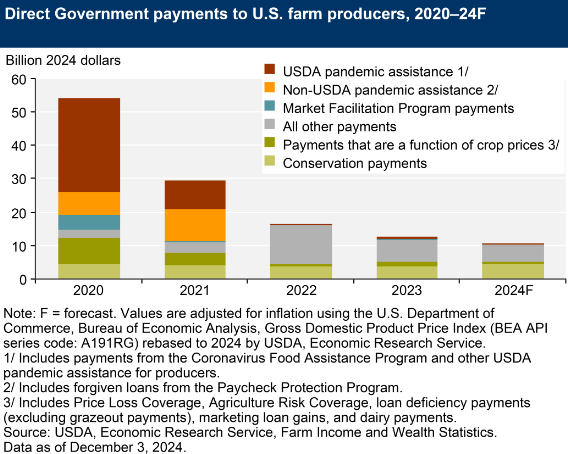 [USDA chart](https://www.ers.usda.gov/data-products/chart-gallery/chart-detail?chartId=82238&ref=investigatemidwest.org) After hearing about Trump’s order, Richard Lyons, a farmer and director of the Illinois Association of Drainage Districts, said he was worried about an already approved $2.3 million low-interest federal loan to replace drainage tiles in Montgomery County. The loan is part of a $307 million USDA grant to modernize rural drinking water and wastewater infrastructure. Drainage tiles are pipes buried under farmland that carry away excess water. First built in the 1890s, many of the tiles in Montgomery County are collapsing, which causes flooding, Lyons said. “My concerns are that Trump has no knowledge, zero knowledge of which is important relating to agriculture, especially agricultural drainage,” Lyons said. Harvel Drainage District No. 2, which includes Montgomery County in west central Illinois, has already spent $140,000 for engineer assessments and attorney filing fees, Lyons said. 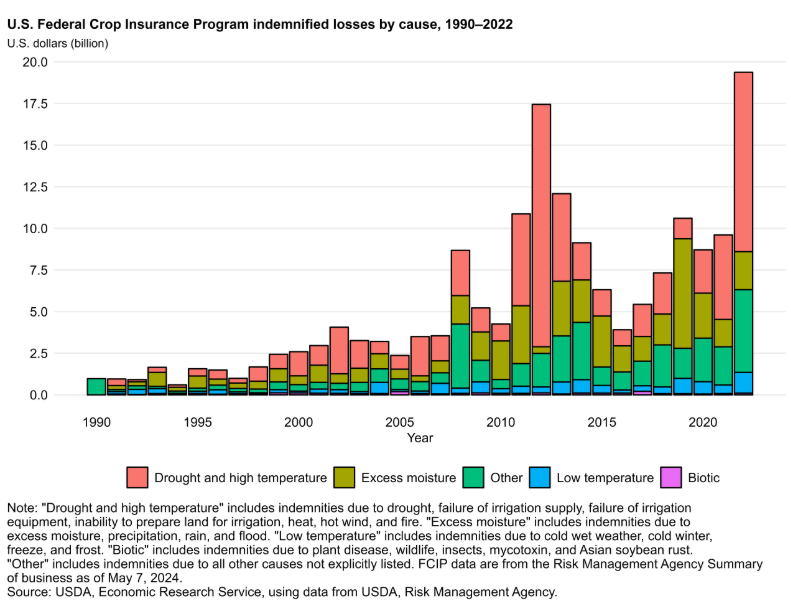 [USDA chart](https://www.ers.usda.gov/data-products/chart-gallery/chart-detail?chartId=106212&ref=investigatemidwest.org#:~:text=Since%202000%2C%20annual%20indemnity%20payments,frequently%20responsible%20for%20large%20indemnities.) With the new system, the drainage district, which serves 20 different farming operations, will be able to monitor whether growers are in compliance with state phosphorus and nitrogen levels. Broken drainage tiles could also lead to a significant reduction in corn yield. “If it comes to the point that we cannot get our loan, we're still going to go ahead and do the project and pay the extra money, because the system needs to, it has to, change,” Lyons said. ## Some lawmakers worry about future IRA funds for farmers Before attempting to freeze federal grants and loans, Trump signed an executive order suspending all Inflation Reduction Act funding disbursements, including the USDA’s Partnerships for Climate-Smart Commodities, a program aimed at supporting sustainable farming practices. The IRA, a cornerstone of former President Joe Biden’s climate policy, allocated $400 billion in funding and tax credits to spur conservation and green energy efforts. At the National Farmers Union’s annual meeting in Peoria on Thursday, Illinois U.S. House Rep. Eric Sorensen, D-Moline, defended IRA funding, saying it has been a positive for farmers and he wants to see them protected. “We need to make sure that we do everything that we can to keep the benefits of the Inflation Reduction Act in the Farm Bill, especially when it comes to conservation, because the other side, they want to gut that. They want to take it out,” Sorensen said. “They don't know enough about farming and how important it is, also how important those decisions are for our kids and our grandkids.” Sorensen, who sits on the House Committee on Agriculture, stated his commitment to passing a new Farm Bill that strengthens crop insurance, supports fair premiums for farmers, expands agricultural export programs, and funds voluntary conservation and smart farming practices. Citing his experience as a meteorologist in Illinois and Texas, Sorensen underscored the importance of a robust crop insurance program in the face of extreme weather events and climate change. “However, the devil is in the details, the new administration is going to give us more pressure to gut critical parts of this Farm Bill,” Sorensen said. “Cutting benefits for those who need help, that's not a way that we reduce waste in our government.” --- ****Citations & References** ****Interviews** Rob Larew, National Farmers Union president, Jan. 28, 2025 Rep. Eric Sorensen (D-Moline), Jan. 28, 2025 Richard Lyons, Illinois Association of Drainage Districts director, Jan 28-29, 2025 News reports [The Inflation Reduction Act: Here’s what’s in it](https://www.mckinsey.com/industries/public-sector/our-insights/the-inflation-reduction-act-heres-whats-in-it?ref=investigatemidwest.org), McKinsey & Company, Oct. 24, 2024 ****Data** [Direct Government payments to U.S. farm producers](https://www.ers.usda.gov/data-products/chart-gallery/chart-detail?chartId=82238&ref=investigatemidwest.org#:~:text=Direct%20payments%20can%20also%20come%20from%20supplemental%20programs%20authorized%20by%20the%20U.S.%20Congress.%20Government%20payments%20do%20not%20include%20Federal%20Crop%20Insurance%20Corporation%20%28FCIC%29%20indemnity%20payments%20%28listed%20as%20a%20separate%20component%20of%20farm%20income%29), 2020–24F, USDA ERS, Dec. 3, 2024 [FCIP indemnities by cause of loss](https://www.ers.usda.gov/data-products/chart-gallery/chart-detail?chartId=106212&ref=investigatemidwest.org#:~:text=Since%202000%2C%20annual%20indemnity%20payments,frequently%20responsible%20for%20large%20indemnities.), USDA ERS, May 20, 2024 Federal government publications [Federal Crop Insurance: A Primer](https://crsreports.congress.gov/product/pdf/R/R46686?ref=investigatemidwest.org), Congressional Research Service, Feb. 18, 2021 [Water and Waste Disposal Loan and Grant Program](https://www.investigatemidwest.org/content/files/www-rd-usda-gov/sites/default/files/wep%5Fnewsreleasechart070621.pdf), USDA, July 7, 2021 [Biden-Harris Administration Invests $307 Million in Rural Water and Wastewater Infrastructure Improvements in 34 States and Puerto Rico](https://www.usda.gov/about-usda/news/press-releases/2021/07/07/biden-harris-administration-invests-307-million-rural-water-and-wastewater-infrastructure?ref=investigatemidwest.org), USDA, July 7, 2021 [USDA Inflation Reduction Act](https://web.archive.org/web/20250117221750/https://www.usda.gov/ira), archived Jan. 17, 2024 Trump administration documents [OMB memo](https://www.documentcloud.org/documents/25507011-omb-memo-on-temporary-pause-of-financial-assistance-programs/?ref=investigatemidwest.org) on temporary pause of financial assistance programs, Jan. 27, 2025 [Unleashing American Energy](https://www.whitehouse.gov/presidential-actions/2025/01/unleashing-american-energy/?ref=investigatemidwest.org)**,* Executive Order, White House, Jan. 20, 2025 ### Trump's moves on ag labor & environmental regs URL: https://www.investigatemidwest.org/trumps-moves-on-ag-labor-environmental-regs/ Last updated: 2026-09-11T03:00:38.000Z Learn more about the president's moves on the agriculture sector during his first days in office. _This post is for subscribers only._ ### Millions of livestock die each year while being transported. Those cases are rarely investigated by the USDA. URL: https://www.investigatemidwest.org/millions-of-livestock-die-each-year-while-being-transported-those-cases-are-rarely-investigated-by-the-usda/ Last updated: 2026-08-28T21:21:00.000Z On Aug. 22, 2024, a semi-trailer truck owned by Demaree Trucking, LLC, was hit by another semi on Interstate 57 in eastern Illinois, causing the truck and its cargo of 67 cows to flip over onto the highway shoulder. Twenty of the cows on board were killed, while another 20 got loose, scattering across the highway and nearby fields, according to records from the Illinois State Police and the Tuscola Fire Department. Several minutes later, one of the stray cows was hit and killed by another truck. A month later, People for the Ethical Treatment of Animals, the animal rights nonprofit, put up a billboard near the site of the wreck. “I’m ME, not meat,” read PETA’s billboard, decrying the carnage and dangerous conditions animals can face while being transported. Law enforcement didn’t find the cattle-carrying truck at fault, but according to police records, the truck that hit it drove away before state police arrived at the scene. The cows killed in the Tuscola incident were just some of the millions of livestock killed in 2024 while being transported. Last year, around 20.3 million animals died — 19.8 million of the deaths were chickens — on the way to a slaughterhouse, according to Investigate Midwest’s analysis of U.S. Department of Agriculture slaughter figures. Beyond accidents, many of the deaths were caused by deadly conditions inside the trailers. USDA records also show more than 800,000 hogs could no longer walk upon arriving at a slaughterhouse. Federal laws require animals to be unloaded at various times for rest and water, but an Investigate Midwest analysis found that the USDA rarely investigates suspected violators. Efforts to strengthen the laws have also been unsuccessful. “Not only do lax federal regulations on farm animal transportation create inhumane and cruel conditions, but these inefficiencies in the law are also causing many animals to succumb to disease and injury during these long journeys, which can be passed on to humans,” said U.S. Rep. Dina Titus, a Nevada Democrat who introduced a bill last year to increase the enforcement of current animal welfare laws.  Overhead views of the footage show one cow making its way through a corn field on Aug. 22, 2024 after a semi-truck hauling animals rolled over on I-57 near Tuscola, Illinois. photo provided by WCIA. The bill was referred to the House Agriculture Subcommittee on Livestock, Dairy, and Poultry in [2024](https://www.congress.gov/bill/118th-congress/house-bill/8699/all-actions?overview=closed&ref=investigatemidwest.org#tabs). No further action has been taken. Animal welfare advocates blame many of the deaths and injuries on a system of weak laws and poor regulatory oversight, especially compared to other Western countries, including Canada and Australia. In some cases, truckers are exempt from drive-time laws if they are hauling livestock. “Part of the reason why animals are treated so poorly is because it’s more economical to do it that way,” said Adrienne Craig, a senior policy associate and staff attorney at the Animal Welfare Institute, a nonprofit advocating for improved travel conditions. The only federal law governing the interstate transportation of livestock is the [Twenty-Eight Hour Law](https://www.nal.usda.gov/animal-health-and-welfare/twenty-eight-hour-law?ref=investigatemidwest.org), which states animals must be unloaded for at least five hours to be fed, watered and rested if the journey takes more than 28 consecutive hours. The Twenty-Eight Hour Law was first enacted in 1873 when rail cars were the primary means of transportation for livestock. Few changes have been made to the law since. The USDA determined in 2006 that the law applied to trucks, but only after [intense pressure](https://www.aasv.org/2006/10/usda-concedes-the-28-hour-law-applies-to-trucks/?ref=investigatemidwest.org) from animal rights organizations. Between 2006 and 2023, the USDA conducted just 19 investigations into possible violations, according to public records obtained and shared by the Animal Welfare Institute. Craig said any sort of distance traveled can have varying effects on animals, especially when there is prolonged food and water deprivation, crowding and extreme temperatures. “The longer the journey, the longer the animals are exposed to stress, which weakens their immune systems,” Craig said. She added that injury rates peak for cattle when the journey exceeds 12 hours. “If you have an animal that can't balance for, you know, 18 hours on a truck and ends up falling, they can be trampled by other animals,” she said.  This photo shows the aftermath of the Tuscola, Illinois crash, which forced lane shutdowns for several hours on Aug. 22, 2024\. ## Just four warnings in recent years over Twenty-Eighty Hour Law violations While it’s rare for the USDA to investigate suspected violators of the Twenty-Eight Hour Law, it’s even rarer for regulators to take action against a found violator. Of the 19 Twenty-Eight Hour Law investigations the USDA conducted over the last 17 years, 12 of those cases were found to have violations. However, just four resulted in an official warning; the rest were either referred to another agency or determined that no action could be taken due to the shipping companies being Canadian, according to the USDA records. Only two USDA agencies investigate violations of the law: Animal and Plant Health Inspection Service Veterinary Services (APHIS VS) and USDA Food Safety and Inspection Service (FSIS). FSIS inspectors are tasked with alerting veterinary services if they suspect a law violation at a slaughterhouse. They are supposed to watch for dehydrated or exhausted animals and ask the establishment manager if the hauler complied with the law. Veterinary Services requires seals for international truck shipments to determine if the animals were unloaded during the journey. Lyndsay Cole, APHIS assistant director of public affairs, declined to answer questions about whether the Twenty-Eight Hour Law is sufficient at protecting animal health. In an emailed statement, Cole said the USDA investigates alleged violations of the law and then gives the findings to the Department of Justice. The Attorney General can seek penalties for violators if it’s determined that a transporter knowingly and willingly violated the law. The Department of Justice declined to answer questions concerning how many violations have occurred and what penalties have been issued. Cole said if the DOJ were to issue a penalty, it would notify the USDA — but when asked how many times the USDA has received such a notification, Cole said that information isn’t tracked. ## Livestock haulers are exempt from some laws The Federal Motor Carrier Safety Administration sets hours of service (HOS) rules that state the maximum amount of time truck drivers are allowed to be on duty and the number and length of rest periods. According to the [regulations](https://www.fmcsa.dot.gov/regulations/hours-service/summary-hours-service-regulations?ref=investigatemidwest.org), property-carrying drivers may drive no more than 11 hours after 10 consecutive hours off duty, and may not drive past the 14th consecutive hour after coming on duty. However, drivers hauling agricultural commodities, including livestock, are exempt from some of the rules. The exemptions include livestock haulers within 150 miles from the source of the livestock, such as a sales barn, and 150 miles from where the livestock is to be delivered. This allows drivers to forgo using an electronic logging device or keep paper logs. Zach Cahalan, executive director of the Truck Safety Coalition, which supports truck crash victims and advocates for truck safety regulations, believes the exemptions increase driver fatigue. “What we see is, ‘How can we short circuit the system to transport goods as cheaply as possible, and then foist the cost for that on state-level government, on victims of crashes; really anyone but us, so that more people get to buy goods cheaply, and we make more money?’ ” Cahalan said.  Overhead views of the footage show a person riding a horse after tracking it down on Aug. 22, 2024 after a semi-truck hauling animals rolled over on I-57 near Tuscola, Illinois. photo provided by WCIA. Cahalan believes that hours of service exemptions result from industry pressure to keep shipping costs as low as possible. “One in five (trucks), statistically, should be placed out of service, meaning it’s unsafe to be on the road,” he said, [citing national roadside inspection data](https://www.truckinginfo.com/10227773/whats-happening-with-fmcsa-proposed-rules-not-much-till-2025?ref=investigatemidwest.org). Jon Samson, executive director of the agricultural and food transporters conference at the American Trucking Associations, the largest national trade association for the trucking industry, said he supports the current hours of service exemptions. “The reason that got put in place is because agriculture revolves around inclement weather,” Samson said. “Say a storm was coming in; sometimes it was necessary to run more hours than the current hours of service regulations allowed to get more products out of the field,” Samson said. Samson also believes the exemption prevents some animal loss by getting animals to their destination quicker and maximizing production. “We need to continue to grow as much food as efficiently as we can in order to make sure that everybody continues to be fed,” Samson said. ## Animal welfare advocates point to Europe, Canada transportation laws In their push for stricter transportation laws, many animal welfare advocates point to the European Union, Canada and Australia as examples to follow. Craig, with the Animal Welfare Institute, said the European Food Safety Authority based its recommended animal transportation standards on scientific studies. The authority [recommended](https://www.investigatemidwest.org/content/files/food-ec-europa-eu/system/files/2023-12/aw%5Fin-transit%5Freg-proposal%5F2023-770%5F0.pdf) a limit of nine hours for animals being sent directly to slaughter, a 21-hour limit for animals not being sent to slaughter, and an eight-hour limit for unweaned calves, lambs, kids, piglets, and foals. If the mode of transport is equipped with a feeding system, the maximum is nine hours. Craig said decreasing the maximum transport time for vulnerable animals, such as neonates, animals under four weeks old, or weak or sick animals, should be a priority. “What would be even better, though, is comprehensive legislation that dealt with all aspects of transport, rather than just duration,” she said. In the European Union, livestock transportation vehicles are [required](https://eur-lex.europa.eu/legal-content/EN/TXT/HTML/?uri=CELEX:32005R0001&from=en&ref=investigatemidwest.org) to have ventilation systems and a continuous supply of fresh water. Resting and feeding periods are determined by the animal’s age and species rather than a universal standard, like in the U.S. The EU also has stocking density regulations for animal shipments, which prevent animals from being too tightly packed into a trailer. Canada has comprehensive humane animal transport regulations that are backed by “science-informed requirements,” according to a 2022 [National Institutes of Health article](https://pmc.ncbi.nlm.nih.gov/articles/PMC9282547/?ref=investigatemidwest.org#:~:text=Animals%20must%20be%20transported%20in,sustain%20an%20injury%2C%20or%20die.) on the country’s regulations. Canada’s regulations include a required contingency plan to reduce avoidable animal suffering and restrictions on overcrowding. Craig said she wants the U.S. to adopt fitness regulations so that animals can be evaluated for how healthy they are before they’re hauled. “Beyond the distance that animals have to travel, one of the factors that is important in whether or not they're going to make it to their destination is what conditions they are in when they're put on the truck,” Craig said. --- ****Citations & References** ****Interviews and statements** [Dina Titus](https://titus.house.gov/news/documentsingle.aspx?DocumentID=3634&ref=investigatemidwest.org), June 11, 2024 Zach Cahalan, Oct. 21, 2024 Adrienne Craig, Oct. 29, 2024 Lyndsay Cole, Nov. 26, 2024 Jon Samson, Dec. 12, 2024 ****Documents and reports** "[PETA Memorial Rises to Honor Cows Killed in Truck Crash](https://www.peta.org/media/news-releases/update-peta-memorial-rises-to-honor-cows-killed-in-truck-crash/?ref=investigatemidwest.org)," PETA, Sept. 25, 2024 "[Twenty-Eight Hour Law](https://www.nal.usda.gov/animal-health-and-welfare/twenty-eight-hour-law?ref=investigatemidwest.org)", USDA "[USDA Concedes the 28-Hour Law Applies to Trucks](https://www.aasv.org/2006/10/usda-concedes-the-28-hour-law-applies-to-trucks/?ref=investigatemidwest.org)", Assocation of Swine Veterinarians, Oct. 4, 2006 "[A Review: The Twenty-Eight Hour Law and Its Enforcement](https://awionline.org/sites/default/files/uploads/documents/20TwentyEightHourLawReport.pdf?ref=investigatemidwest.org)," Animal Welfare Institute, April 2016 "[Summary of Hours of Service Regulations](https://www.fmcsa.dot.gov/regulations/hours-service/summary-hours-service-regulations?ref=investigatemidwest.org)," Federal Motor Carrier Safety Administration "[Hours of Service](https://www.fmcsa.dot.gov/regulations/hours-of-service?ref=investigatemidwest.org)," FMCSA "[ELD Hours of Service (HOS) and Agriculture Exemptions](https://www.fmcsa.dot.gov/hours-service/elds/eld-hours-service-hos-and-agriculture-exemptions?ref=investigatemidwest.org)," FMCSA "[What's Happening With FMCSA Proposed Rules? Not Much Before 2025](https://www.truckinginfo.com/10227773/whats-happening-with-fmcsa-proposed-rules-not-much-till-2025?ref=investigatemidwest.org)," Heavy Duty Trucking, Sept. 5, 2024 [Regulation of the European Parliament and of the Council](https://www.investigatemidwest.org/content/files/food-ec-europa-eu/system/files/2023-12/aw%5Fin-transit%5Freg-proposal%5F2023-770%5F0.pdf), European Commission, July 12, 2023 [Council Regulation on the Protection of Animals During Transport](https://eur-lex.europa.eu/legal-content/EN/TXT/HTML/?uri=CELEX:32005R0001&from=en&ref=investigatemidwest.org), Official Journal of the European Union, Dec. 22, 2004 "[Canada's animal transport regulations and the veterinarian's role](https://pmc.ncbi.nlm.nih.gov/articles/PMC9282547/?ref=investigatemidwest.org#:~:text=Animals%20must%20be%20transported%20in,sustain%20an%20injury%2C%20or%20die.)," National Institutes of Health, August 2022 "[Protection of Animals During Transport](https://www.europarl.europa.eu/RegData/etudes/BRIE/2021/690702/EPRS%5FBRI%282021%29690702%5FEN.pdf?ref=investigatemidwest.org)," European Parliamentary Research Service, June 2021 "[Land transport of livestock standards and guidelines,](https://agriculture.vic.gov.au/livestock-and-animals/animal-welfare-victoria/livestock-management-and-welfare/land-transport-of-livestock-standards-and-guidelines?ref=investigatemidwest.org)" Agriculture Victoria ****Data** [Poultry Slaughter 2023 Summary](https://www.investigatemidwest.org/content/files/downloads-usda-library-cornell-edu/usda-esmis/files/pg15bd88s/q524m975v/zs25zx570/pslaan24.pdf), USDA, February 2024 [Livestock Slaughter 2023 Summary](https://www.investigatemidwest.org/content/files/downloads-usda-library-cornell-edu/usda-esmis/files/r207tp32d/wh248d422/p5549g65c/lsan0424.pdf), USDA, April 2024 [Transport losses in market weight pigs: II. U.S. incidence and economic impact](https://academic.oup.com/tas/article/4/2/1103/5815548?ref=investigatemidwest.org), Translational Animal Science, April 2, 2020 [Reasons or whole carcass condemnations of cattle in the United States and implications for producer education and veterinary intervention](https://www.researchgate.net/publication/38010462%5FReasons%5For%5Fwhole%5Fcarcass%5Fcondemnations%5Fof%5Fcattle%5Fin%5Fthe%5FUnited%5FStates%5Fand%5Fimplications%5Ffor%5Fproducer%5Feducation%5Fand%5Fveterinary%5Fintervention?ref=investigatemidwest.org), Journal of the American Veterinary Medical Association, October 2009 "[The Large Truck Crash Causation Study - Analysis Brief,](https://www.fmcsa.dot.gov/safety/research-and-analysis/large-truck-crash-causation-study-analysis-brief?ref=investigatemidwest.org)" FMCSA, July 2007 ### Farm households will see more tax liability when Trump tax cuts expire URL: https://www.investigatemidwest.org/farm-households-will-see-more-tax-liability-when-trump-tax-cuts-expire/ Last updated: 2026-08-28T21:21:01.000Z One of President Donald Trump’s first-term achievements was a major tax cut, which he signed into law in 2017\. The Tax Cuts and Jobs Act largely benefited the wealthiest families in the U.S. But farm households also saw their tax rates decrease. That means many farms will see their tax liability increase when the tax cuts expire at the end of the year, according to [U.S. Department of Agriculture research](https://www.ers.usda.gov/amber-waves/2024/march/farm-households-face-larger-tax-liabilities-when-provisions-of-the-tax-cuts-and-jobs-act-of-2017-expire?ref=investigatemidwest.org). Congress could extend the tax cuts through legislation, and Trump has said he wants more changes to the tax code. If the tax cuts do expire, which is scheduled for midnight on Dec. 31, 2025, farm households of varying sizes would be affected in different ways. [ ](https://public.flourish.studio/story/2834102/?utm%5Fsource=embed&utm%5Fcampaign=story/2834102) ## Child tax credit For instance, fewer farm households would receive the Child Tax Credit. The 2017 law temporarily increased this credit and raised the income threshold for eligibility. Under the current law, about 36% of all farm households are eligible for the tax credit. When the law sunsets, about 27% of farm households will be, according to USDA research. The tax credit amount will also decrease. Currently, farm households have an average credit of about $3,800\. Unless Congress acts, it could be about $1,300. ## Qualified business income deduction Another 2017 tax cut that farmers were eligible for was the qualified business income deduction. It is for businesses that are not organized as C-corporations, which [allows](https://www.investopedia.com/terms/c/c-corporation.asp?ref=investigatemidwest.org) owners and shareholders to separate their tax liability from that of the corporation (such as publicly traded corporations). The new deduction was intended to “provide parity with C-corporations” for farms and other businesses, according to the USDA. Almost half of farm households receive the deduction. If the deduction is eliminated, the farms’ average tax bill would increase by 9%, or about $2,500. ## Estate tax Another part of the tax cut that could sunset is the provision related to the estate tax, which applies to the transfer of property after a relative dies. The tax only affects the wealthiest families in the U.S. and has become a persistent target of Republicans, who have labeled it the “death tax.” Though implemented in 1916, the estate tax has “never directly affected a large percentage of farmers,” USDA researchers wrote. USDA researchers estimate that, currently, just 0.3% of all farm households would be eligible to pay the estate tax. If this part of the 2017 tax cut expires, though, 1% of all farm households would be eligible. This mostly affects the largest U.S. farms, which generate more than $1 million in annual gross income. --- ****Citations & References** ****Government publications** “[Farm Households Face Larger Tax Liabilities When Provisions of the Tax Cuts and Jobs Act of 2017 Expire](https://www.ers.usda.gov/amber-waves/2024/march/farm-households-face-larger-tax-liabilities-when-provisions-of-the-tax-cuts-and-jobs-act-of-2017-expire?ref=investigatemidwest.org),” Amber Waves (U.S. Department of Agriculture’s Economic Research Service publication), March 6, 2024 “[Reference Table: Expiring Provisions in the ‘Tax Cuts and Jobs Act’ (TCJA, P.L. 115-97)](https://crsreports.congress.gov/product/pdf/R/R47846?ref=investigatemidwest.org),” Congressional Research Service, Nov. 13, 2024 “[Forming a corporation](https://www.irs.gov/businesses/small-businesses-self-employed/forming-a-corporation?ref=investigatemidwest.org),” Internal Revenue Service, undated ****News stories** “[House Republicans reintroduce bill to repeal ‘death tax,’](https://www.cnbc.com/2024/01/19/house-republicans-reintroduce-bill-to-repeal-death-tax.html?ref=investigatemidwest.org)” CNBC, Jan. 19, 2024 “[Trump-era tax cuts set to expire after 2025 — here’s what you need to know](https://www.cnbc.com/2024/05/18/trump-tcja-tax-cuts-are-slated-to-expire-after-next-year.html?ref=investigatemidwest.org),” CNBC, May 18, 2024 “[Trump floats ending the federal income tax. Here’s what that would mean](https://www.cnn.com/2024/10/26/politics/trump-income-taxes-tariffs/index.html?ref=investigatemidwest.org),” CNN Politics, Oct. 27, 2024 “[Looking at Tax Debate and Farmers](https://www.dtnpf.com/agriculture/web/ag/livestock/article/2024/12/13/income-deductions-estate-tax-cost?ref=investigatemidwest.org),” Progressive Farmer/DTN, Dec. 16, 2024 “[Trump’s Agenda: Taxes](https://www.factcheck.org/2024/12/trumps-agenda-taxes/?ref=investigatemidwest.org),” FactCheck.org, Dec. 20, 2024 ****Other** “[What Is a C Corp? Definition, Pros & Cons, and Taxes](https://www.investopedia.com/terms/c/c-corporation.asp?ref=investigatemidwest.org),” Investopedia, April 22, 2024 “[The 2017 Trump Tax Law Was Skewed to the Rich, Expensive, and Failed to Deliver on Its Promises](https://www.cbpp.org/research/federal-tax/the-2017-trump-tax-law-was-skewed-to-the-rich-expensive-and-failed-to-deliver?ref=investigatemidwest.org),” Center on Budget and Policy Priorities, June 13, 2024 ### Iowa immigrants fear the Trump administration's move toward mass deportation URL: https://www.investigatemidwest.org/iowa-immigrants-fear-the-trump-administrations-move-toward-mass-deportation/ Last updated: 2026-09-23T18:11:43.000Z President Donald Trump's pledge to enact mass deportations has spread fear and panic across Iowa’s immigrant communities, especially in parts of the state where immigrants are a large part of the agriculture and meatpacking workforce. Community organizations and religious leaders have been inundated with frantic phone calls as warnings spread over social media. Some posts claimed without evidence that Immigration and Customs Enforcement, ICE, officers were actively patrolling Latino neighborhoods across the state, conducting operations to capture undocumented individuals. “I want to convey a clear message to everyone listening, no matter where you are — remain calm,” said Father Nils Hernandez, from the Queen of Peace Parish, in Waterloo, during a Facebook Live session organized by the community media outlet [El Trueque](https://www.facebook.com/people/Manny-Galvez/100039502340179/?locale=es%5FLA) on Tuesday night. The session aimed to counter the misinformation circulating among the immigrant community. Trump officials have said raids should be expected in large Democratic-controlled cities, including New York City, Chicago and Denver. But there’s also concern in many of America’s rural communities, especially as some Republican governors have pledged to help the Trump administration with its deportation efforts. Iowa, with a population of more than [3 million people](https://www.census.gov/quickfacts/fact/table/IA/PST045224?ref=investigatemidwest.org), is home to approximately 52,300 undocumented immigrants, according to 2022 estimates by the[ American Immigration Council](https://map.americanimmigrationcouncil.org/locations/iowa/?ref=investigatemidwest.org). Many undocumented residents work in the state’s agricultural industry — one of its most vital economic sectors. “Here in Iowa, the immigrant community plays a very important role in agriculture, construction and service sector health care,” said Joe Henry, state political director of the League of United Latin American Citizens. Iowa Gov. Kim Reynolds, a Republican, has also directed state law enforcement to assist the federal government in its anticipated campaign to deport undocumented immigrants. In a [memo](https://x.com/IAGovernor/status/1880280414302192103?ref=investigatemidwest.org) to state law enforcement agencies, Reynolds instructed them to comply with the Department of Homeland Security's detainer requests and ensure the transfer of individuals to immigration authorities. The directive also mandates notifying Immigration and Customs Enforcement when individuals are scheduled for release from criminal custody and holding them until they can be transferred to federal authorities. > Today, I sent a memo to [@IowaDPS](https://twitter.com/IowaDPS?ref%5Fsrc=twsrc%5Etfw&ref=investigatemidwest.org) Commissioner Bayens and [@IowaCorrections](https://twitter.com/IowaCorrections?ref%5Fsrc=twsrc%5Etfw&ref=investigatemidwest.org) Director Skinner to ensure they are prepared on Day 1 of the [@realDonaldTrump](https://twitter.com/realDonaldTrump?ref%5Fsrc=twsrc%5Etfw&ref=investigatemidwest.org) administration to support his enforcement of our immigration laws and keep our communities safe. [pic.twitter.com/PakQYjRtr3](https://t.co/PakQYjRtr3?ref=investigatemidwest.org) > > — Gov. Kim Reynolds (@IAGovernor) [January 17, 2025](https://twitter.com/IAGovernor/status/1880280414302192103?ref%5Fsrc=twsrc%5Etfw&ref=investigatemidwest.org) “Let’s Make America Safe Again!” Reynolds wrote in a [social media post accompanying](https://www.facebook.com/KimReynoldsIA/posts/pfbid0GLMhoGXUPkWUNzJNxGQSMmiLHcj4jgDU2xrWJaS7PB2xc1NhDWJsrokVCNMWXRvnl) the announcement, signaling her support for the incoming administration’s hardline immigration policies. This is not the first action against undocumented immigrants in the state. Last year, Reynolds [approved a law](https://www.legis.iowa.gov/legislation/BillBook?ga=90&ba=SF2340&ref=investigatemidwest.org) that criminalizes entering the state after being deported or denied entry into the United States. The law also grants state law enforcement the authority to arrest individuals who violate this provision. It was temporarily blocked by a federal judge. ## Trump's swift action Iowa averaged 919 immigration-related arrests per year during Trump’s first term, according to data from Syracuse University's Transactional Records Access Clearinghouse or TRAC, which tracks immigration enforcement across the United States. It was lower than the 1,575 average during President Barack Obama’s first term. One of the most significant immigration raids in U.S. history occurred in Iowa in 2008 during the \*George W. Bush administration, when [389 immigrant workers](https://www.univision.com/especial/noticias/redadas/eng/389-arrests-that-changed-a-town/index.html?ref=investigatemidwest.org) were arrested at the Agriprocessors meatpacking plant in Postville. At the time, it was the largest raid of its kind, leaving a profound and lasting impact on the local community, as families were torn apart and the local economy suffered severe disruptions. Arrests dropped to a 787 annual average during Obama’s second term before increasing again under Trump. But many who work in the immigrant community say there is fear Trump’s second term will be even more focused on deportations. “People are afraid, people are nervous, people don’t want to go to work,” said Ninoska Campos, a member of Escucha Mi Voz Iowa, an Iowa city organization that works with immigrants and refugees. “This was not the experience during his first term. There was always fear, but there wasn't as much threat.” On his first day back in office, Trump signed several executive actions targeting the undocumented population, including [granting federal authorities](https://www.theguardian.com/us-news/2025/jan/21/trump-ice-churches-schools-hospitals-sensitive-areas?ref=investigatemidwest.org) the power to detain individuals in or near schools and churches. Trump also attempted to restrict automatic birthright citizenship in the United States, but this latest executive order was[ blocked by a federal judge](https://www.nytimes.com/2025/01/23/us/politics/judge-blocks-birthright-citizenship.html?ref=investigatemidwest.org) on Thursday. Nationwide, an estimated [42% of farm workers](https://www.investigatemidwest.org/graphic-as-trump-policy-changes-loom-nearly-half-of-farmworkers-lack-legal-status/) were undocumented in 2022, according to the U.S. Department of Agriculture’s Economic Research Service. Mass deportation could lead to a 10% increase in food prices, according to a September [study](https://www.investigatemidwest.org/content/files/www-piie-com/sites/default/files/2024-09/wp24-20.pdf) from the Peterson Institute for International Economics, a nonpartisan think tank based in Washington, D.C. “If we lost half of the farmworker population in a short period of time, the agriculture sector would likely collapse,” Mary Jo Dudley, the director of the Cornell Farmworker Program, [told Investigate Midwest](https://www.investigatemidwest.org/deportations-raids-visa-election-immigrant-farmworkers/). “There are no available skilled workers to replace the current workforce should this policy be put into place.” --- ****Corrections** \*An early version of this story mistakenly reported that a 2008 immigration raid took place during the Obama administration. ****Citations & References** ****Interviews/statements** Joe Henry, state political director of the League of United Latin American Citizens, June 30, 2024 Manny Galvez, journalist El Trueque, Jan. 21, 2025 Maria Gonzalez, a community organizer with the Iowa Migrant Justice Movement, Jan. 22, 2025 Ninoska Campos, member of Escucha Mi Voz Iowa, Jan. 21, 2025 Father Nils Hernandez, Queen of Peace Parish, Jan. 21-23, 2025 ****Data** Syracuse University's Transactional Records Access Clearinghouse ([TRAC](https://tracfed.syr.edu/?ref=investigatemidwest.org) ### Trump ag secretary nominee says food issues from mass deportations are ‘hypothetical’ URL: https://www.investigatemidwest.org/trump-ag-secretary-nominee-says-food-issues-from-mass-deportations-are-hypothetical/ Last updated: 2026-09-23T18:11:42.000Z Farmers have [begun raising concerns](https://www.bloomberg.com/news/features/2025-01-17/will-trump-remove-illegal-immigrants-farmers-say-deportations-raise-food-prices?ref=investigatemidwest.org) about the potential impact of President Donald Trump’s mass deportations on their operations, but the president’s nominee for agriculture secretary, Brooke Rollins, said any issues stemming from a lost labor force are “hypothetical.” If farms are affected by mass deportations, she and other administration officials would “hopefully solve some of these problems,” Rollins said during her nomination hearing in front of the U.S. Senate Committee on Agriculture, Nutrition and Forestry Thursday. When a senator remarked he hoped the issues caused by mass deportations were hypothetical, Rollins said, “I do, too.” These comments stand in contrast with those of other Trump policy officials regarding mass deportations. In an [interview with The New York Times](https://www.nytimes.com/2023/11/11/us/politics/trump-2025-immigration-agenda.html?ref=investigatemidwest.org) in 2023, Stephen Miller, now a deputy chief of staff in the White House, said the deportations would have a major impact: “Mass deportation will be a labor-market disruption celebrated by American workers.” Before Trump was elected, experts and farmworker rights advocates said mass deportations could lead to the agriculture industry’s [collapse](https://www.investigatemidwest.org/deportations-raids-visa-election-immigrant-farmworkers/). Nationwide, an estimated [42% of farm workers](https://www.investigatemidwest.org/graphic-as-trump-policy-changes-loom-nearly-half-of-farmworkers-lack-legal-status/) were undocumented in 2022, according to the U.S. Department of Agriculture’s Economic Research Service. Given how long farms have relied on undocumented labor, no other workforce currently exists that could replace unauthorized workers. Rollins said Trump would not forget about farmers’ needs when implementing his deportation plans. While she agreed with the policies, she said she would listen to farmers and act accordingly, likely by augmenting the H-2A program, which brings foreign workers into the U.S. temporarily to pick crops. The program is run by the U.S. Department of Labor. “The president’s vision of a secure border and mass deportation at a scale that matters is something I support,” Rollins said during Thursday’s hearing. “You may argue that is in conflict” with my duties to support agriculture, she added, but, “having both of those as key priorities, my job is to work with the secretary of labor on the H-2A program.” The H-2A program is rife with well-documented abuse and wage theft. There have already been [warnings](https://www.investigatemidwest.org/us-could-rely-more-on-foreign-ag-workers-under-trump-high-demand-is-already-straining-the-government/) that increased use of the program could overwhelm the government and negatively impact workers’ rights. Rollins was also asked if she thought deporting farmworkers could increase food prices, as Trump campaigned on the high cost of groceries. She again said that was a hypothetical issue. While food prices have [outstripped](https://www.investigatemidwest.org/graphic-u-s-consumers-spent-more-on-food-in-2022-than-ever-before/) the rate of inflation in recent years, one reason food has remained [relatively affordable in the U.S.](https://www.fastcompany.com/91208387/food-grocery-prices-us-world-comparison?ref=investigatemidwest.org) is because farm labor can be cheap. In the Times interview, Miller said Americans would replace the deported workers and “be offered higher wages with better benefits to fill these jobs.” [ ](https://public.flourish.studio/visualisation/16636447/?utm%5Fsource=embed&utm%5Fcampaign=visualisation/16636447) Rollins and Republican senators on the Senate’s agriculture committee emphasized her rural roots and her time in 4H, but Rollins does not have extensive experience in the agriculture industry. Multiple times, she told senators that she looked forward to learning more about an issue they asked about, including the increase in bird flu among poultry and livestock. She repeatedly said Thursday she would rely on data to help drive decision-making. But, when discussing undocumented labor on farms, she said no one knew how many people might be affected by Trump’s mass deportations. “We don’t know, first of all, who ‘they’ are,” Rollins said, putting air quotes around “they.” “We all throw numbers around. 40%, 50%, 60%. The answer is we just don’t know.” While the exact figure may not be known, the U.S. Department of Labor publishes a survey with well-regarded and oft-cited data on the number of undocumented farmworkers. According to the survey, about 40% of America’s 2 million farmworkers are not authorized to work in the country. ### Join us to fuel our investigative journalism. Donation Amount $10 $25 $50 $75 $100 ``` ``` Several agricultural industries rely on undocumented labor. For instance, dairy farms are not eligible for H-2A visa labor — often trumpeted as a labor solution — and often do not ask about employees’ statuses. The meatpacking industry, subjected to immigration raids under the first Trump administration, also uses undocumented labor. One of the largest meatpacking companies in the country, Tyson Foods, told Investigate Midwest it would not be affected by any mass deportations, however. “Tyson Foods is strongly opposed to illegal immigration, and we fully participate with the federal government’s E-Verify and IMAGE programs,” a Tyson Foods spokesperson said. “We employ 120,000 team members in the United States, all of whom are required to be legally authorized to work in this country and any enforcement against undocumented workers would not have an impact on our company.” Near the end of Rollins’ nomination hearing, Sen. Adam Schiff, a California Democrat, asked Rollins how farms would replace their workforce if mass deportation plans materialized. “Americans don’t want to do that work,” he said. “It’s frankly too backbreaking, so who is going to work the farms?” Rollins responded by saying, “President Trump ran and was overwhelmingly elected on the priority of border security and mass deportation.” Trump’s margin of victory in November was the fourth-smallest since 1960, at 1.62%, [according to PBS](https://www.pbs.org/newshour/politics/the-size-of-donald-trumps-2024-election-victory-explained-in-5-charts?ref=investigatemidwest.org). “The American people have asked for a secure border and a system where they do not have to be concerned with the millions and millions that crossed here illegally and brought a lot of strife and unsafe communities to America.” She added there might need to be changes made to the H-2A program to address a lost workforce. “I will work around the clock with our new labor secretary, if she’s confirmed,” she said. Then, Schiff asked, “If they’re gone, who’s going to do that work?” [Send Us a Secure Tip](https://investigatemidwest.org/send-us-a-secure-tip/?ref=investigatemidwest.org) “As these processes and programs are being implemented under this new administration and with the full support of the majority of Americans,” Rollins replied. “I think that we — as the leaders in agriculture, myself as the leader at USDA, you on this committee as well as others on the committee — that we will work together to understand and hopefully solve some of these problems. “The dairy cattle have to be milked,” she added, “but if we have a mass deportation program underway, then there is a lot of work that we need to do through the labor department and working with Congress to solve for a lot of this through our current labor programs that are already on the books.” Schiff then asked about food prices. “If we deport a large percentage of our farm workforce, farm labor is going to be scarce,” he said. “Isn’t that inevitably going to push up food prices? And if so, isn’t that in sharp contrast with what the president said he wanted to do to bring down egg prices and food prices?” “First of all, we’re speaking in hypotheticals,” Rollins said. “But, certainly, these are hypotheticals that we do need to be thinking through. It’s a very fair point. The president has made food inflation and the cost of food one of his top priorities. I have worked alongside him and have been part of his team for many years now. I believe in his vision and his commitment to America and to his promises, and in so doing, we will be able to find in our toolkit what we need to do to solve for any hypothetical issues that turn out to be real moving forward over the coming months and years.” “I hope they’re hypothetical,” Schiff responded. “I do, too,” Rollins said. “I fear they’re all too real,” Schiff said. --- ****Citations & References** ****Government publications** “[Farm Labor](https://www.ers.usda.gov/topics/farm-economy/farm-labor?ref=investigatemidwest.org#demographic),” U.S. Department of Labor’s Economic Research Service, updated Jan. 8, 2025 ****News stories** “[Sweeping Raids, Giant Camps and Mass Deportations: Inside Trump’s 2025 Immigration Plans](https://www.nytimes.com/2023/11/11/us/politics/trump-2025-immigration-agenda.html?ref=investigatemidwest.org),” The New York Times, Nov. 11, 2023 “[GRAPHIC: U.S. consumers spent more on food in 2022 than ever before](https://investigate-midwest.ghost.io/graphic-u-s-consumers-spent-more-on-food-in-2022-than-ever-before/?ref=investigatemidwest.org),” Investigate Midwest, Feb. 1, 2024 “[Deportations, raids and visa access. How the presidential election could alter life for immigrant farmworkers.](https://investigate-midwest.ghost.io/deportations-raids-visa-election-immigrant-farmworkers/?ref=investigatemidwest.org)” Investigate Midwest, Sept. 11, 2024 “[How food prices in the U.S. compare to rest of the world](https://www.fastcompany.com/91208387/food-grocery-prices-us-world-comparison?ref=investigatemidwest.org),” Fast Company, Oct. 12, 2024 “[Stephen Miller will be Trump's homeland security advisor in new White House role](https://www.npr.org/2024/11/11/g-s1-33741/trump-stephen-miller-deputy-chief-of-staff-immigration-policy-deportations?ref=investigatemidwest.org),” NPR, Nov. 13, 2024 “[US could rely more on foreign ag workers under Trump. High demand is already straining the government.](https://investigate-midwest.ghost.io/us-could-rely-more-on-foreign-ag-workers-under-trump-high-demand-is-already-straining-the-government/?ref=investigatemidwest.org)” Investigate Midwest, Nov. 15, 2024 “[The size of Donald Trump’s 2024 election victory, explained in 5 charts](https://www.bloomberg.com/news/features/2025-01-17/will-trump-remove-illegal-immigrants-farmers-say-deportations-raise-food-prices?ref=investigatemidwest.org),” PBS News, Nov. 24, 2024 “[A Trump-Voting Farmer's Warning: Mass Deportations Would Be a Disaster](https://www.bloomberg.com/news/features/2025-01-17/will-trump-remove-illegal-immigrants-farmers-say-deportations-raise-food-prices?ref=investigatemidwest.org),” Bloomberg, Jan. 17, 2025 “[WATCH: Brooke Rollins testifies at Senate confirmation hearing for agriculture secretary](https://www.pbs.org/newshour/politics/watch-live-brooke-rollins-testifies-at-senate-confirmation-hearing-for-agriculture-secretary?ref=investigatemidwest.org),” PBS News, Jan. 23, 2025 ### With Lee Zeldin tapped to head EPA, President Trump sets the stage for regulatory rollbacks URL: https://www.investigatemidwest.org/with-lee-zeldin-tapped-to-head-epa-president-trump-sets-the-stage-for-regulatory-rollbacks/ Last updated: 2026-09-23T18:11:39.000Z Lee Zeldin, President Donald Trump's pick to lead the Environmental Protection Agency, is poised to spearhead a sweeping rollback of regulations related to meatpacking plant pollution, fertilizer chemicals and a wide range of other agriculture-related environmental standards. In selecting Zeldin, a former New York congressman, Trump has echoed the deregulation priorities of his first term, setting the stage for potential legal clashes between agriculture industry groups and environmental advocates. "Day one, and the first 100 days, we have the opportunity to roll back regulations that are forcing businesses to … struggle," said Zeldin in an [interview with Fox News](https://www.foxnews.com/video/6364562435112?ref=investigatemidwest.org), the day Trump announced his nomination in November. "President Trump, when he called me up — gosh, he was rattling off 15, 20 different priorities with clear focus." Zeldin built his political career representing a Long Island state house district before moving to Congress in 2015\. He was one of the first Republicans to endorse Trump during the 2016 campaign, joined the president’s impeachment defense team and amplified doubts about the legitimacy of the 2020 election. As EPA administrator, many environmentalists expect Zeldin to carry on with Trump’s first-term efforts to significantly dismantle environmental regulations. Zeldin "will gladly take a sledgehammer to EPA's most recent lifesaving regulations, putting politics over science and endangering our communities,” said Abigail Dillen, president of Earthjustice, an environmental law organization. The organization actively opposed Trump’s environmental policy decisions during his first term, filing more than [130 lawsuits](https://earthjustice.org/feature/inside-trump-administration-public-health-environment?ref=investigatemidwest.org) to uphold existing health and environmental safeguards. During his first term, Trump rolled back more than 100 environmental rules, according to a [New York Times](https://www.nytimes.com/interactive/2020/climate/trump-environment-rollbacks-list.html?ref=investigatemidwest.org) analysis. Among them was the narrowing of pesticide application buffer zones intended to protect farmworkers and bystanders from accidental exposure. Trump’s EPA also rejected a proposed ban on chlorpyrifos, a pesticide linked to developmental disabilities in children. Trump also rolled back the requirement for concentrated animal feeding operations, or CAFOs, to report emissions of ammonia and hydrogen sulfide, a move that marked a major setback in air quality monitoring. The Biden administration pushed forward with stronger environmental regulations, including proposed updates to the[ Effluent Limitation Guidelines (ELGs)](https://www.federalregister.gov/documents/2024/01/23/2023-28498/clean-water-act-effluent-limitations-guidelines-and-standards-for-the-meat-and-poultry-products?ref=investigatemidwest.org) for meat and poultry processing facilities. Designed to strengthen wastewater discharge standards for meatpacking plants, the proposed rules met strong resistance from industry groups. The Meat Institute, the American Farm Bureau Federation, the National Chicken Council, and the National Pork Producers Council [argued that the proposed rules](https://www.meatinstitute.org/press/meat-and-poultry-coalition-epa-wastewater-guidelines-true-cost-over-1-billion-and-over-100000?ref=investigatemidwest.org) could cost meatpackers hundreds of millions of dollars, leading to the closure of numerous processing plants. ## A closer look at water protection laws Stacy Woods, research director for the Food and Environment Program at the Union of Concerned Scientists, said Trump’s first term significantly altered the Clean Water Act and the Clean Air Act, allowing large agriculture corporations to pollute more freely. She expects more of the same during his second term. "While it is hard to predict what exact requirements will be repealed in the coming months and years, any changes made to rules governing air, water, and toxic chemicals discharged from industries will likely weaken reporting requirements, monitoring limits and allow big industries to pollute with impunity," Woods said in an email. Omanjana Goswami, a scientist who also is part of the Food and Environment Program, said large companies often view pollution fines as just another cost of doing business, leveraging their market share to absorb penalties with minimal impact. She referenced a report published by the [Union of Concerned Scientists](https://www.ucsusa.org/resources/waste-deep?ref=investigatemidwest.org) in April, which found that Tyson Foods — the nation's largest meat and poultry producer — discharged hundreds of millions of pounds of pollutants from its slaughterhouses and processing plants into local waterways across the U.S. between 2018 and 2022. “Weakening or rolling back rulemaking and investments made to increase competition in the agribusiness sector will reinforce corporate industrial agriculture’s power to pollute,” Goswami said. Over the years, farmers and ranchers have experienced numerous changes in U.S. water regulations. In 2023, the [U.S. Supreme Court](https://supreme.justia.com/cases/federal/us/598/21-454/?ref=investigatemidwest.org) limited the bodies of water the EPA could regulate. Although Biden's EPA issued a rule amending the law to comply with the ruling, many loopholes remain. The administration’s expansion of federal protections for small streams and wetlands has faced opposition from [many farmers who see it as government overreach](https://www.fb.org/issue/regulatory-reform/waters-of-the-united-states?ref=investigatemidwest.org) into private land management. During his Senate confirmation hearing last week, Zeldin said he felt it was important for the EPA to provide "clean, clear and durable guidance” regarding the waters of the U.S.. "It should be as clear as possible so that your people can understand without having to go hire an attorney or someone else to assist them with compliance and definitions," said Zeldin, answering Nebraska senator [Pete Ricketts’ question on the subject](https://www.youtube.com/watch?v=YsIxgufCzDk&ref=investigatemidwest.org). J.W. Glass, EPA policy specialist at the Center for Biological Diversity, believes the Trump administration will likely push for the narrowest possible definition of wetlands to cater to industry interests, even if such a definition ultimately conflicts with the Supreme Court ruling. “Destruction of wetlands in agricultural areas will ramp up significantly, which will ultimately result in the degradation of rural water quality and the removal of natural flood protections that prevent water logging of crops,” Glass stated in an email. However, Ariel Ortiz-Bobea, associate professor of applied economics and policy at Cornell University, said that discussions around deregulation often miss the broader context of agricultural production and its environmental impact. “Agricultural production causes pollution, like many other economic activities. Does that mean ag is 'bad'? No,” Ortiz-Bobea stated in an email. “It just means we have to account for that negative effect on the environment to improve the livelihoods of everyone. Now, how you achieve this is another problem.” In 2022, the agriculture sector made up 9.4% of total U.S. greenhouse gas emissions, [according to the EPA](https://www.epa.gov/ghgemissions/agriculture-sector-emissions?ref=investigatemidwest.org#:~:text=The%20Agriculture%20sector%20accounted%20for,of%20these%20greenhouse%20gas%20emissions.). The biggest source of agricultural emissions was soil management, including the use of fertilizers, livestock manure, and nitrogen-fixing plants, which made up 75% of the country's nitrous oxide emissions. Ortiz-Bobea believes water quality is a critical issue in agriculture, noting that many streams in the United States remain polluted due to nutrient runoff. He worries that the focus on deregulation is less about simplifying regulations to make them more effective and less burdensome for farmers, and more about removing regulations entirely. “The concern with a focus on 'deregulation' is that it is often not about simplifying regulations so that they are more effective and do not impose unnecessary costs on farmers, but about eliminating those regulations altogether,” he said. “That means poorer environmental quality for everyone.” ## How Zeldin might reshape enforcement Trump has also indicated plans to significantly reduce federal budgets, which is expected to heavily impact the operations of the EPA. During the first 18 months of Trump’s first term, the EPA lost nearly 1,600 staff members, accounting for an 8% reduction in the agency's workforce, according to [The Washington Post](https://www.washingtonpost.com/national/health-science/with-a-shrinking-epa-trump-delivers-on-his-promise-to-cut-government/2018/09/08/6b058f9e-b143-11e8-a20b-5f4f84429666%5Fstory.html?noredirect=on&ref=investigatemidwest.org). Among the specific roles impacted were 260 scientists, 106 engineers and 185 environmental protection specialists, highlighting a decrease in the agency's technical and specialized expertise. "EPA is currently underfunded and Trump has said he wants to make major cuts at the agency, especially in the offices that work on climate change and environmental justice,” said Judith Enck, former EPA regional administrator and president of Beyond Plastics. “He will undoubtedly propose significant cuts to the agency and Congress should not go along with the cuts, especially given the seriousness of the environmental problems facing every corner of the nation.”  Main entrance of U.S. EPA Headquarters; the William Jefferson Clinton Federal Building on 12th Street, N.W., Washington, D.C. photo by Carol McKinney Highsmith via Wikimedia Commons ## State-level defenses in an era of federal deregulation State law could become a crucial defense against federal rollbacks of environmental protections, said Peg Sheaffer, communications director of Midwest Environmental Advocates. “While the Trump administration will do its best to roll back environmental policy at the federal level, environmental protection is not governed solely by federal policy. In Wisconsin, our state laws can be an important backstop, no matter what a Trump EPA does,” Sheaffer said in an email. Sheaffer added that federal environmental laws – like the Clean Water Act – generally set national standards, but it is up to individual states to implement, enforce, and tailor those laws to meet their specific needs. In Wisconsin, the Department of Natural Resources (DNR) oversees the administration and enforcement of the Clean Water Act, including [permitting for large livestock facilities known as CAFO](https://dnr.wisconsin.gov/topic/CAFO/StatsMap.html?ref=investigatemidwest.org). “Wisconsin's CAFO permitting program will be a critical tool in protecting our environment in the event that the Trump Administration attempts to roll back the Clean Water Act,” Sheaffer said. Another example has to do with [Wisconsin's Spills Law](https://dnr.wisconsin.gov/wnrmag/2018/Fall/spills?ref=investigatemidwest.org), a state law that gives the Department of Natural Resources the authority to hold polluters accountable. “In some ways, the Spills Law is actually more powerful than its federal counterpart,” Sheaffer said. “That’s because the Spills Law imposes reporting, testing and remediation obligations on polluters regardless of whether the contaminant in question has been designated as hazardous under federal law.” --- ****Citations & References** ****Interviews and statements** Lee Zeldin,[ Fox News interview](https://www.foxnews.com/video/6364562435112?ref=investigatemidwest.org), Nov. 11, 2024 Kyle Ann Sebastian, a communications officer at the Union of Concerned Scientists (UCS), Jan. 16, 2025 Abigail Dillen, president of Earthjustice,[ statement](https://earthjustice.org/press/2024/earthjustice-statement-on-announcement-of-lee-zeldin-to-head-environmental-protection-agency?ref=investigatemidwest.org), Nov. 12, 2024 J.W. Glass, EPA policy specialist at the Center for Biological Diversity, Jan. 16, 2025 Ariel Ortiz-Bobea, associate professor of applied economics and policy at Cornell University, Jan. 16, 2025 Judith Enck, former EPA regional administrator and president of Beyond Plastics, Jan. 16, 2025 Scott Faber, senior vice president of government affairs at the Environmental Working Group, Jan. 16, 2025 Peg Sheaffer, communications director of Midwest Environmental Advocates, Jan.16, 2025 ****Reports and documents** [Clean Water Act Effluent Limitations Guidelines and Standards for the Meat and Poultry Products Point Source Category](https://www.federalregister.gov/documents/2024/01/23/2023-28498/clean-water-act-effluent-limitations-guidelines-and-standards-for-the-meat-and-poultry-products?ref=investigatemidwest.org) [Waters of the United States](https://www.fb.org/issue/regulatory-reform/waters-of-the-united-states?ref=investigatemidwest.org) [Meat and Poultry Coalition: EPA’s Wastewater Guidelines True Cost Is Over $1 Billion and Over 100,000 Jobs.](https://www.meatinstitute.org/press/meat-and-poultry-coalition-epa-wastewater-guidelines-true-cost-over-1-billion-and-over-100000?ref=investigatemidwest.org) [Waste Deep: How Tyson Foods Pollutes US Waterways and Which States Bear the Brunt](https://www.ucsusa.org/resources/waste-deep?ref=investigatemidwest.org) [Sackett v. Environmental Protection Agency, 598 U.S. \_\_\_ (2023)](https://supreme.justia.com/cases/federal/us/598/21-454/?ref=investigatemidwest.org) [Trump’s EPA Exempts Factory Farms From Reporting Harmful Emissions](https://biologicaldiversity.org/w/news/press-releases/trumps-epa-exempts-factory-farms-from-reporting-harmful-emissions-2019-06-04/?ref=investigatemidwest.org) [Statement From President Donald J. Trump, Lee Zeldin Nomination](https://www.trumpvancetransition.com/s/trump-announces-administrator-of-epa?ref=investigatemidwest.org) ****Data** [EPA Inventory of U.S. Greenhouse Gas Emissions and Sinks](https://cfpub.epa.gov/ghgdata/inventoryexplorer/?ref=investigatemidwest.org) ### Corn & ethanol lobby fight for carbon capture URL: https://www.investigatemidwest.org/corn-ethanol-lobby-fight-for-carbon-capture/ Last updated: 2026-09-11T03:00:33.000Z Learn about Illinois agriculture's carbon capture efforts. _This post is for subscribers only._ ### Campaign cash flows from ethanol and corn sectors as Illinois lawmakers weigh carbon capture regulations URL: https://www.investigatemidwest.org/campaign-cash-flows-from-ethanol-and-corn-sectors-as-illinois-lawmakers-weigh-carbon-capture-regulations/ Last updated: 2026-09-23T18:11:41.000Z *Note: This story was updated 10:23 a.m. Jan. 27, 2025.* Nestled along the curves of the Illinois River just outside the town of Hennepin is the country’s largest dry-mill ethanol plant, where a network of pipes, grain elevators and exhaust towers rise like a mini-city. Surrounding the plant are hundreds of acres of corn, the state’s top crop often used to make ethanol fuel. The plant’s owner, Marquis Energy, processes 360,000 bushels of corn each day, making it an important customer for the state’s nearly $21 billion corn industry. A third of Illinois corn is used to make ethanol fuel.  Map by Lauren Cross, Investigate Midwest via OpenStreetMap, with overlays created in Canva. Marquis Energy plans to build a new carbon capture and sequestration project — which would bury millions of tons of the ethanol plant’s air pollution underground — allowing it to expand its ethanol production and secure lucrative federal tax credits. But the proposal has drawn opposition from some farmers and state lawmakers who worry carbon capture could pollute a nearby aquifer and disturb topsoil as new pipelines are built. Marquis Energy, along with the state’s corn lobby, has responded with millions of dollars in campaign contributions to state lawmakers, an Investigate Midwest analysis has found. Some of its largest recipients have pushed for pro-carbon capture policies and opposed new regulations.  Senate President Don Harmon, D-Oak Park Last year, the Illinois General Assembly approved a temporary ban on carbon capture projects and introduced a new bill to ban the practice around the Mahomet Aquifer in Central Illinois, which is the water source for over half a million people. However, Senate President Don Harmon, an Oak Park Democrat, used his position as a committee chairman to table the Mahomet Aquifer bill during a November hearing. Multiple observers attending the hearing told Investigate Midwest they believe the bill would have passed if Harmon had allowed for a vote. Since 2021, Harmon has received $147,500 from Marquis Energy, according to the campaign finance database [Illinois Sunshine](https://illinoissunshine.org/search/?term=Marquis+Energy&table%5Fname=candidates&table%5Fname=committees&table%5Fname=officers&table%5Fname=receipts&table%5Fname=expenditures&ref=investigatemidwest.org). Since 2020, Harmon has also received $17,500 from the Illinois Corn Association, which also opposed the bill. A spokesman for the Senate said Harmon was unaware Marquis Energy opposed the bill to protect the Mahomet Aquifer. ### Join us to fuel our investigative journalism. Donation Amount $10 $25 $50 $75 $100 ``` ``` “I support additional safeguards to protect our drinking water and the Mahomet Aquifer specifically,” Harmon said in a written statement to Investigate Midwest. “Given the moratorium that’s already in place and uncertainty of the new federal administration, I think it makes sense to pause and see what shakes out in D.C., and then consider our options. Our only priority is protecting clean drinking water.” Overall, Marquis Energy, a private company, contributed $248,000 to state lawmakers last year, most of which went to Illinois’ four most powerful legislative leaders. But last year’s contributions are just the latest in a decade-long effort by Marquis Energy and its CEO to shape policy at the Illinois statehouse. Since 2008, the company has spent $1.2 million on state lawmaker campaigns. Investigate Midwest attempted to contact Marquis Energy by phone and email several times. A spokesperson for the company said they were not interested in commenting at this time.  *The Marquis Biocarbon Project site sits on the northern edge of the Illinois Basin. The Mt. Simon Sandstone in Hennepin, Illinois has been identified as the target injection zone for CO2 storage.* *Also shown are the FutureGen2 and the Illinois Basin – Decatur Project sites, which have demonstrated the capability for CO2 storage in the Mt. Simon Sandstone*. **This map was listed in Marquis Energy's biocarbon energy project narrative submitted to the EPA.** ## Carbon capture proponents claim it fights climate change, expands Illinois corn market Based on technology originally used to squeeze oil out of nearly depleted fields, carbon capture is the process of converting carbon dioxide pollution into liquid, sending it through a pipeline, and then pumping it nearly a mile underground. Marquis Energy’s specific plans are to inject CO2 over a five-year period to only about half a mile underground, according to the Illinois State Geological Survey. Carbon capture and sequestration may someday be considered a normal part of waste management, like garbage removal or sewage treatment, said Holly Jean Buck, a climate politics sociologist at the University at Buffalo in New York. Some see carbon capture as an answer to climate change. Storing carbon dioxide emissions underground can prevent the gas from warming the atmosphere.   **From left to right**: The first diagram depicts the carbon capture and storage (CCS) process, from capturing CO2 at industrial facilities to its transportation, injection, and long-term storage in underground formations with depth of storage approximately one mile underground. The second diagram shows the structure of a Class VI well used for geologic sequestration of CO2\. It includes safeguards like cement and casing to protect underground drinking water sources (USDWs) and illustrates the CO2 plume within the deep injection formation. [charts by EPA](https://www.epa.gov/uic/class-vi-wells-used-geologic-sequestration-carbon-dioxide?ref=investigatemidwest.org) However, expanding Marquis Energy’s use of carbon capture, which in turn increases the use of ethanol fuel, means continued use of the fossil fuel industry at a time when Illinois and the federal government are trying to incentivize electric vehicles as a way to fight climate change, said Silvia Secchi, an economist and geographer at the University of Iowa. “It's a really big problem that we have essentially obsolete Big Ag still driving climate mitigation policy in 2024,” Secchi said. “It's very much the power of a lobby against the power of science, the way I see it.”  Silvia Secchi, economist and geographer at the University of Iowa But state Sen. Sue Rezin, a Republican from Morris, believes carbon capture is needed to offset climate change while still being able to meet energy demands. “In order to reduce our carbon footprint, to achieve our goals that were signed by the state of Illinois, we will have to have carbon capture; otherwise the numbers simply won’t add up,” she said. Rezin has received $76,100 from Marquis Energy since 2011\. In [2021](https://beta.ilga.gov/Legislation/BillStatus/FullText?LegDocId=170196&DocName=10200SB1473sam001&DocNum=1473&DocTypeID=SB&LegID=134106&GAID=16&SessionID=110&SpecSess=&Session=&ref=investigatemidwest.org) and [2023](https://beta.ilga.gov/Legislation/BillStatus?DocNum=1550&GAID=17&DocTypeID=SB&LegId=146297&SessionID=112&ref=investigatemidwest.org), she proposed bills to grant the company pipeline access through public land along the Illinois River. The bills were unsuccessful. In a written statement provided to Investigate Midwest, Rezin stated that one of her top priorities as a senator is to advance laws “that create jobs, support economic development, and help the industries that are vital to Illinois and my district.” She wrote that the legislation she introduced “was aimed at expanding opportunities for our state’s agribusiness, utilizing the ethanol industry to its fullest potential, and helping to reduce our carbon footprint.”  Sen. Sue Rezin, R-Morris The Illinois Corn Growers Association has supported Marquis Energy’s carbon capture push, promoting it as a way to increase the market for Illinois corn. “With the severe downturn in the ag economy happening today, Illinois corn farmers need additional market demand,” said Brad Stotler, director of public policy for the Illinois Corn Growers Association. Marquis Energy employed 49 people in 2019, according to Bloomberg. As a private company, it is not required to disclose financial information, such as annual profits or CEO pay. ## Opponents worry about water pollution, pipeline leaks Some Illinois farmers worry that buried carbon dioxide could leak into groundwater, which prompted the Illinois General Assembly to impose a moratorium on CO2 pipeline construction until July 2026, or until the Pipeline and Hazardous Materials Safety Administration comes up with new safety standards. In March 2024, a leak occurred at one of Archer Daniels Midland’s carbon dioxide wells in Decatur, prompting lawmakers to introduce additional legislation prohibiting carbon sequestration activity over, under or through any sole-source aquifers. That bill was stalled during its November hearing by Harmon, the Senate leader. Some witnesses at the hearing questioned whether the ban was necessary. [Send Us a Secure Tip](https://investigatemidwest.org/send-us-a-secure-tip/?ref=investigatemidwest.org) \*Marc Miller, deputy director of the Prairie Research Institute at the University of Illinois, which has studied ADM’s carbon dioxide well since 2011, said future projects would store carbon dioxide more than a mile underground, while the Mahomet Aquifer is just 500 feet below the surface. “To date, PRI has found no evidence of negative impacts from carbon storage to the groundwater supply,” Miller testified during the hearing. But state Sen. Rachel Ventura, a Joliet Democrat, is still concerned.  Sen. Rachel Ventura, D-Joliet “Even though we have maybe a limestone shale there, there are cracks in it. We have our own holes for things like wells and other pipes,” said Ventura, who co-sponsored the aquifer ban bill. “So the reality is that the gas, over time, will come back to the surface.” Ventura also co-sponsored a bill last legislative session to ban the use of eminent domain for carbon dioxide pipelines. The bill did not pass. There’s also concern about leaks along the pipelines transporting carbon dioxide throughout the state. While Marquis Energy’s proposal would sequester its emissions on site, other proposals from out-of-state companies would require hundreds of miles of pipelines carrying carbon dioxide to wells in Illinois. In 2020, a CO2 pipeline burst in Satartia, Mississippi, sending 45 people to the hospital. Within minutes, carbon dioxide overwhelmed residents, who collapsed in their homes and outdoors. The dense fog of CO2 also displaced enough oxygen to choke car engines. Cars stalled in the middle of the road as people tried to evacuate. Some drivers who left their cars became disoriented and lost, and others lost consciousness. There were no deaths. Susan Adams operates a corn and soybean farm in southwest McLean County, about 300 feet from a proposed carbon capture injection well. “We will be in the immediate vicinity of the pipeline and well when farming that field, and I think that gives us, if there’s a rupture, we would have two minutes to evacuate,” Adams said. ## Uncertainty over Trump’s plans for carbon capture tax credit As the Earth’s surface temperature continues to rise from the use of fossil fuels, Marquis Energy says its plant can achieve “net zero production” through carbon capture. The company can also receive $85 for every ton of carbon it sequesters through federal tax credits that could total millions of dollars annually. Without the tax credit, companies have little incentive to invest in carbon capture, said Scott Irwin, chair of the University of Illinois’ agricultural marketing department. President Donald Trump has repeatedly [called climate change a hoax](https://x.com/JonesPete/status/1853123125010984975?ref=investigatemidwest.org)*,* but his picks to lead the Environmental Protection Agency and his proposed National Energy Council have been vocal in their support for carbon capture. Darrell “Mark” Marquis, CEO of Marquis Energy, spent $110,000 last year on several pro-Trump campaigns, according to federal campaign finance records. Still, uncertainty surrounds the Trump administration’s plans for the [45Q tax credit](https://crsreports.congress.gov/product/pdf/IF/IF11455?ref=investigatemidwest.org) for carbon capture. The president has promised to end EPA rules limiting power plant emissions, which may affect whether those industries proceed with their carbon capture plans. However, if the current credit of $85 per ton remains, ethanol companies may still want to cash in. Some say carbon capture should be focused on more difficult to decarbonize industries, like cement and steel plants, which produce more global carbon emissions. “Ethanol is the low-hanging fruit. They aren’t really solving a difficult problem,” said Tracy Fox, who is with the Coalition to Stop Predatory Pipelines, an Illinois-based group opposed to CO2 pipelines. But beyond the science and environmental arguments over carbon capture, many see ethanol as purely a local economic issue. Reducing Marquis Energy’s ethanol production would be detrimental to many Illinois farmers, said Betsy Rowland, who farms 8,000 acres of corn and soybeans in Bureau County. “If something were to happen to those ethanol plants, they wouldn't just be the farmers that were hurting,” she said. “There's not a lot going on in Bureau County job-wise besides agriculture, and to have something happen to those plants would really hurt the community.” *\**CORRECTION: *This story has been updated to reflect Marc Miller's title as deputy director of the Prairie Research Institute.* --- ****Citations & References** ****Interviews** Pam Richart, Nov. 8 and Dec. 13, 2024 Sen. Paul Faraci (D-Champaign), Nov. 13, 2024 Holly Buck, Nov. 19, 2024 Tracy Fox, Nov. 21, 2024 Sen, Sue Rezin (R-Morris), Nov. 20, 2024 Madhu Khanna, Dec. 4, 2024 Silvia Secchi, Dec. 10, 2024 Andrew Larson, IL Soybean Association, Dec. 11, 2024 Sen. Rachel Ventura (D-Joliet), Dec. 27, 2024 Susan Adams, Jan. 8, 2025 Betsy Rowland, Dec. 17, 2024 ****Statements** Brad Stotler, director of public policy for Illinois Corn Growers Association, Dec. 17, 2024 Sen. Sue Rezin, email statement, Jan. 15, 2025 Sen. Don Harmon, email statement, Jan. 15, 2025 ****Data** [Reform for Illinois' Sunshine Database](https://illinoissunshine.org/search/?term=Marquis+Energy&table%5Fname=candidates&table%5Fname=committees&table%5Fname=officers&table%5Fname=receipts&table%5Fname=expenditures&ref=investigatemidwest.org) on campaign donations ****Marquis documents** [Marquis Energy website](https://marquisinc.com/?ref=investigatemidwest.org) [Marquis Biocarbon Project Narrative](https://www.documentcloud.org/documents/25497268-marquis-narrative-03-27-2024/?ref=investigatemidwest.org), submitted to the EPA on April 27, 2022 ****News reports** [How Does Carbon Capture Work? ](https://www.nytimes.com/interactive/2023/03/19/us/carbon-capture.html?ref=investigatemidwest.org)New York Times, March 19, 2023 [Bloomberg business profile](https://web.archive.org/web/20190925022942/https://www.bloomberg.com/profile/company/6662636Z:US) of Marquis Energy, LLC, Dec. 25, 2019 [ADM carbon sequestration project violated Safe Drinking Water Act, per EPA](https://capitolnewsillinois.com/news/adm-carbon-sequestration-project-violated-safe-drinking-water-act-per-epa/?ref=investigatemidwest.org), Capitol News Illinois, Sept. 13, 2024 [The Gassing Of Satartia](https://www.huffpost.com/entry/gassing-satartia-mississippi-co2-pipeline%5Fn%5F60ddea9fe4b0ddef8b0ddc8f?ref=investigatemidwest.org), Huffpost, Aug. 26, 2021 [Marquis director for carbon removal: 'The neighbors' air will be cleaner thanks to our project'](https://illinoisvalleytimes.com/stories/623341318-marquis-director-for-carbon-removal-the-neighbors-air-will-be-cleaner-thanks-to-our-project?ref=investigatemidwest.org), Illinois Valley Times, Apr. 21, 2022 [Carbon Capture Progress Is Low Hanging Fruit For Lee Zeldin](https://www.forbes.com/sites/davidblackmon/2024/11/15/carbon-capture-progress-is-low-hanging-fruit-for-lee-zeldin/?ref=investigatemidwest.org), Forbes, Nov. 15, 2024 [Biden Never Wrote Carbon Capture Rules. That’s a Big Opening for Trump](https://heatmap.news/climate/trump-carbon-capture-rules?ref=investigatemidwest.org), Heatmap, Nov. 26, 2024 [How carbon capture could outlive Trump](https://www.eenews.net/articles/how-carbon-capture-could-outlive-trump/?ref=investigatemidwest.org), E&E News by Politico, Dec. 9, 2024 [Decarbonizing Steel and Cement](https://www.energypolicy.columbia.edu/decarbonizing-steel-and-cement/?ref=investigatemidwest.org), Center on Global Energy Policy, Aug. 8, 2023 ****Industry reports** [Corn Farming Contribution to the U.S. Economy](https://investigate-midwest.ghost.io/content/files/dt176nijwh14e-cloudfront-net/file/700/economic-contribution-study.pdf?ref=investigatemidwest.org), National Corn Growers Association Economic Contribution Study, July 2024 [Fueling Illinois: How Ethanol Powers Our Economy and Communities](https://www.ilcorn.org/news-and-media/current-news/article/2024/09/fueling-illinois-how-ethanol-powers-our-economy-and-communities?ref=investigatemidwest.org), Illinois Corn Growers Association, Sept. 26, 2024 [Carbon Capture Law Delivers Opportunity for Ethanol & Protects Landowners](https://www.ilcorn.org/news-and-media/current-news/article/2024/05/carbon-capture-law-delivers-opportunity-for-ethanol-and-protects-landowners?ref=investigatemidwest.org), Illinois Corn Growers Association, May 28, 2024 Scott Irwin, [The Outlook for U.S. Biofuels: Ethanol and SAF](https://farmdoc.illinois.edu/webinar/the-u-s-biofuels-feedstock-puzzle?ref=investigatemidwest.org) webinar, Dec. 4, 2024 ****NGO and nonprofit reports** [Environmental outcomes of the US Renewable Fuel Standard](https://www.pnas.org/doi/10.1073/pnas.2101084119?ref=investigatemidwest.org), The Proceedings of the National Academy of Sciences, Feb. 14, 2022 [Farm to Fumes - Hazardous Air Pollution from Biofuel Production](https://investigate-midwest.ghost.io/content/files/environmentalintegrity-org/wp-content/uploads/2024/06/eip%5Freport%5Ffarmtofumes%5F06-12-2024.pdf?ref=investigatemidwest.org), Environmental Integrity Project, June 12, 2024 ****Federal government publications** [U.S. Department of Energy Awards $8.5 Million to Marquis Energy to Accelerate Domestic Biofuel Production and Carbon Capture](https://investigate-midwest.ghost.io/content/files/www-energy-gov/sites/default/files/2023-01/2638-1532%5Fmarquis%5Finc%5Fsubtopic%5Farea%5F4%5Fsummaryabstract.pdf?ref=investigatemidwest.org), Jan. 26, 2023 [Illinois Groundwater Protection Program Biennial Report](https://investigate-midwest.ghost.io/content/files/epa-illinois-gov/content/dam/soi/en/web/epa/topics/water-quality/groundwater/wellhead-protection/documents/2020-01-07-final-igpa-report.pdf?ref=investigatemidwest.org), prepared by the Interagency Coordinating Committee on Groundwater, Dec. 2019 [UIC Class VI Permit Tracker Dashboard](https://awsedap.epa.gov/public/single/?appid=8c074297-7f9e-4217-82f0-fb05f54f28e7&sheet=51312158-636f-48d5-8fe6-a21703ca33a9&theme=horizon&bookmark=6218ffed-bb6e-42e4-a4f1-52d87e036a1b&opt=ctxmenu&ref=investigatemidwest.org) [The Section 45Q Tax Credit for Carbon Sequestration](https://crsreports.congress.gov/product/pdf/IF/IF11455?ref=investigatemidwest.org), Congressional Research Service, Aug. 25, 2023 [USDA Technical Memorandum](https://investigate-midwest.ghost.io/content/files/www-usda-gov/sites/default/files/documents/usda-oce-review-of-lark-2022-for-submission.pdf?ref=investigatemidwest.org) response to PNAS study, Dec. 14, 2022 ****Illinois state bills and government publications** [SB 3968](https://beta.ilga.gov/Legislation/BillStatus?DocNum=3968&GAID=17&DocTypeID=SB&LegId=155251&SessionID=112&ref=investigatemidwest.org) \- 103rd Illinois General Assembly, 2023-2024 [Illinois Oil and Gas Resources](https://prairie-research.maps.arcgis.com/apps/webappviewer/index.html?id=af7f150b9ec348d3860b1d225bffb035&ref=investigatemidwest.org), ISGS Geological Records Unit Prairie Research Institute [SB1550](https://beta.ilga.gov/Legislation/BillStatus?DocNum=1550&GAID=17&DocTypeID=SB&LegId=146297&SessionID=112&ref=investigatemidwest.org) \- 103rd Illinois General Assembly, 2023-2024 [SB1473](https://beta.ilga.gov/Legislation/BillStatus/FullText?LegDocId=170196&DocName=10200SB1473sam001&DocNum=1473&DocTypeID=SB&LegID=134106&GAID=16&SessionID=110&SpecSess=&Session=&ref=investigatemidwest.org) \- 102nd Illinois General Assembly, 2021-2022 [SB1289](https://beta.ilga.gov/Legislation/BillStatus?DocNum=1289&GAID=17&DocTypeID=SB&LegId=145538&SessionID=112&ref=investigatemidwest.org) \- 103rd Illinois General Assembly, 2023-2024 [SB2860](https://beta.ilga.gov/Legislation/BillStatus?DocTypeID=SB&DocNum=2860&GAID=17&SessionID=112&LegID=151707&ref=investigatemidwest.org) \- 103rd Illinois General Assembly, 2023-2024 ### An alternative to the USDA Organic label could be more accessible for farmers. Can it stick with consumers? URL: https://www.investigatemidwest.org/an-alternative-to-the-usda-organic-label-could-be-more-accessible-for-farmers-can-it-stick-with-consumers/ Last updated: 2025-01-22T22:24:55.000Z PRAIRIE DU ROCHER, Illinois – On a cold winter day in Illinois, three little pigs are resting in a three-sided shed. They have plenty of space to trot around, as they do when Jennifer Duensing approaches. Those footsteps mean it's feeding time. They squeal impatiently, waiting for their usual diet of organic feed, which sometimes includes vegetables like squash grown right here on the farm. The farm, [Illinois Country Harvest](https://www.illinoiscountryharvest.com/?ref=investigatemidwest.org), had been in Duensing’s family for generations when she took it over in 2015\. She was new to farming, so there was a lot to learn about how to best manage the near-12 acres now under her purview. But one thing she definitely knew was that she wanted to manage the land, crops and animals without chemical inputs. “We use absolutely zero chemicals, which means if we have pests, we don't spray,” she said. There are countless certifications she could have chosen and labels she could slap on her products to try and prove her farm has good practices. In the midst of [rising consumer demand for organic foods](https://www.ers.usda.gov/amber-waves/2023/november/rising-consumer-demand-reshapes-landscape-for-u-s-organic-farmers?ref=investigatemidwest.org#:~:text=Organic%20pastureland%20and%20cropland%20both,and%20soybeans%20for%20animal%20feed), a nonprofit called “A Greener World” which “promotes practical, sustainable solutions in agriculture by supporting farmers and educating consumers” has a [15-page guide](https://agreenerworld.org/wp-content/uploads/2015/03/AGW-Food-Labels-Exposed-2017-EMAIL-SCREEN-8-31-2017.pdf?ref=investigatemidwest.org) that attempts to clear up consumer confusion around labels that use terms like “natural,” “humane” and “organic.” Certified Naturally Grown was a perfect fit for how she was already running her farm. “Our certification process is really pretty simple, because we have zero chemical inputs,” she said. “There's nothing we had to justify or have reasoning for, because we just do not use anything.” Started in 2002, the non-profit organization’s standards are modeled after the U.S. Department of Agriculture’s Certified Organic Label, but they’re designed to give farmers a cheaper and more accessible way to certify and communicate how their farms work. “A lot of farmers are committed to ecological practices, and probably would qualify for organic certification, but they hesitate because of the expense and also the paperwork,” said Alice Varon, CNG’s executive director. “There's some minor differences, but for the most part, it’s just like the National Organic Program.” she added.  David Lovelady just purchased organic food from Happy Hollow Farm at the Columbia Farmers Market in Missouri on Dec. 7, 2024\. “I want to make sure that I put good fuel in my body, because I feel it's a temple,” he said. photo by Harshawn Ratanpal, KBIA ## USDA Organic certification vs. CNG Liz Graznak is a certified organic farmer in Jamestown, Mo. The program’s requirements vary by produce and animal, but generally, [it requires](https://www.ams.usda.gov/services/organic-certification/organic-basics?ref=investigatemidwest.org) the use of “eco-friendly pest control,” “natural fertilizers,” and for farmers to allow animals to “roam freely outdoors.” She has to renew her certification every year. After adopting organic practices, the next step is applying to a USDA-accredited certifying agent. While there are [more than 17,000 certified organic farms operating in the U.S](https://www.usda.gov/about-usda/news/blog/2023/01/18/ever-expanding-industry-certified-organics?ref=investigatemidwest.org#:~:text=In%202021%2C%20the%20U.S.%20had,to%20%246.1%20billion%20in%202021.), there are less than 80 certifying agencies. They send inspectors out to interview farmers and check that they are abiding by the USDA standards. “Someone comes to my farm and pretty much spends the entire day at the farm looking through my records, looking through the records of the crop rotations that I use, what was planted in what field last year, what was planted in that field this year,” Graznak said. “I have those records for 14 years of my farming,” She pays the certifier for this service, including their travel costs. “I was with an agency out of Florida that based their costs on a percentage of my sales,” she said. A few years ago, she switched to a closer certifier – based out of Oklahoma. Out of the 73 active agencies, there aren’t any headquartered in Missouri. Her bill is usually $2,000 to $3,000 a year. The USDA does have a [cost-sharing program](https://www.fsa.usda.gov/resources/programs/organic-certification-cost-share-program-occsp?ref=investigatemidwest.org) that can help reimburse organic farmers for up to 75% of these costs, which is capped at $750 per certification category, which include “crops, wild crops, livestock, processing/handling, and state organic program fees.” Varon said the reimbursement is useful, but fronting the cash is still a barrier for small operations. CNG certification costs just $250 a year. That’s because instead of certifying agencies, CNG farmers are peer-reviewed by other CNG farmers, either in-person or online. CNG provides farmers with training and allows them to virtually observe inspections of other farms. “It helps keep the program affordable for the farmers because they're not paying someone to come out and do the annual inspection,” Varon said. “Instead, they agree to conduct a peer review of another farmer if there's someone nearby who needs one.” To be certified organic, farmers must stop using chemical inputs for three years, and the certification process typically takes about six months. According to CNG’s website, it takes one year of growing and selling before farmers can apply, and certification usually takes two months or fewer. The other hurdle CNG is trying to help farmers avoid is laborious bookkeeping. The organic certification requires farmers like Graznak to keep diligent, in-depth and plentiful paperwork of what they do on their farms and when. “It's extremely arduous, an immense amount of record keeping for all things that I do on the farm, from the compost that I buy to the seeds that I buy to the fertilizers that I buy,” Graznak said.  Produce from Happy Hollow Farm at the Columbia Farmers Market in Missouri on Dec. 7, 2024 sports various labels, including “USDA Certified Organic.” Farmer Liz Graznak said the label is valuable and recognizable to customers. photo by Harshawn Ratanpal, KBIA It’s such a common challenge that there are even bookkeeping companies to help farmers remain compliant with the standards. “For example, I have to keep very detailed records of planting, seeding, and harvesting,” she said. Duensing said the paperwork was a major reason she avoided USDA organic certification. “That kind of scares me a little bit to be overwhelmed with all that,” she said. CNG still requires paperwork, but a lot less. It requires an application that details the farm’s operations, [which becomes available to the public](https://www.naturallygrown.org/application/illinois-country-harvest-livestock-application/?ref=investigatemidwest.org). There’s also a form to fill out during annual inspections. They’re also asked to keep receipts of purchases, like seeds, in case an inspector wants to take a look. “We want to know how they're producing the crops, what are the inputs and what seeds they're using,” Varon said. Varon said another benefit to CNG is the networking opportunities from the peer-to-peer inspection. Jill Beebout runs Blue Gate Farm in Chariton, Iowa. There are two other CNG farms near her, and she says the peer-review process has given her ideas about how to better her own farm. “I've learned great things about improving our fruit tree production or orchard management, things that I didn't know,” she said. CNG peaked with around 800 certified farms around 2018\. Post-pandemic, they’re down to 600\. Varon says that may say less about CNG and more about general trends in farming – [the number of farms has been steadily decreasing](https://www.ers.usda.gov/data-products/chart-gallery/gallery/chart-detail?chartId=58268&ref=investigatemidwest.org), while the average farm size has been increasing, according to the USDA. In 2023, [the average size of a U.S. farm was 464 acres.](https://www.ers.usda.gov/data-products/chart-gallery/gallery/chart-detail?chartId=58268&ref=investigatemidwest.org) Most CNG farms are just 2-10 acres. Varon said they typically ask farmers who choose not to renew their certification why they left the program. “The main reasons are they've stopped farming, or they can't justify the cost and effort of certification with the value it's bringing to them,” she said. The USDA doesn’t publish surveys on the National Organic Program every year, but between [2021 and 2019](https://www.investigatemidwest.org/content/files/www-nass-usda-gov/Newsroom/Executive%5FBriefings/2022/12-15-2022.pdf), there was a 5% increase in the number of organic producers.  One of the pigs at Illinois Country Harvest waits for organic feed in Prairie du Rocher, Illinois, on Dec. 12, 2024\. Once butchered, in about two months, the meat will be Certified Naturally Grown. photo by Harshawn Ratanpal, KBIA ## Label confusion While some seek out certification alternatives to the organic label, Graznak says the cost and “arduous” process of getting USDA’s certification are worth it because the label is both recognizable and trusted. “The public knows what the USDA label is, they recognize that, and it means something,” Graznak said. According to [a survey by a trade](https://ota.com/news/press-releases/23100?ref=investigatemidwest.org) association of organic businesses, she’s right. The group’s 2024 survey estimates that the label is “trusted by 70 percent of consumers.” ### Join us to fuel our investigative journalism. Donation Amount $10 $25 $50 $75 $100 ``` ``` Graznak said it's a quick way to communicate how she grows her produce, which is particularly important because she sells in retail and wholesale spaces where she can’t have conversations with every customer. “I sell to 500 plus customers every Saturday (at the farmers market), and I can't have a long detailed conversation with all of them.” she said. With so many labels on the market, there aren’t a lot of things that can cut through the noise like the USDA’s Certified organic label, and there are a lot of gaps in knowledge about what they even mean. David Lovelady purchased produce from Graznak at the Columbia Farmers Market. Eating healthy is important to him, but he says the current labeling system is confusing.. “It’s a leap of faith,” he said. “There will probably be an additional cost to these particular labels, (like USDA Certified Organic) but I don't mind that. I want to make sure that I put good fuel in my body, because I feel it's a temple, so I want to make sure that I get what I pay for.” Another customer, Barbara Parker, agreed. “It’s kind of like playing Russian roulette with your food,” Parker said. “You want to know that your cows ate grass, you don't want to know that your cows ate ‘question mark.’” ## An uphill battle Sharon Gray at the University of Connecticut’s Department of Extension works on fixing the knowledge gap around labels. She educates consumers about nutrition and what food labels do or don’t mean. She said consumers sometimes see terms like “natural” as buzzwords without backing, so Certified Naturally Grown might be in an uphill battle to earn trust and recognition. “People do like purchasing natural foods,” Gray said. “I think right now, it's just the definition isn't clear enough that people buy it, and it's not necessarily regulated.” CNG is making an effort to increase its name recognition and opportunities for certified producers. “We have some funding from the USDA for a three-year project to really invest in expanding customer awareness of what it means for a farm to be Certified Naturally Grown,” Varon said. The grant was given through the USDA’s [Farmers Market Promotion Program](https://www.ams.usda.gov/services/grants/fmpp?ref=investigatemidwest.org). [CNG received over $400,000 for the project](https://www.investigatemidwest.org/content/files/www-ams-usda-gov/sites/default/files/media/2024%5Ffmpp%5Fallawards.pdf), with the goal of “Opening Doors and Boosting Sales for Local and Certified Producers.” It will start in western Virginia and central Arkansas and will roll out to a third location sometime in the next three years. “We really want to expand the purchasing of local direct sales from farmers to independent grocers of locally produced food, and then help those grocers feature what food is local and what food is certified,” Varon said. With the money, they’ll also train farmers in marketing their business and reach out to grocers, influencers and media to do outreach about local producers and what labels like CNG mean. But some CNG farmers don’t seem too worried about the label’s recognition. Duensing, of Illinois Country Harvest, has a small operation and sells directly to consumers. She’s not in retail stores and she’s able to directly show and tell her customers exactly how her animals are treated and how her produce is grown. She said that communicates more than any label could. For her, being Certified Naturally Grown is to prove to her consumers, and herself, that she’s following those standards correctly. “I feel like some people who say that they grow naturally and don't go through the certification process may not have the correct understanding of what growing naturally is,” Duesning said. Just like consumers, producers aren’t always correct about what food labels mean, she said, and the CNG helps give both sides that assurance. As someone on both sides, Duensing is glad that both her family and her customers can feel confident in her food. “It's how we want to live,” she said. “It's not only how we want to put our products out there… this is how we want to eat. We want to eat chemical-free. We want to live chemical-free.” *This story is a product of the* [*Mississippi River Basin Ag & Water Desk*](http://www.agwaterdesk.org/?ref=investigatemidwest.org)*, an independent reporting network based at the* [*University of Missouri*](https://journalism.missouri.edu/2023/07/mississippi-river-basin-ag-water-desk-expands-coverage-of-local-environment-and-agriculture-news-with-new-grant/?ref=investigatemidwest.org) *in partnership with* [*Report for America*](http://www.reportforamerica.org/?ref=investigatemidwest.org)*, with major funding from the Walton Family Foundation.* ### Second Trump administration must take bird flu seriously URL: https://www.investigatemidwest.org/second-trump-administration-must-take-bird-flu-seriously/ Last updated: 2025-01-22T20:52:10.000Z In the run up to the November elections, then-Republican vice presidential candidate J.D. Vance [famously blamed Democrat presidential candidate Kamala Harris for spiking the price of eggs](https://www.wattagnet.com/blogs/agrifood-angle/blog/15684465/jd-vance-and-his-egg-price-buffoonery?ref=investigatemidwest.org). “Let’s talk about eggs. Eggs, when Kamala Harris took office were short of $1.50 a dozen. Now, a dozen eggs will cost you around $4, thanks to Kamala Harris’ inflationary policies.” It's true egg prices are through the roof. The Consumer Price Index for [last November](https://www.bls.gov/news.release/cpi.t02.htm?ref=investigatemidwest.org) showed the price of eggs jumped 8.2% from October and spiked 37.5% year over year. But Vance is oh so wrong on why egg prices are out of control. Inflation really has very little to do with it. The driving culprit is the spread of bird flu across the country. The Centers for Disease Control and Prevention says [more that 133 million birds have been detected with the highly pathogenic viruses since January 2022](https://www.cdc.gov/bird-flu/situation-summary/data-map-commercial.html?ref=investigatemidwest.org). All those dead chickens directly impact the U.S. egg supply. And fewer eggs combined with higher holiday demand equals higher retail egg prices. Since the fall elections, Donald Trump [admitted bringing down the cost of groceries would be some feat](https://abcnews.go.com/Politics/trump-now-bringing-grocery-prices-promised-hard/story?id=116763207&ref=investigatemidwest.org): "I'd like to bring them down. It's hard to bring things down once they're up. You know, it's very hard." But when it comes to the bird flu, the Trump White House has much bigger problems than the cost of eggs. And it better be paying attention. ### Join us to fuel our investigative journalism. Donation Amount $10 $25 $50 $75 $100 ``` ``` That's because the bird flu can infect dairy cows. USDA confirmed the [first-ever case of bird flu infection of a dairy cow](https://www.avma.org/news/highly-pathogenic-avian-influenza-found-texas-kansas-dairy-cattle?ref=investigatemidwest.org) on a farm in Texas last March. Less than a week later on April 1, [tests confirmed the first reported human case](https://www.who.int/emergencies/disease-outbreak-news/item/2024-DON512?ref=investigatemidwest.org) of bird flu in the U.S. As of mid-January, the CDC reported that [928 U.S. dairy herds in 16 states were infected with bird flu ](https://www.cdc.gov/bird-flu/situation-summary/mammals.html?ref=investigatemidwest.org)as well as [67 people](https://www.cdc.gov/bird-flu/situation-summary/index.html?ref=investigatemidwest.org). Just as disconcerting: in December, a Louisiana man, who contracted [the first human case of severe bird flu](https://www.cdc.gov/bird-flu/spotlights/h5n1-response-12232024.html?ref=investigatemidwest.org), [died](https://www.nytimes.com/2025/01/06/health/bird-flu-death-louisiana.html?campaign%5Fid=60&emc=edit%5Fna%5F20250106&instance%5Fid=143994&nl=breaking-news®i%5Fid=98483632&segment%5Fid=187456&user%5Fid=401a3403b1fbeb708ba8719730621a67&ref=investigatemidwest.org). The CDC reported genetic mutations that could [potentially make it easier for bird flu to spread more easily from person to person](https://www.nytimes.com/2024/12/27/health/bird-flu-mutations-louisiana.html?ref=investigatemidwest.org). Reportedly the man likely was infected following exposure to birds carrying the D1.1 genotype virus. While different from the virus genotype currently infecting almost 100% of U.S. dairy cow herds, the man's death is a clear warning sign that bird flu needs close monitoring and potential rapid response. The National Institutes of Health [admitted](https://www.science.org/doi/10.1126/science.adt0180?ref=investigatemidwest.org) the current strain of H5N1, with just a single glutamine to leucine mutation, would make human-to-human infection possible. [Efforts are underway to develop a new vaccine, in the event of a pandemic](https://time.com/7203820/h5n1-new-bird-flu-vaccine-update/?ref=investigatemidwest.org). Federal and state health officials [got off to a rocky start in deciding how to work together](https://www.investigatemidwest.org/response-to-avian-flu-in-us-dairy-herd-lacking/) to understand the potential threat of bird flu on dairy cattle. The governmental turf war created unnecessary delay as bird flu infected dairy cattle from Hawaii to Florida. [Send Us a Secure Tip](https://investigatemidwest.org/send-us-a-secure-tip/?ref=investigatemidwest.org) It was only last month that USDA's Animal and Plant Health Inspection Service finally [announced a national milk testing program](https://www.usda.gov/article/usda-announces-new-federal-order-begins-national-milk-testing-strategy-address-h5n1-dairy-herds?ref=investigatemidwest.org) and other requirements to understand what in blue blazes is going on. The Fed's sluggish response to these emerging bird flu outbreaks is too familiar. [Recall the U.S. train wreck in dealing with COVID](https://www.nytimes.com/2020/03/28/us/testing-coronavirus-pandemic.html?ref=investigatemidwest.org). The nadir, perhaps, was when then President Donald Trump [publicly encouraged his top health officials](https://www.nbcnews.com/politics/donald-trump/trump-suggests-injection-disinfectant-beat-coronavirus-clean-lungs-n1191216?ref=investigatemidwest.org) to study the injection of bleach into the human body as a means of fighting COVID: > "I see the disinfectant that knocks it out in a minute, one minute. And is there a way we can do something like that by injection inside or almost a cleaning? As you see, it gets in the lungs, it does a tremendous number on the lungs, so it would be interesting to check that.” Earlier this week, Trump was inaugurated for a second term. So it is fair to ask how the Trump White House will treat bird flu. [The CDC continues to stress that public health risk is low](https://www.cdc.gov/bird-flu/situation-summary/index.html?CDC%5FAA%5FrefVal=https://www.cdc.gov/bird-flu/php/avian-flu-summary/index.html&ref=investigatemidwest.org). But the risk of a worldwide COVID pandemic was also low ... until it wasn't. Have the feds learned from their blunders in dealing with COVID? If bird flu mutates in such a way that allows easy spread from human to human, will the government be ready? That one cannot confidently answer those questions with “yes” and “yes” should be upsetting. --- ### 134M poultry and counting: Interactive charts show hardest-hit counties in bird flu crisis URL: https://www.investigatemidwest.org/134m-poultry-and-counting-interactive-charts-show-hardest-hit-counties-in-bird-flu-crisis/ Last updated: 2026-09-23T18:11:40.000Z *Note: An earlier version of this story did not correctly combine county data, leading to an inflated number associated with an outbreak date*. *The figures have been corrected.* The latest data from the CDC and USDA show the continued devastating effects of bird flu outbreaks across the United States – with Iowa, the nation's leading egg producer, suffering substantial losses. Since November 2023, more than 12.1 million poultry birds have been affected in Sioux, Iowa. On Jan. 17, health officials in Georgia, the nation's leading state for chicken production, announced it was [suspending poultry sales ](https://agr.georgia.gov/pr/highly-pathogenic-avian-influenza-confirmed-commercial-poultry-flock-georgia-all-poultry?ref=investigatemidwest.org)after detecting bird flu, for the first time, in flocks designated for commercial sale. This recent development is not yet reflected in the CDC and USDA databases used for this analysis. "This is a serious threat to Georgia’s #1 industry and the livelihoods of thousands of Georgians who make their living in our state’s poultry industry. We are working around the clock to mitigate any further spread of the disease and ensure that normal poultry activities in Georgia can resume as quickly as possible," Georgia Agriculture Commissioner Tyler Harper said in a news release. Since federal and state government officials began tracking in February 2022, at least 1,400 outbreaks have been reported in more than 600 counties nationwide, affecting nearly 135 million birds. ### Join us to fuel our investigative journalism. Donation Amount $10 $25 $50 $75 $100 ``` ``` Other counties experiencing severe losses include Weld County, Colorado, with 9.95 million since April 2022, and Merced County, California, recording 8.35 million, according to the data. Midwest states with the highest number of birds affected include Iowa, Ohio, Minnesota, Michigan, and Nebraska. Meanwhile, 67 human cases have been reported in the U.S. since the flu was first detected in humans in 2024, according to the CDC. “While the current public health risk is low, CDC is watching the situation carefully and working with states to monitor people with animal exposures,” the agency stated [on its website](https://www.cdc.gov/bird-flu/situation-summary/index.html?ref=investigatemidwest.org), which is regularly updated with the latest information. ### New Senate ag leaders: An insight into their corporate links URL: https://www.investigatemidwest.org/new-senate-ag-leaders-an-insight-into-their-corporate-links/ Last updated: 2026-09-11T03:00:27.000Z Explore the corporate affiliations influencing our new leaders. _This post is for subscribers only._ ### Trump inherits another Big Ag lawsuit as FTC sues John Deere URL: https://www.investigatemidwest.org/trump-inherits-another-big-ag-lawsuit-as-ftc-sues-john-deere/ Last updated: 2026-08-28T21:21:06.000Z *This story was updated to add Deere & Company's statement.* Deere & Company, one of America’s largest farm equipment manufacturers, was sued Wednesday by federal and state governments for not allowing farmers to repair machines they own — an allegedly unfair business practice that handsomely profits Deere. In a statement, Deere called the lawsuit “baseless.” The lawsuit joins a handful of ongoing legal actions and investigations, largely focused on economic power, by the outgoing Biden administration against Big Ag companies. President Joe Biden made antitrust policies a priority during his term in office. #### Cases include: ****Corteva and Syngenta:** The Federal Trade Commission is suing Corteva Agrisciences and Syngenta, two companies that dominate the agrochemical industry, over policies the government says limit generic competition, which would decrease pesticide prices for farmers. The companies have said the policies are not illegal. ****ADM:** The U.S. Department of Justice is investigating Archer Daniels Midland’s possible accounting misconduct. In 2024, ADM, a major grain processor and commodities trader, placed its chief financial officer on administrative leave, and it [revised](https://www.bloomberg.com/news/articles/2024-03-12/adm-records-charge-adjusts-three-years-of-internal-sales?ref=investigatemidwest.org) years of sales data reported to its shareholders. The company [has said](https://investors.adm.com/news/news-details/2024/ADM-Provides-Update-on-Audit-Committee-Led-Investigation/default.aspx?ref=investigatemidwest.org) the revisions do not affect the integrity of its overall earnings statements. ****Tyson Foods:** The U.S. Department of Agriculture is investigating Tyson Foods, one of America’s largest meat companies, over potential violations of antitrust laws, [Investigate Midwest reported](https://www.investigatemidwest.org/tyson-foods-is-being-investigated-by-the-usda/). It closed several processing plants, leaving its growers with nowhere else to sell and saddled with debt. It also allegedly blocked a competitor from buying a shuttered facility. Tyson Foods has not commented publicly. ****Agri Stats:** The DOJ is also suing a company named [Agri Stats](https://www.investigatemidwest.org/is-this-legal-why-an-obscure-data-service-has-been-sued-nearly-100-times-for-facilitating-anti-competitive-behavior/), a little-known data services firm that provides detailed sales to meat processing giants. The company has been accused of facilitating anti-competitive behavior, at a time when meat prices have increased [dramatically](https://www.investigatemidwest.org/graphic-food-prices-especially-meat-are-outstripping-historical-inflation/). Agri Stats [has said](https://www.agristats.com/doj-lawsuit-against-agri-stats-is-wrong-on-the-law-and-bad-for-consumers/?ref=investigatemidwest.org) the lawsuit is “bad for consumers.” It’s unclear how the cases will proceed with President-elect Donald Trump, whose inauguration is Monday. During his first term, Trump was mostly hands-off when it came to regulating large agricultural firms. For instance, the agrochemical and seed industry saw three mergers while he was in power. During the COVID-19 pandemic, he signed an executive order allowing meat processing plants to remain open, even as workers fell ill and died in droves. It was later [revealed](https://www.investigatemidwest.org/tyson-foods-authored-draft-version-of-trumps-2020-executive-order-to-keep-meatpacking-plants-open-during-covid-19-pandemic-emails-show/) by Congress that Tyson Foods authored an early draft of the executive order. The latest Biden administration lawsuit focuses on Deere’s policy to not allow its customers to fix the machines they purchase. Instead, farmers have to contact the company and wait for a technician to visit. This can create delays during harvest time when farmers need to be working nearly constantly. Farmers have been clamoring[ for years](https://www.investigatemidwest.org/farmers-have-clamored-for-the-right-to-repair-for-years-its-getting-little-traction-in-john-deeres-home-state/) for the so-called “right to repair,” meaning they could fix any issues with their farm equipment, such as tractors or combines, themselves. In 2023, Deere and other farm equipment manufacturers agreed to give farmers slightly more control over repairs. The lawsuit was filed by the Federal Trade Commission and the attorneys general for Minnesota and Illinois, Deere’s home state. The FTC said Deere’s practice unfairly steered profits to its parts business, which has grown in recent years. “Illegal repair restrictions can be devastating for farmers, who rely on affordable and timely repairs to harvest their crops and earn their income,” FTC Chair Lina M. Khan said in a statement. “The FTC’s action today seeks to ensure that farmers across America are free to repair their own equipment or use repair shops of their choice — lowering costs, preventing ruinous delays, and promoting fair competition for independent repair shops.” Khan is on her way out of the FTC. Even before she worked in government, Khan [examined](https://washingtonmonthly.com/2012/11/09/obamas-game-of-chicken/?ref=investigatemidwest.org) monopolistic behavior in the agriculture industry. Trump has [tapped](https://www.cnbc.com/2024/12/10/trump-names-andrew-ferguson-as-head-of-federal-trade-commission-to-replace-lina-khan.html?ref=investigatemidwest.org) Andrew Ferguson, now a commissioner on the FTC’s five-person board, to be the agency’s new chair. Ferguson, who previously was chief counsel for Sen. Mitch McConnell, R-Kentucky, [objected](https://www.investigatemidwest.org/content/files/www-ftc-gov/system/files/ftc%5Fgov/deere-ferguson-dissent-final.pdf) to the lawsuit against Deere. Saying he supports “right to repair” legislation, Ferguson wrote in his dissent that the action “appears to be taken in haste to beat President Trump into office.” Also, filing the lawsuit “shortchanges an ongoing investigation,” he wrote, adding he believes there is not enough evidence to support a lawsuit. “The parties are in active negotiations over a fix that, if brought to fruition, could provide meaningful relief to America’s farmers,” he wrote. “I favor settling this litigation but *only* \[sic\] if that settlement provides real, tangible benefits to America’s farmers.” In a statement, Deere said the FTC’s complaint “is based on flagrant misrepresentations of the facts and fatally flawed legal theories” that punish innovation. “It is extremely disappointing that three Commissioners of the FTC chose to file a meritless lawsuit on the eve of the transition to a new Administration,” a Deere executive, Denver Caldwell, vice president of aftermarket and customer support, said in the statement. “Our recent discussions with the Commission have revealed that the agency still lacked basic information about the industry and John Deere’s business practices and confirmed that the agency was instead relying on inaccurate information and assumptions.” Read the full statement [here](https://www.documentcloud.org/documents/25492603-deere-response-to-ftc-01/?ref=investigatemidwest.org). A day before the lawsuit was filed, Deere released a [statement](https://www.deere.com/en/our-company/repair/expanding-access-to-self-repair-solutions/?ref=investigatemidwest.org) saying it was expanding farmers’ ability to repair its machinery. The company said its new policies increased farmers’ independence. In November, Deere [reported](https://www.investigatemidwest.org/content/files/s22-q4cdn-com/253594569/files/doc%5Ffinancials/2024/q4/de-4q24-news-release.pdf) earning more than $7 billion in net income. It earned more than $10 billion in net income in 2023. --- ****Citations & References** ****Statements** Deere & Company's statement to Investigate Midwest, Jan. 15, 2025 ****Government publications** “[FTC and State Partners Sue Pesticide Giants Syngenta and Corteva for Using Illegal Pay-to-Block Scheme to Inflate Prices for Farmers](https://www.ftc.gov/news-events/news/press-releases/2022/09/ftc-state-partners-sue-pesticide-giants-syngenta-corteva-using-illegal-pay-block-scheme-inflate?ref=investigatemidwest.org),” Federal Trade Commission press release, Sept. 29, 2022 “[Justice Department Sues Agri Stats for Operating Extensive Information Exchanges Among Meat Processors](https://www.justice.gov/opa/pr/justice-department-sues-agri-stats-operating-extensive-information-exchanges-among-meat?ref=investigatemidwest.org),” U.S. Department of Justice press release, Sept. 28, 2023 “[FTC, States Sue Deere & Company to Protect Farmers from Unfair Corporate Tactics, High Repair Costs](https://www.ftc.gov/news-events/news/press-releases/2025/01/ftc-states-sue-deere-company-protect-farmers-unfair-corporate-tactics-high-repair-costs?ref=investigatemidwest.org),” Federal Trade Commission press release, Jan. 15, 2025 “[Dissenting Statement of Commissioner Andrew N. Ferguson](https://www.investigatemidwest.org/content/files/www-ftc-gov/system/files/ftc%5Fgov/deere-ferguson-dissent-final.pdf),” Federal Trade Commission letter, Jan. 15, 2025 “[Andrew Ferguson](https://www.ftc.gov/about-ftc/commissioners-staff/andrew-n-ferguson?ref=investigatemidwest.org),” Federal Trade Commission bio, undated ****News stories** “[Obama’s Game of Chicken](https://washingtonmonthly.com/2012/11/09/obamas-game-of-chicken/?ref=investigatemidwest.org),” Washington Monthly, Nov. 9, 2012 “[A week before Trump’s order protecting meat plants, industry sent draft language to feds](https://www.investigatemidwest.org/a-week-before-trumps-order-protecting-meat-plants-industry-sent-draft-language-to-feds/),” Investigate Midwest/USA TODAY, Sept. 14, 2020 “[‘Is this legal?’: Why an obscure data service has been sued nearly 100 times for facilitating anti-competitive behavior](https://www.investigatemidwest.org/is-this-legal-why-an-obscure-data-service-has-been-sued-nearly-100-times-for-facilitating-anti-competitive-behavior/),” Investigate Midwest, July 29, 2021 “[GRAPHIC: Food prices — especially meat — are outstripping historical inflation](https://www.investigatemidwest.org/graphic-food-prices-especially-meat-are-outstripping-historical-inflation/),” Investigate Midwest, March 2, 2022 “[Tyson Foods authored draft version of Trump’s 2020 executive order to keep meatpacking plants open during COVID-19 pandemic, emails show](https://www.investigatemidwest.org/tyson-foods-authored-draft-version-of-trumps-2020-executive-order-to-keep-meatpacking-plants-open-during-covid-19-pandemic-emails-show/),” Investigate Midwest, May 12, 2022 “[ADM Rises After Revising Years of Internal Unit Sales](https://www.bloomberg.com/news/articles/2024-03-12/adm-records-charge-adjusts-three-years-of-internal-sales?ref=investigatemidwest.org),” Bloomberg, March 12, 2024 ****“**[Farmers have clamored for the Right to Repair for years. It’s getting little traction in John Deere’s home state.](https://www.investigatemidwest.org/farmers-have-clamored-for-the-right-to-repair-for-years-its-getting-little-traction-in-john-deeres-home-state/)” Investigate Midwest, April 10, 2024 “[ADM trumpeted its nutrition and flavor business. Now the government’s investigating.](https://www.investigatemidwest.org/adm-trumpeted-its-nutrition-and-flavor-business-now-the-governments-investigating/)” Investigate Midwest, April 18, 2024 “[Tyson Foods is being investigated by the USDA](https://www.investigatemidwest.org/tyson-foods-is-being-investigated-by-the-usda/),” Investigate Midwest, Aug. 16, 2024 “[Trump’s victory throws new USDA framework on seed industry into question](https://www.investigatemidwest.org/trumps-victory-throws-new-usda-framework-on-seed-industry-into-question/),” Investigate Midwest, Nov. 13, 2024 “[Trump picks Andrew Ferguson to chair FTC](https://www.reuters.com/world/us/trump-picks-andrew-ferguson-chair-ftc-2024-12-10/?ref=investigatemidwest.org),” Reuters, Dec. 10, 2024 “[Tyson Foods cut contracts with poultry farmers. Now the company is working to silence their legal fight](https://www.investigatemidwest.org/tyson-foods-cut-contracts-with-poultry-farmers-now-the-company-is-working-to-silence-their-legal-fight/),” Investigate Midwest, Dec. 17, 2024 ****Company statements** “[DOJ Lawsuit Against Agri Stats is Wrong on the Law and Bad for Consumers](https://www.agristats.com/doj-lawsuit-against-agri-stats-is-wrong-on-the-law-and-bad-for-consumers/?ref=investigatemidwest.org),” Agri Stats press release, Sept. 28, 2023 “[ADM Provides Update on Audit Committee Led Investigation](https://investors.adm.com/news/news-details/2024/ADM-Provides-Update-on-Audit-Committee-Led-Investigation/default.aspx?ref=investigatemidwest.org),” Archer Daniels Midland press release, March 12, 2024 “[John Deere Quarterly Earnings & Events](https://investor.deere.com/Home/default.aspx?ref=investigatemidwest.org),” 4Q earnings call press release, Nov. 21, 2024 “[Empowering Farmers Through Innovation: John Deere Expands Self-Repair Solutions, Furthering Farmer Independence](https://www.deere.com/en/our-company/repair/expanding-access-to-self-repair-solutions/?ref=investigatemidwest.org),” Deere & Company press release, Jan. 14, 2025 ****Other** “[United States v. Agri Stats, Inc. (0:23-cv-03009)](https://www.courtlistener.com/docket/67840811/united-states-v-agri-stats-inc/?page=3&ref=investigatemidwest.org),” CourtListener.com “[Corporate Enforcement Tracker](https://www.citizen.org/article/corporate-enforcement-trump-tracker/?ref=investigatemidwest.org),” Public Citizen webpage, last updated Jan. 10, 2025 ### Juan Vassallo to cover Oklahoma agribusiness and meat industry URL: https://www.investigatemidwest.org/juan-vassallo-to-cover-oklahoma-agribusiness-and-meat-industry/ Last updated: 2025-01-15T19:31:37.000Z Investigate Midwest is pleased to announce Juan Vassallo has joined its editorial staff as an Oklahoma-based reporter covering the state’s agribusiness and meat industry. Vassallo started Jan. 13 and is based in Oklahoma City, Oklahoma. “Agribusiness is a vital sector that shapes not only our food supply but also our communities, economy, and environment,” Vassallo said. “I’m eager to investigate the forces at play within this industry and shed light on how policies and practices impact the lives of farmers and workers in Oklahoma.” Vassallo recently completed his master of science in investigative journalism at Columbia University in New York City. While there, Vassallo covered fraudulent employment services geared towards immigrants and the Alzheimer’s Association’s role in promoting risky drugs. [Send Us a Secure Tip](https://investigatemidwest.org/send-us-a-secure-tip/?ref=investigatemidwest.org) Investigate Midwest began covering Oklahoma in 2023 and has produced award-winning stories, including on the state’s growing poultry industry, groundwater depletion from industrial farming, and how tribal communities are responding to consolidation in the meat industry. "As a Midwest-adjacent state with its own significant agriculture footprint, Oklahoma is a key piece of our focus on the impacts of big agribusiness and industrial agriculture,” said Erin Orr, Investigate Midwest’s executive director. “We're excited Juan has joined our award-winning team and look forward to how he will build on our coverage of the state's agribusiness and animal industry sectors." **Juan Vassallo** **Email**: [juan.vassallo@investigatemidwest.org](mailto:juan.vassallo@investigatemidwest.org) **Cellphone:** [941-981-2747](tel:941-981-2747) [Twitter](https://x.com/JuanVassallo?ref=investigatemidwest.org) [LinkedIn](https://www.linkedin.com/in/juan-vassallo/?ref=investigatemidwest.org)  ### New Senate agriculture committee leadership has extensive ties to industry heavyweights URL: https://www.investigatemidwest.org/new-senate-agriculture-committee-leadership-has-extensive-ties-to-industry-heavyweights/ Last updated: 2026-08-28T21:21:07.000Z The new leader of the U.S. Senate’s agriculture committee, Arkansas’ John Boozman, has several ties to meatpacking behemoths, including Tyson Foods, and has recently [resisted](https://www.politico.com/news/2022/03/10/senate-republicans-battle-over-big-beef-00015101?ref=investigatemidwest.org) efforts by his fellow Republicans to reign in their economic power. New Democratic leadership on the committee also has strong agriculture ties, as Sen. Amy Klobuchar has received thousands from employees at the grain processor Cargill. Republicans recently won control of the U.S. Senate, along with the presidency and the U.S. House of Representatives. This puts the GOP back in charge of the Senate Committee on Agriculture, Nutrition and Forestry, which has sway over important food legislation, such as the Farm Bill. New chairman Boozman became the committee’s ranking minority member in 2021, with Democrats controlling the Senate. He was first elected in 2001. Over his two decades in Congress, employees at Tyson Foods, one of America’s largest meat companies, donated more than $120,000 to his campaigns — the third-most he’s received during his career, [according to OpenSecrets](https://www.opensecrets.org/members-of-congress/john-boozman/summary?cid=N00013873&cycle=CAREER&type=I&ref=investigatemidwest.org). Neither Boozman or Tyson returned a request for comment. Just four companies, including Tyson Foods, control 85% of the beef industry, which critics argue limits competition and gives them significant power to set prices. Most beef is bought through contracts, but independent ranchers in rural areas have called for legislation requiring the companies to purchase at least some of their beef on the open market. In 2021, Sen. Chuck Grassley, a Republican from Iowa, championed the Cattle Price Discovery and Transparency Act to address ranchers’ concerns. But, when the bill faced opposition from his fellow Republicans, Grassley pointed the finger at Tyson and its peers. “You got to think behind all this is the political power of the big four packers,” he said, [according to Politico](https://www.politico.com/news/2022/03/10/senate-republicans-battle-over-big-beef-00015101?ref=investigatemidwest.org). In response, Boozman said Grassley is a “good friend and we work together very closely, but I think there’s a misunderstanding that somehow we’re trying to block this bill.” Politico reported that some of the concerns among those trying to pass the legislation were the connections to the meat industry on Boozman’s committee staff. His policy director, Chelsie Keys, used to work for the National Pork Producers Council, which represents major meatpackers. Also, the policy director’s spouse, Gordon Chandler Keys III, is a lobbyist for JBS USA, one of the four companies that control most of the beef industry. In recent years, Chandler Keys has lobbied the Senate on issues related to “meat inspection” and the Grain Inspection, Packers and Stockyards Administration, or GIPSA, according to lobbying disclosure records. GIPSA is tasked with investigating unfair market practices. Originally an independent agency within the USDA, the first Trump administration [moved](https://www.usda.gov/about-usda/news/press-releases/2017/09/07/secretary-perdue-announces-usda-improvements-customer-service-efficiency?ref=investigatemidwest.org) it under the umbrella of another agency, which has reduced its effectiveness, [critics have said](https://www.investigatemidwest.org/congress-could-beef-up-meatpacking-oversight-this-fall-but-obstacles-to-enforcement-remain/). The records do not specify which senators were lobbied, and a committee spokesperson [told Politico in 2022](https://www.politico.com/news/2022/03/10/senate-republicans-battle-over-big-beef-00015101?ref=investigatemidwest.org) that Keys does not lobby Boozman. Keys did not return requests for comment. Grassley [told KMALand](https://www.investigatemidwest.org/content/files/www-kmaland-com/news/grassley-continuing-push-for-cattle-price-discovery-and-transparency-act/article%5F7ab259f0-cd1f-11ef-91de-07e84dbe1e88.html), a radio station in Iowa, that he will continue to push for the Cattle Price Discovery and Transparency Act in this year’s Congress, perhaps as an addition to the Farm Bill. When asked about the act’s chances, given Boozman’s reported resistance, a spokesperson for Grassley’s office said, “Senator Grassley remains committed to enhancing transparency in the cattle market and ensuring a level playing field for all cattle producers.” Tyson’s relationship with its contract farmers could be further scrutinized during the next congressional term as the U.S. Department of Agriculture is investigating the company after it closed several of its plants in recent years. Because of industry consolidation, rural farmers who raised Tyson’s chickens had no other company to sell their chickens to, leaving them saddled with debt. In Missouri, a Tyson competitor attempted to buy a shuttered plant, but Tyson worked to prevent the purchase, according to an investigation by Watchdog Writers Group and Investigate Midwest. Tyson also subpoenaed communication between former growers and federal investigators. Boozman’s Republican colleague, Sen. Josh Hawley of Missouri, [called](https://www.investigatemidwest.org/u-s-senator-slams-tyson-foods-for-wrong-and-anti-american-efforts-to-silence-farmers/) the company’s actions “anti-American.” So far, Boozman has not publicly commented on the Tyson plant closures. When he was formally tapped to lead the agriculture committee, he released a [statement](https://www.agdaily.com/news/boozman-to-serve-as-chairman-of-senate-ag-committee/?ref=investigatemidwest.org) saying his aim was to “bolster rural communities.”  Sen. Amy Klobuchar, D-Minnesota, speaks with reporters on Capitol Hill, Dec. 3, 2024, in Washington. photo by Mark Schiefelbein, AP Photo ## Sen. Klobuchar, a Democratic member of the Senate ag committee, has ties to Cargill On the Democratic side, significant changes are reshaping the Senate agriculture committee’s leadership for the first time in years, driven by a major retirement and election losses. Sen. Debbie Stabenow, a Michigan Democrat first elected to the U.S. Senate in 2001, is leaving. She has helped shape several farm bills, most recently as committee chairwoman. Sen. Sherrod Brown, an Ohio Democrat who has been a recent committee mainstay, lost his re-election bid in November. Klobuchar, of Minnesota, is now the ranking minority member. She’s received consistent support from employees at Cargill, the nation’s largest private company and a major grain processor. Over the years, she’s supported the biofuel industry, a key component of Cargill’s business. [Send Us a Secure Tip](https://investigatemidwest.org/send-us-a-secure-tip/?ref=investigatemidwest.org) In 2020, as Klobuchar ran for president, the then-CEO of Cargill, Dave MacLennan, served as her campaign [bundler](https://web.archive.org/web/20200131205858/https://amyklobuchar.com/qncw8rrs6sv8aaf7wntzxsrbqexwgnw2rb2mxw/), a usually wealthy person who raises substantial cash from others. Overall that year, Cargill employees donated about $37,000 to her — the third highest total from company employees, [according to OpenSecrets](https://www.opensecrets.org/orgs/cargill-inc/summary?topnumcycle=2024&contribcycle=2024&lobcycle=2024&outspendcycle=2024&id=D000000511&toprecipcycle=2020&ref=investigatemidwest.org). In 2024, Cargill employees donated about $13,600 to Klobuchar, the fifth-most that year, [according to OpenSecrets](https://www.opensecrets.org/orgs/cargill-inc/recipients?id=D000000511&ref=investigatemidwest.org). Cargill employees also donated to Boozman and California’s Adam Schiff, who is also on the Senate agriculture committee. Cargill is a major producer of biofuels, such as ethanol. A growing body of evidence suggests that ethanol — trumpeted as a climate smart alternative to gasoline — might have minimal climate benefits or, perhaps, [might be worse](https://www.reuters.com/business/environment/us-corn-based-ethanol-worse-climate-than-gasoline-study-finds-2022-02-14/?ref=investigatemidwest.org) than gas. Klobuchar has consistently supported the industry. Over the past few years, she has introduced legislation focused on E15, a blend of ethanol that Cargill and others sell. [One bill](https://www.klobuchar.senate.gov/public/index.cfm/2021/2/klobuchar-ernst-introduce-legislation-to-expand-renewable-fuel-market-and-consumer-access?ref=investigatemidwest.org) would have removed warnings about ethanol’s potential impact on cars, and [another](https://thehill.com/policy/energy-environment/3901981-klobuchar-fischer-introduce-bill-to-make-higher-ethanol-fuel-available-year-round/?ref=investigatemidwest.org) would allow E15 to be sold year-round. Klobuchar’s office did not respond to requests for comment. The email address that Cargill said was the “[best way](https://www.cargill.com/news/media-contacts?ref=investigatemidwest.org)” for reporters to contact the company bounced back. ## New Farm Bill will be area of focus for new committee leaders The agriculture committee's most important business will likely be passing a Farm Bill, which funds subsidies for farms and financial assistance for low-income families, such as the Supplemental Nutrition Assistance Program (SNAP). The 2018 Farm Bill expired in 2023, but Congress has approved two-year [funding stopgaps](https://www.agriculturedive.com/news/farm-bill-extension-government-spending-agriculture-economic-aid/736215/?ref=investigatemidwest.org) since then. In June, Boozman, as the ranking minority member, published his [framework](https://www.agriculture.senate.gov/newsroom/rep/press/release/boozman-unveils-senate-ag-republicans-framework-answering-call-to-put-more-farm-in-the-farm-bill?ref=investigatemidwest.org) for a new farm bill. He called for increased spending on the so-called “farm safety net” and on trade programs. In November, following her retirement announcement, Stabenow released her [framework](https://www.agriculture.senate.gov/newsroom/dem/press/release/chairwoman-stabenow-introduces-rural-prosperity-and-food-security-act?ref=investigatemidwest.org), which Boozman called “[insulting](https://arktimes.com/arkansas-blog/2024/11/19/boozman-calls-senate-dems-farm-bill-proposal-insulting?ref=investigatemidwest.org).” While also increasing funding for the farm safety net, it emphasized funding for SNAP and conservation programs related to climate change. ### Join us to fuel our investigative journalism. Donation Amount $10 $25 $50 $75 $100 ``` ``` Republicans have 53 votes in the U.S. Senate, but it takes 60 to pass a farm bill in the upper chamber. The legislation will need to attract some Democrats. “I think at times last year, pretty consistently, it was clear that the ability to work across partisan lines had frayed in the Senate ag committee,” said Mike Lavender, the policy director for the National Sustainable Agriculture Coalition, which advocates for sustainable food systems. “The biggest question on my mind is, how will new leadership really lean into a bipartisan approach and working together to get a bill done?” From a policy standpoint, the shift in leadership likely won’t result in dramatic changes, especially given Boozman’s previous role as ranking minority member, he said. But having different individuals in charge might lead to different points of emphasis. For instance, Stabenow focused on funding specialty crops, which are a big part of Michigan agriculture. But Klobuchar might focus on competition and antitrust laws, Lavender said. In 2022, Klobuchar published a [book on monopoly power](https://www.penguinrandomhouse.com/books/586000/antitrust-by-amy-klobuchar/?ref=investigatemidwest.org). --- ****Citations & References** ****Interviews/statements** Mike Lavender, Jan. 13, 2025 Emailed statement from office of Sen. Chuck Grassley, Jan. 13, 2025 ****Data** OpenSecrets data on campaign donations ****News stories** “[Remembering Don Tyson](https://www.arkansasonline.com/news/2011/jan/07/remembering-don-tyson/?ref=investigatemidwest.org),” Arkansas Democrat Gazette, Jan. 7, 2011 “[Inside Senate Republicans’ battle over the future of big beef](https://www.politico.com/news/2022/03/10/senate-republicans-battle-over-big-beef-00015101?ref=investigatemidwest.org),” Politico, March 10, 2022 “[U.S. corn-based ethanol worse for the climate than gasoline, study finds](https://www.reuters.com/business/environment/us-corn-based-ethanol-worse-climate-than-gasoline-study-finds-2022-02-14/?ref=investigatemidwest.org),” Reuters, Feb. 14, 2022 “[Congress could beef up meatpacking oversight this fall. But obstacles to enforcement remain.](https://www.investigatemidwest.org/congress-could-beef-up-meatpacking-oversight-this-fall-but-obstacles-to-enforcement-remain/)” Investigate Midwest, Aug. 4, 2022 “[Klobuchar, Fischer introduce bill to make higher-ethanol fuel available year-round](https://thehill.com/policy/energy-environment/3901981-klobuchar-fischer-introduce-bill-to-make-higher-ethanol-fuel-available-year-round/?ref=investigatemidwest.org),” The Hill, March 15, 2023 “[Early morning calls. Barren chicken barns. Millions in debt.](https://www.investigatemidwest.org/early-morning-calls-barren-chicken-barns-millions-in-debt/)” Investigate Midwest, May 8, 2024 “[Boozman calls Senate Dems’ farm bill proposal ‘insulting,’](https://arktimes.com/arkansas-blog/2024/11/19/boozman-calls-senate-dems-farm-bill-proposal-insulting?ref=investigatemidwest.org) ” Arkansas Times, Nov. 19, 2024 “[Tyson Foods cut contracts with poultry farmers. Now the company is working to silence their legal fight.](https://www.investigatemidwest.org/tyson-foods-cut-contracts-with-poultry-farmers-now-the-company-is-working-to-silence-their-legal-fight/)” Investigate Midwest, Dec. 17, 2024 “[USDA’s investigation into Tyson Foods has collected thousands of documents. Would Donald Trump end it?](https://www.investigatemidwest.org/usdas-investigation-into-tyson-foods-has-collected-thousands-of-documents-would-donald-trump-end-it/)” Investigate Midwest, Dec. 17, 2024 “[Democrat Sherrod Brown says US Senate departure won’t be the last Ohioans hear from him](https://apnews.com/article/sherrod-brown-departure-senate-ohio-democrat-229d4ad04d7a7993583b05efeeacaf6c?ref=investigatemidwest.org),” Associated Press, Dec. 17, 2024 “[U.S. Senator slams Tyson Foods for ‘wrong and anti-American efforts to silence farmers](https://www.investigatemidwest.org/u-s-senator-slams-tyson-foods-for-wrong-and-anti-american-efforts-to-silence-farmers/),’ ” Investigate Midwest, Dec. 20, 2024 “[Farm bill extended in last minute funding deal: What to know](https://www.agriculturedive.com/news/farm-bill-extension-government-spending-agriculture-economic-aid/736215/?ref=investigatemidwest.org),” Agriculture Dive, Dec. 21, 2024 “[Boozman to serve as chairman of Senate Ag Committee](https://www.agdaily.com/news/boozman-to-serve-as-chairman-of-senate-ag-committee/?ref=investigatemidwest.org),” Ag Daily, Jan. 7, 2025 “[Grassley continuing push for ‘Cattle Price Discovery and Transparency’ Act](https://www.investigatemidwest.org/content/files/www-kmaland-com/news/grassley-continuing-push-for-cattle-price-discovery-and-transparency-act/article%5F7ab259f0-cd1f-11ef-91de-07e84dbe1e88.html),” KMALand, Jan. 7, 2025 ****Other** “[Secretary Perdue Announces USDA Improvements for Customer Service & Efficiency](https://www.usda.gov/about-usda/news/press-releases/2017/09/07/secretary-perdue-announces-usda-improvements-customer-service-efficiency?ref=investigatemidwest.org),” USDA press release, Sept. 7, 2017 “[Amy for America](https://web.archive.org/web/20200131205858/https://amyklobuchar.com/qncw8rrs6sv8aaf7wntzxsrbqexwgnw2rb2mxw/),” Klobuchar campaign website, captured in Internet Archive on Jan. 31, 2020 “[FACT SHEET: The Biden-Harris Action Plan for a Fairer, More Competitive, and More Resilient Meat and Poultry Supply Chain](https://www.whitehouse.gov/briefing-room/statements-releases/2022/01/03/fact-sheet-the-biden-harris-action-plan-for-a-fairer-more-competitive-and-more-resilient-meat-and-poultry-supply-chain/?ref=investigatemidwest.org),” White House press release, Jan. 3, 2022 “[Boozman Unveils Senate Ag Republicans Framework Answering Call to Put more Farm in the Farm Bill](https://www.agriculture.senate.gov/newsroom/rep/press/release/boozman-unveils-senate-ag-republicans-framework-answering-call-to-put-more-farm-in-the-farm-bill?ref=investigatemidwest.org),” U.S. Senate agriculture committee press release, June 11, 2024 “[Chairwoman Stabenow Introduces Rural Prosperity and Food Security Act](https://www.agriculture.senate.gov/newsroom/dem/press/release/chairwoman-stabenow-introduces-rural-prosperity-and-food-security-act?ref=investigatemidwest.org),” U.S. Senate agriculture committee press release, Nov. 18, 2024 “[Senator Debbie Stabenow Agriculture Resume](https://www.politico.com/pdf/PPM152%5Fsenator%5Fstabenow%5Fag%5Fresume.pdf?ref=investigatemidwest.org),” Politico, undated ### As foodborne illnesses sicken tens of millions each year, FDA falls behind on mandated inspections URL: https://www.investigatemidwest.org/as-foodborne-illnesses-sicken-tens-of-millions-each-year-fda-falls-behind-on-mandated-inspections/ Last updated: 2026-08-28T21:21:08.000Z The Food and Drug Administration has not performed its legally required number of food safety inspections each year since 2018, according to a new government watchdog report. Each year, about one in six Americans falls ill to foodborne illnesses, and oversight agencies have routinely found that the U.S. food safety system — a shared responsibility of the FDA, the U.S. Department of Agriculture and several others — falls short. In 2017, the Government Accountability Office called for a unified strategy to address food safety, as no less than eight different federal departments had a hand in fortifying the nation’s food. And in 2018, the GAO criticized the USDA for not doing enough to keep foodborne pathogens out of the nation’s meat supply. In 2021, ProPublica [found](https://www.propublica.org/article/salmonella-chicken-usda-food-safety?ref=investigatemidwest.org) that the USDA knew of an ongoing salmonella outbreak but had allowed contaminated meat to continue to be sold. Generally, the USDA inspects meat and poultry, and it sometimes has inspectors stationed inside large meat processing plants. The FDA inspects fruits, vegetables, dairy products and processed foods — about 80% of the food supply. It also inspects food overseas that will be imported to the U.S. “Given the large number of food facilities and the agency’s limited resources, meeting the existing inspection mandates has been challenging for the agency,” the FDA told the GAO. However, the “FDA is excited for the work underway” at the agency to address food safety. In October 2024, the FDA announced it was implementing a near agency-wide reorganization that it said would help it better oversee the nation’s food supply. The reorganization was prompted, in part, by the FDA’s delayed response to a whistleblower complaint about infant formula produced at an Abbott Nutrition factory. Despite receiving the complaint, the agency took no action for 15 months, during which time several infants fell ill after consuming the contaminated formula. In its announcement, the FDA said it was “focused on transforming the agency to be more efficient, nimble and ready for the future.” ## COVID-19 inhibited inspections The FDA is required to inspect about 75,000 food facilities in the U.S. each year, according to the GAO’s report, published Jan. 8\. However, between 2018 and 2023, the latest year data is available, it failed to perform the number of inspections mandated by the 2011 Food Safety Modernization Act. One reason the FDA fell behind was the COVID-19 pandemic. It affected the agency’s ability to conduct in-person inspections (as it did for other agencies, such as the Occupational Safety and Health Administration). The year of the pandemic, the FDA only inspected 7% of facilities identified as “high-risk” for foodborne illnesses, according to the GAO. The number increased to about half the following years. Still, the pandemic created a significant backlog, which the agency is still dealing with, the GAO said. “While it is unclear when FDA will be able to clear the backlog of past due inspections created during the pandemic, FDA officials told us they are taking steps to address it,” the watchdog said in its report. ## Inspection gaps, staffing challenges Another challenge is the lack of experienced inspectors. As of 2024, the agency had 432 inspectors, which the GAO said was 90% its full capacity. As of mid-2024, a quarter of FDA food inspectors were eligible for retirement, and more will be eligible by summer 2025\. (The GAO report does not say how many retired.) The FDA is hiring new staff, but “the hiring rate has not outpaced losses,” the GAO reported. When a foodborne illness outbreak does occur, FDA inspectors must focus their attention on the outbreak. But that adds to the backlog of regular inspections, the GAO said: Prioritizing outbreaks “directly affects” the agency’s ability to conduct inspections that might prevent outbreaks. Adding to the workforce issue is that it takes about two years to train a new food inspector. The FDA said it had stepped up efforts to recruit qualified inspectors, including offering student loan reimbursements. “While these actions represent positive steps,” the GAO said, “FDA continues to face long-standing and significant workforce capacity challenges.” The USDA has also struggled to hire and retain food safety inspectors. Even before the pandemic — when meat processing plants were known COVID-19 [hotspots](https://www.investigatemidwest.org/they-think-workers-are-like-dogs-how-pork-plant-execs-sacrificed-safety-for-profits/) — agency employees reported feeling burned out with heavy workloads, [Investigate Midwest reported in 2019](https://www.investigatemidwest.org/critics-worry-about-food-safety-as-federal-meat-inspectors-face-work-overload-burnout/). For instance, due to low staffing, one USDA food inspector, at eight months pregnant, was working double shifts. ## Too few overseas inspections The FDA is required to perform about 19,000 food safety inspections overseas each year, as the U.S. imports many foods consumers want year-round, such as bananas. It also did not meet this threshold, averaging just 5% of the required figure between 2018 and 2023. The FDA told the GAO that the required number of foreign inspections was unrealistic. As of mid-2024, just 20 employees were dedicated to foreign inspections. In 2015, the GAO recommended the FDA determine a reasonable target for foreign inspections. Responding to this latest GAO report, the FDA said it would not do so. “FDA officials told us in August 2024 — nearly 10 years after we made our recommendation — that they do not intend to take any further action to address it,” the GAO said. “We maintain that identifying an appropriate annual target for conducting foreign inspections and using it to assess FDA’s performance in safeguarding imported food is important.” --- ****Sourcing & Methodology Statement** ****Government publications** “[FDA Should Strengthen Inspection Efforts to Protect the U.S. Food Supply](https://www.gao.gov/products/gao-25-107571?ref=investigatemidwest.org),” U.S. Government Accountability Office report, Jan. 8, 2025 “[What You Need to Know about Foodborne Illness](https://www.fda.gov/food/consumers/what-you-need-know-about-foodborne-illnesses?ref=investigatemidwest.org),” U.S. Food and Drug Administration webpage, last updated Feb. 17, 2022 “[FDA Modernization Efforts for Establishing a Unified Human Foods Program, New Model for Field Operations and More](https://www.fda.gov/about-fda/fda-organization/fda-modernization-efforts-establishing-unified-human-foods-program-new-model-field-operations-and?ref=investigatemidwest.org),” U.S. Food and Drug Administration webpage, last udpated Oct. 1, 2024 ****News stories** “[Cracks in the System: Debate continues on the safest method to house hens](https://www.investigatemidwest.org/cracks-in-the-system-debate-continues-on-the-safest-method-to-house-hens/),” Investigate Midwest, Aug. 1, 2013 “[Cracks in the System: Salmonella proves to be a problem in beef, too](https://www.investigatemidwest.org/cracks-in-the-system-salmonella-proves-to-be-a-problem-in-beef-too/),” Investigate Midwest, Aug. 2, 2013 “[Report knocks ‘fragmented’ federal food-safety system](https://www.investigatemidwest.org/report-knocks-fragmented-federal-food-safety-system/),” Investigate Midwest, Feb. 20, 2017 “[Report: U.S. Department of Agriculture can do more to keep pathogens out of meat and poultry supply](https://www.investigatemidwest.org/report-u-s-department-of-agriculture-can-do-more-to-keep-pathogens-out-of-meat-and-poultry-supply/),” Investigate Midwest, April 18, 2018 “[Critics worry about food safety as federal meat inspectors face work overload, burnout](https://www.investigatemidwest.org/critics-worry-about-food-safety-as-federal-meat-inspectors-face-work-overload-burnout/),” Investigate Midwest, Sept. 18, 2019 “[America’s Food Safety System Failed to Stop a Salmonella Epidemic. It’s Still Making People Sick](https://www.propublica.org/article/salmonella-chicken-usda-food-safety?ref=investigatemidwest.org).” ProPublica, Oct. 29, 2021 “[E. Coli outbreaks linked to leafy greens continue despite FDA, industry prevention efforts](https://www.investigatemidwest.org/e-coli-outbreaks-linked-to-leafy-greens-continue-despite-fda-industry-prevention-efforts/),” Investigate Midwest, April 7, 2022 “[FDA took months to react to complaint about Abbott infant formula factory, audit finds](https://apnews.com/article/fda-infant-formula-abbott-nutrition-cronobacter-1c45a6714b2d415784671dcfc8516946?ref=investigatemidwest.org),” Associated Press, June 13, 2024 ### John Deere has cut more than 4,500 jobs since 2015 URL: https://www.investigatemidwest.org/john-deere-has-cut-more-than-4500-jobs-since-2015/ Last updated: 2025-01-14T17:03:37.000Z For nearly 200 John Deere workers in Iowa, the first few days of 2025 marked the end of their employment. On Jan. 3, 112 employees were laid off at the Waterloo facility and 80 were laid off at John Deere Davenport Works. Next month, 75 additional employees will be laid off at a plant in Ottumwa, Iowa, according to a review of WARN layoff data. The Moline, Illinois-based agricultural giant laid off 2,167 workers in 2024 at facilities in Waterloo, Davenport, Dubuque, Ankeny, Johnston, Urbandale, Ottumwa in Iowa and in Moline and East Moline in Illinois, according to layoff data. In a statement issued Monday, Deere attributed the cuts to “challenging market conditions” and subsequent lower demand from farmers. Deere’s profits peaked at record highs in 2022 at $10.16 billion, partly due to Russia’s invasion of Ukraine that sent crop prices soaring in the U.S., allowing farmers to spend more on equipment, according to [Bloomberg](https://www.bloomberg.com/news/articles/2024-11-20/deere-results-to-reflect-farm-woes-while-trump-seen-as-wild-card?ref=investigatemidwest.org). Since then,sales have declined 20% and Deere’s stock price is down 16%, according to the company. Profits in 2023 fell to $7.1 billion. ### Join us to fuel our investigative journalism. Donation Amount $10 $25 $50 $75 $100 ``` ``` CEO John May received $26.7 million in compensation in 2023 and $20.3 million in 2022, according to the company’s public filings with the Securities and Exchange Commission. In a [statement](https://www.kwqc.com/2024/10/16/deere-laying-off-hundreds-more/?ref=investigatemidwest.org) from Oct. 16 regarding last year's layoffs, Deere noted that the U.S. Department of Agriculture had projected row-crop cash receipts to fall considerably for 2024 following a 5% drop in 2023. [Send Us a Secure Tip](https://investigatemidwest.org/send-us-a-secure-tip/?ref=investigatemidwest.org) The statement also noted that the average price for corn being harvested at the time was down 37% from 2022\. Soybean prices were down 24% and wheat prices had declined 35%. In June, Deere & Co announced plans to move manufacturing of skid steer loaders and compact track loaders from a facility in Dubuque, Iowa to Mexico by the end of 2026\. A Deere representative told[Industrial Equipment News](https://finance.yahoo.com/news/john-deere-reveals-more-jobs-142222572.html?ref=investigatemidwest.org) that the move is “unrelated to the layoffs.” In September, then-Republican presidential nominee Donald Trump threatened to impose a 200% tariff on John Deere products built in Mexico, and erroneously claimed in October that the company called off the move in response. A spokesperson for Deere & Co. told [Bloomberg](https://www.bloomberg.com/news/articles/2024-10-15/trump-interview-fact-check-economy-fed-migrants?utm%5Fsource=twitter&utm%5Fcampaign=socialflow-organic&utm%5Fcontent=business&cmpid=socialflow-twitter-business&utm%5Fmedium=social) that no changes have been made to shift some production from Iowa to Mexico. ### Drones above crop fields: A growing trend URL: https://www.investigatemidwest.org/drones-above-crop-fields-a-growing-trend/ Last updated: 2026-09-11T03:00:24.000Z Discover why drones are increasingly used in agriculture. _This post is for subscribers only._ ### As the agricultural drone industry takes off, federal regulators struggle to keep up URL: https://www.investigatemidwest.org/as-the-agricultural-drone-industry-takes-off-federal-regulators-struggle-to-keep-up/ Last updated: 2026-09-23T18:11:37.000Z Dust swirled as the 83-pound drone launched from a clearing near a Nebraska cornfield. With its four propellers humming, Paige Browning used a handheld controller to move the drone across the field, spraying a mist of fungicide on the crops below. “You think in your head it’s going to be fun — cool job, right?” said Browning, a Nebraska rancher who started flying agricultural drones two years ago with her father and uncle. “But when you get into the nitty gritty and actually doing it, it’s a very dirty job.” Browning is one of around 1,000 pilots authorized to fly agricultural drones in the U.S., according to a spokesperson with the Federal Aviation Administration. Around 85% of those pilots were approved last year. Agricultural drones can cost between $30,000 and $50,000 but are still cheaper than traditional crop-dusting airplanes. The drones can also spread chemicals and seeds more efficiently by getting closer to the ground, especially when dealing with hilly terrain, telephone poles and oddly shaped fields. However, the agricultural drone industry is much more complex than traditional “backyard” drones flown by hobbyists. With a width sometimes exceeding 35 feet, the drones can cause significant damage in a crash. Flight patterns must also be carefully monitored as the chemicals they spread can be toxic to farmworkers on the ground. Federal regulators are struggling to keep up with the emerging technology and the flood of pilot applications, which topped 1,200 during the first six months of 2024, according to an Investigate Midwest analysis of records in October.  Isaac Strubbe launches his DJI Agriculture T40 spray drone at a field near Jacksonville, Illinois on Aug. 15, 2024\. photo by Darrell Hoemann, Investigate Midwest But just as the agricultural drone industry has started to take off, a proposed federal ban last year on Chinese manufacturers threatened to ground much of the sector. “We've been working really hard to educate various members of Congress in the House and the Senate as well as in the USDA about the benefits of spray drones,” said Mariah Scott, CEO of Rantizo, an Iowa-based drone dealer. “These are really useful tools that are creating great jobs in rural communities. They're helping farmers treat their acres more efficiently and more cost-effectively.” Before getting a specific Agricultural Aircraft Operator Certificate, which allows a drone pilot to use chemicals, a person must first complete training and secure a basic drone license. At the start of last year’s summer growing season, at least 200 pilots were still waiting for the specific certificate, according to federal records obtained by Investigate Midwest. Desperate, some pilots chose to fly anyway. Several pilots told Investigate Midwest they had illegally flown agricultural drones or suggested they knew others who did. The pilots are not named in the story because they feared penalties ranging from fines to permit denials. An FAA spokesperson said pilots who fly illegally could face fines up to $30,000. “The FAA looks into all reports of [unauthorized drone operations](https://www.faa.gov/uas/contact%5Fus/report%5Fuas%5Fsighting?ref=investigatemidwest.org#:~:text=If%20you%20witness%20a%20drone%20not%20following%20FAA%20rules%2C%20you,to%20penalties%20and%20criminal%20charges.) and investigates when appropriate,” an FAA spokesperson wrote in a statement. Dealers promoting the new technology and its business opportunities have aided the growth of the agricultural drone industry. The dealers often advertise their ability to help new pilots obtain their certificates quickly. “If you wait until June (to start your business), it just takes longer than you think it will,” said Isaac Strubbe, a drone pilot who became a dealer last year. “July hits, and legally, you can’t do anything about it.”  Isaac Strubbe with the controller of his DJI Agriculture T40 spray drone at a field near Jacksonville, Illinois on Aug. 15, 2024\. This screen shows the camera view from the drone. photo by Darrell Hoemann, Investigate Midwest **Drone proponents call Chinese fears unfounded, worry ban would sink industry** Despite the increased demand for agricultural drones, a volatile regulatory environment could limit growth. Last year, one version of the U.S. House’s National Defense Authorization Act included a ban on Chinese-manufactured drones. DJI Agriculture, a Chinese-based company, manufactures around 70% of the nation’s agricultural drones. Lawmakers behind the proposed ban warned the Chinese government could remotely use drones to attack or spy on the United States. However, many in the drone industry have called those fears unfounded. “One of the things that we’ve seen claimed is that these drones could be somehow remotely taken over and directed to go apply (harmful) chemicals to our food supply,” said Scott, the Iowa-based drone dealer. “But the drones aren’t connected on a network, so they’re not centrally controlled.” Scott also points out that an agricultural drone's battery life is about 10 minutes and that a nearby operator would need to fill its tank with chemicals for such an attack to be possible. “When you put those things together, the idea that somehow a swarm of spray drones could be remotely commandeered and would go spray things is just not true,” Scott said. As for spying, critics of the proposed ban point out that agricultural drones aren’t used to collect imagery and that most field data is publicly available through the U.S. Department of Agriculture. “There has been no factual evidence suggesting that data collected by agricultural drones is being provided to the Chinese government,” said Bryan Sanders, president of HSE-UAV, an agricultural drone seller, and a member of the American Spray Drone Coalition. “On the contrary, companies like DJI have proactively (and voluntarily) implemented geofence flight restrictions for restricted airspace, demonstrating a commitment to security, not espionage.”  Isaac Strubbe demonstrates the operation of his spray drone at a field near Jacksonville, Illinois on Aug. 16, 2024\. photo by Darrell Hoemann, Investigate Midwest Formed earlier this year, the American Spray Drone Coalition lobbied against the proposed ban. The organization said the companies in its coalition represent 80% of the U.S. drone spraying market, including Agri Spray Drones, Bestway Ag, Drone Nerds and Pegasus Robotics. **Drone efficiency could improve waste and benfit environment** Agricultural drone proponents also believe the industry could benefit the environment. A 2021 study by the University of Iowa’s Department of Occupational and Environmental Health found that spray drones may substantially reduce chemical drift compared to conventional ground-based spray systems. “As farms grow larger, so will their dependence on precision agriculture and broader application technologies provided by outside labor forces, including UAV application,” the study said. However, more research needs to be done to confirm the strengths and tradeoffs, said Erdal Ozkan, a pesticide application professor at Ohio State University. “I cannot say clearly that drift is going to be much reduced with the drones compared to ground application because there are not enough experiments conducted by third-party universities and other research organizations,” Ozkan said. However, spraying efficiency could increase as technology advances, Ozkan said, especially as drones become more capable of moving autonomously in groups – a process known as swarming. While most popular for spraying pesticides and fungicides, some drone models also come with tanks for solid materials, allowing pilots to spread seeds for cover crops. Others use drones to spray paint the roofs of livestock sheds to reflect more sunlight and reduce heat risks to the animals inside. Beyond crops, agricultural drones can also spray mosquito and fly repellent for livestock. Browning, the Nebraska drone pilot, said her family volunteers their services to churches to spray for bugs around cemeteries. The volunteer work has helped their business expand through word of mouth. Her family has traveled up to 100 miles from their home for a spray job. “It’s definitely harder to do all of this than it seems,” Browning said. “It’s a great idea and all of that, but it’s not easy.” #### By the numbers ****1,000+** pilots authorized to fly agricultural drones in the U.S. ****85%** of current pilots approved in the last year ****$30,000–$50,000**: Average cost of an agricultural drone ****1,200+** pilot applications submitted in the first six months of 2024 ****$30,000 fine** for unauthorized drone operations graphic by Lauren Cross, Investigate Midwest --- ****Citations & References** ****Interviews/statements** Paige Browning, July 26 and Sept. 6, 2024 Erdal Ozkan, Oct. 8, 2024 Mariah Scott, Oct. 11, 2024 Isaac Strubbe, Oct 27, 2024 Bryan Sanders, American Spray Drone Coalition Press Release July 16, 2024 Aug. 6, 2024 statement from FAA Press Office ****Documents/reports** [Countering CCP Drones Act introduced by Elise Stefanik](https://www.congress.gov/bill/118th-congress/house-bill/2864?ref=investigatemidwest.org) [University of Iowa UAV Droplet Size Study](https://pmc.ncbi.nlm.nih.gov/articles/PMC10476208/?ref=investigatemidwest.org) [Ohio State University Extension Report on Spray Drones](https://ohioline.osu.edu/factsheet/fabe-540?ref=investigatemidwest.org) [XAG P100 Pro User Manual](https://investigate-midwest.ghost.io/content/files/static-xag-cn/img/service/ying%5Fwen%5Fban%5Fp100%5F2022kuan%5Fnong%5Fye%5Fwu%5Fren%5Fji%5Fshi%5Fyong%5Fshuo%5Fming-v1-0%5Fen%5Fren%5Fzheng%5F11032033041051.pdf?ref=investigatemidwest.org) [Letter from American Spray Drone Coalition to Secretary of Agriculture Tom Vilsack](https://investigate-midwest.ghost.io/content/files/americanspraydronecoalition-com/wp-content/uploads/2024/11/asdc-response-to-stefanik-hinson-letter-on-chinese-ag-drones.pdf?ref=investigatemidwest.org) ### It’s hard to see a silver lining ahead for 2025 URL: https://www.investigatemidwest.org/its-hard-to-see-a-silver-lining-ahead-for-2025/ Last updated: 2025-01-08T17:35:02.000Z Seeing how we all managed to survive another trip around the sun, it's time again for this columnist to predict which agricultural stories will make news in 2025\. I've grabbed some of my most reliable aids, including[ a handful of bone oracles made out of cattle shoulder blades](https://www.learnreligions.com/bone-divination-2562499?ref=investigatemidwest.org),[ my grandmother's tea cup](https://www.allure.com/story/how-to-read-tea-leaves-tasseography?ref=investigatemidwest.org), [a scrying ball](https://tinyrituals.co/blogs/tiny-rituals/crystal-balls?srsltid=AfmBOoq7H8EnSElH0sQ0c8N8MJzvBtlhpLtDefNHIusYnlr8rbysS7-%5F&ref=investigatemidwest.org),[ and five free range chicken and a bag of seeds](https://quod.lib.umich.edu/d/did/did2222.0003.928/--alectryomancy?rgn=main;view=fulltext&ref=investigatemidwest.org) (just keeping it ag) to guarantee crystal clear clairvoyance. Here we go. ## The farm economy What do the U.S. farm economy and a John Deere tractor with engine issues have in common? Neither are going anywhere without serious attention. Virtually all parts of the U.S. agricultural complex — including farmers, Big Ag, Big Meat and food manufacturers — found 2024 challenging. The eternally optimistic will call it an economic cycle downturn. But[ you could call it a recession](https://www.agweb.com/news/policy/ag-economy/majority-ag-economists-say-u-s-agriculture-ending-year-recession?ref=investigatemidwest.org) and you wouldn't be wrong. And the U.S. Department of Agriculture doesn't offer much of an optimistic outlook for 2025\. The U.S. agricultural trade deficit is[ set to hit](https://www.ers.usda.gov/webdocs/outlooks/110521/aes-130.pdf?v=3978&ref=investigatemidwest.org) a record $45.5 billion this year. The USDA predicts low commodity prices will continue to depress profit opportunities for farmers. That's roughly 43% over last fiscal year's projected $30.7 billion shortfall. Exports to nearly all major trading partners are predicted to remain flat or decline. U.S. ag exports in 2025 are forecast at $170 billion, down $4 billion from 2024\. U.S. ag imports are projected at $215.5 billion, up $9.3 billion from last year. That's not a recipe for a turnaround. I often look at what business decisions farmers make in judging the overall health of the agricultural industry. Catching my attention last November was[ news](https://www.reuters.com/markets/commodities/cash-strapped-us-farmers-switch-generic-crop-chemicals-blow-big-manufacturers-2024-11-14/?ref=investigatemidwest.org) that cash-strapped farmers are opting in large numbers to give a hard pass to traditional pesticides, including Bayer's Roundup, in favor of more wallter-friendly generic fungicides and pesticides for the 2025 growing season. Illinois producer Jeff O’Connor put it succinctly: “It's like if you grew up eating Fruity Pebbles and now you go to Dollar General and get Fruity Bites." Some farmers may get help in 2025 from a bruising fight on Capitol Hill last month that resulted in an 11th\-hour $10 billion economic relief package before lawmakers closed shop. But the devil is in the details. How much will go to individual farmers as opposed to Big Ag business interests? Speaking of Big Ag, economic forecasts are also gloomy for 2025\. For example Bayer — facing slowing farmer purchases of agricultural imports and regulatory pressures on dicamba, l[owered this year's earning outlook](https://www.agriculturedive.com/news/bayer-earnings-weak-agriculture-market-glyphosate/732816/?ref=investigatemidwest.org). But all of that is no more than a snapshot of where U.S. ag is at the moment. The biggest issue is the industry has absolutely no idea of where it's headed this year. The ag economy is still limping along with an antiquated farm bill passed in 2018\. The nation should have gotten a new bill in 2023, but ineptitude in Congress — and both political parties share blame — have contributed to uncertainty and the current economic malaise. More on that in a bit. ## Climate change policy President-elect Donald Trump —[ who once took a sharpie to forecast a hurricane](https://www.investigatemidwest.org/opinion-weather-forecasting-isnt-a-political-game/) —[ had this to say about climate change](https://www.factcheck.org/2024/09/trump-clings-to-inaccurate-climate-change-talking-points/?ref=investigatemidwest.org) just days before the November election: *“We don’t have a global warming problem… Do you remember how this whole hoax started?”* *She came down and she started screaming at senators that have been there for 30 years. … And we’ve spent trillions and trillions of dollars on things that, you know, putting windmills all over these magnificent plains and fields and valleys and oceans. And then they had one whale in, I think, 50 years come up. And then last year they had like 18 of them, wash ashore, die. And it’s all a big hoax.”* The “she” in question is New York Democratic Congresswoman Alexandria Ocasio-Cortez, who called on her fellow lawmakers to strike a “Green New Deal” in a[ 2019 House Resolution](https://apps.npr.org/documents/document.html?id=5729033-Green-New-Deal-FINAL&ref=investigatemidwest.org). All of which to say, Trump will make life tough for those who are concerned about the impacts of carbon dioxide and methane pollution on Earth's atmosphere. Bank on Trump signing a fistful of executive actions intended to radically change America's current approach to the environment, energy and climate. Expect Trump to[ withdraw](https://www.nytimes.com/2024/11/06/climate/trump-climate-change-paris-cop29.html?campaign%5Fid=54&emc=edit%5Fclim%5F20241203&instance%5Fid=141198&nl=climate-forward®i%5Fid=98483632&segment%5Fid=184718&user%5Fid=401a3403b1fbeb708ba8719730621a67&ref=investigatemidwest.org) the U.S. — as he did in his first term — from[ the Paris Climate Agreement](https://unfccc.int/process-and-meetings/the-paris-agreement?ref=investigatemidwest.org). Trump could go further by reneging on[ U.S. promises to reduce methane emissions](https://www.nytimes.com/2021/10/11/climate/methane-global-climate.html?campaign%5Fid=54&emc=edit%5Fclim%5F20241203&instance%5Fid=141198&nl=climate-forward®i%5Fid=98483632&segment%5Fid=184718&user%5Fid=401a3403b1fbeb708ba8719730621a67&ref=investigatemidwest.org). And Trump could attempt to[ withdraw the U.S. from the UN Framework Convention on Climate Change](https://www.climatechangenews.com/2024/11/04/legal-experts-say-trump-could-quit-paris-pact-but-leaving-unfccc-much-harder/?ref=investigatemidwest.org) — the founding treaty of United Nations climate talks approved by the U.S. Senate. Trump also is very likely to[ repeal the electric-vehicle tax credit](https://www.nytimes.com/2024/11/15/climate/electric-vehicles-trump-tax-credit.html?campaign%5Fid=54&emc=edit%5Fclim%5F20241203&instance%5Fid=141198&nl=climate-forward®i%5Fid=98483632&segment%5Fid=184718&user%5Fid=401a3403b1fbeb708ba8719730621a67&ref=investigatemidwest.org). [Also expect pointed efforts to reverse a Securities and Exchange Commission rule](https://www.politico.com/live-updates/2024/12/09/congress/paul-atkins-sec-climate-00193254?nname=the-long-game&nid=00000171-5b34-d92d-a5ff-db3ee8890000&nrid=00000152-1d05-d13e-abf2-7f2dff800001&nlid=2672637&ref=investigatemidwest.org) that would require publicly-traded companies to be transparent about how climate change affects their businesses. Scientists are trying to estimate the impact the second Trump administration’s climate policy might have on the long-term outlook of global warming.[ Climate Action Tracker suggests](https://www.investigatemidwest.org/content/files/climateactiontracker-org/documents/1277/cat%5F2024-11-14%5Fglobalupdate%5Fcop29.pdf) a complete rollback of current policy “could further add a 0.04˚C of warming by 2100 to our current policy estimate of 2.7°C.” ## The H5N1 strain of avian influenza USDA confirmed the[ first-ever case of H5N1 infection of a dairy cow](https://www.avma.org/news/highly-pathogenic-avian-influenza-found-texas-kansas-dairy-cattle?ref=investigatemidwest.org) on a farm in Texas last March. Less than a week later on April 1,[ tests confirmed the first reported human case](https://www.who.int/emergencies/disease-outbreak-news/item/2024-DON512?ref=investigatemidwest.org) of H5N1 bird flu in the U.S. Since then, H5N1 bird flu has marched across the U.S. Last month, the Center for Disease Control reported[ the first severe human case of bird flu](https://www.cdc.gov/media/releases/2024/m1218-h5n1-flu.html?ref=investigatemidwest.org). As of late last December, CDC reports that[ 875 U.S. dairy herds have been infected with H5N1 bird flu](https://www.aphis.usda.gov/livestock-poultry-disease/avian/avian-influenza/hpai-detections/hpai-confirmed-cases-livestock?ref=investigatemidwest.org) as well as[ 65 people in nine states](https://www.cdc.gov/bird-flu/situation-summary/index.html?ref=investigatemidwest.org). There are likely significant under counts due to a lack of testing. Also last month, California Gov. Gavin Newson signed an[ emergency proclamation](https://www.investigatemidwest.org/content/files/www-gov-ca-gov/wp-content/uploads/2024/12/correct-attested.pdf) on the spread of H5N1 bird flu. Thus far, there haven't been any known cases of human-to-human contamination, which could potentially set off a pandemic. But the National Institutes of Health[ ](https://www.science.org/doi/10.1126/science.adt0180?ref=investigatemidwest.org)[notes](https://www.cdc.gov/bird-flu/situation-summary/index.html?ref=investigatemidwest.org) the current strain of H5N1 with just a single glutamine to leucine mutation would make human-to-human infection possible. Federal and state agricultural agencies[ were relatively slow in responding](https://www.investigatemidwest.org/response-to-avian-flu-in-us-dairy-herd-lacking/) to the H5N1 risk last spring. Now they're playing catch up. In addition to last April's[ federal order](https://www.usda.gov/media/press-releases/2024/04/24/usda-actions-protect-livestock-health-highly-pathogenic-h5n1-avian?ref=investigatemidwest.org), requiring mandatory testing of lactating dairy cows prior to shipping across state lines, last month USDA's Animal and Plant Health Inspection Service issued a second[ federal order](https://www.usda.gov/article/usda-announces-new-federal-order-begins-national-milk-testing-strategy-address-h5n1-dairy-herds?ref=investigatemidwest.org) requiring national milk testing and other reporting requirements. A new study in[ Nature](https://www.nature.com/articles/s41586-024-07849-4?ref=investigatemidwest.org) suggests there are likely multiple pathways for the spread of H5N1 virus. Federal officials have thus far essentially placated the public with assurances the virus can be curbed by taking precautions. All true — unless it mutates and then it's kitty bar the door. ## The Farm Bill Last month, Congress simultaneously avoided a governmental shutdown by mere minutes and[ passed yet another extension of the 2018 Farm Bill](https://www.agriculturedive.com/news/farm-bill-extension-government-spending-agriculture-economic-aid/736215/?ref=investigatemidwest.org) through the end of September. The nation's agricultural industry was supposed to get a new farm bill back in 2023, but partisan infighting has prevented a deal getting done. Now it's up to a new cast of politicians including: - Rep. Glenn Thompson, incoming House Agriculture Committee chair; - Rep. Angie Craig, House ag committee ranking member; - Sen. John Boozman, who moves from ranking member to chairman on the Senate ag committee - and Sen. Amy Kobuchar who replaces retired Sen. Debbie Stabanow to serve as ranking member. In the current political climate, getting a bill to the president's desk will be a tall order. Not only does the[ GOP have razor thin majorities in the House and Senate](https://www.pewresearch.org/short-reads/2024/12/17/slim-majorities-have-become-more-common-in-the-us-house-and-senate/?ref=investigatemidwest.org), but there are[ deep partisan divides](https://www.stlpr.org/government-politics-issues/2022-11-21/a-new-divided-congress-will-have-to-take-on-a-new-farm-bill-with-far-reaching-effects?ref=investigatemidwest.org) over the[ Supplemental Nutrition Assistance Program](https://www.fns.usda.gov/snap/supplemental-nutrition-assistance-program?ref=investigatemidwest.org) and climate change funding. I wouldn't be surprised if Farm Bill negotiations drag on into the fall, despite[ Thompson's wishes to move quickly](https://agriculture.house.gov/news/documentsingle.aspx?DocumentID=7826&ref=investigatemidwest.org). I’ve got to wonder if Thompson and the rest of the ag committee will be able to keep the GOP wolves from raiding SNAP, conservation programs and whatever dollars remain in the Inflation Reduction Act to help enact Trump's promise for new tax cuts. Kicking the Farm Bill down the road again in September would amount to maleficence. ## The ‘Ag-disrupter-in Chief’ Trump spent an inordinate amount of time on two issues during his first presidency — tariffs and immigration, both of which had major negative consequences for U.S. agriculture. **Tariffs** Not much good came out of the Trump tariff trade war. USDA's Economic Research Service[ reports](https://www.ers.usda.gov/webdocs/publications/102980/err-304.pdf?ref=investigatemidwest.org): > *“From mid-2018 to the end of 2019, this study estimates that retaliatory tariffs caused a reduction of more than $27 billion (or annualized losses of $13.2 billion) in U.S. agricultural exports, with the largest decline in export losses occurring for exports to China. At the commodity level, soybeans accounted for the predominant share of total trade loss, making up nearly 71 percent ($9.4 billion of annualized losses) of the total, followed by sorghum (over 6 percent or $854 million in annualized losses), and pork (nearly 5 percent or $646 million in annualized losses). At the State level, losses were largely concentrated in the Midwest with Iowa ($1.46 billion in annualized losses), Illinois ($1.41 billion in annualized losses), and Kansas ($955 million in annualized losses), accounting for approximately 11, 11, and 7 percent, respectively, of the total losses.”* Things got so bad that Trump gave farmers[ a series of government handouts](https://www.politico.com/news/2020/07/14/donald-trump-coronavirus-farmer-bailouts-359932?ref=investigatemidwest.org). If you include dollars given to farmers for market disruptions during the COVID pandemic,[ more than 40% of farm incomes in 2019 and 2020 came from federal assistance](https://www.wpr.org/more-40-percent-2020-farm-income-projected-come-federal-payments?ref=investigatemidwest.org). The tariff war with China only ended when[ Chinese Vice Premier Liu He signed a “phase one” trade deal](https://grains.org/phase-one-trade-deal-with-china-promises-ag-sales-structural-reform/?ref=investigatemidwest.org) promising to buy $80 billion of U.S. agricultural products over two years. But anyone knowing a little something about agricultural markets knew[ Trump was getting played](https://www.investigatemidwest.org/opinion-u-s-china-phase-1-trade-deal-may-be-a-pig-in-a-poke-for-farmers/).[ The deal failed spectacularly](https://www.piie.com/blogs/trade-and-investment-policy-watch/anatomy-flop-why-trumps-us-china-phase-one-trade-deal-fell?ref=investigatemidwest.org). [But now Trump promises more of the same — on steroids](https://www.csis.org/analysis/trump-trade-20?ref=investigatemidwest.org). **Immigration** Shortly after Trump won the presidency in 2016 it became clear that White House policy to expel undocumented immigrants[ could have massive consequences on U.S. agriculture](https://www.investigatemidwest.org/graphic-heres-why-mass-deportation-could-affect-the-nations-food-supply/). And Immigration and Customs Enforcement raids on farms occasionally made the news – in [California](https://www.latimes.com/local/lanow/la-me-farmworkers-ice-20180316-htmlstory.html?ref=investigatemidwest.org),[ New York](https://www.nytimes.com/2019/03/18/nyregion/ny-farmers-undocumented-workers-trump-immigration.html?ref=investigatemidwest.org), and[ Minnesota](https://www.mprnews.org/story/2019/07/02/minnesota-immigration-crackdown-farmers-trump?ref=investigatemidwest.org), to name a few. No one knows for sure exactly how many undocumented ag workers ICE rounded up during Trump's time in the White House. But just the threat put the agricultural industry on edge. It would take a massive targeted immigration operation to really undermine the U.S. farm economy, including[ thousands of additional ICE officers and a beefed up judicial system to handle the caseload](https://www.bbc.com/news/articles/ce9z0lm48ngo?ref=investigatemidwest.org). Trump has suggested the use of the U.S. military and[ local law officials](https://www.nytimes.com/2024/12/25/us/trump-deportations-migrants-san-diego.html?campaign%5Fid=2&emc=edit%5Fth%5F20241226&instance%5Fid=143204&nl=today%27s-headlines®i%5Fid=98483632&segment%5Fid=186650&user%5Fid=401a3403b1fbeb708ba8719730621a67&ref=investigatemidwest.org), though both choices likely would face court challenges.[ The financial costs of massive roundups are likely prohibitive](https://www.americanimmigrationcouncil.org/research/mass-deportation?ref=investigatemidwest.org). Already some in the U.S. agricultural industry are[ pleading for waivers to protect undocumented farm workers](https://www.reuters.com/world/us/us-farm-groups-want-trump-spare-their-workers-deportation-2024-11-25/?ref=investigatemidwest.org). The fight over deportation is just getting started. I expect these five top issues will make agricultural headlines in 2025\. And it’s hard to see a silver lining. _Includes the latest 500 public posts. Use `/sitemap.xml` for the complete archive of public content._